Our readers keep the lights on and my smoothie glass nicely filled. As an Amazon Associate, I earn from qualifying purchases.
Nothing kills a backyard barbecue faster than a cloud of mosquitoes or a sudden tick crawling up a leg. The real challenge isn’t finding a spray — it’s finding one that suppresses the specific pests in your region without staining your siding or harming your vegetable garden. The wrong choice either evaporates in a day or nukes every beneficial insect within a hundred feet.
I’m Mohammad Maruf — the founder and writer behind WellFizz. My deep market research focuses on chemical formulations, residual activity windows, and NSF safety classifications for outdoor pest control products so you don’t have to decode a dozen labels.
This guide breaks down five proven formulas ranging from concentrated permethrin to natural-oil solutions. Whether you need a fast knockdown for a weekend event or season-long barrier protection, you’ll find the right backyard bug spray for your property.
How To Choose The Best Backyard Bug Spray
Backyard bug sprays fall into two broad families: synthetic pyrethroids (permethrin, bifenthrin, lambda-cyhalothrin) and natural oils (pyrethrin, neem, rosemary). Your choice depends on target pests, nearby pollinators, and how long you want protection to last.
Active Ingredient & Residual Duration
Permethrin and bifenthrin can remain active on foliage for three to six weeks, making them ideal for perimeter barrier treatments. Natural oils break down within hours under sunlight but offer immediate knockdown for day-of-event use. If you want to spray once and forget it for a month, stick with synthetic pyrethroids. If you harvest vegetables daily or keep beehives, a natural formula lets you control pests without persistent chemical residue.
Application Format — Hose-End vs. Concentrate vs. RTU
Ready-to-spray (RTS) bottles connect to your garden hose and automatically mix the concentrate with water as you spray — no measuring, no mixing bucket. Hose-end products typically treat 2,000 to 5,300 square feet per bottle. Concentrates require a pump sprayer and manual dilution but give you precise control over concentration and cost less per treatment. Ready-to-use trigger bottles work for spot treatments but struggle to cover an entire yard.
Target Species Spectrum
Mosquitoes and ticks are the primary targets, but many sprays also kill ants, fleas, chiggers, spiders, and grasshoppers. Check the label for the specific pests in your region. Products labeled “mosquito control” may not control ticks, and vice versa. If you have a Japanese beetle infestation, look for a formulation that explicitly lists beetles in its control claims.
Quick Comparison
On smaller screens, swipe sideways to see the full table.
| Model | Category | Best For | Key Spec | Amazon |
|---|---|---|---|---|
| Ortho Bug B Gon | Ready-to-Spray | Broad-spectrum lawn & garden | Treats 5,300 sq ft | Amazon |
| Martin’s Permethrin | Concentrate | Tick control & perimeter barriers | 13.3% Permethrin concentrate | Amazon |
| Cutter Combo Pack | Hose-End + Fogger | Instant relief for patios & decks | 3.68 lbs total weight | Amazon |
| Control Solutions Cyonara | Ready-to-Spray | Grasshoppers & general yard pests | 946 ml liquid volume | Amazon |
| Dr. Earth 8004 | Natural Ready-to-Spray | Edible gardens & pet-safe yards | 32 oz ready-to-spray | Amazon |
In‑Depth Reviews
1. Ortho Bug B Gon Insect Killer for Lawns and Gardens Ready-to-Spray
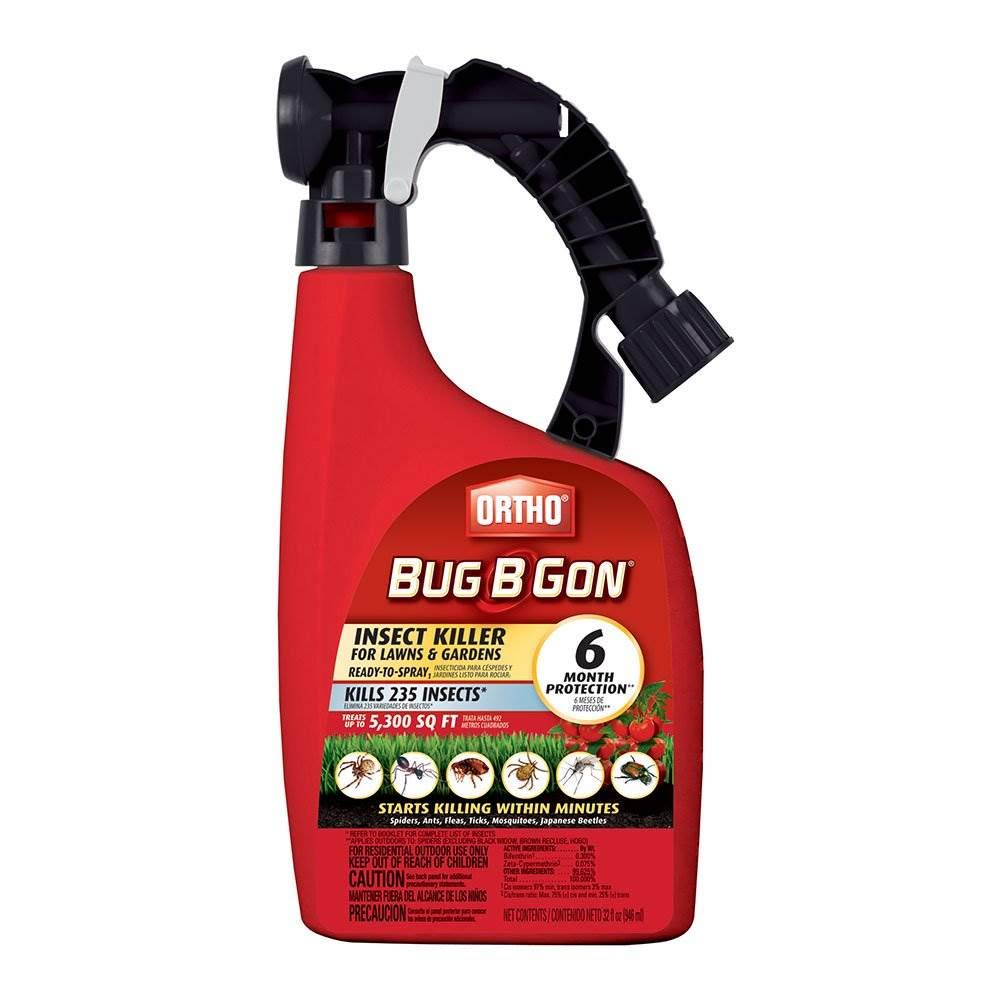
Ortho Bug B Gon covers the broadest spectrum in this lineup — 235 listed species including spiders, ants, fleas, ticks, mosquitoes, and Japanese beetles. The ready-to-spray hose attachment treats up to 5,300 square feet per bottle, and the manufacturer claims up to six months of protection for spiders when applied around the foundation.
Multiple verified buyers report complete mosquito elimination for an entire month after a single application on bushes and shaded areas. Pet owners note that it keeps fleas and ticks off Australian Shepherds and other dogs after the lawn dries. The formula uses bifenthrin, a synthetic pyrethroid that holds tight to soil and organic matter, which explains its lasting residual on grass and mulch beds.
The catch is toxicity to bees, butterflies, fish, and amphibians. Several reviews warn that spraying blooming plants kills flowers and visiting pollinators, so you must avoid open blossoms and apply only to foliage. A single spring and fall treatment keeps most yards pest-free for the season, but always read the label before treating vegetable gardens.
Why it’s great
- Covers 5,300 sq ft per bottle — enough for a quarter-acre lot
- Kills 235 listed insect species including spiders and beetles
- Pet-safe when dry; two applications per year suffice for many users
Good to know
- Highly toxic to bees — do not spray open flowers
- May kill blooms on treated ornamentals
- Rain may reduce residual duration
2. Martin’s 32 oz Permethrin 13.3% Concentrate
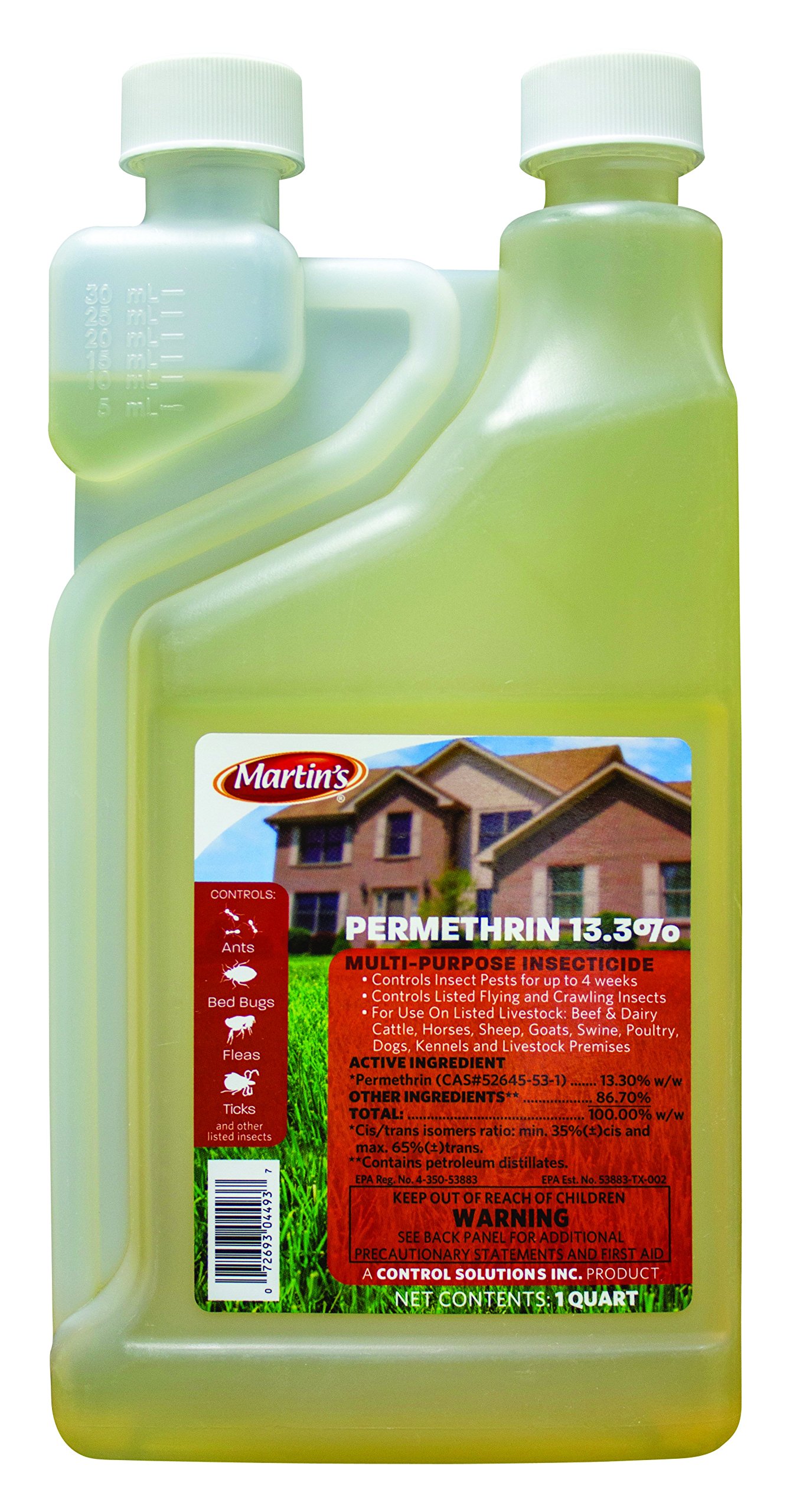
Martin’s Permethrin is the concentrated workhorse for serious tick management. At 13.3% active ingredient, a single 32-ounce bottle makes multiple gallons of finished spray. Users report four to six weeks of tick control per application when mixed at 1.5 ounces per gallon of water and applied to the perimeter of the yard every four to six weeks from February through November.
Buyers with wooded properties near ponds swear by this formula for crushing tick populations where nothing else worked. One reviewer makes “tick tubes” (cotton balls soaked in the diluted solution stuffed into toilet paper rolls) and places them around brush lines — mice pick up the cotton and carry the permethrin into their nests, breaking the tick life cycle. The same concentrate can be diluted and sprayed directly on clothing for a personal tick shield that lasts through multiple washes.
The most consistent complaint is the chemical odor, which several users describe as smelling like paint thinner. That smell lingers for hours after spraying, so the product is best used outdoors only. It has limited efficacy against ants, crickets, and roaches, so it’s not a universal yard spray — it excels specifically at ticks and, to a lesser degree, mosquitoes.
Why it’s great
- Extremely cost-effective — one bottle makes multiple gallons of spray
- Controls ticks for four to six weeks per application
- Can be used on clothing for personal tick protection
Good to know
- Strong chemical odor persists for hours after spraying
- Not effective for ants, crickets, or roaches
- Must apply at dawn/dusk to protect bees and dragonflies
3. Cutter Backyard Bug Control Combo Pack

The Cutter Combo Pack bundles two tools in one box: a hose-end spray concentrate for lawns and landscapes, and a fogger for patios, decks, and picnic areas. This dual approach lets you treat the grass perimeter with the hose spray and then fog the immediate seating zone before guests arrive. Users with ponds and wooded lots report excellent mosquito suppression for two to three days after fogging — ideal for pre-event prep rather than season-long control.
Buyers consistently praise the hose-end spray for knocking down flea and mosquito populations in the lawn, with many saying it outperforms every other brand they tried. The “just me” approach of keeping kids and pets off the lawn for a full day after spraying is common among cautious users, though the label allows re-entry once the spray dries.
The fogger’s residual is short — roughly 48 to 72 hours — so it works best as a tactical tool for weekend gatherings rather than a set-and-forget program. A few users noted that spraying the foundation drove ants indoors seeking refuge, so seal entry points before treating the base of your house. Grass die-off was also reported in scattered cases, likely from overdosing one spot.
Why it’s great
- Two-in-one value: hose spray for lawn, fogger for patio
- Knocks down mosquitoes instantly in treated areas
- Trusted brand with consistent performance across multiple seasons
Good to know
- Fogger residual lasts only 2-3 days
- May drive ants indoors if foundation is treated without sealing
- Over-application can cause grass die-off
4. Control Solutions Cyonara Lawn & Garden RTS

Cyonara is the go-to choice when specific plant-munching pests like lubber grasshoppers and springtails have taken over your flower beds. The ready-to-spray bottle uses lambda-cyhalothrin, a pyrethroid that provides fast knockdown and moderate residual on foliage. Verified buyers who were losing their roses and vegetable plants to grasshoppers saw the majority wiped out within a day of spraying.
Springtail control required heavier dosing — nearly half a bottle over three applications on a 1,500-square-foot area — and overdosing browned the grass temporarily. A follow-up application the next year with standard rates didn’t burn the lawn and kept springtail populations manageable while also killing spiders on the patio. The formula is effective against a wide range of flying and crawling insects, but the liquid volume is only 32 ounces, so coverage is limited compared to hose-end products.
The main limitation is the small batch size. For large lots over a quarter acre, you’ll need multiple bottles or a switch to a concentrate. Users also report that it’s not as effective on heavy mosquito infestations as dedicated mosquito formulas, so if mosquitoes are your primary enemy, look at the Ortho or Cutter options instead.
Why it’s great
- Excellent against grasshoppers and springtails
- Fast knockdown — visible results within 24 hours
- Made in the USA with consistent quality
Good to know
- Small 32 oz bottle covers limited area
- Overdosing can brown the grass
- Mosquito control is weaker than leading competitors
5. Dr. Earth 8004 Ready to Spray Yard and Garden Insect Killer

Dr. Earth 8004 is the natural alternative for organic gardeners and pet owners who want to avoid synthetic residues. The ready-to-spray formula uses plant-based oils (typically pyrethrin, neem, and rosemary) to knock down aphids, mites, flies, and mosquitoes on contact. It is approved for use on edible crops up to the day of harvest — a critical advantage if you grow vegetables, herbs, or fruit trees.
Buyers with golden retrievers and small grandchildren report using it safely around play areas and vegetable patches. One reviewer applied it weekly on strawberries, chard, parsley, beans, tomatoes, and cucumbers with no leaf burn or crop damage. The bottle itself is made from ocean-recycled plastic, which aligns with the eco-conscious positioning of the brand.
The trade-off is short residual activity — natural oils break down rapidly under UV light and rain, so you need to reapply after heavy weather or every 5-7 days during peak pest pressure. It does not kill ants, and some users found it less effective than synthetic sprays on heavy mosquito infestations. The spray window is also limited to early morning or late afternoon to prevent leaf burn in direct sun.
Why it’s great
- Safe for use on edible crops up to day of harvest
- Made from natural oils — no synthetic residual
- Pet-friendly and child-safe when applied correctly
Good to know
- Requires weekly reapplication — short residual
- Not effective against ants
- Must avoid spraying in direct sunlight to prevent leaf burn
FAQ
Which backyard bug spray works best for ticks?
Can I use these sprays around vegetable gardens?
How do I protect bees while spraying my yard?
Why does my yard spray only work for a few days?
Final Thoughts: The Verdict
For most users, the backyard bug spray winner is the Ortho Bug B Gon because it covers the broadest pest spectrum (235 species) and treats up to 5,300 square feet with zero mixing. If ticks are your primary concern, grab the Martin’s Permethrin — its concentrated 13.3% formulation delivers month-long tick protection at a fraction of the cost per treatment. And for organic gardeners who harvest daily, nothing beats the Dr. Earth 8004, which lets you spray edible crops up to the day of picking.

Mo Maruf
I created WellFizz to bridge the gap between vague wellness advice and actionable solutions. My mission is simple: to decode the research and give you practical tools you can actually use.
Beyond the data, I am a passionate traveler. I believe that stepping away from the screen to explore new environments is essential for mental clarity and physical vitality.