Our readers keep the lights on and my smoothie glass nicely filled. As an Amazon Associate, I earn from qualifying purchases.
Dull blades turn every prep job into a frustrating battle with bruised vegetables and torn herbs, forcing more pressure and inviting accidental slips. An effective, budget-friendly sharpening setup solves that by restoring a razor edge with precise, repeatable passes.
I’m Mohammad Maruf — the founder and writer behind WellFizz. After analyzing dozens of manual sharpening systems, comparing grit materials, and cross-referencing real user results, I’ve narrowed down the options that deliver genuine cutting performance without forcing you to overspend.
Whether you prefer a guided pull-through or a traditional stone, this guide on the best affordable knife sharpener will help you find the right tool to keep your blades consistently sharp and your hands safe in the kitchen.
How To Choose The Best Affordable Knife Sharpener
A cheap sharpener that doesn’t cut is no bargain. The true value comes from matching the abrasive type and grit progression to how you actually use your knives. Below are the three non-negotiable factors that separate effective tools from frustrating ones.
Abrasive Type and Grit Progression
Diamond plates cut the fastest and last longest but can feel aggressive on very thin Japanese edges. Silicon carbide (like Norton Crystolon) works well on softer steels and heavier tools, while ceramic and white corundum stones (water stones) excel at producing a mirror-polished edge. A combination stone — coarse on one side, fine on the other — gives you a two-stage process so you can repair a dull edge and then refine it to shaving sharpness in one tool.
Angle Control vs. Freehand Skill
Pull-through sharpeners with adjustable angle dials (14°-24°) remove the guesswork, making them ideal for beginners or anyone with a mixed collection of knives. Traditional bench stones require you to maintain a consistent angle manually, which takes practice but offers unlimited flexibility for convex edges or odd-shaped blades. If you prefer speed and consistency, a guided system wins. If you want total control and enjoy the craft, go with a stone.
Footprint and Stability
A sharpener that slides around the counter is unsafe and ineffective. Look for silicone pads, rubber feet, or a weighted base that anchors the tool firmly. Stones should come with a holder or be wide enough (at least 2 inches) to prevent tipping during long strokes. Portability matters too — compact diamond plates are easier to pack for camp or cabin, while larger bench stones stay put in the home kitchen.
Quick Comparison
On smaller screens, swipe sideways to see the full table.
| Model | Category | Best For | Key Spec | Amazon |
|---|---|---|---|---|
| MAD SHARK | Pull-Through | Quick, consistent edges | 6 adjustable angles (14°–24°) | Amazon |
| MITSUMOTO SAKARI | Water Stone | Polished, razor-sharp finish | 1000/3000 white corundum grit | Amazon |
| Norton Combination | Oil Stone | Heavy-duty edges and tools | 100/280 grit oil-filled corundum | Amazon |
| YCAMMIN Diamond Plate | Diamond Plate | Fast metal removal | 400/1000 diamond coated surface | Amazon |
| Norton Crystolon File | File Stone | Field sharpening of large tools | 100 grit silicon carbide, 14” | Amazon |
In‑Depth Reviews
1. MAD SHARK Knife Sharpener

The MAD SHARK stands out because it removes the angle guessing game entirely. With six settings from 14° to 24°, you can match a 15° angle for thin Japanese blades and switch to 20° for a German chef’s knife without changing tools. The tungsten steel slot handles coarse edge repair, while the ceramic slot fine-hones the edge — two stages in a single pull-through pass.
Silicone pads on the base keep the unit anchored even when you bear down on a stubborn dull spot. At just 0.4 pounds, it’s light enough to stash in a drawer, yet the ergonomic handle keeps your fingers well clear of the sharpening zone. Multiple verified reviews from professional chefs confirm the edge holds longer than many electric systems they have tried.
The scissor slot is a practical bonus, saving you from digging out a separate tool for shears. The dial detents are clicky and precise, so the angle stays locked mid-job. If you own a mixed set of knives and want consistent results without a steep learning curve, this is the most versatile mid-range option available today.
Why it’s great
- Six adjustable angles cover Asian and Western knife geometries
- Tungsten coarse slot and ceramic fine slot in one body
- Scissor slot adds real utility without extra cost
Good to know
- Right-hand ergonomics may feel awkward for left-handed users
- Requires a few practice pulls to learn optimal pressure
2. MITSUMOTO SAKARI Whetstone 1000/3000

This Japanese water stone hits the sweet spot for home cooks who want professional-grade edge refinement without the premium pricing. The 1000-grit side reprofiles a dull edge quickly, while the 3000-grit side delivers a polished, mirror finish that slices through tomato skin with zero pressure. The white corundum abrasive cuts cleanly and releases fresh grit as it wears, keeping the surface active.
The fixed wooden base includes TPR rubber strips underneath that grip wet countertops firmly, eliminating the slip that frustrates many stone sharpeners. Soaking for five minutes is all it needs — no oil required, no messy cleanup. Reviewers consistently note the 3000-grit side produces a shaving-sharp edge on carbon-steel blades like yagangi or blue-super steel.
One trade-off: there is no built-in angle guide, so beginners should pair it with a few practice runs on a beater knife. The stone measures 7.09 by 2.36 inches, which suits standard chef blades but feels narrow for large cleavers. Experienced sharpeners will appreciate the feedback and speed of this stone; it’s a true performance upgrade over generic combination stones.
Why it’s great
- 1000/3000 grit progression restores and polishes in one stone
- Non-slip wooden base with TPR rubber stays put when wet
- White corundum cuts aggressively yet leaves a near-mirror finish
Good to know
- No angle guide included — requires freehand technique
- Stone width (2.36”) feels narrow for larger blades
3. Norton Combination Oil Stone 100/280

The Norton 100/280 is built for edge repair on abused blades, not just maintenance. The 100-grit side plows through nicks and rolled edges on hunting knives, hatchets, and lawn mower blades in seconds. The 280-grit side refines that edge enough for everyday kitchen tasks, though many users follow up with a finer stone for a polished finish.
Because the stone is pre-filled with oil, you can start sharpening immediately with a few drops of mineral oil or WD-40. No soaking, no drying — just apply lubricant and work. At 1.5 pounds and 8 inches long, it sits solidly on the bench and provides a consistent flat surface for long, sweeping strokes. Woodworkers report excellent results on plane irons and chisels.
A key nuance: the 280 side is coarser than typical “fine” stones, so you may not achieve a razor-polish direct from this stone. Experienced sharpeners pair it with a 1,000-grit water stone or strop for final refinement. If your primary need is re-profiling heavily damaged edges at a low cost, this Norton stone outperforms virtually everything in its tier.
Why it’s great
- 100-grit side removes nicks and re-profiles edges extremely fast
- Prefilled with oil — no soaking required before use
- Heavy, durable construction stays flat for years
Good to know
- 280 “fine” side is closer to medium — not ideal for final polishing alone
- Requires lubricant (oil or WD-40); dry use causes metal loading
4. YCAMMIN Diamond Sharpening Plate 400/1000

This double-sided diamond plate brings entry-level users into the world of freehand sharpening without a steep price. The 400-grit side grinds through dull edges quickly, and the 1000-grit side refines the blade to a working sharpness ideal for kitchen prep. The honeycomb pattern channels metal swarf away, keeping the abrasive surface clear and cutting efficiently.
At 7 inches by 3.5 inches, the plate is large enough for chef’s knives but compact enough to toss in a camp bag. The plastic base has a grippy texture, though some users note it can slide on smooth countertops during aggressive passes. Diamond abrasives wear slowly, so this plate will outlast multiple silicon carbide stones before showing significant wear.
The biggest learning curve is maintaining a consistent 30° angle — the package suggests 30°, but many kitchen knives benefit from 15°–20°. Beginners should mark the angle with a permanent marker or use a guide wedge. For the price, this plate offers tremendous metal-removal speed and longevity, making it a smart gateway into diamond sharpening.
Why it’s great
- Diamond abrasive cuts fast and lasts much longer than bonded stones
- Honeycomb surface prevents metal loading for consistent cutting
- Lightweight and portable for kitchen drawer or outdoor use
Good to know
- Plastic base can slide on smooth surfaces without added grip
- Requires practice to maintain a consistent freehand angle
5. Norton Crystolon Utility File Stone 100 Grit
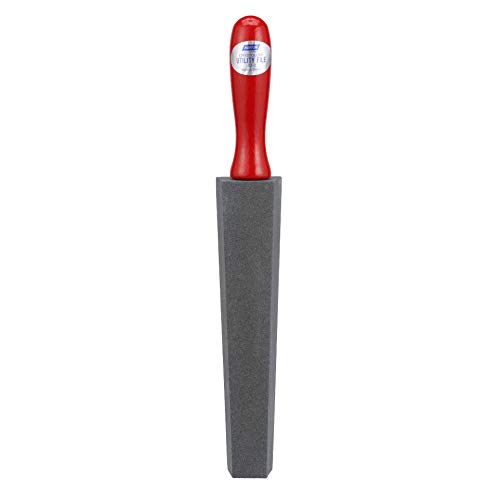
This file-shaped stone is built for coarse outdoor and workshop sharpening, not fine kitchen work. The 100-grit silicon carbide surface self-sharpens, exposing fresh abrasive as it wears, and the 14-inch overall length provides a long stroke for hatchets, axes, shovels, and scythes. The wooden handle keeps your hand safely away from the edge during vigorous field use.
Because it’s designed with four usable sides, you can rotate to a fresh face as one side loads up. Norton’s Crystolon material is more friable than aluminum oxide, meaning it cuts aggressively without glazing over. It works best with a thin oil or kerosene to float away metal particles, though many users run it dry for quick touch-ups in the field.
The coarse 100-grit surface is not intended for final edge polishing — it’s purely for removing dents and reshaping profiles. Think of it as a replacement for a metal file, not a finishing stone. If your primary need is maintaining mower blades, splitting mauls, or carbon-steel knives that see heavy abuse, this tool delivers excellent value and lasting performance.
Why it’s great
- Four-sided design extends usable life before replacement
- Self-sharpening silicon carbide stays aggressive through heavy use
- Ergonomic handle keeps fingers safe during long strokes
Good to know
- 100 grit is too coarse for kitchen knife final sharpening
- Handle attachment stops before the stone tip — careful with short strokes
FAQ
Can I use a diamond plate on a ceramic knife?
How do I flatten a water stone that has developed a low spot?
Do I need oil for a Norton Crystolon stone or can I use water?
Final Thoughts: The Verdict
For most users, the affordable knife sharpener winner is the MAD SHARK Knife Sharpener because its six adjustable angles and dual tungsten-and-ceramic slots deliver consistent, professional-level results without any freehand practice. If you want a polished mirror edge and enjoy the craft of stone sharpening, grab the MITSUMOTO SAKARI Whetstone. And for heavy-duty re-profiling of hatchets, mower blades, and abused workshop tools, nothing beats the Norton Combination Oil Stone.

Mo Maruf
I created WellFizz to bridge the gap between vague wellness advice and actionable solutions. My mission is simple: to decode the research and give you practical tools you can actually use.
Beyond the data, I am a passionate traveler. I believe that stepping away from the screen to explore new environments is essential for mental clarity and physical vitality.