Our readers keep the lights on and my smoothie glass nicely filled. As an Amazon Associate, I earn from qualifying purchases.
You’re choosing between a dozen similar-looking handhelds, each promising to read a tiny black-and-white square in under a second. Get the wrong one and you’ll fight daily with misreads, dead batteries mid-shift, or a Bluetooth connection that drops every third scan. The difference between a smooth workflow and a frustrating one comes down to a few specs most listings barely mention.
I’m Mohammad Maruf — the founder and writer behind WellFizz. I analyze the internal imaging engines, battery algorithms, and drop-test certifications that separate professional-grade barcode readers from disposable toys, using real market data and verified buyer feedback.
After reviewing dozens of units across multiple price tiers, the following guide ranks the top contenders to help you find the ideal best barcode scanner for your specific retail, warehouse, or inventory environment.
How To Choose The Best Barcode Scanner
A barcode scanner is a simple tool in concept, but the real-world variables — lighting conditions, barcode quality, distance, and required uptime — demand specific hardware choices. Ignoring these can turn a tool into a paperweight.
Start With the Barcode Type: 1D Laser vs. 2D Imager
If you only scan standard retail barcodes (UPC/EAN), a 1D laser scanner is fast and cheap. But if you ever need to read QR codes, PDF417 (common on driver’s licenses), or barcodes from a phone screen, you must buy a 2D CMOS imager. Most modern inventory environments benefit from the 2D imager because it handles damaged, wrinkled, or low-contrast codes far better than any laser.
Connection Method: Wired, Bluetooth, or 2.4G Dongle
A wired USB scanner is the most reliable — zero pairing, zero battery anxiety. Bluetooth gives you freedom to move, but introduces pairing delays and potential interference. The 2.4G dongle (a proprietary wireless receiver) often provides the best middle ground: a dedicated wireless link without the latency or dropout issues that can plague Bluetooth in a congested retail environment. Models offering all three modes give you the most flexibility.
Battery Life Is Not Just Capacity — It’s Power Management
A scanner with a 2000mAh battery can still die mid-shift if the firmware doesn’t enter deep sleep between scans. Look for units that advertise “standby time” in weeks or months, not just continuous scan hours. A scanner used intermittently (scanning 50–200 codes per hour) will last drastically longer than one used in high-throughput POS where the trigger is constantly pulled.
Ergonomics and Drop Rating Matter More Than You Think
A scanner that feels heavy after 5 hours will slow down your best cashier. Check the weight in ounces — anything over 10 ounces may cause fatigue. Drop rating (stated in feet or meters) tells you how well the unit survives concrete floor impacts. TPU bumpers and silicone over-molds directly translate to lower replacement costs in a warehouse or retail back office.
Quick Comparison
On smaller screens, swipe sideways to see the full table.
| Model | Category | Best For | Key Spec | Amazon |
|---|---|---|---|---|
| Inateck BCST-23 | Bluetooth | App & SDK Customization | 2600mAh / 1 month high-use | Amazon |
| Zebra DS2278-SR | Enterprise | Fleet Reliability | 7 ft drop / Wi-Fi Friendly | Amazon |
| Tera HW0009 Pro | Premium Feature | On-Screen Settings | 2500mAh / 650 fps scan | Amazon |
| NADAMOO Bur3149 | Mid-Range | Portable Storage Mode | Offline 100,000 barcodes | Amazon |
| Tera HW0002 Orange | Value | Patented Battery Indicator | 2000mAh / 16 hours cont. | Amazon |
| Inateck BCST-70 | Durable | Warehouse Drops | 6 ft drop / 180-day standby | Amazon |
| NetumScan A5 | Entry Level | Simple Hands-Free Desk | Omnidirectional / IP54 | Amazon |
In‑Depth Reviews
1. Inateck BCST-23
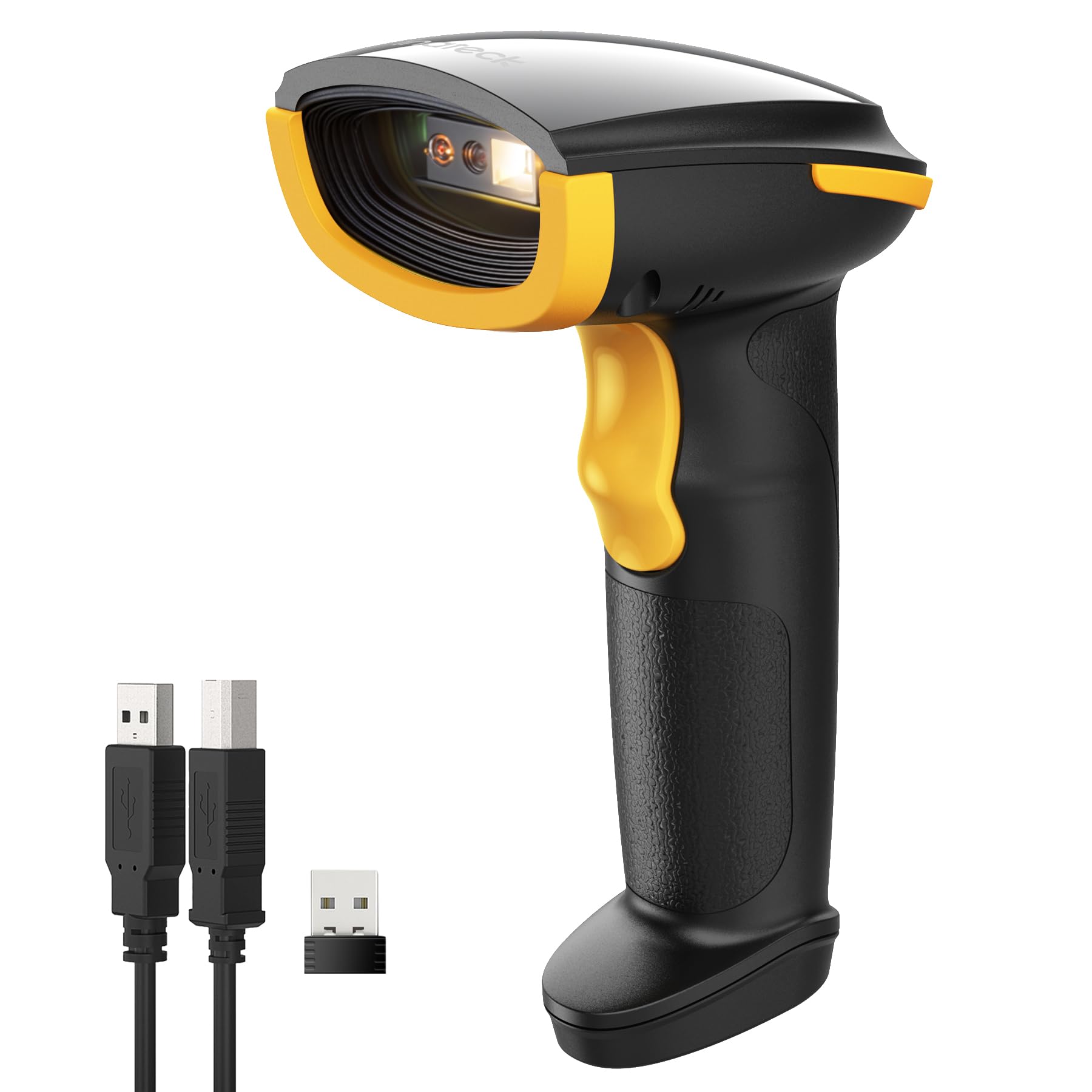
The Inateck BCST-23 strikes a near-perfect balance between modern features and practical reliability. Its 2600mAh battery delivers a full month under heavy daily use, and the three-mode connectivity — Bluetooth, 2.4G dongle, and wired USB — means it adapts seamlessly whether you’re paired to a POS terminal, a tablet, or a laptop running Linux.
What sets this unit apart is the app-based configuration and SDK support. You can adjust symbology settings, manage Bluetooth connections, and monitor battery level from your phone — no need to fumble with a manual of 200 configuration barcodes. The 300,000-pixel 2D module accurately reads damaged codes and screen barcodes, though it cannot decode inverted Data Matrix symbols.
Build quality feels solid at 7.2 ounces, and the rubberized grip helps prevent drops. A minor annoyance is the micro USB-B port instead of USB-C, but the 2600mAh capacity means you won’t be charging it daily anyway.
Why it’s great
- Exceptional battery life — up to 3 months standby
- Free app eliminates need for configuration barcode booklet
- Full SDK support for ERP integration (Python, Java, C, Swift)
Good to know
- Requires some technical setup out of box — not purely plug-and-play
- Uses micro USB-B instead of USB-C
2. Zebra DS2278-SR

The Zebra DS2278-SR is the only unit on this list built to survive a lumber yard floor and still talk to a POS without interfering with your store’s Wi-Fi. Its proprietary Wi-Fi Friendly mode switches the Bluetooth radio to channels not shared with the WLAN, a critical feature in dense retail environments where signal congestion causes dropped connections.
The scan range spans from 0.5 inches up to 14.5 inches, so workers never need to line up the imager perfectly with the barcode. This omni-directional approach speeds checkout and reduces training time significantly. The kit includes the cradle, a rechargeable battery, and a heavy-duty shielded 7-foot USB cable — everything needed for a complete deployment.
At 16 ounces, it’s the heaviest model here, and the price reflects true enterprise tier. But for high-volume or rough-environment use, the build quality and wireless stability justify the investment. Multiple buyers report purchasing fleets of 6, 7, or 30 units without a single failure.
Why it’s great
- Wi-Fi Friendly mode eliminates Bluetooth/WLAN interference
- 14.5-inch scan range improves checkout speed
- Proven reliability in rough environments (lumber yards, workshops)
Good to know
- Heavier than most competitors at 16 ounces
- Premium price tag — best for fleets, not single users
3. Tera HW0009 Pro
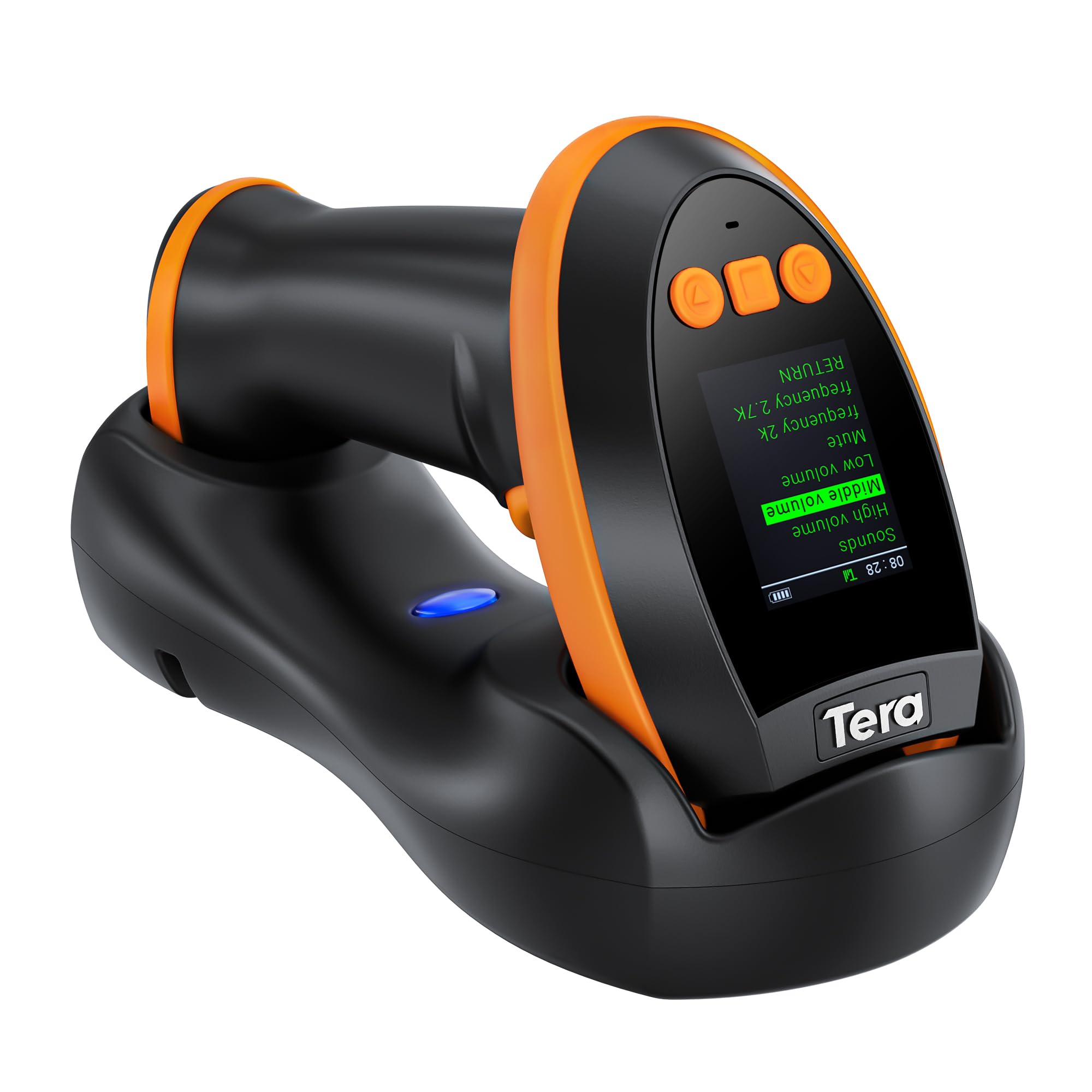
The Tera HW0009 Pro solves one of the biggest setup headaches: the need to manually scan dozens of configuration barcodes to change settings. Its integrated digital screen and keypad let you adjust language, volume, connection mode, and even view stored barcode totals directly on the device. No manual, no app, no scanning cheat sheets.
Under the hood, it features a 2500mAh battery — the largest capacity in this lineup — plus a charging cradle that keeps the scanner ready between shifts. The 2D CMOS imager handles PDF417 on driver’s licenses, underwater reading, and reflective surfaces with ease. The 3-in-1 connectivity (Bluetooth, 2.4G dongle, wired) covers any device scenario.
The unit feels slightly heavier than average, but the silicone protective cover and 1-year warranty provide peace of mind. A handful of users note that the screen interface can be a bit cluttered, but once configured, most never touch it again.
Why it’s great
- On-scanner screen eliminates manual barcode configuration
- Large 2500mAh battery with convenient charging cradle
- Exceptional 2D decode on high-density codes like PDF417
Good to know
- Screen interface can feel cluttered with advanced options
- Heavier than basic handheld models
4. NADAMOO Bur3149

The NADAMOO Bur3149 is a versatile wireless scanner that excels in environments where you need to scan items far from a connected computer. Its standout feature is offline storage mode: it can internally hold up to 100,000 barcodes, letting you scan a shelf or pallet away from the receiver and batch-upload later. This is a game-changer for inventory workers who roam a large warehouse.
The included charging dock keeps the scanner powered whenever it’s not in use, so you never face a dead battery. The compact form factor and lightweight design make it easy to carry during long shifts. Setup is simple — Bluetooth pairs easily with PCs, tablets, and iPhones — and the 2D imager reads paper labels and screen barcodes without issues.
Some users mention the beep volume is quite loud out of the box, but it’s adjustable. The plastic build feels adequate for light industrial use but not as tough as the Zebra or Inateck BCST-70. For the price, the storage mode alone makes it a strong contender.
Why it’s great
- Offline storage up to 100,000 barcodes for batch upload
- Compact design with convenient charging cradle
- Quick Bluetooth pairing with multiple device types
Good to know
- Beep volume is loud by default
- Plastic build not as rugged as enterprise models
5. Inateck BCST-70

The Inateck BCST-70 is built for durability without sacrificing portability. Its TPU protective case is twice as thick as similar products, and triple consolidation treatment on internal components enables it to survive repeated 6-foot drops onto concrete. For warehouse and shipping environments, this drop rating translates directly to lower replacement costs and less downtime.
Battery performance is exceptional: a full charge enables 180 days of standby or roughly 15 days of active use. Charging once a month or less means you can practically ignore battery management. The 115-foot Bluetooth range covers even large warehouse aisles without needing to carry the base station around. Setup is genuinely fast — out of the box and paired within 3 seconds.
One limitation: the BCST-70 is 1D-only, so it cannot read QR codes or 2D matrix barcodes. It also lacks the modern USB-C port. But if your operation is strictly UPC/EAN focused and you need a device that survives abuse, this is a top-tier choice.
Why it’s great
- Extremely durable — 6-foot drop resistance to concrete
- 180-day standby battery life
- Fast 3-second Bluetooth pairing out of box
Good to know
- 1D only — cannot scan QR codes or 2D matrix
- Uses micro USB, not USB-C
6. Tera HW0002 Orange

The Tera HW0002 Orange stands out with a patented battery level indicator light that gives you real-time charge status at a glance — no more guessing if it’s about to die mid-scan. This feature alone makes it a smart pick for high-traffic retail where unexpected downtime slows checkout lines.
It includes a vibration alert in addition to the standard beep and LED, which is useful in noisy environments where you can’t hear the confirmation tone. The silicone protective cover adds drop resistance, and the 2000mAh battery delivers 16 to 19.5 hours of continuous scanning. The 3-in-1 connectivity (Bluetooth, 2.4G dongle, wired) offers flexibility for any setup.
The build uses plastic, and some users reported reliability issues after extended use. It also lacks true plug-and-play simplicity — initial configuration requires scanning barcodes from the manual. For the price, the vibration feature and battery indicator are genuine differentiators, but long-term dependability is a mixed bag.
Why it’s great
- Patented battery level indicator prevents surprise shutdowns
- Vibration alert works in noisy environments
- 3-in-1 connectivity covers all connection scenarios
Good to know
- Plastic build quality raises durability questions
- Initial setup requires scanning configuration barcodes
7. NetumScan A5

The NetumScan A5 is a wired, hands-free desktop scanner designed for simple, high-volume scanning at a fixed POS station. Its omnidirectional reading window captures barcodes from any angle, so the cashier never needs to line up the label perfectly. The smart-sensing trigger automatically activates when an item passes under the window, then enters sleep mode after a short idle period.
The non-slip base and anti-shock design (IP54-rated against dust) mean it stays stable on a counter and can survive a 4.92-foot fall if knocked off. Setup is true plug-and-play — no drivers, no software, no configuration necessary. It reads 1D, 2D, and QR codes from paper and phone screens with reliable speed.
The limitation is that it is entirely wired and stationary. You cannot roam the warehouse with it, and it does not support Bluetooth or wireless operation. It also is not compatible with Square, Clover, or Shopify systems. For a dedicated checkout lane or simple inventory desk, it delivers exceptional value.
Why it’s great
- Hands-free omnidirectional scanning speeds up checkout
- True plug-and-play with zero setup required
- IP54-rated anti-shock design for durability
Good to know
- Wired only — no wireless mobility
- Not compatible with Square, Clover, or Shopify POS
FAQ
Can I scan a barcode from my phone screen with any of these scanners?
Does Bluetooth range matter if I only scan at a fixed POS desk?
What does drop rating mean, and how many feet do I need?
Final Thoughts: The Verdict
For most users, the best barcode scanner winner is the Inateck BCST-23 because it combines a large 2600mAh battery, app-based configuration, and triple-mode connectivity at a price that undercuts most Bluetooth competitors. If you need enterprise-grade durability in a rough environment, grab the Zebra DS2278-SR. And for simple, hands-free desktop scanning with zero setup headache, nothing beats the NetumScan A5.

Mo Maruf
I created WellFizz to bridge the gap between vague wellness advice and actionable solutions. My mission is simple: to decode the research and give you practical tools you can actually use.
Beyond the data, I am a passionate traveler. I believe that stepping away from the screen to explore new environments is essential for mental clarity and physical vitality.