Our readers keep the lights on and my smoothie glass nicely filled. As an Amazon Associate, I earn from qualifying purchases.
Local news, live sports, and primetime network shows remain the main reasons millions of homes still pay for cable. Yet the clearest path to those channels cuts through the air, not a coaxial bill. Free over-the-air broadcasts—distributed from local towers in 1080p and 4K—offer a picture quality that often surpasses compressed cable feeds. The only barrier is finding an antenna that can lock onto those signals without constant pixelation or dropouts.
I’m Mohammad Maruf — the founder and writer behind WellFizz. My research into OTA reception has focused on how construction materials, distance to towers, and antenna design elements such as Yagi versus omni-directional patterns and the presence of built-in 4G LTE filtering affect real-world performance.
Whether mounting in an attic or on a roof, the right choice depends on your specific terrain. This guide walks through the key specs and real-world trade-offs so you can confidently pick the antenna for local channels that matches your home’s broadcast environment.
How To Choose The Best Antenna For Local Channels
Selecting an antenna is less about brand loyalty and more about mapping the unique broadcast geometry where you live. The critical variables are the distance and direction of your local towers, the type of signals they emit (UHF vs. VHF), and the physical obstructions between you and them. An antenna that works brilliantly in a flat suburban area can fail completely in a valley just fifteen miles away.
Understand UHF vs. VHF Signal Needs
Most local channels broadcast on UHF frequencies (channels 14-51), which are easier to capture with compact loops or flat panels. However, many markets still have major networks like NBC or PBS on high-VHF (channels 7-13). If you skip VHF elements, those channels will remain unwatchable. Look for antennas that explicitly list both UHF and VHF reception elements — Yagi-style designs with longer rods typically handle VHF better than omni-directional discs.
Evaluate the Role of Amplification and Noise Filters
An amplifier boosts signal strength, but it also amplifies noise. Too much signal from a close tower can overload the amplifier and cause dropouts. The best approach is to try a passive antenna first, then add amplification only if needed. Built-in 4G LTE filters are now essential, as cellular signals can bleed into the UHF band and cause interference on channels like 13 or 14. Premium models often include SmartPass technology that adjusts amplification levels automatically to prevent overload.
Weigh Outdoor Mounting vs. Attic vs. Indoor Placement
An outdoor roof mount on a J-pole offers the best line-of-sight and highest signal gain, but it exposes the antenna to lightning and weather degradation. Attic installation protects the antenna and avoids roof penetration, but metal roofing, radiant barriers, and concrete tiles can cut reception by 30-50 percent. Indoor placement is the most convenient but typically works only within 20-30 miles of the tower and suffers from building material attenuation. For maximum reliability with a budget-friendly unit, attic mounting on a metal yagi design provides the best trade-off.
Quick Comparison
On smaller screens, swipe sideways to see the full table.
| Model | Category | Best For | Key Spec | Amazon |
|---|---|---|---|---|
| Antennas Direct ClearStream 2V | Premium | Multi-directional suburban/rural | 60+ mile, UHF+VHF elements | Amazon |
| PIBIDI UHD-8903 | Premium | Extreme rural range | 200-mile rating, long elements | Amazon |
| 1byone Omni-Directional | Premium | All-weather omni installation | SmartPass Amp + 4G LTE filter | Amazon |
| GE Pro Outdoor Yagi | Mid-Range | Attic/outdoor 80-mile range | Yagi style, 80-mile, ATSC 3.0 | Amazon |
| CeKay Yagi HD | Mid-Range | Attic Yagi budget performance | 70-mile, all-metal, pre-assembled | Amazon |
| PBD Motorized Rotation | Mid-Range | Adjustable direction with remote | 150-mile, 360° motorized rotator | Amazon |
| BEFORE Omni-Directional | Budget-Friendly | Quick entry-level omni install | 150-mile, built-in low-noise amp | Amazon |
In‑Depth Reviews
1. Antennas Direct ClearStream 2V
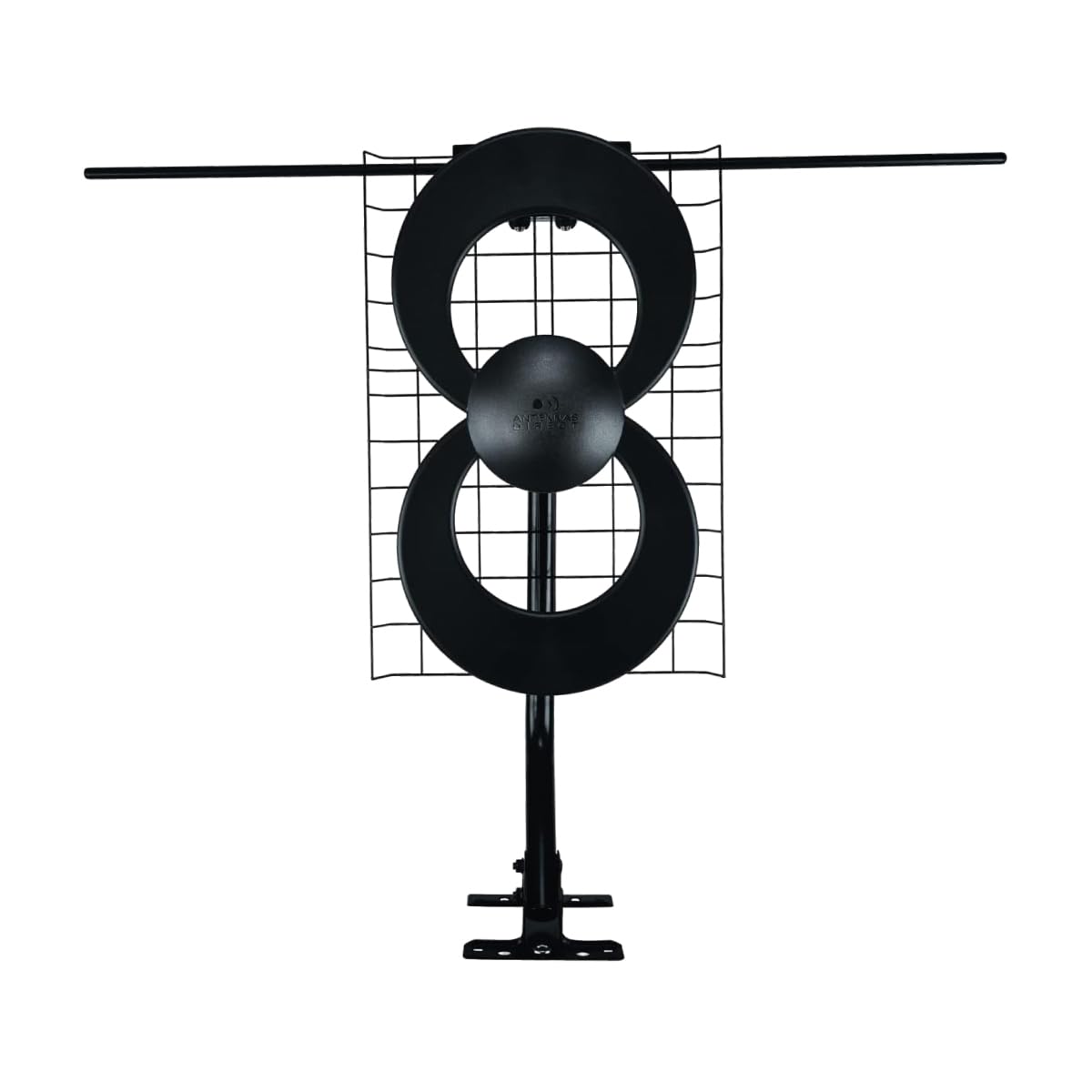
The ClearStream 2V distinguishes itself with a multi-directional design that captures both UHF and high-VHF signals without requiring a motorized rotator. Its double-loop architecture combined with a phasing reflector provides forward gain while rejecting rear interference — a clear advantage when towers sit in different directions. The pivoting mast base allows flush mounting on rafters, walls, or a standard J-pole, making it equally suited for attic or outdoor installation.
In real-world use, users report pulling in 65 to 70 perfectly clear channels from 35-40 miles away, even in challenging terrain. The built-in reflector does a solid job of blocking signal bounce from nearby structures, which significantly reduces pixelation compared to flat indoor panels. At just 2 pounds and 31 inches wide, it is lightweight enough for a single-person install.
The only notable gap is the lack of a pre-installed amplifier — you will need to add an external pre-amp if your cable run exceeds 50 feet or you are splittting to multiple TVs. This is a deliberate choice, as it allows advanced users to match gain precisely to their environment without overdriving the signal.
Why it’s great
- True multi-directional VHF+UHF capture without moving parts
- Included reflector reduces multi-path interference
- Lifetime antenna warranty and US-based engineering support
Good to know
- No coaxial cable included in the box
- Requires separate pre-amp for long cable runs or splits
2. PIBIDI UHD-8903

The PIBIDI UHD-8903 targets users living 40 to 100 miles from broadcast towers, where signal strength drops significantly. Its extended-length receiving elements, longer than typical Yagi models, provide a larger capture area for weak VHF and UHF signals. The all-metal construction includes lightning protection and grounding provisions, making it a serious outdoor unit for rural installations.
Customers in Oregon and upstate South Carolina report picking up between 64 and 86 channels after roof mounting, with some stations coming in from 90 miles out. The straightforward assembly requires no tools, and users appreciate being able to use existing dish mounts and coax runs to speed up installation. The amplifier-free design keeps noise low, which is beneficial when the nearest cell tower is miles away.
Because it lacks a built-in rotator, you will need to physically re-aim the antenna if your towers are spread across a wide arc. Additionally, some users note that the 200-mile rating assumes perfect line-of-sight with zero obstructions — realistic range in hilly terrain is closer to 60-70 miles. For those in extremely remote areas, this is still excellent performance at this price tier.
Why it’s great
- Extended element length improves weak-signal capture
- Easy tool-free assembly with included mounting hardware
- Weather-resistant with built-in lightning protection
Good to know
- No rotator means manual re-aiming for multi-direction towers
- Advertised 200-mile range dependent on ideal conditions
3. 1byone Omni-Directional Outdoor

The 1byone uses an omni-directional pattern, meaning it receives signals equally from all 360 degrees without requiring you to find the exact tower direction. This is ideal for homes in dense suburban areas where towers sit at different compass points. Its exclusive SmartPass amplifier technology adjusts gain in real time — boosting weak signals while preventing overload from strong nearby stations, which is a common failure point in cheaper amplified antennas.
Built-in 4G LTE filtering is a standout feature, as cellular interference can wipe out UHF channels 13 and 14 entirely. Users in Manhattan report grabbing 60 channels from a high-rise, while suburban buyers routinely pull 28 to 58 channels depending on window orientation. The moisture-proof and flame-retardant housing makes it safe for attic use, though some customers mention that outdoor longevity depends on sealing the coax connection properly.
A known limitation is that the omni-directional design trades some peak gain for convenience — you may get 80% of available channels without aiming, but you might miss fringe stations that a directional Yagi would lock onto. Water ingress has been reported after extended outdoor exposure, so mounting it under an eave or inside the attic is the safest placement for long-term reliability.
Why it’s great
- SmartPass amp prevents overload from strong nearby towers
- Built-in 4G LTE filter stops cellular interference
- 360-degree reception eliminates aiming guesswork
Good to know
- Omni design sacrifices fringe gain compared to directional yagis
- Waterproofing can degrade after multiple seasons outdoors
4. GE Pro Outdoor Yagi 33685

As America’s number-one antenna brand, GE backs this Yagi-style design with a limited-lifetime replacement pledge — a strong indicator of confidence in build quality. The 80-mile range estimate is realistic for suburban and semi-rural environments, and the inclusion of both a J-mount and weather-resistant bracket means you can install it on a roof, siding, or mast immediately without additional purchases. It is also ATSC 3.0 (NextGen TV) compatible, future-proofing your setup as broadcasters upgrade.
Users in Seattle and Colorado report picking up 70 to 93 channels with pixel-free reception, even under concrete tile roofs when attic-mounted. The unit handles VHF and UHF well, and the reflector elements provide the directional gain needed to lock onto distant towers. Assembly requires some attention — the instructions are sparse — but the parts fit together intuitively once you line up the rods.
The main drawback is the lack of a pre-installed amplifier, which means users splitting signals across multiple TVs will need to add a separate distribution amp. The assembly process also takes roughly 20-30 minutes, as each element must be manually inserted and tightened. For users willing to invest that short setup time, the signal reliability is excellent.
Why it’s great
- Limited-lifetime replacement pledge and US-based support
- ATSC 3.0 ready for NextGen TV broadcasts
- Solid 80-mile range with weather-resistant bracket
Good to know
- Sparse assembly instructions require some trial-and-error
- No amplifier included — recommended for multi-room splits
5. CeKay Yagi HD

The CeKay Yagi HD is designed for users who prioritize a simple, pre-assembled setup with a lower price of entry. It arrives mostly assembled — you only need to slide the arms into the rubber holder, which takes about five minutes. The all-metal construction and J-mount make it ready for attic or outdoor installation, and the included 40-foot RG6 coax cable saves the cost of buying one separately.
Customer feedback is consistent: installed in the attic with a concrete tile roof, it pulls in 51 channels clearly. Users report 100% signal metrics even when mounted in a basement or backwards, thanks to the strong Yagi gain pattern. The antenna supports 4K and ATSC 3.0, and its 70-mile range is achievable in moderate terrain. The included cable is kinked from packaging but works fine for receive-only applications.
The trade-off for the low price is build thinness: the arms require extreme force to seat into the rubber holder, and the metal feels bendy if exposed to strong winds outdoors. It is best suited for attic placement where wind is not a factor. Some users also note that the pole connections are not fully tight, so adding a zip tie for reinforcement is recommended.
Why it’s great
- Almost fully pre-assembled — install in minutes
- 40-ft RG6 cable included saves extra spend
- Strong Yagi gain works well even in basements and attics
Good to know
- Arms difficult to insert into rubber holders
- Thinner metal not ideal for exposed roof mounting
6. PBD Motorized Rotation Antenna

The PBD antenna solves a common suburban problem: towers in different directions require either a rotator or frequent trips up a ladder. This unit includes a wireless remote-controlled 360-degree motorized rotator, letting you fine-tune direction from the couch for optimal signal on each channel. It also features dual TV outputs, so you can feed two televisions without an external splitter while maintaining good signal strength on each.
Performance feedback from users 20 to 35 miles from towers shows significant improvement over previous antennas, with one user replacing a Mohu Sky 60 and pulling in 80+ channels. The built-in low-noise amplifier helps with long cable runs, and the included 40-foot RG6 cable supports attic placement without needing to relocate the TV. Customer support is frequently praised for promptly sending UHF enhancer upgrades to improve reception further.
Motorized rotators add mechanical complexity. Some users report snapping lag bolts during installation if the wrong drill bit is used, and the rotator motor has a slight audible hum when turning. The UHF array can be improved by swapping to an external UHF enhancer, and the white color of the stock cable may not match everyone’s exterior trim.
Why it’s great
- Motorized rotator allows remote aiming without climbing the roof
- Dual TV outputs eliminate need for external splitter
- Responsive customer support with free UHF enhancer upgrades
Good to know
- Rotator adds a small hum during adjustment cycles
- Lag bolts can snap if pilot holes are not pre-drilled
7. BEFORE Omni-Directional Antenna
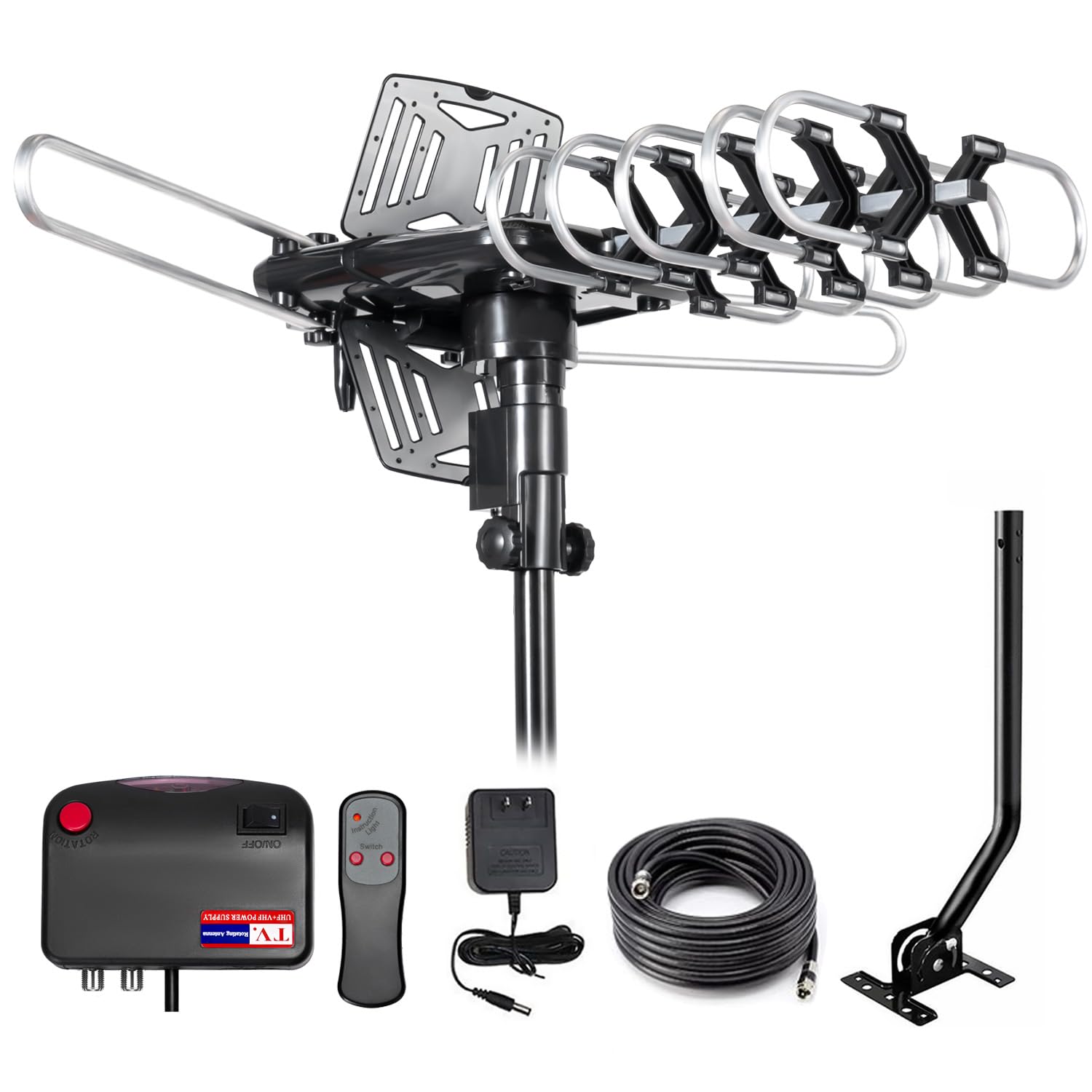
The BEFORE Omni-Directional is the budget-friendly entry point in this lineup, designed for users who want a quick antenna without extensive research or installation effort. It includes a built-in low-noise amplifier, a 25-foot RG6 coax cable, and a mounting pole — everything needed for a basic outdoor or attic setup. Its 150-mile range claim is optimistic, but the omni-directional pattern eliminates the need for precise aiming, which helps first-time cord-cutters.
Users report that the antenna works well within a 10-mile radius of towers, pulling in clear 1080p and 4K signals. In suburban zones 20-30 miles out, it picks up the major networks reliably, though some users note that performance drops off significantly as distance increases. The included remote is a nice add-on for quick channel rescanning, though one reviewer found the initial setup required patience.
At this price point, build quality reflects the savings — multiple reviewers describe the construction as flimsy, with the antenna detaching easily at the coax connector in windy conditions. For users in mild climates with towers within 15 miles, it works as a low-cost entry. Those in more challenging reception zones or harsh weather areas should consider stepping up to the Yagi or premium options.
Why it’s great
- All-in-one kit with built-in amp and mounting pole
- Omni-directional design great for total beginners
- Excellent performance within 10-mile tower distance
Good to know
- Coax connector easily detaches in windy conditions
- Flimsy build compared to all-metal Yagi designs
FAQ
Can I use an old satellite dish mount for my new antenna?
Why do I lose reception when it rains or snows?
How often should I rescan for channels?
Final Thoughts: The Verdict
For most users, the antenna for local channels winner is the Antennas Direct ClearStream 2V because its multi-directional design captures both UHF and VHF from various tower directions without a rotator, and its all-weather build ensures years of reliable service. If you need extreme range for rural towers, grab the PIBIDI UHD-8903. And for a remote-controlled solution that adjusts from your sofa, nothing beats the PBD Motorized Rotation Antenna.

Mo Maruf
I created WellFizz to bridge the gap between vague wellness advice and actionable solutions. My mission is simple: to decode the research and give you practical tools you can actually use.
Beyond the data, I am a passionate traveler. I believe that stepping away from the screen to explore new environments is essential for mental clarity and physical vitality.