Our readers keep the lights on and my smoothie glass nicely filled. As an Amazon Associate, I earn from qualifying purchases.
A budgeting planner isn’t just a notebook—it’s the single physical anchor that turns abstract income and expense numbers into a repeatable habit. The difference between a stack of loose receipts and a dedicated planner is the difference between hoping you’re on track and knowing you are.
I’m Mohammad Maruf — the founder and writer behind WellFizz. I’ve spent years analyzing how physical planners structure financial routines, comparing paper weight, layout logic, pocket durability, and binding quality to find what actually survives daily use.
Whether you’re a first-time budgeter or a seasoned planner enthusiast, locking in the right tool makes all the difference. This guide breaks down the top options to help you find the best budgeting planner for your personal finance style and daily carry needs.
How To Choose The Best Budgeting Planner
The right budgeting planner balances three things: a layout that matches how you naturally think about money, a physical build that survives being tossed in a bag, and enough dedicated sections to cover your bills, savings, and expenses without forcing you to flip endlessly. Here are the decisions that matter most.
Layout style: line-by-line vs. category blocks
If you track every transaction down to the penny, a planner with high entry-line counts (think 29 lines per page or more) lets you log each debit or credit without cramming. If you prefer a broader view—a monthly income total, a single savings line, a bill checklist—look for dedicated category blocks and monthly overview pages. The wrong layout creates friction, and friction kills habits.
Paper weight and bleed-through
Most budget planners use 70 to 100 GSM paper. Lightweight paper (60–70 GSM) is fine for ballpoint pens but will bleed through with gel or fountain pens. Heavier 100 GSM paper, found in the better spiral-bound options, handles markers and gel ink cleanly. If you color-code your tracking with highlighters, do not compromise on paper quality.
Pockets, dividers, and the “stash” factor
The best planners include at least one interior pocket per month section or a back pocket for receipts and uncashed checks. Some models offer 24 pockets (one per month plus extra). If you stuff every bill, pay stub, and bank statement into your planner, pocket count becomes the single most important spec. Without enough pockets, receipts migrate to your wallet or purse and vanish from the record.
Binding type: spiral vs. hardcover vs. disc
Spiral binding lets the planner lay fully flat—critical for writing near the spine without crushing the binding. Hardcover construction with reinforced edges adds weight but dramatically improves durability over a year of daily use. Disc-bound systems let you add and remove pages, but budget-specific disc-bound options are rarer. For pure longevity, a spiral-bound hardcover beats a softcover every time.
Quick Comparison
On smaller screens, swipe sideways to see the full table.
| Model | Category | Best For | Key Spec | Amazon |
|---|---|---|---|---|
| Pukka Pad Carpe Diem | Premium | Structured monthly tracking with savings goals | 12-month calendar with coated tab dividers | Amazon |
| Adams Home Office Budget Book | Premium | Detailed weekly/monthly home budget tracking | 34 columns x 33 lines per double-page spread | Amazon |
| Hadley Designs Budget Planner | Mid-Range | Goal-oriented budgeting with debt payoff focus | 170 pages with monthly tabs and sticker sheet | Amazon |
| Paper Junkie Budget Planner | Mid-Range | Receipt storage with monthly bill pockets | 24 pockets with elastic closure | Amazon |
| Yaridar Bill Tracker Notebook | Budget | Simple bill tracking with high line count | 3,680 entry lines at 29 lines per page | Amazon |
In‑Depth Reviews
1. Pukka Pad Carpe Diem Budget Planner

The Carpe Diem planner from Pukka Pad nails the balance between fun design and hard-finance structure. It comes with a hardcover that has reinforced edges—far more durable than the typical softcover spiral—and coated tabbed dividers that resist tearing. Inside, you get a 12-month calendar, a budget overview page, and dedicated savings goal and tracker sections that turn abstract dreams (new car, vacation) into monthly targets.
Each month includes three expense tracker pages, a bill checklist, and space for debt and donation tracking. The interior pocket keeps loose receipts contained without adding bulk. The spiral binding lays completely flat on a desk, which is critical when you’re balancing columns. At 8 inches square, it fits comfortably in a standard tote without being too small to write in.
Customer feedback consistently highlights how the layout encourages consistency without feeling like homework. Monthly and weekly breakdowns keep you honest without requiring hours of data entry. The two included sticker sheets add a visual reward layer that helps maintain momentum through the year.
Why it’s great
- Coated tab dividers survive repeated flipping without fraying
- Savings goal and tracker sections turn planning into actionable steps
- Hardcover with reinforced edges handles daily bag carry
Good to know
- Three expense tracker pages per month may feel tight for high-transaction households
- Not undated—you start with the current 12-month cycle
2. Adams Home Office Budget Book

The Adams Home Office Budget Book is a workhorse for detail-oriented trackers. Its 10 x 7-inch double-page spread gives you 34 columns and 33 lines—that’s 1,122 data points per spread if you fill every cell. This means you can track income, expenses, and transfers across multiple accounts or categories without running out of space mid-month. The weekly format forces a consistent check-in rhythm that monthly overviews don’t.
The interior print uses colors selected to reduce eye strain—a small detail that matters when you’re reconciling columns at the end of a long day. The polypropylene spiral-bound cover is water-resistant and protects the pages from coffee spills and rain. Annual summary pages at the back keep year-end totals handy, which simplifies tax preparation and annual spending reviews.
This is a no-nonsense tool for someone who likes granular data. The trade-off is that the line-item categories are generic, so you’ll need to customize them for your specific spending patterns each month. That takes about ten minutes per cycle, but once done, the tracking is thorough and rewarding.
Why it’s great
- 34 columns and 33 lines per spread give extreme data capacity
- All-column lines accommodate detailed tracking without clutter
- Eye-strain-reducing ink colors make long sessions easier
Good to know
- Generic line categories require manual heading edits each month
- Spaces are narrow—use a fine-point pen for legibility
3. Hadley Designs Budget Planner
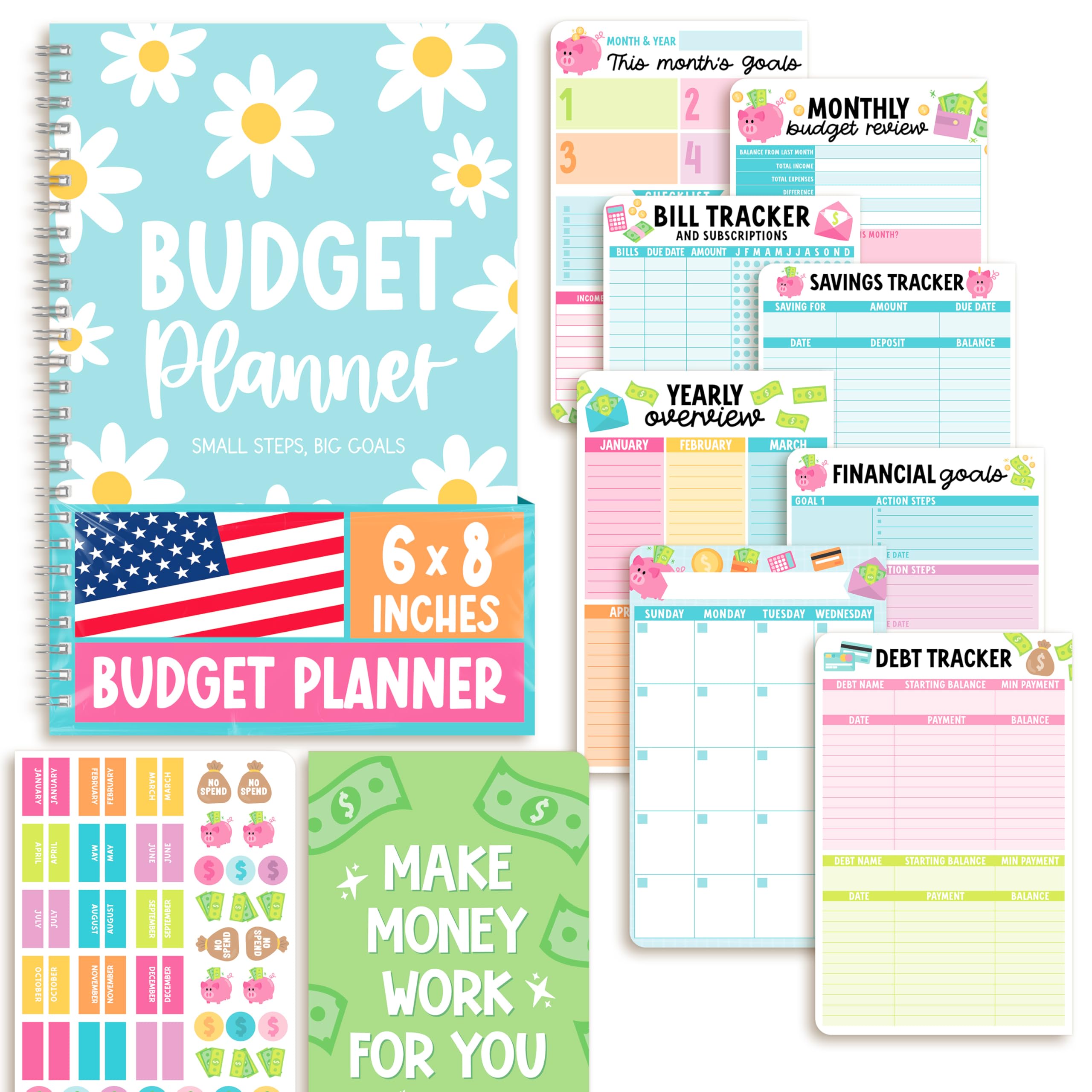
Hadley Designs has built a planner that explicitly targets debt payoff and savings acceleration. At 5.8 x 8.3 inches, it’s the most portable option on this list—small enough to slide into a purse without dominating the bag—yet it packs 170 pages covering expense trackers, bill planners, savings logs, and debt payoff schedules. The biweekly format aligns with paycheck cycles, which many budgeters find more natural than calendar months.
The polyurethane cover is flexible but resistant to scuffs, and the spiral coil allows full 360-degree rotation. A sticker sheet adds motivational rewards for hitting milestones, a small touch that helps habit formation. The monthly budget review pages force a periodic check-in that catches spending creep before it becomes a problem.
One recurring note among users is that the monthly tabs are sticker-based rather than printed into the page, so they can peel or wear over time. Adding clear tape or laminate tabs solves the issue. The paper is slightly stiff, which reduces bleed-through but means it takes a bit of pressure to leave a clean impression with lighter pens.
Why it’s great
- Biweekly layout matches paycheck schedules for accurate tracking
- Debt payoff and savings log sections keep goals front and center
- Compact 5.8 x 8.3-inch size is truly portable
Good to know
- Monthly tabs are sticker-based and may need reinforcement
- Multiple sections require writing the same numbers in different places
4. Paper Junkie Budget Planner

If your budgeting workflow relies on storing physical receipts, pay stubs, and bills alongside your written entries, this Paper Junkie planner is built for exactly that. The standout feature is its 24 storage pockets—one for each month plus extra for recurring documents—that let you stash checks and statements without needing a separate filing system. The cardstock cover is sturdy enough for a year of daily use, and the elastic closure keeps everything secure when the planner is closed.
The 8 x 8-inch square format is compact enough for a desk drawer or small bag. Inside, the ruled paper includes a monthly bill payment checklist, sections for notes and to-do lists, and expense sheets that cover the essentials without overwhelming you with fifty different trackers. It’s a clean, distraction-free layout that works well for beginners or anyone who wants simplicity.
The main trade-off is pocket durability. When you stuff a pocket with multiple receipts and folded bills, the pocket cardstock can feel strained and may tear if overstuffed consistently over several months. Users also note the lack of a monthly calendar view, which would help visualize due dates at a glance. For pure receipt storage density, though, this is the top option.
Why it’s great
- 24 integrated pockets eliminate the need for a separate filing system
- Elastic closure keeps receipts and bills from spilling out
- Simple layout reduces friction for first-time budgeters
Good to know
- Pockets can feel fragile when overstuffed with bulky receipts
- No monthly calendar or overview page for visual planning
5. Yaridar Bill Tracker Notebook
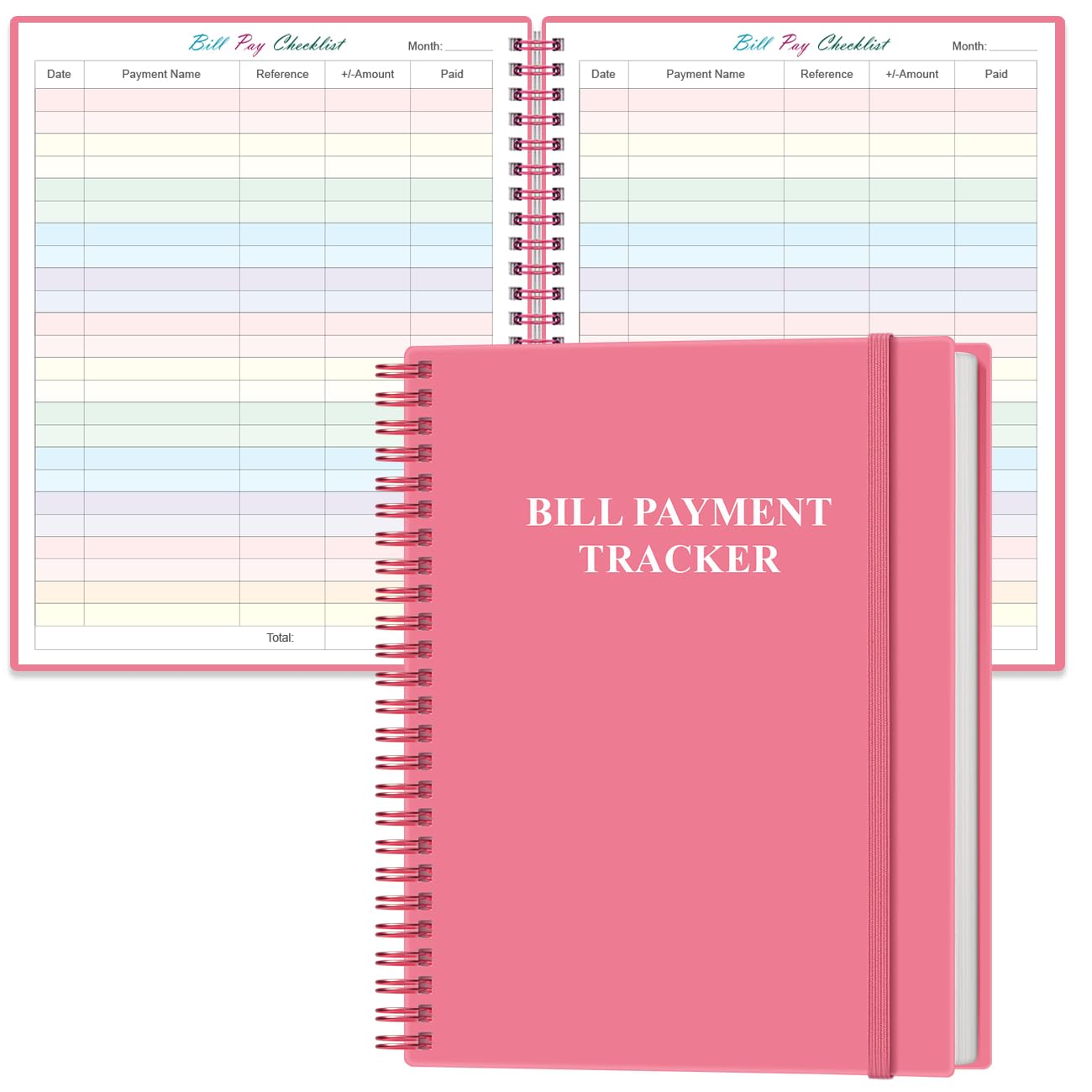
The Yaridar Bill Tracker is the most accessible entry point on this list, and it earns its spot through sheer line capacity. With 127 pages of 100 GSM paper and 29 lines per page, you get 3,680 total entry lines—enough to log every single transaction for a small household for a full year without needing a second notebook. The 100 GSM paper weight handles gel pens and mild highlighters with minimal bleed-through, a rarity at this tier.
The spiral-bound design measures 8.5 x 11 inches, giving each line plenty of horizontal space for writing payee names, amounts, and payment methods without cramping. The polypropylene cover resists spills and the elastic band keeps the notebook closed in transit. A back pocket provides basic receipt storage, though it’s smaller than dedicated pocket systems.
This is a pure bill tracker—it doesn’t offer savings goal sections, debt payoff trackers, or budget overview pages. If your financial tracking is primarily about making sure every bill gets paid on time and every amount is recorded, this notebook does that one job extremely well. The colored line patterns help keep entries visually distinct, reducing errors when scanning back through months of data.
Why it’s great
- 3,680 entry lines provide year-long capacity for high-volume tracking
- 100 GSM paper resists bleed-through with gel and fine-tip pens
- Large 8.5 x 11-inch pages give generous writing space per line
Good to know
- No dedicated savings, debt, or budget overview sections
- Back pocket is smaller than multi-pocket systems
FAQ
What is the difference between a monthly and weekly budget planner layout?
How many pockets do I really need in a budgeting planner?
Should I choose an undated or dated budgeting planner?
What paper weight prevents ink from bleeding through to the next page?
Final Thoughts: The Verdict
For most users, the best budgeting planner winner is the Pukka Pad Carpe Diem because it combines a durable hardcover, coated tab dividers, and a layout that balances goal tracking with expense logging without feeling like homework. If you want deep data capacity, grab the Adams Home Office Budget Book. And for a compact, goal-focused planner that fits in any bag, nothing beats the Hadley Designs Budget Planner.

Mo Maruf
I created WellFizz to bridge the gap between vague wellness advice and actionable solutions. My mission is simple: to decode the research and give you practical tools you can actually use.
Beyond the data, I am a passionate traveler. I believe that stepping away from the screen to explore new environments is essential for mental clarity and physical vitality.