Our readers keep the lights on and my smoothie glass nicely filled. As an Amazon Associate, I earn from qualifying purchases.
The sharp, stabbing pain right below your kneecap after every jump, cut, or squat — that’s patellar tendinitis, the hallmark of jumper’s knee. A properly fitted brace redirects forces off the tendon, allowing you to stay active without sidelining yourself with rest.
I’m Mohammad Maruf — the founder and writer behind WellFizz. I have spent years analyzing biomechanical support gear, sifting through clinical studies on patellar load distribution, and comparing real-world durability across dozens of tendon straps.
Working through warehouse shifts, daily runs, and basketball leagues, I narrowed the field to a few essential picks. Here is my research-backed breakdown of the brace for jumper’s knee that delivers measurable relief without restricting your range of motion.
How To Choose The Best Brace For Jumper’s Knee
Not every knee support works the same way. For jumper’s knee specifically — patellar tendinitis — the mechanism that matters most is a small, focused pressure point that rests over the patellar tendon just below the kneecap. A full sleeve may provide warmth, but a targeted strap disrupts the pain cycle more effectively.
Compression Type: Strap vs Sleeve vs Hinged Brace
For jumper’s knee, a dedicated patellar tendon strap is rarely the wrong starting point. It applies direct compression on the tendon itself, altering the angle of pull and redistributing force away from the inflamed area. Sleeves offer generalized warmth and proprioception but lack the pinpoint focus needed for tendinitis. Hinged braces are overkill unless you have ligament instability alongside tendinopathy.
Material and breathability matter for all-day wear
Neoprene straps trap heat and can cause sweat buildup during high-output sports like basketball or volleyball. Silicone-based or fabric-backed straps vent moisture better and resist odor buildup. If you plan to wear the brace under leggings or compression tights, a low-profile silicone web design like the DonJoy is easier to forget about than a bulky neoprene wrap with thick Velcro.
Secure fit without slippage
A strap that migrates down your leg during a sprint is worse than no strap at all. Look for non-slip interior textures, medical-grade closures, or pull-on silicone sleeves that stay locked at the correct position. Feedback from runners and basketball players consistently points to slippage as the top reason for abandoning a brace mid-season.
Quick Comparison
On smaller screens, swipe sideways to see the full table.
| Model | Category | Best For | Key Spec | Amazon |
|---|---|---|---|---|
| DonJoy Webtech Strap | Premium | High-impact sports & long activity | Silicone web pressure pad | Amazon |
| Pro-Tec Athletics Strap | Mid-Range | Consistent one-hand fit & moderate compression | Neoprene with stretch allowance | Amazon |
| Stabilizing Patella Strap | Mid-Range | Versatile support for multiple knee conditions | Breathable neoprene, 2.4 oz | Amazon |
| Fit Geno 2-Pack | Budget | Budget value, anti-slip silicone | One size fits most, 2-pack | Amazon |
| BraceAbility Youth Strap | Kids | Osgood-Schlatter in active children | 0.63 oz, child-sized padding | Amazon |
In‑Depth Reviews
1. DonJoy Performance Webtech Patella Knee Strap

The DonJoy Webtech looks different because it is different. Instead of a wide neoprene band, it uses a silicone web pad that sits directly on the patellar tendon, spreading pressure across a larger contact area without hot spots. The contoured top and bottom edges follow the natural bend of the leg, preventing the rolling or digging that happens with rectangular straps.
Reflective strips add visibility for low-light runs, and the TPR pull tabs make donning and doffing easy even with sweaty hands. In practical use, warehouse workers and delivery drivers report significant pain reduction during 10-hour shifts with constant ladder climbing and jumping out of trucks. Runners with mild-to-moderate knee pain find it secure enough for 10K distances without needing to retighten.
Where this strap falls short is the one-size limitation. The Small/Medium fits most average builds, but larger legs may struggle to get the right tension. Over several months, the Velcro loses some tack, though not to the point of failure. It is not designed for maximum tension — over-tightening can cause discomfort after 30 minutes on high-impact hikes.
Why it’s great
- Lightweight silicone web distributes pressure evenly without bunching
- Secure fit stays in place through runs, lifts, and long shifts
- Breathable mesh back pad prevents heat buildup during intense activity
Good to know
- One size may not accommodate very large or muscular legs
- Hook-and-loop grip weakens slightly after months of daily use
- Must be cinched tight for full effect on severe tendinitis
2. Pro-Tec Athletics Patellar Tendon Strap

The Pro-Tec strap has been a fixture in physical therapy clinics since 2002, and that longevity tells you something about its clinical reliability. It relies on a moderate-compression neoprene pad with a internal cushion that sits over the patellar tendon. The one-hand adjustment system is genuinely useful — you can tighten or loosen mid-workout without taking the strap off.
User feedback highlights its comfort under leggings and pants because the profile is thinner than many alternatives. The fabric backing stays in place even when wet from sweat, which is a common frustration with straps that use a plastic nub for the pressure point. It weighs only 1.76 ounces, so you won’t notice it during lateral movements like court sports.
The sizing runs small. Several buyers report that the Extra Large fits more like a Large, and the neoprene stretches about half an inch to an inch over the first month with frequent use. If you are between sizes, sizing up is the safer bet. A small number of users find the Velcro closure can leave a red mark on sensitive skin after prolonged wear, though no numbness is reported.
Why it’s great
- Proven clinical design with decades of real-world usage
- Stays put during sweaty runs and circuit training without slipping
- Low-profile shape fits discreetly under workout clothing
Good to know
- Sizing chart runs tight — measure carefully and consider sizing up
- Neoprene stretches slightly over weeks of daily wear
- Not ideal for severe cases needing high tension; moderate compression only
3. Stabilizing Patella Knee Strap by MDUB
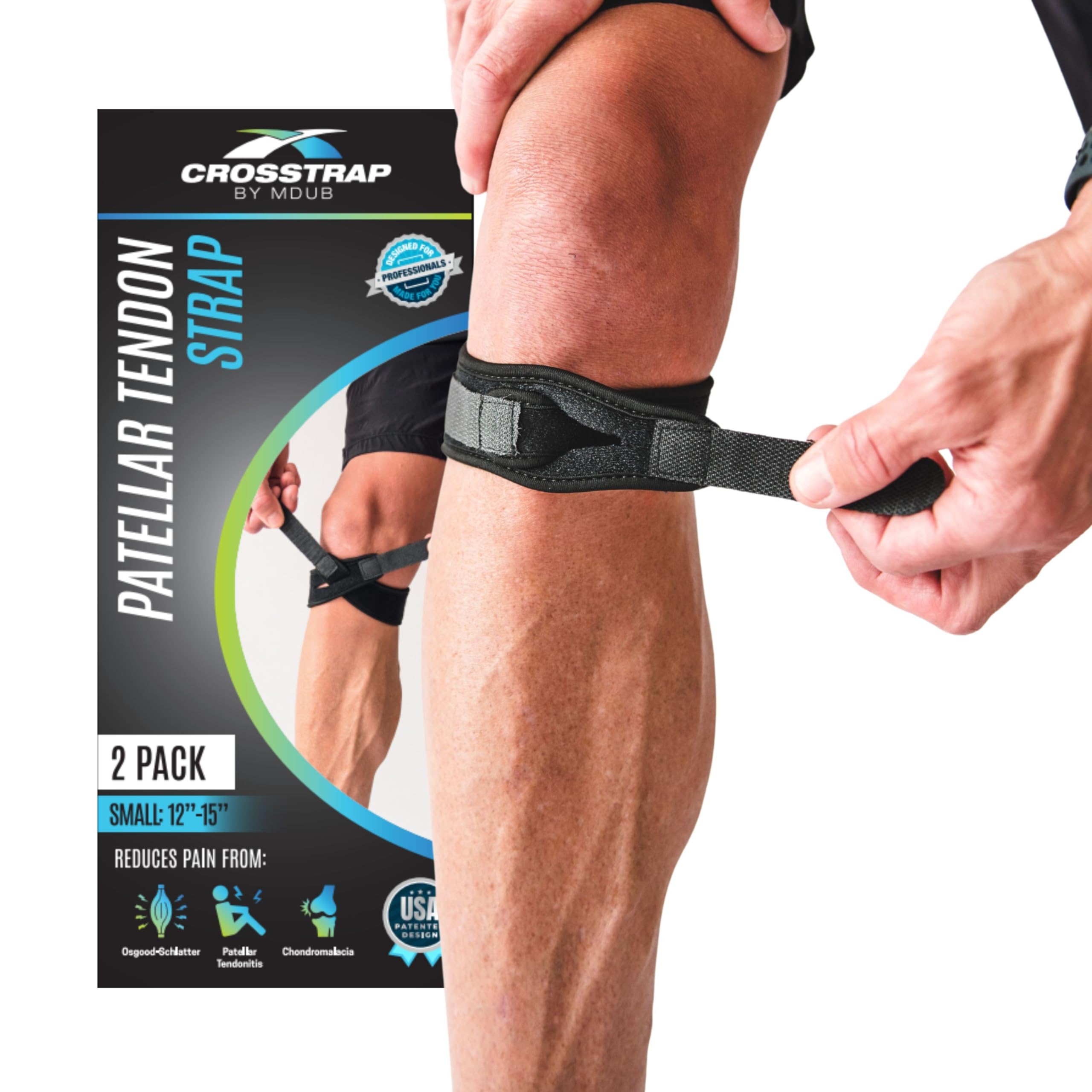
The MDUB Stabilizing Patella Strap employs a cross-strap mechanism that wraps around the leg and crosses over the tendon area. This design creates isolated pressure on the patellar tendon without squeezing the sides or back of the knee, which means you retain full range of motion during squats, cycling, and stair climbing. At just 2.4 ounces, it is among the lightest options in this class.
Buyers with Osgood-Schlatter disease in teenagers and IT band syndrome in runners report consistent relief. The Velcro adjustable closure accommodates a wide range of leg sizes, from pre-teens with 11-inch knee circumferences to larger adults. Multiple reviewers note the strap stays secure during 15,000-step days on vacation without needing readjustment — a strong indicator of design stability.
The main drawback is the scratchiness of the Velcro tab. If the strap is positioned so the tab rubs against your skin or opposite leg during side sleep, it can cause irritation. Overtightening is also easy to do, which can restrict circulation. A few users report the Velcro and band material degrade after several months of heavy use, though the low entry cost makes replacement painless.
Why it’s great
- Cross-strap design targets the tendon without squeezing other knee structures
- Ultra-lightweight build works under leggings and capris without bulk
- Highly adjustable fit across a wide range of ages and leg sizes
Good to know
- Velcro tab can feel scratchy against bare skin or opposite leg
- Band and closure may wear out after several months of daily use
- Easy to overtighten — watch for circulation restriction
4. BraceAbility Kids Knee Band

The BraceAbility Kids Knee Band is purpose-built for young athletes dealing with Osgood-Schlatter disease, which typically flares during growth spurts between ages 8 and 15. Instead of scaling down an adult strap, this band uses a smaller pad circumference and lighter compression padding over the tibial tuberosity. The neoprene material traps therapeutic heat to increase circulation around the sore growth plate without feeling bulky.
The medical-grade fastener closure is easy enough for children to adjust themselves — a meaningful detail for parents who want their kids to wear the brace consistently during soccer practice, basketball games, or dance class. Multiple parents report that their 11- to 15-year-old children experience near-immediate pain reduction and continued compliance because the strap does not restrict their movement or feel like an adult brace.
The easy-adjust Velcro could be more durable. Several users mention the strap slipping undone during heavy activity, requiring periodic retightening. The sizing is tight for taller teens — a 15-year-old on the upper end of the size range may have no room to grow. If your child has a knee circumference above 12 inches, the adult-sized MDUB strap or Fit Geno pack will provide a more secure long-term fit.
Why it’s great
- Designed specifically for children with Osgood-Schlatter and growing pains
- Low-profile enough for kids to forget they are wearing it during sports
- Encourages independence with easy child-operated fastener
Good to know
- Would benefit from a more durable Velcro closure for high-intensity play
- Sizing runs tight on tall or muscular teens; best for smaller kids
- Occasional slippage during soccer or basketball requires readjustment
5. Fit Geno Knee Strap Patella Support 2-Pack

Fit Geno bundles two identical patellar straps in one package, addressing the most common complaint about single-strap models: what do you wear while the other is drying after a sweaty session? The strap relies on a stretchable silicone rubber construction instead of Velcro or neoprene, which makes it waterproof and odor-resistant. It also eliminates the fabric snagging issue that Velcro straps cause against gym leggings or compression tights.
The one-size design accommodates patellar circumferences from 11.4 to 16.5 inches, covering the vast majority of adult legs. The silicone grip is genuinely non-slip during runs and court sports; users specifically note it does not migrate during 30-45 minute running sessions. For the price of a single premium strap, you get a backup unit that fits both left and right legs without distinction.
The pull-on silicone closure means you cannot fine-tune the tightness mid-activity the way you can with a Velcro strap. Some cyclists report the silicone band is less effective on the bike than KT tape, though it works well for running, walking, and general weightlifting. Over months of use, the silicone can lose some elasticity, but the low price of entry and included spare make this non-critical.
Why it’s great
- Two straps for one price — always have a clean, dry backup
- Waterproof silicone material resists odor and snagging on clothes
- Stays locked in place during runs and court sports without adjustment
Good to know
- No fine-tuning adjustment; what you slide on is the tightness you get
- Less effective for cycling-specific patellar pain compared to running
- Silicone may stretch over heavy long-term use, but spare is included
FAQ
Will a patellar strap cure my jumper’s knee permanently?
Why does my strap keep sliding down below my kneecap during sports?
Can I wear a patellar strap over compression tights or leggings?
Final Thoughts: The Verdict
For most users, the brace for jumper’s knee winner is the DonJoy Performance Webtech Strap because the silicone web pad offers targeted, even pressure without the bulk or heat retention of neoprene. If you want a proven daily-use strap with a one-hand adjustment that you can wear under work clothes, grab the Pro-Tec Athletics Strap. And for managing Osgood-Schlatter pain in an active child, nothing beats the BraceAbility Kids Knee Band.

Mo Maruf
I created WellFizz to bridge the gap between vague wellness advice and actionable solutions. My mission is simple: to decode the research and give you practical tools you can actually use.
Beyond the data, I am a passionate traveler. I believe that stepping away from the screen to explore new environments is essential for mental clarity and physical vitality.