Our readers keep the lights on and my smoothie glass nicely filled. As an Amazon Associate, I earn from qualifying purchases.
Power outages and voltage surges don’t announce themselves. One moment you’re deep in a project, and the next, your screen goes dark and your unsaved work is gone. A quality UPS combines surge protection with enough battery runtime to save your data and keep your router alive—turning a potential disaster into a minor inconvenience.
I’m Mohammad Maruf — the founder and writer behind WellFizz. My research focuses on the measurable specs that separate a reliable uninterruptible power supply from a glorified power strip: VA ratings, transfer times, battery chemistry, and outlet configuration.
After analyzing dozens of models across price and performance tiers, I’ve found that the best battery backup and surge protector for most home offices balances VA capacity, outlet count, and voltage regulation without forcing you into a premium price bracket you don’t need.
How To Choose The Best Battery Backup And Surge Protector
Choosing a UPS isn’t about picking the biggest number on the box. It’s about matching three core variables—how much power your gear draws, how long you need it to run, and what kind of incoming power quality you’re dealing with—to a unit that delivers those specs without waste.
VA vs. Watts: The Capacity Deception
Volt-Amps (VA) and Watts (W) are not the same thing. VA is the theoretical maximum load the UPS can handle; Watts is the real power your devices actually consume. A 900VA unit might only deliver 500W. Always check the watt rating first. Add up the wattage of your computer, monitor, and router (check their power bricks or specs), then choose a UPS with at least 20% headroom above that total. Under-speccing a UPS leads to overload alarms and premature shutdown.
Automatic Voltage Regulation (AVR) vs. Basic Surge Only
AVR is the feature that separates a true UPS from a simple battery-and-surge box. AVR detects undervoltage (brownouts) and overvoltage spikes—the most common power events—and adjusts them to safe 120V without draining the battery. Units without AVR switch to battery every time the voltage dips, wearing out the cells faster. In areas with frequent voltage fluctuations, AVR is non-negotiable.
Battery Chemistry: Lead-Acid vs. Lithium
Traditional sealed lead-acid (SLA) batteries are affordable and proven, but they degrade after 3-5 years and need replacement. Lithium Iron Phosphate (LiFePO4) batteries last 10+ years, handle more charge cycles, and are significantly lighter. The trade-off is upfront cost—LiFePO4 units cost roughly 2x more than equivalent SLA models. For a home office UPS that you plan to keep for a decade, the lithium premium pays off in avoided battery swap costs.
Transfer Time: The Gap That Matters
Transfer time is the milliseconds between when the power cuts and when the battery kicks in. Most standby UPS units switch in 8-12 milliseconds, which is fine for desktop PCs, monitors, and routers. Active PFC power supplies and some sensitive audio/video gear may require pure sine wave output with a faster transfer (under 4ms) to avoid glitches. If you’re protecting a gaming rig with a high-efficiency PSU, check for “active PFC compatible” labeling.
Quick Comparison
On smaller screens, swipe sideways to see the full table.
| Model | Category | Best For | Key Spec | Amazon |
|---|---|---|---|---|
| CyberPower CP850AVRLCD | Premium AVR | Home offices needing AVR and LCD monitoring | 850VA / 510W, 9 outlets, AVR | Amazon |
| APC BX850M | Mid-Range AVR | Full desktop setups with coax protection | 850VA / 510W, 8 outlets, AVR | Amazon |
| CyberPower ST900U | Mid-Range Slim | Gaming consoles and desktop PCs | 900VA / 500W, 12 outlets | Amazon |
| Eaton Tripp Lite OMNI1500LCDT | High-Capacity | Whole-desks with high-wattage towers | 1500VA / 810W, 10 outlets, AVR | Amazon |
| GOLDENMATE 1000VA | Lithium Premium | Long-term use with LiFePO4 battery tech | 1000VA / 600W, 8 outlets, pure sine wave | Amazon |
| SKE SK425 | Value AVR | Budget-conscious network and home office setups | 850VA / 480W, 6 outlets, AVR | Amazon |
| APC BE600M1 | Entry-Level | Compact single-PC or router-only setups | 600VA / 330W, 7 outlets, USB port | Amazon |
In‑Depth Reviews
1. CyberPower CP850AVRLCD
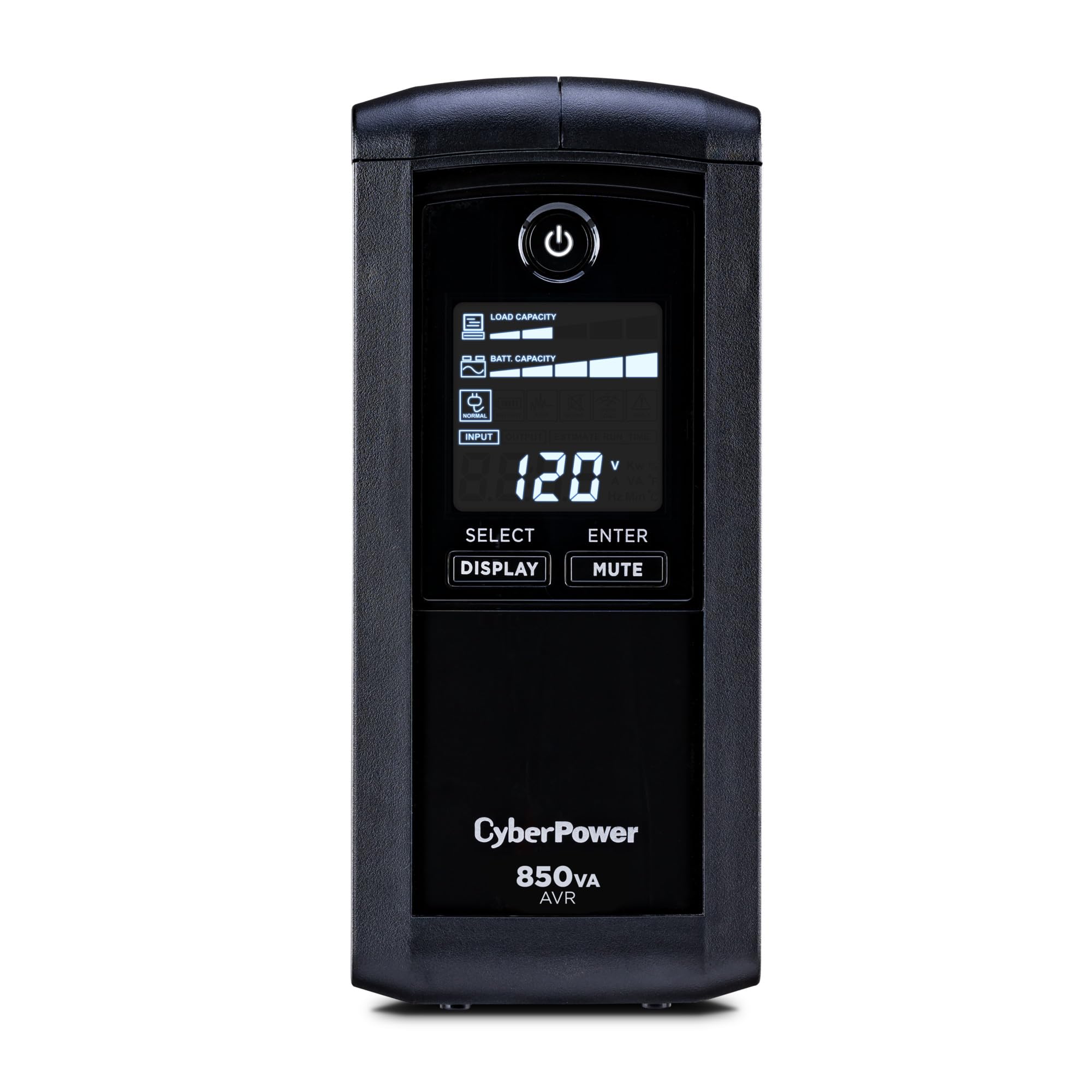
The CyberPower CP850AVRLCD hits the sweet spot of VA capacity, outlet density, and intelligent features. Its multifunction LCD panel shows estimated runtime, battery capacity, and load percentage—data you’d normally only get from a management app—so you can see exactly how much headroom you have at a glance. The mini-tower form factor occupies minimal desk or floor space, and the five battery-backup outlets with four surge-only outlets give you flexibility for separating critical and non-critical gear.
Automatic Voltage Regulation corrects brownouts and overvoltages without tapping into battery reserves, preserving runtime for actual blackouts. Real-world reviews report the original battery lasting 5.5 years under normal use, with one owner keeping a CP1500 alive for 12 years through third-party battery swaps. The simulated sine wave output handles standard desktop PCs, monitors, and networking equipment without issue.
The bundled PowerPanel Personal Edition software allows automatic shutdown scheduling, but it’s limited to monitoring one unit over USB unless you pay extra for network management. The 3-year warranty covering the battery and the connected equipment guarantee provides substantial peace of mind for a mid-range investment.
Why it’s great
- Informative LCD display shows real-time runtime and load data
- AVR extends battery life by correcting fluctuations without switching to battery
- Proven long-term reliability with battery replacement options after 5+ years
Good to know
- Software limits single-USB monitoring without paid upgrade
- Simulated sine wave may not suit high-end audio or active PFC PSUs
- Battery health visibility requires cloud subscription
2. APC BX850M

The APC BX850M brings Automatic Voltage Regulation into the mid-range category, correcting undervoltage down to 88V and trimming surges by 13% without draining the battery. The 850VA/510W capacity provides over 6 minutes of runtime at a 300W load—enough for a desktop computer and monitor to save work and shut down gracefully. Active PFC compatibility means it won’t glitch with modern gaming PC power supplies that demand clean sine-wave-like output.
Eight NEMA 5-15R outlets split into four battery-backup and four surge-only ports, plus built-in coaxial and Ethernet surge protection for cable modems and networked peripherals. The LCD display cycles through input voltage, load level, and battery capacity. Users report the unit surviving direct lightning strikes through the coax line, sacrificing the modem but protecting the computer—exactly the kind of scenario coaxial protection is designed for.
The user-replaceable RBC17 battery (sold separately) adds long-term value, and the ENERGY STAR certification means 92%+ efficiency during normal operation. Some users note the companion PowerChute software feels bare-bones compared to competitor offerings, but the hardware reliability and equipment protection policy offset that shortcoming.
Why it’s great
- Coaxial and Ethernet surge protection included for cable internet setups
- Active PFC compatible for modern high-efficiency PC power supplies
- User-replaceable battery extends the unit’s usable life
Good to know
- Software and diagnostic tools feel outdated compared to CyberPower
- Battery replacement costs add up over 5+ years
- Some users report sensitivity to minor voltage dips from printers
3. CyberPower ST900U

The CyberPower ST900U delivers a high outlet count—12 total, with 6 battery-backup and 6 surge-only—in a slim 3.1-inch profile that slides neatly under a monitor riser or alongside a desk leg. The 900VA/500W capacity provides 10-20 minutes of runtime under a typical gaming load (PC drawing 180W, plus monitor and audio), enough to save progress and initiate a safe shutdown without panic.
Four of the battery-backup outlets are widely spaced to accommodate bulky power bricks from gaming console power supplies or audio equipment. The right-angle NEMA 5-15P input plug keeps the unit flush against the wall, saving further space. GreenPower UPS technology minimizes standby power draw, and the included PowerPanel management software enables automatic shutdown scheduling for your PC.
Users in areas with unstable power—like Texas during storm season—report the ST900U handling a gaming PC and PS5 simultaneously through 1-2 minute outages without screen flicker or equipment restarts. The simulated sine wave output triggers an audible click when the unit switches to battery, but the alarm tone can be disabled. The 3-year warranty including the battery and connected equipment guarantee cover your investment well.
Why it’s great
- 12 outlets (6 battery backed) with wide spacing for bulky adapters
- Slim 3.1-inch profile fits tight desk setups
- Proven compatibility with gaming consoles and high-draw PCs
Good to know
- Simulated sine wave may cause issues with active PFC power supplies
- Audible relay click during power events can be startling
- No AVR, so battery drains during minor voltage dips
4. Eaton Tripp Lite OMNI1500LCDT

The Eaton Tripp Lite OMNI1500LCDT is the high-capacity option for users who need to protect an entire desk—gaming tower, dual monitors, modem, router, external drives, and a laptop—all on one UPS. With 1500VA and 810W of real power, it handles loads that would overwhelm smaller units. The Automatic Voltage Regulation covers a wide input range from 92V to 150V, correcting both severe brownouts and overvoltage conditions without switching to battery.
Ten outlets (8 battery-backup and 2 surge-only) provide ample room for expansion, though the tower form factor is larger than compact competitors. The LCD screen cycles through input voltage, load wattage, runtime estimate, and battery status. The internal sealed lead-acid battery is user-replaceable with Tripp Lite’s RBC51 cartridge, and at a 50% load (around 400W), the unit delivers approximately 50 minutes of runtime—enough to finish a work session or ride through extended outages.
Real-world reviews confirm the reliability over many years: one owner reported the unit still going strong after five years of powering a cable modem and network drive. The 3-year warranty with connected equipment insurance is the highest in this tier. The bundled software is notoriously poor for network discovery, but the hardware itself is rock solid, with one reviewer noting a 22-year-old Tripp Lite unit still in service.
Why it’s great
- 810W real capacity handles full desktop setups including dual monitors and peripherals
- Wide AVR range (92V-150V) protects against severe brownouts
- User-replaceable battery with proven 5+ year lifespan in real use
Good to know
- Large tower footprint requires dedicated floor or shelf space
- Bundled management software has known discovery and compatibility issues
- Initial break-in period may produce strong electronic smell
5. GOLDENMATE 1000VA/600W

The GOLDENMATE 1000VA distinguishes itself with a Lithium Iron Phosphate (LiFePO4) battery pack rated for over 5000 charge cycles and a 10-year lifespan—dramatically outlasting the 3-5 year expectancy of lead-acid competitors. The 153.6 Wh capacity powers a typical PC + monitor load for 40 minutes with over 90% remaining charge, thanks to the pure sine wave output that sensitive electronics prefer. The BMS (Battery Management System) works in tandem with a temperature-controlled fan that stays below 50 dB.
Eight NEMA 5-15P outlets provide both surge protection and battery backup, though the spacing is tight—large power bricks will block adjacent outlets, requiring a power strip extender. The intelligent LCD panel shows runtime, load, battery capacity, and alerts if temperature or charge limits are exceeded. At under 11 pounds, this unit is significantly lighter than a comparable lead-acid UPS, making it easier to reposition or wall-mount.
The pure sine wave output is the key differentiator here: it’s compatible with active PFC power supplies, sensitive audio equipment, and medical devices that simulated sine wave units can glitch. The 20ms transfer time is slightly slower than premium units, but most desktop equipment tolerates this seamlessly. Note that there is no USB port or network connectivity for automated shutdown scripting—this unit is best for non-PC applications or setups that don’t require managed shutdown.
Why it’s great
- LiFePO4 battery lasts 10 years and over 5000 charge cycles
- Pure sine wave output is compatible with active PFC and audiophile gear
- Lightweight and compact compared to lead-acid units of similar capacity
Good to know
- No USB data connection for automated PC shutdown
- Outlets are closely spaced, blocking adjacent plugs with large adapters
- 20ms transfer time may be borderline for some sensitive equipment
6. SKE SK425
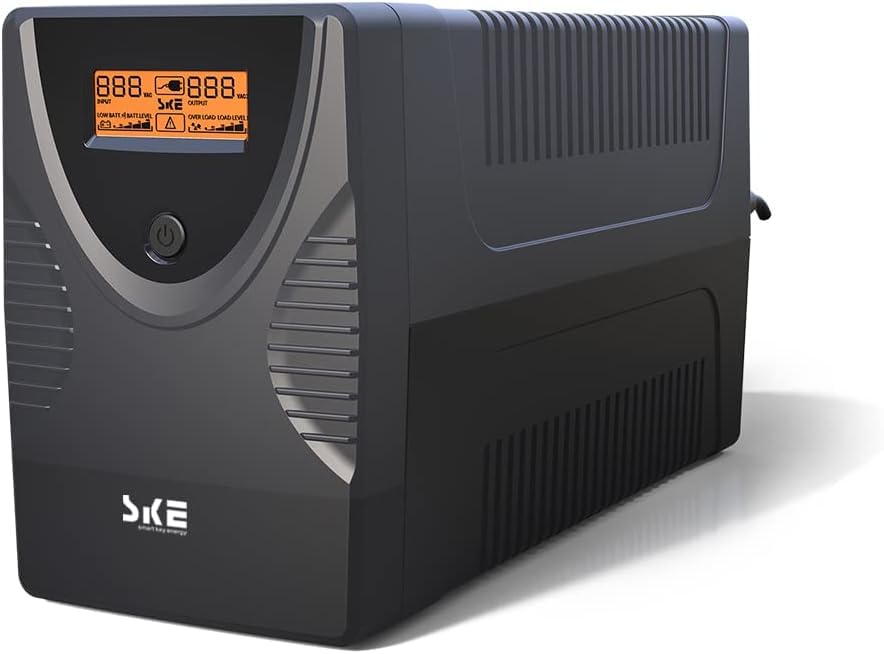
The SKE SK425 brings Automatic Voltage Regulation and a readable LCD display to the budget-friendly tier, making it one of the few sub–class UPS units that actively stabilizes voltage without burning through battery capacity. The 850VA/480W rating provides enough headroom for a desktop PC, monitor, router, and several peripherals, with real-world reports of 1-2 minutes of runtime—enough to save work and shut down during brief flickers. The AVR handles the typical 100V-130V range fluctuations that plague older wiring.
Six outlets (4 battery-backup, 2 surge-only) are adequate for a focused setup, though the spacing is tight—users report that adjacent outlets may be blocked by larger power adapters, so a small extension strip may be needed. The tower form factor with a metal enclosure feels sturdier than the all-plastic competitors at this price point. The 10.1-pound weight is manageable for relocation between workspaces.
User reviews highlight compatibility with older operating systems (Windows 7, 98) and the ability to clean generator power for sensitive networking gear. The replaceable battery design allows you to swap in a new cell when the original ages out, extending the unit’s useful life well beyond the initial purchase. The lack of a dedicated management software for modern NAS setups is a minor drawback, but for basic desktop and network protection, this unit punches well above its price class.
Why it’s great
- AVR at a price point where most competitors omit it entirely
- Metal enclosure provides better heat dissipation than plastic alternatives
- User-replaceable battery design for long-term value
Good to know
- Tightly spaced outlets limit plug options for bulky adapters
- 480W real capacity may be insufficient for high-end gaming PCs
- Limited software compatibility for automated NAS shutdowns
7. APC BE600M1

The APC BE600M1 is the entry-level champion for single-device protection—a compact UPS that fits under a monitor or beside a modem shelf without dominating your workspace. The 600VA/330W capacity provides 23 minutes of runtime at a 100W load, which is perfect for keeping a Wi-Fi router and modem alive during a 10-minute outage. The seven outlets split into 5 battery-backup/shared and 2 surge-only ports, plus a built-in 1.5A USB port that charges phones even during blackouts.
The recessed on/off button is a thoughtful design detail that prevents accidental shutdowns by pets or stray feet—a common complaint with exposed-button units. The battery is user-replaceable (APC RBC154 sold separately), allowing you to refresh the unit after the lead-acid cell’s typical 3-year life rather than replacing the entire device. The included PowerChute software enables automated shutdown scheduling for your computer when the battery runs low.
Real-world reviews consistently praise the 30-45 minute runtime when powering a router and modem alone, making this a reliable companion for maintaining internet connectivity through short outages. The lead-acid battery requires a 10-hour charge time from empty, so it’s not suited for multi-hour backup scenarios. For a basic computer, home office, or network closet protector, this is a proven, cost-effective starting point.
Why it’s great
- Compact footprint ideal for small desks and network shelves
- USB charging port works during power outages for phone backup
- User-replaceable battery extends product life beyond the initial battery’s lifespan
Good to know
- 330W real capacity limits protection to one PC or low-power gear
- No AVR means every voltage fluctuation drains the battery
- 10-hour recharge time from full discharge
FAQ
What size UPS do I need for a gaming PC with a 750W power supply?
Can I plug a power strip into a UPS to add more outlets?
How often should I replace the battery in my UPS?
What does the beeping alarm on my UPS mean?
Do I need pure sine wave output for my computer equipment?
Final Thoughts: The Verdict
For most users, the best battery backup and surge protector winner is the CyberPower CP850AVRLCD because it delivers AVR, an informative LCD display, and proven long-term reliability at a mid-range price, making it the most balanced option for protecting a home office computer and networking gear. If you want pure sine wave output and a decade-long lithium battery that won’t need swapping every three years, grab the GOLDENMATE 1000VA. And for high-capacity protection of an entire desk setup including a gaming tower and multiple monitors, nothing beats the Eaton Tripp Lite OMNI1500LCDT with its 810W real capacity and industry-best equipment guarantee.

Mo Maruf
I created WellFizz to bridge the gap between vague wellness advice and actionable solutions. My mission is simple: to decode the research and give you practical tools you can actually use.
Beyond the data, I am a passionate traveler. I believe that stepping away from the screen to explore new environments is essential for mental clarity and physical vitality.