Our readers keep the lights on and my smoothie glass nicely filled. As an Amazon Associate, I earn from qualifying purchases.
The stack of paper on your desk isn’t going to digitize itself. Whether it’s receipts from a business trip, signed contracts, or decades-old family photos, an automatic scanner is the only tool that turns that pile into searchable, organized files without you standing over a flatbed for hours. The difference between a good scanner and a frustrating one comes down to speed, duplex ability, and software that actually works the way you do.
I’m Mohammad Maruf — the founder and writer behind WellFizz. I’ve analyzed over 200 document scanners across every price tier, parsing real user data on feed reliability, OCR accuracy, and driver support to separate the workhorses from the paperweights.
This guide filters the noise to help you find the best automatic scanner for your specific workload, whether that means a portable travel companion or a high-speed office beast for thousands of pages a week.
How To Choose The Best Automatic Scanner
Picking the right document scanner is about matching hardware capabilities to the physical reality of your paper workload. A mobile simplex unit will frustrate a busy law office, while a 100-sheet duplex behemoth is overkill for scanning a handful of receipts each month. Here are the specs that actually separate a good buy from a regret.
Duplex vs. Simplex: The Hidden Time Sink
A simplex scanner reads only one side of the page per pass. If your documents are printed on both sides, you must manually flip the stack and feed it a second time. Duplex scanning captures both sides in a single pass, effectively doubling your throughput for the most common office documents. For anything beyond single-sided photos or business cards, duplex is non-negotiable.
ADF Capacity and Daily Duty Cycle
The Auto Document Feeder (ADF) capacity tells you how many pages you can stack before the scanner stops to let you reload. A 20-sheet feeder is fine for occasional receipt batches, but a high-volume workflow demands 50, 80, or even 100 sheets. The daily duty cycle is the manufacturer’s recommended maximum pages per day — exceeding it regularly will shorten the scanner’s lifespan and increase paper jam frequency.
Software and Connectivity Matters More Than You Think
Hardware speed is useless if the bundled software fights you. Look for a scanner that includes robust OCR (Optical Character Recognition) for searchable PDFs, the ability to scan directly to cloud services like Dropbox or OneDrive, and integration with accounting tools like QuickBooks. TWAIN driver support is essential if you use third-party document management software. Wi-Fi or Ethernet connectivity is a major convenience for shared office environments.
Quick Comparison
On smaller screens, swipe sideways to see the full table.
| Model | Category | Best For | Key Spec | Amazon |
|---|---|---|---|---|
| ScanSnap iX1300 | Compact Duplex | Home & small office versatility | 30ppm duplex | Amazon |
| ScanSnap iX2400 | High-Speed Duplex | High-volume paperless workflow | 45ppm duplex, 100-sheet ADF | Amazon |
| Epson ES-580W | Wireless Duplex | Wireless, no-PC scanning | 35ppm duplex, 4.3″ touchscreen | Amazon |
| Brother ADS-2700W | Network Duplex | Shared office & IT environments | 1200dpi, TWAIN/SANE support | Amazon |
| Fujitsu fi-7160 | Professional Duplex | Mission-critical daily volume | 60ppm duplex, CCD sensor | Amazon |
| RICOH SP-1130Ne | Network Duplex | Budget network scanning | 30ppm duplex, Ethernet | Amazon |
| Doxie Pro | Duplex Desktop | Home office with varied media | Duplex, 600dpi, direct feed | Amazon |
| Epson RR-60 | Receipt-Focused | Receipt & invoice organization | 10ppm, QuickBooks integration | Amazon |
| HP HPPS100 | Portable Simplex | Light travel & home use | 15ppm, single-sided | Amazon |
In‑Depth Reviews
1. ScanSnap iX1300

The ScanSnap iX1300 strikes a rare balance of speed, size, and connectivity that nails the sweet spot for most home and small office users. Its 30 ppm duplex engine is genuinely fast for the price, and the innovative space-saving design lets the scanner sit flush against a wall or fold away into a drawer without sacrificing the ADF’s 50-sheet capacity. The inclusion of both USB and Wi-Fi connectivity gives you flexibility that many similarly-priced models lack, and the ScanSnap Home software handles image cleanup, blank page removal, and searchable PDF creation without demanding any technical know-how.
Users with high-volume needs or stacks of oddly-sized paper should note that the iX1300’s sensor is CIS rather than CCD, which means it can struggle with heavy cardstock or documents that have tight folds. Some users also report occasional paper jams with very thin or crinkled paper, though this is common across most scanners in this class. The mobile app for Chromebook, iOS, and Android is a welcome addition for those who need to scan directly to a tablet or phone.
For a single user or a small team looking to go paperless without dedicating a whole desk corner to hardware, the iX1300 delivers the most well-rounded package. Its combination of duplex speed, wireless freedom, and polished software makes it the default recommendation for anyone who doesn’t yet know they need something more specialized.
Why it’s great
- Excellent 30ppm duplex speed for its compact size
- Reliable ScanSnap Home software with auto-cleanup features
- USB and Wi-Fi connectivity for flexible placement
Good to know
- CIS sensor may not handle very thick or heavily creased paper as well as CCD models
- Occasional paper jams reported with flimsy or wrinkled documents
2. ScanSnap iX2400
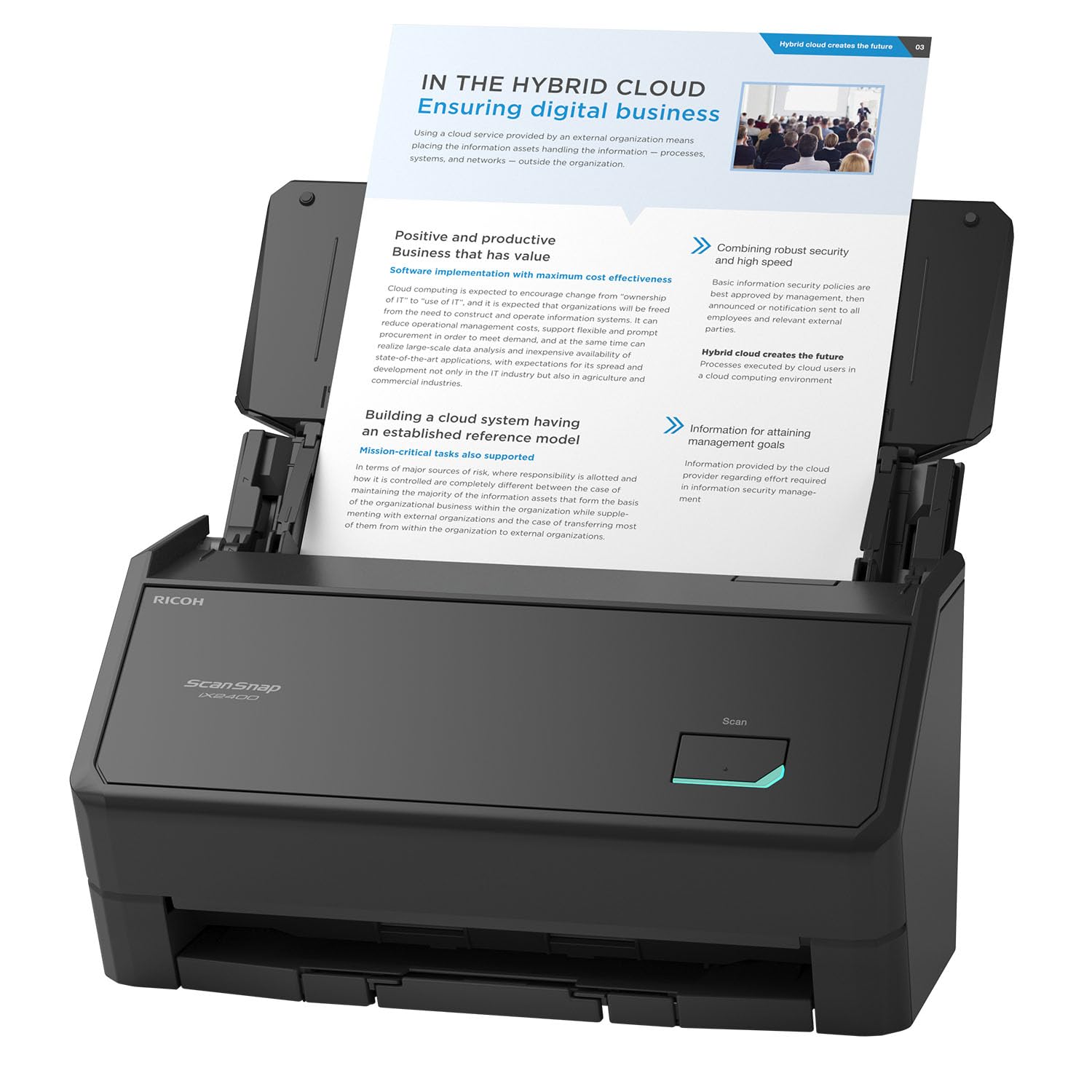
When your daily scanning volume hits triple digits, the iX2400 moves from a luxury to a necessity. This machine pumps out 45 pages per minute in duplex mode and packs a 100-sheet auto document feeder, so you can load an entire contract pack or a thick folder of invoices and walk away. The one-touch button and Quick Menu software let you scan directly to a pre-configured folder or application with zero on-screen interaction, which is a massive time saver for repetitive batch jobs.
The trade-off is that the iX2400 lacks Wi-Fi, relying on a wired USB connection for stability. That’s actually a reliability feature for high-volume environments, but it does lock the scanner to a specific workstation or server. A few users note that the ScanSnap Home software can feel clunky for deep profile management, and the occasional upside-down page output requires manual correction. There’s also no TWAIN or WIA driver, so compatibility with third-party document management systems is limited.
For anyone whose primary frustration is waiting for a slow all-in-one to crawl through a stack of double-sided documents, the iX2400 is the cure. Its raw speed, generous feeder, and reliable paper handling justify the investment for serious paperless conversion projects.
Why it’s great
- Blazing 45ppm duplex speed for high-volume throughput
- 100-sheet ADF handles large batches without reloading
- Rock-solid USB connection avoids Wi-Fi dropouts
Good to know
- No Wi-Fi or Ethernet connectivity
- Lacks TWAIN/WIA driver for third-party software integration
3. Epson ES-580W
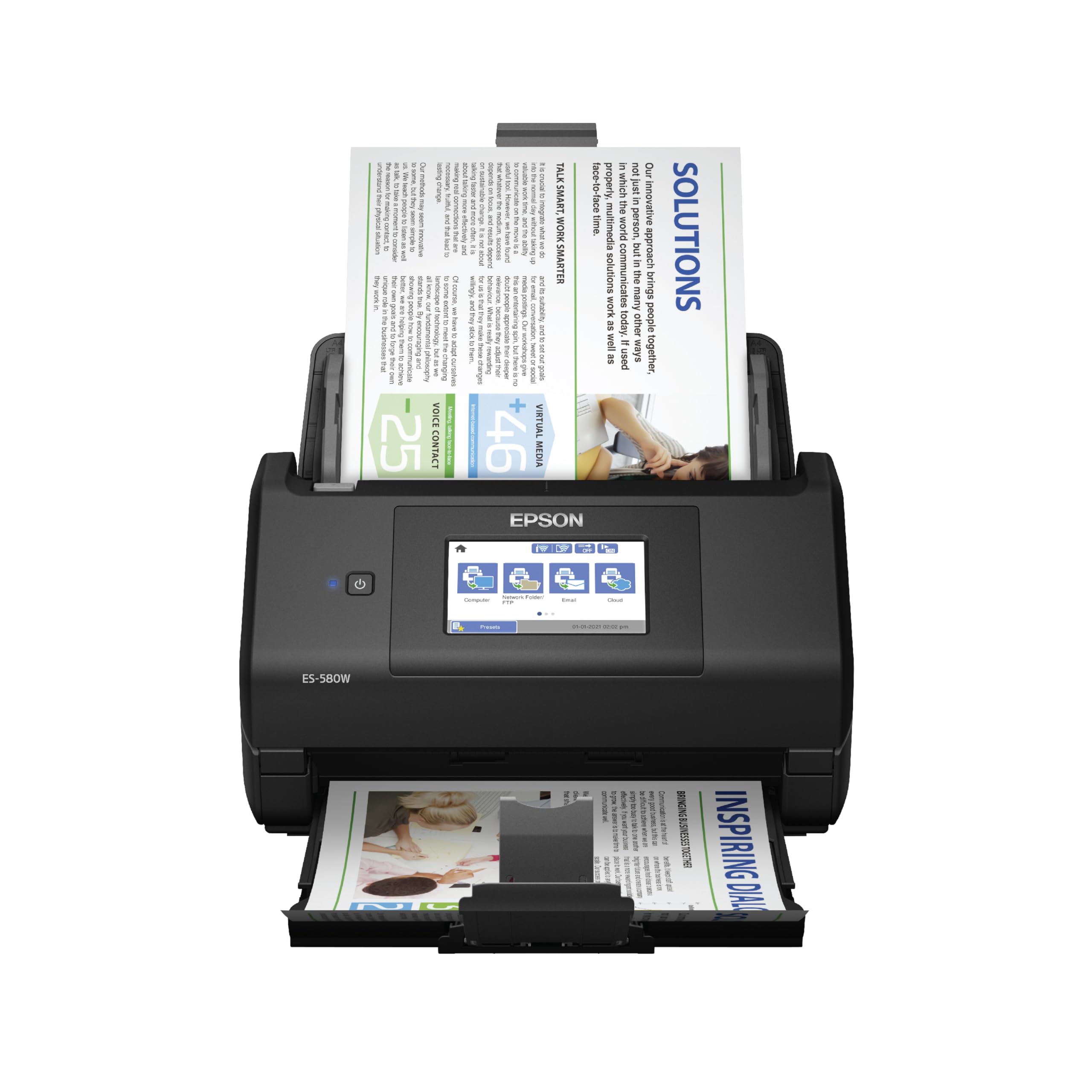
The Epson ES-580W is the scanner that frees you from the computer entirely. Its large 4.3-inch color touchscreen lets you select destinations, adjust scan profiles, and send documents directly to email, USB drive, or cloud services like Dropbox and Google Drive without a PC booting up. The 100-sheet ADF and 35 ppm duplex speed are strong enough for moderate office use, and the single-step duplex technology captures both sides simultaneously for true one-pass efficiency.
Powered by a CCD sensor, the ES-580W delivers superior depth of field compared to CIS scanners, meaning it handles thick ID cards, embossed credit cards, and folded documents with more consistent clarity. The built-in staple detection and intelligent jam recovery are welcome safety nets for high-stakes batch scanning. However, some users report that the Epson ScanSmart software can feel overly complex for simple tasks, and the lack of an Ethernet port is a head-scratcher for an office scanner in this price tier, as Wi-Fi can be less stable for large file transfers.
For a professional who wants to scan to a USB drive or cloud account with zero computer interaction, the ES-580W’s standalone operation and CCD quality are compelling. It’s a particularly strong fit for legal, medical, and accounting practices where direct scanning into practice management software is a daily requirement.
Why it’s great
- Standalone scanning via large touchscreen without a PC
- CCD sensor provides better quality on thick and mixed media
- Quick file naming and auto-sorting presets save time
Good to know
- No Ethernet port for wired networking
- ScanSmart software has a steeper learning curve than competition
4. Brother ADS-2700W

The Brother ADS-2700W is built for IT managers who need a scanner that plays nice with everyone. It supports not just TWAIN and WIA for Windows, but also ICA for Mac and SANE for Linux environments, alongside Ethernet, Wi-Fi, and USB 2.0 connectivity. That broad compatibility makes it a rare find for heterogeneous networks or Linux-based workflows. The 2.8-inch color touchscreen is smaller than Epson’s, but it still provides one-touch scanning to preset profiles and network destinations.
With a daily duty cycle rated for up to 3,000 pages, the ADS-2700W is a true workhorse that can handle heavy use without overheating or jamming. The 48-bit color depth and 1200 dpi resolution produce detailed scans of photos and fine print. Some users note that the LCD interface software could be more intuitive, and network connectivity can require a firmware update to resolve sleep-mode disconnects. The auto-rotation feature is slightly less accurate than premium Fujitsu models, occasionally requiring manual correction.
For a small office or workgroup that needs to share a scanner across multiple operating systems and wants the reliability of wired Ethernet plus the convenience of Wi-Fi, the Brother ADS-2700W is the most versatile choice in its tier. Its generous duty cycle and broad driver support justify the investment for mixed-platform environments.
Why it’s great
- Multi-OS support with TWAIN, WIA, ICA, and SANE drivers
- Ethernet, Wi-Fi, and USB connectivity for flexible networking
- High 3,000-page daily duty cycle for demanding workloads
Good to know
- LCD interface can be non-intuitive for managing profiles
- Auto-rotation feature is less reliable than high-end competition
5. Fujitsu fi-7160

The Fujitsu fi-7160 is the gold standard for a reason — it’s the most popular business scanner worldwide, and its reputation is built on day-in, day-out reliability. The 60 ppm duplex speed is genuinely fast, and the CCD sensor provides industry-leading image quality with superior depth of field that reproduces fine print and embossed text with exceptional clarity. Paper handling technology minimizes jams even with mixed-stock batches, and the 80-sheet ADF keeps workflows moving.
Integration is a key strength: the fi-7160 supports TWAIN, ISIS, and Kofax VRS, making it the top choice for enterprise document management systems and medical records software. The included PaperStream ClickScan software simplifies basic operations to a single button push. The drawbacks are the cost, which is substantial, and the software ecosystem is powerful but can feel bloated for basic users. A few units ship as European models, so checking the power cable before purchase is wise.
If your operation depends on scanning thousands of pages per week without failure, and you need guaranteed compatibility with professional document management platforms, the fi-7160 is the correct answer. It’s not for the casual user, but for the professional it’s an investment in productivity that pays for itself in avoided downtime.
Why it’s great
- 60ppm duplex speed with exceptional paper handling reliability
- CCD sensor delivers best-in-class image quality for all media
- Full TWAIN, ISIS, and Kofax VRS support for enterprise integration
Good to know
- Premium price point well above consumer and prosumer models
- PaperStream software is powerful but has a steep learning curve
6. RICOH SP-1130Ne

The RICOH SP-1130Ne solves a specific problem — providing a TWAIN-compatible duplex scanner with Ethernet networking at a price point that undercuts the professional Fujitsu lineup by a wide margin. The 30 ppm duplex speed is competitive with mid-range consumer models, but the Ethernet connectivity and included PaperStream ClickScan software bring it into the workgroup conversation. The one-push button scanning to email, folder, or cloud is genuinely simple for everyday use.
The CMOS-CIS sensor is adequate for standard document scanning but won’t match CCD models for depth of field on thick or textured paper. Network access is limited to one user at a time, which is fine for small offices but a limitation for larger workgroups. Some users report that the initial TWAIN driver setup on macOS requires more steps than expected, but once configured, operation is stable and reliable.
For a small business or department that needs a network-compatible scanner with TWAIN support but can’t justify the expense of a high-end Fujitsu, the SP-1130Ne delivers the essential features at a compelling price. It’s a solid choice for budget-conscious IT buyers who need to standardize on a single networked scanning solution.
Why it’s great
- Ethernet connectivity for shared network scanning
- TWAIN driver support for third-party document management
- Budget-friendly price for a network duplex scanner
Good to know
- Network access limited to one user at a time
- CMOS-CIS sensor not ideal for thick or textured media
7. Doxie Pro

The Doxie Pro stands out by emphasizing smart software and versatile handling of non-standard media. Its 20-sheet ADF is modest, but the direct feed slot allows you to scan thick items like folded maps, photos, and even plastic cards without jamming. The duplex scanning is crisp at 600 dpi, and the Doxie software automatically crops, straightens, and enhances scans in real-time, which is a huge time saver for batch photo digitization. Scan to JPG, PNG, PDF, or OCR PDF with flexible output options.
Doxie’s software is genuinely intuitive, with options to send scans directly to Dropbox, Evernote, OneNote, and iCloud without complex profile setup. The collapsible ADF makes the unit more compact for storage. However, the scanner lacks Wi-Fi, relying on a USB connection, and there is no SD card slot for standalone operation. A few users note that at maximum resolution, processing speed slows noticeably, and the absence of a Linux or Chromebook app limits its platform reach.
For the home office user who scans a variety of media types — from receipts to photos to homework pages — and wants software that just works without a manual, the Doxie Pro is a polished and reliable choice. Its direct feed capability is a genuine differentiator for anyone who regularly encounters non-standard paper sizes.
Why it’s great
- Direct feed slot handles thick, folded, and delicate media
- Intuitive Doxie software with auto-crop and straightening
- Easy direct exports to Dropbox, Evernote, and OneNote
Good to know
- No Wi-Fi or SD card slot for standalone operation
- 20-sheet ADF is small for high-volume batch scanning
8. Epson RR-60

The Epson RapidReceipt RR-60 is a purpose-built tool for anyone drowning in receipt and invoice paper. Unlike general-purpose scanners, the RR-60 uses ScanSmart AI PRO technology to read the text on your receipts and automatically categorize them by expense type, vendor, and date, then export that data directly into QuickBooks, TurboTax, and other accounting software. This extraction intelligence is the core value — it transforms physical receipts into categorized digital records without manual data entry.
The scanner itself is compact — the smallest and lightest in its class — and USB-powered, making it easy to tote in a laptop bag. The 10 ppm simplex speed is adequate for the occasional receipt pile but slow for general document scanning. Some users report that the software’s text recognition struggles with faded or handwritten receipts, and the CSV consolidation process can be tedious. A few reliability complaints mention connection errors after extended use.
If you are a freelancer, small business owner, or anyone who needs to submit expense reports and wants receipts automatically categorized, the RR-60 is more efficient than any general-purpose scanner. For general document digitization, however, its slow speed and simplex-only design limit its versatility.
Why it’s great
- AI-powered receipt data extraction and categorization
- Direct integration with QuickBooks and TurboTax
- Compact, USB-powered for easy portability
Good to know
- 10 ppm simplex speed is slow for general document scanning
- OCR struggles with faded or handwritten receipt text
9. HP HPPS100

The HP HPPS100 is the entry-level automatic scanner that prioritizes portability and simplicity above all else. Weighing just 3 ounces and powered entirely by USB 2.0, it slides into a laptop bag or even a large pocket without adding noticeable weight. The 15 ppm simplex speed is enough for light home use or travel scanning, and the 1200 dpi resolution delivers surprisingly sharp images for its size. Setup is genuinely plug-and-play, with no power adapter needed.
The HP WorkScan software provides basic editing, cropping, and file export to PDF and JPG formats. However, the scanner is simplex-only, meaning double-sided documents require you to manually flip and re-feed each page — a genuine workflow killer for duplex-heavy tasks. The 10-sheet ADF capacity is tiny, suited for single receipts or short documents rather than batch jobs. Some users also note that the software locks resolution at 300 dpi, and the build quality feels correspondingly lightweight.
For the student, traveler, or occasional home user who needs to scan a few pages at a time without dedicating desk space or budget, the HPPS100 is a functional and affordable entry point. It is not a solution for high-volume or duplex scanning, but it occupies a useful niche as a truly portable, low-friction scanner.
Why it’s great
- Exceptionally portable at only 3 ounces, USB-powered
- Simple plug-and-play setup with no power adapter required
- Sharp 1200 dpi resolution for such a compact device
Good to know
- Simplex-only, requiring manual flips for double-sided documents
- 10-sheet ADF is too small for batch scanning tasks
FAQ
What does automatic document feeder ADF capacity mean for daily use?
Can I use an automatic scanner for scanning photos without damaging them?
Why does my scanner need TWAIN or ISIS driver support for business use?
Final Thoughts: The Verdict
For most users, the best automatic scanner winner is the ScanSnap iX1300 because it delivers fast duplex scanning, reliable software, and wireless flexibility at a price that makes sense for both home and small office use. If you need maximum speed for high-volume daily scanning, grab the ScanSnap iX2400 for its 45 ppm duplex engine and 100-sheet ADF. And for mission-critical professional environments requiring enterprise-grade durability and CCD image quality, nothing beats the Fujitsu fi-7160.

Mo Maruf
I created WellFizz to bridge the gap between vague wellness advice and actionable solutions. My mission is simple: to decode the research and give you practical tools you can actually use.
Beyond the data, I am a passionate traveler. I believe that stepping away from the screen to explore new environments is essential for mental clarity and physical vitality.