Our readers keep the lights on and my smoothie glass nicely filled. As an Amazon Associate, I earn from qualifying purchases.
Finding a grass seed that survives South Carolina’s brutal summer sun, sticky humidity, and occasional drought spikes without turning into a patchy mess is a specific challenge that demands a variety bred for that exact stress. A generic blend from a big-box store often burns out or gets overtaken by crabgrass before the first football Saturday arrives.
I’m Mohammad Maruf — the founder and writer behind WellFizz. I’ve spent years analyzing regional seed labels, germination trial data, and soil compatibility reports to separate what actually holds up from what just looks good on a bag.
After digging into the specs and real-world feedback on five top contenders, this guide narrows the field to the best bermuda grass seed for south carolina that stands up to heat, traffic, and the state’s variable clay-to-sand soils without breaking your budget.
How To Choose The Best Bermuda Grass Seed For South Carolina
South Carolina sits squarely in the warm-season transition zone, where summers are long and humid but winters occasionally dip below the threshold that kills off tender varieties. That means the seed you pick must balance heat tolerance with enough winter hardiness to green back up in spring without a total reseed.
Cold Tolerance vs. Heat Tolerance
Not all Bermuda grass is created equal. Look for improved cold-tolerant varieties on the label — these go dormant later in the fall and wake up earlier in the spring, giving you a longer green window across the upstate, midlands, and low country.
Coverage Capacity and Seeding Rate
Check the square-foot coverage for both new lawn and overseeding. A 5-pound bag of pure Bermuda might cover 2,000 to 5,000 square feet depending on the variety and application rate. If you plan to fill in bare patches, a smaller bag of patch mix with mulch and fertilizer can save you from buying separate starter products.
Wear and Drought Resistance
Bermuda naturally handles foot traffic better than fescue or ryegrass, but the degree of wear resistance varies between common and improved hybrid types. Deep root systems also dictate how long the lawn stays green without irrigation during a July dry spell.
Quick Comparison
On smaller screens, swipe sideways to see the full table.
| Model | Category | Best For | Key Spec | Amazon |
|---|---|---|---|---|
| Pennington Bermudagrass 5 lb | Pure Seed | Full lawn establishment with aggressive spread | Improved cold-tolerant varieties | Amazon |
| Scotts Turf Builder Sunny Mix 2.4 lb | Seed + Fertilizer | New lawn or overseeding in full sun | Root-Building Nutrition formula | Amazon |
| Scotts PatchMaster Southern Gold 4.75 lb | Patch Repair | Bare spot repair for Fescue lawns | Absorbs 3x weight in water | Amazon |
| Pennington Smart Patch Dense Shade 10 lb | Shade Mix | Full shade areas and dog spot repair | Tackifier for slopes and rain | Amazon |
| GreenView Perennial Ryegrass 7 lb | Pure Seed | Quick greening in sun or partial shade | 99.9% weed-free test result | Amazon |
In‑Depth Reviews
1. Pennington Bermudagrass Grass Seed (5 lb)

Pennington’s 5-pound bag delivers pure Bermuda seed with improved cold-tolerant genetics that make it a natural choice for South Carolina’s transition-zone climate. The aggressive self-spreading habit means it fills in thin areas without needing to re-seed every year, and the deep root system provides the drought resistance that Charleston and Columbia summers demand.
The seed requires consistent daily watering and soil temps around 70–80°F to germinate, but once established it produces a low-growing turf that mows clean at 1 to 1.5 inches. Multiple users reported good color and high germination percentages when they prepped the soil and watered twice daily during the first two weeks.
Because it goes dormant and turns brown in winter, this is a true warm-season play — perfect for full-sun lawns where winter color is not the priority. The 5-pound bag covers roughly 2,000 to 5,000 square feet depending on whether you are starting fresh or overseeding, making it a versatile workhorse for medium-to-large yards.
Why it’s great
- Improved cold-tolerant varieties extend green season in the transition zone
- Deep root system handles South Carolina drought periods well
- Aggressive self-spread fills bare spots naturally over time
Good to know
- Requires daily watering and 70-80°F soil for germination
- Goes dormant and browns in winter — not for year-round green
2. Scotts Turf Builder Grass Seed Sunny Mix (2.4 lb)
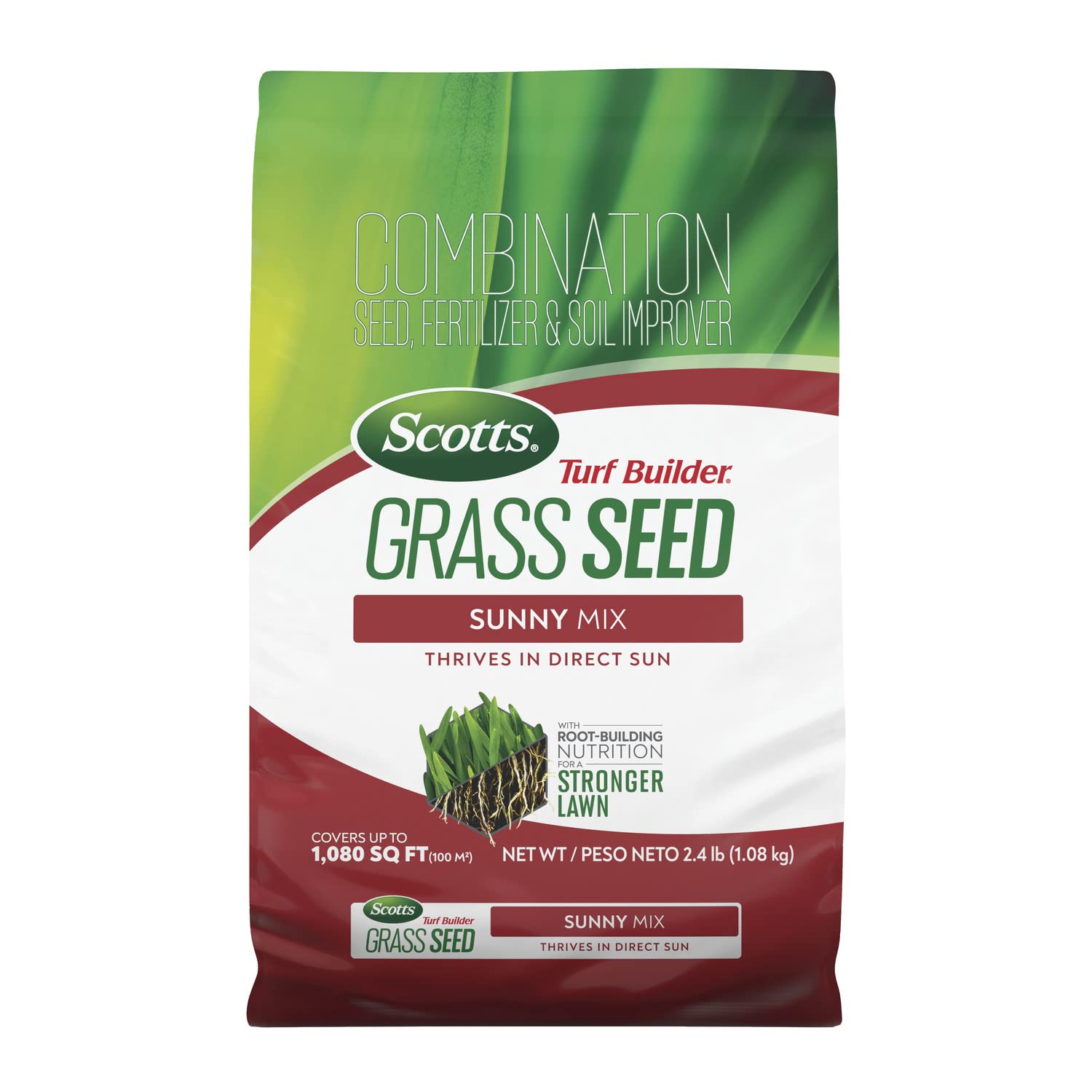
Scotts combines seed, fertilizer, and a soil improver into one bag, so you skip the step of spreading starter fertilizer separately. The Root-Building Nutrition formula is designed to drive deep root establishment, which directly helps the grass survive the kind of heat stress that South Carolina lawns face from May through September.
This mix is rated for full sun and light shade, with medium-to-high drought resistance and medium-to-high durability. Customers consistently noted fast growth and strong performance even during dry spells, with one reviewer reporting that grass filled in well on scraped-to-dirt pavement areas after applying topsoil.
The 2.4-pound bag covers 360 square feet for a new lawn or 1,080 square feet for overseeding, making it a good option for smaller yards or targeted sections. The blend is not pure Bermuda — it is a sunny mix suited for direct-sun areas — so it works well for patchwork or as a complement to an existing Bermuda base.
Why it’s great
- Integrated fertilizer and soil improver saves a separate application step
- Fast germination reported even in drought conditions
- Designed for full sun with strong wear resistance
Good to know
- Small bag limits coverage to smaller areas or patchwork
- Not a pure Bermuda seed — mixed grass blend
3. Scotts PatchMaster Southern Gold Mix (4.75 lb)
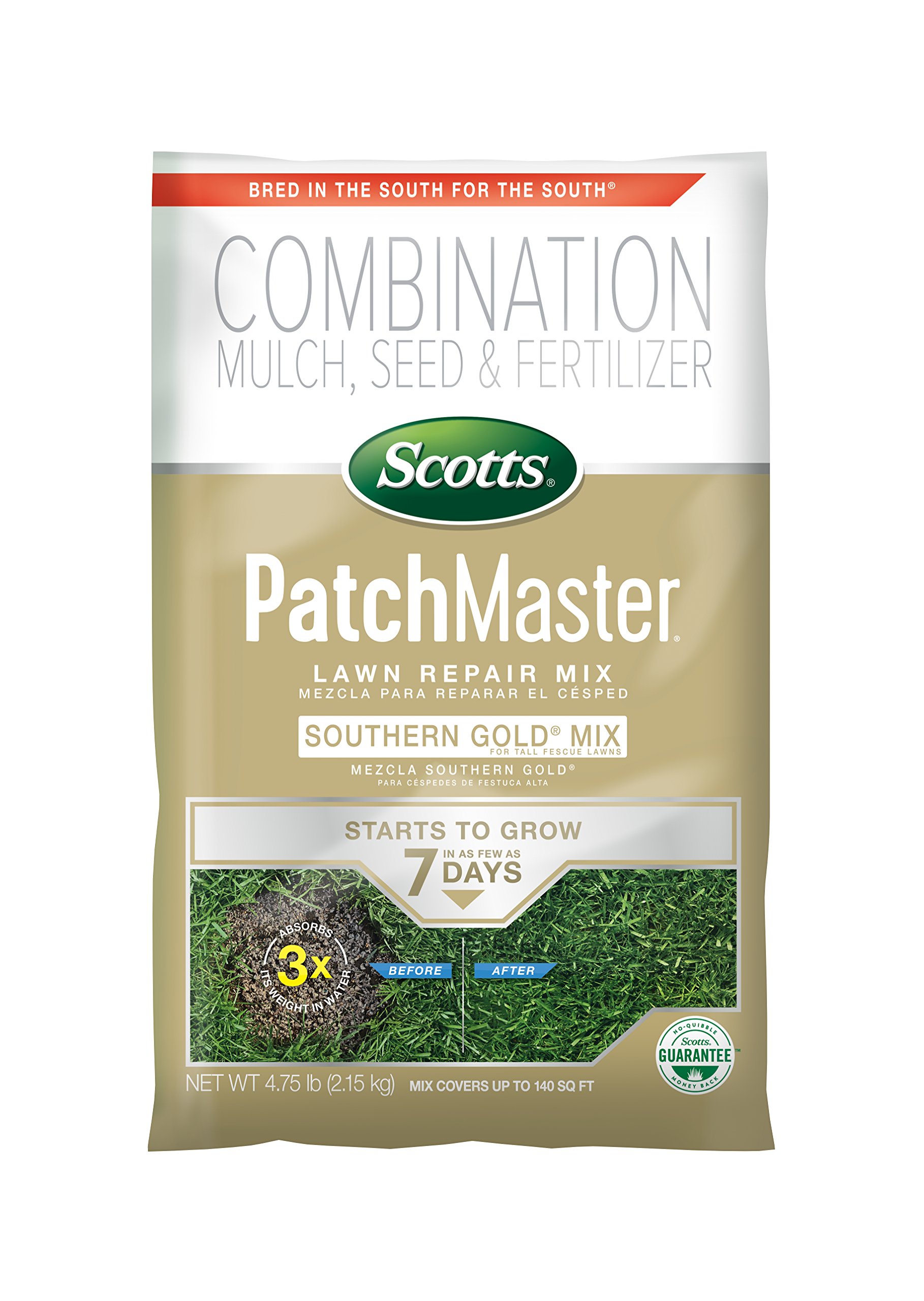
Scotts bred this Southern Gold Mix specifically for the region, combining premium Tall Fescue seed with recycled mulch and fertilizer in a patch-ready formula. The mulch absorbs three times its weight in water, keeping the seed moist through the afternoon heat that dries out bare spots in South Carolina lawns so quickly.
The mix is designed to germinate in as few as seven days and feeds for up to six weeks, which is helpful when you are trying to fill in a high-traffic zone or repair damage from the previous season. Real-world feedback shows it works well on clay and sandy soil, though several users noted that the current formula requires more seed per patch than older versions of the same product.
At 4.75 pounds covering up to 140 square feet, this is strictly a spot-repair product — not a full-lawn solution. Because it is Tall Fescue rather than Bermuda, it works best for overseeding cool-season patches or blending into an existing fescue lawn in the upstate region.
Why it’s great
- Mulch holds moisture critical for South Carolina summer heat
- Starts growing in as few as 7 days with consistent watering
- Bred specifically for Southern soil and climate conditions
Good to know
- Bag covers only 140 sq. ft. — not for large areas
- Tall Fescue variety, not Bermuda — different growth habit and look
4. Pennington Smart Patch Dense Shade Mix (10 lb)

Pennington’s Dense Shade Mix brings together Tall Fescue and American Ryegrass with a tackifier coating that acts like a blanket, preventing the seed from washing away during afternoon thunderstorms. For South Carolina properties with deep shade under mature oaks or pines, this solves the common problem of seed sliding off sloped areas before it has a chance to root.
The formula includes microbials that fight disease, plus a color-changing indicator in the mulch that fades to a lighter shade when the patch needs water — a practical feature when you are managing multiple bare spots across different microclimates. Several customers with virtually no sun in their backyards reported visible growth in two to three weeks.
The 10-pound bag is generous for a patch product, covering up to 140 square feet depending on application thickness. Because the mix is Tall Fescue and Ryegrass rather than Bermuda, it stays green through cooler months but will struggle in full, direct South Carolina summer sun without regular watering.
Why it’s great
- Tackifier prevents seed washout on sloped and rainy sites
- Moisture indicator changes color when it is time to water
- Works well in full shade where Bermuda would not grow
Good to know
- Not a Bermuda seed — mix of Tall Fescue and Ryegrass
- Requires consistent moisture and may struggle in all-day direct sun
5. GreenView Pure Grass Seed Perennial Ryegrass Blend (7 lb)

GreenView’s Perennial Ryegrass blend is 99.9 percent weed-free and germinates in seven to twelve days, making it a nearly instant gratification option for homeowners who want a green lawn fast. The dark green, medium-to-fine blade texture gives a manicured look that competes well with weeds once established.
This blend tolerates both sunny and partially shady areas and adapts to all common soil types, including the clay-heavy or sandy variations found across South Carolina. The 7-pound bag covers up to 3,500 square feet for overseeding or 1,750 square feet for a new lawn, which is one of the highest coverage-per-dollar ratios in this group.
Keep in mind that Perennial Ryegrass is a cool-season grass, so it will look best in fall and spring and may struggle through a full July August in the low country without heavy irrigation. Several users reported it outperformed Scotts in head-to-head germination tests, but it will not self-spread like Bermuda and requires annual overseeding to maintain density.
Why it’s great
- Nearly weed-free — 99.9% purity reduces unwanted invaders
- Fast germination in 7-12 days provides quick ground cover
- Large coverage — up to 3,500 sq. ft. for overseeding
Good to know
- Cool-season grass that fades in South Carolina summer heat
- Does not self-spread — requires annual re-seeding
FAQ
Can Bermuda grass seed survive South Carolina clay soil?
What month should I plant Bermuda seed in South Carolina?
Why does my Bermuda seed turn brown in winter and should I worry?
Final Thoughts: The Verdict
For most users, the best bermuda grass seed for south carolina winner is the Pennington Bermudagrass 5 lb because its improved cold-tolerant genetics and aggressive spread give you a thick, drought-hardy lawn that survives the transition zone without constant re-seeding. If you want an all-in-one solution with built-in fertilizer for a smaller patch, grab the Scotts Turf Builder Sunny Mix. And for deep shade areas under trees where Bermuda will not grow, nothing beats the Pennington Smart Patch Dense Shade Mix with its tackifier coating and moisture indicator.

Mo Maruf
I created WellFizz to bridge the gap between vague wellness advice and actionable solutions. My mission is simple: to decode the research and give you practical tools you can actually use.
Beyond the data, I am a passionate traveler. I believe that stepping away from the screen to explore new environments is essential for mental clarity and physical vitality.