Our readers keep the lights on and my smoothie glass nicely filled. As an Amazon Associate, I earn from qualifying purchases.
A brittle, flaking seasoning layer or a sticky, gummy surface on your cast iron isn’t a sign of poor cookware—it’s a sign you’ve used the wrong oil. The secret to a durable, glass-smooth patina lies in picking an oil designed specifically for thermal polymerization, not your kitchen cabinet vegetable oil.
I’m Mohammad Maruf — the founder and writer behind WellFizz. I’ve spent years analyzing the thermal chemistry of drying oils versus cooking oils to understand why some cast iron seasonings bond permanently while others peel off after one sear.
This guide walks through five purpose-built oils, from avocado blends to flaxseed concentrates, to help you find the best cast iron seasoning for your cookware without wasting time on sticky failures.
How To Choose The Best Cast Iron Seasoning
Not every oil labeled “seasoning” actually polymerizes into a hard, nonstick layer. The difference comes down to fatty acid composition, smoke point, and whether the oil is a drying oil versus a cooking oil. Here are the three specs that separate a lasting patina from a peeling mess.
Smoke Point vs. Polymerization Temperature
A high smoke point (above 450°F) prevents the oil from burning off during oven seasoning, but it doesn’t guarantee a hard finish. The oil must cross its polymerization threshold—the temperature at which fatty acids link into a solid film—before it breaks down into carbon. Oils with a high concentration of saturated or monounsaturated fats (like coconut, avocado, or safflower) polymerize cleanly at 400–500°F without smoking out your kitchen.
Drying Oil vs. Non-Drying Oil
Flaxseed (linseed) oil is a true drying oil: it oxidizes and hardens at room temperature, then cross-links further when heated. This creates a thin, hard, glass-like layer. Non-drying oils like olive or vegetable oil stay partially liquid even after baking, resulting in a tacky surface that attracts dust and flakes under high heat. If you want a durable, rock-solid seasoning, prioritize a drying oil or a high-saturation blend over standard cooking oils.
Additives and Carriers
Some seasoning products add beeswax or plant-based carriers to improve spreadability and rust protection. Beeswax-based creams melt during heating and deposit a thin, even oil layer, then the wax itself burns off cleanly. This is convenient for stovetop touch-ups but doesn’t contribute to the polymerized base layer. For initial seasoning, a pure oil with no wax is more effective; for daily maintenance, a wax-blend cream saves time.
Quick Comparison
On smaller screens, swipe sideways to see the full table.
| Model | Category | Best For | Key Spec | Amazon |
|---|---|---|---|---|
| Walrus Oil | Safflower Oil | High-heat searing and oven seasoning | Smoke Point 450–500°F | Amazon |
| Heritage Products | Avocado Blend | Low-smoke seasoning and vegan cookware care | Low-Smoke Polymerization | Amazon |
| Crisbee Cream | Beeswax + Oil | Stovetop touch-ups and daily maintenance | Beeswax + Sunflower Oil | Amazon |
| Clark’s | Coconut Oil | Rust prevention and moisture protection | 100% Refined Coconut Oil | Amazon |
| Kuche Chef | Flaxseed Oil | Building a hard, glass-like initial seasoning | Organic Flaxseed (Drying Oil) | Amazon |
In‑Depth Reviews
1. Walrus Oil

Walrus Oil is a 100% natural, high-oleic safflower oil with a smoke point that hangs between 450 and 500°F—right in the sweet spot for oven polymerization without triggering your smoke detector. Its NSF certification confirms it’s food-contact safe, and the high monounsaturated fat content means it cross-links into a hard, amber-colored patina rather than a sticky mess.
Customer reviews consistently call out the “smooth coating” and “low odor” during seasoning. One user restored a rusty vintage skillet and reported pristine results after a single application cycle. The 8-ounce bottle is small, but a little goes a long way—you only need a few drops per layer.
The major frustration is the bottle cap: it’s wide and prone to spills, so you’ll want to decant into a squeeze bottle or use a small brush for controlled application. The oil itself is stellar, but the packaging design could be more precision-oriented for the task.
Why it’s great
- Very high smoke point suits oven and stovetop seasoning
- NSF certified and 100% food-contact safe
- Low odor during application and baking
Good to know
- Wide bottle cap leads to spills if you pour directly
- Only available in 8-ounce size
2. Heritage Products

Heritage Products uses a plant-based avocado oil blend engineered to polymerize at lower temperatures than pure high-smoke-point oils. This means you can build a seasoning layer in your oven at 375–400°F without filling your kitchen with smoke. The formula also cleans and deodorizes between uses, which is handy for dutch ovens that trap residual odors.
One reviewer restored a Blackstone griddle that had rusted after a camper flood and reported that the oil “worked amazingly” to bring back a nonstick surface. Another noted that it didn’t go rancid or leave sticky residue—a common complaint with cheaper vegetable-based alternatives.
Because the blend is optimized for low-smoke application, it may require more coats to reach the same hardness as a pure high-smoke-point oil. It’s best for maintenance and mid-temperature seasoning rather than a single-layer, high-heat base coat.
Why it’s great
- Low-smoke formula suitable for indoor seasoning without ventilation headaches
- Non-rancid blend made from natural plant ingredients
- Cleans and deodorizes cast iron between uses
Good to know
- May need extra coats to achieve a hard, glass-like finish
- Avocado oil has a milder polymerization profile than drying oils
3. Crisbee Cream

Crisbee Cream is a semi-solid blend of non-GMO sunflower oil and beeswax, packaged in a jar. It’s designed for stovetop touch-ups: warm the pan, wipe on a thin layer, and let the beeswax melt and distribute the oil evenly. The beeswax burns off cleanly during heating, leaving behind the sunflower oil to polymerize.
Vintage skillet collectors love this stuff. One user restored an old Wagner skillet and used Crisbee post-cook for maintenance, reporting that the seasoning stayed intact even with modern detergents. Another struggled with sticky spots for ten years until Crisbee Cream fixed the surface in a few oven rounds.
The cream is less effective for building a thick base layer from bare iron. Users note that it adheres less evenly than a pure liquid oil, and you may need to follow up with oven cycles for a uniform finish. It shines as a daily conditioner rather than a full-strip restoration product.
Why it’s great
- Convenient beeswax carrier spreads easily on warm pans
- Great for daily maintenance and post-wash touch-ups
- Family-owned brand with strong user loyalty
Good to know
- Less even polymerization compared to pure liquid oils
- Not ideal for initial seasoning of bare, stripped iron
4. Clark’s
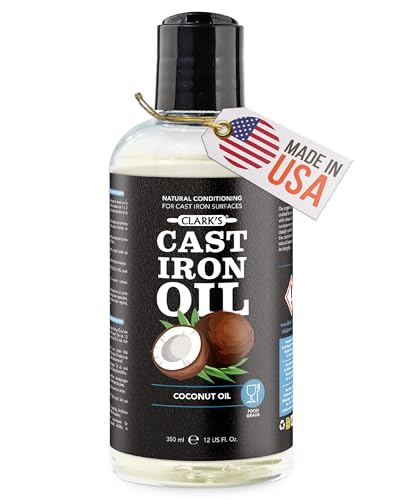
Clark’s uses highly refined coconut oil, which is nearly 90% saturated fat. Saturated fats are incredibly stable—they resist oxidation and won’t go rancid, even if you leave the bottle out for months. This also translates to a seasoning layer that repels moisture effectively, making it a top choice for preventing rust on carbon steel and cast iron.
One reviewer who inherited a skillet from the 1800s reported that Clark’s kept it perfectly seasoned for years. Another noted that a light coating after washing—without oven baking—provided sufficient rust protection. The 12-ounce bottle is the largest in this roundup, offering more applications per purchase.
The trade-off is that coconut oil’s high saturation means its polymerization temperature is slightly lower than safflower or flaxseed. It can produce a slightly softer patina if not baked at the right temperature (350–400°F is ideal). It’s excellent for maintenance but not the fastest for building a hard, glass-like initial layer.
Why it’s great
- Won’t go rancid even without refrigeration
- Large 12-ounce bottle offers great value per coat
- Excellent moisture barrier for rust prevention
Good to know
- Slightly softer patina compared to drying oils like flaxseed
- Requires careful oven temperature control for best results
5. Kuche Chef

Kuche Chef is 100% organic flaxseed oil grown and cold-pressed in North Dakota. Flaxseed is a true drying oil—it hardens through oxidation even before you apply heat, then cross-links further in the oven. This creates the hardest, most glass-like seasoning layer of any oil in this lineup, often described by users as “Teflon-like” after 4–8 oven cycles.
Vintage skillet restorers love it for bringing stripped 1860s-era pans back to life. One user applied 6 oven coats and reported a mirror-smooth cooking surface. Another noted that a single bottle is economical enough to season multiple pieces of cookware, including woks and carbon steel pans.
The catch: flaxseed oil is thin and requires patience. It takes 4–8 thin coats to build a durable layer, and each coat must be baked at a low temperature (around 300–350°F) to prevent the oil from smoking. It’s not great for quick stovetop touch-ups—if you apply it over an existing seasoning without thorough cleaning, it can turn gummy.
Why it’s great
- Organic drying oil produces the hardest, most glass-like patina
- Economical bottle stretches across multiple pans
- Grown and pressed in the USA from organic flaxseed
Good to know
- Requires 4–8 thin oven coats for best results
- Can become gummy if applied over dirty or old seasoning
FAQ
What is the best oil for seasoning cast iron for the first time?
Why does my cast iron seasoning keep flaking off?
Can I use coconut oil for cast iron seasoning?
Final Thoughts: The Verdict
For most users, the best cast iron seasoning winner is the Walrus Oil because it combines a high smoke point, NSF certification, and a balanced monounsaturated fat profile that polymerizes into a durable, low-odor patina in just a few oven cycles. If you want a true glass-like drying oil finish for a stripped vintage pan, grab the Kuche Chef. And for daily stovetop maintenance without the smoke, nothing beats the Crisbee Cream.

Mo Maruf
I created WellFizz to bridge the gap between vague wellness advice and actionable solutions. My mission is simple: to decode the research and give you practical tools you can actually use.
Beyond the data, I am a passionate traveler. I believe that stepping away from the screen to explore new environments is essential for mental clarity and physical vitality.