Our readers keep the lights on and my smoothie glass nicely filled. As an Amazon Associate, I earn from qualifying purchases.
The worst travel battery bank is the one you packed but refused to carry. A slab of dead weight at the bottom of a backpack, a plastic brick that maxes out at a half charge, or a mislabeled battery that gets flagged at airport security. Travel charging is a physics problem with a weight and volume budget, and the solution has to satisfy your phone, your itinerary, and the TSA simultaneously.
I’m Mohammad Maruf — the founder and writer behind WellFizz. I spend my research cycles dissecting LiPo cell density, PD negotiation protocols, and airline Wh limits so you don’t have to guess which power bank survives a layover.
A five-day trip with three devices demands more than raw capacity; it demands a smart balance of weight, power delivery, and durability. This guide evaluates the top models to help you find the best battery bank for travel that matches your specific packing style and device arsenal.
How To Choose The Best Battery Bank For Travel
Travel battery banks live in a zone of trade-offs between capacity, physical size, charging speed, and the convenience of integrated cables. Before you buy, lock in your device list and your trip length. Those two facts determine everything else.
Capacity vs. Airline Compliance
The TSA caps lithium-ion batteries at 100 watt-hours (Wh) for carry-on. A typical 20,000mAh power bank lands around 72Wh — well under the limit and enough to refuel a phone three or four times. A 50,000mAh giant pushes past 185Wh, which is outright banned on most airlines. For almost every traveler, 20,000mAh is the practical ceiling. Go smaller (10,000mAh) if you only need a single top-up and want something that slides into a jeans watch pocket.
Fast Charging Standards: Look for PD, Not Just Watts
Power Delivery (PD) is the protocol that talks to your phone and negotiates the fastest safe charge. A power bank labeled “20W PD” will charge most iPhones to 50% in under 30 minutes. Jump to 45W PD and you can charge a MacBook Air or a Samsung Galaxy S25 Ultra at full speed. Check that the output port you’ll use most — USB-C, ideally — supports PD 3.0. QC (Quick Charge) is common for Android devices, but PD is the universal standard for modern travel.
Built-In Cables vs. Detachable Cables
Built-in cables eliminate the “I forgot the cord” panic. They also add weight and limit reach. If you charge an iPhone and a pair of AirPods, a power bank with a built-in USB-C cable plus a secondary Lightning or USB-A port is a strong setup. Detachable lanyard cables, like the one on the INIU 20,000mAh unit, offer flexibility without a separate cable cluttering your bag. The trade-off is durability — built-in braided cables tested to 10,000 bends typically outlast the battery cells themselves.
Weight and Dimensions in Real Pockets
A 10,000mAh power bank at 6 ounces slides into a jacket pocket without pulling the fabric. A 20,000mAh unit at 11 ounces becomes a noticeable lump in jeans. The Baseus PicoGo AC22 is 45% smaller than standard 10,000mAh banks because of stacked cell technology. If you prioritize pocket fit over maximum capacity, look for dimensions under 3 inches x 2.5 inches and weight under 7 ounces. For backpack travel, the extra ounces matter less, and you can prioritize capacity and port count.
Quick Comparison
On smaller screens, swipe sideways to see the full table.
| Model | Category | Best For | Key Spec | Amazon |
|---|---|---|---|---|
| INIU 20,000mAh | Mid-Range | All-in-one travel with detachable cable | 22.5W PD, 320g | Amazon |
| Anker 10K 30W | Mid-Range | Ultra-compact everyday carry | 30W PD, 212g | Amazon |
| Baseus PicoGo AC22 | Mid-Range | Pocket-sized 45W speed | 45W PD, 170g | Amazon |
| NOBIS 65W 20K | Mid-Range | Laptop + phone charging | 65W PD, 286g | Amazon |
| Orfeika 20K 4-Cables | Premium | Multi-device family travel | 20W PD, 0.73 lb | Amazon |
| Anker Prime 20K 220W | Premium | High-power laptop + app control | 220W total, 510g | Amazon |
| AONIMI 50800mAh | Budget | Extreme capacity road trips | 25W PD, 1.42 lb | Amazon |
In‑Depth Reviews
1. INIU Smallest 20000mAh Power Bank
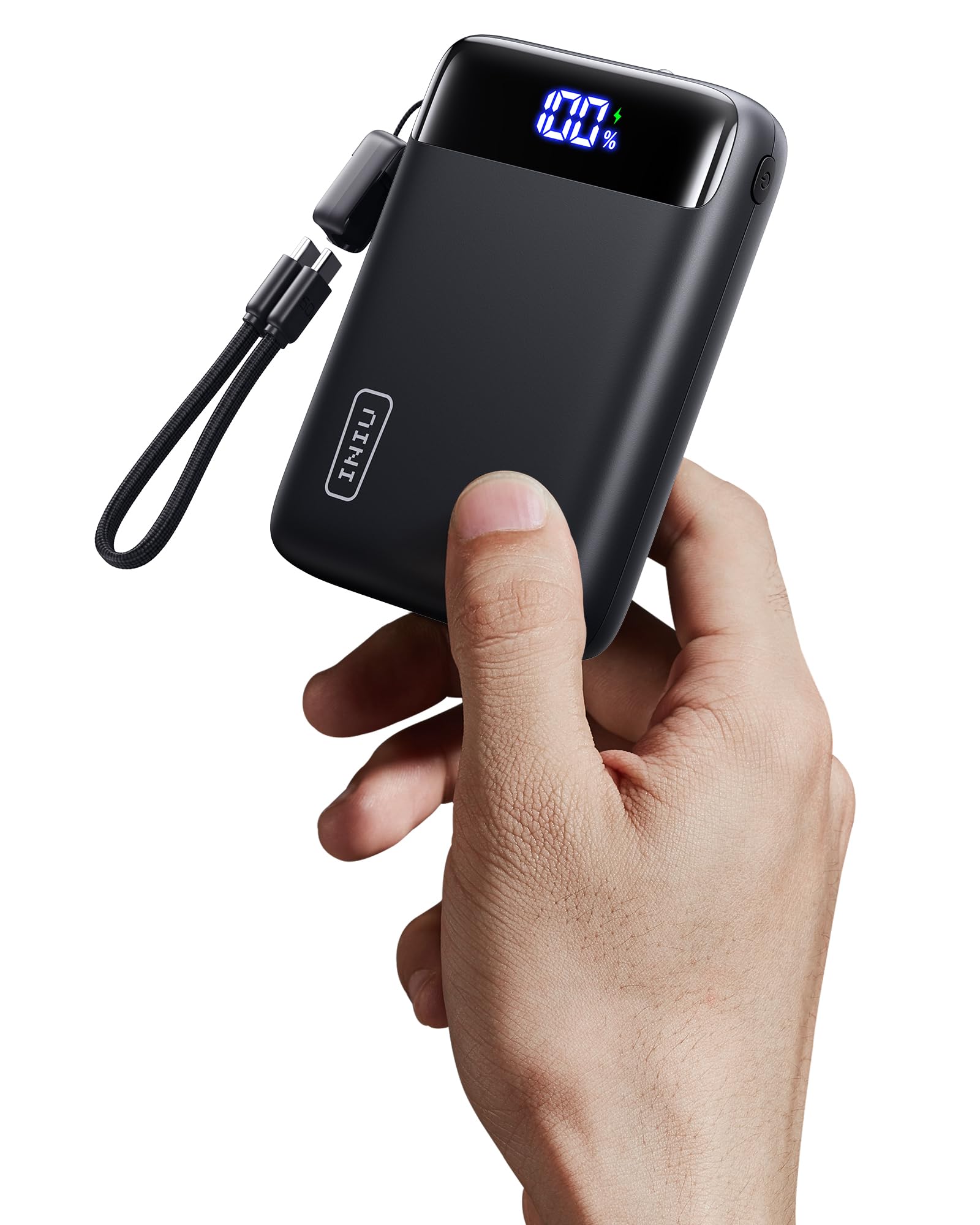
The INIU strikes the hardest balance in the travel category. Its 20,000mAh capacity (320g, 4.1 x 2.8 x 1.2 inches) fits inside a carry-on toiletry bag or a jacket pocket, while the 22.5W PD output pushes an iPhone 16 to 60% in 25 minutes. The built-in USB-C cable doubles as a nylon lanyard — you wear it around your wrist or clip it to a backpack strap, eliminating the hunt for a loose cord at the airport gate.
The LED display shows exact remaining percentage, which matters more during multi-day travel than a four-dot LED guess. Thermal sensors actively dissipate heat during fast charging, keeping the casing cool even when the bank is running at 22.5W flat out. The 3-year replacement warranty from INIU, backed by 38 million users, removes the gamble you take with no-name brands.
Where it lags slightly: the detachable lanyard cable is easy to misplace if you’re not deliberate about clipping it back in. Some users prefer a permanently attached cable. The 22.5W output is fast for phones but won’t charge a MacBook at full speed. For a travel power bank that covers phone, AirPods, and a Kindle on a weekend trip, this is the most complete package at a mid-range price.
Why it’s great
- True 20,000mAh in a pocket-friendly 320g frame
- Detachable nylon lanyard cable eliminates cord clutter
- 22.5W PD fast charging with active thermal dissipation
- Flight-approved with real-time LED percentage display
- 3-year hassle-free replacement warranty
Good to know
- Detachable cable can be lost if not clipped back
- 22.5W output insufficient for high-speed laptop charging
- Slightly thick at 1.2 inches for a slim jeans pocket
2. Anker Portable Charger 10,000mAh 30W
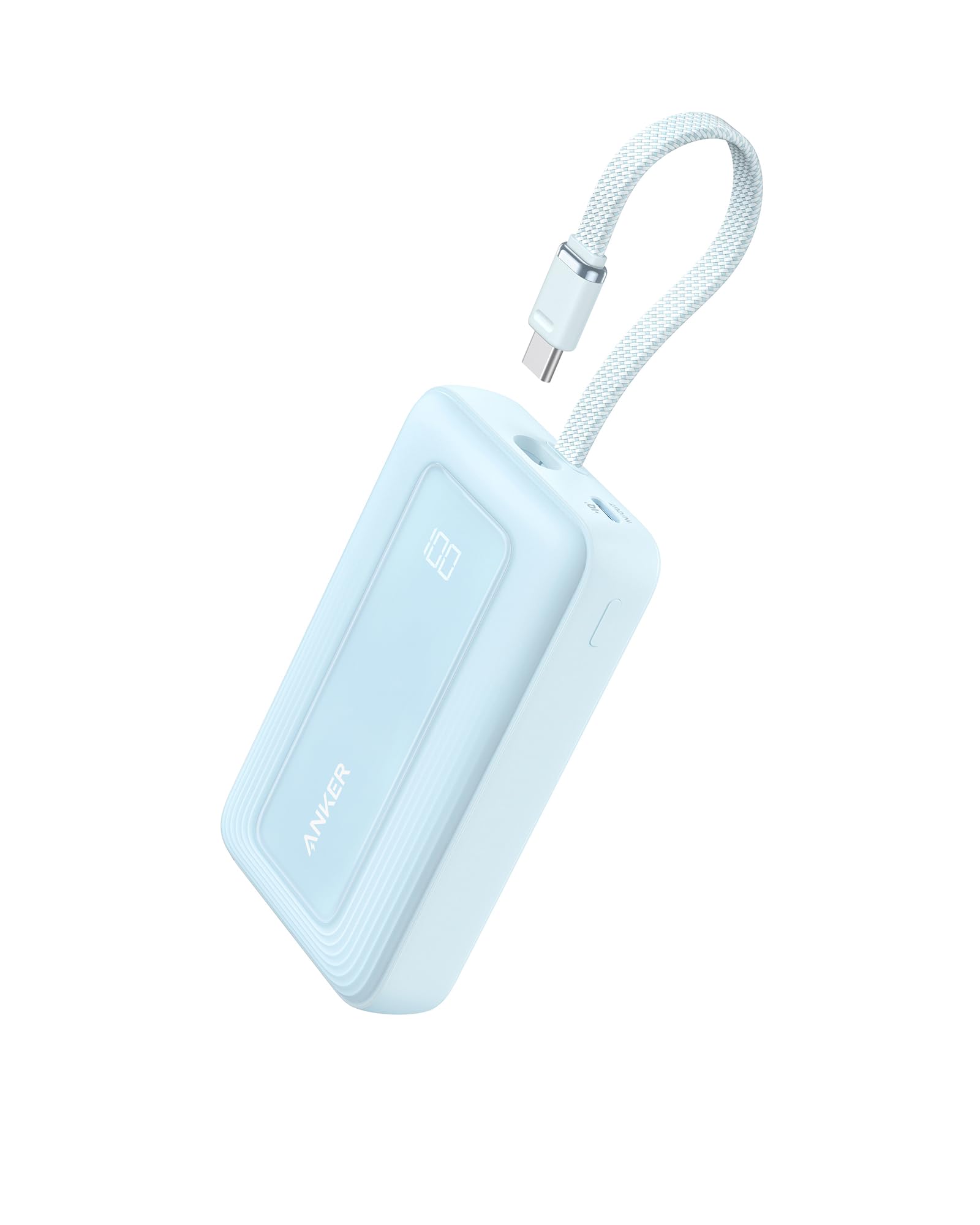
The Anker Zolo 10K, at 212 grams and dimensions of 4.32 x 2.58 x 0.98 inches, is the definition of a pocket-first power bank. It’s barely larger than a credit card stack and slides into a front jeans pocket or a compact passport pouch. The 30W PD output is unusually high for a 10K unit — it charges an iPhone 16 Pro Max to 50% in 27 minutes, a speed typically reserved for 20K bricks.
The built-in USB-C cable is tested to 10,000 bends and eliminates the need to carry a separate cord for charging the bank itself. An additional USB-C and USB-A port let you charge three devices simultaneously. The digital percentage display on the front is crisp and shows remaining charge without guesswork. Users report the battery holds its charge well for months between trips, which is a common failure point in cheaper lithium-polymer packs.
The trade-off is capacity: 10,000mAh gives you about two full iPhone charges, not three or four. For single-day outings, layovers, or minimalist travel where every gram matters, this Anker hits a sweet spot that no 20K unit can match in pocket feel. If your trip exceeds three days without wall access, you’ll want the INIU or a 20K partner.
Why it’s great
- Ultra-compact 212g at 30W PD output
- Built-in USB-C cable rated for 10,000 bends
- Three-device simultaneous charging
- Crisp LED percentage display
- Long shelf life between trips
Good to know
- 10,000mAh delivers only about two full phone charges
- Slightly thicker than expected for the capacity class
- Requires Lightning cable for pre-iPhone 15 models
3. Baseus PicoGo AC22 Mini Power Bank 10,000mAh 45W
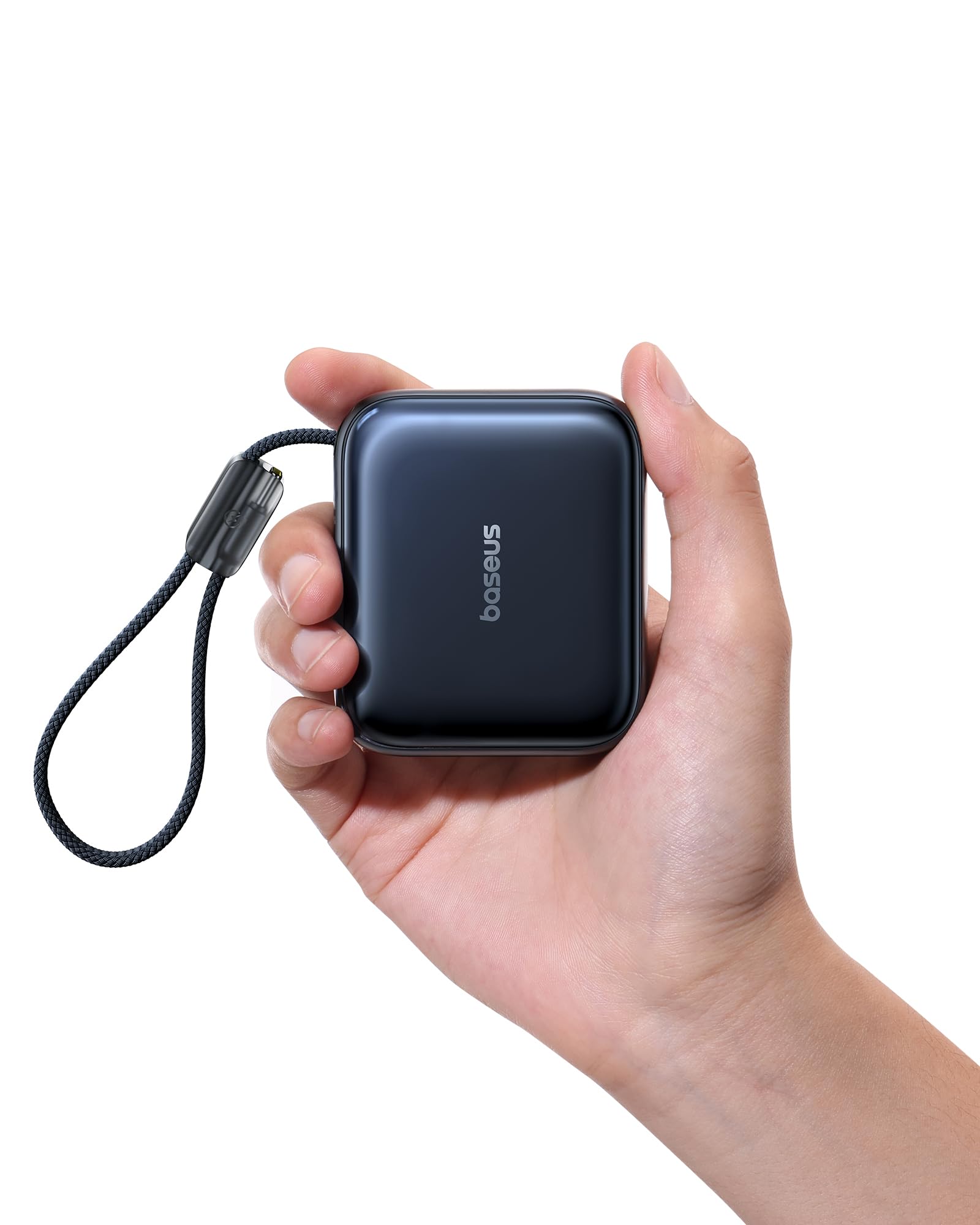
The Baseus PicoGo AC22 challenges the notion that 45W charging requires a large battery. It packs 10,000mAh into dimensions of 2.8 x 2.4 x 1.0 inches and weighs just 6 ounces — about the size of a wireless earbuds case. The 45W PD output is the headline: it charges a Samsung Galaxy S25 Ultra in 27 minutes and can push a MacBook Air to 42% in 25 minutes, a capability normally reserved for 20K power banks.
The built-in braided USB-C cable doubles as a carrying strap and is tested to 12,000 bends with a 25-pound load rating. An extra USB-C port on the side allows charging two devices simultaneously. The battery uses high-density stacking technology that achieves the small form factor without sacrificing cell safety — the casing stays cool during sustained 45W output thanks to an NTC temperature control chip and nine-layer safety protection system.
The limitation is obvious: 10,000mAh is a one-day capacity for heavy users. You get about two full phone charges before the bank itself needs a wall outlet. For travelers who carry a laptop plus phone and need backup power for both, the 45W output is a lifeline in a tiny package. If you need multi-day range, pair this with a second battery or look at the 20K offerings.
Why it’s great
- 45W PD in an earbuds-case footprint (6 oz)
- Can charge a MacBook Air alongside a phone
- Built-in braided cable rated for 12,000 bends
- Stays cool under load with NTC temperature chip
- Lanyard cable doubles as carry strap
Good to know
- 10,000mAh capacity limits multi-day trips
- Extra port is USB-C only, no USB-A for older cables
- Slightly heavier than a deck of cards
4. AONIMI 50800mAh Power Bank with 3 Built-in Cables
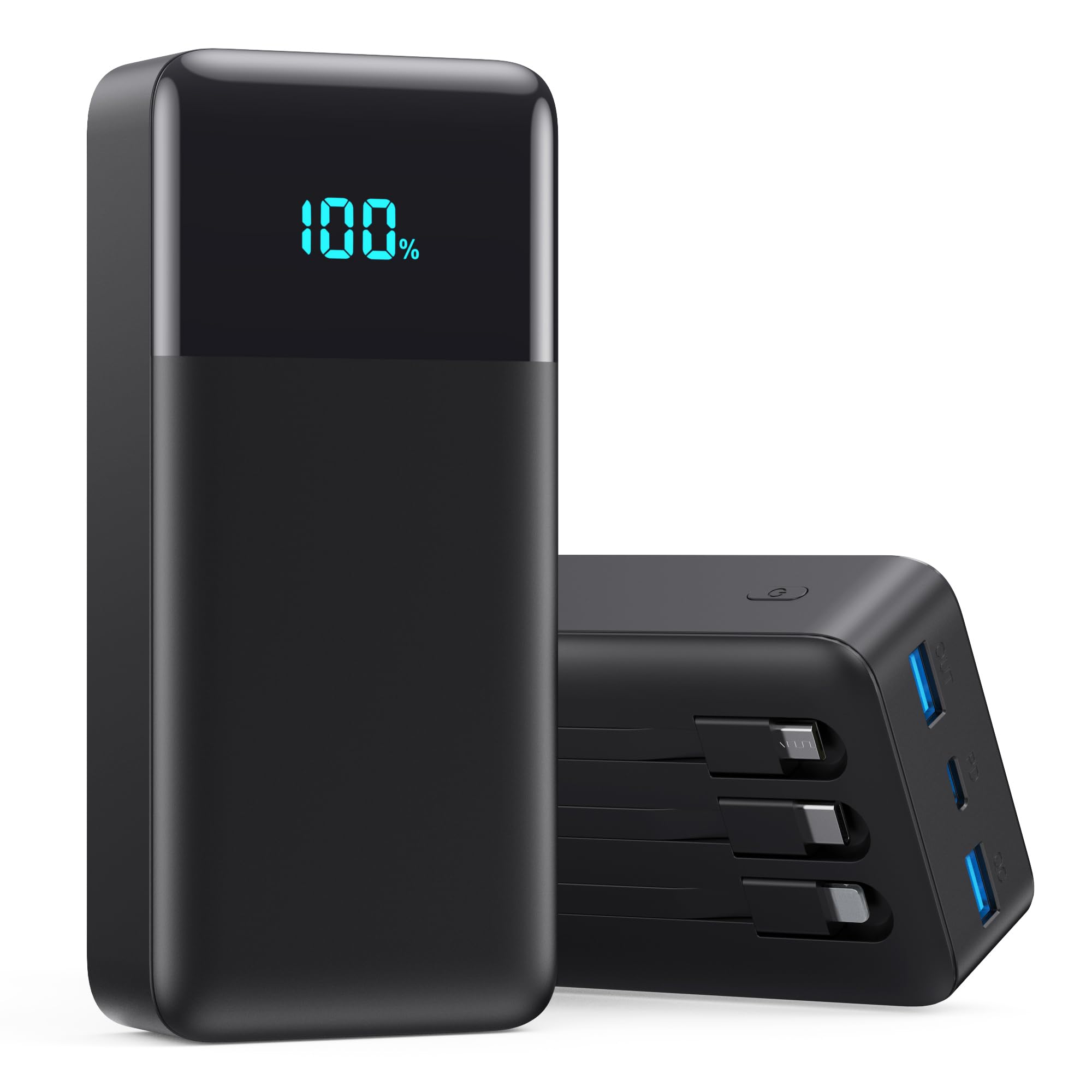
The AONIMI 50800mAh is a beast — 6.02 inches long, 1.42 pounds, and packing enough lithium-ion cells to charge an iPhone 14 ten times. Three built-in cables (USB-C, Lightning, Micro USB) plus three extra ports let you charge six devices simultaneously, making this the ultimate group-trip or family-travel battery bank. The 25W PD and QC 4.0 fast charging refuel an iPhone 16 from 20% to 70% in about 30 minutes.
The digital LCD display shows remaining percentage, and the low-temperature ice-core system monitors voltage and current to prevent overheating. The 2-year warranty adds peace of mind for a unit this large. Its 185Wh+ capacity, however, exceeds the 100Wh airline limit — several users report it being confiscated at international airport security. The manufacturer explicitly notes it is not suitable for air travel.
This is not a battery bank for flights. It’s a road trip, camping, or emergency preparedness power station. If you’re buying purely for air travel, skip this and go to the INIU or Anker 10K. For anyone driving cross-country or working remotely from an RV, 50800mAh of hot-swappable energy is transformational. It costs significantly less than two 20K banks with equivalent total capacity.
Why it’s great
- Massive 50800mAh capacity for extended off-grid use
- Three built-in cables cover Lightning, USB-C, and Micro
- Six outputs charge a full family’s devices simultaneously
- Fast 25W PD for quick phone top-ups
- Excellent value per mAh compared to premium brands
Good to know
- Exceeds 100Wh airline limit — not flight-compatible
- Heavy at 1.42 pounds, bulky for daypacks
- Slow self-recharge if wall supply is under 25W
5. Orfeika 20000mAh Power Bank with 4 Built-in Cables
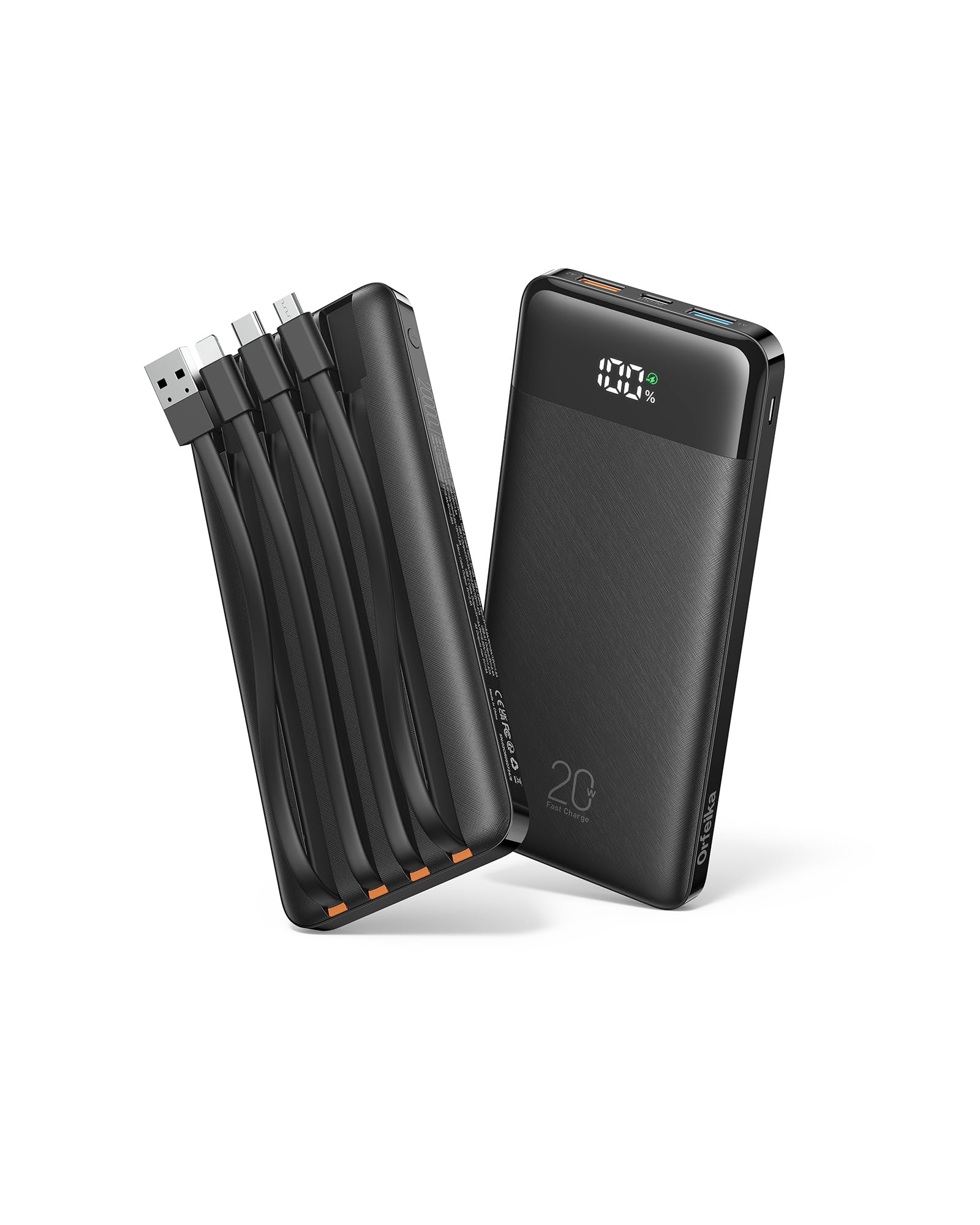
The Orfeika K26F delivers 20,000mAh (77Wh) with four built-in cables — USB-C, Lightning, USB-A, and Micro — plus three external ports for a total of six outputs. That means you can charge an iPhone, an Android phone, AirPods, a tablet, a smartwatch, and a Bluetooth speaker simultaneously without carrying a single extra cord. At 6.33 x 2.85 x 0.74 inches and 0.73 pounds, it’s slightly larger than a smartphone but thin enough to slide into a tech organizer or backpack pocket.
The 20W PD fast charging is modest compared to the 45W and 65W units, but for phones, tablets, and earbuds, 20W is sufficient — it pushes an iPhone 16 to 50% in 45 minutes. The UL 2056 and UN38.3 safety certifications mean it passes the same drop, fire-retardant, and overcurrent tests as premium-tier banks. Users report the unit retains charge for six months when unused, a strong indicator of quality Li-Po cells.
The biggest drawback is the 20W output ceiling. If you need to charge a MacBook Pro or a high-wattage Android phone at full speed, you’ll be limited to slower charging rates. The built-in cables are also short (about 6-7 inches), which is fine for stacking devices but forces you to keep the bank close to your phone. For a family shared charger or a vacation backup that covers every cable type, this is tough to beat at its price tier.
Why it’s great
- Four built-in cables cover Lightning, USB-C, USB-A, Micro
- Six total outputs charge a group’s devices at once
- UL 2056 and UN38.3 certified for flight and safety
- Retains charge for up to 6 months in storage
- Comes with travel pouch and 24-month support
Good to know
- 20W PD is slower than 45W/65W alternatives
- Short built-in cables limit device placement
- 0.73 lb is weighty for a slim profile
6. NOBIS 65W 20000mAh Power Bank
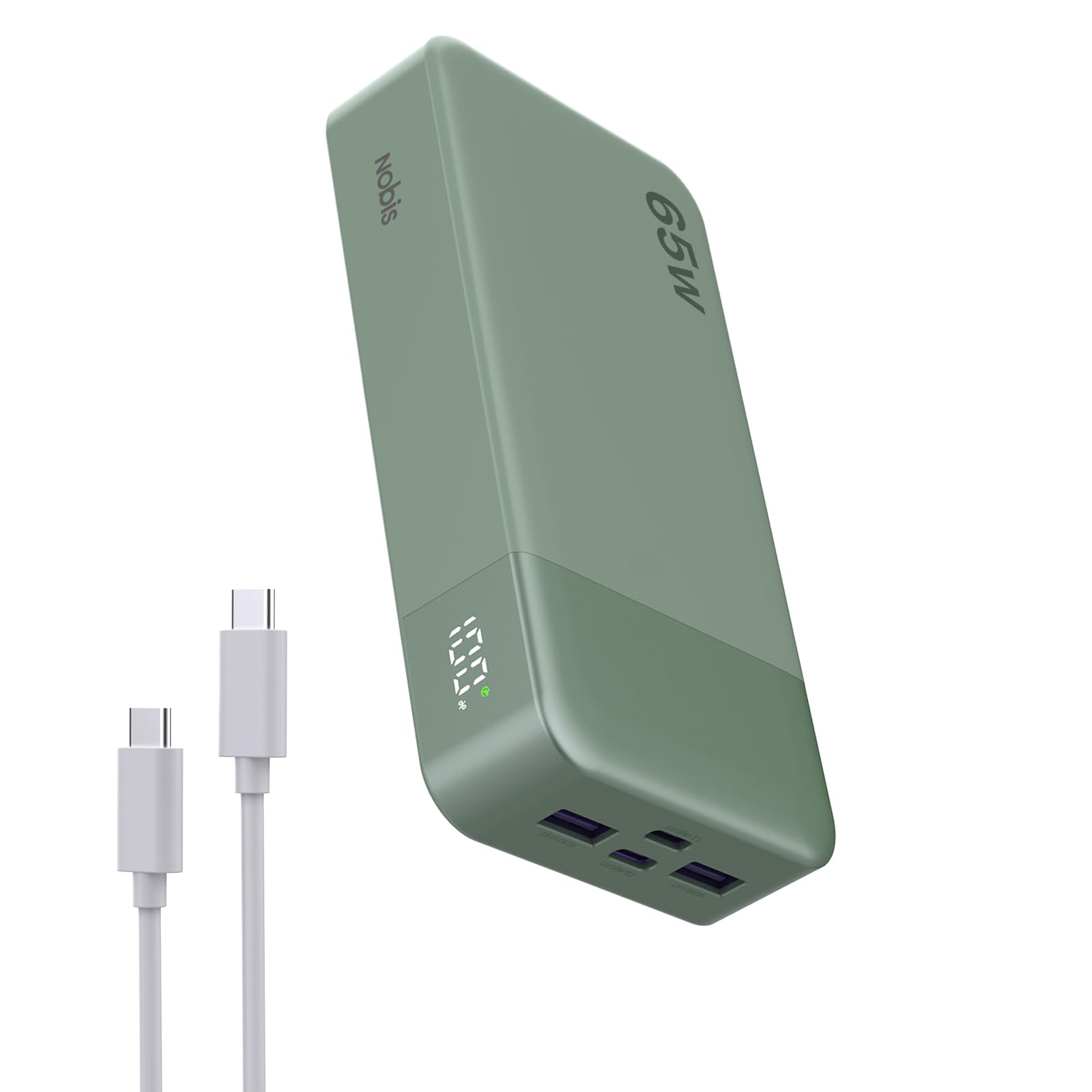
The NOBIS 65W packs 20,000mAh into a compact 5.39 x 2.76 x 1.04 inch frame that weighs 0.63 pounds — lighter than many 20K competitors. The headline feature is bidirectional 65W PD: it charges a laptop to 45% in 30 minutes and recharges itself to full in 1.5 hours when plugged into a 45W wall charger. Two USB-C ports (one with 65W output, one with 45W output) and two USB-A ports let you power a laptop, phone, tablet, and earbuds simultaneously.
The digital display shows remaining battery level clearly, and the low-current mode delivers stable charging for earbuds, smartwatches, and other small-device electronics without damaging the cells. The multi-layer protection system covers overcharge, over-discharge, over-voltage, over-current, short-circuit, and temperature control — essentially the full safety stack you’d expect from a unit that can push 65W through a single port.
User feedback is overwhelmingly positive, with reports of the NOBIS charging a MacBook Pro quickly and an iPhone 17 from zero to full without significant battery drain on the bank itself. The green color option is a refreshing departure from the black-brick standard. The lack of built-in cables means you still need to carry your own USB-C to USB-C cable for laptop charging, but for those already carrying a laptop charger, that’s a minor complaint.
Why it’s great
- 65W PD charges a MacBook to 45% in 30 minutes
- Bidirectional fast charging — self-recharges in 1.5 hours
- Four ports (2 USB-C, 2 USB-A) run a laptop + phone + tablet
- Lightweight at 0.63 pounds for a 20K unit
- Low-current mode for earbuds and watches
Good to know
- No built-in cables — bring your own USB-C cord
- Full 65W requires a 5A-rated USB-C cable
- Not as slim as built-in-cable competitors
7. Anker Prime Power Bank 20,100mAh 220W
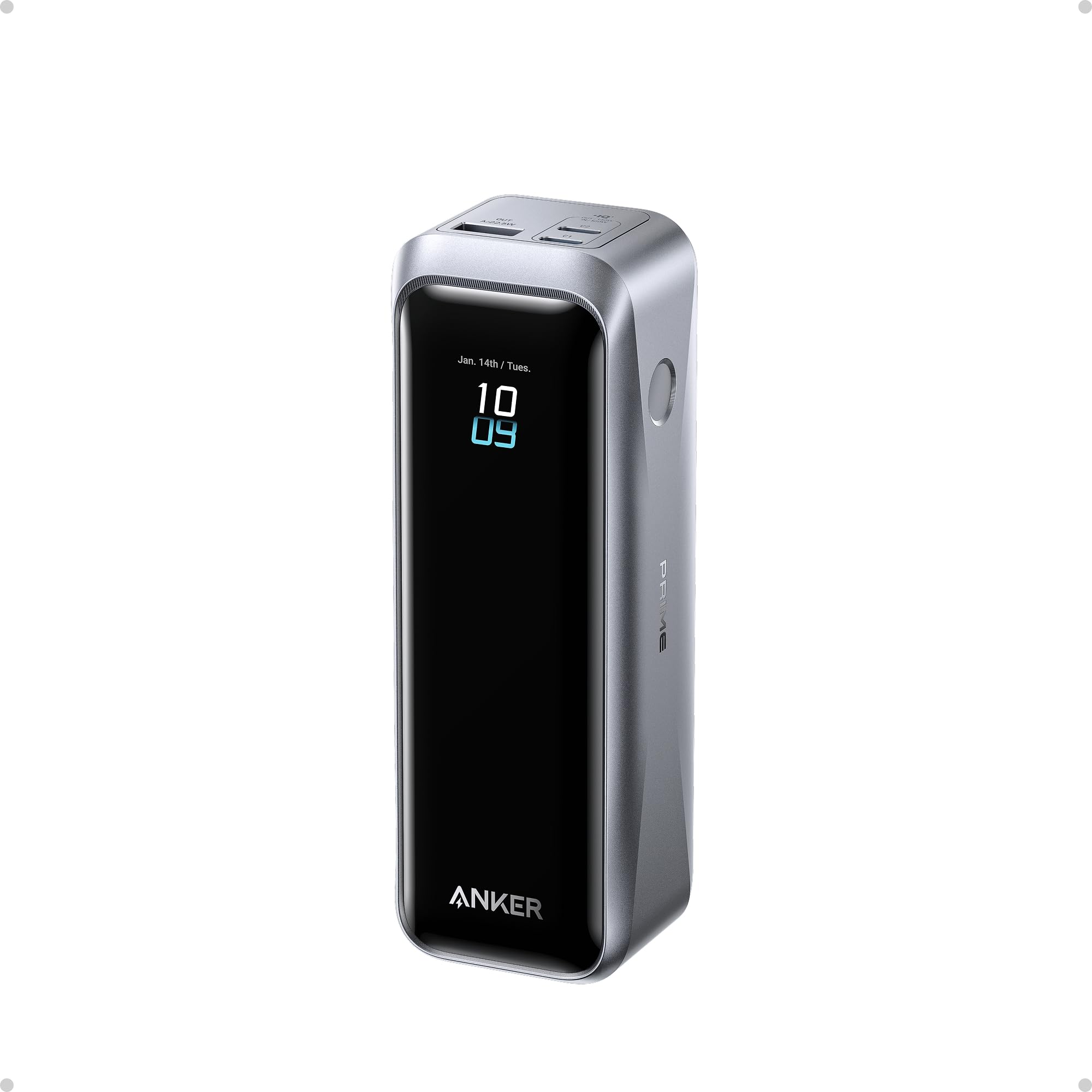
The Anker Prime 220W is the powerhouse finale. At 20,100mAh (72.36Wh) and 510 grams, it’s the densest, most capable travel battery bank on this list — though it carries a premium price tag. The 220W total output is distributed across two USB-C ports (one at 140W, one at 100W) and one USB-A port (at 65W). A 16-inch MacBook Pro hits 50% in 28 minutes through the USB-C 140W port, and you can simultaneously fast-charge an iPhone 17 Pro Max and an iPad Pro at full speed without throttling.
The standout feature is the Bluetooth app control. The Anker app displays real-time telemetry: charge rates per port, remaining time to full, and historical charging logs. An integrated digital screen on the bank itself shows the same data without needing your phone. The 100W max input recharges the bank to 50% in 25 minutes, so even if you drain it on a red-eye flight, a short layover charge tops it up. The unit is TSA-approved and fits inside a slim laptop bag pocket.
The premium price is the only real barrier. For most travelers, the NOBIS or INIU covers 90% of the same use cases at a fraction of the cost. But if you carry a high-wattage laptop (16-inch MacBook Pro, Dell XPS 15, Lenovo ThinkPad P-series) and need to charge it alongside a phone and tablet at full speed, the Anker Prime 220W is the only bank that does it without compromise. The magnetic charging base sold separately is a nice desk-dock add-on but not essential for travel.
Why it’s great
- 220W total output — highest power density in the category
- 140W port charges a 16-inch MacBook Pro in 28 minutes
- Bluetooth app for real-time power telemetry
- 100W self-recharge reaches 50% in 25 minutes
- TSA-approved 72.36Wh capacity
Good to know
- Premium price well above mid-range competitors
- 510g weight is the heaviest 20K bank on the list
- Magnetic charging base sold separately
- App control is a nice-to-have, not essential
FAQ
Can I bring a 20,000mAh power bank on a plane?
Is 45W PD fast enough to charge a laptop while traveling?
What’s the practical difference between built-in and detachable cables for travel?
How do I know if a power bank supports Samsung Super Fast Charging 2.0?
Final Thoughts: The Verdict
For most travelers, the best battery bank for travel winner is the INIU 20,000mAh because it hits the exact capacity, weight, and charging speed sweet spot for flights and daily carry while the detachable lanyard cable eliminates cord anxiety. If you want a pocket-sized unit that charges a laptop too, grab the Baseus PicoGo AC22 for its 45W PD in a 6-ounce frame. And for the road warrior who needs 65W laptop charging without the bulk, nothing beats the NOBIS 65W 20K at its price tier.

Mo Maruf
I created WellFizz to bridge the gap between vague wellness advice and actionable solutions. My mission is simple: to decode the research and give you practical tools you can actually use.
Beyond the data, I am a passionate traveler. I believe that stepping away from the screen to explore new environments is essential for mental clarity and physical vitality.