Our readers keep the lights on and my smoothie glass nicely filled. As an Amazon Associate, I earn from qualifying purchases.
There is a unique frustration that comes with a blister on the arch of your foot, a cut on the ball, or a raw spot on the heel pad. Standard adhesive bandages are engineered for the relatively flat, hairless skin of a knuckle or forearm — they have zero chance against the shear forces, moisture, and weight-bearing pressure of a walking sole. They curl, peel, and fail within minutes, leaving you exposed to friction and infection.
I’m Mohammad Maruf — the founder and writer behind WellFizz. I have spent over a decade analyzing consumer health hardware, focusing on adhesive technologies, hydrocolloid absorption rates, and the specific material science that separates a wound care product that actually works from one that belongs in a junk drawer.
This guide cuts through the marketing around blister pads and gel bandages to focus on the products that survive the high-friction, high-moisture environment of the human foot. Whether you are a distance runner, a construction worker, or someone breaking in a stiff pair of leather boots, these are the tested options that define the category of a reliable bandage for bottom of foot.
How To Choose The Best Bandage For Bottom Of Foot
The bottom of the foot is a mechanically brutal environment for any adhesive. The skin is thick, calloused, and constantly flexing. It is also enclosed in a dark, warm, moist shoe — the perfect conditions for conventional adhesive failure. You need a bandage that is designed for this specific biomechanical reality, not a general-purpose strip.
Adhesion Under Shear Load
The most common failure mode for foot bandages is edge curling caused by the sliding friction of the foot against the sock and shoe. Look for bandages that use a strong medical-grade acrylic adhesive backing, often described as “waterproof” or “sweatproof.” A good hydrocolloid bandage will form a tight seal at the edges and resist peel forces for multiple days. If reviews mention that the bandage stays on after a shower or a sweaty hike, that is the real test.
Cushion Thickness and Absorption Capacity
A thin fabric bandage provides zero shock absorption for the plantar surface. You need a minimum of 2-3 millimeters of hydrocolloid gel cushioning to disperse the pressure from walking. For blisters, the gel material also absorbs exudate (fluid) and turns white, which indicates it is working and requires replacement. Thicker pads like the Kimihome 30-count are better for high-impact activities like running or standing all day.
Shape and Size Variety
One size does not fit the foot. The arch, ball, heel, and toe all have different curvatures. A good product provides multiple shapes — ellipse, strip, and specialized heel or toe shapes. A variety pack with 4-5 different sizes allows you to match the bandage precisely to the wound location. A strip cut to length will always outperform a generic rectangle on a curved surface like the toe pad.
Quick Comparison
On smaller screens, swipe sideways to see the full table.
| Model | Category | Best For | Key Spec | Amazon |
|---|---|---|---|---|
| Medtecs Hydrocolloid Gel | Mid-range | Everyday wound care with multi-day wear | 2x faster absorption, 30 count | Amazon |
| Promifun Hydrocolloid Variety | Premium | High-intensity activity & heavy sweating | 32 count, 25% more cushioning | Amazon |
| Kimihome Heel Pack | Premium | Heel blisters & long travel days | 30 count, targeted heel shape | Amazon |
| Spenco 2nd Skin Blister Kit | Mid-range | Cooling relief & active blisters | Moist pad + adhesive knit tape | Amazon |
| Welnove Blister Bandages | Mid-range | Blisters from orthotics & sports | 21 count, 25% more cushioning | Amazon |
In‑Depth Reviews
1. Medtecs Hydrocolloid Gel Bandage
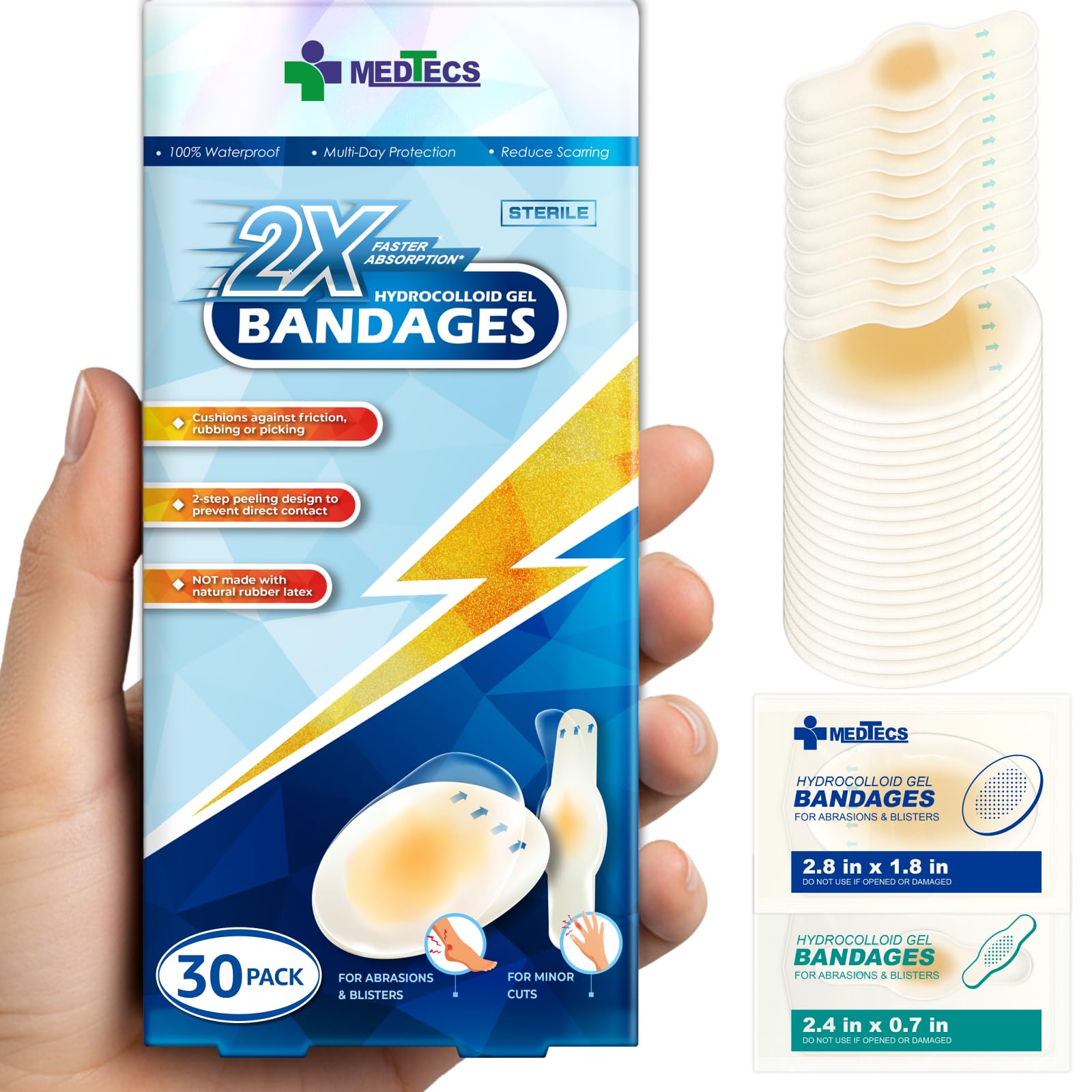
Medtecs combines a next-generation hydrocolloid gel formulation with a truly robust waterproof adhesive seal that outperforms standard retail bandages by a wide margin. The engineering claim of twice the absorption power is backed by real-world reviews showing the bandage turning white as it pulls fluid from the wound, which is the hallmark sign of effective hydrocolloid action on a plantar blister or cut. At 30 pieces per box (20 ellipse and 10 strips), you get enough coverage for a month of daily use.
The adhesive frame creates a tight seal against water and sweat, which is critical for the bottom of the foot where moisture from walking and enclosed shoes is constant. Users report that this bandage stays in place for multiple days, even through showers, which is a stronger performance than many blister-specific competitors. The ellipse shape is particularly well-suited for the arch and ball of the foot.
One common note is that some users experienced edge curling after several days, particularly if the bandage was applied to a heavily calloused area without pressing the edges firmly. Taping the perimeter can extend wear further, but for most daily wound care needs, the stick-to-skin bond is excellent. Medtecs is a proven global PPE manufacturer, adding a layer of quality assurance to the product.
Why it’s great
- Strongest adhesive bond of the mid-range options; survives showers and sweaty feet.
- Hydrocolloid gel absorbs fluid twice as fast, accelerating wound healing.
- Two useful sizes (ellipse + strip) cover most foot wound locations.
Good to know
- Edges can peel if not pressed firmly on calloused skin.
- Only 30 pieces per pack; heavy users may need to reorder frequently.
2. Promifun Hydrocolloid Gel Blister Bandages

Promifun’s blister bandage set takes the premium spot with the highest cushioning density in the group and a very high adhesive strength that users consistently describe as “staying put until you want it to come off.” The 32-count variety pack provides four distinct shapes (heel, toe, and two generic ovals), which is the most comprehensive shape library in this comparison. The additional 25% cushioning over standard bandages is noticeable when walking on hard pavement for hours.
The hydrocolloid technology in this pad is slick on the wound-facing side and creates a moist healing environment that the manufacturer claims speeds healing by 20%. While the exact percentage varies by wound, the principle is sound — a moist environment allows epithelial cells to migrate faster than a dry scab. Users report that these pads stay on for 5+ hours during high-friction hiking, and some users with known adhesive allergies reported no reaction, suggesting a hypoallergenic formulation.
The only consistent critique is that the adhesion, while excellent, can be almost too strong for sensitive non-calloused skin — removal should follow the manufacturer’s instructions to avoid irritation. The 32-piece count makes this a strong value for the price, especially for those who anticipate multiple blisters or cuts during a hiking trip or sports season. For high-sweat environments, this is the most reliable performer.
Why it’s great
- Highest cushion thickness in the lineup for impact absorption on the plantar surface.
- Extremely strong waterproof adhesive that lasts through sweat and friction.
- Large 32-count pack with four distinct shapes for every foot zone.
Good to know
- Adhesive can be difficult on non-calloused skin; follow removal instructions.
- Some users noted a 5-hour wear limit on high-friction hikes.
3. Kimihome Hydrocolloid Blister Bandages (Heel Pack)
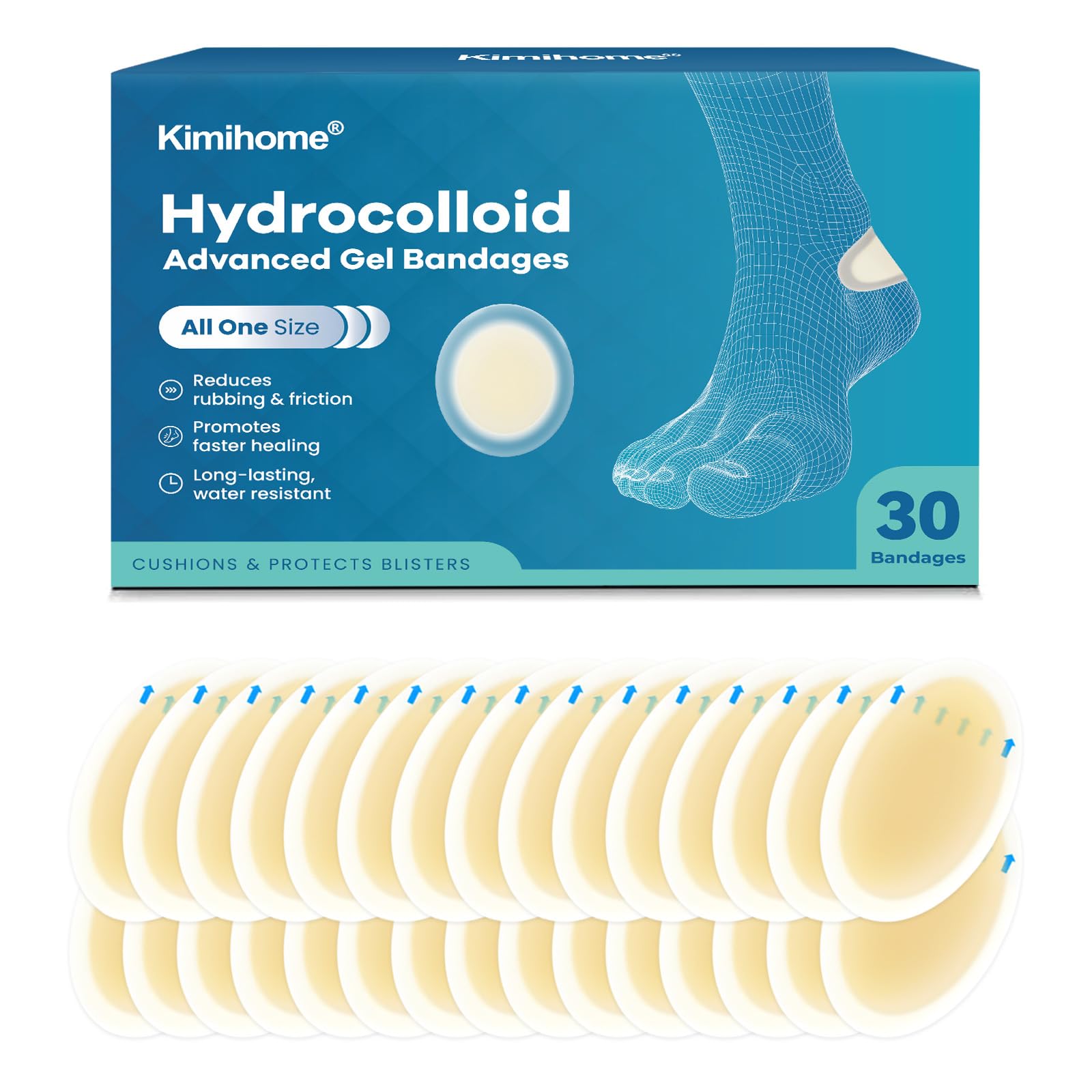
Kimihome designed this pack specifically around the heel, making it the best choice for the back of the foot where shoes rub most aggressively. The 30-count box is entirely composed of heel-shaped pads, which are pre-curved to wrap around the Achilles area and the plantar heel pad. This targeted geometry means there is less guesswork when applying — the bandage fits the anatomy of the rear foot better than a generic ellipse.
The cushioning is thicker than the Medtecs pad, providing a noticeable shock-absorbing layer that reduces pain when walking on a raw blister. The water-resistant seal holds up well to daily wear and showering, though a small number of users reported that the adhesive on this specific product did not stick as aggressively as Promifun’s. The manufacturer’s claim of 25% more cushioning than ordinary bandages is consistent with the in-hand feel.
These are individually wrapped, which makes them ideal for tossing into a carry-on bag or daypack. One review from a traveler noted that the pads held up well during multi-day European walking tours. The main downside is the limited shape variety — if you need coverage for the ball or toe, this pack is not the right fit. But for the specific plantar heel blister, the Kimihome is purpose-built and effective.
Why it’s great
- Pre-curved heel shape provides a superior fit for the rear foot and Achilles.
- Thick hydrocolloid cushion absorbs impact and reduces walking pain on blisters.
- Individually wrapped for portable, on-the-go use during travel.
Good to know
- Adhesive strength is slightly less aggressive than Promifun; may peel on sweaty soles.
- Only heel-shaped pads — not suitable for toes or the ball of the foot.
4. Spenco 2nd Skin Blister Kit

The Spenco 2nd Skin Blister Kit works on a completely different principle from the hydrocolloid bandages above. Instead of an adhesive hydrocolloid pad, it provides a hydrogel-soaked moist pad that you place directly on the blister, then secure with the included adhesive knit tape. This two-component system is designed for a specific scenario: an already-raised blister that needs immediate friction relief and cooling without the gel pad itself being the adhesive interface.
The moist gel provides a noticeable cooling sensation that instantly reduces the burning pain of a broken blister. Users report it is highly effective for long-distance hiking, theme park days, and horseback riding where constant friction against a saddle or shoe creates hotspots. The knit tape is breathable, flexible, and sticks well to dry skin. For raw blisters that have already popped, this system is better than any hydrocolloid because it maintains a moist environment without sticking to the wound bed.
The limitation is that the tape fails quickly if it gets wet from sweat or showering, and the gel pad is not designed for multi-day wear — it is a temporary relief patch that should be changed daily. Also, the kit does not include a large variety of sizes, so you may need scissors to cut the tape and pad to fit smaller toes. It remains a staple for any serious first aid kit due to its unique cooling mechanism.
Why it’s great
- Hydrogel provides instant cooling and pain relief for active, raw blisters.
- Frictionless design outperforms standard bandages during heavy walking.
- Does not stick to the wound bed, making removal painless for open blisters.
Good to know
- Tape loses adhesion when wet; not suitable for sweaty or shower conditions.
- Kit requires assembly; not a single-step bandage application.
5. Welnove Blister Bandages Variety Pack

Welnove’s blister bandage set is the most budget-friendly option in this list without sacrificing the core hydrocolloid technology. The claim of 25% more cushioning than comparable products matches the Kimihome and Promifun figures, but the overall adhesive performance is slightly less robust. That said, the 21-count variety pack with four distinct shapes provides excellent coverage for the entire foot — including the often-neglected toe pads and the side of the foot.
Real-world use by dancers, orthotic wearers, and athletes shows that the Welnove bandages stick well enough to survive a full basketball practice or dance rehearsal. The adhesive is described as “comfortable and sticky,” with residue-free removal being a key benefit. One parent of a dancer reported that these were the only bandages that stayed on the bottom of her daughter’s feet throughout practice. The material is latex-free, which is important for users with latex sensitivities.
The primary trade-off is that the edge adhesion can start peeling within a few hours for some users, especially if the bandage is not held down for 30-60 seconds after application. For the price, this pack offers the best shape variety per dollar spent, and many users find that the four sizes fit every common blister location. It is the ideal entry-level choice for someone who wants to try hydrocolloid foot bandages without committing to a premium brand.
Why it’s great
- Excellent shape variety (4 shapes) for the price; covers all foot zones.
- Residue-free removal makes it gentle for sensitive skin.
- Latex-free construction for users with common allergies.
Good to know
- Edge adhesion can peel earlier than premium competitors; needs firm initial press.
- Only 21 pieces per pack; larger volume users will run out quickly.
FAQ
Why do regular bandages fail on the bottom of my foot?
How long should a hydrocolloid bandage stay on the foot?
Can I use a foot bandage on an open blister or cut?
What is the best way to apply a bandage to the bottom of the foot?
Final Thoughts: The Verdict
For most users, the winner for the bandage for bottom of foot is the Medtecs Hydrocolloid Gel Bandage because it delivers the best overall balance of adhesive strength, absorption speed, and shape variety at an accessible price point. If you need maximum cushion thickness and the strongest possible adhesive for heavy sweating and high-intensity activity, grab the Promifun Hydrocolloid Variety Pack. And for a targeted solution that focuses exclusively on the heel and rear foot, nothing beats the Kimihome Heel Pack.

Mo Maruf
I created WellFizz to bridge the gap between vague wellness advice and actionable solutions. My mission is simple: to decode the research and give you practical tools you can actually use.
Beyond the data, I am a passionate traveler. I believe that stepping away from the screen to explore new environments is essential for mental clarity and physical vitality.