Our readers keep the lights on and my smoothie glass nicely filled. As an Amazon Associate, I earn from qualifying purchases.
A stubborn patch of crabgrass or a sudden flush of Poa annua can turn a manicured Bermuda lawn into an eyesore within weeks. The difference between a pristine turf and a weedy mess often comes down to one thing: timing the application of a pre-emergent herbicide correctly.
I’m Mohammad Maruf — the founder and writer behind WellFizz. I’ve spent years analyzing chemical formulations, reading turf science research, and comparing label rates for the specific active ingredients that keep Bermuda grass competitive against invasive weeds.
Whether you are establishing a new lawn or maintaining an established hybrid, choosing the best bermuda pre emergent means understanding how prodiamine, dithiopyr, and mesotrione differ in their soil activity and application windows.
How To Choose The Best Bermuda Pre Emergent
Bermuda grass goes dormant when soil temperatures drop below 55°F, which is exactly when winter annual weeds germinate. Applying a pre-emergent at the right temperature window — typically when soil temps hit 55°F in spring and again in early fall — creates a chemical barrier that stops weed seeds from rooting. The wrong active ingredient or an incorrect application rate can waste your effort or damage the turf.
Match the active ingredient to your weed pressure
Prodiamine (Barricade) is the workhorse for season-long control of crabgrass, goosegrass, and Poa annua. It provides 8–12 weeks of protection from a single spring application. Dithiopyr (Dimension) offers the same pre-emergent barrier plus early post-emergent activity on crabgrass that germinated just before your spray date — a safety net for imprecise timing. Mesotrione works differently: it can be used on dormant Bermuda to control existing broadleaf weeds while providing a short pre-emergent window for crabgrass.
Granular vs. liquid: choose your application method
Granular products like The Andersons Barricade combine pre-emergent with fertilizer, making them simple to spread with a drop or rotary spreader. The downside: you cannot control the precise distribution of active ingredient across slopes or thin areas, and you must water them in immediately. Liquid formulations (concentrates you mix with water) let you spot-treat or adjust rates for specific weed species, but they require sprayer calibration and careful tank mixing to avoid overlapping or missing strips.
Check the turf tolerance label
Not all pre-emergents play nicely with Bermuda. Prodiamine and dithiopyr are safe on established Bermuda at labeled rates. Mesotrione, however, will severely damage or kill actively growing Bermuda — it is only safe on dormant turf or when used as a post-emergent spot treatment on cool-season grasses. Always read the fine print: some products are labeled for warm-season turf but forbid use on hybrid Bermuda varieties like Tifway or TifGrand.
Quick Comparison
On smaller screens, swipe sideways to see the full table.
| Model | Category | Best For | Key Spec | Amazon |
|---|---|---|---|---|
| The Andersons Barricade 50 lb | Granular | Season-long crabgrass prevention on large lawns | 0.48% Prodiamine, covers 14,200 sq ft | Amazon |
| Dimension 2EW Herbicide | Liquid | Early post-emergent crabgrass control | Dithiopyr 2EW, 64 fl oz | Amazon |
| Prodiamine 65 WDG 5lb | Dry Flowable | Budget-friendly concentrated prodiamine | 65% Prodiamine, 80 oz | Amazon |
| Quali-Pro Negate 37WG | Water Dispersible Granule | Post-emergent Poa annua control on warm-season turf | Rimsulfuron 16.67%, Metsulfuron 20% | Amazon |
| The Andersons 18-0-4 Barricade 18 lb | Granular + Fertilizer | Early spring feed + weed prevention | 0.426% Prodiamine, 5,000 sq ft | Amazon |
| Liquid Harvest Mesotrione 8oz | Liquid Concentrate | Dormant Bermuda weed cleanup + pre-emergent | Mesotrione 8 fl oz | Amazon |
| Target 6 Plus (MSMA 48.2%) | Liquid | Post-emergent dallisgrass and nutsedge control | MSMA 48.3%, 2.5 gal | Amazon |
In‑Depth Reviews
1. The Andersons Barricade 50 lb Bag
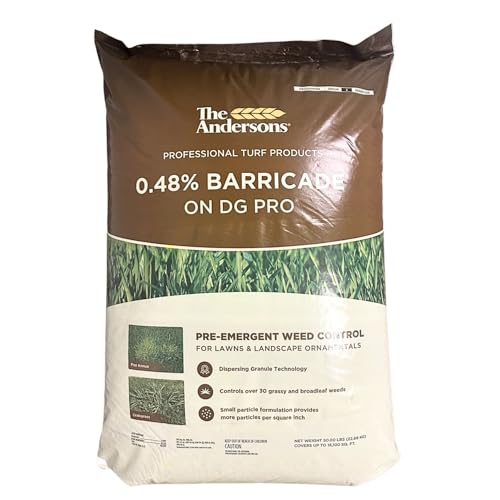
This is the professional-grade granular product that lawn care operators reach for when they need season-long crabgrass, goosegrass, and Poa annua suppression on large Bermuda lawns. The 0.48% prodiamine concentration is optimized for split applications — early spring at soil temp 55°F, then a lighter follow-up in early fall to prevent winter annuals. One 50-pound bag covers 14,200 square feet, making it the most economical choice for properties over a quarter acre.
The DG Pro (dispersible granule) technology is what sets this apart from generic granular pre-emergents. Each pellet dissolves quickly on contact with water, moving the active ingredient into the soil profile rather than sitting on the thatch layer where it degrades under UV light. Users report visible weed suppression lasting 8–10 weeks per application, though heavy clover pressure may require a complementary post-emergent spray midsummer.
Apply with a rotary spreader at the labeled setting — do not use a drop spreader for this large a volume, as overlapping strips create uneven chemical deposition. Water-in within 24 hours with at least 0.5 inch of irrigation or rainfall. Do not apply to wet turf or aerate immediately after, as this can break the chemical barrier.
Why it’s great
- Excellent value per square foot for large lawns
- DG Pro granules dissolve fast for immediate soil incorporation
- Trusted by turf professionals for commercial sports fields
Good to know
- 50 lb bag is heavy and requires careful spreader calibration
- Not effective against existing emerged weeds
2. Dimension 2EW Herbicide 64 oz

Dimension 2EW (dithiopyr) is the only pre-emergent that offers a legitimate safety net for those who miss the ideal spring application window. If you apply it after crabgrass has begun germinating but before it reaches the 2-leaf stage, the chemical will still kill those tiny seedlings post-emergence. This dual-mode activity makes it the best choice for homeowners who need flexibility in their spring schedule or who live in regions with unpredictable soil warm-up patterns.
The 64-ounce bottle is a liquid concentrate designed for tank mixing with a backpack or tow-behind sprayer. Use a rate of 1.1 to 2.2 fluid ounces per 1,000 square feet depending on weed pressure and desired residual length. It is registered in all 50 states and labeled for use on both warm-season Bermuda and cool-season turf, which simplifies inventory if you manage multiple lawn types. Users note that it works well with spray dye to track coverage and prevent overlapping.
One common frustration: the product ships in a Corteva white jug rather than the Dow bottle shown in the product photos, which can cause confusion at delivery. The performance is identical regardless of packaging. Mix only what you will use in 24 hours; the emulsion can separate if stored after mixing.
Why it’s great
- Dual pre- and early post-emergent activity on crabgrass
- Safe on established Bermuda and over 440 ornamental species
- Excellent for spot-treatment missed patches in mid-spring
Good to know
- Liquid requires sprayer and careful calibration
- Not for use on newly seeded Bermuda
3. Prodiamine 65 WDG 5lb (Generic Barricade)
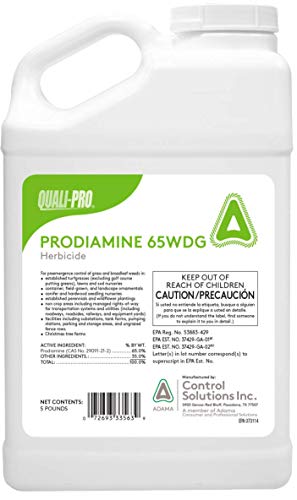
This is the generic equivalent of Barricade at a significantly lower cost per application. The 65% prodiamine concentration means a 5-pound bag makes roughly 30 to 60 gallons of spray solution depending on your target rate (0.185 to 0.55 ounces per 1,000 square feet). For a 5,000-square-foot Bermuda lawn, a single bag will last multiple seasons, making it the clear choice for owners who want professional-grade active ingredient without paying for a brand name.
The water-dispersible granule (WDG) formulation mixes easily in a pump sprayer as long as you agitate the tank continuously. Prodiamine binds tightly to soil organic matter, which means it stays in the top inch of the soil profile where weed seeds germinate. Users report excellent results against crabgrass, dandelions, and bindweed when applied at the first spring soil temperature signal. One note: you must water the lawn thoroughly before application to trigger weed seed germination, then apply the spray and water it in again within 24 hours.
The big warning: prodiamine is extremely potent, and overdosing can stunt Bermuda root development. Always measure carefully using a scale or measuring spoon designed for dry flowable herbicides. Do not exceed the maximum annual rate of 2.3 pounds per acre to avoid turf injury.
Why it’s great
- Extremely low cost per application for the active ingredient
- 5 lb bag covers many seasons for a typical lawn
- Effective against crabgrass, goosegrass, and Poa annua
Good to know
- Requires accurate scale for measuring small doses
- Must be watered in before and after application
4. Quali-Pro Negate 37WG Herbicide
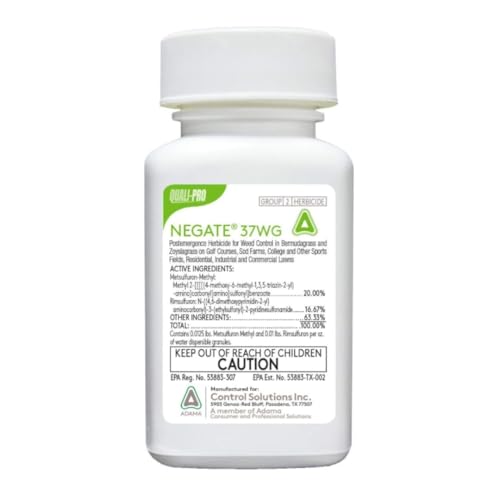
Negate 37WG is not a true pre-emergent — it is a dual sulfonylurea (rimsulfuron + metsulfuron) post-emergent herbicide that targets Poa annua, Poa trivialis, ryegrass, and broadleaf weeds already growing in established Bermuda. It earns a place in this guide because many Bermuda owners use it as a clean-up treatment before applying a traditional pre-emergent, effectively creating a two-step program: kill existing Poa in late winter, then prevent re-germination with prodiamine or dithiopyr.
The entire 1.5-ounce bottle must be mixed with 1 gallon of water for a single treatment, which covers about 1,800 to 2,000 square feet. Users report seeing weed decline within 5 to 7 days, with full death in 2 weeks. The product does cause temporary stunting or whitening of Bermuda grass — this is normal and resolves within 2 to 3 weeks if you follow up with a balanced fertilizer and iron application. Do not spray on stressed or drought-damaged turf.
Because the mixed solution loses potency after 30 days, this is best for targeted spot treatment rather than blanket application. One bottle is enough for one full treatment of a small lawn; larger properties will need multiple bottles. The price per bottle is relatively high for the coverage, but the efficacy against Poa annua is unmatched among post-emergent options labeled for warm-season grass.
Why it’s great
- Highly effective on Poa annua and Poa trivialis
- Works fast with visible results in 5–7 days
- Low-odor formulation suitable for residential use
Good to know
- Expensive per treatment for larger lawns
- Mixed solution degrades within 30 days
- Temporarily stunts Bermuda — needs follow-up fertilizer
5. The Andersons 18-0-4 Barricade Fertilizer 18 lb
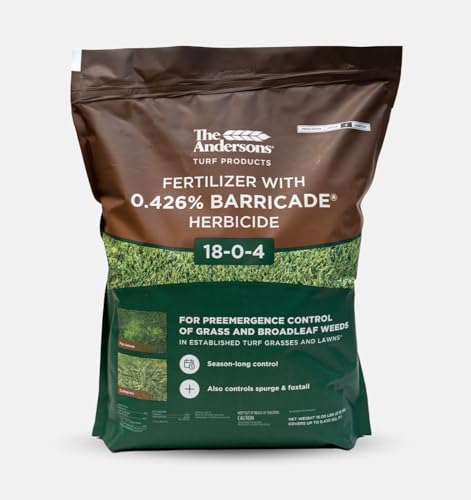
This granular combination simplifies the spring routine by delivering both a slow-release nitrogen fertlizer (18-0-4) and the prodiamine pre-emergent in one pass. The 18-pound bag covers 5,000 square feet, making it an ideal size for the typical suburban Bermuda lawn. The 18-0-4 analysis provides the nitrogen boost that Bermuda needs coming out of winter dormancy to encourage early green-up without excessive vertical growth.
The DG Technology granules break down rapidly when watered in, moving nutrients and prodiamine into the root zone simultaneously. Users consistently report excellent crabgrass suppression when applied at the correct timing (early spring before soil temperatures hit 55°F). The fertilizer component also helps mask the white granular appearance of straight prodiamine, reducing the risk of visible residue on the turf after application.
One limitation: the prodiamine concentration (0.426%) is calibrated for a single spring application at the labeled rate. If your weed pressure is high or you want season-long control, you will need a second application in late summer or a separate liquid prodiamine spray. Do not use a drop spreader for this product; a rotary spreader gives better coverage at the 10–12 lb per 1,000 sq ft rate.
Why it’s great
- Combines fertilizer and pre-emergent in one application
- DG granules dissolve quickly for fast soil incorporation
- Ideal 5,000 sq ft coverage for urban lawns
Good to know
- Single application may not provide full season control
- Overpriced relative to separate fertilizer + generic prodiamine
6. Liquid Harvest Mesotrione 8oz Concentrate

Mesotrione is the same active ingredient as Tenacity, but Liquid Harvest offers it at a significantly lower price. This product occupies a unique niche in Bermuda management: it is a pre-emergent that also works post-emergence on existing broadleaf weeds, but it can severely damage or kill actively growing Bermuda grass. Its safe application window is strictly before Bermuda breaks dormancy in early spring, or after it goes dormant in late fall, when it targets winter annuals like henbit and chickweed.
At the labeled rate of 1 teaspoon per 2 gallons of water, the 8-ounce bottle makes 96 gallons of spray solution — enough for multiple seasons on a standard lawn. Users report excellent results against crabgrass when applied as a pre-emergent to dormant Bermuda, with visible whitening of treated weeds within 7–10 days. The chemical inhibits photosynthesis in susceptible plants, so you will see the weed foliage turn white before it dies. Do not use on actively growing Bermuda; wait until the grass is fully dormant (no green color remaining).
One practical note: the product requires activation with 0.15 inches of water within 10 days if no rainfall occurs. Because it is highly concentrated, never use a hose-end sprayer — stick to a calibrated backpack or pump sprayer with a spray dye indicator to prevent overlap. The 8-ounce bottle is an entry-level size; if you have a large property, the economics improve with the larger commercial container.
Why it’s great
- Effective pre- and post-emergent on weeds in dormant Bermuda
- Highly concentrated — 8 oz makes 96 gallons
- Good alternative to Tenacity at a lower price point
Good to know
- Can kill actively growing Bermuda — apply only to dormant turf
- Requires rain or irrigation within 10 days for activation
- Not for use with hose-end sprayers
7. Target 6 Plus (MSMA 48.2%) 2.5 Gallon

MSMA (monosodium methanearsonate) is the heavy artillery for post-emergent control of grassy weeds that pre-emergents cannot touch — specifically dallisgrass, johnsongrass, and nutsedge in established warm-season turf. The 2.5-gallon jug is a professional volume intended for golf courses, sod farms, and large-acreage residential properties. At 2 ounces per gallon of water, one jug makes roughly 150 gallons of spray solution, covering extensive areas.
Users report that MSMA is remarkably fast-acting on dallisgrass and nutsedge, with visible damage within 48 hours and full kill in 7–10 days. However, it is very strong: mixing errors or overdosing can cause severe browning or dormancy in Bermuda, especially if applied during hot, dry conditions. The standard safe rate is 1.25 to 2 ounces per gallon of water, never exceeding 2 ounces per gallon. Always use a measuring cap or graduated cylinder — eyeballing it will damage your turf.
MSMA has been re-regulated by the EPA in recent years, so availability may vary by state. Some states restrict its use to commercial applicators only. Check your local regulations before purchasing this volume. On the positive side, a single 2.5-gallon jug has a multi-year shelf life if stored properly, making it a one-time investment for severe weed problems that return annually.
Why it’s great
- Unmatched post-emergent control of dallisgrass and nutsedge
- Extremely concentrated — 2.5 gal makes ~150 gallons of spray
- Long shelf life for infrequent heavy use
Good to know
- Can severely damage Bermuda if mixed incorrectly
- EPA restrictions may limit availability in some states
- Overdose forces Bermuda into dormancy
FAQ
What soil temperature is right for applying a pre-emergent to Bermuda?
Can I apply a pre-emergent to newly seeded Bermuda sod or sprigs?
Will prodiamine or dithiopyr damage my St. Augustine or Zoysia if it overlaps from my Bermuda lawn?
How long after applying a granular pre-emergent can I mow the Bermuda?
Final Thoughts: The Verdict
For most homeowners who want a simple, season-long solution for a standard Bermuda lawn, the best bermuda pre emergent winner is the The Andersons Barricade 50 lb Bag because its DG Pro formulation and high prodiamine concentration deliver reliable crabgrass suppression for up to 12 weeks per application at an unbeatable cost per square foot. If you need flexibility in spring timing and want early post-emergent protection, grab the Dimension 2EW 64 oz. And for targeted control of dallisgrass or nutsedge that pre-emergents cannot touch, nothing beats the Target 6 Plus MSMA.

Mo Maruf
I created WellFizz to bridge the gap between vague wellness advice and actionable solutions. My mission is simple: to decode the research and give you practical tools you can actually use.
Beyond the data, I am a passionate traveler. I believe that stepping away from the screen to explore new environments is essential for mental clarity and physical vitality.