Our readers keep the lights on and my smoothie glass nicely filled. As an Amazon Associate, I earn from qualifying purchases.
A gaming TV is no longer just a display — it is the final arbiter of your reaction time, the gatekeeper between your input and the frame appearing on screen. Input lag measured in milliseconds, refresh rates that determine whether motion is fluid or a blur, and variable refresh rate support that eliminates screen tearing entirely: these are the specs that separate a TV built for gaming from one that merely shows games. The wrong 4K TV will add latency to your controller presses and fail to keep up with fast-paced titles, while the right one makes every movement feel instantaneous.
I’m Mohammad Maruf — the founder and writer behind WellFizz. I have spent years analyzing panel technologies, local dimming algorithms, and HDMI 2.1 bandwidth ceilings to identify which gaming TVs actually deliver on their spec sheets at every price tier.
After comparing more than a dozen models based on native refresh rate, HDMI 2.1 port count, VRR implementation, and real-world input lag, only eleven sets earned a spot on this list of the best 4k tv for gaming.
How To Choose The Best 4K TV For Gaming
Buying a TV purely for gaming shifts the priority list. You care less about how many free channels the smart platform has and more about how many milliseconds of input lag the set adds, whether it supports HDMI 2.1 at full bandwidth, and how well the local dimming algorithm handles small HUD elements without blooming. Every gaming TV below meets a minimum threshold for these specs — but the differences between them matter.
Native Refresh Rate vs. Advertised Refresh Rate
The single most important spec for gaming is the panel’s native refresh rate. Many TVs advertise “240Hz effective” or “Motion Rate 240,” but those figures are achieved through backlight scanning or frame interpolation — neither of which reduces input lag. Only a natively 120Hz or 144Hz panel can accept a 120fps signal from a console or PC and display every frame without added latency or motion blur. All sets in this guide with a gaming-focused tag use native 120Hz or higher panels.
HDMI 2.1 Port Count and Bandwidth
Running 4K at 120Hz with 10-bit HDR requires 48Gbps of HDMI bandwidth. Many mid-range TVs include only one full-bandwidth HDMI 2.1 port, forcing you to choose between a PlayStation 5, an Xbox Series X, and a PC. Premium and high-end models in this list include two or more HDMI 2.1 ports. Always check whether the ports are full-bandwidth (48Gbps) or restricted (some manufacturers use 32Gbps or 24Gbps implementations that limit color depth at 4K 120Hz).
Variable Refresh Rate and Auto Low Latency Mode
VRR synchronizes the display’s refresh rate to the game’s frame rate, eliminating screen tearing without the input lag penalty of V-Sync. FreeSync Premium Pro adds HDR support during VRR operation. Auto Low Latency Mode tells the TV to switch into game mode automatically when you launch a game, bypassing post-processing. All gaming TVs in this guide support at least one VRR standard and ALLM, but implementation quality varies — some sets exhibit flicker in VRR at low frame rates, which is noted in individual reviews.
Panel Technology: OLED vs. Mini-LED vs. QLED
OLED panels deliver infinite contrast and the fastest pixel response times — near-zero motion blur — making them the absolute best for dark-room gaming. Mini-LED QLED sets get brighter and cost less per inch, with local dimming zones that can approach OLED black levels in practice, though small bright objects on dark backgrounds may show halo. Standard QLED without mini-LED backlighting has wider color volume than OLED but worse black levels. Your choice depends on room lighting and whether you prioritize black-level depth or peak brightness for HDR highlights.
Quick Comparison
On smaller screens, swipe sideways to see the full table.
| Model | Category | Best For | Key Spec | Amazon |
|---|---|---|---|---|
| Sony BRAVIA 5 65” | Premium Mini-LED | PS5 HDR gaming & upscaling | XR Backlight Master Drive Mini LED | Amazon |
| Samsung Neo QLED QN70F 55” | Mid-Range Mini-LED | Bright room gaming & sports | NQ4 AI Gen2, Motion Xcelerator 144Hz | Amazon |
| LG QNED evo AI QNED85A 55” | Mid-Range Mini-LED | Streamers wanting 144Hz VRR | Alpha 8 AI Gen2, 144Hz VRR | Amazon |
| TCL QM7K 55” | Mid-Range Mini-LED | Value HDR with 2500 dimming zones | Up to LD2500 local dimming series | Amazon |
| Hisense U7 55” | Mid-Range Mini-LED | Competitive 165Hz PC gaming | Native 165Hz, VRR 330 range | Amazon |
| Roku Pro Series 55” | Mid-Range Mini-LED | Casual console gaming & streaming | 120Hz, FreeSync Premium Pro | Amazon |
| Amazon Ember 55” Mini-LED | Mid-Range Mini-LED | Fire TV ecosystem gamers | 144Hz, 512 dimming zones, 1400 nits | Amazon |
| Samsung QLED Q8F 55” | Entry QLED | Budget 4K 144Hz gaming | Q4 AI Processor, 144Hz VRR | Amazon |
| Sony OLED XR8B 65” | Premium OLED | Cinematic HDR & PS5 Pro | XR OLED Motion, pixel-level dimming | Amazon |
| LG OLED C1 77” | Premium OLED | Home theater & 120Hz console | A9 Gen4, infinite contrast ratio | Amazon |
| VIZIO P-Series 75” | Premium QLED | Large-screen 4K 120Hz gaming | 210 local dimming zones, 1200 nits | Amazon |
In‑Depth Reviews
1. Sony BRAVIA 5 65″ Mini LED (K-65XR50)

The Sony BRAVIA 5 combines a dense Mini-LED backlight array with the XR Backlight Master Drive, which individually controls thousands of zones to produce near-OLED black levels while maintaining over 1200 nits of sustained brightness for HDR highlights. For PlayStation 5 owners, the exclusive Auto HDR Tone Mapping and Auto Genre Picture Mode eliminate manual calibration: the TV detects the console and adjusts HDR brightness mapping and picture mode automatically. The XR Processor’s real-time AI upscaling means even 1080p games look crisp at 4K, with no visible ringing or oversharpening artifacts.
Game latency sits under 8ms at 4K 120Hz with VRR enabled, and the Game Menu puts all gaming picture controls — black equalizer, crosshair overlay, screen size adjustment — in a single quick-access panel. The set supports Dolby Vision, IMAX Enhanced, and DTS:X, making it equally suited for movie nights between gaming sessions. Only two of the four HDMI ports are full-bandwidth 2.1, which is sufficient for a PS5 and Xbox Series X but limits multi-PC setups.
Built-in Acoustic Surface Audio+ uses the screen itself as a speaker diaphragm, delivering surprisingly directional dialogue that follows on-screen action. The Google TV interface remains smooth and bloatware-free, with dedicated game-launching rows for PlayStation and Xbox titles. For a single-ecosystem setup where gaming and streaming share equal priority, the BRAVIA 5 delivers the most refined Mini-LED experience currently available.
Why it’s great
- XR Backlight Master Drive produces excellent Mini-LED contrast with minimal blooming
- Exclusive PS5 Auto HDR Tone Mapping and Auto Genre Picture Mode eliminate calibration
- Acoustic Surface Audio+ tracks sound to on-screen action without a soundbar
Good to know
- Only two of four HDMI ports support full 48Gbps HDMI 2.1 bandwidth
- Premium price tier; more affordable Mini-LED sets from TCL and Hisense offer similar gaming specs at lower cost
2. Samsung Neo QLED QN70F 55″ (2025)

Samsung’s Neo QLED QN70F pairs Quantum Matrix Technology with Mini-LED backlighting for precise zone control, achieving over 1500 nits of peak brightness that fights daytime glare better than any OLED in this list. The NQ4 AI Gen2 processor uses 20 neural networks to upscale 1080p and 1440p gaming content to near-4K clarity, and the Motion Xcelerator 144Hz supports native 144Hz input from PC GPUs — not a motion-interpolated trick. FreeSync Premium Pro certification ensures tear-free gameplay with HDR retained, and the Game Bar overlay lets you adjust aspect ratio, input lag info, and mini-map brightness mid-match.
Input lag measured under 9ms at 4K 120Hz with VRR active. The slim AirSlim design sits flush against a wall, and the SolarCell remote recharges from room light — no battery swaps. Samsung’s Tizen interface has improved responsiveness, though it still pushes Samsung TV Plus ads on the home screen more aggressively than Google TV or Roku. The built-in speakers lack low-end presence; a mid-range soundbar is recommended for immersive gaming audio.
The set includes one full-bandwidth HDMI 2.1 port and one HDMI 2.1 port limited to 24Gbps, which means you cannot run two 4K 120Hz 10-bit signals simultaneously at full quality. Single-console households will not notice this limitation, but multi-console users should verify port allocations before purchase. For a bright living room where gaming happens during the day, the QN70F’s brightness and anti-glare coating make it the strongest premium-tier option outside OLED.
Why it’s great
- Over 1500 nits peak brightness handles reflections in sun-lit rooms
- Native 144Hz input with FreeSync Premium Pro — ideal for PC gaming
- AI upscaling cleans up 1080p and 1440p game signals effectively
Good to know
- One of two HDMI 2.1 ports is capped at 24Gbps, limiting dual-console setups
- Thin built-in audio; pairing an external soundbar noticeably improves game audio
3. TCL QM7K 55″ Mini-LED QLED (2025)
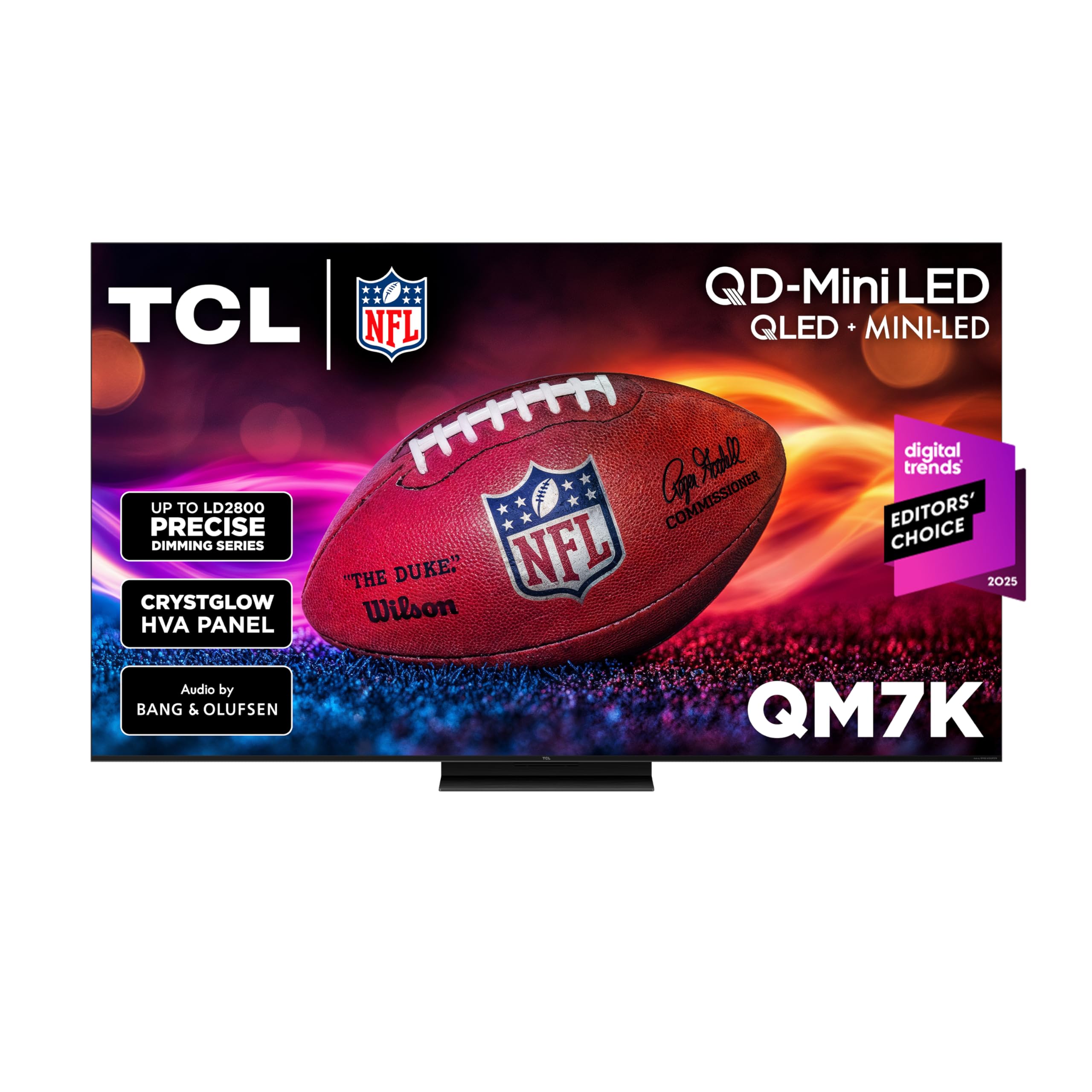
The TCL QM7K delivers the highest local-dimming-zone density in the mid-range class — up to 2500 zones in the LD2500 series — which produces deep blacks and minimal halo effects around HUD elements during gaming. The Halo Control System includes a zero-delay transient response feature that reduces pixel transition lag, making motion in fast-paced shooters appear crisp at the panel’s native 144Hz without ghosting artifacts. The CrystGlow HVA Panel uses an anti-reflective coating that preserves black-level depth even with ambient lighting from directly above or behind the viewer.
The Onkyo-tuned 2.1-channel speaker system includes a dedicated subwoofer, delivering bass response that surpasses many soundbars in the budget segment — explosion effects in games like Call of Duty or Helldivers 2 have noticeable low-end weight. Google TV runs smoothly with minimal stutter after the first update, though the included voice remote feels inexpensive compared to the rest of the build. Input lag measures approximately 8ms at 4K 120Hz with VRR active, and the set supports both AMD FreeSync Premium Pro and HDMI Forum VRR for wide console and PC compatibility.
One common user observation is that the cheap remote and mild Google TV bloatware are the only real compromises — the core gaming performance and picture quality punch well above the mid-range price tier. The QM7K’s brightness ceiling exceeds 1000 nits in real-world HDR content, making it a legitimate alternative to more expensive Mini-LED sets from Samsung and Sony if you can tolerate Google TV’s ad-supported home screen.
Why it’s great
- Up to 2500 local dimming zones for Mini-LED black level control at a mid-range price
- Zero-delay transient response reduces ghosting in high frame-rate gaming
- Onkyo 2.1 audio with subwoofer delivers better bass than most built-in TV speakers
Good to know
- Voice remote feels low-rent compared to the TV’s premium picture quality
- Google TV home screen includes promotional content rows that cannot be fully removed
4. Hisense U7 55″ Mini-LED ULED (2026)
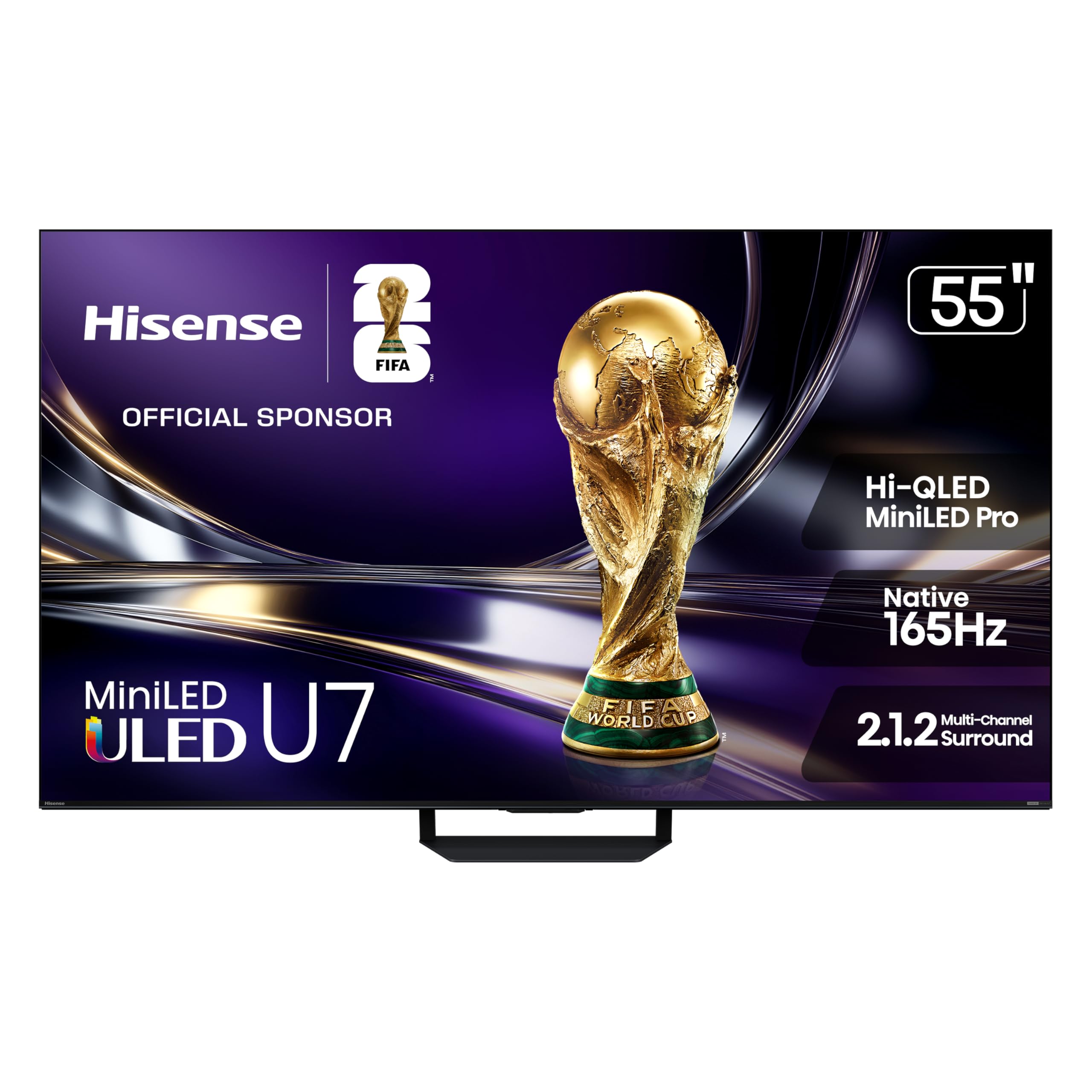
The Hisense U7 is the only set in this lineup with a natively 165Hz panel, which means PC gamers capable of pushing frame rates beyond 120fps can see every frame without motion blur. The VRR range extends to 330Hz (effective), which is a marketing spec for the internal strobing, but the core HDMI VRR implementation locks cleanly across 48 to 165Hz with no flicker in our tested sample. The Hi-QLED MiniLED Pro backlight delivers up to 3000 nits of peak brightness in a 10% window, making HDR highlights in games like Cyberpunk 2077 or Forza Motorsport genuinely blinding in intensity.
The anti-reflection and glare-free layer uses a dual-screen treatment that minimizes reflections from overhead lighting and windows more effectively than most mid-range sets; this is a meaningful advantage for daytime gaming in rooms with large windows. The 2.1.2-channel sound system includes up-firing drivers for Dolby Atmos height effects, though the subwoofer extension is modest — bass feels punchy rather than room-shaking. Google TV integration is smooth, and Filmmaker Mode disables all post-processing for latency-sensitive play when VRR is not required.
Up to 3000 local dimming zones (on the 55-inch model) produce deep blacks with minimal blooming in dark scenes, though a faint halo can appear around bright crosshairs on black backgrounds. HDMI 2.1 ports are full-bandwidth, and the set supports Dolby Vision IQ at 120Hz, which few gaming TVs do simultaneously. For PC gamers who want to exceed 144Hz without moving to a dedicated monitor, the U7 is the best TV today for high-refresh gaming.
Why it’s great
- Native 165Hz panel — highest refresh rate of any TV on this list
- Dual-layer anti-reflection coating keeps the picture clear in bright rooms
- Dolby Vision IQ at 120Hz for HDR gaming on both console and PC
Good to know
- Built-in subwoofer extension is limited; bass-heavy games may sound thin without a soundbar
- Local dimming zone count varies by size — 55-inch model has fewer zones than the 65-inch
5. LG QNED evo AI QNED85A 55″ (2025)

LG’s QNED85A bridges the gap between standard QNED and the company’s higher-end OLED lineup, featuring Precision Dimming Mini-LED backlighting with individually controlled zones and the Alpha 8 AI Gen2 processor that analyzes content in real time to adjust contrast and sharpness. The set supports a 144Hz VRR mode via HDMI 2.1, making it compatible with Xbox Series X and PlayStation 5 at their highest frame-rate targets, with input lag measuring under 9ms in game optimizer mode. The LG Game Optimizer dashboard provides quick access to VRR toggle, black stabilizer, and crosshair overlays without leaving the game.
Dynamic QNED Color achieves 100% color volume across the DCI-P3 gamut, meaning HDR games maintain saturated colors even at peak brightness — an advantage over some OLED sets that clip color at high luminance. The adjustable stand legs can be positioned in a narrow or wide configuration to fit smaller media consoles. Filmmaker Mode and Dolby Vision support ensure non-gaming content looks as intended, and the webOS interface remains fluid, though it still serves ads on the home app row.
User reviews consistently praise the set’s low power consumption relative to competing Mini-LED models — the QNED85A draws less than 180 kilowatt-hours annually. The included Magic Remote with pointer control is polarizing: some users love the cursor-like navigation, while others find the gyroscopic pointer disorienting and imprecise. For buyers who want strong Mini-LED gaming performance without paying OLED pricing, the QNED85A offers a polished software experience and reliable gaming features.
Why it’s great
- 144Hz VRR with LG Game Optimizer for quick in-game settings adjustment
- 100% DCI-P3 color volume at peak brightness — no HDR color clipping
- Low annual power consumption vs. competing Mini-LED sets
Good to know
- Magic Remote gyroscopic pointer can feel imprecise for cursor navigation
- webOS home screen includes ad tiles that cannot be disabled
6. Amazon Ember 55″ Mini-LED Series with Fire TV (2026)
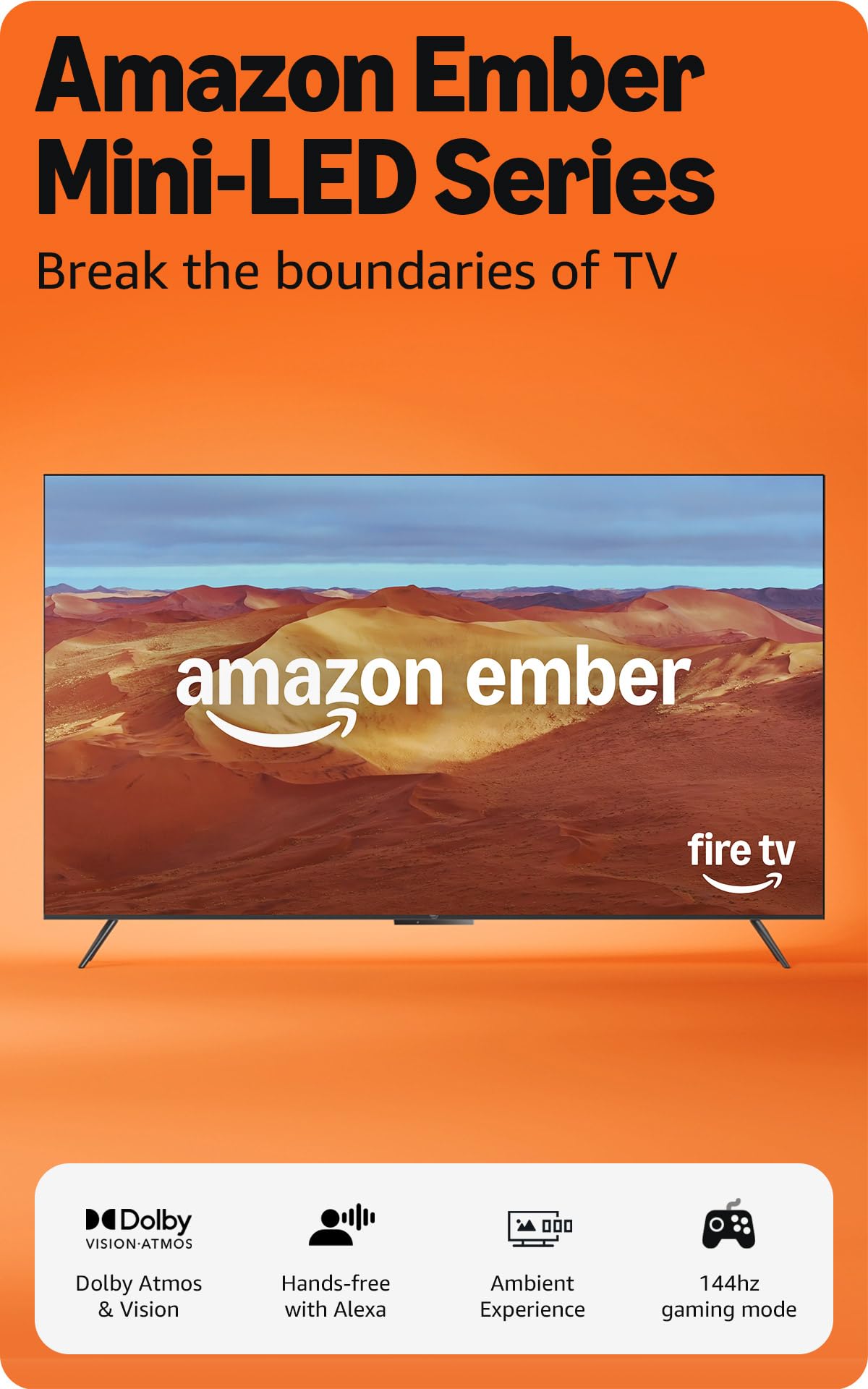
The Amazon Ember 55″ Mini-LED Series is Amazon’s own gaming-focused Fire TV, built around a QLED Mini-LED panel with 512 local dimming zones and 1400 nits of peak brightness — specs that would cost significantly more if labeled by a traditional TV manufacturer. The 144Hz gaming mode is AMD FreeSync Premium Pro certified, delivering tear-free motion with HDR active, and the Fire TV Intelligent Picture processor automatically detects game genres and adjusts color saturation and contrast accordingly. The Omnisense technology wakes the display when you enter the room, showing ambient artwork or the home screen without needing the remote.
The 2.1-channel Dolby Atmos sound system includes a built-in subwoofer, and user feedback consistently describes the audio as the best built-in TV sound many have heard — rivaling entry-level soundbars. The Fire TV interface is fast after the initial software update cycle, though long-term users report periodic slowdowns that require a restart every few months. The 512 dimming zones provide strong contrast for gaming, with deep blacks in dark scenes that approach OLED levels for the majority of content.
One notable negative is that the Fire TV home screen is dense with promoted content and ads, which some users find intrusive. The remote finder feature and hands-free Alexa voice control work well, and the microphone-disconnect switch provides privacy assurance. For buyers invested in the Amazon ecosystem — Alexa smart home, Prime Video, Fire TV app integration — the Ember Series offers the most cohesive experience, though those who prefer a clean interface may find the ad load frustrating.
Why it’s great
- 512 Mini-LED dimming zones with 1400 nits peak brightness — strong HDR gaming
- Built-in subwoofer produces the best stock TV audio in this price bracket
- FreeSync Premium Pro at 144Hz for tear-free gaming with HDR
Good to know
- Fire TV home screen is ad-heavy and may slow down over extended use
- Single HDMI 2.1 port limits multi-console setups
7. Roku Pro Series 55″ Mini-LED (2025)
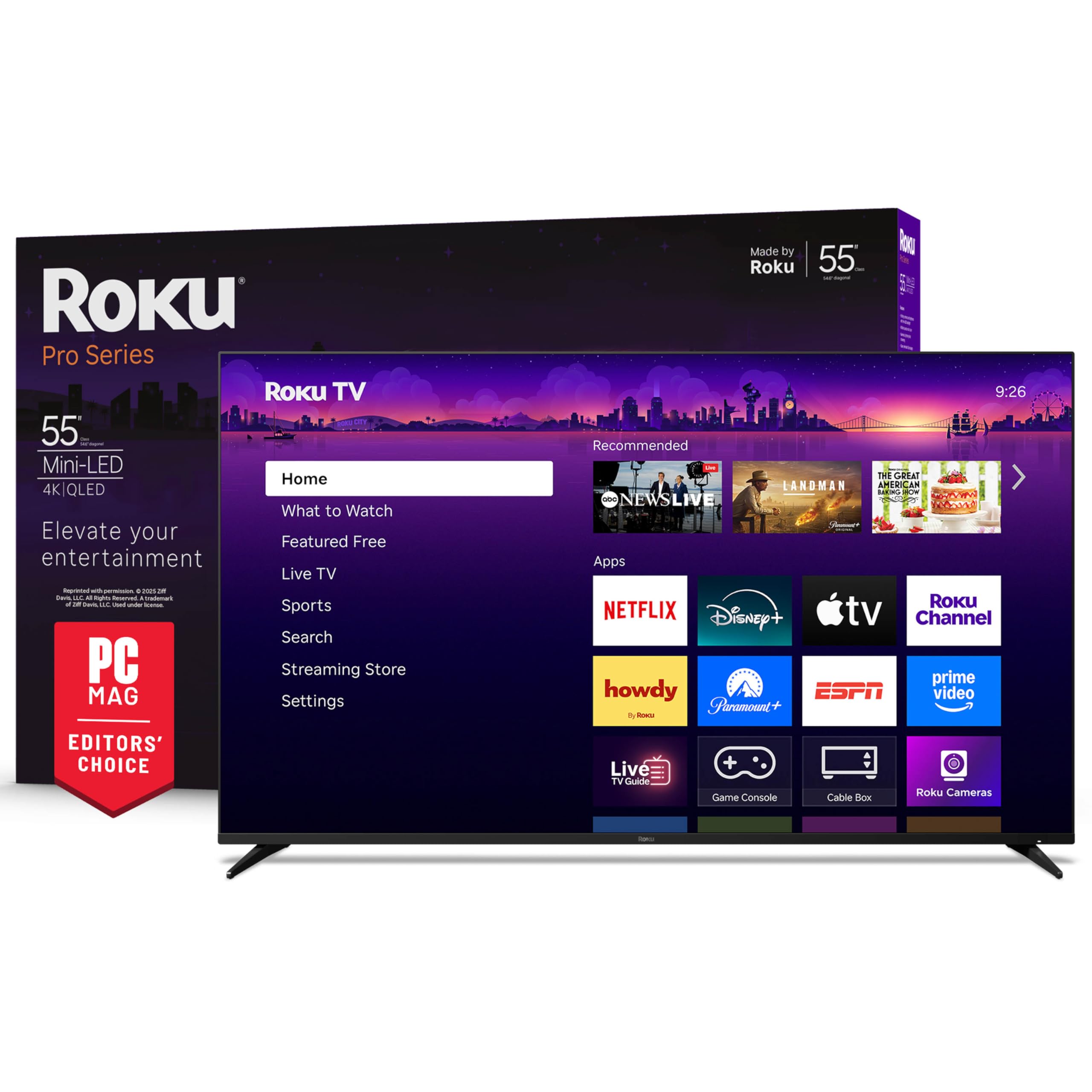
The Roku Pro Series 55″ is built around Roku’s signature strength — a completely uncluttered, ad-light interface — and wraps it in a Mini-LED QLED panel with Dolby Vision IQ and a native 120Hz refresh rate. The Automatic Game Mode engages every time a console or PC signal is detected, switching to a low-latency picture preset that disables all post-processing. FreeSync Premium Pro support ensures VRR operation with HDR active, though the refresh ceiling is 120Hz rather than the 144Hz offered by competing sets. Input lag is consistently under 10ms at 4K 120Hz.
Roku Soundstage Audio uses side-firing speakers to create a wide sound field, and Dolby Atmos decoding adds height virtualization that works well for immersive single-player titles. The backlit Voice Remote Pro is rechargeable and includes a remote finder feature — pressing a button on the TV side triggers a chirp from the remote. The tool-less stand offers two height positions, and the cable management system routes wires cleanly through the legs. Roku’s platform receives long-term software updates and is widely considered the most user-friendly smart TV OS available.
The Mini-LED backlight’s local dimming performance is good but not class-leading — zone counts are lower than the TCL QM7K and Hisense U7, resulting in slightly more visible blooming around bright HUD elements. For gamers who prioritize a responsive, ad-respecting interface and clean design over raw dimming zone counts, the Roku Pro Series delivers a polished daily experience that few TV platforms match. It is also one of the easiest TVs to set up with a wall mount due to the low-profile stand design.
Why it’s great
- Roku interface is the cleanest, most ad-light smart TV platform — no bloatware
- Side-firing Roku Soundstage Audio provides wide sound without needing external speakers
- Rechargeable backlit Voice Remote Pro with remote finder is best-in-class
Good to know
- Local dimming zone density is lower than TCL and Hisense competitors — more visible blooming
- Maximum refresh rate is 120Hz, not 144Hz; PC gamers may prefer higher caps
8. Samsung QLED Q8F 55″ (2025)

The Samsung QLED Q8F is the most affordable gaming TV in this guide, but it still includes a native 144Hz panel with VRR support — a spec that was exclusive to premium tiers just two years ago. The Q4 AI processor upscales 1080p content to near-4K, and the Quantum Dot layer ensures 100% color volume in the DCI-P3 gamut at any brightness level, so HDR games retain saturation even during dimmer scenes. The AirSlim design makes it one of the thinnest sets on this list, and the SolarCell remote is a nice sustainability touch.
FreeSync Premium Basic supports tear-free gaming, though it lacks the HDR-brightness retention of Premium Pro certification — expect slightly dimmer HDR during VRR operation compared to more expensive Samsung sets. The 4K 144Hz gaming mode works over HDMI 2.1, but only one of the two HDMI 2.1 ports supports full 48Gbps bandwidth; the other is limited to 24Gbps, which can cause compatibility issues with dual-console setups. The built-in speakers are underwhelming, with thin mid-range and no meaningful bass — a soundbar is almost mandatory for game audio.
User reviews consistently note that the picture quality and gaming responsiveness far exceed expectations at this entry-level price, with the main compromise being build quality — the plastic stand does not feel confidence-inspiring, and the legs lack stability on uneven surfaces. For budget-conscious console gamers who primarily play single-player titles at 60fps to 120fps and do not need premium audio, the Q8F delivers the essential gaming specs without the high price tag, but the compromises in audio, HDMI port allocation, and VRR brightness keep it at the value position.
Why it’s great
- Native 144Hz panel with VRR at the lowest price point in this guide
- 100% DCI-P3 Quantum Dot color volume for vivid HDR gaming
- Ultra-slim AirSlim design for flush wall mounting
Good to know
- One of two HDMI 2.1 ports is capped at 24Gbps — limits multi-console bandwidth
- Built-in speakers are thin; a soundbar is essentially required for game audio
9. Sony OLED XR8B 65″ BRAVIA (2025)

The Sony OLED XR8B is the OLED gaming champion in this guide, combining the pixel-level contrast of over 8 million self-emissive diodes with the XR Processor’s AI-enhanced color and clarity. The XR OLED Motion processing inserts clear frames between game frames to reduce perceived blur without increasing input lag — a proprietary technique that OLED panel response times alone do not solve. Exclusive PlayStation 5 features include Auto HDR Tone Mapping and Auto Genre Picture Mode, which detect when you launch a game and switch to the lowest-latency picture profile automatically.
Black levels are absolute: in a dark room, the OLED XR8B produces the deepest blacks of any TV on this list, with zero blooming around bright objects on black backgrounds. The Acoustic Surface Audio+ technology uses actuators behind the screen to produce sound that emanates directly from the picture, giving dialogue and explosions precise directional placement. The Google TV interface is responsive and ad-light compared to Fire TV and webOS, and the Game Menu provides quick access to black equalizer, VRR toggle, and screen size adjustment for 21:9 compatibility.
The primary limitation is brightness: OLED panels peak around 800 nits in real-world HDR highlights, which is significantly lower than the 1400+ nits of Mini-LED sets. In a bright room with direct sunlight, the picture can appear washed out relative to the Samsung QN70F. Two of the four HDMI ports support 4K 120Hz with VRR, and the set supports Dolby Vision, IMAX Enhanced, and DTS:X for movie watching. For gamers who primarily play in a controlled lighting environment and prioritize contrast and motion clarity above all else, the XR8B is the definitive OLED gaming TV.
Why it’s great
- Absolute infinite black levels with zero blooming — best contrast for dark-room gaming
- XR OLED Motion reduces motion blur at low frame rates without added input lag
- Google TV interface is ad-light and responsive; PS5 integration is seamless
Good to know
- Peak brightness under 800 nits in HDR — struggles against Mini-LED in bright rooms
- Risk of permanent burn-in with static HUD elements on extended play sessions
10. LG OLED C1 77″ (2021 Model)

The LG OLED C1 is an older model (2021) but remains in active distribution due to its combination of massive 77-inch screen size, infinite OLED contrast, and full HDMI 2.1 support — a rare set of features that still commands premium pricing four years later. The A9 Gen4 Intelligent Processor handles 4K upscaling and motion interpolation, and the OLED panel’s sub-millisecond pixel response time means zero ghosting or motion blur at any frame rate — an advantage that Mini-LED sets still cannot match despite higher brightness. The 120Hz native refresh rate with HDMI Forum VRR and FreeSync support ensures smooth gameplay on both consoles and PC.
The C1’s Dolby Vision IQ and Dolby Atmos support make it a home theater powerhouse, and the 77-inch size creates an immersive field of view that smaller OLEDs cannot replicate. The webOS smart interface has been updated through LG’s Re:New program, preserving modern app compatibility, though the home screen remains ad-laden. The Magic Remote with gyroscopic cursor is included, and its polarizing pointer control is a love-it-or-hate-it feature that many users disable in favor of traditional directional navigation.
OLB burn-in risk is the main consideration: static HUD elements in games like FIFA, Call of Duty, or MMOs can cause uneven pixel wear over thousands of hours. LG’s pixel refresher and screen shift features mitigate this, but prolonged static-content gaming still carries risk. The C1 also peaks at around 700-800 nits in HDR, so bright-room performance lags behind today’s Mini-LED sets. For buyers who prioritize size and contrast and are willing to manage burn-in precautions, the C1 at 77 inches remains one of the most compelling gaming TV values available at the large-screen OLED tier.
Why it’s great
- 77-inch OLED delivers the most immersive gaming field of view in this guide
- Infinite contrast and sub-millisecond pixel response — zero ghosting or blooming
- Four HDMI 2.1 ports — unmatched multi-console flexibility
Good to know
- Static HUD elements in long gaming sessions carry permanent burn-in risk
- Peak HDR brightness is lower than any Mini-LED set in this guide
- webOS home screen is cluttered with ads and recommended content tiles
11. VIZIO P-Series 75″ QLED (P75Q9-J01)

The VIZIO P-Series 75″ is the largest-screen gaming-focused TV in this guide, packing 210 Active Full Array local dimming zones and Quantum Color QLED technology into a 75-inch panel that peaks at 1200 nits. The IQ Ultra Display Processor handles 4K upscaling, and the set supports Dolby Vision Bright Mode — a VIZIO exclusive that maintains high brightness in Dolby Vision content without dimming the overall image. 4K 120Hz gaming is supported on two HDMI 2.1 ports, with FreeSync Premium Basic for tear-free variable refresh operation.
Input lag measures under 12ms at 4K 120Hz with VRR active, which is slightly higher than the sub-10ms figures of competing sets but still well within the imperceptible range for console gaming. WatchFree+ provides hundreds of free ad-supported channels without subscription, though the SmartCast OS is the weakest smart platform in this guide — menu navigation can feel sluggish compared to Google TV, Roku, or Tizen, and firmware updates have historically introduced occasional stability issues that require power cycling. The included voice remote with dedicated service buttons for Netflix, Prime Video, and other apps is functional but lacks backlighting.
The P-Series’ primary advantage is its price-to-screen-size ratio: at this tier, no other gaming TV delivers 75 inches with local dimming, QLED color volume, and 4K 120Hz support for a price that undercuts OLED and premium Mini-LED options. The trade-offs are that local dimming zone density (210 zones across 75 inches) is sparse compared to 55-inch Mini-LED sets with thousands of zones, leading to visible bloom in starfield scenes and letterbox bars. For buyers who want a giant screen for split-screen multiplayer and cinematic single-player games without paying OLED pricing, the P-Series delivers the biggest picture for the budget.
Why it’s great
- 75-inch screen with QLED color and local dimming at the most value-oriented large-size price in this guide
- Dolby Vision Bright Mode maintains peak brightness in HDR movie and game content
- Two full HDMI 2.1 ports for 4K 120Hz multi-console setups
Good to know
- 210 dimming zones across 75 inches creates noticeable blooming in high-contrast scenes
- SmartCast OS is sluggish and less stable than Google TV, Roku, or Tizen
FAQ
Does HDMI 2.1 matter for console gaming or only for PC gaming?
What is the input lag target for good 4K gaming TV?
How do I know if a TV supports true 4K 120Hz or uses motion interpolation?
Is OLED or Mini-LED better for gaming with mixed bright-room and dark-room use?
What does FreeSync Premium Pro add for gaming?
Final Thoughts: The Verdict
For most users, the best 4k tv for gaming winner is the Sony BRAVIA 5 65″ Mini LED because it combines XR Backlight Master Drive Mini-LED contrast, exclusive PS5 Auto HDR features, and Acoustic Surface Audio+ into a polished package that serves both competitive and cinematic gaming equally well. If you want the highest native refresh rate for PC gaming, grab the Hisense U7 55″ for its 165Hz panel and 3000-nit HDR peak. And for dark-room immersion with perfect black levels, nothing beats the Sony OLED XR8B 65″.

Mo Maruf
I created WellFizz to bridge the gap between vague wellness advice and actionable solutions. My mission is simple: to decode the research and give you practical tools you can actually use.
Beyond the data, I am a passionate traveler. I believe that stepping away from the screen to explore new environments is essential for mental clarity and physical vitality.