Our readers keep the lights on and my smoothie glass nicely filled. As an Amazon Associate, I earn from qualifying purchases.
That first camera purchase can feel like a maze of megapixels, sensor sizes, and confusing lens jargon. You want a tool that grows with your skills, not one you abandon in a drawer after a few months because the menus are too deep or the image quality doesn’t beat your phone. The goal is a body that rewards mistakes with teachable moments, not frustration.
I’m Mohammad Maruf — the founder and writer behind WellFizz. I analyze camera hardware, sensor specs, and autofocus systems to cut through the marketing noise so you find the right technical foundation for your budget.
After testing dozens of entry-level bodies and lenses, I’ve narrowed the field to the eleven that offer the clearest path from confused beginner to confident shooter, and these are my picks for the best cameras for photography beginners in the current market.
How To Choose The Best Cameras For Photography Beginners
Buying your first real camera is a decision between sensor size, lens ecosystem, and form factor. A phone camera already handles the basics; a dedicated body needs to offer something clearly better. You want a camera that pushes you to learn without punishing you with complicated menus.
Sensor size class
The sensor is the heart of any camera. Entry-level cameras almost always use an APS-C sensor, which is about four times larger than a typical smartphone sensor. This gives you better low-light performance and that sought-after background blur (bokeh). A few premium bodies in this range offer a full-frame sensor, which is even larger and captures more light, but those come with a higher price and larger lens costs.
Autofocus capability
Phase-detection autofocus points cover more of the frame than contrast-detection systems. For beginners, cameras with eye-detection and subject tracking are a huge advantage because they handle focus while you concentrate on composition. The Sony ZV-E10 and Canon EOS R100 offer excellent eye-detection that works on people and animals, which dramatically reduces the number of out-of-focus shots.
Lens compatibility and growth path
You are not just buying a camera body; you are buying into a lens system. Canon EF/EF-S and Nikon F mounts have huge, affordable used lens markets. Canon RF and Nikon Z mounts represent the newer mirrorless systems with a smaller selection of native lenses so far, but they are the direction the industry is moving. Sony E-mount has a mature third-party lens ecosystem, making it a safe long-term investment.
Quick Comparison
On smaller screens, swipe sideways to see the full table.
| Model | Category | Best For | Key Spec | Amazon |
|---|---|---|---|---|
| Canon EOS R8 | Mirrorless | Learning full-frame on a budget | 24.2MP Full‑Frame, 40fps e‑shutter | Amazon |
| Canon EOS RP Kit | Mirrorless | Lightweight full-frame travel | 26.2MP Full‑Frame, 5‑stop IS lens | Amazon |
| Nikon Z50 II | Mirrorless | Beginner creative presets | 20.9MP APS‑C, 31 Picture Controls | Amazon |
| Sony Alpha ZV-E10 | Mirrorless | Vlogging and hybrid work | 24.2MP APS‑C, 425 phase‑detect AF | Amazon |
| Panasonic LUMIX G85 | Mirrorless | Steady handheld video & photo | 16MP MFT, 5‑Axis IBIS + OIS | Amazon |
| Canon EOS M50 | Mirrorless | Budget vlogging with 4K | 24.1MP APS‑C, 143 Dual Pixel AF | Amazon |
| Canon EOS R100 | Mirrorless | Smallest RF‑mount entry point | 24.1MP APS‑C, 6.5 fps shooting | Amazon |
| Nikon D3500 | DSLR | Classic DSLR learning platform | 24.2MP APS‑C, 5 fps, Guide Mode | Amazon |
| Canon EOS Rebel T7 DSLR Kit | DSLR | Full accessory bundle with telephoto | 24.1MP APS‑C, 500mm tele lens | Amazon |
| Canon EOS Rebel T7 | DSLR | Affordable renewed DSLR | 24.1MP APS‑C, 9‑point AF system | Amazon |
| Canon EOS Rebel T100 Bundle | DSLR | Cheapest full entry‑level bundle | 18MP APS‑C, 64GB card & tripod | Amazon |
In‑Depth Reviews
1. Canon EOS R8 Mirrorless Camera Body

The Canon EOS R8 is the lightest full-frame RF-mount body Canon makes, weighing just 461 grams, and it packs the same DIGIC X processor and autofocus engine found in the far more expensive R6 Mark II. That means you get 40 fps electronic shutter with full autofocus tracking, dual-pixel CMOS AF II with 1,053 zones that covers 100% of the frame, and deep-learning subject detection for people, animals, vehicles, and even aircraft. For a beginner, the autofocus system is a cheat code — it locks onto eyes and holds them even during erratic movement, so you can concentrate entirely on composition and exposure while the camera handles the sharpness.
The uncropped 4K 60p video is oversampled from a 6K readout, producing clean, detailed footage. Canon Log 3 and HDR PQ profiles are available for those who want to learn color grading later. The vari-angle 1.62 million-dot touchscreen makes creative angles easy, and the 0.39-inch OLED EVF with 120 fps refresh rate is crisp and responsive. The body lacks in-body image stabilization, so you will need stabilized RF lenses for smooth handheld video, but for photography that is rarely a problem at the shutter speeds beginners typically use.
Battery life is the main trade-off — the LP-E17 pack manages roughly 250 to 300 shots per charge, and 4K 60p recording can trigger thermal shutdown after about 30 minutes. The single UHS-II SD card slot is also a limitation for backup in professional use. Overall, the R8 offers a straight path from entry-level to enthusiast without forcing a body upgrade later.
Why it’s great
- Full-frame sensor delivers superior low-light and dynamic range over APS-C
- 40fps burst with full AF tracking makes action photography easy
- Lightest full-frame body in Canon’s lineup, perfect for travel
Good to know
- No in-body stabilization; requires stabilized lenses for steady video
- Battery life is short — carry at least one spare for a full day
- Not available as a kit with a lens; purchase an RF lens separately
2. Canon EOS RP Full-Frame Mirrorless + RF24-105mm F4-7.1 Lens Kit

The Canon EOS RP is the most affordable full-frame mirrorless camera on the market, and when bundled with the RF 24-105mm F4-7.1 IS STM lens, it becomes a complete learning system. The 26.2-megapixel full-frame sensor offers a clear step up in image quality from any APS-C body — better dynamic range, smoother tonal transitions, and significantly cleaner high-ISO performance. The kit lens provides a versatile 24-105mm equivalent zoom range with optical image stabilization that delivers up to five stops of shake correction, making handheld shooting in dim interiors much more forgiving.
The body itself is compact at 485 grams, on par with many APS-C mirrorless cameras, and the RF mount gives you direct access to Canon’s developing lens ecosystem plus full compatibility with EF and EF-S lenses via an adapter. The 2.36 million-dot OLED electronic viewfinder is clear, and the fully articulating touchscreen is useful for selfie angles and vlogging. Dual Pixel CMOS AF covers 88% of the sensor area with 4,779 selectable positions, providing fast and reliable face and eye detection that works in stills and video.
Where the RP shows its entry-level roots is in burst speed — just 5 fps with continuous AF, and 4K video is limited to 24p with a 1.6x crop and no Dual Pixel AF. The battery is the same LP-E17 that struggles in the R8, and the single SD slot is a limitation. For someone moving up from a phone or compact camera, the RP is a patient teacher that rewards careful technique with genuinely professional-quality photos.
Why it’s great
- Full-frame sensor in a compact, lightweight body at an entry-level price
- Versatile 24-105mm stabilized kit lens covers most daily scenarios
- Excellent Dual Pixel AF with eye detection for portraits
Good to know
- 4K video has a heavy 1.6x crop and no Dual Pixel AF
- Burst shooting at 5 fps is slow for action
- Single UHS-II SD card slot
3. Nikon Z50 II Mirrorless Camera

The Nikon Z50 II is the second generation of Nikon’s APS-C mirrorless camera, and it brings the same EXPEED 7 processor and deep-learning autofocus that powers the flagship Z9. This gives you 231 phase-detection AF points with subject detection for people, dogs, cats, birds, and vehicles, plus dedicated bird and airplane modes. The 20.9-megapixel DX-format sensor is a few megapixels less than competitors, but the lack of an optical low-pass filter means it resolves fine detail impressively well, and the native ISO range up to 51,200 handles low light competently.
The standout feature for beginners is the Picture Control button, which gives instant access to 31 built-in color presets including Creative Picture Controls and Cloud Picture Controls that can be downloaded directly to the camera via the Nikon Imaging Cloud. You can preview the effects live in the viewfinder, which makes learning about color science and stylistic choices intuitive rather than theoretical. The Z50 II also records 4K UHD at 60p with built-in electronic VR stabilization, and a product review mode automatically racks focus to a close subject — a feature borrowed from the Z30 for vloggers and content creators.
The built-in flash, a rarity in modern mirrorless cameras, helps with indoor portraits, and the Night Portrait mode uses slow-sync flash to balance ambient light for natural-looking results. Nikon’s SnapBridge app sends photos to your phone in seconds via Bluetooth low energy. The battery life is modest at around 280 shots per charge, and the single UHS-I SD card slot is entry-level. The Z50 II is the most beginner-forward camera on this list because it actively teaches creative decisions instead of hiding them in menus.
Why it’s great
- Picture Control button with 31 built-in presets teaches color grading live
- EXPEED 7 autofocus with dedicated bird and airplane tracking
- Compact body with built-in flash for indoor portraits
Good to know
- Lower 20.9MP sensor may not satisfy pixel peepers
- Single UHS-I SD card slot limits write speed
- Battery life is average; a spare is recommended for all-day shoots
4. Sony Alpha ZV-E10 Mirrorless Vlog Camera
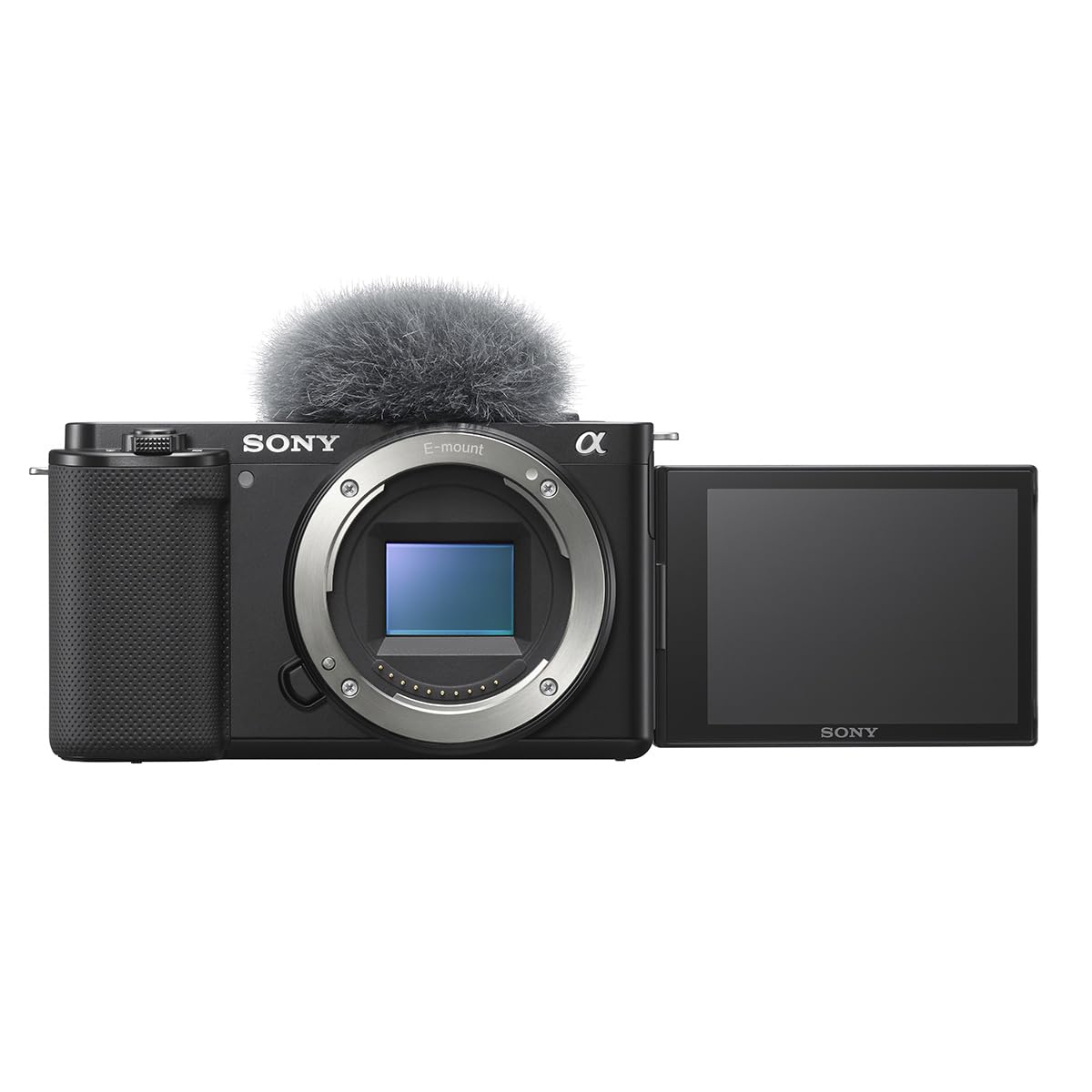
The Sony ZV-E10 is a dedicated content creation tool built around the proven 24.2-megapixel APS-C Exmor CMOS sensor and BIONZ X processor found in the a6100. It offers 425 phase-detection autofocus points covering 84% of the sensor area, with Real-Time Eye AF for humans and animals. This is the most reliable beginner autofocus system on the list, and it truly does let you set the camera on a tripod, walk into frame, and stay perfectly in focus without touching the screen.
Video performance distinguishes the ZV-E10 from traditional photo-first cameras. The 4K recording is oversampled from a 6K readout with full pixel readout and no pixel binning, producing very clean footage. The Product Showcase Setting transitions focus smoothly from your face to an object held up to the camera, perfect for reviews and tutorials. A dedicated Background Defocus button toggles between a defocused and stopped-down aperture instantly. The camera has a 3.5mm microphone jack for external audio and supports UVC/UAC for plug-and-play live streaming over a single USB cable. The latest firmware also adds S-Log2, S-Log3, and HLG picture profiles for those who want to learn color grading.
The rolling shutter in 4K is severe enough to ruin fast panning shots, and there is no in-body stabilization, so a gimbal is almost mandatory for smooth walking footage. Battery life hits around 80 minutes of continuous 4K recording, and the small LCD screen is difficult to see in bright sunlight. For vloggers who shoot primarily at a desk or indoors, the ZV-E10 is the best value content machine available.
Why it’s great
- 425-point Real-Time Eye AF is the most reliable beginner autofocus
- Product Showcase and Background Defocus buttons simplify video controls
- Clean 4K from 6K oversampling with S-Log profiles for grading
Good to know
- Severe rolling shutter and no IBIS; a gimbal is recommended
- Battery life is poor for video recording
- Small LCD screen is hard to see outdoors
5. Panasonic LUMIX G85 Mirrorless Camera with 12-60mm Lens

The Panasonic LUMIX G85 is a Micro Four Thirds camera that punches well above its weight class thanks to class-leading 5-axis in-body image stabilization which works in concert with the 12-60mm Power O.I.S. lens for dual stabilization. The 16-megapixel sensor lacks a low-pass filter, which gives it a noticeable sharpness boost over standard 16MP sensors. The magnesium alloy body is weather-sealed against dust and splash, a feature almost unheard of at this price point, and the deep grip makes it comfortable to hold during long sessions.
The G85 records 4K video at 30p and includes Panasonic’s 4K Photo mode, which lets you extract 8-megapixel stills from 30fps bursts. 4K Post Focus allows you to select the focus point after you have taken the photo, a genuinely useful feature for macro and product shots where depth of field is tight. The OLED live viewfinder has 2.36 million dots, and the 3-inch 1.04 million-dot touchscreen tilts and articulates, giving you flexible framing options. The autofocus system uses contrast detection with depth-from-defocus and covers 49 areas — not as fast as phase detection in good light, but reliable for most still photography.
Battery life is middling, with CIPA ratings around 320 shots, and the 16-megapixel sensor is outclassed by APS-C and full-frame competitors for noise performance in deep shadow. The Micro Four Thirds lens ecosystem is vast and affordable, but the 2x crop factor means you need faster lenses for similar low-light performance to APS-C cameras. The G85 is the best stabilizer at this price, making it ideal for handheld video and photography where a tripod is not an option.
Why it’s great
- 5-axis IBIS + lens OIS gives near-gimbal level handheld stability
- Weather-sealed magnesium alloy body is durable and robust
- 4K Photo and Post Focus modes are creative learning tools
Good to know
- 16MP sensor lags behind APS-C in dynamic range and high ISO
- Contrast-detect AF is slower in low light than phase-detect
- No headphone jack for audio monitoring during video
6. Canon EOS M50 Mirrorless Camera Kit with EF-M15-45mm

The Canon EOS M50 has been a staple recommendation for beginners since its release, and the renewed market price makes it one of the best values for those entering the mirrorless world. The 24.1-megapixel APS-C CMOS sensor paired with the DIGIC 8 processor delivers the classic Canon color science — warm, pleasing skin tones straight out of camera. The 143-point Dual Pixel CMOS AF covers a wide portion of the frame and provides fast, accurate phase-detection autofocus with eye detection that works in both stills and 4K video.
The M50 body is exceptionally compact at 387 grams, and the built-in OLED electronic viewfinder with 2.36 million dots is a rarity in this price tier. The vari-angle touchscreen flips out to the side, making it suitable for vlogging, and the built-in flash is handy for fill light. The camera records 4K UHD at 24p, though with a heavy 1.6x crop that uses only the center of the sensor, and 1080p at 60fps for smooth slow-motion. The EF-M 15-45mm kit lens is compact, but the EF-M mount is effectively discontinued by Canon in favor of the RF mount, meaning lens upgrades are limited to the handful of native EF-M lenses or adapted EF/EF-S glass.
The 4K crop and lack of in-body stabilization are the main drawbacks, and the battery life is around 300 shots per charge. The M50 remains a fantastic introduction to mirrorless photography because it teaches you the shooting fundamentals without overwhelming you with menus, and it produces excellent still images that will be satisfying for years.
Why it’s great
- Excellent Dual Pixel AF with human and eye detection works reliably
- Compact and lightweight body with built-in EVF and flash
- Classic Canon color science produces pleasing JPEGs out of camera
Good to know
- EF-M mount system is discontinued; limited native lens options
- 4K video has a severe 1.6x crop factor
- No in-body image stabilization
7. Canon EOS R100 Mirrorless Camera with RF-S18-45mm Lens Kit

The Canon EOS R100 is the smallest and lightest camera in the EOS R series, weighing just 356 grams, and it offers the most affordable entry point into the RF mirrorless system. The 24.1-megapixel APS-C CMOS sensor paired with the DIGIC 8 image processor provides the same image quality as the M50, but the RF-S 18-45mm F4.5-6.3 IS STM lens gives you direct compatibility with Canon’s growing RF lens lineup, including the ability to adapt the massive library of EF and EF-S glass. The camera has 143-zone Dual Pixel CMOS AF with human face and eye detection, and it can shoot continuously at 6.5 fps with One-Shot AF.
The body includes a built-in pop-up flash, which is a rarity among mirrorless cameras at this level, and the in-camera feature guide explains functions as you scroll through the menu. 4K video is available at up to 24fps, and Full HD at 60fps, so it works for casual video capture. The RF-S 18-45mm kit lens is exceptionally small and retracts when powered off, making the whole package truly pocketable in a large jacket. The camera uses an LP-E17 battery, and since no charger is included in the box, you will need to charge via USB-C or purchase a separate charger.
The R100 lacks a touchscreen — the 2.95-inch LCD is fixed and non-touch, which is an odd omission in 2024. The electronic viewfinder is a 0.39-inch type with 2.36 million dots but has a lower refresh rate that can feel laggy. For a beginner who wants the smallest possible mirrorless camera with a clear path to Canon’s full-frame RF system, the R100 is a compelling and compact starter.
Why it’s great
- Smallest and lightest EOS R body, ideal for travel and daily carry
- Entry into the RF lens system with future upgrade potential
- Built-in flash and in-camera feature guide for beginners
Good to know
- No touchscreen on the LCD display
- EVF refresh rate is low and can appear laggy
- No battery charger included in the box
8. Nikon D3500 DSLR with AF-P 18-55mm VR Lens (Renewed)

The Nikon D3500 is arguably the most respected entry-level DSLR ever made, and for good reason. The 24.2-megapixel DX-format CMOS sensor has no optical low-pass filter, which gives it excellent resolving power. The EXPEED 4 processor provides a native ISO range of 100 to 25,600, which is very usable for a camera at this level. The OLPF-free sensor gives you noticeably sharper output than many competing APS-C cameras, and the Guide Mode built into the menu system is still the best walkthrough for learning exposure triangle concepts — it shows you exactly how changing aperture, shutter speed, and ISO affect the image in real time.
The optical viewfinder offers a clear, lag-free view with 95% frame coverage, and the 11-point autofocus system with a cross-type center point is fast and accurate in good light. The AF-P 18-55mm f/3.5-5.6G VR lens is one of the best kit lenses available, with a quiet stepping motor and VR (vibration reduction) that gives up to four stops of stabilization. The D3500 also gets roughly 1,550 shots per charge thanks to the efficient optical viewfinder system, which is dramatically better than any mirrorless option on this list.
The main limitation of the D3500 is its age — the SnapBridge app for wireless photo transfer has known crashing issues on modern smartphones, and there is no way to connect a remote shutter release for long exposures. The 3-inch 921k-dot LCD is fixed and has limited viewing angles. For a beginner who prefers a classic learning experience with a pristine optical viewfinder and outstanding battery life, the D3500 is still a compelling pick.
Why it’s great
- Guide Mode is the best built-in tool for learning photography fundamentals
- 1,550-shot battery life lasts for days of shooting
- No OLPF sensor captures exceptionally sharp details
Good to know
- SnapBridge app is unstable and often fails to connect
- No remote shutter release or IR sensor for long exposures
- LCD screen is fixed and has limited resolution
9. Canon EOS Rebel T7 DSLR Kit with 18-55mm + 500mm Telephoto Lens Bundle
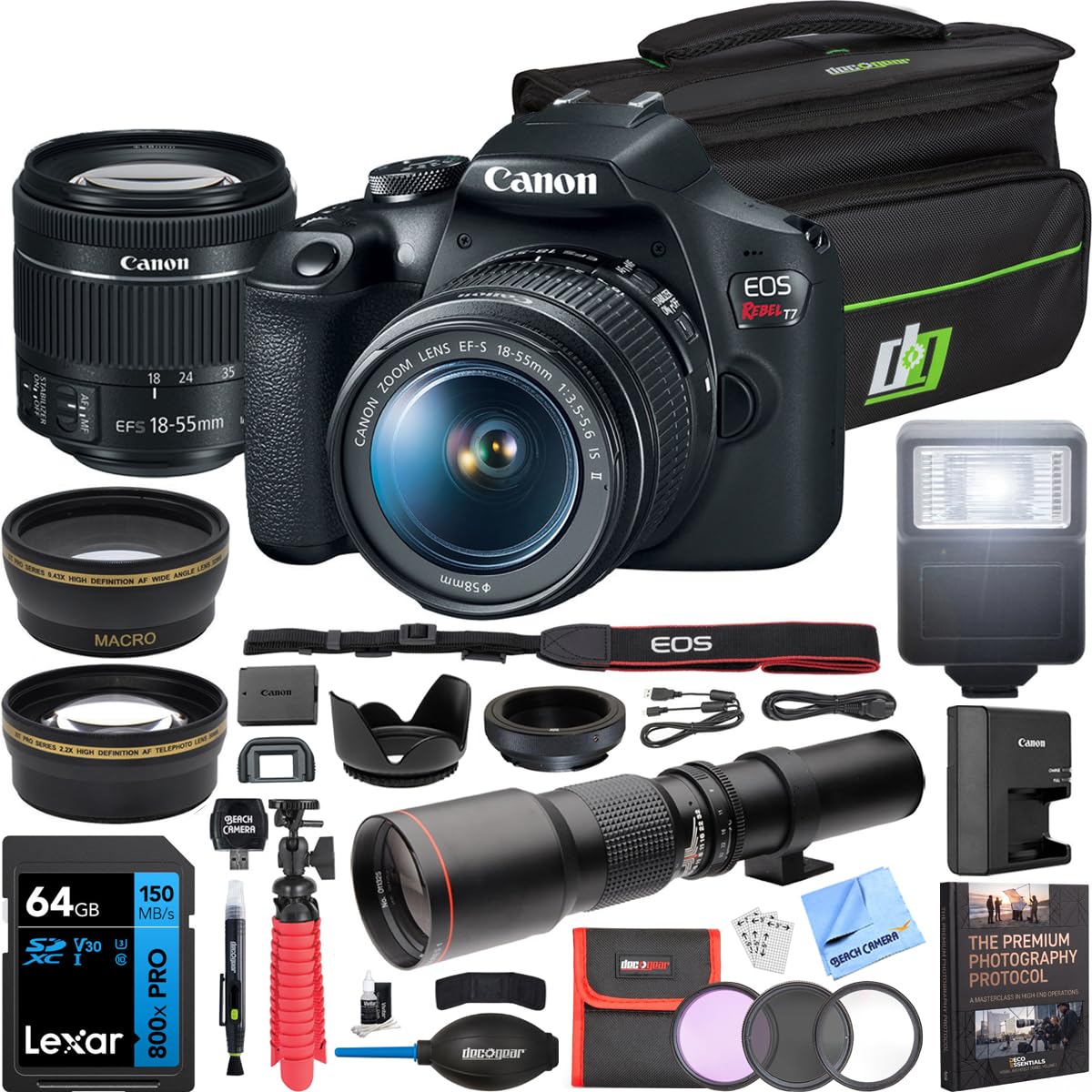
The Canon EOS Rebel T7 is the classic DSLR starter, and this bundle from Canon USA adds a 500mm f/8 preset telephoto lens, a 0.43x wide-angle adapter, a 2.2x telephoto adapter, a tulip hood, a Deco Gear camera bag, a 58mm UV/polarizer/FLD filter set, an SF3000 bounce zoom flash, a 60-inch tripod, memory card, card reader, and cleaning kit. For a beginner, this bundle eliminates the need to purchase any accessories for the first year of shooting, covering everything from birding to wide-angle landscapes to basic macro.
The camera itself uses the same 24.1-megapixel APS-C CMOS sensor and DIGIC 4+ processor found in the standard T7, with a 9-point autofocus system, Scene Intelligent Auto mode, and built-in Wi-Fi and NFC for wireless image transfer. The EF-S 18-55mm f/3.5-5.6 IS II lens includes optical image stabilization and covers the essential wide-to-normal zoom range. The 500mm preset telephoto lens is manual focus only and requires a fast shutter speed or tripod to avoid blur, but it offers an incredible reach for wildlife and sports photography that no kit lens provides.
The build is all plastic, the burst rate is a slow 3 fps, and the battery is reported by some users to drain quickly — one reviewer noted the battery died after eight photos on a full charge, so testing the included battery upon arrival is critical. The bag is too small to hold all bundled accessories simultaneously. For a beginner on a tight budget who wants everything needed in one box, the Rebel T7 bundle is impossible to beat for sheer value.
Why it’s great
- 13-piece kit includes telephoto lens, flash, tripod, filters, and bag
- Canon USA authorized with full 1-year warranty
- 500mm telephoto lens offers wildlife reach not available in other kits
Good to know
- Battery drain issues reported; charge and test immediately on arrival
- Included bag is too small for all accessories
- 3 fps burst rate is the slowest on this list
10. Canon EOS Rebel T7 DSLR with 18-55mm Lens (Renewed)

The renewed Canon EOS Rebel T7 is the most affordable way to get into a full Canon DSLR ecosystem. The 24.1-megapixel APS-C CMOS sensor captures clean images up to ISO 6400 (expandable to 12,800), and the DIGIC 4+ processor handles the 9-point autofocus system with AI Servo AF for tracking moving subjects. The 3-inch 920k-dot LCD is clear enough for reviewing shots, and the Scene Intelligent Auto mode does a good job of selecting appropriate settings for common scenes.
Renewed units from trusted sellers typically arrive in like-new condition with no scratches or defects, and the bundle includes the EF-S 18-55mm f/3.5-5.6 IS II lens, battery, charger, and strap. The included lens has optical image stabilization, which helps with handheld shots in moderate light. The camera features built-in Wi-Fi and NFC, which works reliably for transferring JPEGs to your phone for social sharing.
The plastic body feels less substantial than the magnesium alloy builds of higher-end cameras, and a drop from as little as two feet can scuff the chassis. The 3 fps burst rate is slow for action, and the 9-point AF system feels dated compared to the 425-point systems in modern mirrorless bodies. For learners who want the lowest cost path to mastering a DSLR, the renewed T7 offers solid fundamentals at a rock-bottom entry price.
Why it’s great
- Renewed units often look and function like new at a reduced price
- Canon’s vast EF/EF-S lens ecosystem is affordable on the used market
- Wi-Fi and NFC for easy image transfer to a phone
Good to know
- Plastic body is fragile; a small drop can cause visible scuffs
- 3 fps burst and 9-point AF are outdated for action photography
- Essential kit — no tripod, bag, or extra accessories included
11. Canon EOS Rebel T100 (EOS 4000D) DSLR Bundle (Renewed)

The Canon EOS Rebel T100 (also known internationally as the EOS 4000D) is the very bottom of Canon’s DSLR lineup, and this renewed bundle from Al’s Variety includes a Transcend 64GB Class 10 SD memory card, a 58mm UV filter, a tulip lens hood, a Gripster tripod, battery charger, lens cleaning cloth, and a one-year seller warranty. The camera itself features a 16-megapixel APS-C CMOS sensor — Note: the official specs advertise 18MP (effective) — and the DIGIC 4+ image processor. The 9-point autofocus system and Scene Intelligent Auto mode handle basic shooting, and the Canon Connect app allows for Wi-Fi transfer to your smartphone.
The EF-S 18-55mm f/3.5-5.6 DC III lens is a basic kit lens without image stabilization, so you will want to use a fast shutter speed or a tripod to avoid blur. The 2.7-inch 230k-dot LCD is noticeably lower resolution than any other camera on this list, and the optical viewfinder has only 95% frame coverage. The camera records Full HD 1080p at 30fps, which is functional for basic video but lacks any advanced features.
The T100 is a functional camera, but the 16-18MP sensor and lower build quality make it clearly inferior to the T7 or D3500. The included tripod is described as cheap by reviewers, and the bag is too small for the bundled accessories. For a beginner who absolutely needs the lowest price point and a bundle of accessories, the T100 works, but sensitivity to sensor resolution and build quality means you should save a bit more for the T7 or D3500.
Why it’s great
- Lowest price entry into interchangeable lens photography with a full bundle
- Includes 64GB memory card, tripod, filters, hood, and cleaning cloth
- Wi-Fi connectivity for sharing to smartphone
Good to know
- 18MP sensor has the lowest resolution on this list
- Low-res 2.7-inch LCD with 230k dots is difficult to review images
- Kit lens lacks image stabilization; bundled accessories are basic quality
FAQ
Is a DSLR or mirrorless camera better for a beginner photographer?
How many megapixels do I really need as a beginner photographer?
Do I need an extra lens as a beginner, or is the kit lens enough?
What is the difference between APS-C and full-frame for a beginner?
Should I buy a new camera or a renewed/refurbished model as a beginner?
Final Thoughts: The Verdict
For most users, the best camera for photography beginners winner is the Canon EOS R8 because it offers flagship-level autofocus and a full-frame sensor in the lightest possible body, giving you the longest runway before you feel the need to upgrade. If you want the best value with a complete kit lens, grab the Canon EOS RP with RF24-105mm lens. And for a beginner who prioritizes learning the craft with a dedicated Guide Mode and exceptional battery life, nothing beats the Nikon D3500.

Mo Maruf
I created WellFizz to bridge the gap between vague wellness advice and actionable solutions. My mission is simple: to decode the research and give you practical tools you can actually use.
Beyond the data, I am a passionate traveler. I believe that stepping away from the screen to explore new environments is essential for mental clarity and physical vitality.