Our readers keep the lights on and my smoothie glass nicely filled. As an Amazon Associate, I earn from qualifying purchases.
A dedicated shelf system should fill your room with clear, room-filling sound without dominating your furniture. The challenge is separating genuine hi-fi performance from the noise of underpowered all-in-one units that distort at higher volumes or fumble the connection to your turntable. You need a compact stack that delivers clean highs, punchy but controlled bass, and the connectivity to handle CDs, vinyl, streaming, and FM without constant button-mashing.
I’m Mohammad Maruf — the founder and writer behind WellFizz. I’ve spent hundreds of hours analyzing amplifier topologies, driver materials, DAC implementations, and real-world Bluetooth stability across compact audio systems to identify which units actually deliver on their wattage claims and which are nothing more than glossy packaging.
Whether you are a vinyl enthusiast looking for a credible second system or a CD collector who wants a crisp bookshelf setup, this guide breaks down the key specs and real owner experiences to help you find the best audio shelf system for your space and budget.
How To Choose The Best Audio Shelf System
Compact shelf systems vary wildly in build quality, amplifier design, and driver performance. The right choice depends on how you listen, what sources you use, and how much space you can dedicate. Here is how to cut through the marketing specs and focus on what actually delivers better sound.
Amplifier Power: RMS vs. Peak
Do not buy a system based on the peak or PMPO wattage printed on the box. Look for continuous RMS output: 20W to 40W per channel is sufficient for a small to medium room, while 80W per channel (like the Panasonic SC-PM700) provides headroom to avoid distortion on dynamic tracks at higher volumes. A system that lists only peak power is likely hiding a weak, overheating amplifier stage.
Driver Quality and Tweeter Type
The tweeter determines the clarity of vocals, cymbals, and string instruments. Silk dome tweeters, found on mid-range and premium models, offer smooth, non-fatiguing highs. Cheaper systems often use piezo or basic mylar tweeters that sound harsh at high frequencies. The woofer material also matters: braided carbon fiber cones, used on the HANLIM HL-616, provide stiffness for tighter bass without the breakup of basic paper cones.
Input Versatility and Bluetooth Stability
Consider your primary sources. A vinyl setup needs a dedicated AUX or RCA input for the turntable’s preamp. CD collectors should verify how the tray loads and whether the transport is a top-loading or slot-loading mechanism. Bluetooth is now standard, but implementation varies widely — systems with Bluetooth Re-Master or external antenna ports (like the Philips TAM8905) maintain a stable connection and compensate for audio compression better than basic integrated modules.
Quick Comparison
On smaller screens, swipe sideways to see the full table.
| Model | Category | Best For | Key Spec | Amazon |
|---|---|---|---|---|
| PANASONIC SC-PM700PP-K | Mid-Range | 80W RMS desktop power | 10cm woofer + 6cm silk tweeter | Amazon |
| DENON D-M41 | Premium | Audiophile CD + speaker setup | 30W/ch, silk dome tweeter | Amazon |
| PHILIPS TAM8905/37 | Premium | Wi-Fi + Internet radio streaming | 100W, 5.25” woofers | Amazon |
| LONPOO LP-816 | Budget | Vintage look with 40W RMS | 4” drivers, copper cap tweeter | Amazon |
| AUDIOENGINE A5+ | Premium | Powered bookshelf monitors | 150W, 5” aramid fiber woofer | Amazon |
| HANLIM HL-616 | Budget | Compact office with CD plus USB | 30W RMS, carbon fiber woofer | Amazon |
| PANASONIC SC-PM270PP-K | Budget | Entry-level CD with Bluetooth | 20W RMS, bass reflex port | Amazon |
In‑Depth Reviews
1. PANASONIC SC-PM700PP-K

The PM700 delivers 80W RMS total power through a 10cm woofer and 6cm silk dome tweeter per channel, giving it real headroom for a medium-sized living room or open-plan kitchen. The bass reflex port extends low-end response without the muddiness typical of smaller ported cabinets. Sound Remastering Technology cleans up digital artifacts from compressed Bluetooth streams, so even Spotify sounds less harsh than on basic units.
Setup is genuinely minimal — connect the supplied speakers with the color-coded wire, plug in power, and pair via Bluetooth in seconds. The front-panel bass and treble knobs allow instant tone shaping without diving into menus, and the included remote covers all essential controls. The matte black chassis resists fingerprints and blends into most decor without looking like a toy.
A few owners reported that the CD transport has difficulty reading some burned discs, and the unit lacks a dedicated subwoofer output. However, the bass from the 10cm woofers is sufficient for pop, jazz, and classical. For the price, this is the most balanced package of power, connectivity, and sound quality available.
Why it’s great
- 80W RMS provides distortion-free playback at high volumes
- Silk dome tweeters deliver smooth, detailed highs
- Easy Bluetooth pairing with Sound Remastering
Good to know
- CD transport finicky with some burned discs
- No subwoofer output for expansion
2. DENON D-M41

The D-M41 is a genuine separate-component system: a dedicated CD/FM/AM receiver paired with SC-M41 bookshelf speakers. Each speaker houses a 4 3/4” woofer/mid and a 1” silk dome tweeter, with a claimed frequency response down to 20 Hz. Denon’s Triple Noise Reduction Design isolates the digital and analog stages, reducing power-supply noise that can mask low-level detail.
The amplifier section outputs 30W per channel, which may seem modest, but the quality of the amplification means you get clean, lush sound at moderate volumes with no distortion. Two digital inputs (optical) allow you to connect a TV or set-top box, and the dedicated headphone amplifier section is a rare inclusion at this price tier.
The main caveats are price and a lack of a USB port for direct flash drive playback. Some owners also found the included SC-M41 speakers slightly bass-shy, preferring to add a separate subwoofer for electronic music or blockbuster movies. But for a purist CD and FM setup with excellent build quality, the Denon stands alone.
Why it’s great
- Separate components allow for future upgrades
- Triple noise reduction preserves signal purity
- Dedicated headphone amplifier jack
Good to know
- No USB port for flash drive play
- Speakers benefit from a subwoofer for deep bass
3. PHILIPS TAM8905/37

Philips integrates Wi-Fi and Internet Radio into a single micro system, a rarity in this segment. The central unit uses a matte aluminum chassis and the speaker cabinets are wooden, giving it a retro-minimalist look that also improves acoustic damping. The 5.25” woofers and dome tweeters produce 100W of crisp, room-filling audio with enough bass to anchor a lounge without a separate sub.
Spotify Connect is baked directly into the system, so you can control playback from your phone without Bluetooth compression. The color LCD display shows album art, artist info, and the current radio station — a genuinely useful feature for an all-in-one. FM and internet radio presets store your favorite stations, and the AUX input accommodates older sources.
Some users found the speaker-to-receiver connection cable slightly short for wide placements, and Bluetooth sound quality is noticeably worse than the Wi-Fi streaming path. If you primarily stream from Spotify or use internet radio, the Philips is the most convenient option. For pure CD playback, the Denon or Panasonic sound marginally better.
Why it’s great
- Built-in Wi-Fi with Spotify Connect and Internet Radio
- Color display shows album art and song info
- 100W power fills open-plan rooms easily
Good to know
- Speaker cables are short for wide spacing
- Bluetooth path sounds worse than Wi-Fi streaming
4. LONPOO LP-816
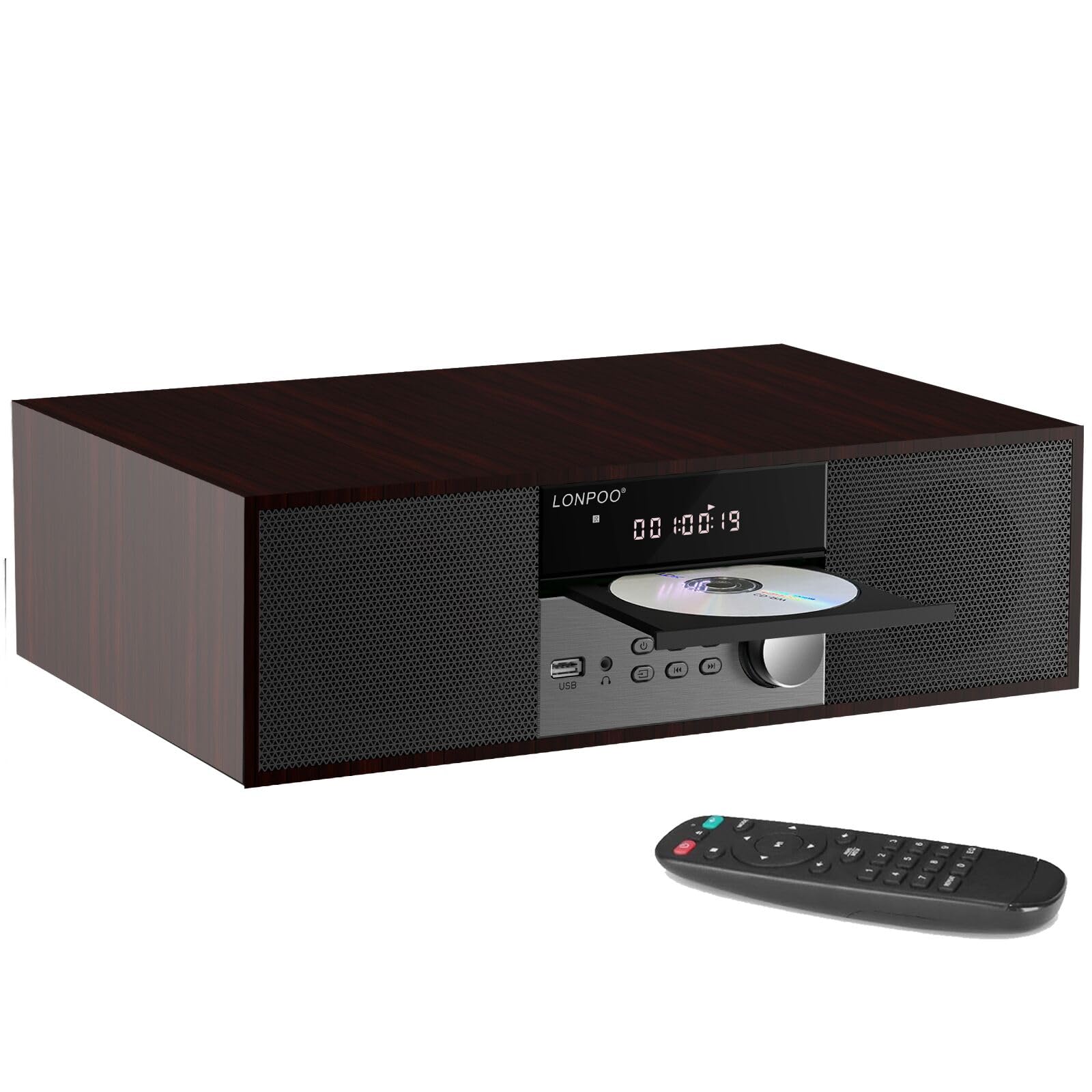
The LONPOO LP-816 targets buyers who want a retro-styled system without paying vintage audio prices. Its brown wood-textured finish and silver front panel mimic classic micro hi-fi designs. Internally, the 4” drivers use a copper cap on the tweeter to stabilize voice coil inductance, theoretically smoothing high-frequency response. At 40W RMS total, it has enough power for a bedroom or small office.
Bluetooth connectivity is stable, and owners report no dropouts during extended play. The remote control covers all basic functions, and the system reads CD-R discs reliably. At this price point, the sound quality is genuinely impressive for vocals and acoustic music, though complex rock tracks can sound a bit congested at higher volumes.
The heatsink design is minimal — owners noted the chassis gets warm after a couple of hours of loud playback. This is not unusual for budget amplifiers, but it means you should leave ventilation space around the unit. If you prioritize style and functional connectivity over raw audiophile resolution, the LP-816 is an excellent entry-level choice.
Why it’s great
- Vintage brown wood finish looks great on shelves
- Copper cap tweeters produce smoother highs than budget peers
- Reliable Bluetooth with no dropouts
Good to know
- Chassis runs warm during extended use
- Soundstage compresses on complex arrangements
5. AUDIOENGINE A5+

The Audioengine A5+ is a powered bookshelf speaker system, meaning no separate amplifier is required. Each speaker contains a 50W amplifier driving a 5” aramid fiber woofer and a 3/4” silk dome tweeter, for a total of 150W. The result is detailed, dynamic sound with tight, articulate bass that puts most all-in-one shelf systems to shame. Custom-tuned crossovers ensure clear vocal reproduction and instrument separation.
Connectivity is straightforward: RCA and 3.5mm AUX inputs for turntables, TVs, computers, and game consoles. The Bluetooth implementation is stable but requires the wired speaker-to-speaker connection to function — it only replaces the cable from your source. The handcrafted wood cabinets (available in bamboo or high-gloss finishes) reduce cabinet resonance and look premium.
The A5+ system occupies more space than a single-chassis micro system and requires AC power to each speaker. There is no CD player or radio, so you must provide your own source. For listeners who want the best sound quality from their turntable or computer, and who do not need physical disc playback, the A5+ is a genuine hi-fi upgrade.
Why it’s great
- 150W of clean, dynamic amplification per pair
- Handcrafted wood cabinets reduce resonance
- Simple RCA/AUX connection for any source
Good to know
- No CD player, radio, or tuner built in
- Requires AC power to both speakers
6. HANLIM HL-616

The HANLIM HL-616 uses a balanced braided carbon fiber woofer — a material choice more common in premium speakers — to deliver punchy, controlled bass from a compact 30W system. The silk tweeter handles high frequencies with less fatigue than typical entry-level mylar drivers. Five EQ presets (Pop, Jazz, Rock, Classic, Flat) plus a dedicated Bass mode let you tailor the sound profile for different genres.
Connectivity covers CD playback, USB flash drive support up to 32GB, Bluetooth, FM radio with RDS, and a headphone jack. The resume playback function is a thoughtful addition for language learners or audiobooks. The system is compact enough for a desk or small shelf without overwhelming the workspace.
Some owners noted distortion at maximum volume, especially with bass-heavy tracks, and the speaker wire is only 3 feet long, which limits placement flexibility. The FM antenna also benefits from extension for clearer reception in basements or urban areas with interference. For background music in a small office or bedroom, the HL-616 offers surprisingly refined driver quality for its price tier.
Why it’s great
- Carbon fiber woofers deliver tight, punchy bass
- Multiple EQ presets including Bass and Jazz modes
- CD, USB, Bluetooth, and FM all in one compact chassis
Good to know
- Distorts at maximum volume on bass-heavy tracks
- Short 3-foot speaker wire limits placement
7. PANASONIC SC-PM270PP-K

The SC-PM270 is Panasonic’s entry-level micro system, offering 20W RMS total power through a 10cm woofer and 6cm tweeter per channel with a bass reflex port. While it lacks the power of the PM700, it compensates with Bluetooth Re-Master technology that compensates for audio compression during wireless streaming, resulting in clearer mids than most budget systems.
The interface is exceptionally simple: a large front-panel volume knob, dedicated bass and treble buttons, and “My Sound” presets for quick tonal adjustment. The included remote covers CD, FM, USB, and Bluetooth controls. The matte front panel resists smudges, and the compact footprint fits easily on a countertop or narrow shelf.
A limitation worth noting is the lack of an AUX input or headphone jack, which restricts wired connections. Some owners also wished for FM preset storage, which is not available here. The 20W output is fine for background listening in a kitchen or bedroom but will struggle to fill a large living room at high volumes without distortion.
Why it’s great
- Bluetooth Re-Master improves compressed audio quality
- Simple, intuitive front-panel controls
- Compact footprint fits small spaces easily
Good to know
- No AUX input or headphone jack
- 20W RMS is underpowered for large rooms
FAQ
Can I connect a turntable directly to an audio shelf system?
Does higher RMS wattage always mean better sound?
Why does Bluetooth sound worse on some shelf systems?
Final Thoughts: The Verdict
For most users, the best audio shelf system winner is the Panasonic SC-PM700PP-K because it delivers 80W of clean RMS power through silk dome tweeters and bass reflex ports at a mid-range price. If you want Wi-Fi streaming and Internet Radio with a color display, grab the Philips TAM8905/37. And for a purist audiophile setup with separate components and a dedicated headphone stage, nothing beats the Denon D-M41.

Mo Maruf
I created WellFizz to bridge the gap between vague wellness advice and actionable solutions. My mission is simple: to decode the research and give you practical tools you can actually use.
Beyond the data, I am a passionate traveler. I believe that stepping away from the screen to explore new environments is essential for mental clarity and physical vitality.