Our readers keep the lights on and my smoothie glass nicely filled. As an Amazon Associate, I earn from qualifying purchases.
The countertop is littered with a standalone grinder, a clunky espresso machine, a drippy kettle for pour-over, and a separate milk frother. Every coffee drink you want demands a different gadget, a different cleaning routine, and a different workflow. The result is a kitchen that looks like a coffee lab and a morning routine that costs you fifteen minutes before you’ve even had a sip. That’s the exact pain an all-in-one coffee machine is engineered to solve.
I’m Mohammad Maruf — the founder and writer behind WellFizz. I’ve spent years analyzing espresso machine engineering, grinding burr geometry, thermoblock vs. boiler heat delivery, and the actual extraction physics that separate a good shot from a bitter disaster.
After evaluating dozens of units across every price tier, I’ve isolated the models that genuinely deliver on the promise of a single-machine workflow. This guide to the best all in one coffee machine will help you match real-world specs to your daily coffee habits without wasting money on flashy features that don’t improve your cup.
How To Choose The Best All In One Coffee Machine
A true all-in-one machine must compress three distinct devices into one footprint: a grinder, a brewer, and a milk steamer. The challenge is that each subsystem has its own engineering requirements. A machine that shortcuts any one of these three pillars will force you to compromise on coffee quality, workflow speed, or cleaning effort. Here are the five specification groups that separate serious contenders from kitchen clutter.
Pump Pressure and Extraction Architecture
The pump pressure rating — typically 15 or 20 bar in home machines — determines how forcefully water is pushed through the coffee puck. A 15-bar pump is sufficient for standard espresso extraction when paired with proper pre-infusion, which wets the grounds at low pressure before ramping up to full force. A 20-bar pump offers more headroom for finer grinds and can produce denser crema, but only if the machine’s OPV (over-pressure valve) is calibrated correctly. Raw bar numbers mean little without temperature stability; look for PID temperature control, which holds water within a single degree of your target brew temperature.
Integrated Burr Grinder Quality
The grinder is the most failure-prone subsystem in any all-in-one. Conical steel burrs are the industry standard for home machines because they produce uniform particle size with fewer fines than blade grinders. Adjustable grind settings — ideally 15 or more — let you dial in extraction for different bean roasts. A straight-through grind path with an anti-static mechanism prevents clogs and reduces mess. Removable burrs that can be rinsed without tools are a major convenience feature that most budget machines skip.
Milk Steaming and Frothing Capability
A manual steam wand with a single-hole tip gives you precise control over microfoam texture for latte art, but it requires practice. Machines with automatic frothers or hands-free systems sacrifice control for convenience — they heat and texture milk with a single button press but often produce coarser foam. If you drink straight espresso or black coffee, a weak frother might not matter. If lattes and cappuccinos are your daily drivers, evaluate steam pressure and wand articulation before anything else.
Water Capacity and Footprint
Water tank volume directly dictates how many drinks you can pull before a refill. A 60-ounce tank handles 15–20 single shots or 8–10 milk drinks. Machines with removable tanks are easier to fill at the sink. Countertop footprint matters more in smaller kitchens; look at total depth, especially if the machine needs clearance for a top-loading bean hopper or rear water tank access. A compact unit like the AIRMSEN at 10 inches wide saves space but may limit cup clearance under the group head.
Build Materials and Maintenance Cycle
Stainless steel exteriors resist fingerprints and scratches better than plastic. Internal components matter more: brass brew groups hold temperature better than aluminum, and removable brewing units simplify deep cleaning. Descaling intervals range from every 2 months to every 6 months depending on water hardness and the machine’s steam usage. Machines with automatic cleaning cycles reduce daily friction but may drain the drip tray faster. Factor in the cost and availability of replacement parts like gaskets, O-rings, and water filters when estimating long-term ownership cost.
Quick Comparison
On smaller screens, swipe sideways to see the full table.
| Model | Category | Best For | Key Spec | Amazon |
|---|---|---|---|---|
| Ninja Luxe Café Pro (ES701) | Super-Automatic | Guided brewing with zero guesswork | Weight-based dosing + 25 grind settings | Amazon |
| De’Longhi Eletta Explore | Super-Automatic | 50+ one-touch hot & cold recipes | Cold Extraction + LatteCrema Cool | Amazon |
| Bosch VeroCafe 800 (TQU60703) | Fully Automatic | Easy maintenance with remote app control | 13 built-in drinks + Home Connect app | Amazon |
| Breville Barista Express (BES870XL) | Semi-Automatic | Manual control for serious home baristas | PID + integrated conical burr grinder | Amazon |
| De’Longhi La Specialista Arte Evo | Semi-Automatic | Cold brew in under 5 minutes | Cold Extraction + 8 grind settings | Amazon |
| Chefman Crema Supreme | Semi-Automatic | 30 grind settings at a mid-range price | 15-bar pump + pressure gauge display | Amazon |
| Gevi 20 Bar | Semi-Automatic | High 20-bar pressure with 30 grind gears | 20 bar + 58mm portafilter | Amazon |
| Electactic (2026 Upgrade) | Semi-Automatic | Clog-resistant grind path for dark roasts | PID + 20% wider polished chute | Amazon |
| AIRMSEN Espresso Machine | Semi-Automatic | Budget entry with 20-bar pump & touchscreen | 20 bar + 1350W motor | Amazon |
In‑Depth Reviews
1. Ninja Luxe Café Pro Series (ES701)

The Ninja Luxe Café Pro is the rare machine that genuinely replaces a grinder, espresso brewer, drip coffee maker, cold brew system, and milk frother without forcing compromises in any single function. Its Barista Assist Technology uses weight-based dosing rather than time-based grinding, so every portafilter basket receives the exact gram weight of grounds for your chosen drink. This eliminates the single biggest variable that ruins home espresso: inconsistent dose weight. The integrated tamper lever means you never touch a handheld tamper or overfill the basket, which is a mess-saving innovation that other brands haven’t matched.
The Dual Froth System Pro includes an insulated steam wand with five preset froth functions — including cold foam — and the machine auto-purges the wand after every use, preventing milk residue build-up. The 25 grind settings on the conical burr grinder cover everything from ristretto-fine to drip-coarse, and the system adapts its grind recommendation based on the pressure and extraction time of your previous shot. It’s not perfect for every workflow: the quad shot option produces a slightly watery extraction compared to pulling two double shots sequentially, and the machine cannot froth milk and brew simultaneously.
Build quality is robust with a stainless steel chassis and a 68-ounce water tank that handles multiple drinks before refilling. The cleaning routine is simplified by an auto-purge steam wand, a detachable drip tray, and a built-in storage compartment for baskets and cleaning tools. For anyone who wants café-quality espresso, drip coffee, and cold brew from a single countertop footprint, this machine delivers the most polished user experience at its price point.
Why it’s great
- Weight-based dosing removes the biggest variable in espresso quality
- Integrated lever tamper eliminates overfilling and mess
- Hands-free frother works with dairy and plant-based milk
- Barista Assist system adapts grind recommendations shot-to-shot
Good to know
- Cannot froth milk and brew espresso simultaneously
- Quad shot extraction is weaker than pulling two doubles
- Relatively heavy at 27 pounds on the countertop
- Requires a knock box for spent pucks
2. De’Longhi Eletta Explore

The Eletta Explore is a super-automatic powerhouse that grinds, doses, brews, and froths with a single button press. It stores over 50 recipes on its 3.5-inch TFT touchscreen, ranging from hot classics like cappuccino and latte macchiato to cold specialties like iced cappuccino and cold brew. The built-in conical burr grinder offers 13 grind settings, and the Bean Adapt Technology guides you through an optimization flow for each new bag of beans, factoring in roast level and your preferred strength. This machine is the most hands-off option on this list for someone who wants full automation without sacrificing drink quality.
De’Longhi’s Cold Extraction Technology creates cold brew in under three minutes, using a precisely controlled water flow and temperature profile rather than the 12–24 hour steep required by traditional methods. The dual LatteCrema systems handle hot and cold milk separately: the hot system textures milk for lattes and cappuccinos, while the cool system produces velvety cold foam for iced drinks. The machine connects to the De’Longhi Coffee Link App, allowing you to create custom user profiles and brew remotely, though the startup cleaning cycle must still complete before brewing begins.
Cleaning is simplified with dishwasher-safe parts, an automatic rinse cycle that runs at startup and shutdown, and a removable brew unit for deep cleaning. The water tank holds 60 ounces and the bean hopper accommodates whole beans for multiple days of heavy use. The primary drawbacks are the serving temperature of milk-based drinks — some users report that lattes come out around 125°F, requiring a microwave reheat — and the frequent drip tray emptying caused by the self-cleaning cycles. For maximum drink variety with minimal manual intervention, this is the strongest super-automatic competitor available.
Why it’s great
- 50+ one-touch recipes for hot and cold drinks
- Cold brew in under three minutes with Cold Extraction Technology
- Bean Adapt Technology optimizes extraction per bean type
- Removable brew unit and dishwasher-safe parts for easy cleaning
Good to know
- Milk drink serving temperature may require reheating
- Frequent tray emptying due to automatic cleaning cycles
- Remote brewing delayed by mandatory startup rinse
- Premium price point requires long-term commitment
3. Bosch VeroCafe 800 (TQU60703)
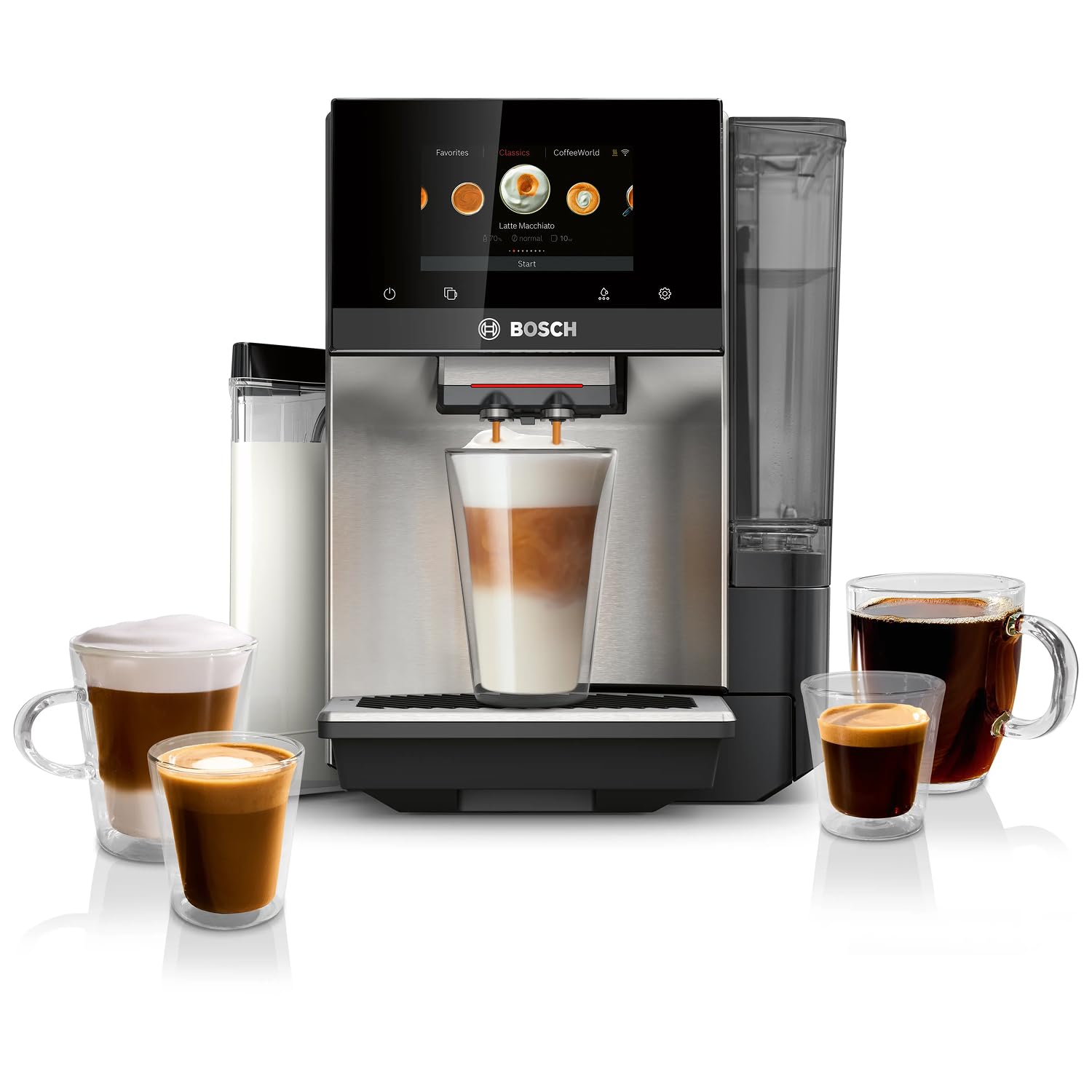
The Bosch VeroCafe 800 takes a different approach than the competition: instead of overwhelming you with hundreds of presets, it focuses on doing 13 core drinks exceptionally well. The large touchscreen interface allows you to customize strength, volume, milk ratio, and aroma for each drink, and the machine remembers your profile for next time. The integrated milk container connects directly to the machine via an adapter, eliminating the need to hold a pitcher under a steam wand. The removable brew unit is one of the easiest to access and clean in this class — you simply pull it out, rinse it under running water, and snap it back in.
The conical burr grinder delivers consistent particle size across the full grind range, and the Home Connect app gives you remote control over brewing schedules and maintenance alerts. The combined cleaning and descaling program is guided step-by-step on the touchscreen, reducing the guesswork that typically leads to machine neglect. The machine self-rinses at startup and shutdown, and the drip tray contains a sensor that alerts you when it needs emptying. The water tank holds a generous capacity for the 22-pound footprint, and the bean hopper has a sealable lid that preserves bean freshness between uses.
Real-world feedback from long-term owners consistently praises the Bosch for producing espresso that rivals dedicated units from Jura and Miele, particularly with medium-roast single-origin beans. The milk system is notably easy to clean — the milk container and all associated tubing can be refrigerated between uses without disassembly. The primary complaints center on the price, which sits at the top of this list, and the fact that the hopper lid can cause bean spillage if not closed carefully. Milk-based drinks may not reach the same temperature as those from a manual steam wand, and the app-assisted drink library is limited compared to the Eletta Explore’s 50-plus recipes.
Why it’s great
- Exceptional espresso quality rivals dedicated premium machines
- Removable brew unit with tool-free rinsing
- Home Connect app for remote brewing and maintenance alerts
- Self-cleaning with guided descaling program
Good to know
- Highest price point limits accessibility
- Limited drink library compared to super-automatic competitors
- Milk drinks not as hot as manual wand alternatives
- Bean hopper lid can spill beans if not handled carefully
4. Breville Barista Express (BES870XL)
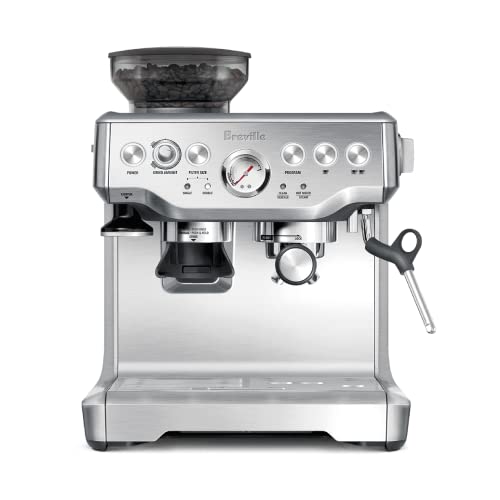
The Breville Barista Express has been the benchmark entry-level semi-automatic all-in-one for years, and for good reason. Its integrated conical burr grinder doses directly into the 54mm portafilter, and the grind size dial on the side of the machine gives you infinite adjustment across the espresso range rather than numbered steps. The PID digital temperature control holds water within a single degree of your target, which is rare at this price point and critical for repeatable extraction. The low-pressure pre-infusion gradually ramps up pressure at the beginning of the shot, which helps prevent channeling and ensures even saturation of the puck.
The manual steam wand uses a single-hole tip that requires some practice to produce microfoam, but it gives you the control necessary for latte art. The included Razor Dose Trimming Tool levels the puck to the correct depth, eliminating the guesswork that beginners struggle with. The machine has a 67-ounce water tank, a stainless steel exterior that resists smudges, and a 1-year limited warranty. Long-term user reports indicate that with proper maintenance — wiping the steam wand, purging the group head, and replacing the water filter every 60 uses — the machine lasts 5–7 years before needing minor repairs like gasket or O-ring replacement.
The Barista Express is not a super-automatic: you must manually grind, tamp (though the integrated tamper helps), attach the portafilter, and steam the milk. For someone who wants to learn the craft of espresso rather than push a button, this hands-on requirement is a feature, not a bug. The main concessions are the 54mm portafilter (smaller than the 58mm professional standard, which limits accessory compatibility), the relatively high coffee waste during the dial-in process, and the fact that the machine does not produce piping-hot espresso out of the box without a pre-warming ritual. For the price, it remains the most repairable and best-documented machine in its class.
Why it’s great
- PID temperature control ensures repeatable shot quality
- Infinite grind adjustment for precise dial-in
- Proven long-term durability with available replacement parts
- Integrated tamper and Razor tool reduce dosing errors
Good to know
- 54mm portafilter limits third-party accessory compatibility
- Requires hands-on workflow for every shot
- High coffee waste during initial dial-in process
- Does not produce piping-hot espresso without pre-warming
5. De’Longhi La Specialista Arte Evo

The La Specialista Arte Evo positions itself as a semi-automatic machine for the user who wants espresso, Americano, and cold brew without investing in a separate cold brew system. Its proprietary Cold Extraction Technology, developed in collaboration with the Specialty Coffee Association, delivers a single-serve cold brew in under five minutes by precisely controlling water flow and pressure at lower temperatures. This is a genuine differentiator: no other machine in this price range can produce cold brew on demand without a 12-hour steep.
The commercial-style steam wand delivers consistent steam pressure for milk texturing, though the limited wand articulation makes it harder to position the pitcher at the optimal angle. The included barista kit — dosing funnel, tamping mat, and stainless steel tamper — improves the consistency of your puck prep. The 15-bar Italian pump uses a low-pressure pre-infusion before ramping to full extraction pressure, and the pressure gauge on the front panel gives you visual feedback on extraction quality. The machine is 21.5 pounds with a stainless steel body and a water tank that is accessible from the top for easy filling.
Customer feedback highlights the forgiving workflow: even first-time users can produce drinkable shots with minimal trial and error. The main downside is the grinder’s tendency to jam with dark-roast beans if the grind setting is too fine — the manufacturer recommends setting the grinder to 7 or 8 (coarser) when using oily beans. The auto shutoff timer is also shorter than some users prefer, requiring a deliberate wake-up before the first morning shot. For someone who wants cold brew capability without sacrificing espresso quality, this machine offers the best cold-to-hot balance in the semi-automatic segment.
Why it’s great
- Cold brew in under five minutes with Cold Extraction Technology
- Active Temperature Control matches brew temp to bean roast
- Forgiving workflow suitable for beginners
- Included barista kit improves puck prep consistency
Good to know
- Grinder can jam with dark-roast beans at fine settings
- Limited steam wand articulation for milk texturing
- Auto shutoff timer requires manual wake-up
- Only 8 grind settings compared to competitors with 20+
6. Chefman Crema Supreme

The Chefman Crema Supreme packs 30 grind settings into a machine that costs significantly less than premium competitors, making it the strongest value proposition for someone who wants granular control over grind size without paying for a Breville or De’Longhi badge. The conical burr grinder dispenses directly into the 58mm portafilter — a professional-size basket that opens up compatibility with standard tampers, distributors, and bottomless portafilters. The 15-bar pump produces respectable crema, and the pressure gauge on the front panel gives real-time feedback on whether your puck prep and grind size are in the correct range.
The machine features a 3-liter water tank — the largest capacity on this list — which translates to fewer refills during heavy use. The included accessories are generous for the price: a stainless steel milk pitcher, a robust tamper, espresso cleaning tools, and a grinding funnel. The steam wand integrates into the side of the machine and produces adequate steam pressure for home milk texturing, though it is louder than the wands on mid-range competitors. The 58mm portafilter is a legitimate advantage over the Breville’s 54mm system, letting you use aftermarket baskets and tampers without compatibility issues.
Owner reports after several months of use indicate that the grinder performs reliably with regular cleaning but can overfill the portafilter basket if the preset dose timing is not adjusted. The milk frother is the weakest link — it is functional but lacks the precision of a dedicated steaming setup. The machine’s 21.8-pound weight and 16-inch height mean it requires dedicated counter space with sufficient overhead clearance. For the budget-conscious home barista who prioritizes grind adjustability and large water capacity over refined milk steaming, the Crema Supreme delivers exceptional value.
Why it’s great
- 30 grind settings for precise dial-in across bean types
- 58mm professional portafilter compatible with standard accessories
- 3-liter water tank minimizes refills
- Pressure gauge provides real-time extraction feedback
Good to know
- Milk frother is louder and less precise than premium wands
- Grinder preset can overfill portafilter basket
- 16-inch height requires overhead clearance
- Some plastic components feel less durable than all-steel builds
7. Gevi 20 Bar Espresso Machine
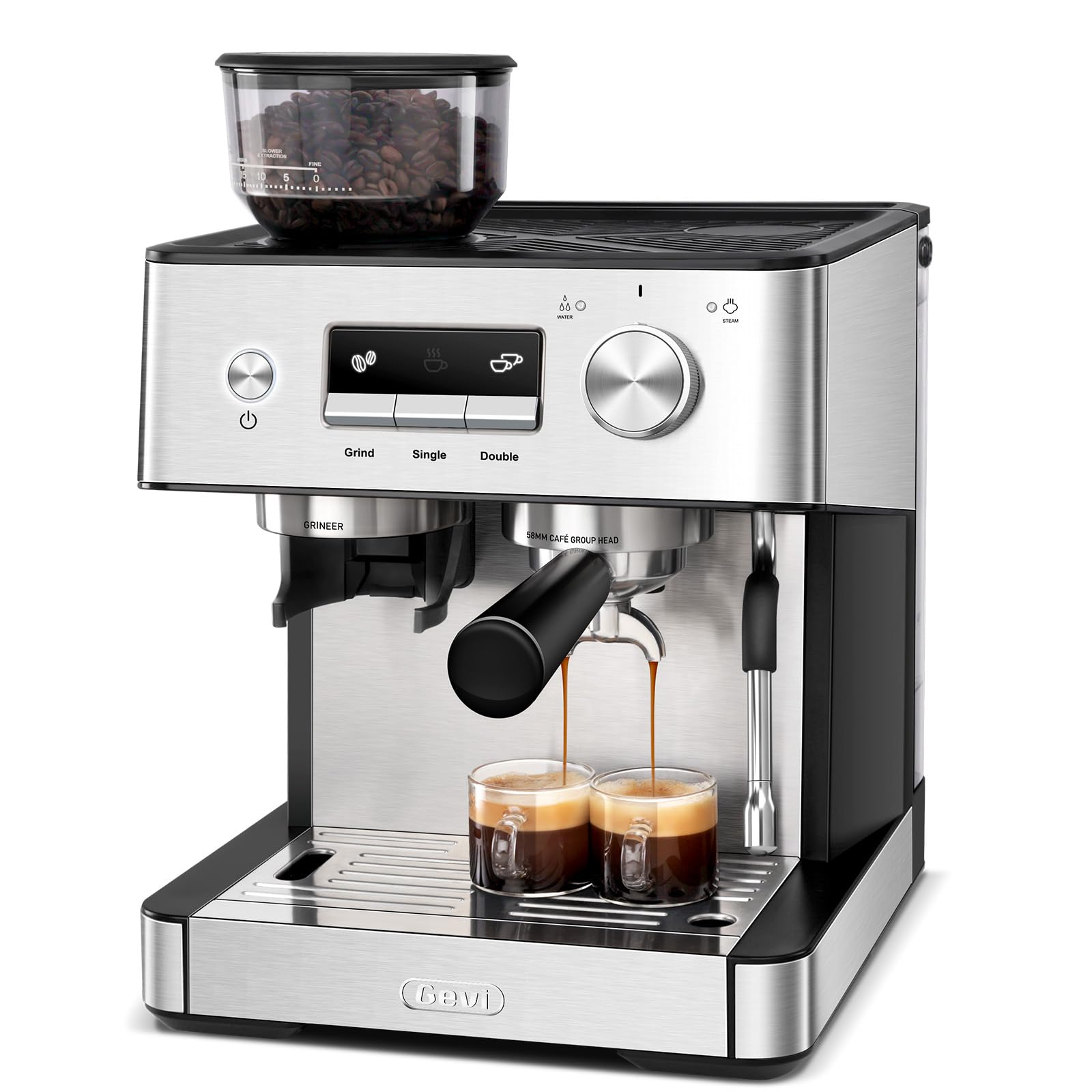
The Gevi 20 Bar is a direct competitor to the Chefman Crema Supreme, offering a similar spec sheet — 20 bar pump pressure, built-in conical burr grinder, and 58mm portafilter — at a near-identical price point. The key differentiator is the 0–30 gear adjustable bean box, which gives you 30 grind settings mapped to numbered gears rather than stepped notches. The 20-bar pump combined with a pre-infusion cycle aims to extract the full aromatic profile of the beans, and user reports confirm that the machine produces golden crema on freshly roasted medium roasts.
The steam wand is constructed from stainless steel and delivers sufficient power for home milk frothing, though it requires the same manual technique as any semi-automatic machine. The water tank holds 2.3 liters and is removable from the top for easy filling. The machine’s all-in-one control panel groups every operation — grind, brew, steam — on a single interface, reducing the learning curve for first-time users. The included accessories cover the basics: a single and double dual-wall filter basket, a tamper, and a cleaning brush.
Customer experiences highlight that the machine requires an initial dial-in period of roughly 15 cups to find the correct grind setting and dose weight for your specific beans. Users who previously owned Breville machines report that the Gevi delivers comparable shot quality at a significantly lower cost, with the main trade-off being less refined steam wand performance and a slightly longer heat-up time. The 9.3-pound weight is notably lighter than many competitors, which may be a concern for stability during the tamping process. For the budget-focused buyer who wants 20-bar extraction and a 58mm portafilter, this machine delivers the core components of a capable espresso setup.
Why it’s great
- 20-bar pump with pre-infusion for rich crema extraction
- 30-gear adjustable grind settings for precise dial-in
- 58mm portafilter for standard accessory compatibility
- Removable water tank simplifies cleaning and refilling
Good to know
- Requires 15+ cups of dial-in time for optimal extraction
- Steam wand performance lags behind premium competitors
- Lightweight build may shift during tamping
- Longer heat-up time than similarly priced machines
8. Electactic (2026 Upgrade)
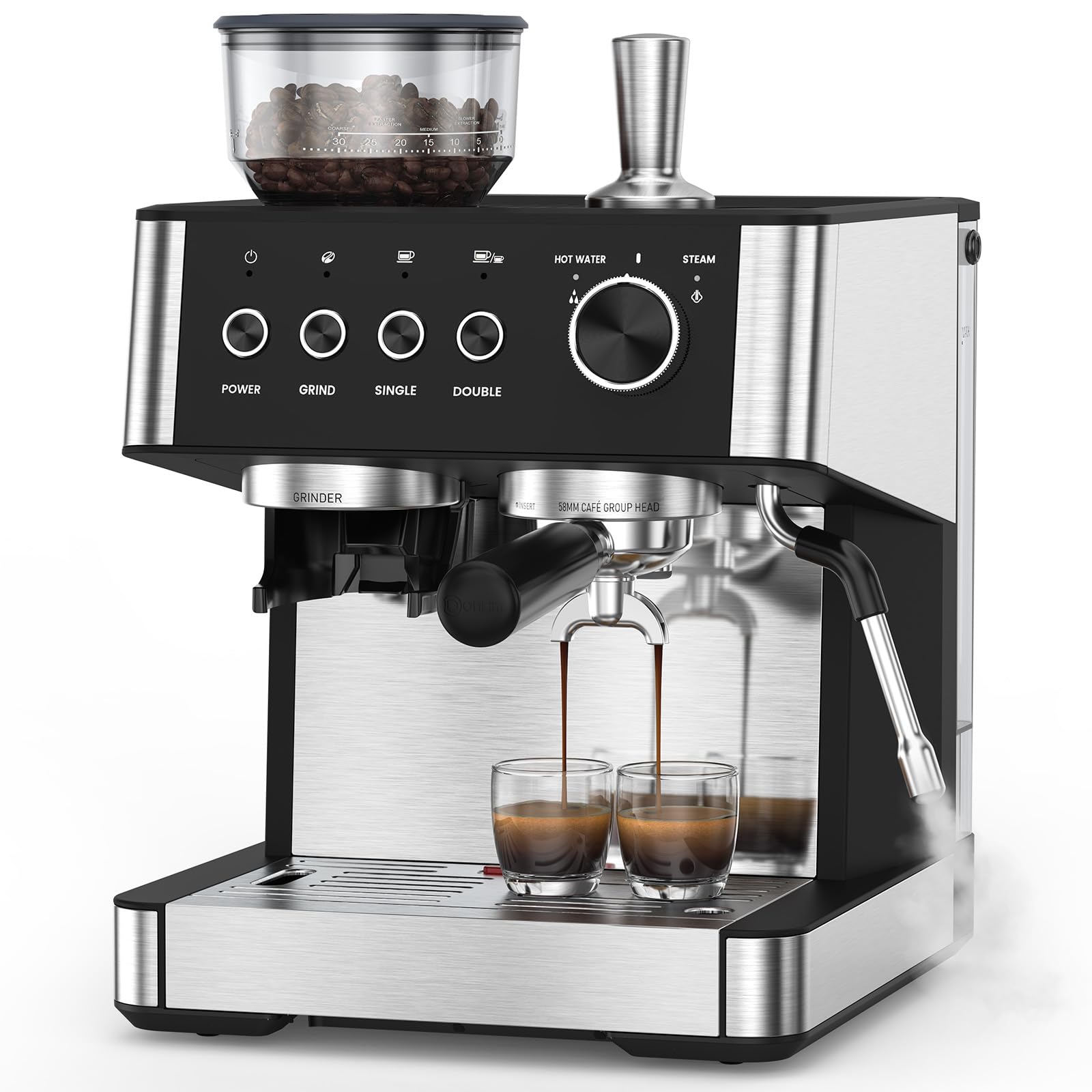
The Electactic 2026 Upgrade targets a specific frustration that plagues integrated grinder machines: clogs from oily dark-roast beans. The upgraded grind path features a 20% wider polished chute and a reinforced helical auger designed to eject grounds instantly rather than letting them accumulate and jam. This engineering focus makes it a strong choice for drinkers who prefer dark roasts or espresso blends that release more oil during grinding. The machine also includes PID temperature control, which maintains a stable brewing temperature throughout extraction — a feature typically found on machines costing significantly more.
The low-pressure pre-infusion system wets the coffee puck before full extraction, reducing channeling and ensuring even flavor extraction. The steam wand produces enough pressure for home milk texturing, though the quality of microfoam is limited by the single-hole tip design. The 2.3-liter water tank is removable and sits behind a satin black exterior that resists fingerprints. The machine is equipped with ETL certification for electrical safety and includes a detachable drip tray for easier cleaning.
User feedback is generally positive, with many noting that the machine produces smooth, rich espresso comparable to cafe quality when dialed in correctly. The integrated grinder is easy to clean with a removable burr, and the machine is forgiving enough for beginners to produce drinkable results within the first few tries. The main consideration is that the PID control, while present, does not offer the same level of fine-tuned adjustment as more advanced machines, making it better suited for drinkers who use one consistent bean type rather than switching between roast levels daily.
Why it’s great
- Anti-clog grind path handles oily dark roasts without jamming
- PID temperature control for stable extraction temperature
- Low-pressure pre-infusion reduces channeling
- Removable burr grinder for easy cleaning
Good to know
- Three-step workflow requires manual water addition for Americanos
- PID adjustment is less granular than premium competitors
- Steam wand microfoam quality is entry-level
- Machine weight of 18 pounds is moderate but not compact
9. AIRMSEN Espresso Machine
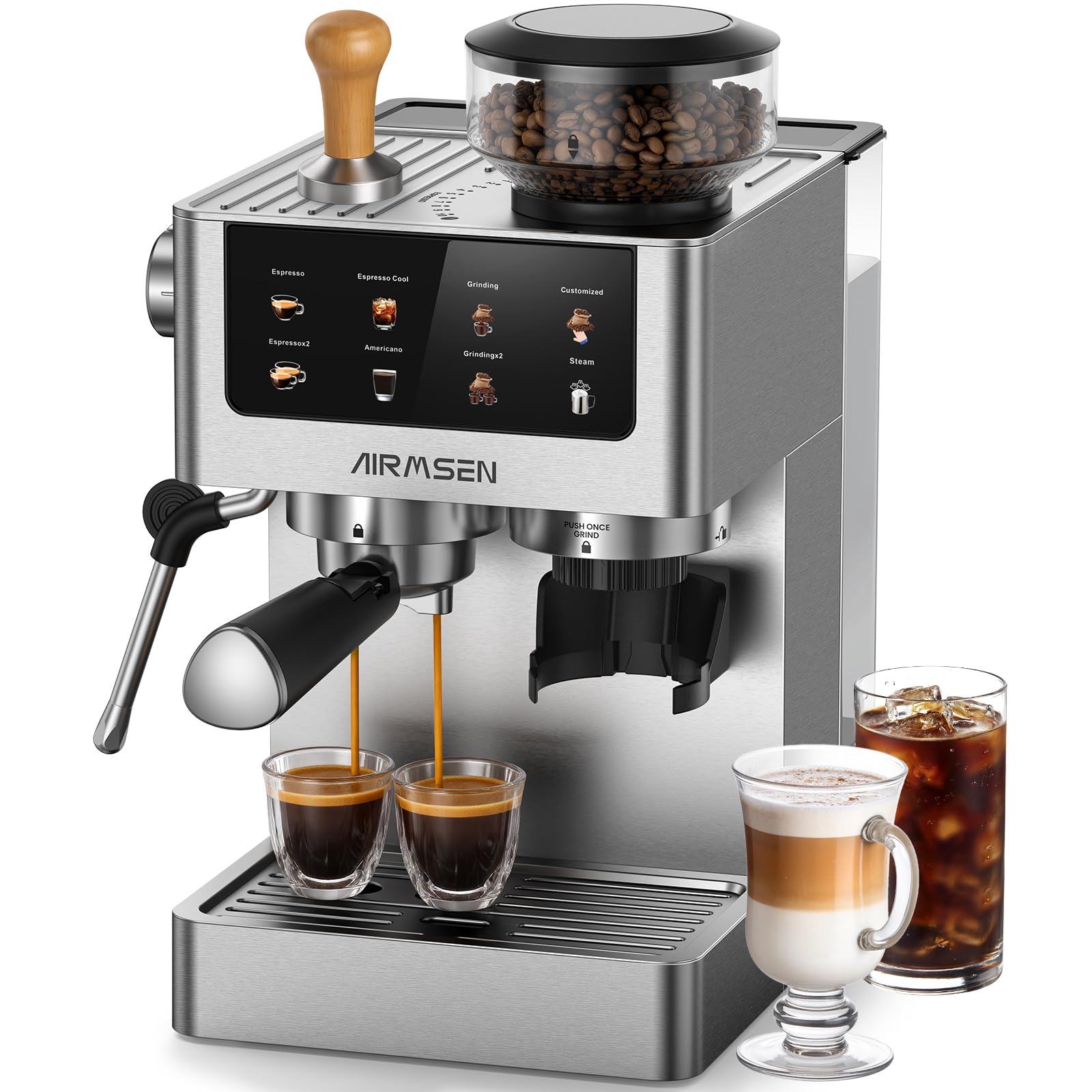
The AIRMSEN is the most affordable machine on this list, yet it packs a 20-bar pump and a 1350W motor — specifications that are typically reserved for mid-range machines. The stainless steel burr grinder offers 10 grind settings and uses a dual anti-static system (ionizer plus ring) to reduce mess during grinding. The full touchscreen LED panel controls the entire brewing process, from grind selection to shot volume, and the compact footprint (7.9 inches wide, 14.6 inches tall) makes it the best option for small countertops with limited depth. The machine measures just 11 pounds, which is light enough to move easily but may feel less stable during the portafilter locking process.
The manual steam wand is detachable for rinsing and produces acceptable steam pressure for basic milk frothing, though it lacks the refinement needed for microfoam suitable for latte art. The 61-ounce water tank is removable and includes a handle for easy transport to the sink. The machine includes a 51mm portafilter, which is smaller than the industry-standard 58mm but consistent with other machines in its price tier. The included accessories — a 2-in-1 measuring spoon with a pressed bottom, single and double cup filter baskets, and a milk box — cover the essentials for getting started without additional purchases.
Customer reviews highlight that the machine produces great coffee when the grind setting is properly dialed in, but several users note that the grinder can be messy, dropping grounds during the brewing cycle. The grinder’s straight-through design is meant to prevent bean jams, but the grind setting #2 can produce more grounds than the basket can hold, leading to waste. Customer service responsiveness is reported as excellent, with one user receiving a replacement unit after six weeks of troubleshooting. For the absolute lowest entry point to an all-in-one espresso experience, the AIRMSEN delivers the core components without the premium fit and finish of higher-priced machines.
Why it’s great
- 20-bar pump at the lowest price point in this category
- Compact footprint fits small countertops
- Touchscreen interface simplifies operation
- Anti-static system reduces grinding mess
Good to know
- Grinder can drop grounds during brewing cycle
- 51mm portafilter limits accessory compatibility
- Lightweight build may shift during portafilter locking
- Steam wand produces basic foam, not microfoam
FAQ
What is the difference between semi-automatic and super-automatic all-in-one machines?
How often should I descale an all-in-one coffee machine?
Can I use pre-ground coffee in a machine with a built-in grinder?
Does the portafilter size matter for an all-in-one machine?
Final Thoughts: The Verdict
For most users, the best all in one coffee machine winner is the Ninja Luxe Café Pro (ES701) because it combines weight-based dosing, an integrated tamper, a hands-free frother, and cold brew capability in a single machine that requires almost no learning curve to produce café-quality drinks. If you want maximum drink variety with one-touch convenience, grab the De’Longhi Eletta Explore. And for the hands-on home barista who values repairability and shot control above automation, nothing beats the Breville Barista Express (BES870XL).

Mo Maruf
I created WellFizz to bridge the gap between vague wellness advice and actionable solutions. My mission is simple: to decode the research and give you practical tools you can actually use.
Beyond the data, I am a passionate traveler. I believe that stepping away from the screen to explore new environments is essential for mental clarity and physical vitality.