Our readers keep the lights on and my smoothie glass nicely filled. As an Amazon Associate, I earn from qualifying purchases.
Shooting in dimly lit venues — a concert hall, a candlelit dinner, an evening street scene — pushes a point-and-shoot camera to its absolute limit. Small sensors and slow lenses turn potentially great shots into a mess of noise and motion blur. The difference between a keeper and a disappointment often comes down to two specs: the physical size of the sensor and the maximum aperture of the lens.
I’m Mohammad Maruf — the founder and writer behind WellFizz. I’ve spent years analyzing sensor architectures, lens coatings, and image-processing pipelines to understand exactly how compact cameras handle the dark, and I’ve broken down the critical specs that separate mediocre low-light performance from genuinely usable results.
After evaluating sensor size, maximum aperture, image stabilization systems, and high-ISO noise handling across the current market, I’ve compiled the definitive list of the best cameras for low light point and shoot to help you capture sharp, vibrant images even when the light gets low.
How To Choose The Best Cameras For Low Light Point And Shoot
Selecting a point-and-shoot for low light is a different game than buying one for bright, sunny landscapes. The standard rule — more megapixels equals better — breaks down when the light fades. You need to prioritize three specific elements: the sensor, the lens, and the stabilization.
Prioritize Sensor Size Over Megapixels
A larger sensor captures more light per pixel. This is the single most important factor. Look for a 1-inch type sensor (like the one in the Sony RX100 series and Canon PowerShot V1) or, for maximum performance, an APS-C sensor (found in the Ricoh GR IIIx and Fujifilm X100VI). These sensors gather significantly more light than the tiny sensors in most budget compact cameras, resulting in cleaner images at high ISOs.
Look for a Fast Lens (Wide Aperture)
The lens aperture, denoted as f/1.8, f/2.0, f/2.8, controls how much light enters the camera. A lower f-number means a wider opening and a much “faster” lens. A camera with an f/1.8 lens lets in four times more light than one with an f/3.5 lens. This directly translates to faster shutter speeds, less noise, and a better chance of freezing motion in a dimly lit room.
Check for Effective Image Stabilization
When you’re forced to shoot at slower shutter speeds in low light, any camera shake will ruin the image. Optical Image Stabilization (OIS) or In-Body Image Stabilization (IBIS) is crucial. Look for features like Nikon’s Dual Detect Optical VR or Canon’s IS modes. Effective stabilization can give you three to five stops of hand-holdability, turning a blurry shot into a sharp one.
Quick Comparison
On smaller screens, swipe sideways to see the full table.
| Model | Category | Best For | Key Spec | Amazon |
|---|---|---|---|---|
| Canon PowerShot V1 | Hybrid | Video & Stills Low Light | 1.4-Type 22.3MP Sensor | Amazon |
| Sony RX100 II | Premium Compact | Pocketable Low Light | 1-inch 20.2MP Exmor R | Amazon |
| Ricoh GR IIIx | APS-C Compact | Maximum Image Quality | 24.2MP APS-C Sensor | Amazon |
| Fujifilm X100VI | Premium Compact | Street & Travel Low Light | 40.2MP APS-C X-Trans | Amazon |
| Canon PowerShot V10 | Vlogging Compact | Ultra-Compact Vlogging | 1-inch 15.2MP BSI CMOS | Amazon |
| Panasonic LUMIX ZS99 | Travel Zoom | Concert & Event Zoom | 30x 24-720mm Leica | Amazon |
| OM SYSTEM Tough TG-7 | Rugged | Adventure & Macro | F2.0 Lens, Waterproof | Amazon |
| Kodak PIXPRO AZ528 | Superzoom | Budget Long Zoom | 52x Optical Zoom | Amazon |
| Nikon COOLPIX P1100 | Superzoom | Ultra-Telephoto Low Light | 125x Optical Zoom | Amazon |
In‑Depth Reviews
1. Canon PowerShot V1

The Canon PowerShot V1 is a hybrid camera that effectively blurs the line between a stills compact and a video rig. Its 1.4-type, 22.3MP sensor is physically larger than a standard 1-inch sensor, giving it a tangible advantage in gathering light. Reviewers consistently praise its sharp lens and good low-light performance, with usable images up to ISO 6400, placing it in a league above typical point-and-shoots for dim environments.
The V1’s built-in cooling fan is a standout feature, allowing for extended 4K recording without overheating — a critical detail for content creators who shoot in warm ambient conditions or for long periods. The inclusion of Canon Log 3 provides a wide dynamic range for video, letting you recover shadow and highlight detail in post-production. It’s clearly built for the modern vlogger who also demands excellent still-image quality.
On the downside, the lens has an f/2.8 maximum aperture, which is slower than the f/1.8 lenses found on some competitors like the Sony RX100 II. It also notably lacks in-body optical image stabilization (OIS), relying on electronic stabilization that can be less effective for walking shots. The body is also bulkier than a traditional pocket camera, but this is the price for its advanced sensor and cooling system.
Why it’s great
- Large 1.4-type sensor delivers excellent high-ISO performance for its class.
- Built-in cooling fan prevents 4K video overheating during long takes.
- Canon Log 3 provides a wide dynamic range for professional-grade color grading.
Good to know
- Maximum aperture of f/2.8 is slower than some competitors’ f/1.8 lenses.
- No in-body optical image stabilization (OIS) for smooth handheld video.
- Larger body is less pocketable than ultra-compact options
2. Sony RX100 II

The Sony RX100 II remains a benchmark for low-light compact cameras years after its release, largely due to its 1-inch 20.2MP Exmor R CMOS sensor paired with a bright F1.8 Carl Zeiss Vario-Sonnar T lens. This combination is legendary for a reason: the wide aperture allows you to shoot in significantly darker conditions without cranking the ISO to noisy levels, and the 1-inch sensor keeps that noise well-controlled through ISO 3200.
Users who have upgraded from smartphones or standard kit lenses are consistently stunned by the RX100 II’s ability to handle light transitions and produce sharp, detailed images in environments that would leave other compacts struggling. The inclusion of a tiltable LCD and a hot shoe for an optional external viewfinder or flash makes it a versatile tool for serious shooters who need pocketable performance.
The primary trade-off for this classic is age-related. The lens zooms to f/3.3 at its telephoto end, reducing the low-light advantage. The autofocus system, while capable, is not as snappy as modern hybrid systems. It also lacks 4K video and a built-in electronic viewfinder, features now common in newer models. But for pure low-light stills performance at its price point, it’s incredibly hard to beat.
Why it’s great
- Fast F1.8 lens is excellent for gathering light in dim environments.
- Large 1-inch sensor delivers clean, low-noise images at high ISOs.
- Classic, pocketable design with a useful tilt screen and hot shoe.
Good to know
- Aperture narrows significantly as you zoom, reducing low-light performance.
- Lacks modern 4K video recording and a built-in viewfinder.
- Autofocus system is slower and less sophisticated than current models.
3. Ricoh GR IIIx

The Ricoh GR IIIx is a purist’s camera that packs a massive APS-C sensor — the same size found in many DSLRs — into an incredibly compact, pocketable body. This sensor is over 7x larger than a standard 1-inch sensor, giving it a monumental advantage in dynamic range and high-ISO noise performance. The 40mm equivalent f/2.8 lens is a classic focal length that forces a natural, human-perspective composition, making it ideal for street and documentary photography.
Reviewers are blown away by its sharpness and the image quality it produces, with the ability to resolve an incredible amount of detail. The inclusion of 3-axis sensor-shift image stabilization (IBIS) is a game-changer for low light, allowing for sharp handheld shots at shutter speeds that would be impossible without it. The camera’s snap focus mode lets you pre-focus to a specific distance, enabling nearly instantaneous captures in dimly lit, fast-moving scenarios.
The GR IIIx’s weaknesses are primarily around its laser focus on stills: video capabilities are basic, its battery life is short (plan for multiple spares), and the fixed lens means you have to zoom with your feet. The autofocus system, while reliable when locked, can hunt in very low contrast situations and lacks eye-detection. It is not a camera for everyone, but for the low-light stills photographer, it is a tool of immense capability.
Why it’s great
- APS-C sensor delivers exceptional low-light image quality and dynamic range.
- 3-axis in-body image stabilization (IBIS) enables sharp handheld shots in the dark.
- Extremely compact body that truly fits in a pocket.
Good to know
- Fixed 40mm lens limits compositional versatility.
- Very short battery life requires carrying multiple spares.
- Autofocus can be slow and struggles in very low contrast.
4. Fujifilm X100VI

The Fujifilm X100VI has achieved cult status for good reason. It marries a beautiful retro design with a modern 40.2MP APS-C sensor and a fast, fixed f/2.0 23mm (35mm equivalent) lens. In low light, the combination of the large sensor and relatively wide aperture is formidable, allowing you to capture rich, detailed images with Fujifilm’s legendary color science. The superb 6-stop in-body image stabilization (IBIS) is a revelation, making handheld night shooting incredibly reliable.
For many, the X100VI’s magic is its film simulation modes, which produce gorgeous, film-like JPEGs straight out of the camera. This eliminates the need for post-processing and gives low-light photos a distinctive, atmospheric character that is difficult to replicate. The tactile, manual control dials encourage a deliberate, engaging shooting experience that stands in stark contrast to menu-diving modern cameras.
The X100VI is not without its quirks. Its battery life is shorter than some mirrorless cameras, and its autofocus, while much improved, can still hunt in very dim conditions. The fixed 35mm equivalent lens is a creative constraint, and the camera doesn’t offer the reach for subjects like stage performers. It’s also a significant investment. However, for an everyday carry camera that excels in low light and produces stunning images, it remains an aspirational and highly capable choice.
Why it’s great
- Large 40.2MP APS-C sensor and f/2.0 lens for exceptional low-light capture.
- Superb 6-stop IBIS for incredibly sharp handheld shots.
- Stunning out-of-camera JPEGs with iconic film simulations.
Good to know
- High price point and often difficult to find in stock.
- Battery life is shorter than many competitors.
- Fixed 35mm equivalent lens is a creative limitation for some.
5. Canon PowerShot V10

The Canon PowerShot V10 is a unique vlogging-centric compact that prioritizes portability and ease of use above all else. Its 1-inch 15.2MP back-illuminated CMOS sensor provides a solid foundation for low-light video, performing noticeably better than a smartphone in dimly lit rooms. The fixed f/2.8 19mm wide-angle lens is purpose-built for selfie-style vlogging, ensuring your face and background remain in focus.
Its built-in retractable stand and front-facing screen make it incredibly convenient for solo content creators. The audio quality, with three microphones, is a standout feature. Reviewers love how easy it is to pull from a pocket and start recording, and the image quality is a clear step up from a phone for video, especially when lighting is less than ideal. The 4K video capabilities are solid for its size.
However, the V10 has some serious limitations. It offers no zoom capability at all, making it a strictly fixed-angle tool. The photo quality is merely “okay,” rated below even some smartphones for stills. The battery life is also a common complaint, with users reporting it drains quickly during video recording. It’s a niche device, perfect for the vlogger who values simplicity and audio quality over photographic flexibility.
Why it’s great
- Excellent audio capture with three built-in microphones for vlogging.
- Compact, pocketable design with a built-in stand for hands-free shooting.
- 1-inch sensor provides a notable low-light advantage over smartphones for video.
Good to know
- No zoom at all — you are stuck with a fixed wide-angle lens.
- Battery life is very short, especially for video recording.
- Photo quality is mediocre and not a substitute for a dedicated stills camera.
6. Panasonic LUMIX ZS99

The Panasonic LUMIX ZS99 is a dedicated travel zoom that trades ultimate low-light sensitivity for incredible reach. Its 24-720mm Leica lens gives you a 30x optical zoom, allowing you to pull in distant subjects at a concert or sporting event. The 1/2.3-inch sensor is smaller than the 1-inch sensors found in the premium compact tier, meaning low-light noise is more of a factor at higher ISOs.
This camera excels in scenarios where you need reach above all else. For a concert, you can get a tight shot of the performer from the back of the venue. The 5-Axis Hybrid O.I.S. is effective at stabilizing the zoom at the telephoto end. It’s an incredibly versatile kit that is genuinely pocketable, bridging the gap between a superzoom bridge camera and a low-light specialist.
The primary limitation is the small sensor. Low-light performance is “good” for its class but will not match cameras with a 1-inch or APS-C sensor. Colors and sharpness are decent up to ISO 1600, but beyond that, noise becomes prominent. It also uses a contrast-detect autofocus system that can be slow to lock on in dim conditions. It is the right tool if your primary need is zoom, but not if your priority is pristine night image quality.
Why it’s great
- Powerful 30x optical zoom (24-720mm) for capturing distant subjects.
- Effective 5-Axis Hybrid O.I.S. for stable telephoto shots.
- True pocketable design for a camera with this zoom range.
Good to know
- Small sensor struggles with noise in low light compared to larger sensor compacts.
- Autofocus can be slow and unreliable in dim conditions.
- Image quality at the telephoto end is softer than at wider angles.
7. OM SYSTEM Olympus Tough TG-7

The OM SYSTEM Tough TG-7 is a rugged compact that can survive what no other camera on this list can: a 15-meter dive, a 2.1-meter drop, and temperatures down to -10°C. Its bright f/2.0 lens is a key feature for low light, letting in more light than the typical f/3.5 lens found on most rugged cameras. For macro photography in dim tidepools or under a forest canopy, this aperture advantage is critical.
Users rave about its “microscope mode,” which allows for extreme close-ups that reveal incredible detail. The camera’s build quality is superb, and the underwater shooting modes produce vibrant and well-exposed images. It also shoots 4K video, making it a durable companion for documenting any adventure, regardless of the conditions.
The TG-7 is not a low-light specialist in the traditional sense. Its 12MP 1/2.3-inch sensor is smaller and will produce noise in dim environments, similar to a good smartphone. It will not match the image quality of a 1-inch camera like the Sony RX100 II in a dark room. It hits its stride in challenging environments where you need a durable camera with a fast-enough lens to make the most of available light without a flash.
Why it’s great
- Extremely durable: waterproof, shockproof, crushproof, and freezeproof.
- Fast f/2.0 lens is a standout for low light in the rugged category.
- Excellent macro and microscope modes for detailed close-ups.
Good to know
- Small sensor means noticeable noise in suboptimal light.
- Image quality is not competitive with 1-inch or APS-C sensor compacts.
- Larger and more pocketable than a dedicated action camera but bulkier than a standard compact.
8. Kodak PIXPRO Astro Zoom AZ528
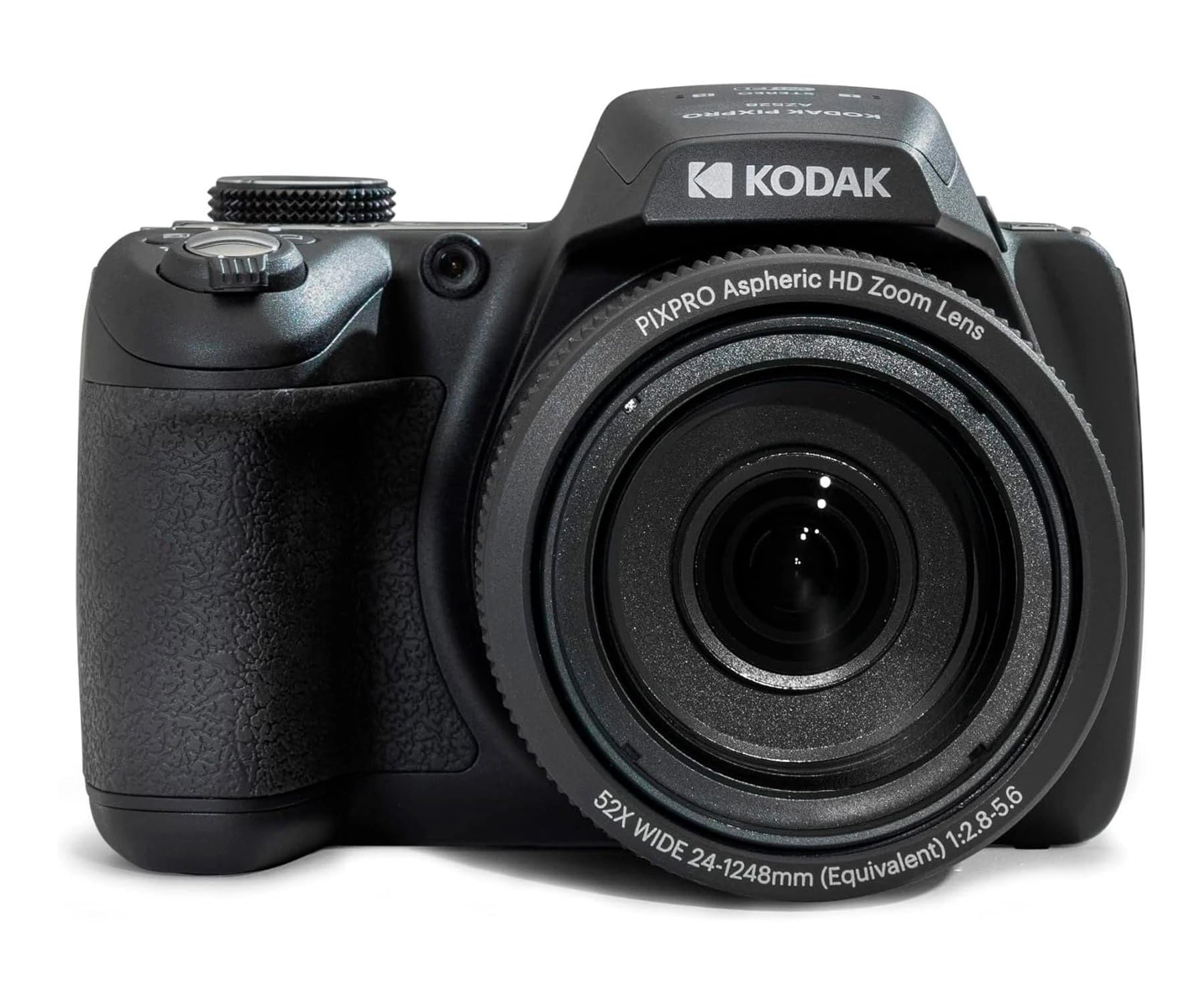
The Kodak PIXPRO AZ528 is a budget-friendly superzoom that offers an incredible 52x optical zoom for a fraction of the price of other cameras on this list. Its 16MP BSI CMOS sensor, combined with an f/2.8 wide-angle aperture, suggests an effort to gather light, and the optical image stabilization (OIS) is crucial for keeping those long shots steady. It’s designed as an entry point for wildlife or event photography where reach is paramount.
User reviews highlight its ease of use and surprising value. It’s lightweight and the interface is straightforward for beginners. The 6 fps burst mode is useful for capturing fast action. For the price, it provides a zoom range that is simply unmatched, allowing users to capture birds, moons, and distant subjects that would be impossible with any other compact camera in its price tier.
The compromises are clear in the image quality and build. Images at full zoom require a very steady hand, and the body itself feels somewhat plasticky. Low-light performance is a challenge, and the camera’s autofocus can be slow to react. Battery life is also a common complaint, though the USB-C charging helps. This is not a camera for pixel-peepers; it is for someone who needs maximum zoom on a minimal budget.
Why it’s great
- Exceptional 52x optical zoom for an entry-level price.
- F2.8 wide-angle aperture helps in low light at the widest setting.
- Lightweight and easy for beginners to use.
Good to know
- Image quality degrades significantly at high ISOs and full zoom.
- Build quality feels plastic and can scuff easily.
- Battery life is short, requiring frequent recharging or spares.
9. Nikon COOLPIX P1100

The Nikon COOLPIX P1100 is a superzoom behemoth with an astonishing 125x optical zoom, offering a 24-3000mm equivalent focal length. This is the ultimate reach for capturing subjects incredibly far away — think wildlife safaris, airshows, and distant mountain peaks. For low light, it features a Dual Detect Optical VR system rated at 4.0 stops, which is essential for getting sharp shots at these extreme zoom lengths.
The P1100 is designed for a single, specific purpose: to bring impossibly distant subjects into frame. Its “Bird-watching Mode” optimizes settings for avian photography, and the ability to shoot in RAW gives you flexibility in post-processing. The rotating LCD screen is helpful for composing shots at awkward angles. For this spectacular zoom performance, the image quality is quite good in good light, delivering sharp, detailed photos.
The camera’s limitations for low light are steep. The lens’s maximum aperture shrinks significantly as you zoom, reaching f/8.0 at the telephoto end. This means you will need very bright light or a tripod to use the full zoom effectively in dim conditions. The camera is also physically large and heavy. At its core, the P1100 is a daylight specialist; its low-light capabilities are confined to its wide-angle end and stabilized static shots.
Why it’s great
- Unmatched 125x optical zoom (24-3000mm) for extreme telephoto reach.
- Effective Dual Detect Optical VR helps stabilize telephoto shots.
- Dedicated bird-watching mode and RAW shooting capability.
Good to know
- Lens aperture narrows dramatically at the telephoto end, making it poor for low light.
- Autofocus can struggle to track fast-moving subjects at full zoom.
- Large, heavy body is not pocketable or convenient for everyday carry.
FAQ
Is a 1-inch sensor enough for good low-light photos?
Does optical image stabilization help in low light?
Why are my low light photos grainy (noisy)?
Final Thoughts: The Verdict
For most users, the best cameras for low light point and shoot winner is the Sony RX100 II because it delivers a perfect balance of pocketability, a fast F1.8 lens, and a large 1-inch sensor at a compelling value. If you want the absolute best image quality for handheld street photography, grab the Ricoh GR IIIx with its massive APS-C sensor. And for a modern content-creation powerhouse that excels in video and stills, nothing beats the Canon PowerShot V1.

Mo Maruf
I created WellFizz to bridge the gap between vague wellness advice and actionable solutions. My mission is simple: to decode the research and give you practical tools you can actually use.
Beyond the data, I am a passionate traveler. I believe that stepping away from the screen to explore new environments is essential for mental clarity and physical vitality.