Our readers keep the lights on and my smoothie glass nicely filled. As an Amazon Associate, I earn from qualifying purchases.
The search for a home theater receiver that delivers room-shaking Dolby Atmos, lag-free 4K/120Hz gaming, and future-proofed 8K video without crossing the thousand-dollar mark is a tightrope walk between power, features, and build quality. You expect clean amplification for your speakers, multiple HDMI 2.1 inputs for your consoles, and room correction that actually tames your space—not a box full of gimmicks.
I’m Mohammad Maruf — the founder and writer behind WellFizz. I’ve spent the last several years analyzing audio hardware specifications from the component level up, digging into pre-out voltage specs, HDMI chipset generations, room correction algorithms, and THD figures to separate genuine performance from marketing labels in the receiver market.
This guide cuts through the spec sheet noise to find the models that earn their price tag with real-world performance. After sifting through decades of market releases and component trends, here is my analysis of the best av receiver under $1000 available right now.
How To Choose The Best AV Receiver Under $1000
Buying a receiver in this tier means you want high-end features like Dolby Atmos, HDMI 2.1, and robust room correction without stepping into the four-figure premium bracket. Here is the shortlist of what to check before you click buy.
HDMI 2.1 Bandwidth and Gaming Features
Not all HDMI 2.1 ports are equal. Full 48Gbps bandwidth is required for uncompressed 4K/120Hz HDR, but many receivers in this price range offer 40Gbps ports which still support 4K/120Hz with 4:4:4 chroma at lower bit depths. Look for explicit support for VRR (Variable Refresh Rate), ALLM (Auto Low Latency Mode), and QFT (Quick Frame Transport) if you own a PS5 or Xbox Series X.
Room Correction and Calibration
Room correction is the secret weapon that transforms how your system sounds in an imperfect room. Basic systems like YPAO or Audyssey MultEQ are fine for most users, but Dirac Live (found on the Onkyo TX-NR7100) offers professional-grade control over frequency response and impulse response. Higher-tier correction can make a budget speaker set sound like a much more expensive system.
Power Output and Speaker Impedance
Don’t get fixated on peak wattage numbers. The important figure is continuous power per channel at the 8-ohm load with low Total Harmonic Distortion (THD). A receiver with 75-100 watts per channel into 8 ohms is typically plenty for medium-sized rooms. If you have 4-ohm speakers, check the receiver’s 4-ohm rating—some models struggle to deliver stable current at that impedance.
Quick Comparison
On smaller screens, swipe sideways to see the full table.
| Model | Category | Best For | Key Spec | Amazon |
|---|---|---|---|---|
| Onkyo TX-NR7100 | 9.2 ch | Room Correction Purists | Dirac Live + THX Select | Amazon |
| Denon AVR-S970H | 7.2 ch | Gaming & Multi-Room Audio | 90W x 7, HEOS, 8K | Amazon |
| Yamaha RX-A2A | 7.2 ch | Premium Build & MusicCast | Surround:AI, YPAO R.S.C. | Amazon |
| Sony STR-AN1000 | 7.2 ch | Sony Ecosystem & 360 Audio | 360 Spatial Sound Mapping | Amazon |
| Yamaha RX-V6A | 7.2 ch | Everyday Value & Reliability | YPAO, 8K/60B, 7 HDMI | Amazon |
| Onkyo TX-NR6100 | 7.2 ch | THX Certified Home Theater | THX Select, 210W/Ch Dynamic | Amazon |
| Denon AVR-S770H | 7.2 ch | Streamlined Setup & Sound | 75W x 7, Dolby Height Virtualization | Amazon |
| JBL MA710 | 7.2 ch | Compact Size & Phono Input | 110W x 7, Shallow Chassis | Amazon |
| Pioneer VSX-935 | 7.2 ch | Budget Atmos Entry | 8K/60B, Dolby Height Virtualization | Amazon |
| Sony STRDH590 | 5.2 ch | Budget 5.1 Setup | S-Force PRO, 725W Total | Amazon |
| JBL MA7100HP | 7.2 ch | High Power Class D | 125W x 7, Class D Amp | Amazon |
In‑Depth Reviews
1. Onkyo TX-NR7100 9.2-Channel AV Receiver
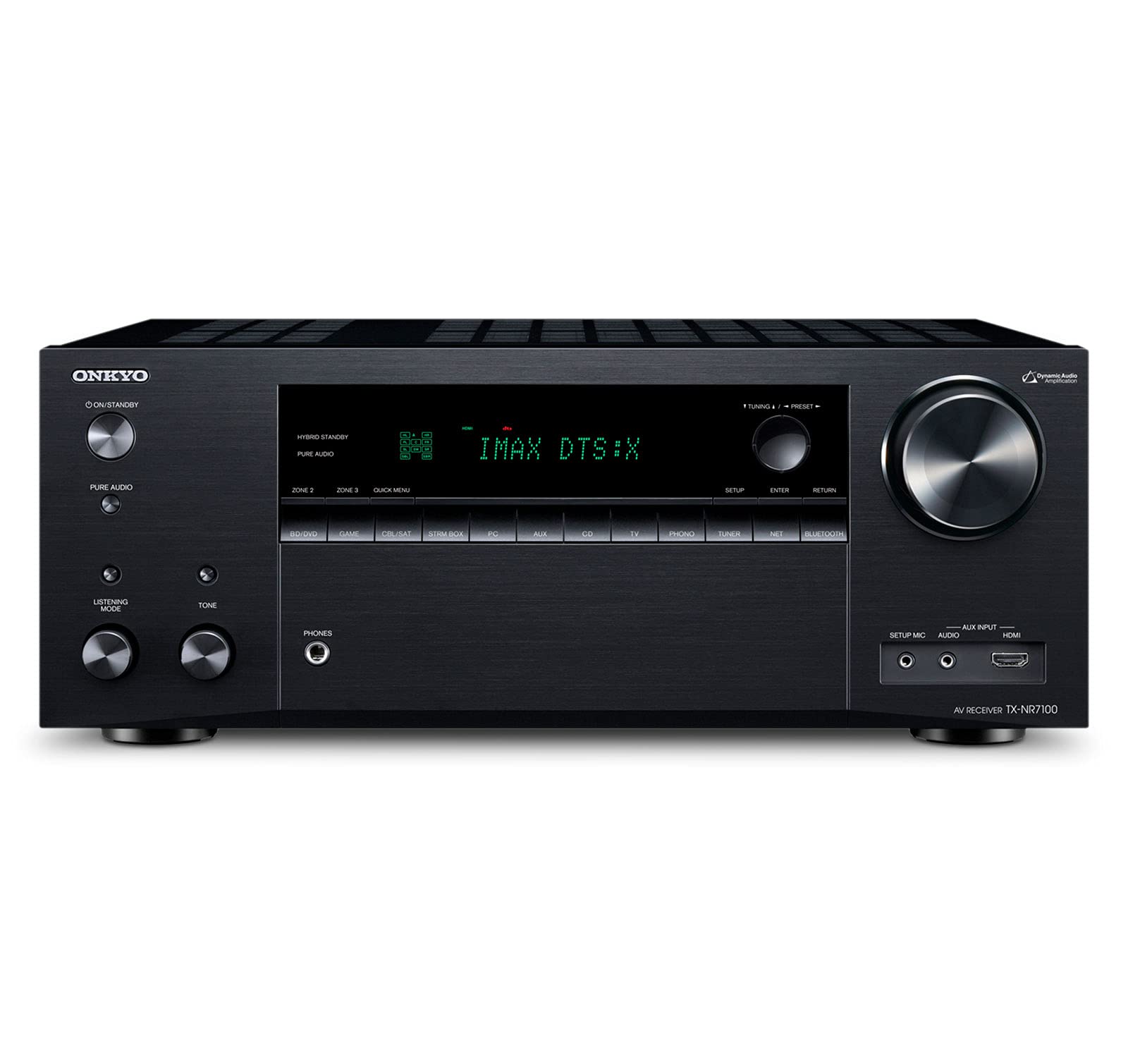
The TX-NR7100 is the rare receiver in this tier that bundles Dirac Live room correction out of the box—a feature usually reserved for units costing double. The calibration adjusts frequency response and impulse response with surgical precision, making a mid-range speaker setup sound far more expensive than it is. The 9.2 channel processing allows a 5.1.4 Atmos configuration, which is ideal for ceiling-mounted height channels.
HDMI 2.1 connectivity here runs at 40Gbps, supporting 8K/60Hz and 4K/120Hz pass-through with VRR, ALLM, and QFT for serious gamers. The unit also works with Sonos, making multi-room integration seamless. The amplifier delivers 100 watts per channel into 8 ohms and runs cleanly at moderate listening levels, though some users report the unit runs warm, so ventilation is essential.
On the downside, the remote control lacks a backlight, which is a persistent annoyance in a dark home theater. The Dirac Live setup is thorough but time-consuming, as the full potential of the software requires a PC or Mac application for the most accurate multipoint calibration. A small subset of units have exhibited HDMI-handling glitches, though firmware updates have resolved most issues.
Why it’s great
- Full Dirac Live room correction included
- THX Select certified for reference-level sound
- HDMI 2.1 with VRR/ALLM for next-gen gaming
Good to know
- Runs warm; needs ventilation
- Non-backlit remote control
- Dirac calibration process is not quick
2. Denon AVR-S970H 7.2 Channel 8K Receiver

The Denon AVR-S970H offers a strong 90 watts per channel into 8 ohms, giving it a slight edge in headroom over many competitors in the same price bracket. This extra power is noticeable when driving less efficient tower speakers in a medium-sized room, especially during dynamic movie soundtracks. The HEOS multi-room platform is polished, allowing seamless grouping with other Denon Home speakers for whole-house audio.
Gamers will appreciate the three dedicated 8K HDMI 2.1 inputs, all supporting 4K/120Hz pass-through, VRR, and ALLM. The onboard phono input is a thoughtful addition for vinyl enthusiasts, and the Audyssey MultEQ room correction does a solid job of smoothing out frequency response dips and peaks. The onscreen setup assistant walks you through initial configuration in under 30 minutes.
The Zone 2 functionality is pre-out only when using powered second-zone speakers, meaning your main 7-channel array is reduced to 5 channels if you run a separate amplified zone. The HEOS app is responsive but can be slow to connect to network libraries. The remote control lacks a dedicated power button for the TV, which is an odd omission for a modern receiver.
Why it’s great
- 90W per channel offers clean headroom
- HEOS multi-room is reliable and feature-rich
- Phono input for turntable connectivity
Good to know
- Zone 2 reduces main channels to 5.1
- No programmable TV power button on remote
- HEOS app occasionally slow with network libraries
3. Yamaha RX-A2A AVENTAGE 7.2-Channel Receiver

The RX-A2A sits in Yamaha’s Aventage line, which means a heavier chassis, a fifth foot for vibration damping, and a three-year warranty. Surround:AI is the standout feature—it analyzes scenes in real time and adjusts the soundfield parameters to optimize dialogue clarity during quiet scenes and expand the soundstage during action sequences. It is a genuinely useful tool that works automatically without manual tweaking.
YPAO R.S.C. with multipoint measurement provides accurate room correction, accounting for the reflective characteristics of your room. The receiver supports 8K/60B and 4K/120AB on three of its seven HDMI inputs, which is sufficient for most gaming setups. MusicCast multi-room audio is intuitive and supports high-resolution streaming from TIDAL, Qobuz, and Amazon Music HD.
Some users report an intermittent “no signal” issue when paired with certain Sony TVs, requiring a power cycle of the receiver to restore video. At its full MSRP, the feature set feels a bit lean compared to the Onkyo TX-NR7100, particularly missing Dirac Live. The supplied AM/FM antenna setup is physically large and can feel dated.
Why it’s great
- Surround:AI dynamically optimizes sound in real time
- Aventage build quality with 3-year warranty
- YPAO R.S.C. multipoint calibration
Good to know
- Potential HDMI handshake issues with some TVs
- No Dirac Live room correction
- Large analog tuner antenna included
4. Sony STR-AN1000 7.2 CH 8K A/V Receiver

Sony’s STR-AN1000 uses 360 Spatial Sound Mapping to create a wide soundstage that feels larger than the physical speaker layout would suggest. This is particularly effective in rooms where symmetrical speaker placement is impossible. The Digital Cinema Auto Calibration IX (D.C.A.C. IX) is one of the most automated room correction systems—it runs quickly and produces impressively accurate results for a fully automatic process.
The unit supports Dolby Atmos and DTS:X, and Sony’s 360 Reality Audio format adds another layer of immersion for compatible tracks. HDMI 2.1 support includes 8K and 4K/120Hz passthrough, though the receiver has a known quirk with Dolby Vision passthrough from Apple TV 4K, sometimes requiring the streaming device to be connected directly to the TV instead. The graphical setup interface is the most beginner-friendly in this class.
The front display is small and hard to read from a seated position across the room, and the remote provides limited feedback about which sound field mode is active. There is no phono input, so a separate preamp is needed for a turntable. The 165-watt rating is into 6 ohms with 0.9% THD, which is a more aggressive spec than the standard 8-ohm measurement most competitors use.
Why it’s great
- 360 Spatial Sound Mapping for a wide soundstage
- Automated D.C.A.C. IX calibration is very fast
- Excellent Dolby Atmos and DTS:X performance
Good to know
- Dolby Vision passthrough issue with Apple TV 4K
- No phono input for turntables
- Front display is small and hard to read from a distance
5. Yamaha RX-V6A 7.2-Channel AV Receiver

The RX-V6A is the sweet spot for buyers who want solid Yamaha reliability, Dolby Atmos with Height Virtualization, and a full suite of streaming options without paying the Aventage premium. Yamaha’s high slew rate amplifier design delivers a clean, detailed sound that handles busy movie soundtracks without smearing. The YPAO multipoint calibration does a good job for most rooms.
With three 8K/60B and four 4K/60 HDMI inputs, this receiver offers excellent flexibility for connecting multiple modern sources. MusicCast is one of the strongest multi-room platforms on the market, supporting high-resolution audio up to 24-bit/192kHz. The unit works with both Alexa and Google Assistant for hands-free control.
The graphical user interface is functional but looks dated compared to competitors. Some users report that the eARC handshake with certain Sony Bravia TVs can be inconsistent, requiring manual input selection. The power rating is 100 watts per channel into 8 ohms at 0.06% THD, which is honest and typical for this class.
Why it’s great
- Strong amplifier design with low THD
- Generous 7 HDMI inputs (3 x 8K)
- MusicCast supports high-res streaming
Good to know
- GUI is functional but visually outdated
- eARC handshake can be finicky with some TVs
- Lacks Aventage vibration-damping chassis
6. Onkyo TX-NR6100 7.2 Channel THX Certified Receiver
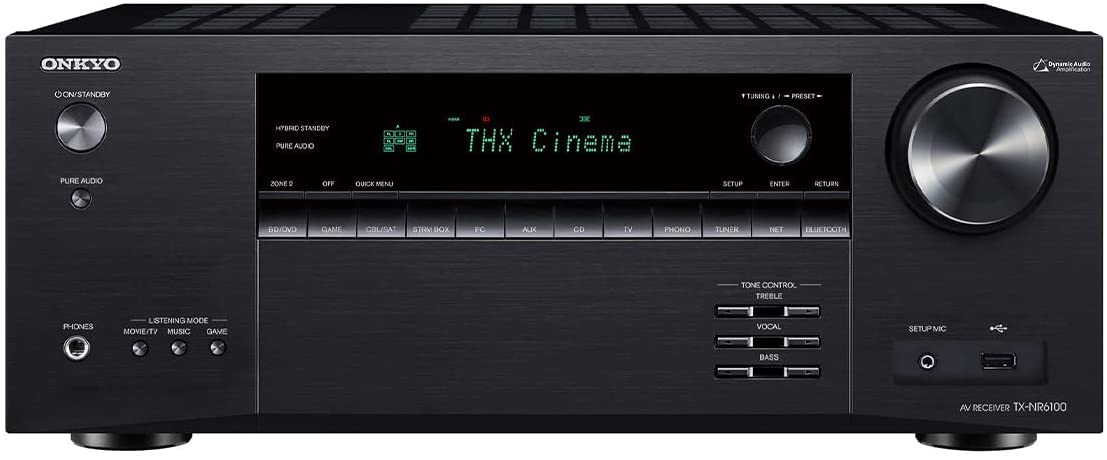
THX Select certification means the TX-NR6100 is tested to deliver reference-level sound in rooms up to 2,000 cubic feet, ensuring consistent dynamics and low distortion. The 210-watt dynamic power rating per channel (6 ohms, 1kHz) provides generous headroom for transient peaks in action movies. The unit supports 5.2.2-channel Dolby Atmos and DTS:X, making it a solid choice for a modest overhead speaker setup.
HDMI 2.1 at 40Gbps supports 8K/60Hz and 4K/120Hz passthrough, along with VRR and ALLM. The receiver includes a discrete Zone 2 audio and video output, allowing different content to play in a second room. Users consistently praise the sound quality when paired with Klipsch and other high-sensitivity speaker brands, noting clear channel separation and powerful bass management.
The remote control is flimsy and not backlit, which feels out of place at this price point. Inputs 4 through 6 are limited to 4K/60Hz, so you must plan your connection layout carefully if you have multiple 8K or 4K/120Hz sources. A small number of long-term users report HDMI 2.1 board failures after a year or two, though this seems to affect a minority of units.
Why it’s great
- THX Select certified for reference sound
- Excellent dynamic headroom for movie peaks
- Discrete Zone 2 audio and video output
Good to know
- Non-backlit, flimsy-feeling remote
- Only 3 of 8 HDMI ports are 8K/4K-120 capable
- Potential long-term HDMI 2.1 reliability concerns
7. Denon AVR-S770H 7.2 Ch Home Theater Receiver

The AVR-S770H is a straightforward, well-executed 7.2-channel receiver that focuses on clean sound and ease of use over unnecessary complexity. The 75-watt-per-channel amplifier (8 ohms) is sufficient for most home theater setups, but the real star is Dolby Height Virtualization, which creates a convincing overhead effect from a standard 5.1 or 7.1 layout without requiring ceiling speakers. This makes it a strong choice for renters or rooms where in-ceiling wiring is impractical.
HEOS built-in offers stable multi-room audio streaming with support for Pandora, Spotify, TIDAL, and Amazon Music HD. Voice control via Alexa is fully integrated, allowing hands-free volume adjustment and input switching. The receiver supports 8K/60Hz and 4K/120Hz passthrough with HDR10+, Dolby Vision, and Dynamic HDR, making it future-proof for current and near-future displays.
Some owners report a frustrating firmware issue where the receiver randomly drops volume to zero and loses the video signal. This occurs in roughly 10% of usage sessions for affected units, according to user reports. The Audyssey MultEQ room correction is functional but lacks the precision of higher-tier Audyssey XT32 found on more expensive Denon models.
Why it’s great
- Dolby Height Virtualization for immersive sound without ceiling speakers
- Stable HEOS multi-room platform
- Alexa voice control integration
Good to know
- Occasional bug causing zero volume and video loss
- Audyssey MultEQ is basic compared to XT32
- Firmware updates can be slow to download
8. JBL MA710 7.2 Channel 8K AV Receiver

The JBL MA710 stands out for its shallow 4.3-inch chassis depth, which makes it one of the few receivers in this class that fits into standard AV cabinets without ventilation clearance issues. The 110-watt-per-channel rating (8 ohms) is generous and provides solid headroom for demanding speaker loads. The inclusion of a moving magnet phono input is a rare and welcome feature at this price point, letting vinyl enthusiasts connect a turntable directly.
Dolby Atmos and DTS:X decoding are fully supported, with a 7.1 or 5.1.2 channel configuration options. The wireless streaming suite includes Apple AirPlay 2 and Google Chromecast built-in, simplifying integration with most mobile devices. The unit drives medium-sensitivity in-wall speakers well, producing clean, balanced sound without audible strain.
The remote control lacks a backlight, making it difficult to use in a darkened room. The auto shut-off defaults to a 20-minute timer and must be manually disabled through the menu. The JBL firmware update process can be confusing initially, as the receiver requires a stable internet connection and patience during the update phase.
Why it’s great
- Shallow 4.3-inch depth fits tight cabinets
- Moving magnet phono input included
- 110W per channel offers good headroom
Good to know
- Remote is not backlit
- Auto shut-off timer requires manual menu change
- Initial firmware setup can be confusing
9. Pioneer VSX-935 7.2 Channel Network Receiver
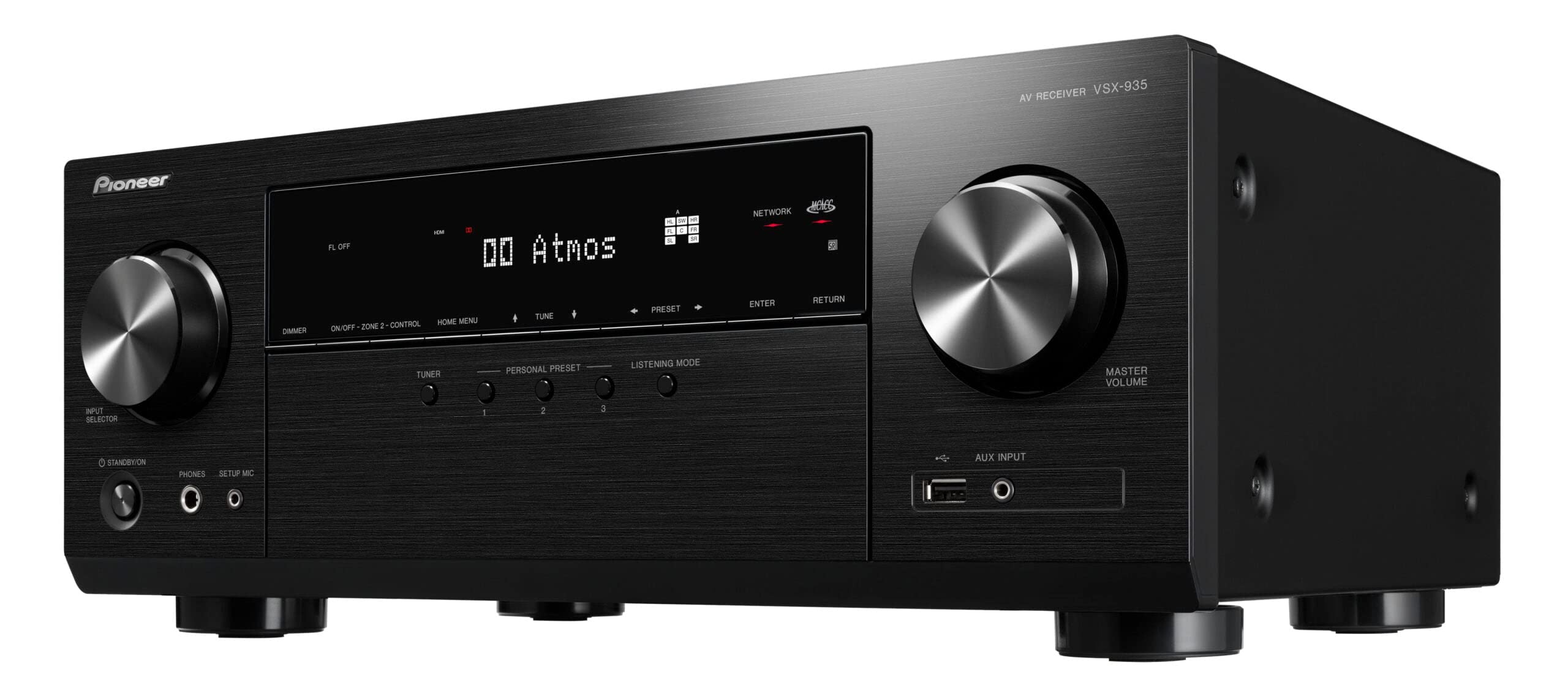
The Pioneer VSX-935 is a solid entry point into Dolby Atmos and 8K video, offering HDMI 2.1 connectivity with 8K/60B passthrough and Dolby Height Virtualization for rooms without dedicated ceiling speakers. The RF remote is responsive and works through walls, a small but appreciated detail. The unit offers dual-zone audio output, allowing music in a second room without a separate amplifier.
Sound quality is crisp and clear, with particularly strong performance on movie soundtracks. The volume ramp is gradual up to 50, then accelerates quickly, giving precise control at lower levels. The display is bright and clear with a dimmer option for dark rooms. Users upgrading from older Onkyo or Yamaha units report a noticeable improvement in dialogue clarity and dynamic range.
The Bluetooth implementation is two-way, but connecting wireless headphones is unreliable and the interface for switching between streaming and headphone output is confusing. A portion of units have arrived DOA or with display defects, so a quick functionality check after purchase is recommended. The on-screen menu interface feels a generation behind modern competitors.
Why it’s great
- Works with Dolby Height Virtualization for virtual Atmos
- RF remote has excellent range and angle
- Crisp, clear sound signature for movies
Good to know
- Two-way Bluetooth is unreliable for headphones
- Some units arrive DOA or with display issues
- Menu interface looks dated
10. Sony STRDH590 5.2 Channel Surround Sound Receiver
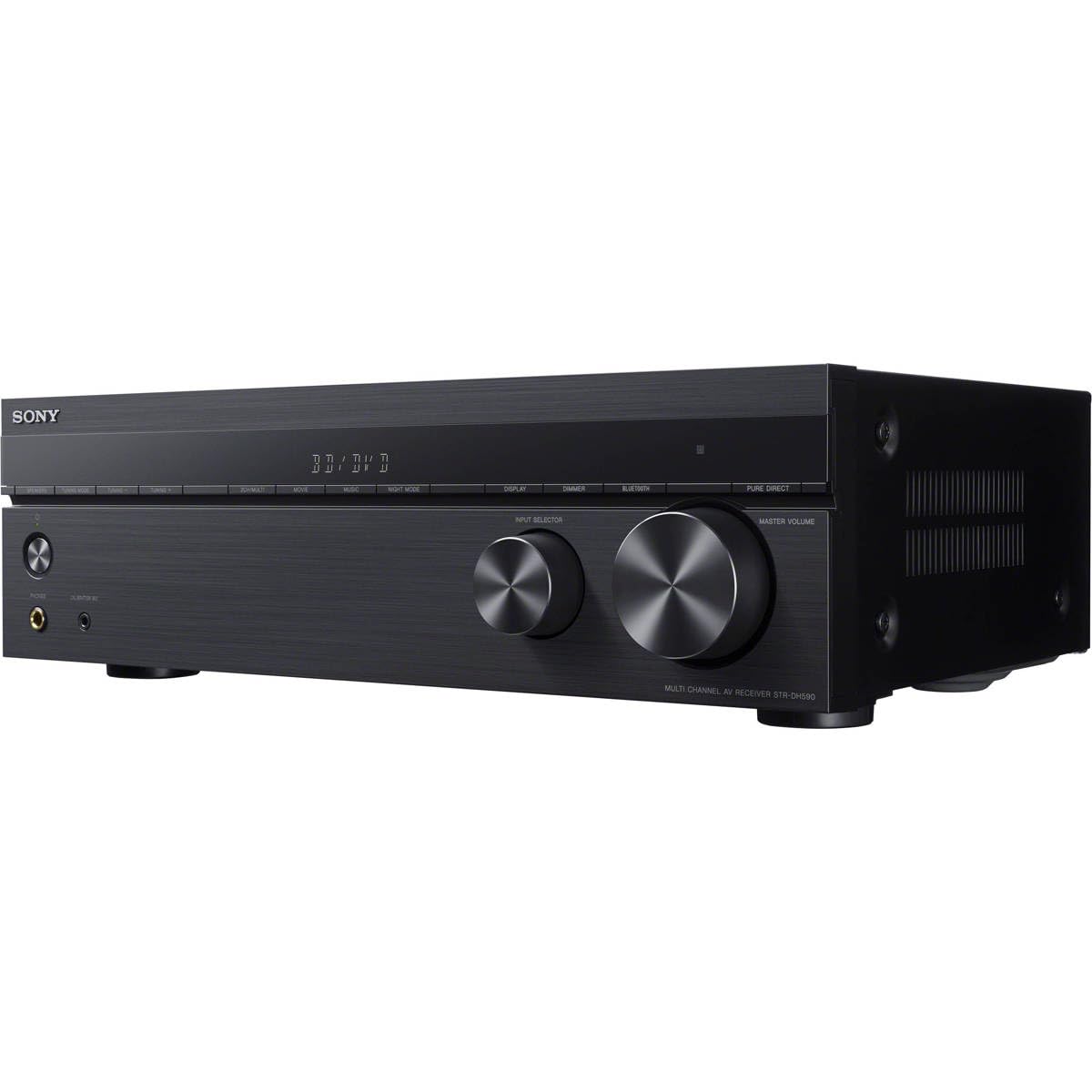
The Sony STRDH590 is a no-frills 5.2-channel receiver designed for buyers on a strict budget who still want 4K HDR compatibility and Bluetooth streaming. S-Force PRO virtual surround sound creates a reasonably wide soundstage from just two front speakers, making it suitable for small apartments or secondary rooms where a full surround speaker setup is not feasible. The 725-watt total power rating (dynamic) is enough to drive compact bookshelf speakers to satisfying levels.
Setup is straightforward, with an auto-calibration microphone included for basic speaker distance and level adjustment. The slim chassis runs cooler than most competitors, which is helpful when ventilation space is limited. The remote is simple and direct, with dedicated buttons for FM radio—a nice touch for users who still listen to broadcast radio.
This receiver lacks advanced room correction, Dolby Atmos, and HDMI 2.1 features. It has only 4 HDMI inputs (one with ARC), which fills up quickly if you have multiple streaming devices and a game console. The speaker terminals for the center and rear channels use small pin connectors instead of standard binding posts, limiting cable options.
Why it’s great
- Very approachable for a budget 5.1 setup
- Runs cool even during extended use
- Simple remote with dedicated FM radio button
Good to know
- No Dolby Atmos or HDMI 2.1 support
- Center/rear channels use pin connectors
- Only 4 HDMI inputs total
11. JBL MA7100HP 7.2 Channel High Performance AV Receiver
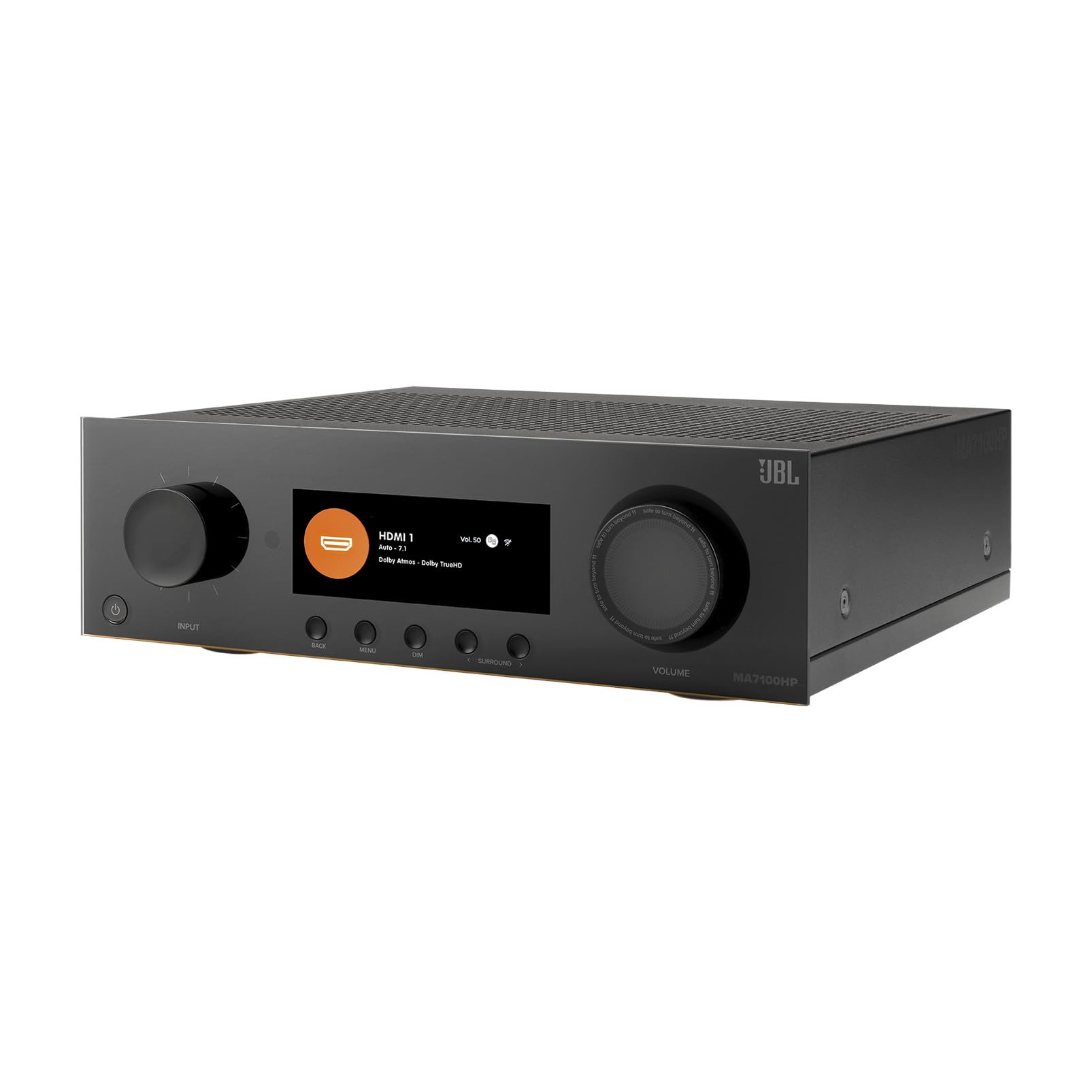
The JBL MA7100HP uses Class D amplification to deliver 125 watts per channel into 8 ohms, making it the most powerful receiver in this comparison on paper. Class D design means it runs cooler and more efficiently than traditional Class A/B designs, which is a real advantage for rack mounting or enclosed cabinetry. The 7.2-channel configuration supports Dolby Atmos and DTS:X with 5.1.2 or 7.1 layouts.
Six HDMI inputs with eARC include support for 8K video and 4K/120Hz passthrough. The unit includes both Apple AirPlay 2 and Google Chromecast for wireless streaming. The shallow chassis is identical to the standard MA710, making it easy to place in tight spaces. Dynamic range is impressive, with the extra wattage providing noticeable punch for large tower speakers in open-concept rooms.
User feedback indicates the MA7100HP does not properly mix down DTS-HD Master Audio to 2.1 channels, which is a problem for stereo-only setups watching Blu-ray content. Dolby TrueHD works fine, but the DTS-HD limitation is a firmware issue that JBL has not addressed. The remote is not backlit, and the auto shut-off timer defaults to 20 minutes and must be changed in the menu.
Why it’s great
- 125W per channel Class D amplification
- Runs cool and efficient
- Shallow chassis fits in tight spaces
Good to know
- DTS-HD Master Audio not properly downmixed to 2.1
- Non-backlit remote control
- Firmware update needed but release history is slow
FAQ
Can I use a receiver under $1000 with 4-ohm speakers?
Do I need Dolby Atmos if I don’t have ceiling speakers?
Is a 7.2 receiver better than a 5.1 for a small room?
How important is room correction for sound quality?
Final Thoughts: The Verdict
For most users, the av receiver under $1000 winner is the Onkyo TX-NR7100 because Dirac Live room correction, THX certification, and 9.2-channel processing deliver measurable performance improvements over competitors. If you want a reliable multi-room system and a robust gaming feature set, grab the Denon AVR-S970H. And for a compact chassis with a phono input and clean Class D power, nothing beats the JBL MA710.

Mo Maruf
I created WellFizz to bridge the gap between vague wellness advice and actionable solutions. My mission is simple: to decode the research and give you practical tools you can actually use.
Beyond the data, I am a passionate traveler. I believe that stepping away from the screen to explore new environments is essential for mental clarity and physical vitality.