Our readers keep the lights on and my smoothie glass nicely filled. As an Amazon Associate, I earn from qualifying purchases.
The average office worker still handles stacks of paper invoices, contracts, and expense receipts that clog desks and kill productivity. A dedicated sheet-fed scanner with a reliable Auto Document Feeder (ADF) is the only way to break the bottleneck — turning a 30-minute manual data entry session into a 30-second digitization job.
I’m Mohammad Maruf — the founder and writer behind WellFizz. I’ve spent years analyzing document workflow hardware, comparing duplex scan engines, ADF roller durability, and driver stability across production-level scanners to find the units that actually survive a busy desk.
Whether you run a home office, a mobile notary practice, or an accounting firm drowning in paperwork, the best business scanner must deliver consistent duplex speeds, jam-free feeding, and reliable OCR output without constant driver troubleshooting.
How To Choose The Best Business Scanner
Selecting a production scanner for your office requires weighing throughput capacity, paper handling reliability, and software integration. The wrong pick can cost hours per week in jam clearing or re-scanning. Focus on these three factors.
Duplex Speed & ADF Capacity
The headline pages-per-minute (ppm) number only tells half the story — you need simultaneous duplex scanning (both sides in one pass) and an ADF that holds at least 50 sheets. A 35-40 ppm duplex scanner with a 50-sheet feeder crushes a 25 ppm unit with a 30-sheet feeder when you process weekly invoice batches.
Sensor Technology: CIS vs. CCD
Contact Image Sensors (CIS) are compact, energy-efficient, and fine for standard documents. CCD sensors capture deeper depth of field — essential for embossed cards, wrinkled receipts, or stapled pages that sit unevenly on the glass. If your workflow includes plastic ID cards or folded documents, prioritize CCD models.
Driver & Software Ecosystem
Hardware is useless if the driver breaks after an OS update. Look for models with TWAIN and WIA/ICA support so the scanner works with your existing document management software (Quicken, EMR systems, or custom workflows). Built-in OCR and direct-to-cloud scanning via Dropbox or OneDrive further reduce manual file handling.
Quick Comparison
On smaller screens, swipe sideways to see the full table.
| Model | Category | Best For | Key Spec | Amazon |
|---|---|---|---|---|
| ScanSnap iX2500 | Premium Wireless | High-volume teams needing Wi-Fi 6 | 45 ppm duplex, 100-sheet ADF | Amazon |
| Epson ES-580W | Premium Touchscreen | Offline scan-to-USB workflows | 35 ppm duplex, 100-sheet ADF | Amazon |
| Brother ADS-2200 | Mid-Range Workhorse | Linux/Mac multi-OS offices | 35 ppm duplex, 50-sheet ADF | Amazon |
| Epson ES-500W II | Premium Hybrid | Photo-heavy digitization projects | 35 ppm duplex, CCD sensor | Amazon |
| ScanSnap iX2400 | Mid-Range Speedster | Solo users wanting 45 ppm speed | 45 ppm duplex, 100-sheet ADF | Amazon |
| Brother ADS-3100 | Mid-Range Compact | Small offices with USB 3.0 | 40 ppm duplex, 60-sheet ADF | Amazon |
| Canon DR-C225 II | Mid-Range Reliable | Mixed media handling | 25 ppm duplex, 30-sheet ADF | Amazon |
| Canon imageFORMULA R30 | Budget Workhorse | Driver-free plug-and-scan | 25 ppm duplex, 60-sheet ADF | Amazon |
| Doxie Pro | Budget Compact | Receipt-heavy home offices | 15 ppm duplex, 20-sheet ADF | Amazon |
In‑Depth Reviews
1. ScanSnap iX2500
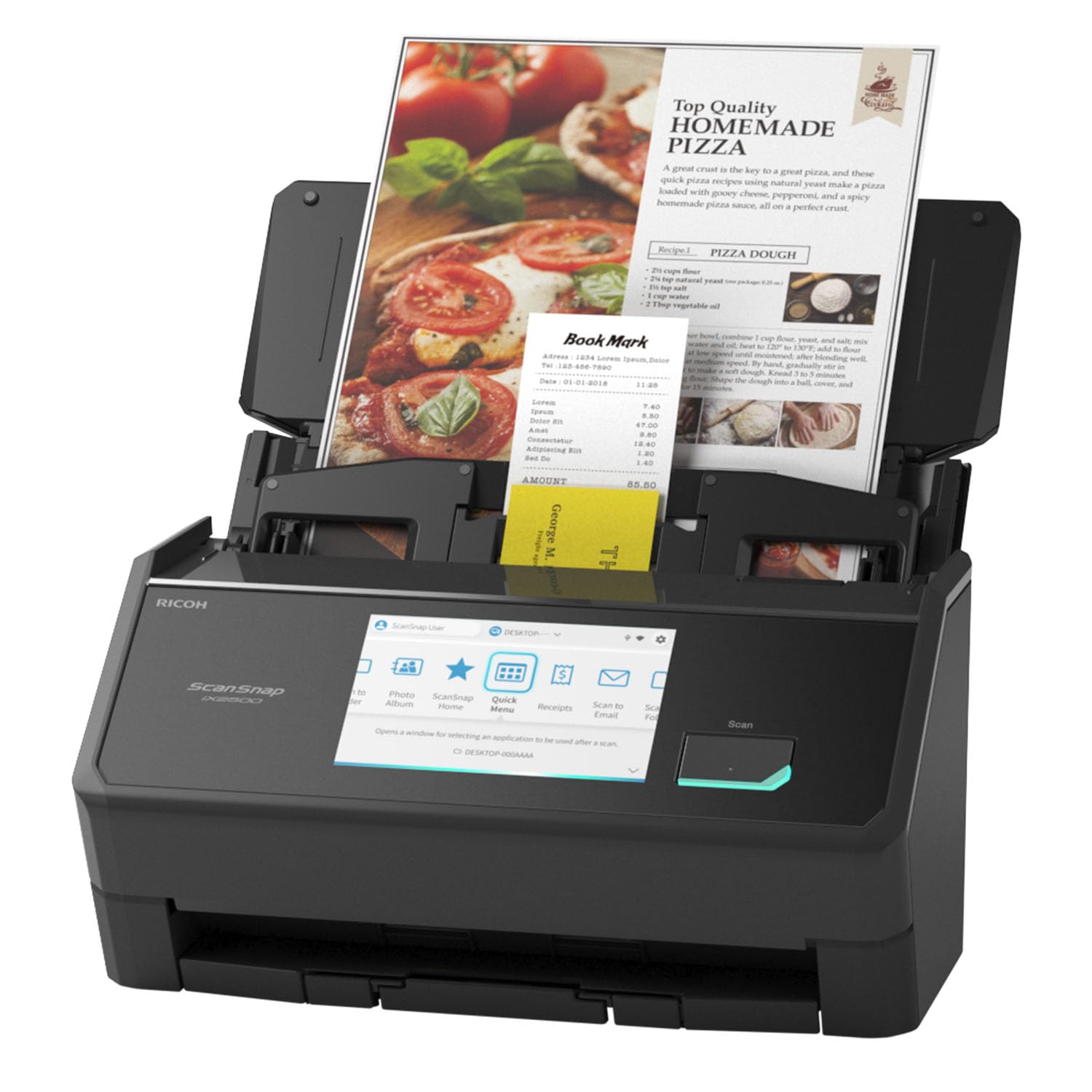
The ScanSnap iX2500 sets the new benchmark for business document throughput with 45 ppm duplex scanning and a 100-sheet ADF that handles mixed media types without constant babysitting. Its built-in Wi-Fi 6 delivers faster wireless transfer than most office-grade competitors, and the 5-inch touchscreen allows profile selection without ever touching a computer. The brake roller system actively prevents jams even when feeding wrinkled receipts alongside standard letter paper.
Nonprofit users report processing 25,000 pages per year across multiple units with high reliability. The driver support spans macOS Sequoia, Windows 10/11, iOS, and Android, making it the most platform-flexible scanner on this list. The ScanSnap Home software automates file naming, OCR, and destination routing, though some long-time users find the software more bloated than the older ScanSnap Manager interface.
Wireless operation runs about 10 percent slower than USB-C, which is negligible for most batch jobs but worth noting if you regularly scan legal-size color documents at 600 dpi. The ADF lacks the sliding extension found on the older iX500, so oversized pages require manual positioning. Replacement pickup rollers are user-serviceable every few years, extending the unit’s lifespan well past the five-year mark.
Why it’s great
- Industry-leading 45 ppm duplex speed with jam-resistant roller system
- Wi-Fi 6 and USB-C connectivity for flexible office setups
- 100-sheet ADF handles mixed paper types
- Touchscreen profile selection removes computer dependency
Good to know
- Software is slower and more complex than older ScanSnap versions
- Build feels slightly lighter compared to the older iX500 chassis
- Color PDF compression results in larger file sizes than some competitors
2. Epson Workforce ES-580W
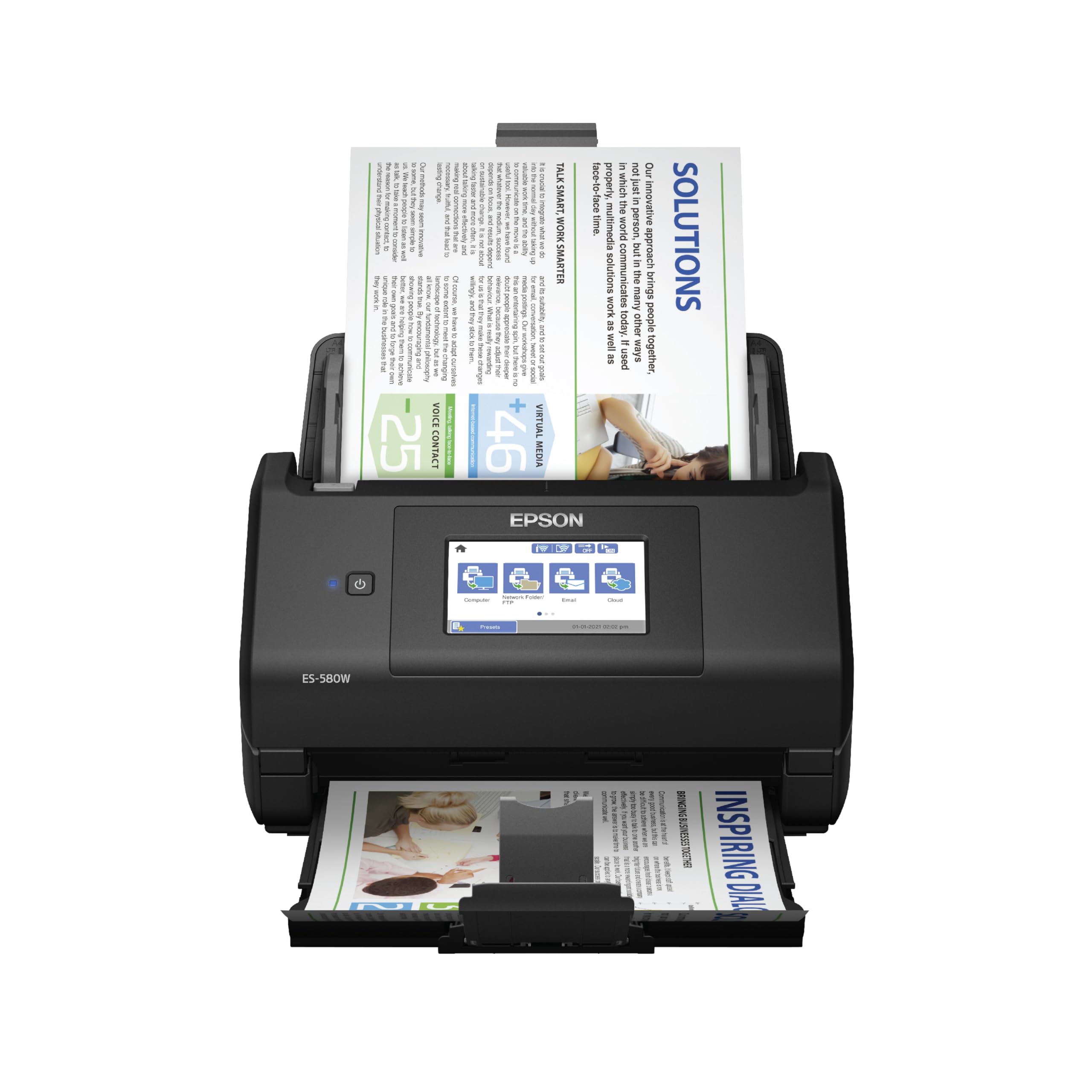
The Epson ES-580W delivers 35 ppm duplex scanning through a robust 100-sheet ADF, backed by a 4.3-inch color touchscreen that lets you scan directly to email, cloud services, or USB flash drive without a computer. Its CCD sensor provides superior depth of field for embossed business cards and stapled document corners that CIS units struggle to capture cleanly. The ultrasonic double-feed detection catches pages stuck together by staples or adhesive, preventing data loss during unattended batch runs.
This scanner shines in mobile notary and medical office environments where staff need to scan directly into EMR systems or QuickBooks. TWAIN driver support ensures compatibility with nearly any existing document management software. The auto-crop, deskew, and blank page removal save significant post-processing time compared to budget scanners that deliver raw, unprocessed images.
The ES-580W lacks an Ethernet port, relying solely on USB and Wi-Fi connectivity, which can be a limitation in wired office networks. The initial wireless setup is less intuitive than plug-and-play USB models, and some users report needing to reinstall drivers when switching between connection modes. At roughly 8 pounds, it’s one of the heavier units on this list but remains compact enough for a shared desk.
Why it’s great
- CCD sensor delivers superior image quality for embossed and uneven documents
- 100-sheet ADF with ultrasonic double-feed detection
- Touchscreen allows scan-to-cloud or scan-to-USB without a computer
- TWAIN driver compatibility with existing business applications
Good to know
- No Ethernet port — limited to USB and Wi-Fi connectivity
- Initial wireless setup can be frustrating without clear instructions
- Weighs over 8 pounds, making it less portable than compact CIS models
3. Brother ADS-2200

The Brother ADS-2200 punches above its price tier with 35 ppm duplex scanning, a 50-sheet ADF, and native support for Windows, Mac, and Linux operating systems — a rarity among business scanners. Its CCD sensor captures up to 1200 dpi resolution for applications requiring high-detail archiving, and the 48-bit color depth preserves accurate color reproduction for marketing materials and branded documents. The folding output tray keeps the footprint compact at just 5.5 pounds.
Multiple driver support (TWAIN, WIA, ICA, SANE) makes this the most OS-flexible unit in the mid-range category. Users report scanning 500+ photos in three hours at 300 dpi with no jams, and the duplex speed is fast enough to process a legal-size contract in about five seconds. The bundled software includes OCR, blank page removal, and background cleanup, reducing the need for third-party editing tools.
The maximum optical resolution is effectively 600 x 600 dpi despite the marketed 1200 dpi spec — an important distinction for users who need genuine high-res archiving. Some units have reported power adapter failures, although customer service has typically resolved those within the warranty period. The 50-sheet ADF is adequate for individual batch sessions but slower than the 100-sheet feeders on higher-end models.
Why it’s great
- Rare Linux/SANE driver support alongside Windows and Mac compatibility
- CCD sensor with 48-bit color depth for accurate document reproduction
- Lightweight 5.5-pound design with folding output tray
- Fast 35 ppm duplex scanning for its price tier
Good to know
- True optical resolution is 600 dpi, not the advertised 1200 dpi
- 50-sheet ADF is smaller than premium competitors
- Some users report power adapter failures requiring replacement
4. Epson Workforce ES-500W II
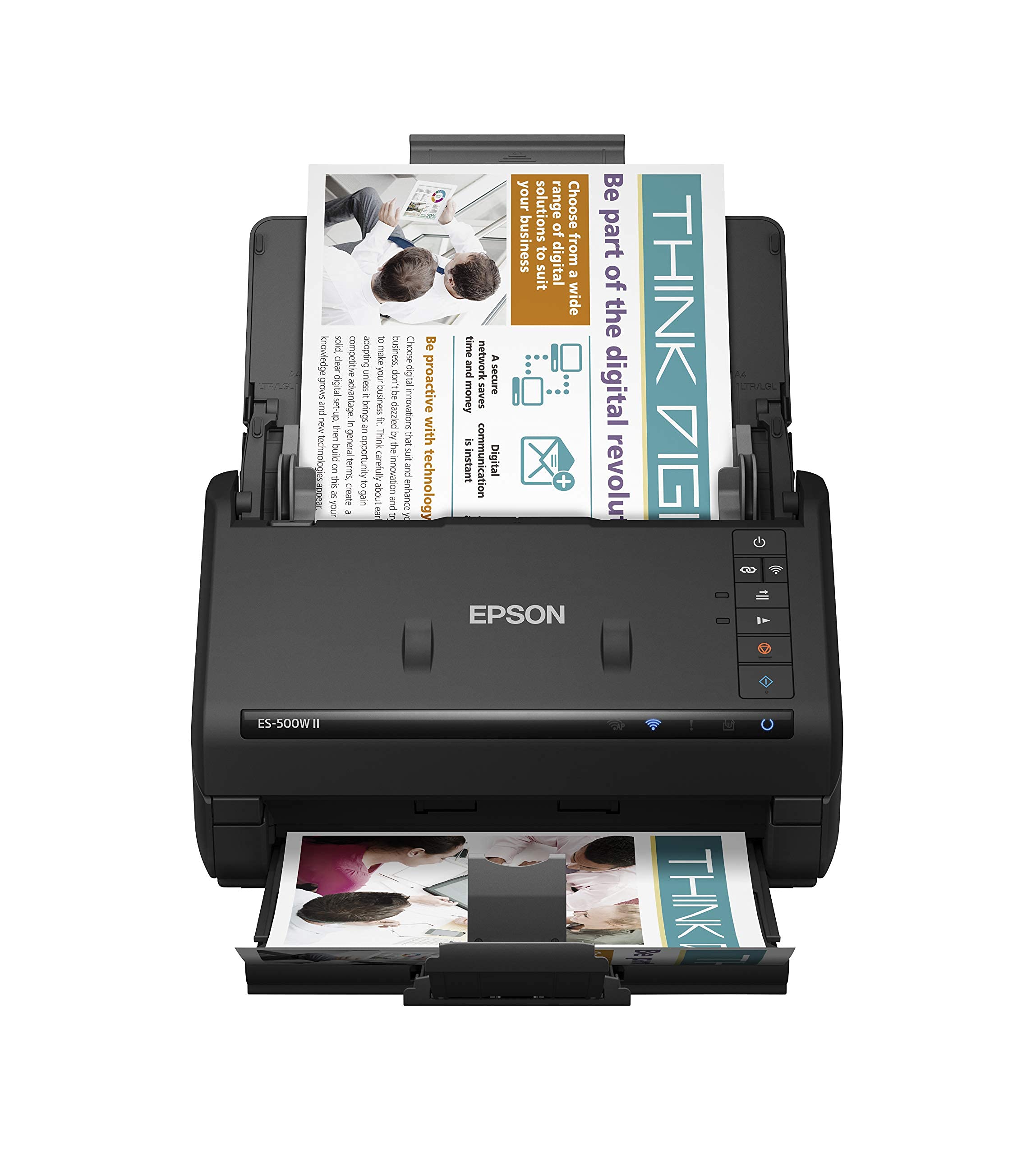
The Epson ES-500W II combines desktop document scanning with genuine photo batch capabilities thanks to its CCD sensor that can handle glossy prints and thick cardstock without the color banding common in CIS scanners. The 50-sheet ADF supports mixed batches of receipts, business cards, and photos up to 240 inches long for continuous feed of banner-sized documents. Its 35 ppm duplex speed keeps pace with daily office workflows while the Epson ScanSmart software provides straightforward one-click routing to cloud storage.
This model has been a favorite among users digitizing family photo archives, with one reviewer reporting over 100,000 photos scanned through a single unit. The ultrasonic double-feed detection prevents missing pages, and the dirt detection feature automatically removes specks from the scanned image. Wireless connectivity works with the Epson Smart Panel mobile app for direct scanning from a smartphone or tablet without a desktop intermediary.
The CCD sensor makes this scanner taller and heavier (8.1 pounds) than compact CIS models, which can be a consideration for tight desk spaces. Some users report memory overflow errors when scanning legal-size color documents at high resolution, though a 2025 driver update has partially addressed the issue. Switching between Wi-Fi and USB modes requires a full driver reinstall, which is inconvenient for users who alternate between connection types.
Why it’s great
- CCD sensor handles glossy photos and embossed cards without banding
- 240-inch maximum scan length for banners and oversized documents
- Ultrasonic double-feed detection prevents missed pages
- Epson ScanSmart software offers simple cloud integration
Good to know
- Heavier and bulkier than CIS-based competitors
- Color legal-size scans at high resolution can trigger memory errors
- Switching between Wi-Fi and USB requires full driver reinstall
5. ScanSnap iX2400
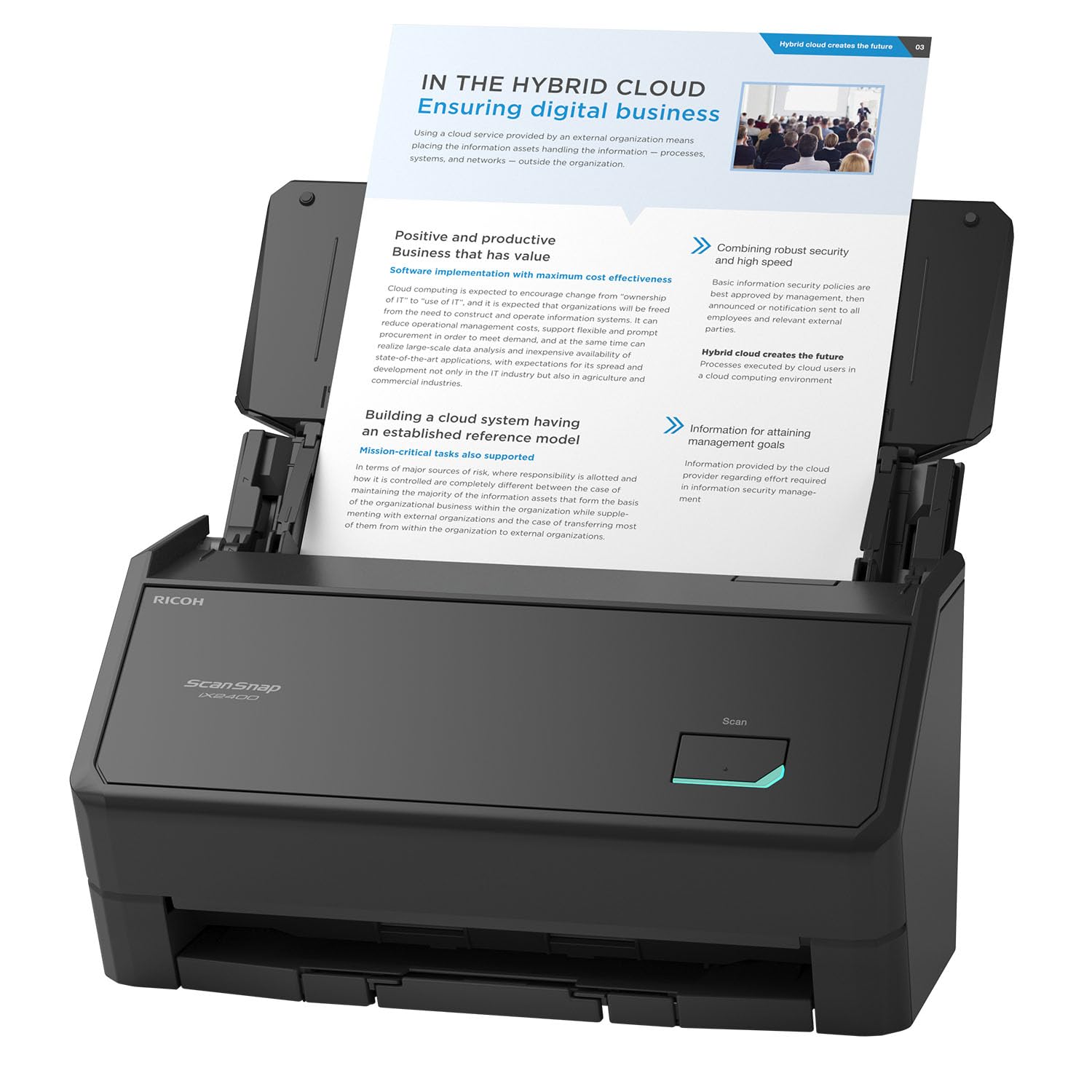
The ScanSnap iX2400 delivers the same blistering 45 ppm duplex speed as its wireless sibling but at a more accessible price point by offering USB-only connectivity. The 100-sheet ADF keeps large batch jobs running without refill interruptions, and the one-touch Quick Menu lets you scan directly to applications like Dropbox, Evernote, or a local folder with a single button press. It handles business cards, receipts, photos, and even envelopes without jamming — a significant upgrade over all-in-one printer scanners.
Users upgrading from older ScanSnap models report night-and-day differences in speed, with one reviewer scanning 500 pages in an hour without a single jam. The ScanSnap Home software automatically detects document size, removes blank pages, deskews, and produces searchable PDFs with OCR. The auto-crop feature is particularly strong for irregularly sized receipts and business cards that would require manual cropping on most competing software.
The iX2400 lacks TWAIN and WIA driver support, which means it won’t integrate with custom document management software that relies on those protocols. Occasional upside-down scans require manual rotation in the software, and some users note the software interface requires unnecessary clicks for basic operations. USB-only limits placement flexibility — the scanner must stay within cable range of the host computer.
Why it’s great
- Fastest duplex speed in its class at 45 ppm
- 100-sheet ADF handles large batches without refilling
- One-touch scanning with automatic deskew and blank page removal
- Reliable feeding mechanism for mixed media types
Good to know
- No TWAIN/WIA driver — incompatible with many business applications
- USB-only connection limits placement within cable range
- Software interface feels bloated with unnecessary steps
6. Brother ADS-3100

The Brother ADS-3100 compresses 40 ppm duplex scanning into a compact 6.1-pound chassis that fits easily on a crowded desk next to a monitor. Its 60-sheet ADF is smaller than the 100-sheet flagships but perfectly sized for small office and home office workflows, and the Hi-Speed USB 3.0 connection ensures fast data transfer for high-resolution scans. The triple-layer security features — secure function lock, IP address filtering, and secure boot — make this one of the few scanners with enterprise-grade data protection at a mid-range price.
The bundled software suite includes seven applications for optimizing, enhancing, and customizing document workflows, including OCR and direct scan-to-USB without a computer. Users report it handles business cards, receipts, and ID cards reliably, and the auto-blank-page skip saves time during long batch runs. The 48-bit color depth captures subtle color variations that matter for branded materials and marketing collateral.
Driver selection can be confusing — the Brother support site lists multiple driver versions without clear guidance on which one matches your OS. Some units experience feeding issues where the ADF grabs multiple pages at once, and Brother support has been criticized for relying on chatbot assistance rather than live technical help. The 60-sheet ADF is too small for high-volume production environments scanning hundreds of pages daily.
Why it’s great
- Very compact and lightweight for its scanning speed
- USB 3.0 connectivity for fast data transfer
- Triple-layer security for sensitive document handling
- Scan-to-USB function works without a computer
Good to know
- Driver selection process on Brother website is confusing
- Some units experience multi-feed issues in the ADF
- 60-sheet ADF is small for high-volume batch scanning
7. Canon imageFORMULA DR-C225 II

The Canon imageFORMULA DR-C225 II earns its reputation as the most jam-resistant scanner in its class, with users reporting zero paper jams over nine years of ownership on the previous-generation model. Its 25 ppm duplex speed is slower than the 40+ ppm competitors, but the trade-off is exceptional reliability with problem documents — Post-it notes, taped pages, and wrinkled receipts that cause other scanners to choke feed through without hesitation. The upright design with top feed and top eject saves desk space and makes jam clearance trivial.
The genuine differentiator here is Canon’s 3-year US-based technical support, which is twice the standard warranty length of most business scanners. The bundled software includes CaptureOnTouch for one-click scanning, Cardiris for business card management, and eCopy PDF Pro Office for document creation and collaboration. The TWAIN driver is rock-solid across Windows and Mac, earning praise from users who previously dealt with unreliable drivers on other brands.
The 30-sheet ADF is the smallest on this list and requires frequent refilling for large batches. Double-feed detection cannot be disabled, which means scanning envelopes or documents with attached Post-it notes will trigger false feed errors that require manual override. The 25 ppm speed becomes a bottleneck when processing stacks of 100+ pages.
Why it’s great
- Exceptional jam resistance with wrinkled, taped, and Post-it documents
- 3-year US-based warranty and technical support
- Compact upright design with top feed and top eject
- Stable TWAIN driver with consistent performance across OS updates
Good to know
- 30-sheet ADF requires frequent refilling for large batches
- Double-feed detection cannot be disabled for mixed media
- 25 ppm speed is slower than mid-range competitors
8. Canon imageFORMULA R30

The Canon imageFORMULA R30 eliminates the most common frustration with business scanners — driver installation — by running entirely on built-in software that requires zero downloads. Simply plug the USB cable into a Windows or Mac computer, and the scanner appears as an external drive with the scanning interface ready to go. The 25 ppm duplex speed and 60-sheet ADF make it capable of digitizing a 1,000-page double-sided document in roughly two hours, as demonstrated by users scanning entire diaries and archives.
This plug-and-scan approach is ideal for IT-averse offices, temporary workstations, or situations where installing corporate-approved software takes weeks. The scanner handles mixed batches of invoices, contracts, and business cards without manual page sorting, and the auto-crop and deskew features clean up uneven originals. The 60-sheet capacity is generous for its price tier and matches some mid-range models.
Some users report the driver becomes unstable and requires reinstallation on every computer restart, though this appears to be an inconsistent issue rather than a universal flaw. The scanner cannot scan bound books, and there’s no output-to-printer option — it saves exclusively to computer storage. The lack of TWAIN driver support means it won’t integrate with specialized document management software that most enterprise workflows require.
Why it’s great
- Truly driver-free plug-and-scan operation on Windows and Mac
- 60-sheet ADF capacity at an entry-level price
- Auto-crop, deskew, and duplex scanning for clean batch output
- Fast enough for large digitization projects (1000+ pages)
Good to know
- Driver reliability is inconsistent — some units require frequent reinstallation
- No TWAIN driver — incompatible with most business software
- Cannot scan bound books or thick documents
9. Doxie Pro

The Doxie Pro is purpose-built for receipt-heavy workflows where document thickness varies wildly from thermal paper slips to folded invoices. Its unique direct feed slot allows single-sheet feeding of thick or delicate paper that would jam standard ADF rollers, and the collapsible document feeder stores flush with the scanner for a footprint measuring just 3.9 x 12 inches. The bundled Doxie software features real-time image editing — contrast boost, gamma adjustment, and crop — before saving, eliminating the need for rescanning.
Users report scanning wrinkled pages and glossy maps that stymie other scanners by adjusting contrast and gamma settings on the fly. The auto-crop and rotation features are particularly accurate for business cards and irregularly sized receipts. Doxie’s software sends scans directly to Dropbox, Evernote, OneNote, and iCloud with minimal configuration, and the company offers US-based support with a 1-year warranty.
The 20-sheet ADF is the smallest on this list, making batch scanning of multi-page documents tedious. The 15 ppm duplex speed is noticeably slower than every other scanner reviewed here, and the scanner lacks Linux and Chromebook support. While excellent for receipt digitization, it’s underpowered for general office document archiving where volume and speed matter most.
Why it’s great
- Direct feed slot handles thick paper, folded documents, and glossy maps
- Real-time image editing before saving reduces rescanning
- Very compact footprint for crowded desks
- Excellent software integration with cloud storage services
Good to know
- 20-sheet ADF is too small for volume document scanning
- 15 ppm duplex speed is slowest among business scanners reviewed
- No Linux or Chromebook support
FAQ
How many pages per minute does a business scanner realistically need?
Can a document scanner replace a flatbed scanner for photo scanning?
What causes paper jams in document scanners and how can I prevent them?
Is a wireless scanner worth the extra cost for a business desk?
Final Thoughts: The Verdict
For most users, the best business scanner winner is the ScanSnap iX2500 because it combines the fastest duplex speed (45 ppm) with the most connectivity options (Wi-Fi 6, USB-C) and a 100-sheet ADF that handles daily batch volumes. If you need offline scan-to-USB capability with a CCD sensor for embossed cards, grab the Epson ES-580W. And for multi-OS offices that rely on Linux or need TWAIN integration with existing software, nothing beats the Brother ADS-2200 at its price point.

Mo Maruf
I created WellFizz to bridge the gap between vague wellness advice and actionable solutions. My mission is simple: to decode the research and give you practical tools you can actually use.
Beyond the data, I am a passionate traveler. I believe that stepping away from the screen to explore new environments is essential for mental clarity and physical vitality.