Our readers keep the lights on and my smoothie glass nicely filled. As an Amazon Associate, I earn from qualifying purchases.
Pairing a capable AV receiver with your speakers is the single most impactful upgrade you can make to your home cinema, yet the market is flooded with confusing specs and diminishing returns. The sweet spot lies in finding a unit that delivers clean amplification for a 5.1.2 Dolby Atmos setup, modern HDMI 2.1 connectivity for gaming and streaming, and reliable room calibration — all without forcing you into the law of sharply diminishing returns. This guide cuts through the noise to focus on the models that actually deliver measurable performance where it counts: per-channel wattage, codec support, and real-world stability.
I’m Mohammad Maruf — the founder and writer behind WellFizz. I’ve spent years analyzing amplifier topology, HDMI chipset generations, and THD ratings to separate genuine value from marketing fluff in the home theater space.
Whether you are building a dedicated theater room or upgrading a living room setup, choosing the right affordable av receiver means weighing channel count, room correction depth, and HDMI 2.1 bandwidth against your specific speaker configuration and source devices.
How To Choose The Best Affordable AV Receiver
An AV receiver is the central brain of your home theater, so choosing correctly prevents a bottleneck in both audio fidelity and video signal path. Focus on these three pillars: channel count and wattage, HDMI version and port configuration, and the quality of the built-in room calibration software.
Channel Count & Real-World Power
A 5.2 channel receiver drives a standard surround setup with left, center, right, two surrounds, and two subwoofers. If you plan to add height speakers for Dolby Atmos in a 5.1.2 configuration, you need a 7.2 channel unit. Pay attention to RMS wattage at 8 ohms with two channels driven — that figure tells you more about dynamic headroom than the inflated total power number. Budget-friendly units typically offer 60–80 watts per channel, while premium options push past 100 watts, allowing cleaner playback at higher volumes with less distortion.
HDMI 2.1 Bandwidth & eARC
Modern gaming consoles and 4K Blu-ray players require HDMI 2.1 ports that support 4K120Hz or 8K60Hz pass-through, along with Variable Refresh Rate (VRR) and Auto Low Latency Mode (ALLM). Ensure the receiver has at least two 40Gbps HDMI 2.1 inputs if you own a PlayStation 5 and Xbox Series X. eARC is equally critical — it lets your TV send uncompressed Dolby TrueHD and DTS-HD Master Audio back to the receiver from built-in apps, preserving object-based audio quality without a separate streaming box.
Room Correction & Setup Experience
A receiver with robust room calibration — such as YPAO R.S.C., Audyssey MultEQ, or AccuEQ — measures speaker distances, levels, and crossover frequencies using the included microphone. Multi-point measurement provides smoother frequency response across multiple seating positions. Budget receivers often offer a single-point calibration, which is acceptable for a dedicated listening chair but less ideal for a family room with a wide couch. The depth of the room correction directly affects dialogue clarity and bass integration.
Quick Comparison
On smaller screens, swipe sideways to see the full table.
| Model | Category | Best For | Key Spec | Amazon |
|---|---|---|---|---|
| Onkyo TX-NR6100 | Premium | THX Certified Home Theater | 210W/Ch THX Select, 7.2 ch | Amazon |
| YAMAHA RX-V6A | Premium | Multi-Room Music & 4K Gaming | 7.2 ch, 8K60 HDMI 2.1 | Amazon |
| JBL MA710 | Mid-Range | 5.1.2 Atmos Setup | 110W/Ch, 7.2 ch, 8K eARC | Amazon |
| Denon AVR-S670H | Mid-Range | Entry-Level Power with HEOS | 75W/Ch, 5.2 ch, 8K Upscaling | Amazon |
| Onkyo TX-NR5100 | Mid-Range | Budget 5.1.2 with Gaming Features | 7.2 ch, 8K60/4K120, Renewed | Amazon |
| Pioneer VSX-935 | Mid-Range | Virtual Height Effects | 7.2 ch, Dolby Atmos Height Virtualization | Amazon |
| YAMAHA RX-V4A | Mid-Range | Compact Streaming Hub | 5.2 ch, MusicCast, 8K60 | Amazon |
| Sony STRDH590 | Budget | Simple 5.1 with S-Force Pro | 5.2 ch, 725W Total, BT | Amazon |
| JBL MA310 | Budget | Compact Shallow Depth Receiver | 60W/Ch, 5.2 ch, 4K ARC | Amazon |
In‑Depth Reviews
1. Onkyo TX-NR6100 7.2 Channel THX Certified Network AV Receiver
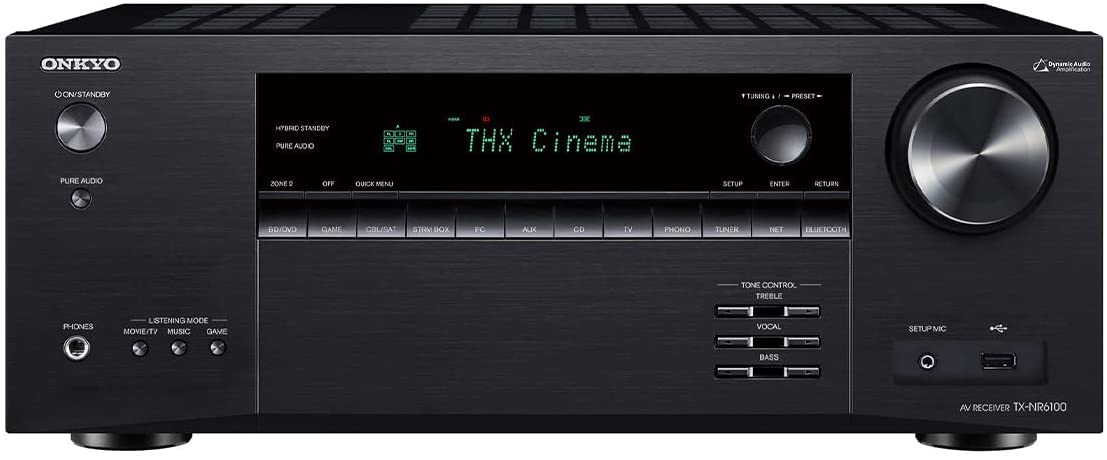
The Onkyo TX-NR6100 delivers THX Select certification and a robust 210W dynamic amplification per channel, making it the most powerful value proposition for a 5.1.2 Dolby Atmos or DTS:X system without stepping into flagship pricing. Its three 40Gbps HDMI 2.1 inputs support 8K60 and 4K120 pass-through with VRR and ALLM, matching the needs of current-gen consoles and PC gaming rigs. The built-in Klipsch Optimize Mode automatically tailors the output curve to Klipsch Reference speakers, a thoughtful touch for owners of that popular brand.
Owner feedback highlights the receiver’s ability to drive demanding 5.1.2 setups with excellent clarity and dynamic range, often outperforming similarly-priced Denon models in pure headroom. The THX-certified amplification provides a higher sustained output ceiling, which translates to cleaner playback during loud action sequences without audible strain. The included AccuEQ room calibration, while not as granular as Audyssey MultEQ XT32, effectively tames room modes and aligns speaker timings for a cohesive soundstage.
The main compromise is the non-backlit remote and the fact that bi-amping the front speakers reduces the system to 5.1 (losing the height channels). Some users report HDMI 2.1 chipset issues after extended use, so verify your unit’s firmware version. For a dedicated theater room with a 5.1.2 layout, this receiver offers an exceptional blend of certified power, gaming features, and build quality that justifies its mid-range cost.
Why it’s great
- THX Select certification ensures reliable high-power delivery for dynamic content.
- Three 40Gbps HDMI 2.1 inputs support 4K120 and 8K60 gaming with no chroma subsampling.
- Klipsch Optimize Mode fine-tunes frequency response for popular speaker brands.
Good to know
- Bi-amping front channels disables rear height outputs, limiting Atmos capability.
- Non-backlit remote makes dark-room navigation frustrating without a universal controller.
- Some units developed HDMI 2.1 switching failures after 1–2 years of use.
2. YAMAHA RX-V6A 7.2-Channel AV Receiver with MusicCast

The YAMAHA RX-V6A bridges the gap between a capable home theater hub and a multi-room music streamer. It offers 7.2 channels with Dolby Atmos Height Virtualization, meaning you can get a convincing overhead effect from a standard 5.1 layout without physically mounting ceiling speakers. The onboard MusicCast platform supports Spotify Connect, TIDAL, Qobuz, and AirPlay 2, and allows grouping compatible wireless speakers across different rooms — a feature set that rivals dedicated multi-room systems like Sonos.
YPAO R.S.C. (Reflected Sound Control) with multi-point measurement is a standout at this price point, automatically adjusting frequency response for early reflections from furniture and walls. Users driving 4-ohm speakers report stable operation without overheating, and the seven HDMI inputs (three 8K-capable) provide ample connectivity for a full gaming and streaming arsenal. The receiver also handles 4K120 gaming from Xbox Series X without signal dropouts, provided the latest firmware is installed.
Setup involves a learning curve, especially around HDMI CEC behavior with LG and Sony TVs where eARC auto-wake can be finicky. The remote, while improved over earlier Yamaha designs, still has small buttons that can be hard to locate in the dark. For a living space where both movie nights and whole-home audio are priorities, the RX-V6A delivers an integrated experience that few competitors match at this tier.
Why it’s great
- MusicCast ecosystem enables seamless multi-room streaming with compatible speakers.
- YPAO R.S.C. multi-point calibration cuts early reflections for smoother frequency response.
- Three 8K60 HDMI 2.1 inputs handle high-bandwidth gaming and video sources.
Good to know
- eARC auto-wake may not trigger correctly with certain Sony and LG TV models.
- Non-backlit remote with small buttons is difficult to navigate in a dark theater room.
- Initial firmware update is mandatory for stable HDMI 2.1 operation; plan for a 30-minute setup.
3. JBL MA710 7.2 Channel (110 Watt x 7) 8K AV Receiver

The JBL MA710 provides a clean 110 watts per channel across seven channels, making it one of the few affordable receivers that can comfortably drive a 5.1.2 Atmos layout with overhead speakers. It includes a dedicated moving magnet phono input for turntable connectivity, six HDMI inputs with eARC, and support for both Apple AirPlay 2 and Google Chromecast built-in. The shallow chassis depth of 13.7 inches is a practical advantage for fitting into standard media consoles without blocking rear ventilation.
Users report that the MA710 powers Polk ES60 tower speakers with authority, producing a wide, immersive soundstage in both stereo and surround modes. The on-screen setup menu is clear and responsive, and the HDMI eARC implementation maintains stable audio return with modern smart TVs. The unit runs relatively cool compared to Class A/B designs, and its minimalist aesthetic with a centered display fits well into modern living rooms.
The major caveat is that the MA710 does not internally decode DTS-HD Master Audio for 2.1 channel playback; owners of stereo-only setups will need an alternative solution. The remote lacks backlighting, and the default auto-shutoff at 20 minutes requires a menu change to disable. For a dedicated home theater with a 5.1.2 configuration, the MA710 offers robust per-channel power and excellent streaming flexibility at a competitive cost.
Why it’s great
- 110W per channel provides real headroom for driving bookshelf or tower speakers in a 5.1.2 setup.
- Shallow 13.7-inch chassis depth fits standard AV cabinets without clearance issues.
- Built-in phono preamp eliminates the need for an external turntable stage.
Good to know
- Does not mix down DTS-HD Master Audio to 2.1; limited to Dolby TrueHD for stereo listening.
- Non-backlit remote and aggressive 20-minute auto-shutoff require manual settings adjustment.
- Firmware updates are infrequent, with the last update released over a year ago.
4. Denon AVR-S670H 5.2 Ch Home Theater Receiver

The Denon AVR-S670H offers a streamlined entry point into 8K-ready home theater with a 75W x 5 channel amplifier, 8K upscaling of 4K content, and HEOS built-in wireless multi-room streaming. It supports Dolby TrueHD, DTS HD, and Dolby Pro Logic II upmixing, and features a dedicated phono input for vinyl enthusiasts. The included Audyssey MultEQ microphone performs a single-point room calibration that corrects basic frequency response issues and sets speaker distances.
Users praise the straightforward setup process, especially the ability to complete configuration without an internet connection. The eARC integration works reliably, allowing the TV remote to control volume and power. Driving a pair of KEF Q150 bookshelf speakers, the AVR-S670H produces clear, detailed sound with enough headroom for moderate listening levels in a living room. The four HDMI inputs (one 8K-capable) handle a streaming box, game console, and Blu-ray player without signal handshake problems.
HEOS wireless streaming can be inconsistent, with some users reporting lag and dropped connections when using Spotify Connect or AirPlay. The amplifier power is noticeably lower than competitors with higher channel counts, so it may struggle to fill a large room at reference volumes without distortion. For a smaller space or secondary setup where simplicity and 8K video support are priorities, the S670H delivers a polished experience without the complexity of higher-tier Denon models.
Why it’s great
- 8K upscaling and HDCP 2.3 ensure compatibility with the latest TVs and streaming devices.
- Phono input and HEOS multi-room streaming add versatility for music lovers.
- Simple, reliable eARC integration lets you control everything with your TV remote.
Good to know
- HEOS wireless performance can be unreliable, with intermittent lag and connection drops.
- 75W per channel may lack headroom for large rooms or low-sensitivity speakers at high volumes.
- Single-point Audyssey calibration is less effective than multi-point systems for wide seating areas.
5. Onkyo TX-NR5100 7.2 Channel Network A/V Receiver (Renewed)

The Onkyo TX-NR5100 brings 7.2 channel amplification with HDMI 2.1 support for 4K120 and 8K60 pass-through, making it a compelling option for gamers who want full next-gen console compatibility without stretching their budget. It includes Klipsch Optimize Mode, AccuEQ room calibration, and support for Dolby Atmos and DTS:X with up to 5.1.2 channel configurations. The renewed certification means it has been tested and repaired, often available at a significant discount versus a brand-new unit.
Users upgrading from a 1080p receiver notice an immediate improvement in picture clarity and motion handling when connecting an Xbox Series X — the 4K120 signal passes through cleanly with VRR enabled. The auto-calibration mic effectively aligns speaker timings for a convincing Atmos bubble, and the interface is responsive once the initial firmware is updated. The receiver runs cooler than previous-generation Onkyo models, addressing a common reliability concern.
The renewed nature introduces risk: several buyers reported receiving units with no audio output or subwoofer channel failures, requiring immediate returns. The user interface and app design feel dated compared to competitors like Yamaha or Denon. For buyers comfortable with the refurb gamble and willing to test functionality within the return window, the TX-NR5100 offers core HDMI 2.1 gaming performance at a price that undercuts most new 7.2 channel receivers.
Why it’s great
- HDMI 2.1 ports support 4K120 and 8K60 with VRR for lag-free gaming.
- 7.2 channel design allows a 5.1.2 Dolby Atmos speaker layout with height channels.
- Klipsch Optimize Mode tailors frequency response for popular Reference speakers.
Good to know
- Renewed units carry a higher failure rate; thorough testing is required immediately upon arrival.
- Interface and app design feel outdated compared to newer competitors.
- Some factory-refurbished units lack working subwoofer outputs or exhibit HDMI handshake issues.
6. Pioneer VSX-935 7.2 Channel Surround Sound Network Receiver
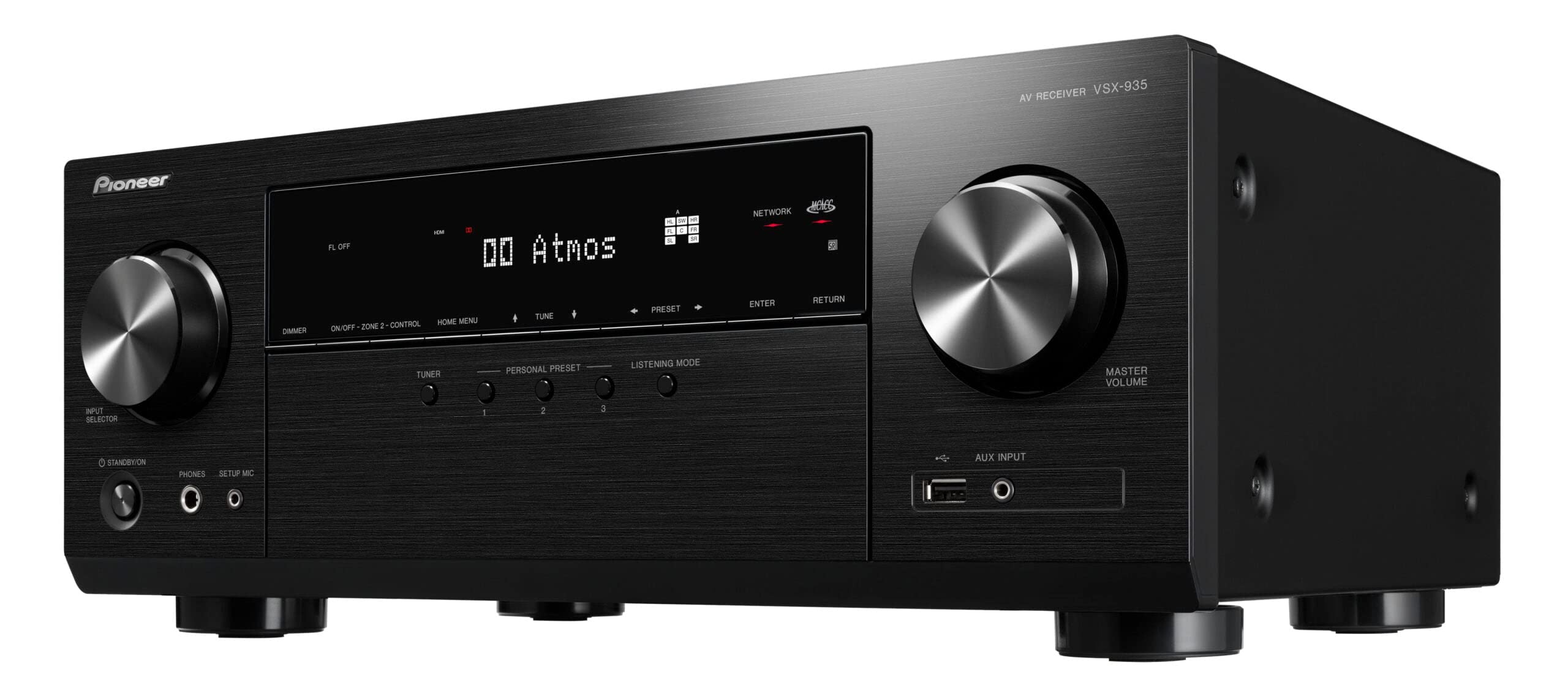
The Pioneer VSX-935 offers a unique selling point with Dolby Atmos Height Virtualization, which simulates overhead effects using only your existing horizontal speakers. This is a cost-effective solution for rooms where ceiling speaker installation is impractical. It also includes HDMI 2.1 with 8K60 pass-through, a high-current amplifier section, and dual subwoofer outputs for balanced low-frequency distribution. The 7.2 channel design allows flexible configurations, including a standard 5.1.2 setup if you choose to add physical height speakers later.
Users consistently praise the crisp, clear audio reproduction and the gradual, precise volume control. The RF remote offers reliable range, and the clear front display includes a dimmer for dark-room viewing. When paired with a mix of bookshelf and tower speakers, the receiver produces a surprisingly wide soundstage with good separation, especially for movie dialogue and music vocals. The dual-zone output is a practical bonus for feeding audio to a second room.
The Bluetooth implementation is notably flawed — it functions almost exclusively as a one-way streamer, and the menu navigation to switch between sources is buried and unintuitive. Some units arrived with a dead display or required a hard reset for audio output. The user interface looks dated, with a clunky on-screen menu system. If reliable Bluetooth streaming is a priority, look elsewhere; but for a dedicated cinema setup that prioritizes virtualization and connectivity, the VSX-935 is a solid performer.
Why it’s great
- Dolby Atmos Height Virtualization provides convincing overhead effects without ceiling speakers.
- Dual subwoofer outputs allow even bass distribution for reduced room mode issues.
- High-current amplifier delivers clear, dynamic sound with good speaker separation.
Good to know
- Bluetooth functionality is restricted to one-way streaming and is difficult to access via menus.
- Some units arrived with dead displays or no audio output, requiring immediate exchange.
- On-screen user interface feels dated and less intuitive than Yamaha or Denon systems.
7. YAMAHA RX-V4A 5.2-Channel AV Receiver with MusicCast

The YAMAHA RX-V4A packs the full MusicCast multi-room streaming ecosystem into a slim 5.2 channel chassis, making it an ideal hub for a compact living room or bedroom setup. It supports 8K60 and 4K120 pass-through via HDMI 2.1, AirPlay 2, Spotify Connect, and voice control through Alexa and Google Assistant. YPAO automatic room calibration measures speaker distance and levels to optimize the listening position, and the receiver drives standard 5.1 speaker packages cleanly without audible distortion.
Users driving 140W towers and a center channel report clean, detailed power delivery with precise imaging. The MusicCast app is a highlight — it lets you group the RX-V4A with other MusicCast devices around your home for synchronized playback, similar to Sonos. The compact dimensions mean it fits easily into a media console, and the unit runs cool thanks to efficient Class AB amplification. HDMI ARC integration with modern TVs works reliably for single-remote control.
The main trade-off is the 5.2 channel limit, which rules out a 5.1.2 Atmos layout with height speakers. Some users experienced HDMI switching issues when passing video through to a monitor, requiring a hard reset. The remote has tiny, stiff buttons that are frustrating to use during setup. For a secondary room or apartment with a 5.1 speaker set, the RX-V4A is a reliable, full-featured entry into the Yamaha ecosystem.
Why it’s great
- Full MusicCast multi-room support with app control, Spotify Connect, and AirPlay 2.
- HDMI 2.1 with 8K60 pass-through ensures compatibility with future video sources.
- Compact chassis and efficient cooling make it suitable for tight media console spaces.
Good to know
- 5.2 channel limit prevents adding height speakers for a Dolby Atmos setup.
- Remote buttons are small, stiff, and poorly labelled, making initial configuration tedious.
- Some units exhibit HDMI switching issues when connected to 1080p monitors or older TVs.
8. Sony STRDH590 5.2 Channel Surround Sound Home Theater Receiver
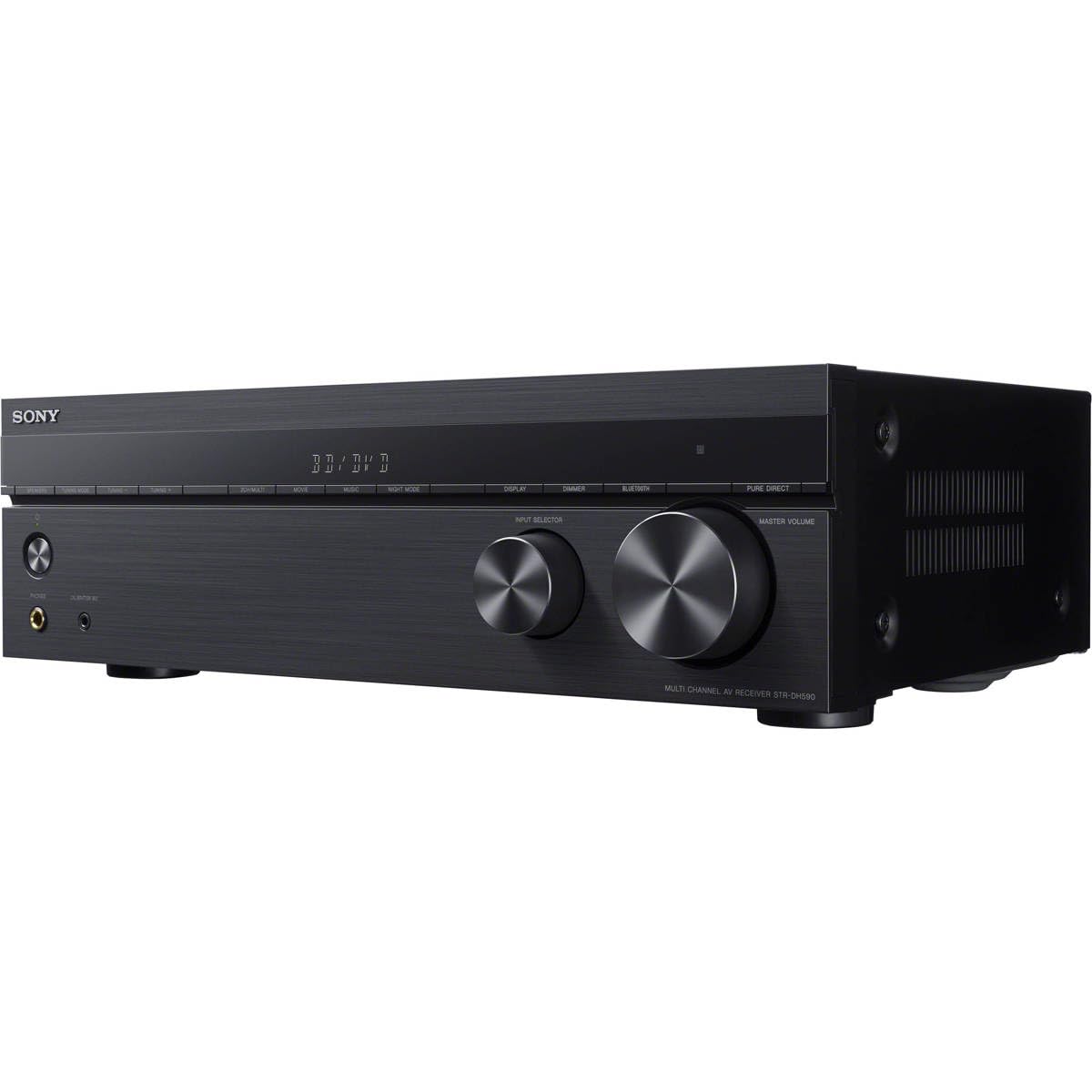
The Sony STRDH590 is a no-frills 5.2 channel receiver that focuses on core surround sound functionality without the complexity of advanced room calibration or multi-room streaming. It features S-Force PRO virtual front surround, which simulates a wider soundstage with only two speakers, and supports 4K HDR passthrough with HDCP 2.2. The front-panel display is clear and adjustable, and the remote includes dedicated one-button inputs for quick switching between TV, FM, and Bluetooth sources.
Users report that the receiver sounds excellent when paired with older KEF and Radio Shack speakers, providing clean amplification for a basic 5.1 setup. The auto speaker calibration via the included microphone sets levels and distances reasonably well for a single listening position. eARC integration works smoothly with modern Sony and LG TVs, simplifying daily operation. The slim 5.25-inch height runs cooler than many competitors, a practical advantage for enclosed shelves.
The STRDH590 lacks support for Dolby Atmos, DTS:X, and any height channel processing, making it unsuitable for immersive audio. The rear speaker jacks use pin connectors instead of standard binding posts, which can be inconvenient for thicker gauge wire. There is no phono input for turntable users, and the FM antenna wire is surprisingly short. For someone building their first 5.1 system on a tight budget, this Sony delivers dependable performance without unnecessary extras.
Why it’s great
- Simple, straightforward setup with auto speaker calibration and clear on-screen menus.
- Compact chassis runs cool, fitting easily in media consoles with limited ventilation.
- Dedicated one-button input switching makes daily use fast and intuitive.
Good to know
- No Dolby Atmos or DTS:X support; limited to legacy 5.1 surround codecs.
- Center and rear speaker terminals use pin connectors, not standard banana plug binding posts.
- Lacks a phono input and AM tuner, limiting vinyl and radio options.
9. JBL MA310 5.2 Channel (60 Watt x 5) 4K AV Receiver

The JBL MA310 is the most compact and budget-friendly receiver in this lineup, offering 60 watts per channel across five channels with 4K ARC support and Bluetooth 5.1 streaming. Its shallow chassis is specifically designed to slide into media consoles with limited depth, and the minimalist front panel with a single large volume knob gives it a clean, modern aesthetic. Native decoding of Dolby and DTS formats is included, and the receiver integrates easily with smart TVs, gaming consoles, and streaming boxes.
Users driving a full 5.1 setup with in-wall Polk speakers and a powered sub report impressive sound quality that exceeds expectations for the price class. The HDMI ARC auto on/off function works reliably with modern TVs, simplifying power management. The on-screen setup menu is clear and responsive, making initial configuration straightforward even for first-time receiver owners. The unit drives Athena tower speakers with authority, producing detailed sound across movies and music.
The remote completely lacks backlighting, which is a significant annoyance in a dark home theater — some users resort to gluing a tactile dot on the volume button. The default auto-shutoff triggers after 20 minutes of inactivity and must be manually disabled in the settings. The MA310 also cannot mix down DTS-HD Master Audio to 2.1, limiting its appeal for stereo-only listeners. For a compact apartment setup with a 5.1 system, the MA310 offers the best blend of affordability and small-footprint design.
Why it’s great
- Extremely shallow chassis fits in media consoles where full-depth receivers cannot.
- 60W per channel is sufficient for small to medium rooms with efficient speakers.
- HDMI ARC auto on/off works seamlessly with modern smart TVs for one-remote control.
Good to know
- Non-backlit remote is nearly unusable in a dark room without added tactile markers.
- Default 20-minute auto-shutoff interrupts playback unless manually disabled in the menu.
- No support for DTS-HD Master Audio downmix to 2.1; only Dolby TrueHD works in stereo mode.
FAQ
Why does my affordable AV receiver sound weak at high volume?
Can I use an affordable AV receiver without a subwoofer?
Do I need a separate amplifier with an affordable AV receiver?
Final Thoughts: The Verdict
For most users, the affordable av receiver winner is the Onkyo TX-NR6100 because its THX Select certification, 210W dynamic power, and three 40Gbps HDMI 2.1 inputs deliver genuine high-end features without the high-end price. If you want seamless multi-room music streaming with solid gaming performance, grab the YAMAHA RX-V6A. And for a compact 5.1.2 Atmos setup where chassis depth is a constraint, nothing beats the JBL MA710 for its clean 110W per channel and phono input at a reasonable cost.

Mo Maruf
I created WellFizz to bridge the gap between vague wellness advice and actionable solutions. My mission is simple: to decode the research and give you practical tools you can actually use.
Beyond the data, I am a passionate traveler. I believe that stepping away from the screen to explore new environments is essential for mental clarity and physical vitality.