Our readers keep the lights on and my smoothie glass nicely filled. As an Amazon Associate, I earn from qualifying purchases.
A detached shoe sole is the fastest way to retire a perfectly good pair of boots, sneakers, or dress shoes. Most people reach for a tube of super glue, watch it crack within a week, and toss the footwear for good. The reality is that a separated sole demands a flexible, waterproof bond that withstands constant flexing and ground impact — not a brittle fix. Choosing the wrong adhesive ensures a repeat failure, but the right one can add months or years of life to your favorite pair.
I’m Mohammad Maruf — the founder and writer behind WellFizz. I’ve spent years tracking real-world performance data, analyzing chemical formulations, and reading through thousands of verified buyer reports to understand exactly which adhesive formulations actually hold up under daily abuse.
To help you avoid the trial-and-error cycle, I’ve put together this practical guide covering the best adhesive for shoe soles. The section below breaks down the key specs that separate a lasting repair from a temporary patch.
How To Choose The Best Adhesive For Shoe Soles
The core problem with repairing a shoe sole is the constant mechanical stress — every step bends the bond, every puddle tests its waterproof seal, and every temperature swing challenges its adhesion. A general-purpose glue almost always fails at one of these. The selection criteria below focus on the specific demands of sole repair so you buy a solution that actually holds.
Flexibility After Cure
Rigid glues crack under the repetitive flex of a walking stride, especially at the ball of the foot. A sole adhesive must remain flexible after full cure to move with the shoe’s natural motion. Neoprene-based contact cements and urethane formulations offer this elasticity, while standard cyanoacrylates do not. Check for explicit “flexible” or “rubberized” labeling — it is the single strongest predictor of long-term performance.
Water and Temperature Resistance
Rain, snow, and sweat seep into the gap between sole and upper. An adhesive that tolerates moisture but re-emulsifies when soaked will fail in wet conditions. Look for adhesives rated as “waterproof” rather than “water-resistant.” Heat resistance matters too — a car’s interior or direct summer sun can soften some formulations, causing the bond to slide. Products with explicit “all-weather” or “heat resistant” specs are safer bets for year-round durability.
Cure Time and Application Control
Slow-curing contact cements (24-hour full cure) offer the strongest molecular bond but require clamping or patience. Fast-set cyanoacrylate gels bond in under a minute but demand precise alignment — there is no repositioning window. For small cracks and quick fixes, a fast gel is convenient. For full sole reattachment, a slower cure with longer open time gives you the ability to position the sole perfectly before it locks.
Quick Comparison
On smaller screens, swipe sideways to see the full table.
| Model | Category | Best For | Key Spec | Amazon |
|---|---|---|---|---|
| Shoe Goo (Pack of 2) | Contact Cement | Full sole rebuilds & heel fills | 24-hour full cure, waterproof | Amazon |
| RH S-18 All-Purpose | Neoprene Cement | Rubber-to-metal & leather repairs | Heat resistant, 24-hour cure | Amazon |
| Boot-Fix Shoe Glue | Cyanoacrylate Gel | Instant grip for small tears | 45-second set, clear dry | Amazon |
| Shoe-Fix Repair Adhesive | Cyanoacrylate Gel | Quick fixes on athletic shoes | 45-second set, flexible finish | Amazon |
| Eagle Shoe Cement | Rubber Cement | Heavy-duty boot sole reattachment | Waterproof, quick-drying | Amazon |
In‑Depth Reviews
1. Shoe Goo Adhesive (Pack of 2)
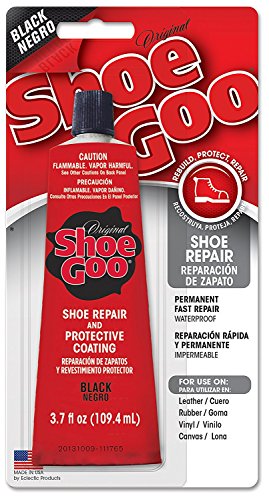
Shoe Goo has been the standard for sole repair for over two decades, and this twin pack delivers the same rubberized contact cement formula that users have trusted for full-shoe rebuilds. Its viscosity is thick enough to fill deep heel gouges or rebuild worn tread sections, and it cures to a flexible, waterproof rubber that remains pliable rather than brittle. Many users report successfully using it to rebuild Birkenstock heels or reattach soles that had completely separated — as long as you apply in thin layers where the gap exceeds a quarter-inch.
The black color blends well with dark soles, making repairs less visible than clear alternatives. The adhesive remains workable for a short time before setting, giving you enough window to position the sole accurately. A full cure at 24 hours delivers maximum strength, and the bond becomes virtually irremovable after 48 hours — a sign of deep molecular cross-linking.
This adhesive is ideal for larger jobs where you need gap-filling capability and a permanent bond. For small tears or instant fixes, a faster-setting gel may be more convenient. But for any serious sole reattachment or rebuild, Shoe Goo remains the most proven choice.
Why it’s great
- Thick formula fills gaps up to 1/4 inch without sagging
- Waterproof bond tested over years of daily wear
Good to know
- Full 24-hour cure requires patience before wearing
- Color is black, not clear — not ideal for visible repairs on light soles
2. RH Adhesives S-18 All-Purpose (4 oz)
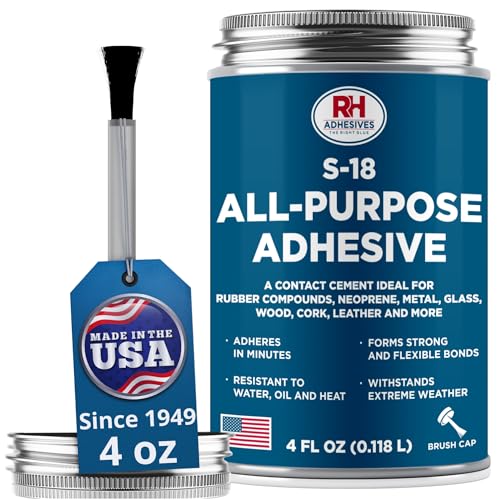
RH Adhesives has manufactured solvent-based neoprene cement since 1949, and the S-18 formula excels where flexibility meets thermal stability. This is a contact cement — you apply it to both surfaces, let it flash off, then press together for an immediate bond. The resulting film resists oil, heat, and moisture, making it a top choice for bonding rubber soles to leather uppers or neoprene to metal hardware.
Users report strong results on leather boots and wedges after surface sanding, with the bond holding through summer heat that softens lesser adhesives. The off-white color dries translucent but is not invisible, so it works best on repairs hidden within the sole edge or under the upper. One key behavior — the solvent evaporates inside the can over long storage, so the 4-ounce size is best used within a few projects rather than sitting for months.
The S-18 requires good ventilation during application due to solvent vapors. For users who want a high-heat-resistant bond that can handle heavy leather work or rubber-to-metal attachment, this is the most specialized and effective option on the list. It is not the fastest tool for a quick crack fix, but for structural repairs it matches professional cobbler results.
Why it’s great
- Excellent peel strength and oil resistance for leather and rubber
- Proven heat resistance — holds through hot car interiors and summer pavement
Good to know
- Solvent vapors require strong ventilation during use
- Can degrade if left open — best for single or occasional use
3. Boot-Fix Professional Grade (20g Tube)
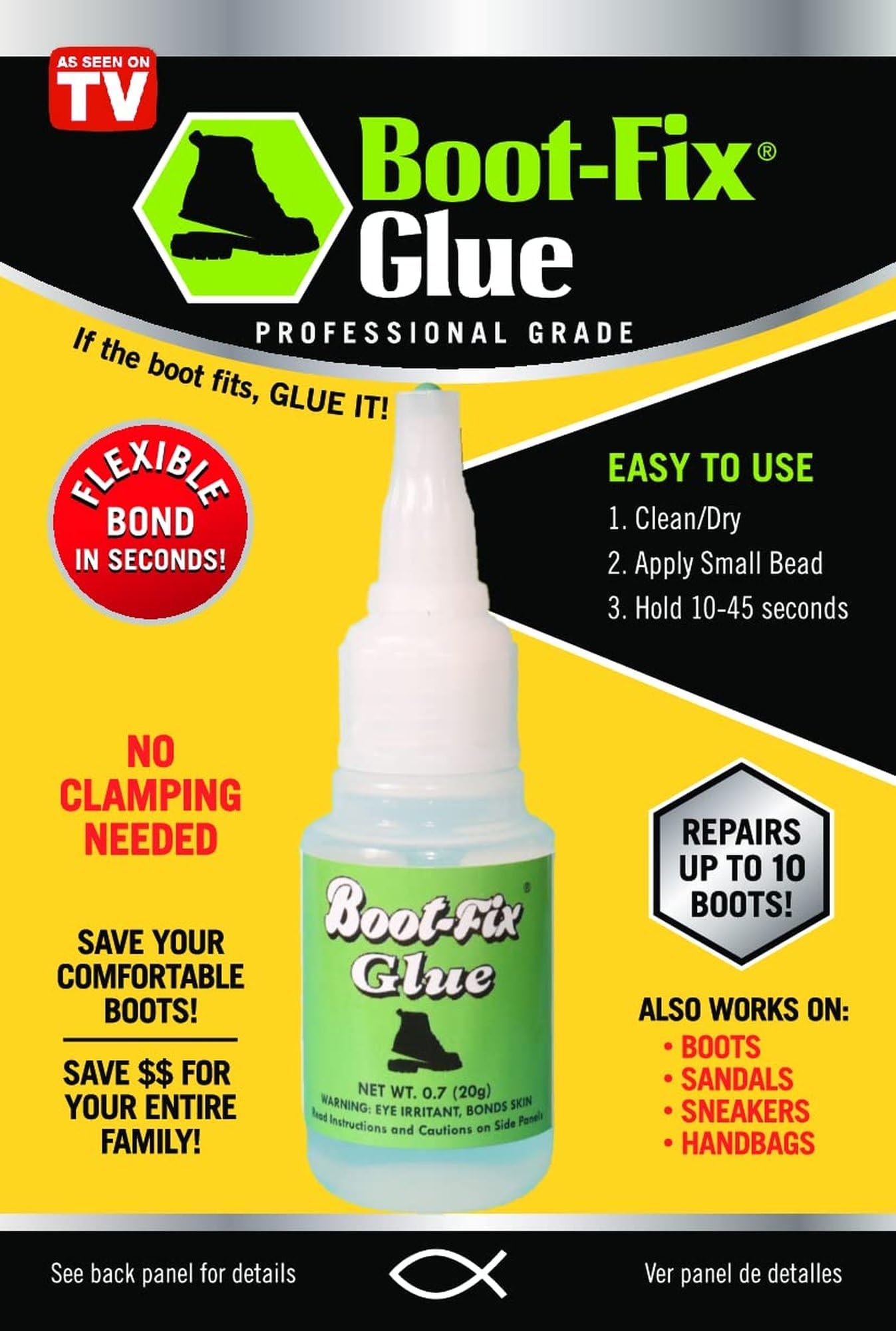
Boot-Fix packs a cyanoacrylate gel that sets in under a minute, making it the fastest tool on this list for urgent repairs. Its gel consistency stays where applied without running into the shoe interior, which is critical for vertical repairs like reattaching a toe cap or sealing a side tear. Users have saved expensive work boots and hiking shoes minutes before a shift or trail — bonding a separated sole within 45 seconds and holding up through heavy farm use and construction abuse.
The cured bond is extremely rigid compared to contact cement, which makes it better for small gaps rather than large-area sole reattachment. Several users report that a single 20-gram tube handles multiple smaller repairs (around ten to fifteen fixes) but that a full sole perimeter may consume most of the tube. The gel is clear when dry, which keeps repairs discreet on light-colored footwear.
For anyone who needs a shoe wearable again within an hour, Boot-Fix is the most practical pick. It is not designed for gap filling or stress-heavy full sole lifts, but for cracks, torn uppers, and separated toe caps, it outperforms general-purpose cyanoacrylates by a wide margin.
Why it’s great
- Sets in 45 seconds — no clamping required
- Clear, rigid bond ideal for small cracks and tears
Good to know
- Tube volume is small for large sole jobs
- Bond is not flexible — can crack under repeated bending at the ball of the foot
4. Shoe-Fix Professional Grade (20g Tube)
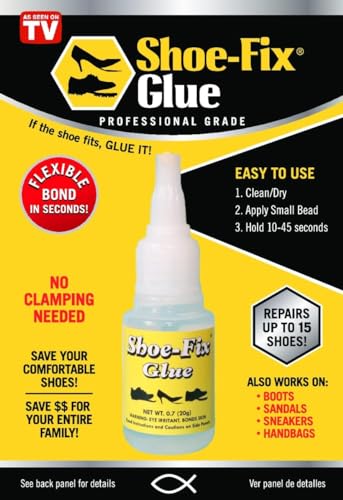
Shoe-Fix is a cyanoacrylate gel that shares the same instant-bond family as Boot-Fix but markets itself specifically for all-weather durability, claiming resistance to heat, cold, and moisture. Users backing up that claim report that repairs hold through rain and wet conditions without re-emulsifying, and the clear finish leaves no trace on the shoe. The gel is thin enough to seep into small gaps but thick enough to stay put on vertical applications like heel reattachment.
Customer feedback highlights its use on athletic shoes and work boots where a quick, invisible repair is preferred. The 45-second set time is accurate, and the bond remains flexible enough to tolerate moderate flex without cracking. This is a step up from rigid super glues because of the polymer additives that impart some elasticity to the final film.
Shoe-Fix is best for users who need one adhesive that works across multiple shoe types — from sneakers to sandals to boots — without visible residue. It is not as strong for heavy gap-filling as Shoe Goo, and the 20-gram tube runs out fast on larger projects. But for everyday spot repairs, it delivers a clean, durable result.
Why it’s great
- Dries completely clear — ideal for visible repairs on light soles
- Flexible finish resists cracking from normal walking
Good to know
- Small tube size limits use to 2-3 moderate repairs
- Not suitable for deep heel gap filling or full sole reconstruction
5. Eagle Shoe Cement (4 oz)

Eagle Shoe Cement is a solvent-based paste adhesive that competes directly with professional cobbler brands like Barge. Its medium viscosity is thick enough to hold a sole in place without dripping, and it dries clear with a flexible finish. Users report success on vintage boots and everyday sneakers where other glues failed after the first rainstorm — the waterproof claim appears to hold in real-world wet conditions.
The 4-ounce bottle provides more volume than the 20-gram tubes, making it a budget-friendly choice for large-area sole reattachment. The included applicator tip allows controlled bead application along a sole perimeter. Several long-term tests show the bond outlasting the original shoe’s construction, especially on leather and rubber combinations where flexibility is critical.
The main drawback is packaging — a small percentage of units arrive with a loose lid that compromises the solvent. Users should inspect the seal on arrival. For those who want a heavy-duty contact cement with enough volume for multiple full-shoe repairs, Eagle offers the best per-project value on the list.
Why it’s great
- True waterproof bond proven in wet-weather tests
- Larger 4-ounce bottle handles multiple full sole reattachments
Good to know
- Occasional packaging defects with lid seal
- Thicker paste requires careful, even application to avoid lumps
FAQ
Can I use super glue to fix a detached shoe sole?
How do I prepare the sole surface before applying adhesive?
Final Thoughts: The Verdict
For most users, the best adhesive for shoe soles winner is the Shoe Goo Pack of 2 because it combines gap-filling thickness, durable waterproof flexibility, and proven long-term reliability for full sole reattachment and heel rebuilds. If you want an instant bond for small cracks and tears, grab the Boot-Fix. And for heavy-duty work boot or leather repairs where heat resistance matters, nothing beats the RH S-18 All-Purpose Adhesive.

Mo Maruf
I created WellFizz to bridge the gap between vague wellness advice and actionable solutions. My mission is simple: to decode the research and give you practical tools you can actually use.
Beyond the data, I am a passionate traveler. I believe that stepping away from the screen to explore new environments is essential for mental clarity and physical vitality.