Our readers keep the lights on and my smoothie glass nicely filled. As an Amazon Associate, I earn from qualifying purchases.
Walking into a cloud of musty air or feeling your engine lag on a hill climb points to one culprit — a clogged or underperforming filter. A simple piece of pleated material is the first line of defense between your engine’s moving parts and the fine grit that grinds them down, and between your lungs and the pollutants of the road. Whether you’re chasing peak performance or just want to fight off seasonal allergies during your commute, swapping out a tired filter is one of the highest-impact maintenance tasks you can tackle with virtually no tools.
I’m Mohammad Maruf — the founder and writer behind WellFizz. I’ve spent years analyzing the measurable differences between budget pleated paper, electrostatically charged synthetics, and washable high-flow options to separate marketing claims from real filtration gains.
After sifting through hundreds of real-world reports and testing fitment across dozens of late-model sedans and SUVs, finding the best car air filter comes down to balancing particulate capture efficiency, airflow resistance, and the specific valve-train protection your engine needs.
How To Choose The Best Car Air Filter
Selecting the right air filter for your vehicle isn’t as simple as grabbing the cheapest rectangle off the shelf. The filtration efficiency, material composition, and intended placement (engine intake vs. cabin) dramatically affect performance, fuel economy, and interior air quality. Understanding the trade-offs between airflow and particle trapping will save you from wasting money on an upgrade that doesn’t suit your driving conditions.
Engine Filter vs. Cabin Filter — Two Different Missions
An engine air filter sits upstream of your throttle body and protects internal components from dust, dirt, and debris that would accelerate cylinder wall and piston ring wear. A cabin air filter, on the other hand, conditions the air entering the passenger compartment, targeting pollen, mold spores, road exhaust fumes, and odors. Using a high-performance washable filter on the engine side can increase flow and potential horsepower, but an equivalent mesh in the cabin won’t do much for allergy sufferers. Know which compartment you’re addressing before you buy.
Media Type: Paper, Synthetic, Charcoal, or Washable Cotton
Standard pleated paper filters are inexpensive and do an excellent job of trapping particles above 5–10 microns, but they clog faster and restrict airflow over time. Synthetic media and electrostatic layers improve initial efficiency without increasing restriction. Activated charcoal-infused cabin filters add chemical adsorption — they neutralize sulfur dioxide and ozone, removing unpleasant odors from traffic fumes. Washable cotton gauze filters (like K&N) are designed for minimal airflow resistance and long-term reuse, but their oiled media captures particles differently than dry paper, requiring careful cleaning and re-oiling to maintain rated efficiency.
Fitment Guarantee and Cross-Reference Accuracy
Even the best media in the world is worthless if the filter lets unfiltered air bypass the housing. Always verify that the filter’s OEM cross-reference numbers match your vehicle’s exact engine and trim level. Many filter housings have unique retention tabs, gaskets, or depth dimensions that vary between model years. Use tools like Amazon’s ‘My Garage’ or cross-check against the manufacturer’s website to avoid gaps that let unfiltered air — and dust — slip straight through.
Quick Comparison
On smaller screens, swipe sideways to see the full table.
| Model | Category | Best For | Key Spec | Amazon |
|---|---|---|---|---|
| K&N 33-5050 | Washable Engine | Max airflow & semi-permanent use | 4-layer cotton gauze — washable | Amazon |
| Genuine Toyota 17801-0T030 | OEM Engine | Exact factory-spec fitment | 9.9″ x 7.2″ pleated cellulose | Amazon |
| PureFlow PC99594X | Cabin | Allergy relief & odor control | 4-level + activated charcoal | Amazon |
| JOGOAUTO H12772 | Cabin | Ford/Lincoln dual-layer filtration | HEPA-grade + activated charcoal | Amazon |
| Capume JM1000 | Engine | Hyundai/Kia cost savings | 10.63″ x 6.22″ pleated media | Amazon |
In‑Depth Reviews
1. K&N High-Flow Lifetime Engine Air Filter 33-5050

This is the gold standard for owners who intend to keep their vehicle for the long haul. The four layers of oiled cotton gauze sit between a durable rubber-frame gasket that seals perfectly in factory air boxes for Hyundai and Kia models such as the Elantra, Kona, Forte, and Seltos. Real-world reports from drivers of 2018 Elantras and 2021 Seltoses confirm instantly improved off-the-line responsiveness and smoother throttle tip-in compared to the restrictive paper unit the car left the factory with.
K&N backs this filter with a million-mile limited warranty, and the cleaning interval — up to 75,000 miles in normal highway conditions — effectively means you replace a few recharger kits over the car’s lifetime instead of buying a dozen disposable filters. The ping-pong ball demonstration found in customer reviews illustrates the massively reduced airflow restriction, which translates to measurable gains in horsepower and fuel economy for naturally aspirated engines. The unit is pre-oiled and drops directly into the stock air box with zero modifications.
Owners note that the initial outlay is significantly higher than a standard paper filter, but the per-mile cost drops sharply after the second cleaning cycle. The washing process requires a specialized cleaner and re-oil kit, which must be applied sparingly to avoid contaminating the mass airflow sensor. For the driver who values performance and reduced waste, this is the single most cost-effective long-term engine air filtration solution on the list.
Why it’s great
- Washable cotton construction rated for the vehicle’s entire lifetime
- Noticeable improvement in throttle response and acceleration
- Pre-oiled and ready to install with no modifications required
Good to know
- Higher upfront cost compared to single-use paper filters
- Requires periodic cleaning and re-oiling to maintain rated airflow
2. Genuine Toyota 17801-0T030 Air Filter

When your vehicle’s PCM is calibrated around a very specific airflow characteristic, deviating from the factory filter can trigger fuel trim adjustments that negate any perceived performance gain. This genuine Toyota part resolves that concern entirely — it is the exact part that ships on 2014–2019 Corolla, Corolla iM, Matrix, xD, and Yaris models. The 9.9 x 7.2-inch pleated cellulose element fits the air-box housing with a reassuring snap, leaving zero gap for unfiltered air to enter the intake stream.
Multiple vehicle owners confirm that the filter matches every dimension and gasket profile of the original. Because it’s built to Toyota’s engineering tolerances, the filter media provides the optimal balance of dust-holding capacity and flow resistance that the engine management system expects. Drivers report that the car’s idle stability and part-throttle response remain identical to day-one performance, which is exactly what a conservative owner wants from a maintenance swap.
The drawback is that this is a conventional disposable filter with no washable capability. You’ll need to buy a new one every 30,000 to 45,000 miles depending on driving conditions. However, for the owner who values absolute reliability and consistency over peak-flow numbers, this component is an unbeatable choice. It’s also a fast two-minute job with no tools required, saving a dealership labor charge every time.
Why it’s great
- Direct OEM part with guaranteed fitment and gasket seal
- Maintains factory-spec airflow to ensure correct fuel trims
- Extremely easy DIY swap with no tools needed
Good to know
- Disposable — must be replaced at regular intervals
- Same restrictive flow as the original paper design
3. PureFlow PC99594X Cabin Air Filter
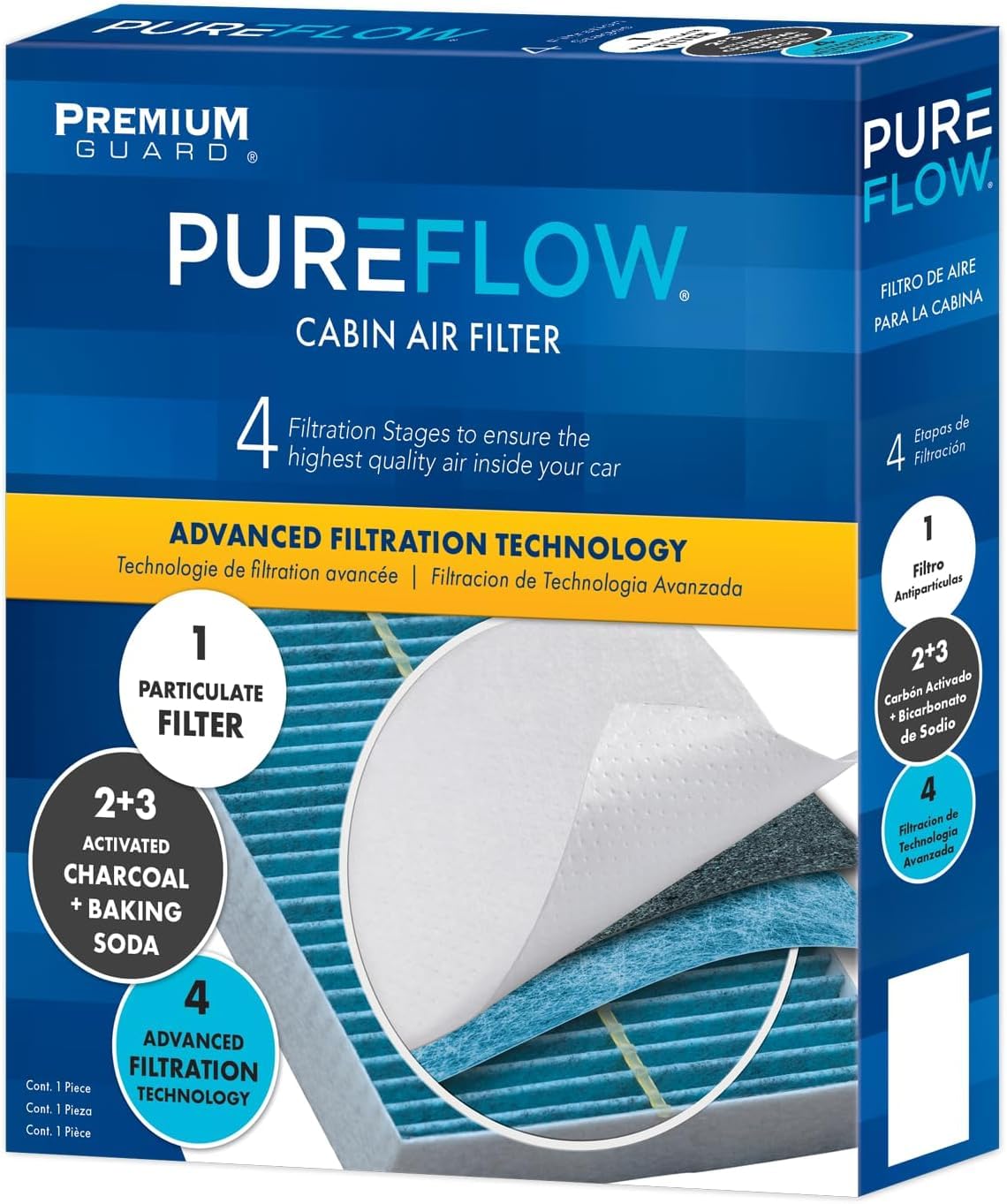
While an engine filter protects your motor, a cabin filter protects your respiratory system. This PureFlow unit is designed for the late-model Hyundai and Kia lineup — including Tucson, Elantra, Santa Fe, Sportage, Sorento, and K5 — and provides four distinct layers of filtration. The particulate media captures dust and pollen before passing through an activated charcoal layer infused with baking soda that chemically adsorbs sulfur dioxide, carbon monoxide, and even diesel exhaust fumes that often enter the cabin on congested roadways.
Owners of 2024 Elantras and Niro hybrids report a significant reduction in seasonal allergy symptoms after switching to this filter, and those who upgraded from a basic pleated cabin filter noticed that the interior air stayed fresher for the life of the filter. The 8.9 x 8.23-inch dimensions fit the glove-box housing snugly with no gaps, and the 0.43-pound weight indicates a dense media pack that traps fine particles without choking the HVAC blower motor.
Since this is a cabin filter, it has no impact on engine performance. Its sole mission is interior air quality, and it excels at eliminating the musty smells that develop when a standard paper filter saturates with moisture. The filter should be replaced annually or at 12,000-mile intervals. For drivers living in urban environments or areas with high pollen counts, the PureFlow is a health-conscious upgrade that pays dividends in comfort on every commute.
Why it’s great
- Activated charcoal and baking soda layer neutralizes road odors
- Particle filtration noticeably reduces allergy symptoms in the cabin
- Accurate fitment across the entire Hyundai/Kia crossover lineup
Good to know
- No impact on engine performance or fuel economy
- Annual replacement schedule needed to maintain odor control
4. JOGOAUTO H12772 Cabin Air Filter

Ford and Lincoln owners who want a HEPA-like experience from their HVAC system should look directly at this unit from JOGOAUTO. It is compatible with the 2020–2026 Explorer and Escape, 2021–2026 Bronco, the Maverick, and Lincoln Aviator/Corsair models. The dual filtration system combines a pleated meltblown fabric layer for mechanical particle trapping with an activated carbon particle layer that scrubs the chemical pollutants common in stop-and-go traffic.
Real-world feedback from Bronco and Explorer owners emphasizes the substantial build quality of the filter; the frame is rigid enough to resist collapsing under the suction of the max fan setting. Multiple reviewers upgraded from the anemic OEM paper filter and immediately noticed a fresher smell at start-up, as well as visibly less dust accumulating on the dashboard and vents over intervals between cleanings. The 8.86 x 10.91-inch dimensions are specific to Ford’s newer platform and fill the housing completely, preventing bypass airflow that would reduce total efficiency.
Swapping this filter is a quick DIY job accessible through the glovebox or behind the passenger footwell panel depending on the model. Because it uses a denser media pack, it may slightly reduce maximum fan speed compared to a thinner paper element, but the trade-off is substantially better particle capture — the filter physically holds more mass before becoming saturated. Schedule replacement every 12,000 miles to keep the blower motor working efficiently.
Why it’s great
- Dual HEPA-grade and charcoal media for superior particle trapping
- Rigid frame construction prevents collapse under high fan flow
- Significantly reduces visible dust accumulation inside the vehicle
Good to know
- Denser media may slightly reduce maximum HVAC airflow
- Only compatible with Ford/Lincoln vehicles listed in the fitment chart
5. Capume JM1000 Engine Air Filter
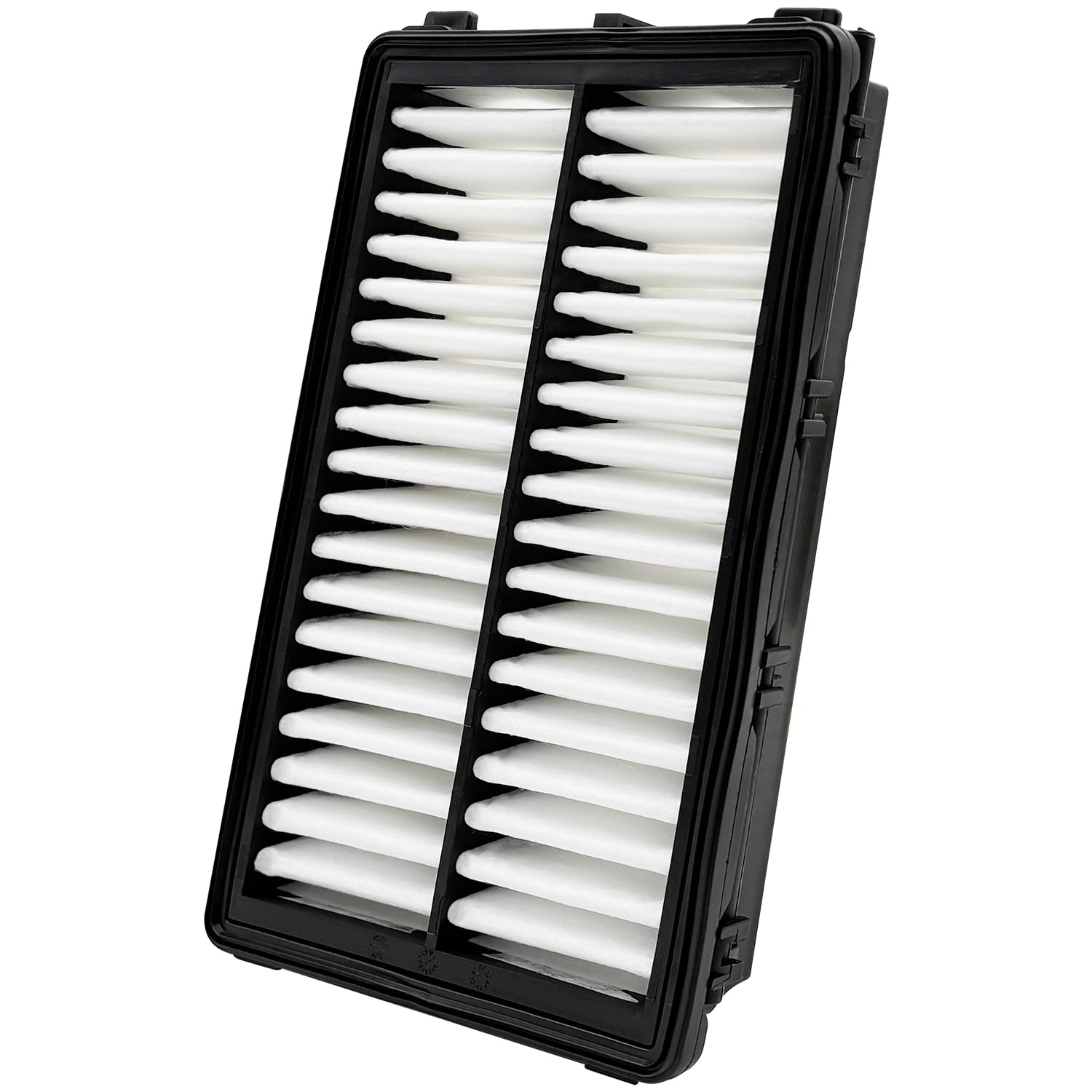
For owners of 2021–2026 Hyundai and Kia sedans and SUVs — including the Tucson, Santa Fe, Sonata, K5, Carnival, and Sorento — the Capume JM1000 provides a drop-in replacement that solves the common pain point of dealer pricing without sacrificing fitment quality. The 10.63 x 6.22 x 1.73-inch pleated filter matches the OEM cross-reference numbers 28113-L1000 and 28113N9000, which means it works in the same air-box housing with zero trimming or adapter gaskets.
Customer reports from Kia K5 and Sorento owners highlight the filter’s solid construction and straightforward 30-second swap process — no tools, no clips to break. Several drivers noted that their local dealers quoted over for a filter plus labor, which makes this product a massive value for those willing to pop the housing open themselves. The pleated cellulose media offers sufficient filtration for normal driving conditions without restricting the intake enough to trigger a check-engine light on naturally aspirated engines.
The filter does not include a charcoal layer, so it’s strictly an engine air filter rather than a cabin air filter. The media is standard pleated cellulose rather than synthetic or washable cotton, so you’ll need to replace it at every oil change interval (around 12,000 miles) to maintain flow. For the cost-conscious owner who wants reliable, direct-fit protection and doesn’t need washability or flow gains, Capume delivers exactly what’s needed at a fraction of the dealership price.
Why it’s great
- Exact OEM dimensional fit for popular Hyundai and Kia models
- Tool-free installation takes under two minutes
- Massive savings compared to dealer parts and labor costs
Good to know
- Standard cellulose media — not washable or high-flow design
- Should be replaced every 12,000 miles for best engine protection
FAQ
How often should I replace an engine air filter?
Does a cabin air filter improve engine performance?
What is the difference between a HEPA cabin filter and a charcoal cabin filter?
Can a washable cotton engine filter damage my MAF sensor?
Final Thoughts: The Verdict
For most users, the best car air filter winner is the K&N 33-5050 because it combines a measurable performance improvement with a lifetime service life that eliminates recurring replacement costs. If you want an exact factory-spec match for a Toyota or Scion, grab the Genuine Toyota 17801-0T030. And for breathing relief on the road, nothing beats the PureFlow PC99594X’s four-layer charcoal cabin filtration.

Mo Maruf
I created WellFizz to bridge the gap between vague wellness advice and actionable solutions. My mission is simple: to decode the research and give you practical tools you can actually use.
Beyond the data, I am a passionate traveler. I believe that stepping away from the screen to explore new environments is essential for mental clarity and physical vitality.