Our readers keep the lights on and my smoothie glass nicely filled. As an Amazon Associate, I earn from qualifying purchases.
A dead grid doesn’t mean you have to sit in the dark. A modern battery for backup power quietly handles your refrigerator, internet router, and phone charger without the noise, fumes, and fuel headache of a gas generator. The challenge is sorting through the capacity specs, inverter types, and battery chemistries to find the one that actually matches your critical loads — not just your budget.
I’m Mohammad Maruf — the founder and writer behind WellFizz. I’ve spent years analyzing backup power hardware, comparing lithium cell topologies, surge capabilities, and real-world runtime data across dozens of models to separate marketing hype from genuine performance.
Whether you need a weekend camping companion or a whole-home emergency lifeline, this guide breaks down the specs that matter — helping you confidently choose the best battery for backup power for your specific situation.
How To Choose The Best Battery For Backup Power
Picking the wrong power station usually comes down to confusing capacity (watt-hours) with output (watts) or ignoring the charging speed entirely. Here’s how to avoid those missteps.
Capacity vs. Output — Understand the Two Numbers
The watt-hour (Wh) rating tells you how much energy the battery holds — think of it like a fuel tank. The watt (W) rating tells you how much power it can deliver at once. A 2048Wh unit with a 2200W inverter can run a 1500W microwave for about one hour, but a 3000Wh unit with only a 1200W inverter cannot start that same microwave at all. Always match the inverter’s continuous rating to your appliance’s running watts, not just the battery capacity.
Battery Chemistry — LiFePO4 is the Standard for Safety and Longevity
Lithium iron phosphate (LiFePO4, or LFP) cells are the current benchmark for stationary backup. They offer 3,000 to 4,000 full cycles before degrading to 80% capacity — roughly 8 to 10 years of daily use. They are also thermally and chemically stabler than older NMC chemistries, making them the safer choice for indoor home backup. Semi-solid LFP is a newer type claiming higher energy density and even lower fire risk, though field data on longevity is still maturing.
Charging Speed and Solar Input Limits
Fast AC charging — at 1200W or more — is the difference between a station that recharges in one hour versus four hours. For off-grid or emergency use, the maximum solar input (measured in watts) and the MPPT voltage range matter more. If you plan to recharge primarily with panels, look for a solar input above 500W and a wide voltage window (e.g., 25–120V) so you can use multiple panels in series.
Quick Comparison
On smaller screens, swipe sideways to see the full table.
| Model | Category | Best For | Key Spec | Amazon |
|---|---|---|---|---|
| EF ECOFLOW DELTA 3 Classic | Mid-Range | Solar + ultra-fast AC charging | 1024Wh / 1800W | Amazon |
| BLUETTI AC200L | Mid-Range | Expandable whole-home backup | 2048Wh / 2400W | Amazon |
| Anker SOLIX C2000 Gen 2 | Premium | Ultra-light + high peak power | 2048Wh / 2400W | Amazon |
| Jackery Explorer 2000 v2 | Premium | Lightweight + quiet operation | 2042Wh / 2200W | Amazon |
| DJI Power 2000 | Premium | Professional gear + quiet UPS | 2048Wh / 3000W | Amazon |
| PECRON F3000LFP | Premium | High capacity + heavy appliances | 3072Wh / 3600W | Amazon |
| DABBSSON 2000L | Mid-Range | Compact 2kWh + fast 1hr charge | 2048Wh / 2200W | Amazon |
| AFERIY P210 | Mid-Range | Quiet 2kWh + app control | 2048Wh / 2400W | Amazon |
| VTOMAN Jump 600X | Budget | Car jump starting + small loads | 299Wh / 600W | Amazon |
In‑Depth Reviews
1. EF ECOFLOW DELTA 3 Classic (with 220W Panel)
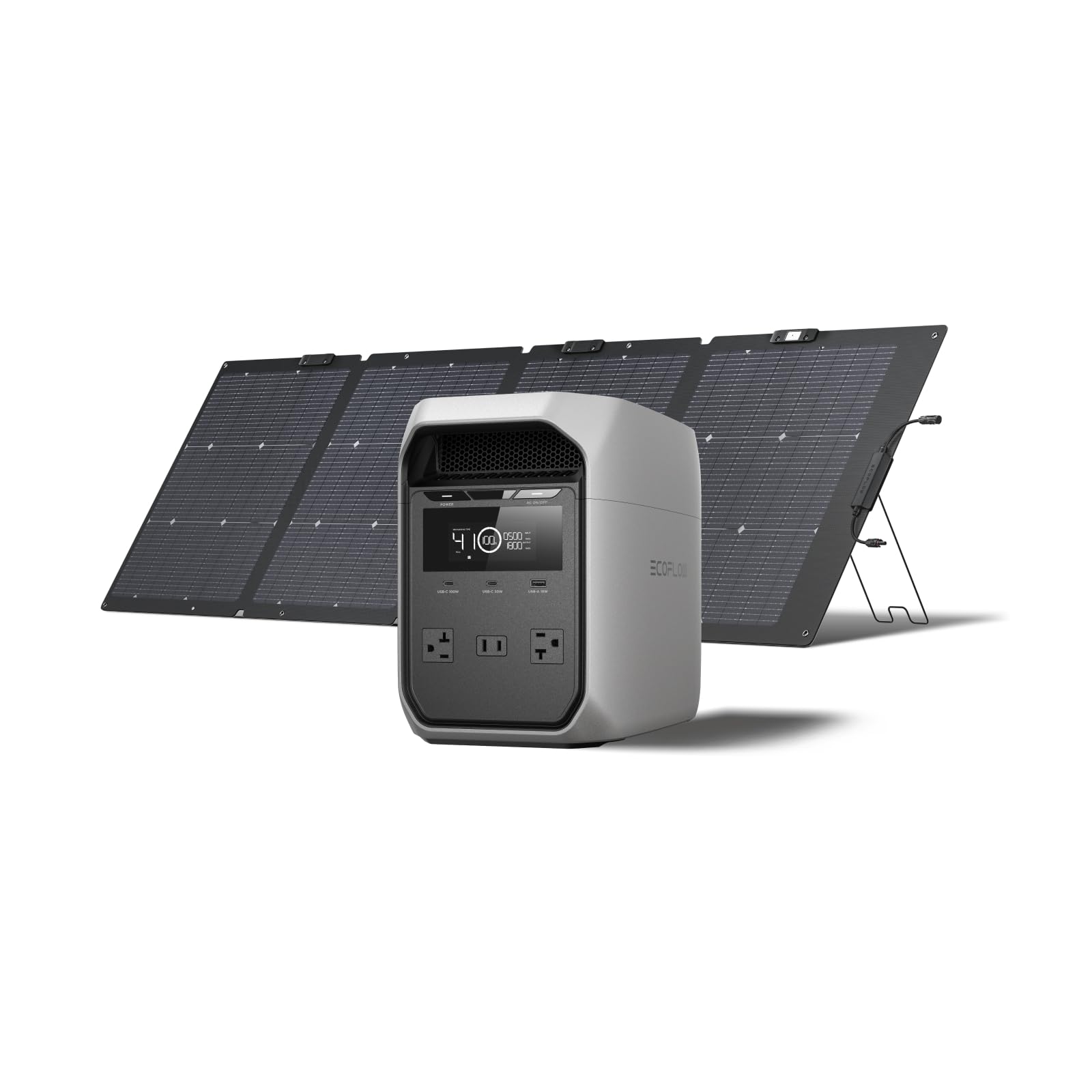
The EcoFlow DELTA 3 Classic hits a sweet spot that few other stations in this class manage: it combines a compact 1024Wh LiFePO4 battery with a surprisingly muscular 1800W pure sine wave inverter. The 3600W surge capability means you can start a compact refrigerator or a sump pump without tripping the inverter, a feature often reserved for larger units. The X-Boost technology lets you power loads up to 2600W by intelligently managing voltage, giving real-world flexibility that spec sheets alone don’t convey.
Charging speed is where this station truly stands apart. The X-Stream AC input delivers 0 to 80 percent in just 45 minutes, and a full 1024Wh charge takes about 56 minutes. The included 220W bifacial solar panel achieves up to 25 percent conversion efficiency with N-Type cells, and real-world users report 190 to 200W in good sunlight. The panel folds into a carry bag, making this a genuine grab-and-go solar generator package rather than a station sold with a separate add-on.
The sub-10ms UPS switch time protects sensitive electronics like PCs and medical devices from power blips seamlessly. The app allows you to adjust AC charge speed from 500W to 1400W, letting you dial in the rate to match your home circuit capacity. At 15.7 inches tall and weighing well under 40 pounds with the panel, it is portable enough for camping yet capable enough for home backup. The 5-year warranty reflects confidence in the battery management system and EV-grade CTC cell design.
Why it’s great
- Fastest AC recharge in its capacity class (0-80% in 45 min)
- Bifacial solar panel included with high real-world output
- Sub-10ms UPS with app-controlled charge rate adjustments
- Compact enough for camping, powerful enough for home backup
Good to know
- 1024Wh capacity is smaller than 2kWh units designed for extended whole-home outages
- X-Boost cannot double the wattage for all devices — some resistive loads may still trip it
- Solar panels are stiff when new and require careful unfolding
2. BLUETTI AC200L

The BLUETTI AC200L is the upgrade everyone expected from the AC200MAX, and it delivers in the right places. The base unit offers 2048Wh of LiFePO4 capacity with a 2400W inverter (3600W Power Lifting surge), which is 200W more continuous output than its predecessor.
Charging flexibility is excellent. The AC200L accepts up to 2400W AC input, recharging 0 to 80 percent in 45 minutes and full in about 1.5 hours. Solar input maxes out at 1200W, which lets you recharge the main unit in under two hours in good sun. The 30A RV output is a rare and valued feature for camper owners — it can directly charge your RV’s house battery through a D40 voltage regulator without additional adapters. The 48V/8A DC port is another unique inclusion for off-grid setups.
Despite its power, the unit weighs 61.4 pounds, which is heavier than some 2kWh competitors. The proprietary AC adapter design has drawn mild criticism from users who prefer standard cords for replacement convenience. The battery is rated for over 3,000 cycles to 80 percent capacity, and the 5-year warranty backs the long-term investment. For users planning to scale their storage over time, the AC200L’s modular approach makes it the most future-proof mid-range option available.
Why it’s great
- Expandable from 2048Wh up to 8192Wh with various battery packs
- 30A RV output and 48V/8A DC port for advanced off-grid use
- Turbo AC charging gets you to 80% in only 45 minutes
- 3600W Power Lifting surge handles demanding appliances
Good to know
- Heavier (61.4 lb) than comparable 2kWh stations
- Proprietary AC power cord is not a standard replacement cable
- Battery expansion modules add significant cost over time
3. Anker SOLIX C2000 Gen 2
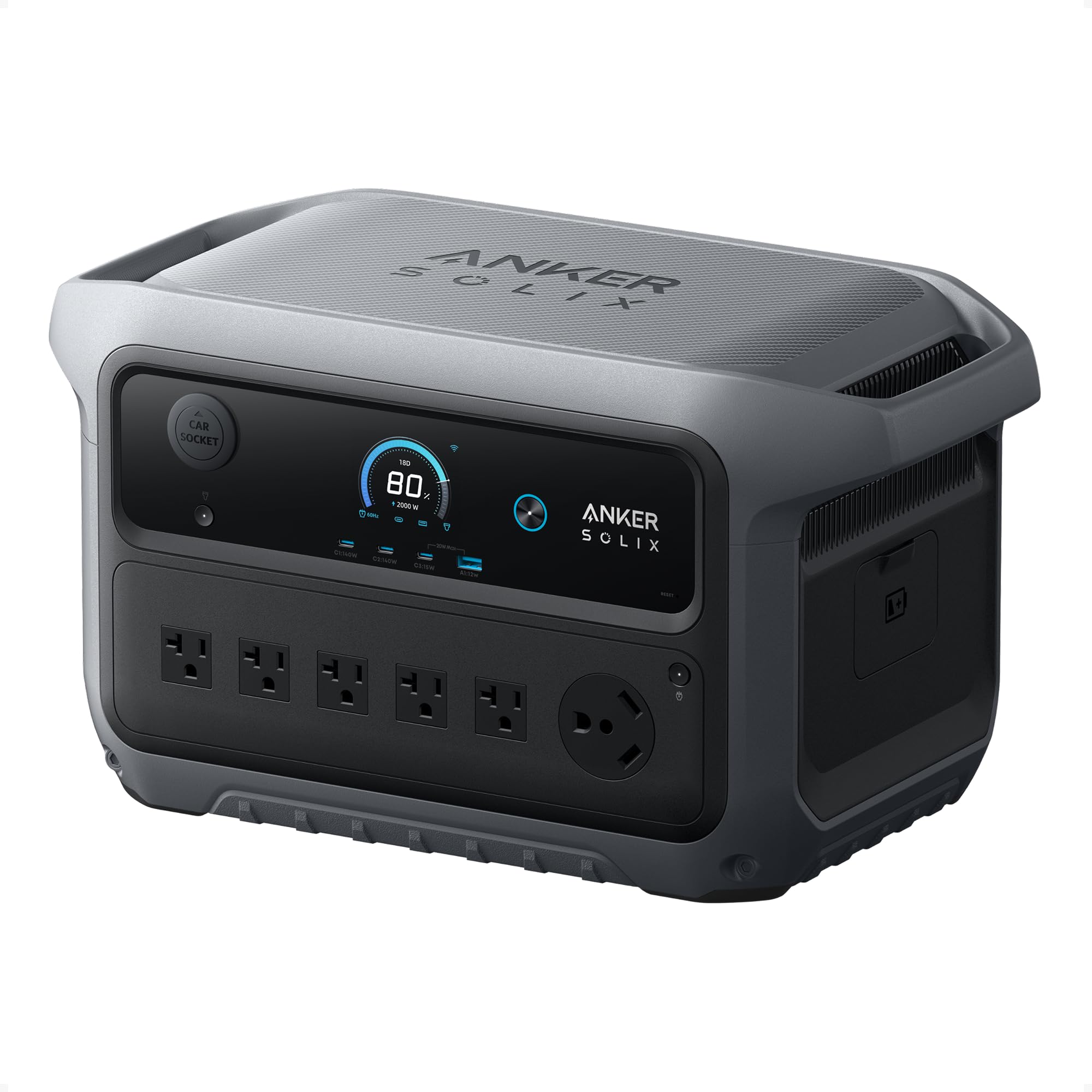
Anker’s SOLIX C2000 Gen 2 distinguishes itself by being significantly lighter and more compact than its 2kWh peers — 41.7 pounds and 18.1 by 9.8 inches, about 25 percent lighter and 29 percent smaller than the category average. This makes it a genuine candidate for users who need to move their backup battery between home and vehicle frequently. Despite the reduced footprint, it still packs a 2048Wh LiFePO4 battery and a 2400W continuous inverter with a 4000W peak surge capable of starting many window and RV air conditioners.
The charging ecosystem is Anker’s strength. Full AC recharge in 58 minutes is competitive with the fastest in this class. Uniquely, it supports 800W ultra-fast alternator charging via a car’s 12V system — that is about eight times faster than a standard cigarette-lighter socket, making road trips and mobile worksites far more practical. The unit also consumes only 9W on standby, which translates to longer usable runtime when powering small loads like a modem or router. Users consistently report running a 30-quart fridge for 5 to 7 days on a single charge in real-world camping use.
The Gen 2 adds expansion battery compatibility to reach 4kWh total capacity. The 6-in-1 port configuration includes three AC outlets, two USB-C with 100W PD, and one USB-A, plus a car outlet. The metal and plastic hybrid housing feels rugged, and the 5-year warranty is standard for this tier. The only notable sacrifice for its compact size is that the internal battery cannot be swapped without disassembly, and the display, while informative, is not as detailed as some competitors’ app-connected dashboards.
Why it’s great
- 41.7 lb — the lightest 2kWh station in this lineup
- 800W alternator charging is a game-changer for mobile use
- 4000W peak surge starts window A/C units reliably
- Expandable to 4096Wh with an optional battery pack
Good to know
- Battery not user-serviceable; expansion is the only way to increase capacity
- No solar panel included in the base package
- App-based setup required for firmware updates and advanced charging modes
4. Jackery Explorer 2000 v2

Jackery has refined its 2kWh formula with the Explorer 2000 v2, achieving a remarkably compact and light design — 39.5 pounds and 13.2 by 10.4 inches — thanks to CTB (cell-to-body) technology borrowed from the EV industry. By integrating cells directly into the chassis structure, Jackery has reduced overall volume by 34 percent compared to typical 2kWh units. For anyone who needs to lift their backup battery from the garage floor into a vehicle, this is a tangible advantage.
The battery chemistry is LiFePO4 rated for 3,000 cycles to 80 percent capacity, roughly 10 years of daily use. The 2200W pure sine wave inverter is paired with 3 AC outlets, 2 USB-C (100W PD), and 1 USB-A. The silent charging mode — under 30dB — is a standout for sleep-sensitive environments like RVs or campers. AC fast charging hits 80 percent in 66 minutes, and the emergency super charging mode through the app reaches full in 102 minutes. Solar input is capped at 400W, which is adequate for a single 400W panel but not ideal for users planning large solar arrays.
Real-world feedback is consistently positive for runtime: one user reported 21.3 hours powering a refrigerator on a single charge. The 20ms UPS switching is certified under UL1778 for uninterruptible power supply use, making it suitable for protecting desktop computers. The handle is well-designed and makes the 39.5-pound weight feel more manageable than the raw number suggests. The only notable weakness is the single 400W solar input limit, which means slower solar recharging than some competitors that accept 800W or more from panels.
Why it’s great
- Weighs only 39.5 lb — easiest 2kWh to move around
- Silent charging mode under 30 dB for overnight RV use
- UL1778 certified UPS with 20ms switch time
- CTB construction makes it 34% smaller than typical 2kWh stations
Good to know
- Solar input limited to 400W; slower to recharge from panels than 800W-capable rivals
- No expansion battery options — capacity is fixed at 2042Wh
- Orange accents may not suit all home decor styles
5. DJI Power 2000
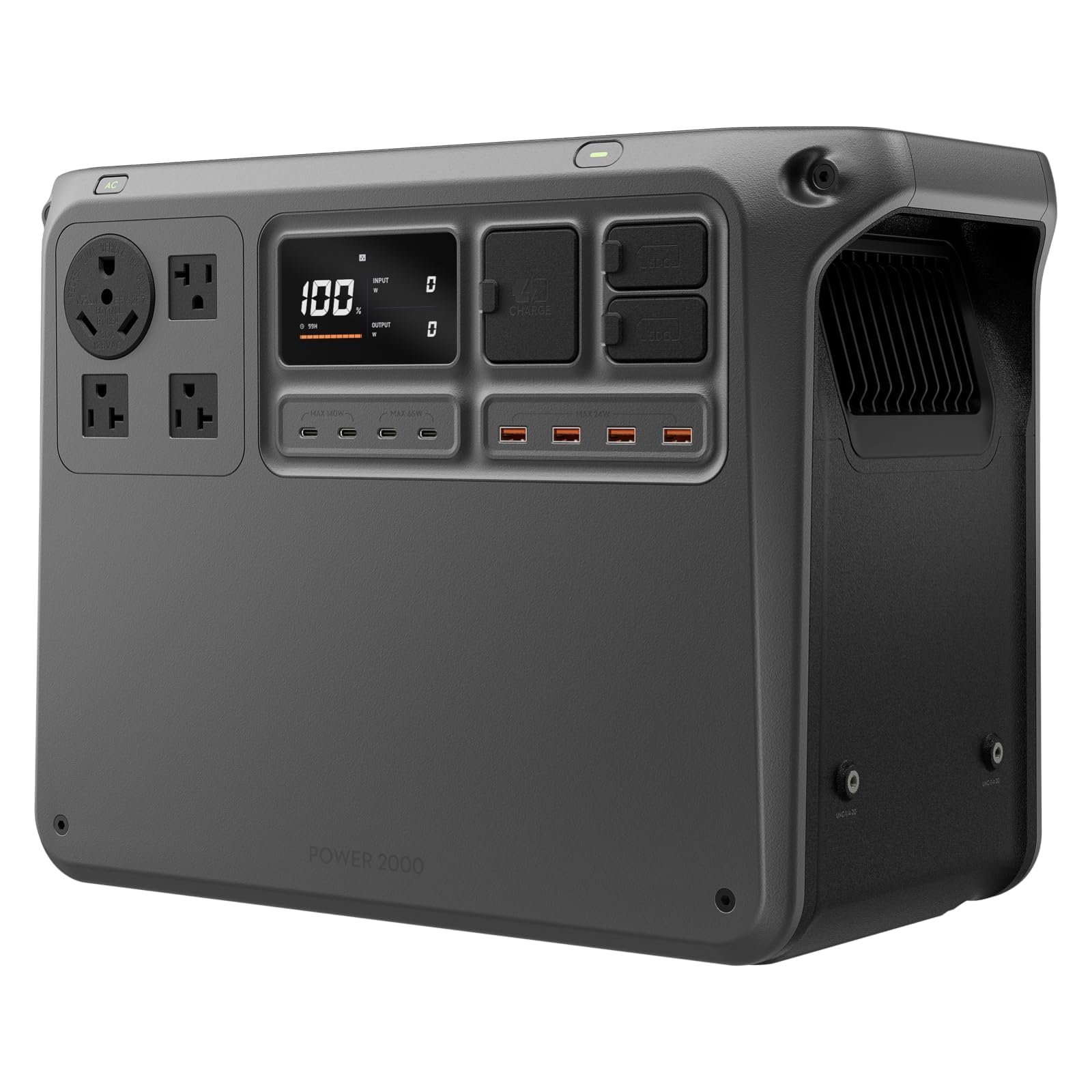
DJI entered the power station market with the kind of engineering precision they’re known for in drones, and the Power 2000 reflects that approach. The 2048Wh LiFePO4 battery is paired with a 3000W continuous inverter (4000W peak) — the highest continuous output in this 2kWh comparison. This means it can handle electric kettles, impact drills, and space heaters that would overwhelm units with only 1800W or 2200W inverters. The battery management system includes 26 temperature sensors and sub-nano coating on the circuit boards for moisture protection, a level of ruggedness rarely seen in portable power stations.
Charging performance matches its output ambition. AC input carries the unit from 0 to 80 percent in 55 minutes, and full charge is achieved in about 90 minutes. Solar input supports up to 1800W — best in class among 2kWh stations — with a wide MPPT voltage range that accommodates multiple high-voltage panels in series. The unit operates below 30dB, making it genuinely quiet during both charging and discharging. The UPS switch time is under 10 microseconds (0.01 seconds), which is effectively instantaneous for any connected electronics.
Connectivity is app-based through the DJI Home app, though the app is required to access advanced charging and power-management settings. The unit includes 4 AC outlets, 4 USB-C ports (two at 140W), and 4 USB-A ports — enough for group camping or multiple devices in an RV. The proprietary SDC ports require adapters for solar and car charging, which is the main logistical drawback. At 47.9 pounds, it is heavier than the Jackery or Anker, but the added inverter headroom and solar input capacity make it the best choice for users who need real power, not just battery capacity.
Why it’s great
- 3000W continuous output — the highest in this 2kWh comparison group
- 1800W solar input capacity for fast off-grid recharging
- Sub-10 microsecond UPS switch time for sensitive electronics
- Moisture-resistant circuit coating and flame-retardant housing
Good to know
- Proprietary SDC ports require separate adapters for solar and alternator input
- DJI Home app necessary for advanced features and settings
- Heavier than some competitors at 47.9 lb
6. PECRON F3000LFP
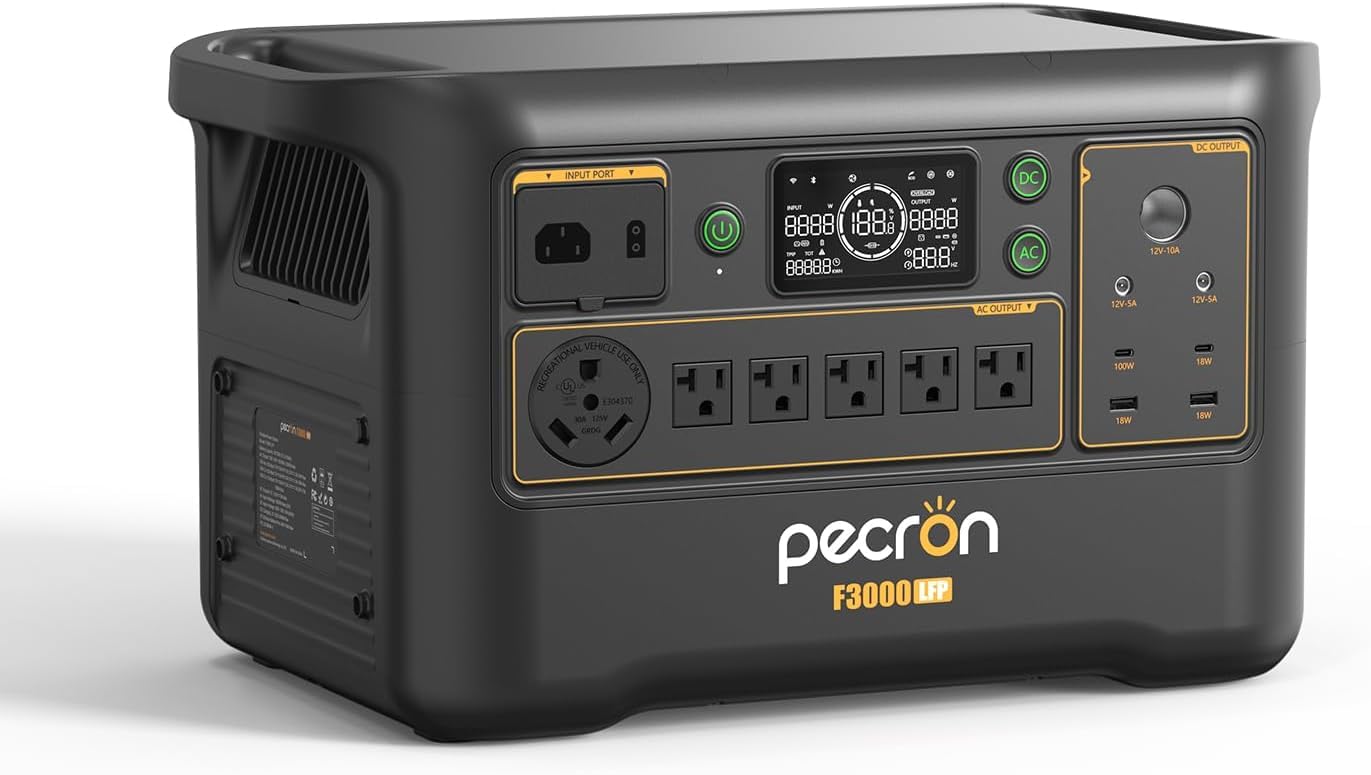
When your backup needs exceed the typical 2kWh ceiling, the PECRON F3000LFP steps in with a serious 3072Wh of LiFePO4 capacity and 3600W of pure sine wave output. This is enough to run a full refrigerator (around 700W), a chest freezer (500W), and a home-office setup (300W) simultaneously for nearly two full days without solar recharge. The 3600W inverter also handles larger resistive loads like a 1500W space heater plus a microwave together — a combination that would trip a smaller unit.
Charging matches the capacity: AC input maxes out at 1800W, delivering a full recharge from zero in just two hours. Solar input accepts up to 1600W with a broad voltage window of 25 to 120V, so you can wire four 400W panels in series and achieve solid charging even in partial shade. The unit includes 6 AC outlets, 2 USB-C with 100W PD, 2 USB-A, a car port, and 2 DC 5525 ports — 13 total. The app provides real-time power monitoring and charge speed control, though it operates over Bluetooth only, not Wi-Fi.
At 63.3 pounds, this station is not portable in the traditional sense — it is a stationary home backup unit that can be moved with effort. The fan runs audibly during high-rate charging, which some users find noticeable indoors. The idle consumption of about 30W when the inverter is on is higher than average, so you will want to switch off the AC output when not actively powering devices. The 2+3-year warranty (5 years total with registration) is competitive, and the expandability to 10752Wh via external battery packs makes this a serious candidate for partial home backup.
Why it’s great
- Large 3072Wh base capacity — runs essential appliances for two days
- 3600W inverter handles heavy loads like space heaters and microwaves simultaneously
- Expandable up to 10,752Wh for long-term backup
- Fast 2hr full charge from AC and 1600W solar input capability
Good to know
- Heavy at 63.3 lb — better suited for stationary home use
- Fan noise is noticeable during high-rate charging
- Idle consumption of ~30W with inverter on requires manual management
7. DABBSSON 2000L
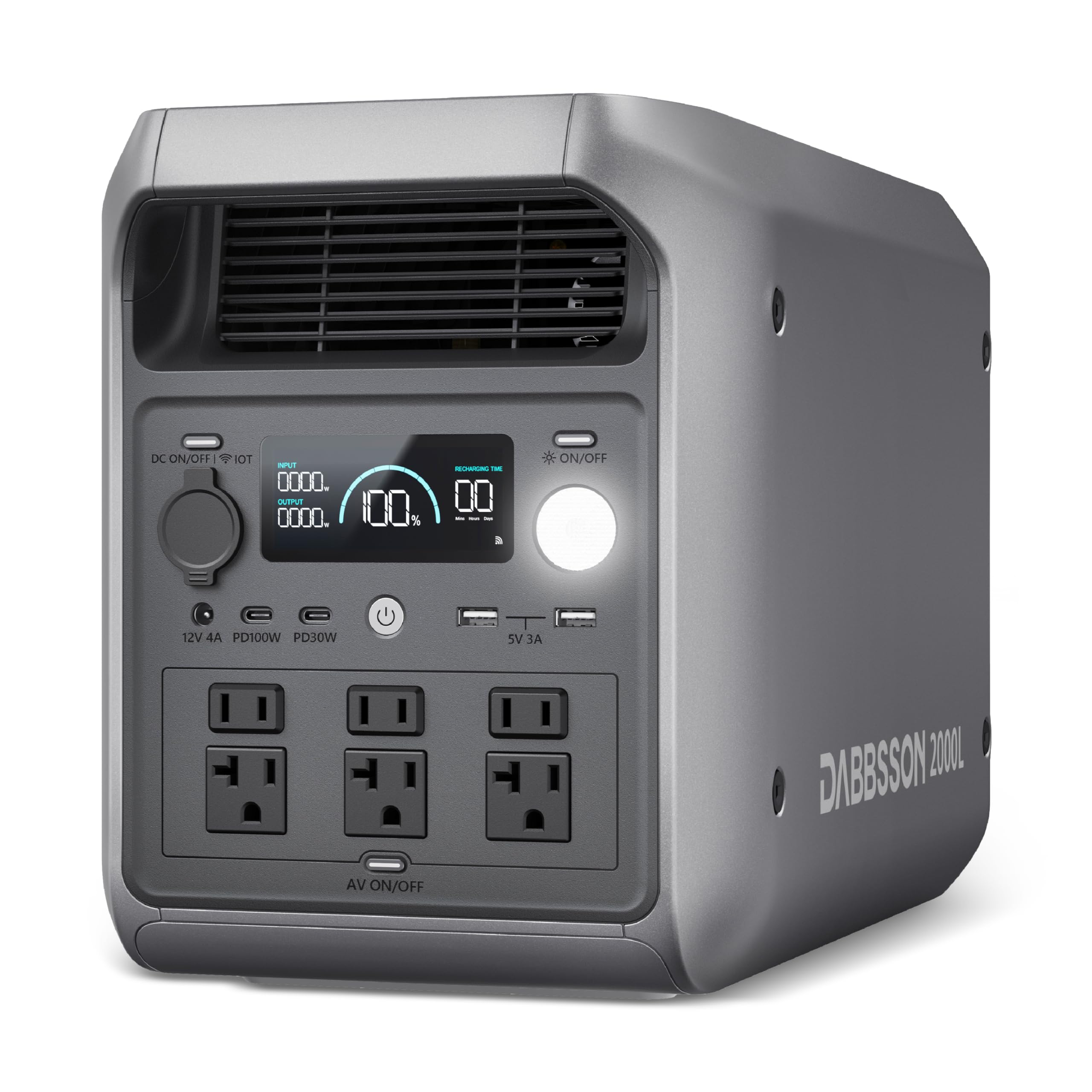
The DABBSSON 2000L brings a genuinely innovative twist to the 2kWh market with its semi-solid LiFePO4 battery cells, a chemistry that offers higher energy density and improved thermal stability compared to standard LFP. The result is a 2048Wh station that weighs just 41 pounds — lighter than many other 2kWh units — while still housing a 2200W inverter with a 3300W surge boost capability. The semi-solid formulation is the same emerging technology used in some next-gen EV batteries, and it promises 4,000 cycles to 80 percent capacity, extending the usable lifespan beyond typical 3,000-cycle LFP packs.
Charging speed is the headline feature here: AC input recharges the full 2048Wh in just one hour, making it the fastest fully recharged unit in this price tier. Solar input supports up to 800W MPPT, and the unit also accepts AC and car charging simultaneously for hybrid top-ups. The EPS (emergency power supply) switch time is under 15 milliseconds, which is fast enough to keep a desktop computer or NAS running through a power blip without crashing.
The Dabbsson App (Wi-Fi and Bluetooth) allows remote monitoring, charge speed adjustments, and scheduling — features usually found on pricier units. The UL94-V0 flame-retardant housing adds a layer of safety for indoor placement. The package includes a standard AC cable and a car charging cable, but no solar panel. Some users note that the plastic enclosure feels slightly less premium than the metal-bodied alternatives, though build quality appears solid. For buyers who prioritize the fastest possible recharge and a longer cycle life, this is an excellent value proposition in the 2kWh class.
Why it’s great
- Full 2048Wh recharge in just 1 hour — fastest in class
- Semi-solid LFP cells offer 4,000 cycles and enhanced stability
- Lightweight at 41 lb for a 2kWh station
- App control with Wi-Fi and Bluetooth for remote management
Good to know
- Plastic housing feels less robust than metal-clad competitors
- Semi-solid LFP is a newer chemistry with fewer long-term field reports
- No solar panel included; must be purchased separately
8. AFERIY P210

The AFERIY P210 is engineered for low-noise operation — it produces less than 30 decibels at full load and only 16dB under normal load, making it effectively silent in a home environment. This is achieved through a combination of a high-efficiency inverter design and a smart temperature-controlled fan that rarely needs to spin at high speed. For users who plan to keep a backup battery running in a bedroom, nursery, or sleep-in RV, this noise profile is a real differentiator versus units that cycle a loud fan under light load.
Under the hood, the P210 delivers 2048Wh of LiFePO4 capacity with a 2400W pure sine wave inverter (4800W surge). The battery is rated for 3,500 cycles to 80 percent capacity, and the manufacturer backs it with a 7-year extended warranty — two years longer than the industry standard. The unit includes 6 AC outlets, 2 USB-A, 4 USB-C (two at 100W PD), 2 DC5521 ports, a car outlet, and an XT60 port rated at 300W. The app provides intelligent energy management, letting you monitor consumption and adjust settings from your phone.
AC charging is fast — 0 to 100 percent in about two hours using the 1800W AC adapter. Solar input is less clearly specified but user reports indicate compatibility with up to 500W of solar panels. The server-level UPS switch time is under 10 milliseconds, qualifying it to protect sensitive electronics like home servers and medical devices. The unit weighs 54 pounds, which is average for the 2kWh class, and includes a dust cover in the box. The main trade-off is that the solar input is not as high as the DJI or PECRON units, so off-grid recharging will be slower if you have a large panel array.
Why it’s great
- 16dB under normal load — virtually silent for indoor or bedroom use
- 7-year warranty — industry-leading coverage
- 4800W surge capacity handles demanding appliances
- Comprehensive port set with 4 USB-C (2 at 100W PD)
Good to know
- Solar input lower than some high-end competitors
- Heavier than the ultra-light Jackery and Anker options
- App requires login and Bluetooth for advanced features
9. VTOMAN Jump 600X

The VTOMAN Jump 600X serves a very specific niche that no other unit in this lineup covers: it is a 2-in-1 portable power station and car jump starter. The 299Wh LiFePO4 battery is small by today’s standards, but the integrated jump-start port can crank a dead 12V battery on a truck, SUV, or midsize car almost instantly — even when the station itself is down to single-digit charge levels. The jumper cables are sold separately, but the capability is real and verified by multiple users who report jump-starting Dodge Rams and similar large vehicles with no issues.
The 600W pure sine wave inverter (1200W surge) is modest but adequate for powering a CPAP machine for 10 hours, a mini fridge for 5 hours, or charging laptops and phones simultaneously. The unit has 2 AC outlets, 2 DC5521 ports, a car port, 3 USB-A ports, and a USB-C port with 60W PD — enough to charge 9 devices at once. The DC outputs are regulated to a steady 12V, which is important for sensitive equipment like CPAP machines that require voltage stability.
Capacity is expandable to 939Wh by adding an extra VTOMAN battery pack (sold separately), turning it from a quick-jump tool into a more capable overnight backup. AC recharge takes about 3 hours, and solar recharge with a 110W panel takes 5-6 hours. At 14.6 pounds, it is truly portable and fits easily in a trunk or under an RV seat. The LED light with 5 modes is a nice emergency touch. The main limitation is the small base capacity — this is not a home backup for extended outages, but it is the ultimate roadside companion and lightweight power source for short trips.
Why it’s great
- Integrated car jump starter — unique capability not found on larger stations
- Compact and lightweight at 14.6 lb for trunk or RV storage
- Regulated 12V DC output for sensitive medical devices like CPAP
- Expandable to 939Wh with optional add-on battery
Good to know
- Base capacity of only 299Wh limits runtime for larger appliances
- Jumper cables not included — must be purchased separately
- Solar charging is slow (5-6 hours with 110W panel) due to lower wattage input
FAQ
What is the difference between LiFePO4 and regular lithium-ion for backup power?
Can I connect a portable power station directly to my house breaker panel?
Final Thoughts: The Verdict
For most users, the best battery for backup power winner is the EF ECOFLOW DELTA 3 Classic because it delivers the best balance of fast charging, portable size, and included solar panel at a reasonable investment. If you need expandable whole-home backup with RV compatibility, grab the BLUETTI AC200L. And for a lightweight, ultra-quiet station that is easy to move between home and car, the Jackery Explorer 2000 v2 is the most travel-friendly choice.

Mo Maruf
I created WellFizz to bridge the gap between vague wellness advice and actionable solutions. My mission is simple: to decode the research and give you practical tools you can actually use.
Beyond the data, I am a passionate traveler. I believe that stepping away from the screen to explore new environments is essential for mental clarity and physical vitality.