Our readers keep the lights on and my smoothie glass nicely filled. As an Amazon Associate, I earn from qualifying purchases.
Choosing a 3400 PSI pressure washer means entering a debate between raw gas-powered torque and the quiet convenience of electric or battery-driven systems. At this pressure level, you are not buying a toy for patio misting; you are buying a machine engineered to strip paint, dissolve oil stains, and restore concrete surfaces that have weathered years of neglect. The wrong choice here costs you hours of rework or premature pump failure.
I’m Mohammad Maruf — the founder and writer behind WellFizz. After analyzing over 40 current models, combing through thousands of verified buyer reports, and mapping the failure points of axial cam pumps versus triplex plunger pumps, I know exactly which specs separate a five-year workhorse from a one-season disappointment.
Whether you are a homeowner facing a stained driveway or a contractor needing daily reliability, this guide will help you make a confident pick. Read on for the definitive breakdown of the best 3400 psi pressure washer for your specific cleaning load.
How To Choose The Best 3400 PSI Pressure Washer
At 3400 PSI, you are in the territory where pump construction, engine quality, and real-world flow rate determine whether your machine lasts three months or three years. Most buyers fixate on the PSI number alone, but the deciding factors are more nuanced.
Pump Type: Axial Cam vs. Triplex
Axial cam pumps are common in value-oriented gas washers. They are light, inexpensive to replace, and fine for intermittent home use. Triplex plunger pumps, found on commercial-grade units, use three plungers running in oil-bathed cylinders. They handle continuous running, higher heat, and far more abuse. If you plan to run the washer for more than two hours at a stretch, a triplex pump is worth the premium.
Flow Rate (GPM) — The Hidden Speed Factor
PSI determines how hard the water hits the surface, but GPM determines how fast dirt is flushed away. A 2.5 GPM washer at 3400 PSI cleans roughly 25% faster than a 2.0 GPM unit at the same pressure. For driveways, siding, and decks, the extra gallon per minute cuts your total job time dramatically. Look for a minimum of 2.5 GPM for real productivity.
Engine Quality and Ease of Start
Engines in the 200-212cc range are the standard for this class. A Honda GX series engine commands a price premium because it starts reliably after months of storage, has easily replaceable parts, and holds resale value. Budget engines from PowerSmart or VEVOR can perform well initially, but user reports often cite choke adjustment issues and harder cold starts after a season.
Quick Comparison
On smaller screens, swipe sideways to see the full table.
| Model | Category | Best For | Key Spec | Amazon |
|---|---|---|---|---|
| Simpson ALH3228-S | Commercial Gas | Professional / daily use | Honda GX200 / CAT Triplex Pump | Amazon |
| Kärcher G 3600 P | Premium Gas | Heavy-duty residential | Triplex / Crankshaft Pump | Amazon |
| Simpson CM61248-S | Mid-Range Gas | Homeowners / surface cleaning | 15” surface cleaner included | Amazon |
| Powerhorse 5774814 | Mid-Range Gas | Reliable daily cleaning | 30 ft hose / CARB, EPA | Amazon |
| Westinghouse WPX3400 | Mid-Range Gas | General home / value | Onboard soap tank / 2.6 GPM | Amazon |
| Giraffe Tools Grandfalls Pro | Electric Wall Mount | Garage / no-fume cleaning | 100 ft retractable hose / 68dB | Amazon |
| EGO Power+ HPW3200 | Battery Powered | Portable / cord-free jobs | Battery 56V / 3200 PSI | Amazon |
| PowerSmart DL1034 | Budget Gas | Light residential / price-conscious | Compact / 31 lbs frame | Amazon |
| VEVOR Gas Pressure Washer | Budget Gas | Entry-level / occasional use | Copper pump / 2.6 GPM | Amazon |
In‑Depth Reviews
1. Simpson Cleaning ALH3228-S
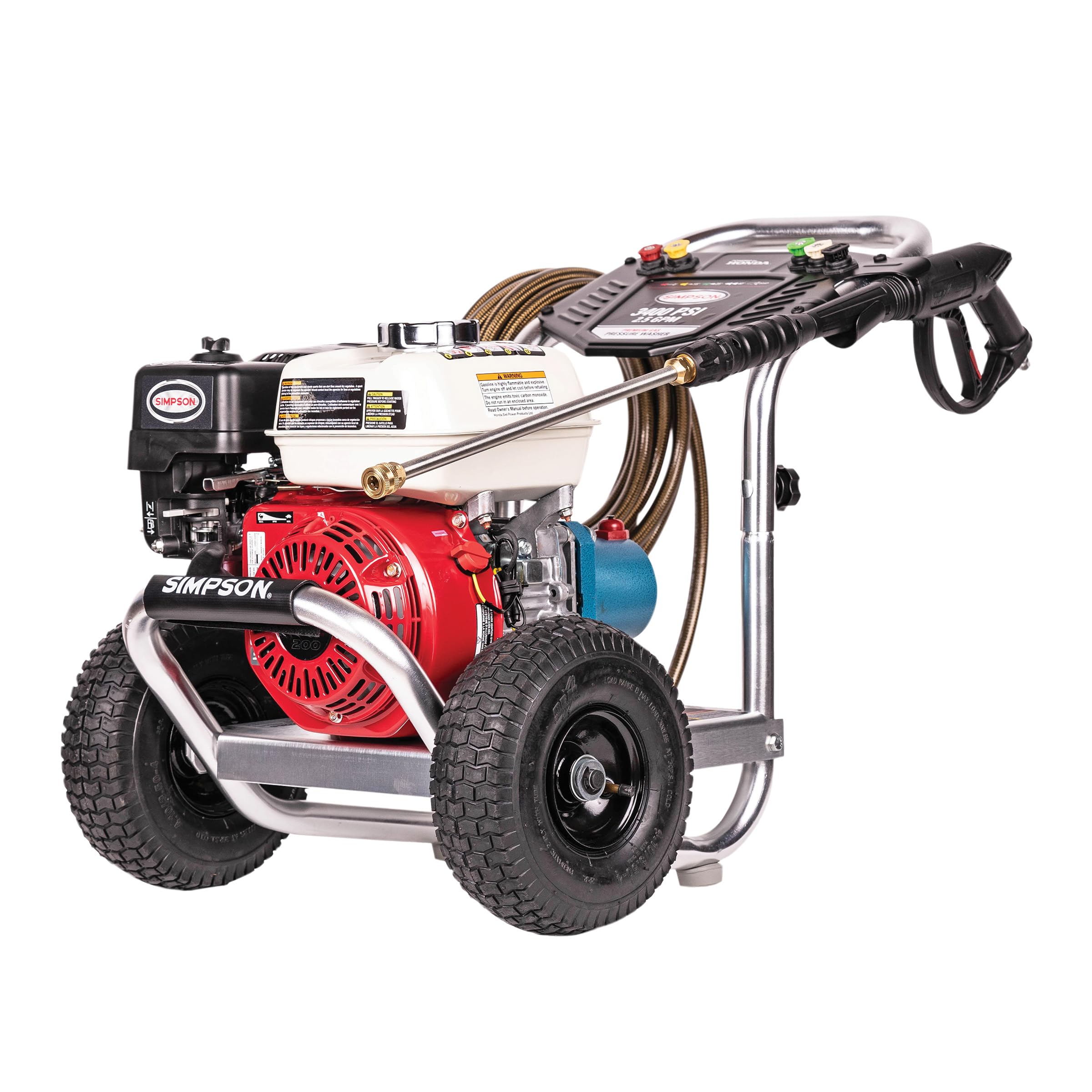
The Simpson ALH3228-S sits at the top of the residential-commercial boundary for a reason: a genuine Honda GX200 engine paired with a CAT Industrial triplex plunger pump. This combination means you get cold-start reliability even after the machine has sat in the shed for months, plus a pump that can run for hours without the thermal breakdown that kills axial cam units. The aircraft-grade aluminum frame keeps the overall weight manageable at 73 pounds while resisting corrosion from constant moisture exposure.
At 3400 PSI and 2.5 GPM, the cleaning speed is not the highest in this roundup, but the consistency is. The CAT pump delivers steady pressure without the surging that cheaper pumps exhibit when the unloader valve cycles. The included 25-foot hose is kink-resistant, though many professionals swap it for a 50-foot rubber hose to reduce repositioning. The five quick-connect nozzles cover every angle from 0-degree stripping to soap application.
Over three seasons of use, owners report the wheel clip as the only recurring annoyance — it can pop off on rough terrain unless you deepen the axle notch. The handle is also a bit short for tall operators. Still, the engine and pump reliability justify the price for anyone making money with their washer or tackling large properties every weekend.
Why it’s great
- Commercial-grade Honda GX200 engine starts reliably after long storage.
- CAT triplex pump handles extended run times without overheating.
- Aluminum frame is corrosion-resistant and lighter than steel alternatives.
Good to know
- Wheel retaining clips can dislodge on bumpy terrain; a simple notch modification fixes it.
- Handle height is short for users over 6 feet tall.
- Included hose is only 25 feet; most users upgrade immediately.
2. Kärcher G 3600 P

Kärcher brings its German engineering heritage into the gas-powered realm with the G 3600 P. The headline specs — 3600 PSI and 2.6 GPM — outpace many competitors on paper, but the real story is the triplex crankshaft pump. Unlike axial cam units that use a wobble plate, this pump uses three independent plungers running in a pressurized oil bath, which dramatically reduces wear and allows the machine to run continuously without pump failure.
The 212cc engine provides 5.9 HP of consistent torque, and the 35-foot high-pressure hose is the longest in this comparison, letting you clean two-story homes without moving the cart. The steel frame and 12-inch never-flat wheels mean you can roll it over gravel and uneven grass without worrying about punctures. The four quick-connect nozzles cover the standard range, though some users wish for a dedicated soap nozzle instead of relying on the low-pressure setting.
Customer reports consistently highlight the ease of assembly — most have it running within 30 minutes of unboxing. The triplex pump does produce a slightly louder operation than an axial cam, but the trade-off is a pump that can survive seasons of abuse. For homeowners who plan to clean driveways, siding, and patios more than twice a year, this is the durability benchmark.
Why it’s great
- Triplex crankshaft pump is far more durable than axial cam designs.
- 35-foot hose provides extended reach without moving the unit.
- Never-flat 12-inch wheels handle rough terrain easily.
Good to know
- No dedicated soap nozzle; relies on low-pressure injector.
- Heavier than many competitors at 64 pounds.
- Triplex pump is louder than axial cam alternatives.
3. Simpson CM61248-S
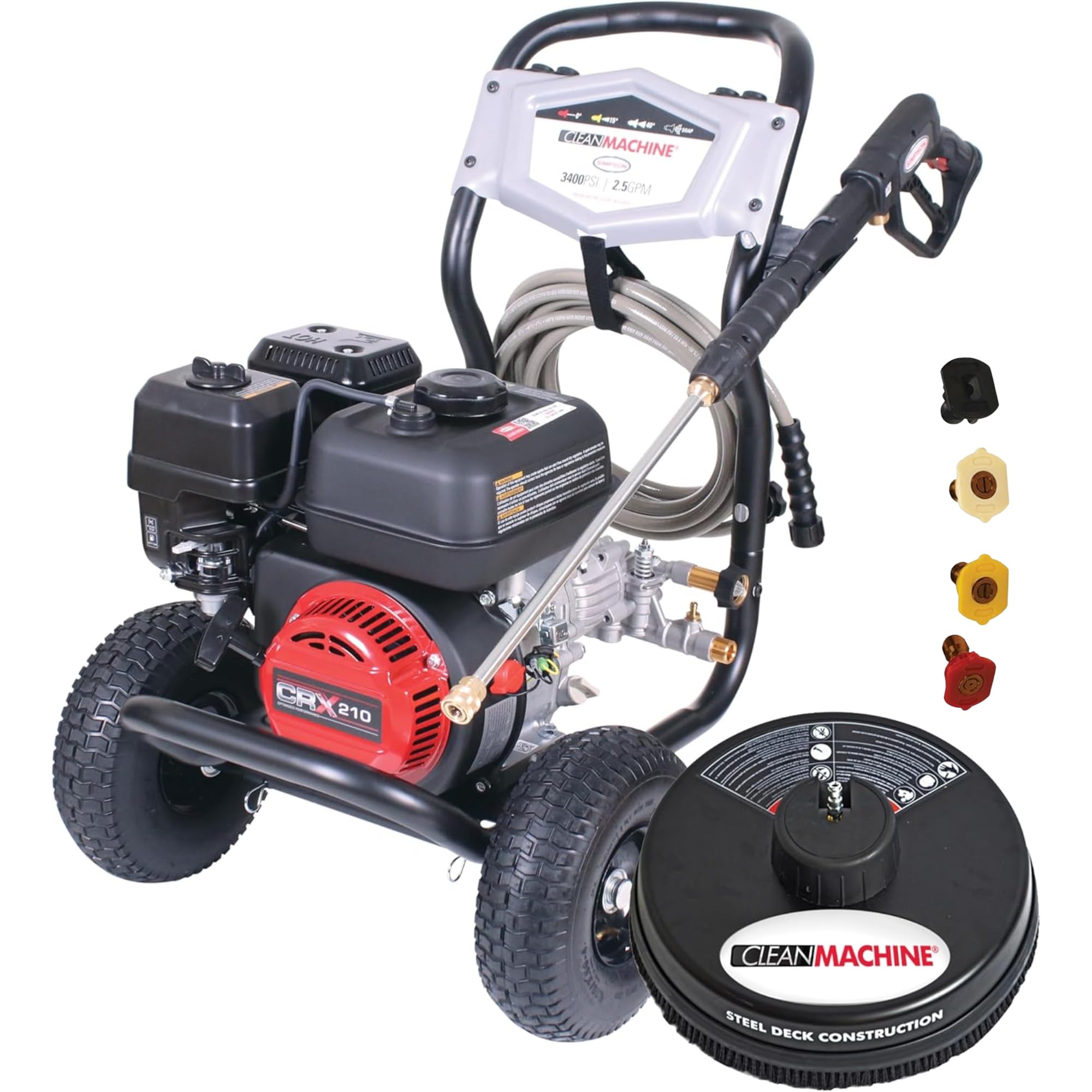
The Simpson Clean Machine bundles a capable 3400 PSI / 2.5 GPM gas washer with a 15-inch surface cleaner, and that inclusion alone changes the value equation. Without a surface cleaner, cleaning a concrete driveway with a spray wand takes 30-45 minutes of slow, overlapping passes. With this attachment, you cover roughly ten times the area per minute, and the dual stainless steel nozzles prevent the streaking that plagues single-nozzle surface cleaners.
The 208cc CRX engine starts easily — multiple reviews from older users confirm it fires on the first or second pull — and the low-oil shutdown feature protects the engine if you forget to check the dipstick. The OEM Technologies axial cam pump is maintenance-free for the average homeowner, meaning no oil changes or seal adjustments. The 10-inch pneumatic tires roll smoothly over grass and gravel, though they do require occasional inflation.
Warranty coverage is notable: five years on the frame, two on the engine, and one on the pump. That frame warranty suggests Simpson trusts the welded steel construction to resist cracking. The only common complaint involves the spray wand developing a leak at the connection point within the first few hours. Early buyers should check the O-ring seating during assembly and consider a light application of plumber’s tape.
Why it’s great
- Includes a 15-inch surface cleaner that cuts driveway cleaning time by half.
- 208cc CRX engine starts reliably with low-oil shutdown protection.
- Five-year frame warranty indicates confidence in the steel construction.
Good to know
- Spray wand connection may leak; check O-ring on assembly.
- Pneumatic tires require inflation and can puncture on construction debris.
- Axial cam pump is less durable than triplex for heavy commercial use.
4. Powerhorse 5774814
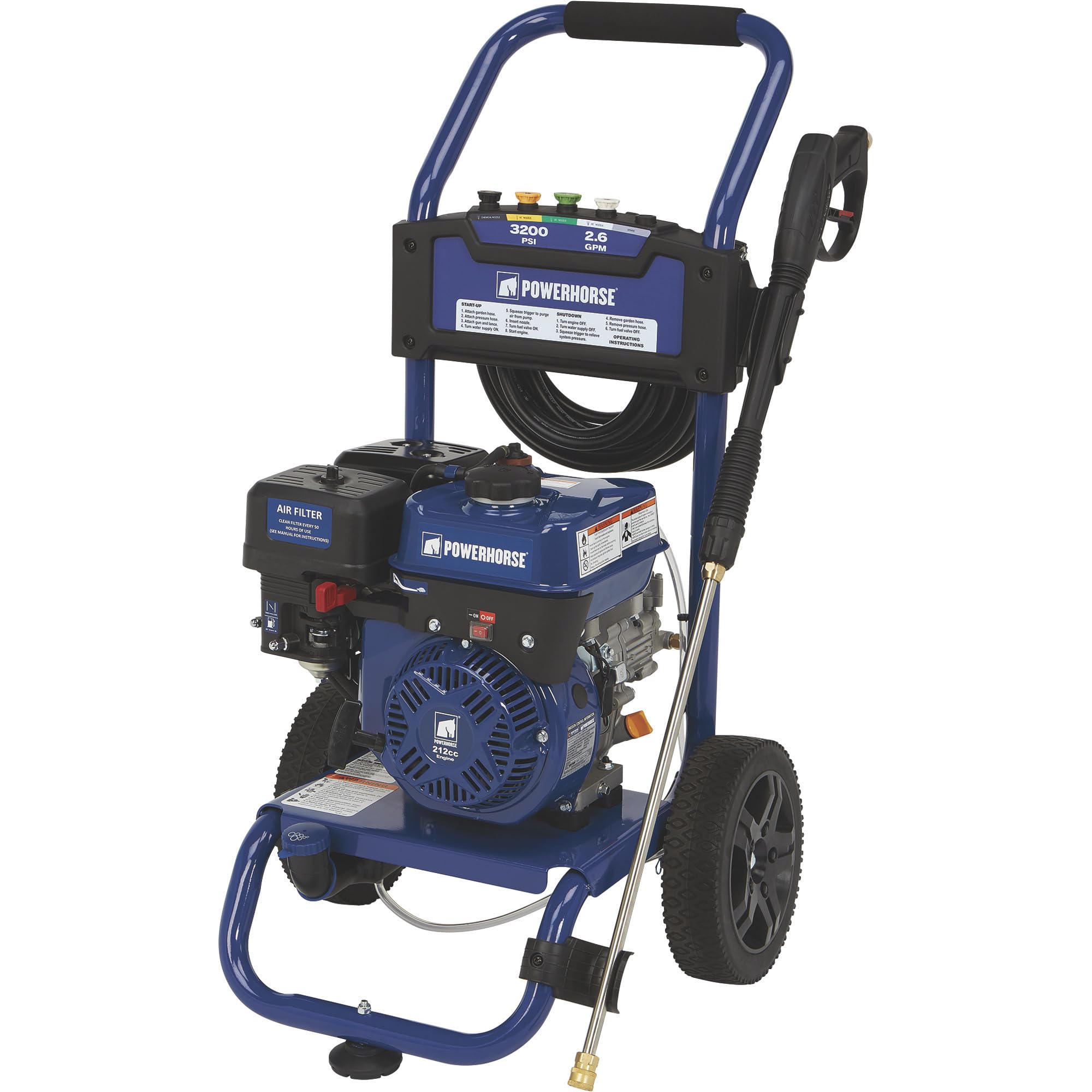
The Powerhorse positions itself as a straightforward, no-nonsense gas washer for homeowners who want raw cleaning force without paying for brand markup. The 212cc OHV engine and maintenance-free axial cam pump deliver 3400 PSI at 2.6 GPM — a flow rate that beats many similarly priced competitors. At this GPM, the rinse stage on a car or driveway moves significantly faster, and the 30-foot hose gives you extra reach over the standard 25-footer.
Assembly is straightforward, though some units arrive with a bent spray wand from shipping — an issue that Powerhorse customer service reportedly resolves quickly. Once running, owners describe the machine as starting on the first or second pull after the initial break-in. One reviewer logged over 8 hours of continuous runtime without issues, which suggests the axial cam pump in this unit is better sealed than budget alternatives. The 10-inch flat-free tires eliminate the flat-tire annoyance of pneumatic wheels.
The biggest operational gripe is the fuel on/off valve location — it is nearly invisible behind the engine shroud, and missing it during startup can lead to frustrating no-start situations. Once you memorize its position, the machine performs consistently. It is CARB and EPA compliant, so it can be sold in all 50 states without restrictions.
Why it’s great
- 2.6 GPM flow rate cleans faster than the 2.5 GPM standard at this price.
- Flat-free tires eliminate puncture worries on job sites.
- Proven ability to run for 8+ hours continuously without pump failure.
Good to know
- Fuel valve is hidden behind the shroud; first-time setup requires careful inspection.
- Spray wand may arrive bent; inspect immediately and contact support if needed.
- Axial cam pump, while reliable for home use, is not meant for daily commercial duty.
5. Westinghouse WPX3400
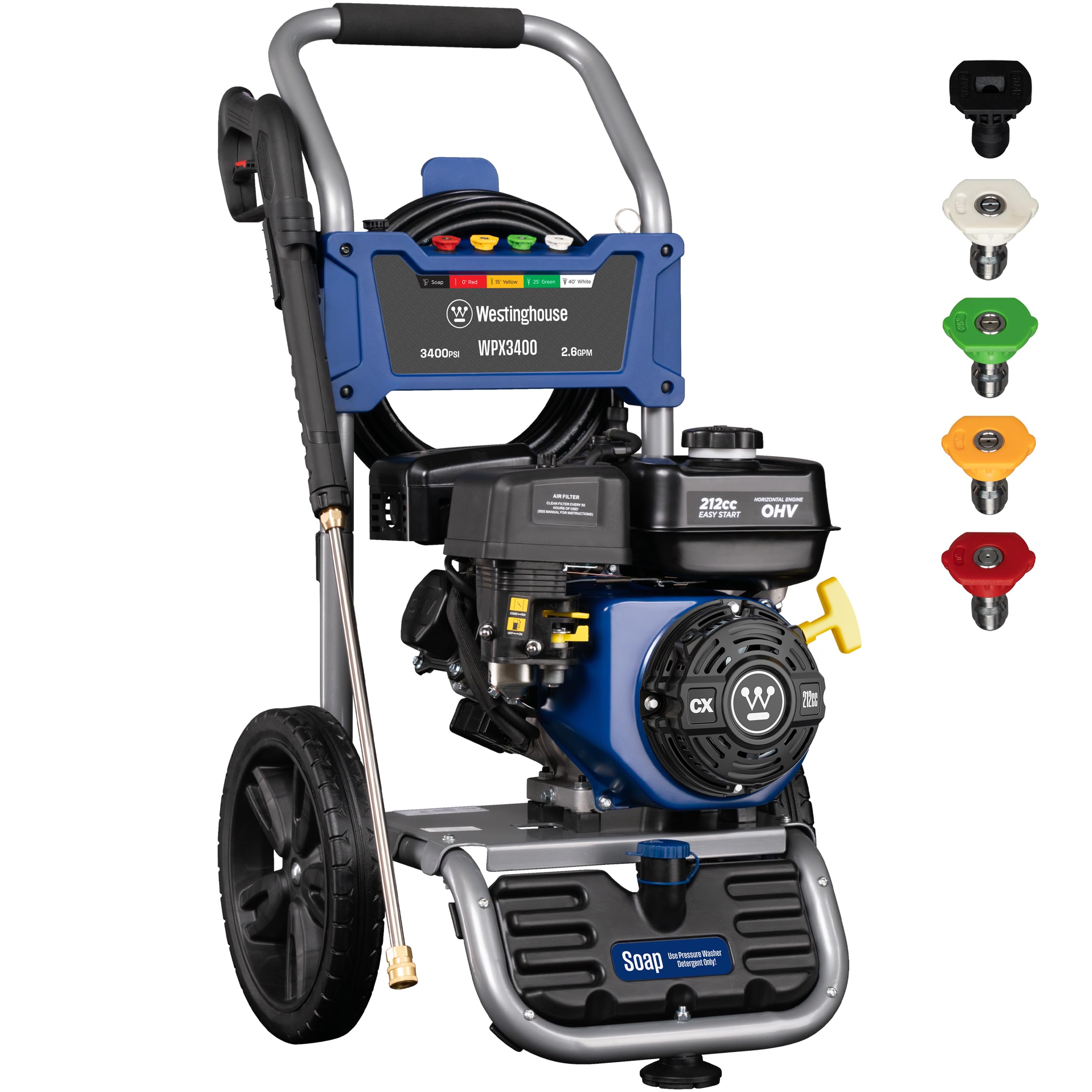
Westinghouse’s WPX3400 competes in the crowded mid-range gas segment by adding an onboard half-gallon soap tank — a convenience feature that eliminates the need to swap bottles or connect a separate siphon tube. Combined with 3400 PSI and 2.6 GPM, this machine is well-suited for homeowners who rotate between soap application, rinsing, and high-pressure stripping on a single property. The 212cc Westinghouse OHV engine delivers reliable power, and the axial cam pump is designed for maintenance-free operation in the residential context.
The 25-foot abrasion-resistant hose is paired with five quick-connect nozzles (0°, 15°, 25°, 40°, and soap), giving you full control from concentrated jet to wide-angle detergent foam. The 12-inch never-flat wheels roll easily over grass and gravel, and the steel frame feels solid without being overly heavy at 63 pounds. Assembly is straightforward, and the included oil and funnel mean you can be running within 20 minutes of opening the box.
Frequent users point out a design flaw: the supply hose that runs from the machine to the spray gun rubs against the right rear wheel during turns, eventually causing chafing and leaks. A simple bungee cord routing the hose away from the wheel solves the problem permanently. The oil drain plug is also positioned above the bottom plate, making oil changes messier than necessary. Despite these quirks, the cleaning performance and soap tank convenience make it a strong contender for mixed-use households.
Why it’s great
- Built-in half-gallon soap tank simplifies switching between detergent and rinse.
- 2.6 GPM flow rate hustles through large surface cleaning tasks.
- 12-inch never-flat wheels provide smooth mobility over uneven ground.
Good to know
- Supply hose rubs against the wheel; a bungee cord reroute is necessary.
- Oil drain plug placement makes changes messier than ideal.
- 25-foot hose is adequate but short for two-story homes without moving the cart.
6. Giraffe Tools Grandfalls Retractable Pro
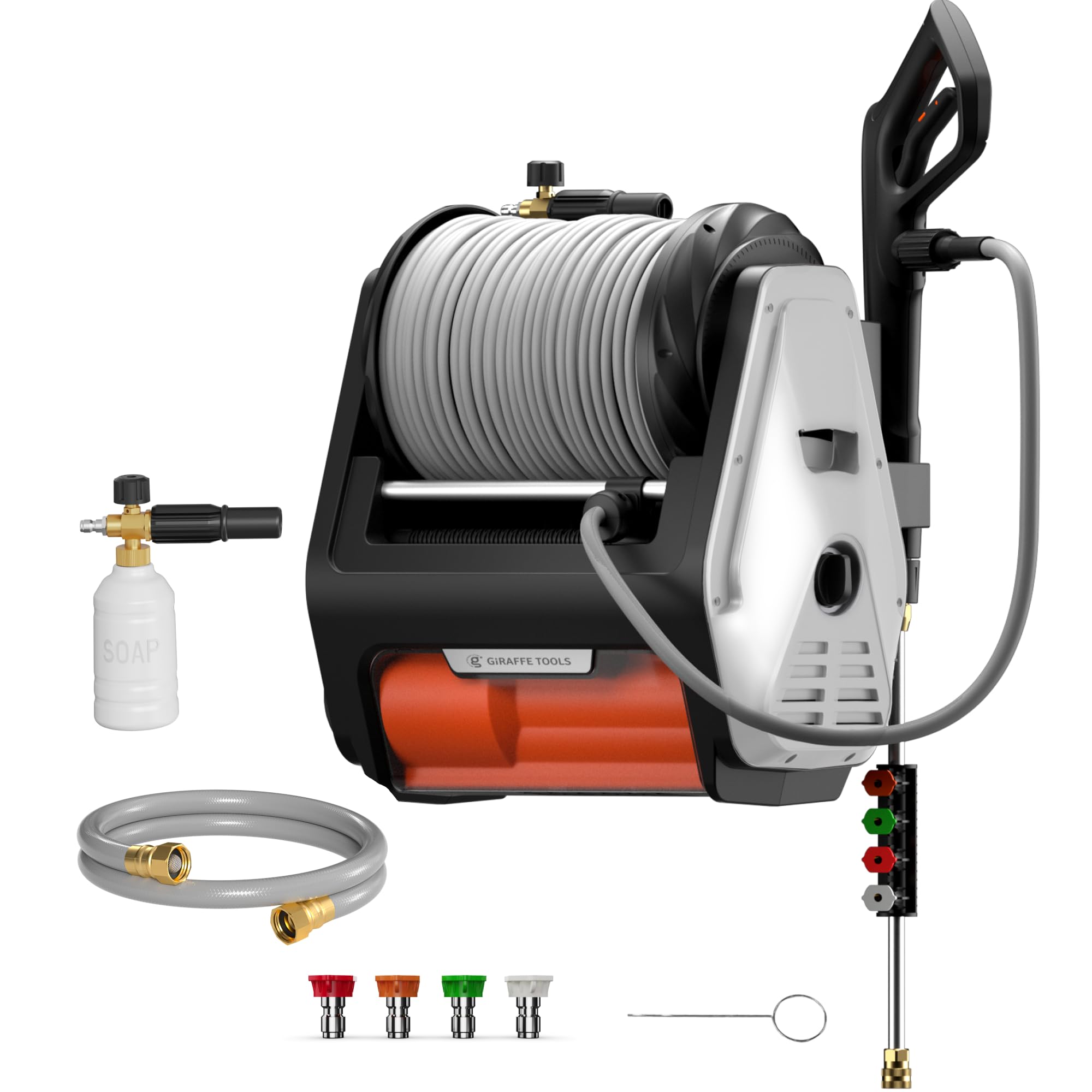
The Giraffe Tools Grandfalls Pro redefines what an electric pressure washer can do at 3700 PSI — technically exceeding the 3400 PSI target while operating at a library-quiet 68 decibels. The wall-mounted design with a 100-foot retractable hose is a game-changer for anyone tired of coiling hoses after every use. The brushless motor is rated for 1000+ hours of operation, which is significantly longer than the typical brushed motor found in most electric units.
At 1.6 GPM, the flow rate is lower than the gas competitors in this list, which means you will not clean a concrete driveway as fast as a 2.6 GPM gas washer. However, the automatic rewind mechanism locks at any length and retracts the full 100 feet in about 18 seconds — no wrestling, no kinks. The military-grade three-layer hose resists cracking down to 32°F, and the detachable sections mean you can replace a damaged segment rather than the whole hose.
The trade-off is installation commitment: the wall mount needs to be anchored into studs, and the unit is heavy at 68 pounds, making solo mounting challenging. Also, the foam cannon is proprietary — standard aftermarket foam cannons do not fit. For homeowners with a dedicated garage wall, the combination of instant hose management, low noise, and zero fumes makes this an attractive alternative to gas, provided you accept the slower rinse speed.
Why it’s great
- 100-foot retractable hose eliminates setup and takedown hassle completely.
- Brushless motor runs at 68dB — quiet enough for early morning use without disturbing neighbors.
- Detachable hose sections allow sectional replacement instead of full hose replacement.
Good to know
- 1.6 GPM flow rate is slower than gas washers for large flat surfaces.
- Heavy unit (68 lbs) requires two people for wall mounting.
- Foam cannon is brand-specific; standard third-party cannons are not compatible.
7. EGO Power+ HPW3200

EGO’s HPW3200 proves that battery-powered pressure washers can hang with gas units in the 3200-3400 PSI range — at least for certain tasks. Peak Power technology combines two 56V ARC Lithium batteries to deliver up to 3200 PSI and 1.2 GPM (up to 2.0 GPM in turbo mode). The wand-integrated display lets you switch between ECO, High, and Turbo modes while wirelessly monitoring battery charge, which is a level of feedback no gas gauge provides.
The runtime reality is the main constraint. With two 6.0Ah batteries, expect about 40 minutes on High mode. That is enough to wash two cars, a patio, and a small driveway, but not enough for a full-day siding project. The Turbo nozzle is genuinely impressive — it removed caked-on oil stains and tire marks that would require multiple passes with a standard 15-degree tip. Setup takes seconds because there is no oil to add, no gas to mix, and no carburetor to prime.
Batteries and charger are sold separately, which is a hidden cost if you are not already in the EGO ecosystem. The 1.2 GPM flow rate is noticeably slow during the rinse phase compared to a 2.5 GPM gas washer, and the included surface cleaner is less effective at lower flow rates. For homeowners who value instant start, zero maintenance, and the ability to pack the washer in a car trunk, this is a compelling option — just budget for extra batteries if you have a large property.
Why it’s great
- Peak Power mode combines two batteries for gas-like 3200 PSI performance.
- Wand-integrated display shows battery level and mode selection wirelessly.
- Zero maintenance — no oil changes, no gas stabilizer, no carburetor cleaning.
Good to know
- Batteries and charger sold separately; initial investment is higher for new users.
- 40-minute runtime on High mode limits it to smaller jobs or requires spare batteries.
- 1.2 GPM flow rate makes rinse cycles slower than gas alternatives.
8. PowerSmart DL1034

The PowerSmart DL1034 stands out for its unusually light frame weight of 31 pounds — about half the weight of most gas pressure washers in this class. That weight reduction comes from a simplified housing design rather than component downgrades; the 212cc OHV engine and 3400 PSI / 2.5 GPM pump match the specs of heavier competitors. For homeowners who need to frequently lift the washer into a truck bed or carry it up stairs, this weight advantage is a real selling point.
The pull-start mechanism is user-friendly, and the 4-stroke engine eliminates the need to mix oil with gas. The five quick-connect nozzles (0°, 15°, 25°, 40°, and soap) cover the full range of cleaning tasks. The foldable handle reduces storage footprint, and the 10-inch wheels provide decent maneuverability despite the lighter frame. Owners report effective cleaning on pool decks, screened enclosures, and driveways.
However, the quality control is inconsistent. Some units arrive with a defective soap dispenser or fail to start without starter fluid. The engine has a tendency to run for only a minute before dying if the carburetor settings are off from the factory. This variability means you may win the lottery with a perfect unit or spend time troubleshooting right out of the box. For budget-conscious buyers willing to accept some risk, the lightweight design and solid specs offer strong value when the machine works correctly.
Why it’s great
- Only 31 pounds — dramatically easier to transport and lift than typical gas washers.
- 3400 PSI and 2.5 GPM match the performance of much heavier machines.
- Foldable handle and compact footprint save storage space.
Good to know
- Quality control varies; some units arrive with carburetor or soap dispenser issues.
- May require starter fluid for initial startup if factory settings are off.
- Lightweight frame may feel less stable on uneven terrain than heavier steel frames.
9. VEVOR Gas Powered Pressure Washer
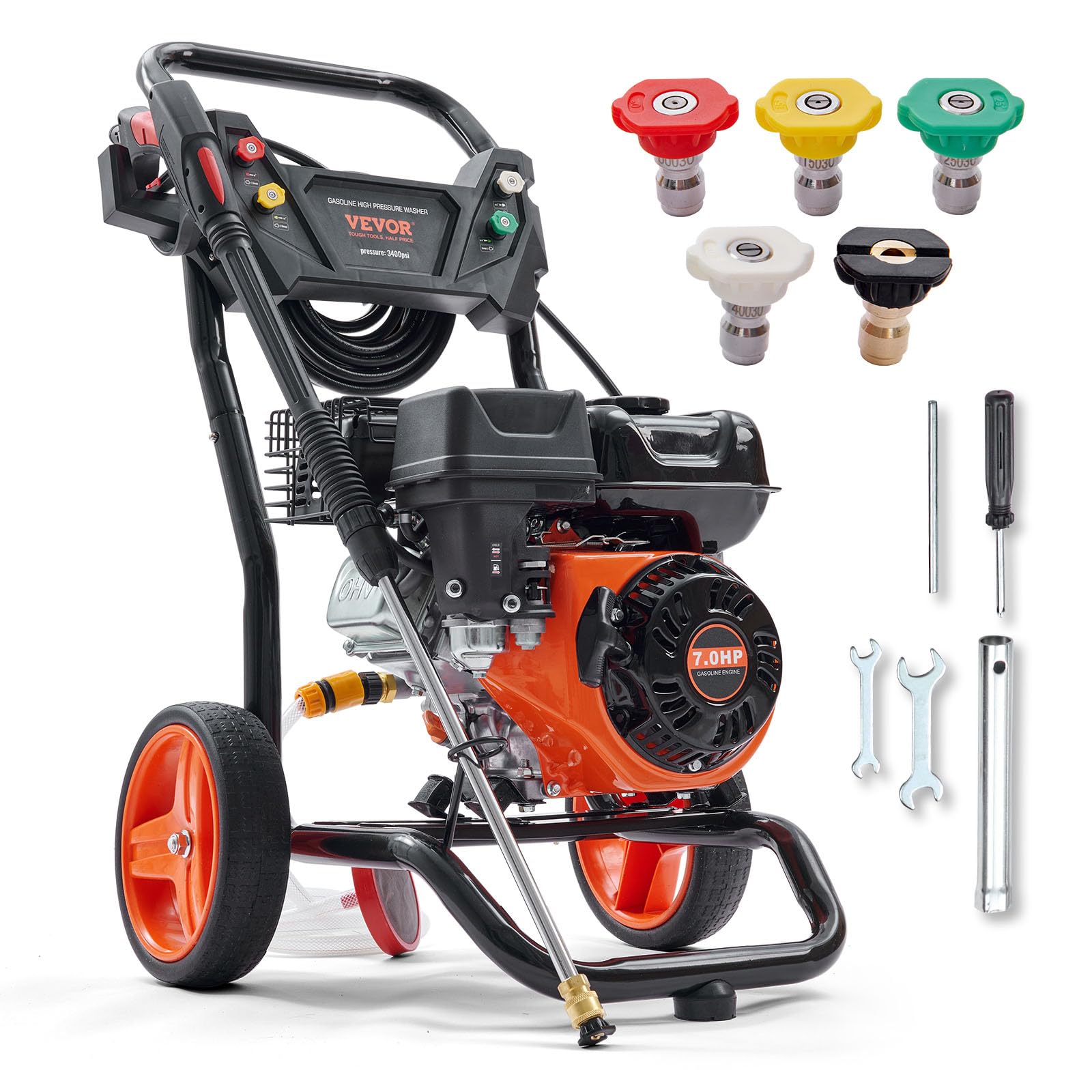
VEVOR’s 3400 PSI gas washer targets the entry-level buyer who needs maximum pressure at the lowest possible investment. The 210cc 4-stroke engine and copper pump deliver 3400 PSI at 2.6 GPM — a flow rate that matches or beats many mid-range units. The copper pump is notable because copper dissipates heat better than aluminum, potentially extending pump life if you run the machine for extended periods. The five quick-connect nozzles and 26-foot abrasion-resistant hose provide all the basics.
Assembly is straightforward, and the machine includes a convenient onboard storage system for the wand and nozzles, reducing the chance of losing parts between jobs. Early performance reviews are strong: owners report excellent cleaning power on cars, siding, and shed prep. The spray gun is comfortable, and the extension wand provides good reach for ground-level cleaning without bending over.
The durability concerns are significant at this price point. One reviewer reported complete failure after 90 minutes of use, and multiple users describe the noise level as unbearable — earplugs are mandatory. The motor mounts feel flimsy, and the hardware is described as cheap (some owners replaced bolts with stainless steel immediately). This is a machine that can perform beautifully for light, intermittent use, but it does not inspire confidence for regular heavy-duty duty. If you need a washer for occasional seasonal cleaning and have realistic expectations, it can save you money upfront.
Why it’s great
- Copper pump provides better heat dissipation than aluminum alternatives.
- 2.6 GPM flow rate is competitive with units twice the price.
- Onboard storage keeps nozzles and wand organized between uses.
Good to know
- Reliability is inconsistent; some units fail within the first few hours of use.
- Extremely loud operation requires hearing protection.
- Motor mounts and hardware feel cheap; proactive bolt replacement is recommended.
FAQ
Is 3400 PSI too strong for car washing?
Can I use a surface cleaner with any 3400 PSI washer?
How often should I change the pump oil on a 3400 PSI washer?
Why does my gas pressure washer surge or pulse while running?
Final Thoughts: The Verdict
For most users, the best 3400 psi pressure washer winner is the Simpson CM61248-S because it combines reliable power, a bundled surface cleaner that halves driveway cleaning time, and a robust five-year frame warranty at a competitive mid-range price. If you want commercial-grade longevity with a Honda engine and triplex pump, grab the Simpson ALH3228-S. And for zero-fume, instant-start convenience in a garage setting, nothing beats the Giraffe Tools Grandfalls Pro with its retractable 100-foot hose.

Mo Maruf
I created WellFizz to bridge the gap between vague wellness advice and actionable solutions. My mission is simple: to decode the research and give you practical tools you can actually use.
Beyond the data, I am a passionate traveler. I believe that stepping away from the screen to explore new environments is essential for mental clarity and physical vitality.