Our readers keep the lights on and my smoothie glass nicely filled. As an Amazon Associate, I earn from qualifying purchases.
Optical zoom is the single feature that separates a real camera from a smartphone attachment. When you need to bring a distant subject into crisp, detailed view—a bird on a wire, a performer on stage, a mountain peak across a valley—digital cropping won’t save you. Only glass moving inside the lens can preserve resolution while pulling the world closer. The challenge is that not all optical zoom cameras handle this job equally: some give you reach but sacrifice stability, others pack a sensor that can’t keep up in low light, and many bury their best features behind confusing spec sheets.
I’m Mohammad Maruf — the founder and writer behind WellFizz. I analyze optical zoom cameras by dissecting sensor performance, lens construction, image stabilization systems, and real-world usability data to separate marketing claims from actual image quality.
This guide breaks down the best models across multiple zoom ranges and price tiers, helping you match hardware to your specific shooting needs so you can confidently choose the right camera with optical zoom for your photography.
How To Choose The Best Camera With Optical Zoom
Optical zoom cameras span from pocket-sized superzooms to full-frame interchangeable lens systems. The decision comes down to three interconnected factors: the zoom range you actually need, the light conditions you typically shoot in, and how much weight you’re willing to carry. Skipping any one of these can leave you with a camera that frustrates you in the field.
Zoom Range and Focal Length
The “X” number (like 30x or 60x) tells you the ratio between the widest and longest focal length. What matters more is the actual millimeter range. A 24-720mm lens (30x) is dramatically different from a 24-1200mm lens (50x)—the latter can capture details nearly twice as far away. For wildlife or bird photography, look for cameras offering at least 60x or 83x optical zoom. For concerts or travel, a 30x to 40x range gives excellent reach without the bulk and weight of a super telephoto lens. Also pay attention to the wide end: 24mm or wider lets you capture landscapes and group shots without stepping backward.
Image Stabilization Is Non-Negotiable
At moderate zooms, hand shake is manageable. At 60x or 83x, even your heartbeat shows up as blur. Optical Image Stabilization (OIS) physically moves lens elements to counteract motion, while Digital Stabilization (EIS) crops the frame. For still photography at long focal lengths, OIS is far more effective. Look for stabilization rated in “stops” of correction—4 stops means you can shoot at a shutter speed 16 times slower than usual without blur. Cameras with Dual Detect or Power O.I.S. technology offer the best handheld performance at max zoom.
Sensor Size and Low-Light Performance
Most superzoom cameras use a 1/2.3-inch sensor, which is small. This gives them incredible zoom reach in a compact body, but it also means they struggle in dim light—images get noisy above ISO 1600. A 1-inch sensor or larger APS-C/full-frame sensor delivers far cleaner images at higher ISOs, but those cameras typically have shorter zoom ranges and cost significantly more. Know your tradeoff: if you shoot mostly outdoors in good light, a small-sensor superzoom is fine. If you shoot indoors, at dusk, or in forests, prioritize sensor size even if it means less zoom.
Autofocus Speed and Accuracy
At telephoto distances, autofocus has less margin for error. Contrast-detection AF, common on budget superzooms, can hunt and fail when the subject is small or low-contrast. Phase-detection AF or hybrid systems lock focus faster and track moving subjects more reliably. Check the number of autofocus points—cameras with 399 or more points offer denser coverage across the frame, which helps when tracking birds, athletes, or wildlife. A manual focus ring is also valuable when AF fails at extreme zoom distances.
Quick Comparison
On smaller screens, swipe sideways to see the full table.
| Model | Category | Best For | Key Spec | Amazon |
|---|---|---|---|---|
| Nikon COOLPIX P1100 | Superzoom | Extreme telephoto reach | 125x optical zoom (24-3000mm) | Amazon |
| Canon EOS RP + RF 24-105mm | Mirrorless | Full-frame image quality | 26.2MP full-frame CMOS sensor | Amazon |
| Nikon COOLPIX P950 | Superzoom | Wildlife and birding | 83x optical zoom (24-2000mm) | Amazon |
| Panasonic LUMIX FZ80D | Bridge | Budget superzoom versatility | 60x optical zoom (20-1200mm) | Amazon |
| Panasonic LUMIX ZS99 | Compact Travel | Pocketable travel zoom | 30x Leica lens (24-720mm) | Amazon |
| Canon PowerShot SX740 HS | Compact Superzoom | Concerts and events | 40x optical zoom (24-960mm) | Amazon |
| TONGVEO Conference Camera | PTZ Webcam | Boardroom video meetings | 3x optical zoom, AI auto-tracking | Amazon |
| Minolta 64MP Digital Camera | Point-and-Shoot | Budget macro and zoom | 10x optical zoom, 64MP sensor | Amazon |
| Kodak PIXPRO AZ255-BK | Budget Point-and-Shoot | Entry-level learning | 25x optical zoom (24mm wide) | Amazon |
In‑Depth Reviews
1. Nikon COOLPIX P1100

The Nikon COOLPIX P1100 sets the benchmark for extreme optical zoom in a fixed-lens camera. Its 125x optical zoom reaches an equivalent 24-3000mm, which means you can capture details on a mountain peak or a bird across a lake with clarity that no phone can touch. The Dual Detect Optical VR provides 4-stop shake correction, a necessity when you’re handheld at 3000mm. Experienced users report sharp photos from safari vehicles and long-distance landscape shots that rival much larger setups.
The dedicated Bird-watching mode on the mode dial optimizes shutter speed and focus for avian subjects, and the Macro mode lets you focus as close as 1 cm for extreme close-ups. The 16MP sensor with 14-bit RAW capture gives you room to recover shadows and highlights in post-processing. The customizable control ring on the lens barrel is a thoughtful addition for photographers who prefer manual exposure adjustment over menu diving.
The build quality, while lightweight, feels less rugged than higher-end Nikon DSLRs, and the autofocus tracking for fast-moving birds in flight is inconsistent compared to mirrorless systems. At full zoom, a tripod becomes nearly essential for critically sharp images. However, as a single-tool solution for nature enthusiasts who want both wide landscapes and extreme telephoto reach, the P1100 delivers unmatched range for its price bracket.
Why it’s great
- World-leading 125x optical zoom with 4-stop VR stabilization
- RAW capture with 14-bit depth for editing flexibility
- Bird-watching mode and 1 cm macro capability
Good to know
- AF tracking struggles with fast, erratically moving birds
- Plastic body feels less durable than premium mirrorless cameras
- Video stutters at extreme zoom without a tripod
2. Canon EOS RP + RF 24-105mm

The Canon EOS RP is not a superzoom—it’s a full-frame mirrorless camera paired with the RF 24-105mm f/4-7.1 IS STM lens, offering a versatile 4.4x optical zoom range. What it lacks in extreme reach it more than compensates for in pure image quality. The 26.2MP full-frame sensor delivers clean, detailed files up to ISO 12800, making it the best choice for indoor events, portraits, and travel photography where light is variable. The Dual Pixel CMOS AF system locks focus smoothly on faces and moving subjects, a clear step up from contrast-detect systems on competing cameras.
The body weighs only 1.07 pounds with the kit lens, remarkably light for a full-frame system. The vari-angle touchscreen and electronic viewfinder make composition flexible, whether shooting overhead or at ground level. The RF mount opens up a future upgrade path to L-series lenses, and the included EF-to-RF adapter compatibility means existing Canon DSLR glass works seamlessly. For hybrid shooters, 4K UHD video with face-tracking autofocus produces excellent results for vlogging and event coverage.
The kit lens, while optically stabilized, has a relatively slow f/4-7.1 aperture, which limits depth-of-field control and low-light performance at the telephoto end. The 105mm maximum reach (169mm equivalent in crop mode) won’t satisfy wildlife photographers. Battery life is adequate but not exceptional—plan for at least one spare battery on a full day of shooting. For anyone prioritizing sensor performance and lens ecosystem over sheer zoom distance, this kit is a standout entry point into full-frame photography.
Why it’s great
- Full-frame sensor offers exceptional low-light and dynamic range
- Dual Pixel AF is fast, accurate, and smooth for video
- Lightweight body with extensive RF and EF lens compatibility
Good to know
- Kit lens aperture is slow, limiting creative background blur
- 105mm telephoto reach is short for wildlife or distant subjects
- Battery life requires carrying spares for full-day shoots
3. Nikon COOLPIX P950

The Nikon COOLPIX P950 is a veteran superzoom that delivers an 83x optical zoom (24-2000mm equivalent) with a dedicated Bird mode and a rotating LCD screen that feels purpose-built for nature observation. The 16MP sensor captures detailed images in good light, and the built-in image stabilization makes handheld use at 2000mm surprisingly viable—users report clear shots of the moon and distant birds without a tripod. The maximum aperture of f/2.8 at the wide end helps in lower light, though it narrows to f/6.5 at full telephoto.
The 399-point contrast-detect autofocus system provides dense coverage across the frame, which aids in locking onto small subjects. The raw file support (12-bit NRW) allows for post-processing adjustments that JPEGs won’t tolerate. For birders, the camera’s Moon mode automatically adjusts ISO and shutter speed for lunar photography, and the ergonomic grip makes extended handheld sessions comfortable. The HDMI output and 4K UHD video recording add versatility for digiscoping and documentation.
The autofocus can hunt when the subject is low-contrast or backlit, requiring users to switch to manual focus via the dedicated ring. The small sensor means image quality drops off noticeably above ISO 800, making low-light performance a clear limitation. The P950 also lacks USB-C charging, relying on a proprietary charger. For photographers who need extreme zoom at a more accessible price point than the P1100, the P950 remains a proven workhorse that has earned its reputation among nature enthusiasts.
Why it’s great
- 83x zoom with effective image stabilization for handheld use
- Dedicated Bird and Moon modes for specialized shooting
- 399 AF points for wide coverage at telephoto distances
Good to know
- Contrast-detection AF hunts on low-contrast subjects
- Small sensor limits image quality above ISO 800
- Proprietary charger included, no USB-C charging
4. Panasonic LUMIX FZ80D

The Panasonic LUMIX FZ80D offers a 60x optical zoom with a 20-1200mm equivalent range, making it one of the few superzooms that starts wider than 24mm. The 20mm wide end is a genuine advantage for landscape and architectural photography, letting you capture expansive scenes without stitching. The Power O.I.S. (Optical Image Stabilizer) is effective at suppressing hand-shake vibration at the tele end, a critical feature when shooting at 1200mm. The 2,360K-dot large LVF (Live View Finder) provides a clear, glare-free view even in bright sunlight, solving a common pain point for outdoor photographers.
The 4K Photo mode extracts 8MP stills from 4K video at 30 fps, letting you capture the exact moment in fast action. The Post Focus feature allows you to select the focus point after taking the shot, which is useful for macro and product photography where precise focus is tricky. The camera records 4K UHD video at 30p, and the 3-inch LCD tilts for high and low-angle composition. The f/2.8-5.9 aperture is reasonably bright at the wide end for its class.
The small 1/2.3-inch sensor inevitably produces grainy images at higher ISOs—users report noticeable noise above ISO 800. The contrast-detect autofocus is adequate but not as snappy as phase-detect systems, and the interface can feel dated compared to newer models. The 60x zoom range, while very good, is outmatched by the 83x and 125x options from Nikon. For photographers who prioritize a wide-angle starting point and budget-friendly superzoom versatility, the FZ80D offers a balanced package with a unique wide-end advantage.
Why it’s great
- 60x zoom starts at an ultra-wide 20mm equivalent
- High-resolution EVF eliminates glare in bright conditions
- Post Focus and 4K Photo modes for action and precision
Good to know
- Small sensor struggles above ISO 800, images get grainy
- Contrast-detect AF is slower than phase-detect systems
- Menus and interface feel less modern than competitors
5. Panasonic LUMIX ZS99

The Panasonic LUMIX ZS99 (TZ99 outside North America) is a true pocket camera with a 30x Leica DC Vario-Elmar lens covering 24-720mm. This form factor is rare: a camera that slides into a jeans pocket yet reaches far enough for concert photography, travel landmarks, and wildlife encounters. The hybrid autofocus system combines contrast and DFD (Depth from Defocus) technology for faster locking than pure contrast-detect systems. Users consistently praise the color accuracy and sharpness of the Leica glass, which produces images with pleasing contrast and minimal chromatic aberration for its class.
The 1,840k-dot tiltable touchscreen is bright enough for most conditions, and the built-in Bluetooth 5.0 with a dedicated Send Image button makes file transfer to a smartphone painless. USB-C charging is a welcome modern convenience—no proprietary cables needed. The 4K video at 30p and 120fps HD high-speed video provide creative flexibility, and the 10-bit bit depth indicates better color gradation than many compact competitors. The stepped zoom function with Lens Position Resume lets you quickly return to a frequently used focal length.
The small sensor carries the same low-light limitations as other 1/2.3-inch compacts—images become noisy above ISO 1600. The autofocus can be inconsistent in low contrast scenes, and the LCD screen can be difficult to read in direct sunlight despite its decent resolution. A few users note that the manual that ships with the camera may be for a European version, which can cause initial confusion. For travelers who refuse to carry a bag but refuse to settle for phone zoom, the ZS99 is the most portable optical zoom camera that still delivers meaningful reach.
Why it’s great
- Pocketable body with a 30x Leica lens (24-720mm)
- USB-C charging and Bluetooth 5.0 for easy connectivity
- Hybrid AF with DFD for faster focusing than predecessors
Good to know
- Small sensor limits usable ISO to 1600
- AF can hunt in low contrast or dim lighting
- LCD screen can be hard to read in bright sunlight
6. Canon PowerShot SX740 HS
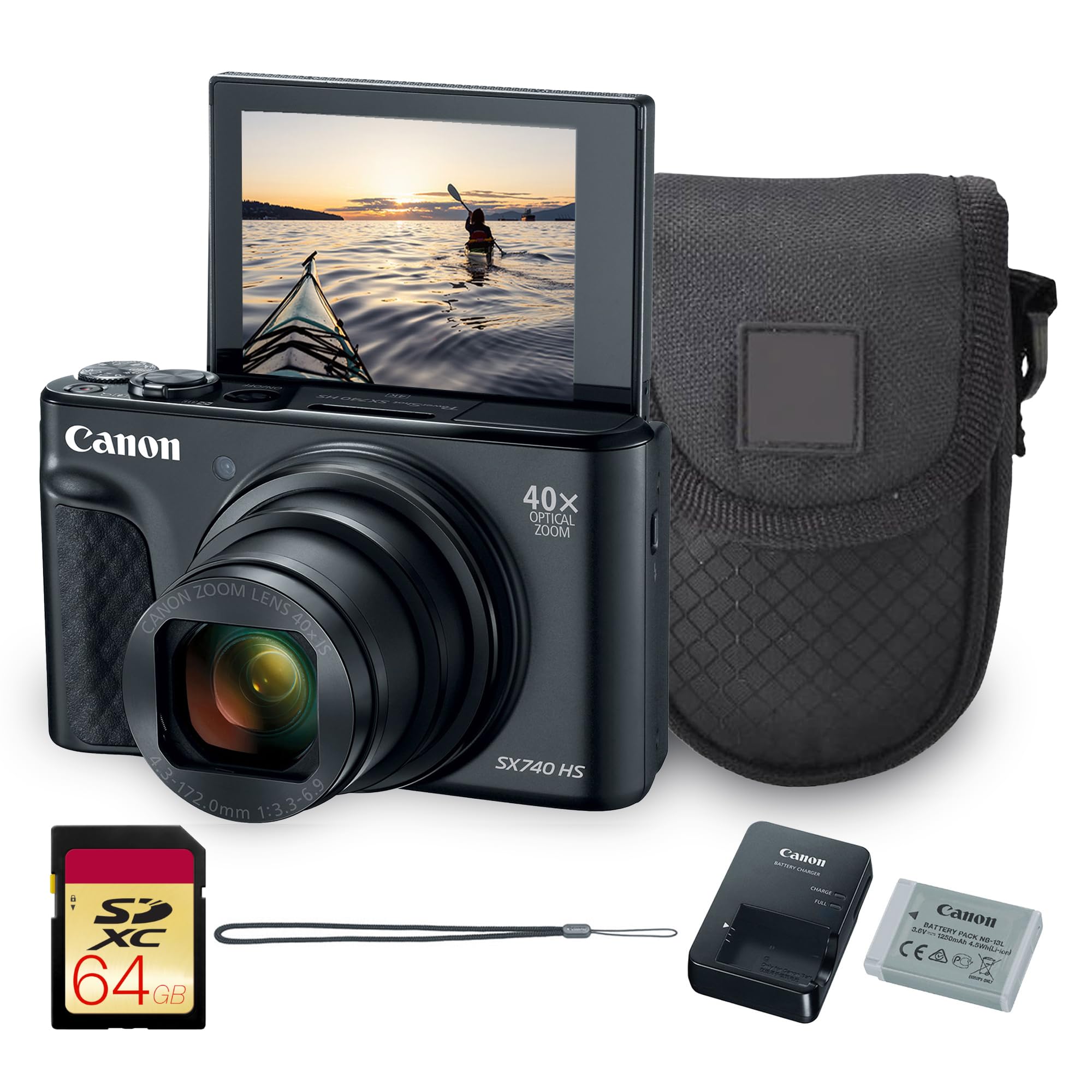
The Canon PowerShot SX740 HS packages a 40x optical zoom (24-960mm equivalent) into a compact body that slips into a jacket pocket. This makes it a primary choice for concert-goers and event attendees who need to capture distant stages without drawing attention. The 20.3MP CMOS sensor paired with the DIGIC 8 processor delivers sharp, vibrant JPEGs straight out of camera, with the 5-axis stabilization smoothing handheld video at full zoom. Users consistently report excellent battery performance, with some shooting for days on a single charge.
Wi-Fi and Bluetooth connectivity allow instant transfer to a smartphone via the Canon Camera Connect app, and the 4K UHD video at 30p provides plenty of resolution for social media and personal videos. The built-in flash is useful for dim indoor environments at shorter focal lengths, and the flip-up screen enables selfie framing. The kit includes a 64GB memory card and a carrying bag, which reduces the need for immediate accessory purchases.
The 1/2.3-inch sensor shows visible noise above ISO 1600, and the lack of a hot shoe or mic input limits expansion for serious vloggers. The autofocus, while generally reliable, can hunt in low-light concert venues where spotlights create high contrast. Some units shipped as international models cannot be registered for US warranty—verify the seller’s listing before purchasing. For the specific use case of capturing performers on a lit stage from a seat in the middle or back rows, the SX740 HS combines reach and portability better than any phone or larger superzoom.
Why it’s great
- 40x zoom in a genuinely pocketable form factor
- 5-axis stabilization smooths handheld telephoto video
- Excellent battery life, often lasting multiple days of use
Good to know
- No hot shoe or external mic input for advanced audio
- Small sensor limits low-light performance above ISO 1600
- Some units sold are international versions without US warranty
7. TONGVEO Conference Camera System
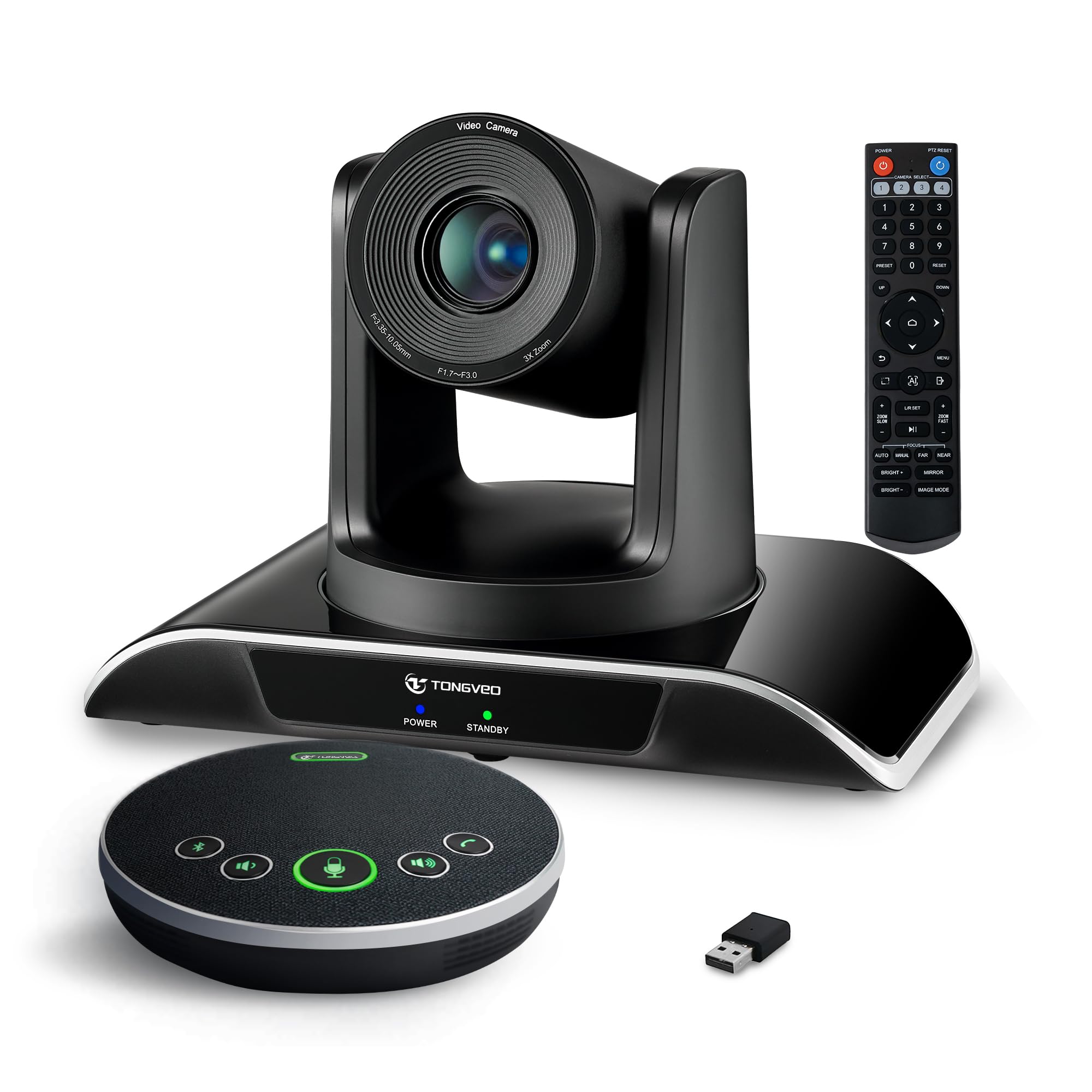
The TONGVEO All-in-One Conference Room Camera System is a PTZ (pan-tilt-zoom) camera with 3x optical zoom designed specifically for small to medium meeting rooms. Unlike the other cameras on this list, its primary function is video conferencing—the 3x zoom is paired with a 114° wide field of view and AI auto-tracking that follows speakers as they move. The 1/2.8-inch 2.38MP CMOS sensor delivers clean 1080p video at 60fps, which is more than adequate for professional conference platforms like Zoom, Teams, and WebEx.
The system includes a Bluetooth conference speakerphone with a full-duplex microphone array and echo cancellation, picking up voices clearly within a 16.4-foot radius. The PTZ camera rotates 350° horizontally and 180° vertically, covering an entire room without repositioning. Plug-and-play USB 3.0 connectivity eliminates driver installation, and the separate speakerphone can be used wirelessly via USB, Bluetooth 5.0, or a wireless dongle. Built-in battery life of 6-8 hours on the speakerphone supports all-day meetings.
The 3x optical zoom is modest compared to photography-focused cameras—this is not a tool for long-distance shooting. The camera is wired to the computer, while the speaker is wireless, which can create cable management consideration. Some users report that the initial unit required replacement via customer service, though support responsiveness is consistently praised. For any business or remote team needing a unified audio-video solution with auto-tracking and optical zoom for presenter framing, this system eliminates the complexity of pairing separate components.
Why it’s great
- All-in-one PTZ camera and Bluetooth speakerphone system
- AI auto-tracking follows presenters across the room
- 1080p 60fps with 114° wide field of view for full room coverage
Good to know
- 3x optical zoom is limited—not for long-distance photography
- Camera wired, speaker wireless—plan cable runs accordingly
- Some units may require warranty replacement shortly after purchase
8. Minolta 64MP Digital Camera

The Minolta 64MP Digital Camera offers a 10x optical zoom with a 64MP CMOS sensor, combining high-resolution capture with moderate telephoto reach. The 10x zoom (approximately 28-280mm equivalent) is ideal for portraits, group shots, and moderately distant subjects like performers at a small venue. The 64MP sensor allows for aggressive cropping after the fact, letting you effectively extend your reach by scaling into the image. The macro mode is specifically praised by users for capturing fine detail on small subjects.
The articulating LCD screen enables flexible framing, and the anti-shake technology helps reduce motion blur at the telephoto end. The package includes a 32GB SD card, a carrying case, a rechargeable lithium battery, and a charger—everything a beginner needs to start shooting immediately. Built-in Wi-Fi allows remote control via smartphone, which is a feature more common on higher-tier models. The A-mount telephoto lens indicates compatibility with a range of Minolta legacy glass for future expansion.
Several user reports indicate reliability concerns—at least one unit developed persistent autofocus blur after three months, which represents a real risk for long-term buyers. The 64MP resolution on a small sensor produces pixel-level noise that requires downscaling for clean results. The 10x zoom is modest compared to the 30x, 60x, and 125x options elsewhere in this guide. For casual shooters who want a high-resolution camera with basic zoom and a complete starter kit, the Minolta delivers useful features at its price tier, but buyers should weigh the reliability reports carefully.
Why it’s great
- 64MP sensor enables significant cropping without detail loss
- Complete kit includes SD card, case, battery, and charger
- Articulating screen and Wi-Fi remote control for flexible shooting
Good to know
- Multiple user reports of autofocus failure after a few months
- High pixel density on a small sensor creates noise at pixel level
- 10x zoom range is limited compared to superzoom competitors
9. Kodak PIXPRO AZ255-BK

The Kodak PIXPRO AZ255-BK is an entry-level point-and-shoot with a 25x optical zoom (24-600mm equivalent) and a 16MP CMOS sensor, designed for beginners who want optical zoom without spending heavily. The 24mm wide angle is genuinely useful for landscapes and group shots, while the 25x zoom brings distant subjects within reach for casual use. The optical image stabilization provides basic shake reduction at telephoto focal lengths, keeping handheld shots usable in good light. Users consistently describe it as beginner-friendly with a clean zoom quality that surpasses digital zoom on phones.
The camera records 1080p Full HD video, adequate for social media and family memories. The 3-inch LCD screen is serviceable for composition, and the use of AA batteries is a double-edged sword—convenient because you can buy replacements anywhere, but limiting because battery life is short compared to lithium-ion packs. The camera includes a lens cover, strap, and connection cord, though it does not include an SD card. The Macro feature performs better than expected, producing good close-up results for its class.
Image quality is limited by the small sensor—photos show noticeable noise above ISO 400, and the autofocus is contrast-detect only, which hunts in low light. The camera is large enough that it won’t fit in a pocket, contradicting any expectation of compactness. The lack of 4K video and the reliance on AA batteries with short runtime are clear compromises. For a first camera for a child or a budget traveler who simply wants more reach than a phone, the AZ255-BK delivers the essential optical zoom experience at its lowest entry point.
Why it’s great
- 25x optical zoom from a 24mm wide angle provides versatile reach
- AA battery system means power is always available
- Intuitive controls and good macro performance for beginners
Good to know
- Short AA battery life requires frequent replacements
- No 4K video—limited to 1080p Full HD
- Small sensor shows noise above ISO 400
FAQ
How much optical zoom do I need for bird photography?
Can a camera with optical zoom replace a smartphone for everyday photos?
What does the aperture number mean at maximum zoom?
Why do superzoom cameras have small sensors?
Final Thoughts: The Verdict
For most users, the camera with optical zoom winner is the Nikon COOLPIX P1100 because its 125x optical zoom combined with Dual Detect VR stabilization covers virtually any distant subject you can see, from wildlife to super moons. If you want full-frame image quality and lens interchangeability for portraits and travel, grab the Canon EOS RP + RF 24-105mm kit. And for pocketable reach without a bag, nothing beats the Panasonic LUMIX ZS99.

Mo Maruf
I created WellFizz to bridge the gap between vague wellness advice and actionable solutions. My mission is simple: to decode the research and give you practical tools you can actually use.
Beyond the data, I am a passionate traveler. I believe that stepping away from the screen to explore new environments is essential for mental clarity and physical vitality.