Our readers keep the lights on and my smoothie glass nicely filled. As an Amazon Associate, I earn from qualifying purchases.
The stud finder you grab to hang a TV or a shelf often becomes the most anxiety-inducing tool in your drawer — beeping at air pockets, missing stud centers entirely, and leaving you with a wall full of patched holes. When you are shopping on a strict budget, the margin for error shrinks even further because every miss costs time and drywall compound. A cheap finder that lies to you is no bargain at all.
I’m Mohammad Maruf — the founder and writer behind WellFizz. I have spent the last decade comparing consumer electronics on measurable performance data, focusing specifically on how sensor quality, calibration logic, and scan depth translate into real DIY results for wall scanners under the premium tier.
This guide sorts through the current market to identify which low-cost models actually detect wood studs, metal pipes, and live AC wires without constant false positives.
How To Choose The Best Budget Stud Finder
Every budget stud finder on this list costs under an hour of a plumber’s visit, but they vary wildly in sensor intelligence and false-alarm frequency. Three decisions define whether your finder becomes a reliable partner or a noisy paperweight.
Scan Modes vs. Actual Utility
A “6-in-1” label on a budget unit usually means it has stud, deep scan, metal, non-ferrous metal, AC wire, and magnetic modes. Most budget buyers will only need the basic stud and AC wire modes. The extra metal modes for copper or ferrous pipes are reassuring but less accurate on cheap sensors — they often alert on a nail head or a staple. If you primarily hang shelves and TVs, verify the stud mode works at ¾-inch depth and the AC mode alerts before you buy.
The Calibration Ritual
All electronic stud finders require calibration against the wall surface. Budget units often use auto-calibration that activates the moment you press the power button. The trick is that they need calibration on every new wall section. Models that allow manual calibration give you more control when scanning textured or uneven surfaces. If the product description only mentions automatic calibration, expect to re-calibrate frequently during use.
Power Source and Battery Life
Most budget stud finders run on one 9V alkaline battery. A few newer units, like the FNIRSI, switch to rechargeable lithium-ion batteries. Alkaline 9V batteries cost about a dollar each and last through several projects. Rechargeable models remove the recurring expense but require you to keep them charged. For a budget tool you might grab once a month, standard 9V power is often the simpler choice — just keep one good alkaline battery in the unit.
Quick Comparison
On smaller screens, swipe sideways to see the full table.
| Model | Category | Best For | Key Spec | Amazon |
|---|---|---|---|---|
| Zircon StudSensor A100 | Edge | Trusted brand, wall safety | 0.75 in. wood/metal stud depth | Amazon |
| FNIRSI 6-in-1 WD-01 | Rechargeable | Deep scans, rechargeable | 1.5 in. deep scan depth | Amazon |
| POROMETISTO DSF01 | Multi-Depth | Pipe detection, bundle | 4.7 in. ferrous metal depth | Amazon |
| TIMORUN TH610 | Value | Entry-level, wide detection | 6-in-1 modes, magnetic sensor | Amazon |
| JAXWQ TH410 | Bright Screen | Low-light scanning | Backlit LCD display | Amazon |
In‑Depth Reviews
1. Zircon StudSensor A100

Zircon is the name most contractors trust at the job site, and the StudSensor A100 brings that reliability down to a price point that fits any tool bag. The edge-finding sensor detects wood and metal studs up to ¾-inch deep with a clear arrow indicator that lights up when you reach the stud edge. The ergonomic grip feels solid in hand, and the unit weighs just over half a pound, which reduces fatigue when scanning an entire wall for shelf installation.
WireWarning AC detection is a passive safety alert that beeps and flashes when live, unshielded electrical wiring is nearby — it will not pinpoint the exact wire path, but it tells you to slow down before drilling. The yellow body is easy to spot in a crowded toolbox, and the single 9V battery slot keeps the power simple. Several user reviews note that fresh batteries are critical; a dying 9V will trigger frequent error beeps that make the finder unusable.
The A100 lacks deep scan mode and the multi-screen visuals found on newer competitors, but its fundamental accuracy for standard stud finding is hard to beat. For someone who needs a wall scanner once a month and wants the peace of mind of a brand that has been refining stud sensors since the 1980s, this is the safest bet in the budget range.
Why it’s great
- Edges on wood and metal studs detected reliably at 0.75 in.
- WireWarning AC feature adds genuine safety without extra buttons
- Contoured grip and lightweight build reduce hand fatigue
Good to know
- No deep scan mode for thicker walls
- 9V battery not included in the box
2. FNIRSI 6-in-1 WD-01

The FNIRSI WD-01 stands out in the budget field because it replaces the standard 9V alkaline battery with a built-in lithium-ion rechargeable cell. That alone saves you the cost of replacements over the life of the tool, and the USB charging port means you can top it off from any laptop or wall adapter. The physical design includes a positioning hole at the top of the unit that lets you drop a pencil mark exactly at the stud center without shifting the scanner off its mark.
Detection modes cover six separate functions: exact scan for standard ¾-inch studs, deep scan for 1.5-inch depth, non-ferrous metal (copper) up to 3.9 inches, ferrous metal (iron) up to 4.7 inches, AC wire detection at 2 inches, and copper wire scan at 1.6 inches. The digital LCD display shows an analog bar that fills as you approach the target. Audio alerts accompany the visual readout, and the overall build feels dense without being heavy.
User reports consistently mention that the calibration is straightforward — press the button on the wall, wait for the green light, then scan. A few early units had inconsistent readings on textured walls, but later production runs seem to have tightened the sensor logic. If you want the deepest scan range and the convenience of no battery shopping, the FNIRSI is the best value upgrade from a basic model.
Why it’s great
- Rechargeable lithium-ion battery eliminates recurring costs
- Positioning hole enables precise center marking
- Deep scan reaches 1.5 in. and ferrous metal up to 4.7 in.
Good to know
- Battery not included in the box; only a charging cable
- Best results require slow movement across the wall
3. POROMETISTO 6-in-1 DSF01
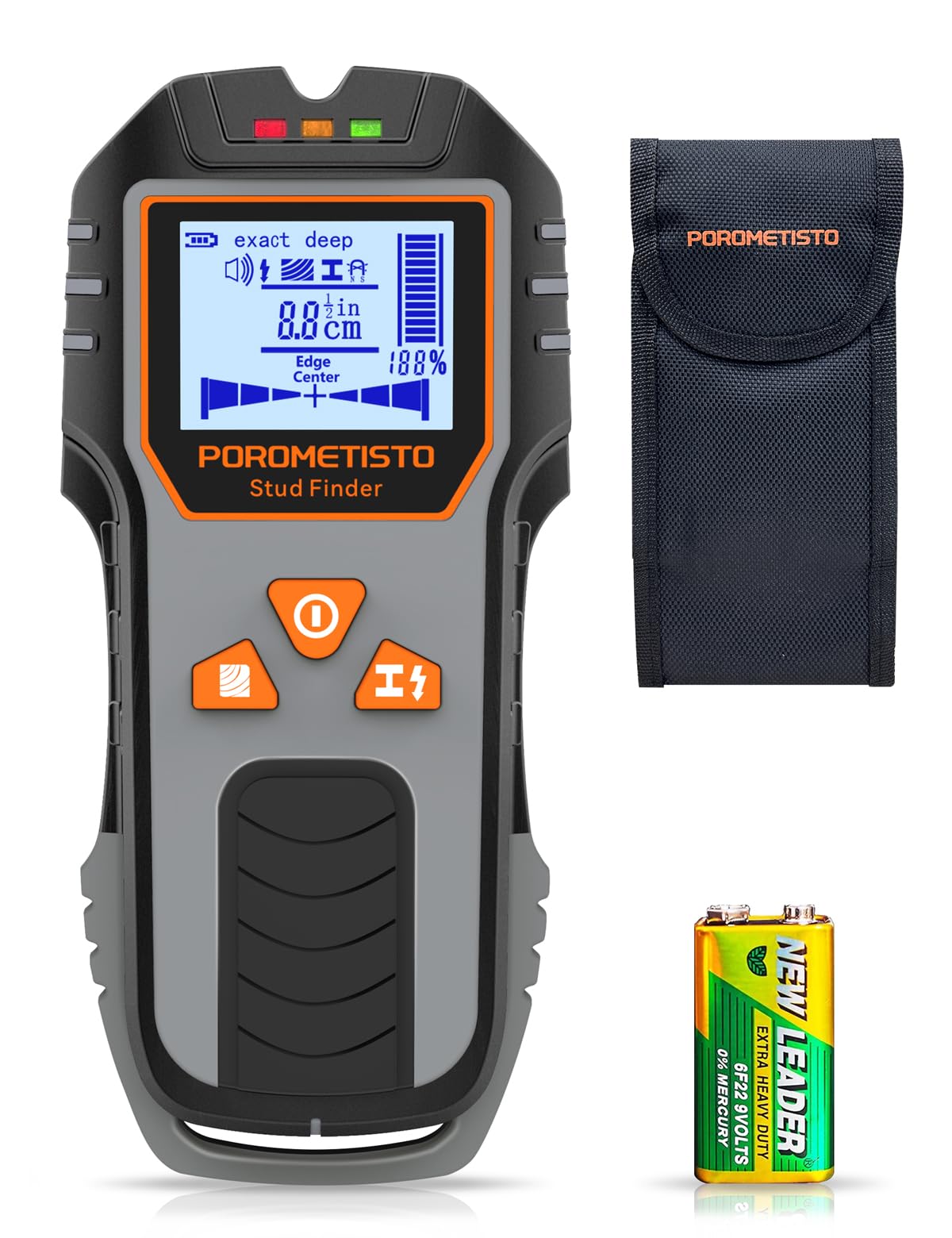
The POROMETISTO DSF01 arrives in a package that feels complete — the box includes the scanner, a detailed user manual, a 9V alkaline battery, and a soft cloth bag for storage. That bag is a small detail, but it prevents the button from being pressed accidentally in a drawer, which was a common complaint on earlier models. The unit uses a push-style on/off button that triggers easily if you slide it into a packed tool pouch without the bag.
Detection specs are generous for the price: metal studs and pipes up to 4.7 inches deep, copper pipes up to 3.9 inches, live AC wires up to 2 inches, and dual calibration modes (auto and manual). The LCD screen displays real-time signal strength as a percentage and an analog bar, plus three color lights (green for ready, yellow for edge, red for target). A mute function silences the continuous humming sound that some users find distracting during fine scanning.
On standard ½-inch drywall, the DSF01 finds studs consistently. The deep scan mode does pick up plumbing pipes and rebar behind thick walls, though the accuracy drops slightly on non-ferrous targets. The manual calibration mode is a welcome addition for uneven wall textures. Overall, this is a strong mid-range contender that bundles everything you need out of the box, including the battery and a carry pouch.
Why it’s great
- Includes 9V battery and cloth storage bag in the box
- Dual calibration with auto and manual options
- Mute button stops continuous humming sound
Good to know
- Push-button power can activate accidentally without the bag
- Non-ferrous metal detection is less reliable than stud mode
4. TIMORUN 6-in-1 TH610
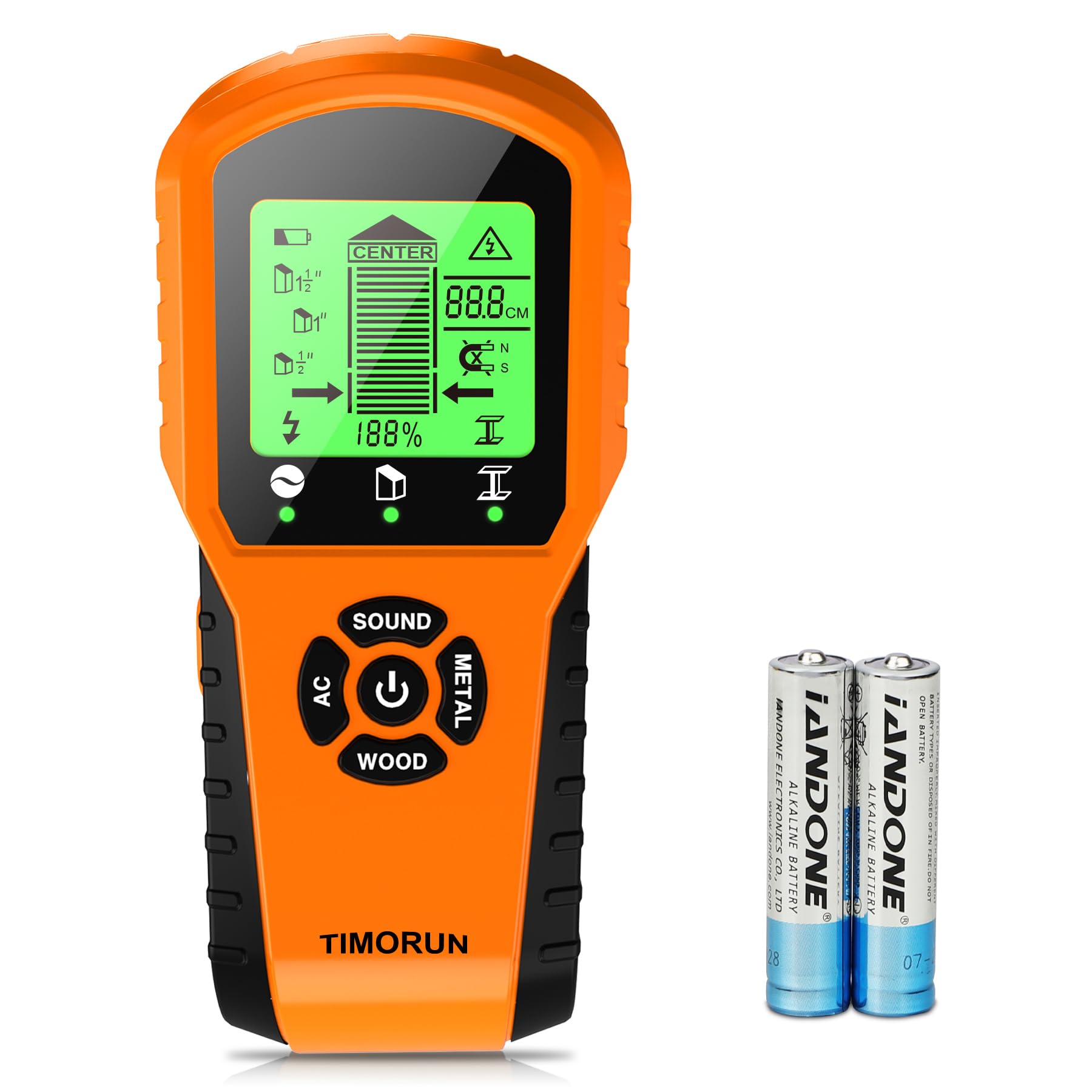
The TIMORUN TH610 is the entry-level champion in this lineup, priced to compete directly with magnetic stud finders that only detect screws. This electronic unit detects wood studs, metal pipes, ferrous and non-ferrous metals, and live AC wires, all while fitting into a compact gear-shaped body that includes a magnetic sensor for locating screws and nails after you find the stud. The pumpkin orange color makes the TH610 easy to spot on a cluttered workbench.
The HD LCD screen shows the detection mode, battery level, and a visual indicator of the target location. A buzzer button lets you turn off the audible beep if you are working in a quiet space. Three depth settings in stud mode allow you to adjust for thin drywall versus thicker plaster. The included 9V alkaline battery is installed and ready to scan out of the box, which removes the “needs battery” frustration.
Some user reviews note that the AC and metal detection modes are more of a safety net than a precision tool — they alert you to the presence of metal or wire, but not to the exact location. The stud mode itself is accurate enough for mounting a TV bracket, as multiple verified buyers confirmed. If you are new to using electronic stud finders and want the lowest possible investment, the TIMORUN TH610 gets the basics right without demanding a steep learning curve.
Why it’s great
- Battery included and pre-installed for immediate use
- Magnetic sensor helps locate screws after finding studs
- Buzzer button silences audio for quiet rooms
Good to know
- AC and metal detection are safety indicators, not locators
- Multiple setting changes per scan can slow workflow
5. JAXWQ 5-in-1 TH410

The JAXWQ TH410 targets the DIYer who values screen clarity above all else. The backlit LCD display is bright enough to read in direct sunlight and dimly lit basements alike, showing the center, edge, and location of detected studs with clear icons. The orange juice color scheme gives it a playful look, but the internals are serious — an intelligent micro-sensor chip drives the 5-in-1 detection modes: stud scan, deep scan, metal scan, and AC wire detection.
The unit calibrates quickly when you press the button against the wall. Audio alerts reinforce the visual display, making it usable without looking at the screen once you get used to the beep pattern. The TH410 is lightweight at 8.1 ounces and slides easily across drywall, textured surfaces, and even acoustic ceilings. The included battery is installed, so you can start scanning immediately after unboxing.
Reviews highlight that the TH410 works well for mounting TVs and checking existing brackets. A few users mention that re-scanning the same wall can produce slightly different center points, though the variation is small enough that the TV mount still lines up correctly. The instructions rely heavily on photos without much text, which can be confusing for first-time users. For someone who wants a bright, easy-to-read display and does not mind a short learning curve, the JAXWQ TH410 delivers reliable performance at a rock-bottom price.
Why it’s great
- Backlit LCD is highly readable in any lighting condition
- Intelligent micro-sensor provides fast calibration
- Battery included and ready to use
Good to know
- Visual-only instructions may require external knowledge
- Center point can shift slightly on re-scan
FAQ
Why does my budget stud finder beep at empty spots on the wall?
Can a budget stud finder detect metal studs in commercial buildings?
How do I mark the stud center with a budget stud finder?
Final Thoughts: The Verdict
For most users, the best budget stud finder winner is the Zircon StudSensor A100 because it combines a trusted brand, reliable edge-finding, and the WireWarning safety feature at a price that undercuts most multi-mode competitors. If you want the deepest scan range and a rechargeable battery that eliminates ongoing costs, grab the FNIRSI 6-in-1 WD-01. And for the absolute lowest entry point with a magnetic sensor bonus, nothing beats the TIMORUN TH610.

Mo Maruf
I created WellFizz to bridge the gap between vague wellness advice and actionable solutions. My mission is simple: to decode the research and give you practical tools you can actually use.
Beyond the data, I am a passionate traveler. I believe that stepping away from the screen to explore new environments is essential for mental clarity and physical vitality.