Our readers keep the lights on and my smoothie glass nicely filled. As an Amazon Associate, I earn from qualifying purchases.
A dead phone halfway through a multi-day hike isn’t just an inconvenience; it means losing your navigation, emergency contact, and camera. A backpacking solar charger converts sunlight into a lifeline for your devices, but picking the wrong one means carrying useless weight. You need a panel that balances wattage, packability, and real-world charging speed for the trail.
I’m Mohammad Maruf — the founder and writer behind WellFizz. I’ve spent years analyzing the specs and customer feedback for hundreds of outdoor power products to identify which models actually deliver on their promises in the backcountry.
After comparing foldable panels on efficiency, portability, connector versatility, and weather resistance, I’ve narrowed the field to the seven most reliable options for hikers and campers. Here is your complete guide to the best backpacking solar charger for any adventure.
How To Choose The Best Backpacking Solar Charger
Selecting a solar charger for backpacking is a different game than choosing a car kit. Every ounce and every fold of material matters when you have to carry it on your back. Focus on these four factors to avoid adding dead weight to your pack.
Wattage vs. Weight: The Real Trade-Off
A 100W panel can charge a power bank in a few hours, but it often weighs over 9 pounds and unfolds to the size of a small table. For most backpackers, a 20W to 30W panel that weighs under 2 pounds is the sweet spot. It will keep your phone and a small battery bank topped off without hogging your pack’s volume.
Cell Efficiency and Low-Light Performance
Monocrystalline cells, especially premium N-type or SunPower MAXEON cells, convert sunlight at 23-25% efficiency. This matters more than total wattage when you’re charging under a forest canopy or on an overcast day. Lower-grade polycrystalline panels will struggle to produce usable current in the same conditions, leaving you waiting hours for a few percentage points of battery.
Port Variety and Connector Standards
Most backpacking panels rely on USB-A and USB-C ports for direct device charging. If you plan to pair the panel with a power station (like a Jackery or EcoFlow), you need a panel with the correct adapter (XT60, DC7909, or Anderson). A good panel includes several connector options in the box, saving you from buying extra cables in the field.
Quick Comparison
On smaller screens, swipe sideways to see the full table.
| Model | Category | Best For | Key Spec | Amazon |
|---|---|---|---|---|
| FlexSolar 25W Mini | Foldable | Ultra-light backpacking | 1.2 lbs, 23.2% efficiency | Amazon |
| BigBlue 25W | Foldable | Minimal weight, high quality | 0.84 lbs, 25.4% efficiency | Amazon |
| FlexSolar 60W | Foldable | Camping & small power stations | 60W max, PD3.0 & DC outputs | Amazon |
| Anker Solix PS30 | Foldable | Reliable brand for phones | 30W, IP65, 2.2 lbs | Amazon |
| ELECOM NESTOUT 28W | Briefcase | Premium build & storage | SunPower cells, 1.2 lbs | Amazon |
| ZOUPW 100W | Foldable | High-watt car camping | 100W, 5-in-1 cable | Amazon |
| HQST 200W | Foldable | Max power for RVs | 200W, 25% efficiency | Amazon |
In-Depth Reviews
1. FlexSolar 25W Ultra-Portable Solar Panel Charger
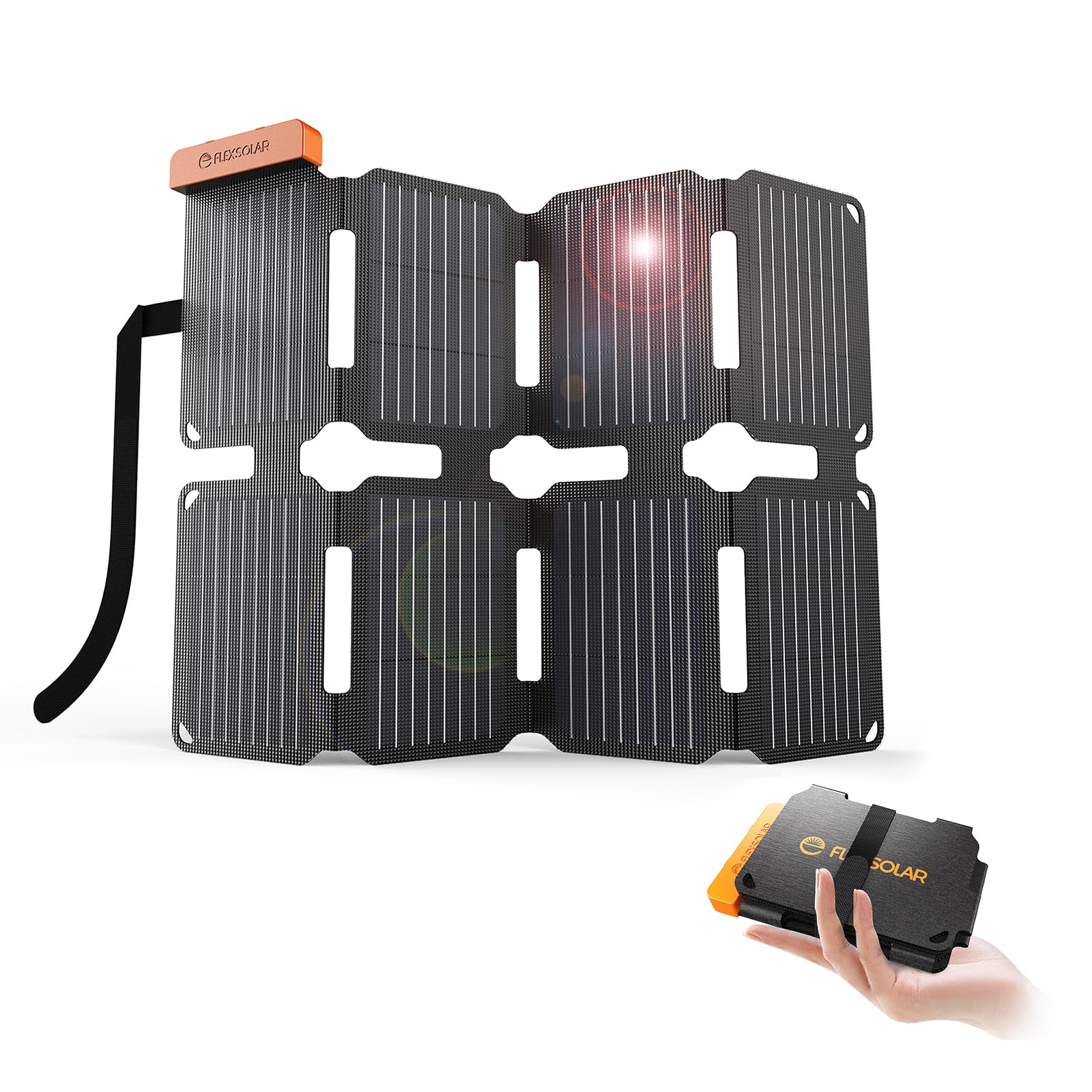
The FlexSolar 25W hits the perfect balance of power and packability for long-distance treks. At just 1.2 pounds and folding to the size of a tablet, it hooks onto a backpack via two carabiners and charges as you walk. The 23.2% photovoltaic efficiency is competitive for its class, and real-world tests show it delivering 2.3A in partial sun at high latitudes, making it a reliable companion even in less-than-ideal light.
This panel includes both USB-A and USB-C ports with MPPT technology that optimizes energy harvest in shade. The triple-layer E-film construction claims over 2,000 fold cycles, addressing the common failure point of micro-cracks in foldable panels. It also features IP67 certification, meaning it can survive rain, dust, and even a brief dunk in a stream.
Customer feedback consistently praises its build quality and lightweight design, though a few note that the 25W rating is generous and real-world output sits closer to 20W under perfect sun. It charges a smartphone in around 4-5 hours of full sun, which is excellent for a panel of this size. For most backpackers, this is the clear winner.
Why it’s great
- Extremely lightweight at 1.2 lbs, easy to attach to a pack
- IP67 rating offers peace of mind in rain or stream crossings
- MPPT controller improves charging in partial shade
Good to know
- Rated 25W, but real-world max is closer to 20W under perfect sun
- Plastic material may feel less premium than fabric-wrapped panels
2. [Upgraded] BigBlue Ultra-Light Portable 25W Solar Panel Charger

The BigBlue 25W is the lightest panel on this list at just 0.84 pounds, making it ideal for ultralight backpackers who count every gram. It uses N-type solar cells without front metal lines, which allows the panel to stay cooler and maintain a conversion efficiency of up to 25.4%. When folded, it measures just 4.65 by 6.42 inches, smaller than many phones.
It features USB-A (5V/2.4A) and USB-C (5V/3A) ports with smart charging technology that optimizes power delivery for connected devices. The ETFE coating and UV-resistant EVA layers provide extended durability, and the IP68 rating means it can survive immersion in water up to a meter deep for 30 minutes. Real-world reports show it charging a 10,000mAh power bank in about 6 hours of direct sun.
Some customers note that the USB-C port maxes out at 15W, not the full 25W suggested by the product name, which is a common caveat for small portable panels. A few also reported missing accessories upon delivery. Despite those issues, its unbeatable weight and impressive efficiency make it a top choice for serious hikers.
Why it’s great
- Weighs under a pound, the lightest option for backpacking
- High 25.4% efficiency with premium N-type cells
- IP68 rated for submersion in fresh water
Good to know
- Real-world USB-C output is closer to 15W, not 25W
- Some units arrive with missing carabiners or cables
3. FlexSolar 60W Portable Solar Panel Charger

The FlexSolar 60W bridges the gap between lightweight phone chargers and full power station panels. It includes QC3.0 USB-A (18W), PD3.0 USB-C (40W), and a DC output (60W max at 20-28V), giving you the flexibility to charge a phone directly or top off a small power station like a Jackery or Anker. Its 24% monocrystalline efficiency is solid for the price.
Weighing 2.6 pounds, it is heavier than the sub-2-pound options, but it folds down to a laptop-like profile (9.8 x 12 x 1 inch) that fits in larger packs. The IP65 water resistance handles rain and dust, though the junction box isn’t waterproof. Real-world tests show it delivering 45-50W in strong sun, which is impressive for a panel in this price range.
Hikers note that the lack of a built-in kickstand means you’ll need to lean it against rocks or your pack to angle it correctly. For car campers or those who rely on a small power station, the extra wattage and multiple connector options make this a strong value proposition.
Why it’s great
- Multiple output ports (QC3.0, PD3.0, DC) for devices and power stations
- Folds to laptop size for easy packing
- Real-world output of 45-50W in strong sunlight
Good to know
- No integrated kickstand; must be propped up manually
- Weighs 2.6 lbs, heavier than ultra-portable 25W models
4. Anker Solix PS30 Solar Panel

The Anker Solix PS30 is a 30W foldable panel from a brand known for reliable power electronics. It charges two devices simultaneously via USB-A and USB-C ports and is built with monocrystalline silicon cells encased in tempered glass and an aluminum frame. The IP65 rating means it is dust-tight and protected against water jets, making it suitable for rain-swept camps.
At 2.2 pounds, it is not the lightest 30W panel, but the build quality is noticeably robust. The foldable design uses sturdy hinges, though a few customers have reported hinge fragility after extended use. In good sun, it can charge a phone from 15% to full in about 1.5 hours, which is faster than many competitors at the same wattage.
One limitation is that its USB-C output is capped at 15W, which means it won’t fast-charge modern laptops or larger power banks at their maximum speed. It is a reliable, well-supported choice for the hiker who prioritizes brand trust and wants a panel that works right out of the box.
Why it’s great
- Fast direct charging: phone from 15% to full in ~1.5 hours
- Robust build with tempered glass and aluminum frame
- Trusted Anker customer service and warranty
Good to know
- USB-C port maxes out at 15W, limiting fast charge speeds
- Hinge durability reported as inconsistent by some users
5. ELECOM NESTOUT Portable Solar Panel 28W

The ELECOM NESTOUT is a design-forward panel that won an IF Design Gold Award. It uses high-quality SunPower MAXEON cells, which offer up to 24% greater efficiency than traditional cells. This 28W panel is unique because the solar cells are integrated into a durable ripstop nylon bag that includes mesh storage pouches for cables and a small battery pack.
The integrated design is a genuine advantage for organization: you can stuff your power bank and phone into the pouch while the panel charges them, keeping everything tangle-free. It includes a built-in current checker LED display so you can see the power being generated. The adjustable stands allow for better sun angling.
The panel only has dual USB-A ports, lacking a USB-C port, which is a notable omission for modern devices. It also uses 14W cells per panel (28W total), meaning it charges slower than many 25W single-panel competitors. For the hiker who values organization and build quality over raw charging speed, this is a compelling, well-constructed option.
Why it’s great
- Integrated storage bag with mesh pouches keeps gear organized
- SunPower MAXEON cells offer high efficiency
- Built-in LED current checker for monitoring output
Good to know
- No USB-C port; only dual USB-A outputs
- Total 28W from two 14W panels, slower than single-panel 25W models
6. ZOUPW 100W Portable Solar Panel

The ZOUPW 100W is built for car campers and overlanders who need to replenish power stations quickly. It uses Grade A+ monocrystalline cells with 23.5% efficiency and an ETFE coating for durability. The panel includes a true 5-in-1 cable with DC8020, XT60, Anderson, DC7909, and DC5521 connectors, ensuring compatibility with most power stations including Jackery, EcoFlow, and Anker models.
It folds to a relatively compact 24.1 x 21.1 x 1.8 inches and weighs 9.48 pounds, making it more suitable for base camping than multi-day hikes. Two adjustable kickstands allow you to angle the panel at 45 degrees to maximize sun exposure. A built-in controller with USB-C (PD 15V/3A) and dual USB-A (including QC3.0) ports allows direct device charging.
Real-world performance is strong: it can charge a Jackery Explorer 300 from 84% to 100% in just 20 minutes on a cloudy day. For extended car camping trips or emergency home backup, this panel punches well above its price point.
Why it’s great
- True 5-in-1 cable for near-universal power station compatibility
- Fast real-world charging, even in cloudy conditions
- Two adjustable kickstands for optimal sun angle
Good to know
- Heavy at 9.48 lbs, not for long-distance backpacking
- Kickstands lack fine-tuned adjustability
7. HQST 200W Ultra-Light Portable Solar Panel
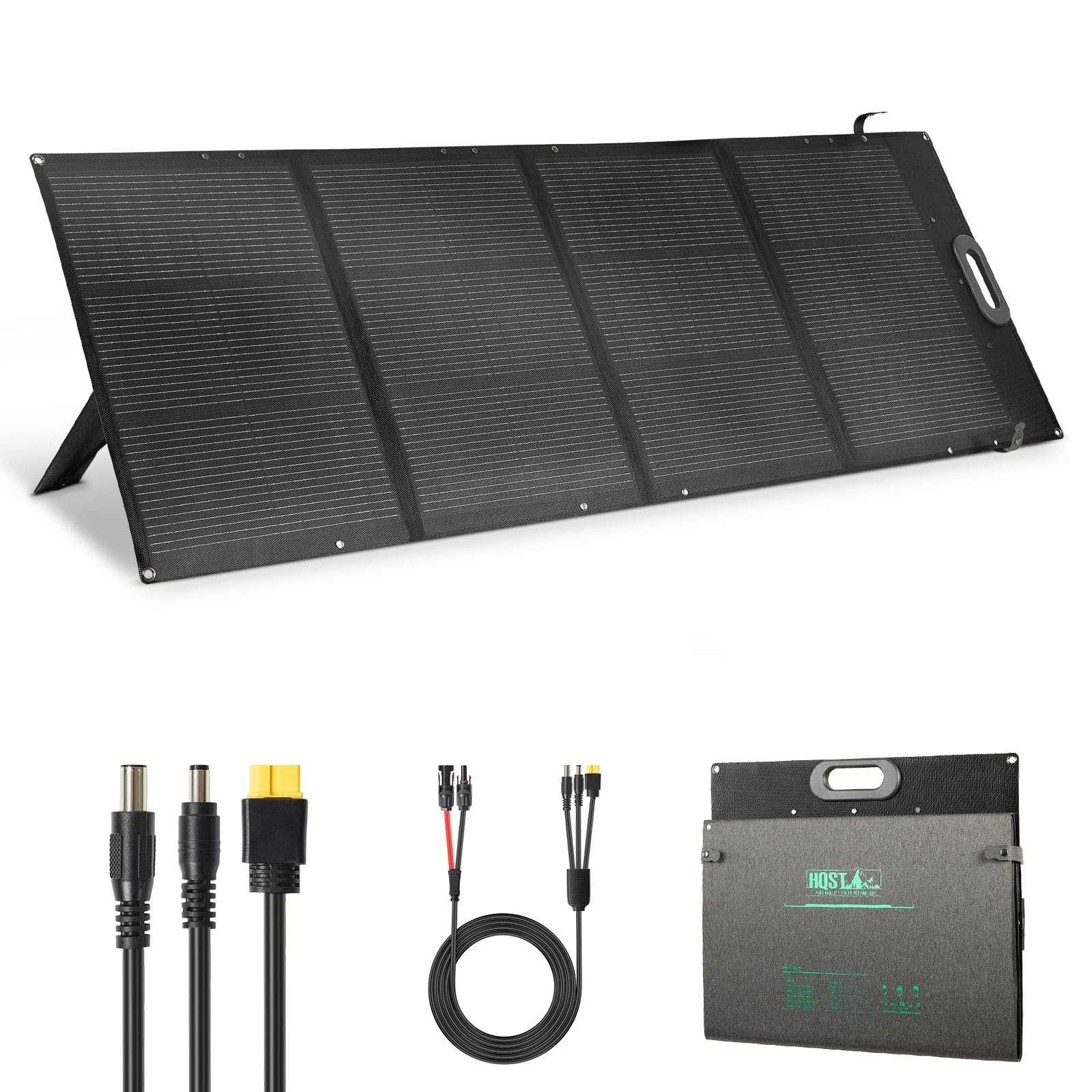
The HQST 200W uses next-generation 16BB N-type cells to achieve 25% efficiency, one of the highest ratings in a portable format. It is designed to charge large power stations quickly for RV or off-grid use. The panel is up to 37% lighter than other 200W panels, yet still weighs 11 pounds, so it remains a vehicle-based solution rather than a backpacking option.
It includes a 4.9-foot 3-in-1 adapter cable (XT60, DC7909, DC5521) for broad compatibility. Two adjustable kickstands allow tilt angles from 40 to 60 degrees. The fully laminated construction with PVDF coating eliminates stitched seams where water could seep in, backed by an IP67 rating for rain and dust protection.
Customer feedback is positive, with users praising its build quality and performance with MPPT controllers. Some panels arrived with minor cosmetic damage due to packaging, but the performance was unaffected. For RV owners or those running larger solar generators, this panel delivers the highest power density in a foldable form.
Why it’s great
- High 25% efficiency with N-type cells for faster charging
- Lighter than most 200W portable panels at 11 lbs
- IP67 rated with seam-free lamination for weather resistance
Good to know
- Heavy at 11 lbs; practical only for vehicle or base camp use
- Packaging can be insufficient, leading to cosmetic damage in transit
FAQ
Can I charge my phone directly from a backpacking solar panel?
How do I keep my solar panel angled at the sun while hiking?
Is an IP67-rated panel necessary for backpacking?
Can I use a backpacking solar panel to charge a power station?
Final Thoughts: The Verdict
For most backpackers, the best backpacking solar charger winner is the FlexSolar 25W because it offers the best balance of weight, efficiency, and weather resistance for multi-day treks. If you want the absolute lightest panel for ultralight backpacking, grab the BigBlue 25W. And for car campers or those who need to recharge a power station, nothing beats the versatility of the FlexSolar 60W.

Mo Maruf
I created WellFizz to bridge the gap between vague wellness advice and actionable solutions. My mission is simple: to decode the research and give you practical tools you can actually use.
Beyond the data, I am a passionate traveler. I believe that stepping away from the screen to explore new environments is essential for mental clarity and physical vitality.