Our readers keep the lights on and my smoothie glass nicely filled. As an Amazon Associate, I earn from qualifying purchases.
Learning to fly a quadcopter for the first time comes with a steep curve: you are fighting wind, camera shake, and the constant fear of a crash. A purpose-built beginner drone solves this with GPS-assisted hovering, propeller guards, and one-key return features that let you focus on framing your shot, not fighting the controls.
I’m Mohammad Maruf — the founder and writer behind WellFizz. I’ve spent years analyzing consumer drone hardware, comparing gimbal stability, transmission range, and flight controller logic to find what actually matters for someone taking their first flight.
After testing dozens of models against real-world conditions, I’ve narrowed the field down to the nine best options currently available. This guide will help you find the perfect beginner drone with camera to match your skill level and budget.
How To Choose The Best Beginner Drone With Camera
Picking your first camera drone is about balancing flight safety, image quality, and ease of use. Prioritize features that prevent loss and breakage over raw camera specs.
GPS Lock & Auto Return
GPS-based positioning holds the drone steady in a hover even when you release the sticks. More importantly, an auto return-to-home (RTH) feature brings the drone back automatically when the battery is low or the signal drops. This single feature saves more beginner drones than any other.
Propeller Guards & Weight Class
Drones under 249 grams avoid FAA registration and Remote ID requirements for recreational flyers, making them the hassle-free choice. Full-coverage propeller guards add a critical layer of crash protection during training, preventing damage to people, property, and the props themselves.
Camera Stabilization Type
There are two stabilization systems: a mechanical 3-axis gimbal that physically counteracts movement, and electronic image stabilization (EIS) that crops and processes the feed. Beginners benefit more from a mechanical gimbal because it delivers smooth footage without the processing lag and crop that EIS introduces.
Battery Life & Spare Batteries
Real-world flight times range from 15 to 40 minutes per battery, but charging takes hours. A kit with two or three batteries effectively doubles or triples your time in the air. Look for 1800mAh or larger cells with intelligent management that prevents over-discharge.
Quick Comparison
On smaller screens, swipe sideways to see the full table.
| Model | Category | Best For | Key Spec | Amazon |
|---|---|---|---|---|
| Potensic ATOM LT | Mid-Range | Long flight practice | 80 min total / 4km range | Amazon |
| Bwine F7MINI | Premium | Pro-grade footage | 3-axis gimbal / 6km range | Amazon |
| DJI Neo 2 | Premium | Palm-launch simplicity | 151g / omnidirectional sensing | Amazon |
| Gleesfun G11PRO | Mid-Range | Wind-resistant filming | 3-axis gimbal / 70 min total | Amazon |
| DJI Mini 4K Fly More | Premium | Ecosystem & accessories | 3-axis gimbal / 10km range | Amazon |
| Oddire HK11 | Budget | Value GPS features | 48 min total / 500m range | Amazon |
| REDRIE HK33 | Budget | Strong wind performance | 2-axis gimbal / 500m range | Amazon |
| Suangrc X9 | Budget | Built-in controller screen | 4.5″ screen / 18 min battery | Amazon |
| Karuisrc K600 | Budget | Controller screen + EIS | 4.5″ screen / 25 min battery | Amazon |
In‑Depth Reviews
1. Potensic ATOM LT

The Potensic ATOM LT packs a 2.5K EIS camera with Sony sensor into a 249g frame that requires no FAA registration. Each of the two intelligent 3000mAh batteries delivers 40 minutes of flight for a combined 80 minutes in the air — far ahead of most entry-level kits. The PixSync 2.0 transmission system pushes a stable HD feed up to 4 kilometers, giving beginners room to explore without signal anxiety.
Four GNSS satellite constellations power the GPS functions, so the auto return, follow-me, and waypoint modes lock position rapidly. The brushless motors handle Level 5 winds, and SurgeFly 2.0 flight modes let you scale from a gentle beginner pace to sport mode for faster maneuvers. FOTA firmware updates mean the drone improves over time without needing new hardware.
Controller connection issues occasionally appear out of the box, but Potensic’s customer support consistently replaces units quickly. The camera is not true 4K, and low-light stabilization struggles without a TOF sensor, but for bright-day flying this is the most confidence-inspiring entry-level drone on the market.
Why it’s great
- Exceptionally long 80 min total flight time with two batteries
- Reliable GPS auto return and multi-constellation positioning
- 4km video transmission range for worry-free exploration
Good to know
- Camera is 2.5K, not true 4K resolution
- Slow GPS satellite lock before first takeoff
- Low-light stabilization degrades without TOF sensor
2. Bwine F7MINI
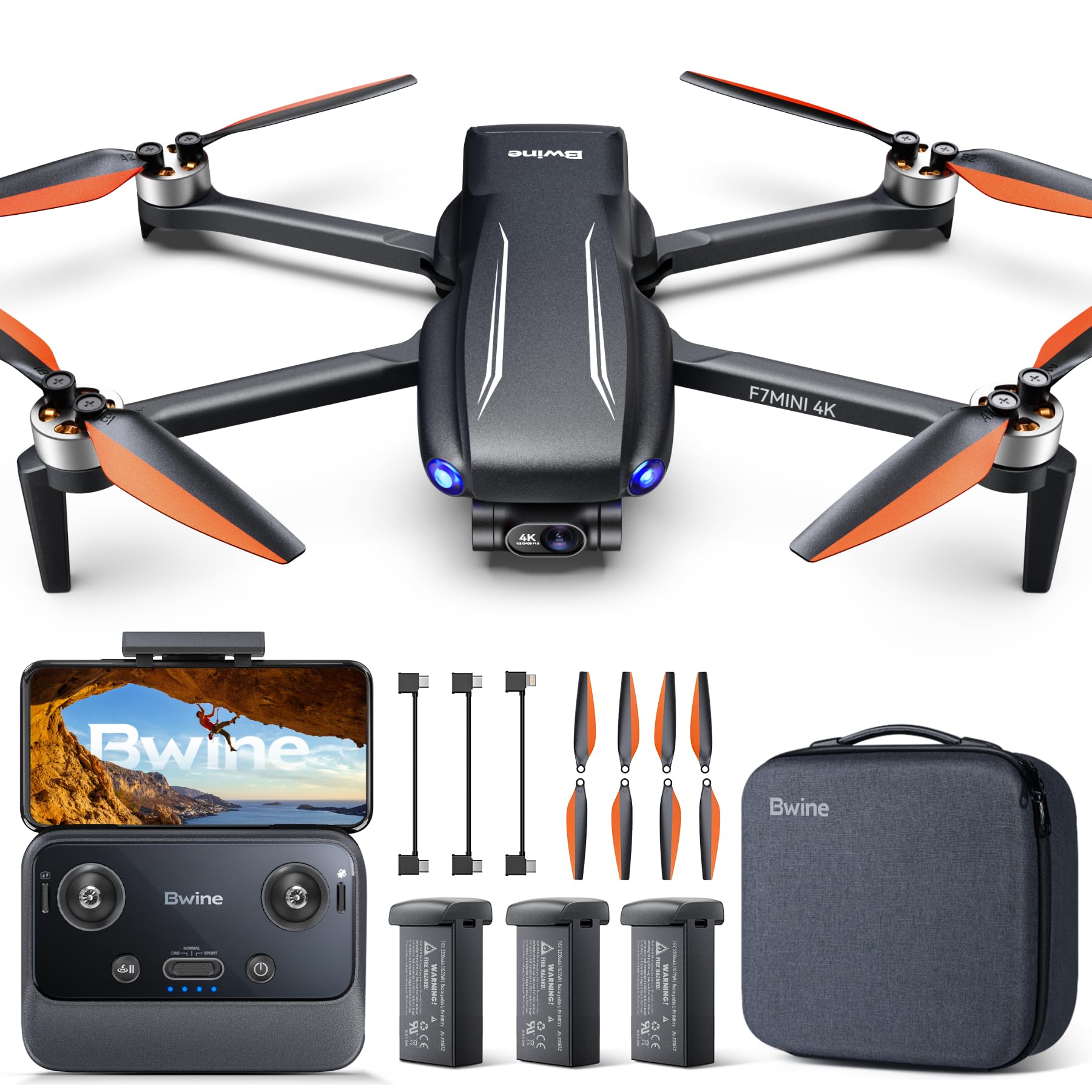
The Bwine F7MINI brings a true 3-axis mechanical gimbal to the sub-250g category, delivering smooth 4K/30fps video and 48MP stills through its 1/2-inch CMOS sensor with F1.8 aperture. The gimbal motors actively cancel pitch, roll, and yaw movements, producing gimbal-stabilized footage that EIS alone cannot match. The built-in 5.5-inch touchscreen on the controller eliminates the need for a phone, and the screen remains readable even in direct sunlight.
Three high-density 2200mAh batteries support PD 3.0 fast charging and provide a total of 96 minutes of flight time. The digital transmission system pushes a zero-latency feed to 6 kilometers, with strong anti-interference performance. Intelligent features include dynamic home point, auto cruise, and a 120dB locator buzzer that makes finding a downed drone straightforward.
Optical flow positioning enables stable indoor flight when GPS is unavailable, a rare feature at this weight. The physical gimbal adds weight and cost compared to EIS-only drones, and media transfer to a phone is slower than pulling files directly via computer. For beginners who want professional-grade stabilization from day one, this is the top choice.
Why it’s great
- True 3-axis mechanical gimbal for smooth, cinematic footage
- Built-in 5.5″ bright controller screen removes phone tethering
- 96 minutes total flight time with PD fast-charge batteries
Good to know
- Heavier build due to physical gimbal mechanics
- Slower wireless media transfer to phone
- Premium price compared to EIS-only competitors
3. DJI Neo 2
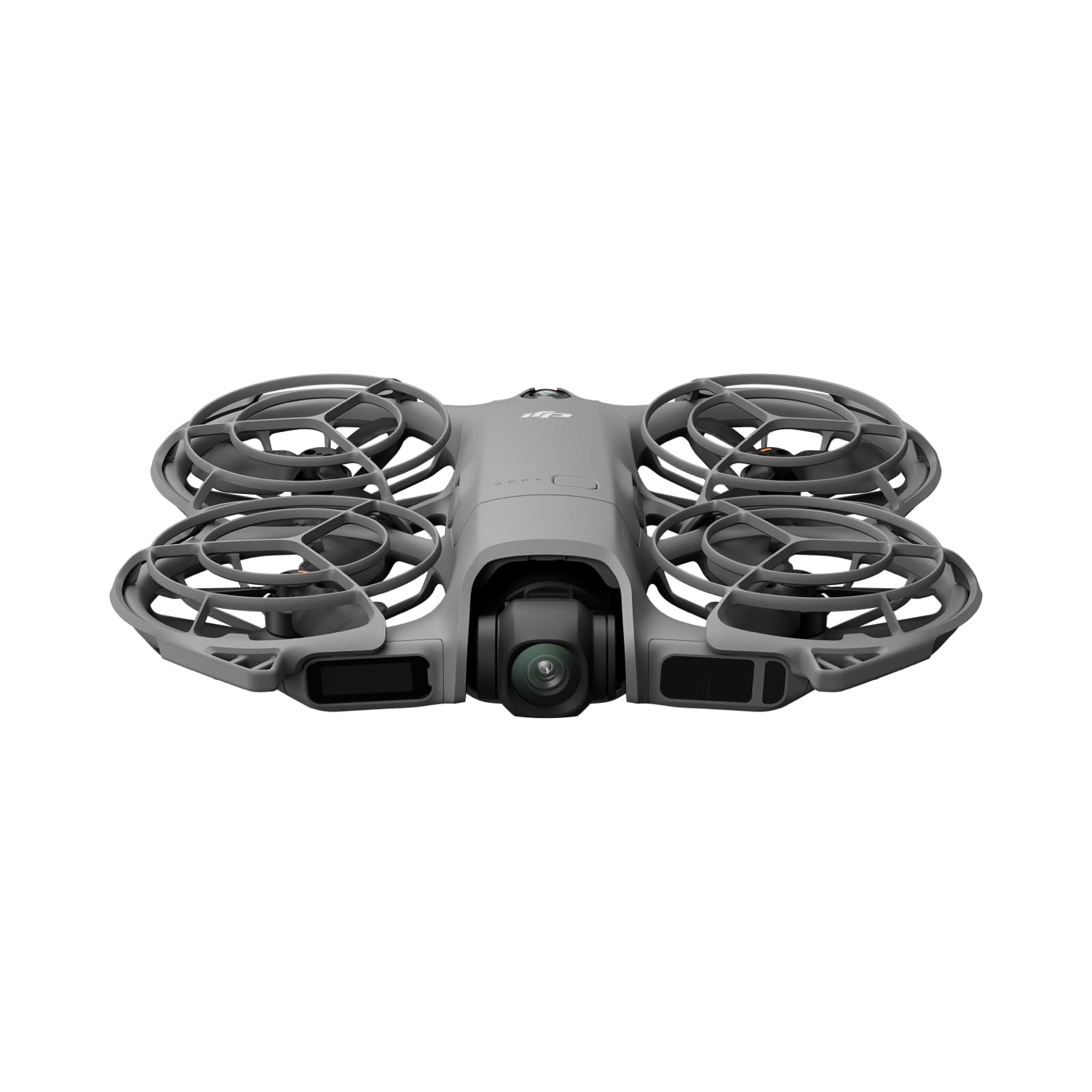
At just 151 grams, the DJI Neo 2 is the lightest drone on this list and carries a C0 certification that exempts it from most regulations globally. Palm takeoff and landing, combined with gesture controls, let you launch and recover without ever touching a controller. ActiveTrack locks onto a subject and keeps it centered in the 4K frame while the omnidirectional obstacle sensing system prevents collisions automatically.
The 12MP camera records 4K video with improved gimbal stabilization over the previous Neo generation, and full-coverage propeller guards provide an extra safety layer for indoor or crowded environments. The fly-by-wire design makes it the easiest drone to operate hands-free — you can control it via the DJI Fly app, an Apple Watch, or voice commands through your phone.
Flight time is limited to about 18-19 minutes per battery, and the Neo 2 ships with only one battery in the standard package. The built-in storage lacks an expansion slot, so you rely on the internal memory or DJI’s cloud transfer. For beginners who prioritize instant, safe launches over endurance, the Neo 2 is an unmatched training tool.
Why it’s great
- Ultra-light 151g design with C0 certification for global travel
- Palm takeoff and gesture control for controller-free flying
- Omnidirectional obstacle sensing boosts crash prevention
Good to know
- Shorter flight time per battery (18-19 minutes)
- Standard package includes only one battery
- No expandable storage; relies on internal memory
4. Gleesfun G11PRO

The Gleesfun G11PRO weighs 357 grams — heavier than the sub-250g regulation threshold — but it earns that weight with a proper 3-axis brushless gimbal that decouples camera motion from flight dynamics. The gimbal’s brushless motors deliver millisecond sync with the flight controller, keeping 4K/30fps video steady even when the drone banks hard or hits turbulence. The GQ2.0 digital transmission system reaches up to 10,000 feet and uses a plug-in wired connection to eliminate phone disconnect issues.
Two 3200mAh batteries support the GL2.0 Smart Battery Management System, which fast-charges in about 2.5 hours and maintains 80% performance retention after 300 cycles. Total flight time reaches 70 minutes. Cruise Control technology automates camera stabilization while you focus on framing, and the multi-directional mode enables 3D aerial shots that are difficult to coordinate manually.
The G11PRO is FAA-compliant with Remote ID, and the kit includes 40 accessories — batteries, propeller casings, a carrying bag, and multiple connection cables. The heavier weight means it requires FAA registration, and the large controller takes up more pack space. For beginners willing to register and carry a larger case, the gimbal quality far exceeds anything at this tier.
Why it’s great
- Professional 3-axis brushless gimbal for shake-free footage
- Fast-charging 3200mAh batteries with 300-cycle longevity
- 10,000ft digital transmission with wired controller connection
Good to know
- Weighs 357g, requiring FAA registration and Remote ID
- Larger controller and kit are less portable
- Heavier than sub-250g alternatives
5. DJI Mini 4K Fly More Combo
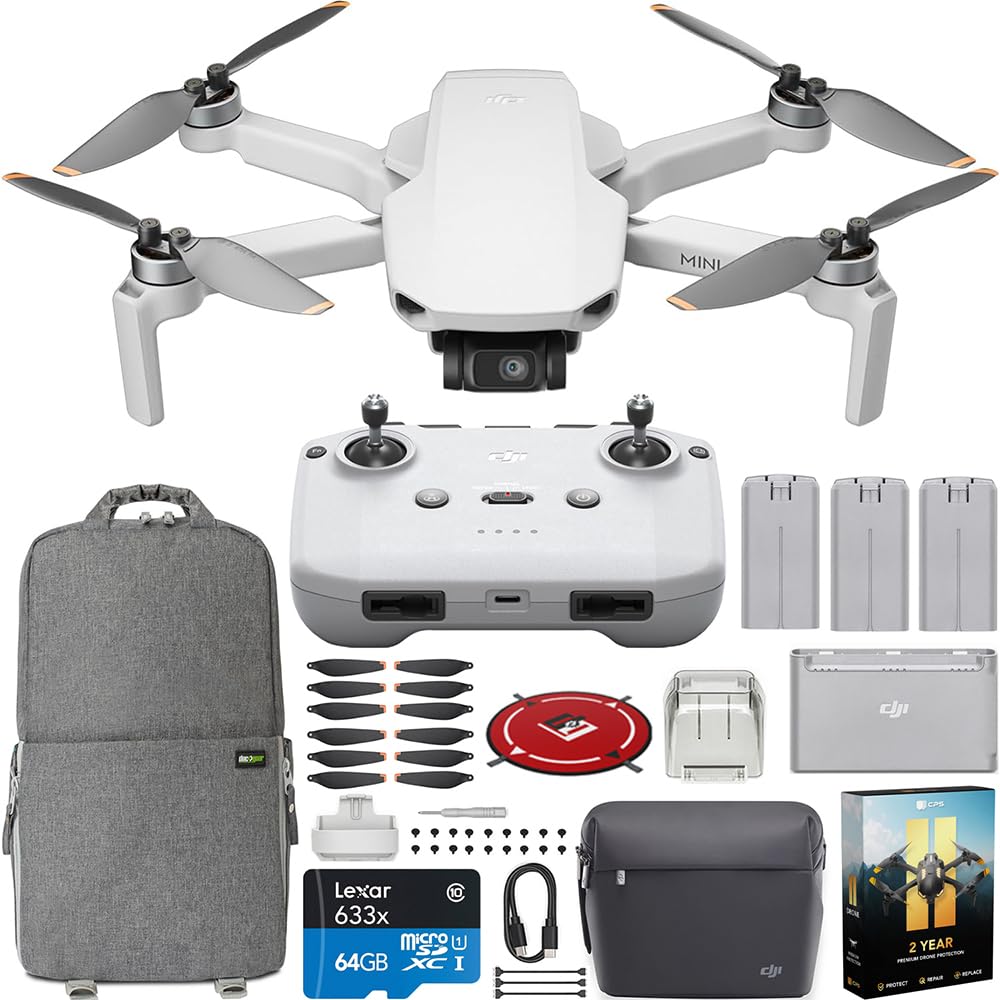
The DJI Mini 4K remains the benchmark for entry-level camera drones, and this Fly More Combo bundles three intelligent flight batteries for a total of 93 minutes of air time. The 3-axis mechanical gimbal delivers the same cinematic stabilization found on DJI’s higher-end models, while the 4K camera captures excellent detail in sunrise and sunset lighting. The 10-kilometer OcuSync video transmission is the longest range in this lineup and maintains a rock-solid link even in high-interference areas.
The drone weighs under 249 grams, so recreational users skip FAA registration. Level 5 wind resistance lets it fly comfortably in 38 kph winds, and the brushless motors support takeoff at altitudes up to 4,000 meters. One-tap takeoff, GPS return-to-home, and stable hovering make it trivially easy for a first-time pilot to get airborne with confidence.
The Fly More bundle includes a Deco Gear backpack, landing pad, 64GB microSD card, and a 2-year extended warranty from CPS. The controller requires a smartphone for the live feed, so you lose the convenience of a built-in screen that some competitors offer. Setup also requires downloading the DJI Fly app from the DJI website rather than Google Play. For a beginner who wants the most proven ecosystem and longest range, this combo is the gold standard.
Why it’s great
- Industry-leading 10km OcuSync HD video transmission
- True 3-axis mechanical gimbal for professional stabilization
- 93 minutes of flight with three included batteries
Good to know
- Controller requires smartphone for live view screen
- DJI Fly app must be sideloaded from DJI website on Android
- Higher upfront investment for the Fly More bundle
6. Oddire HK11

The Oddire HK11 brings GPS intelligence to the budget category at a 249g weight that avoids FAA registration. Its 4K camera uses an F2.15 110-degree wide-angle lens with remote-controlled 90-degree tilt, capturing 4096x3072P stills and smooth 2K video. Two 7.7V 1800mAh batteries combine for 48 minutes of flight time, and the higher voltage provides more punch than standard 3.7V or 7.4V packs.
Advanced GPS modes include auto return on signal loss or low battery, GPS Follow, waypoint route planning, and Orbit Fly around a fixed point. The brushless motors deliver Level 5 wind resistance, and the foldable body packs down to a compact size that fits in the included carrying case. The 5G WiFi transmission with signal repeater reaches 500 meters and provides a stable live feed to your phone via the XDRONE GO app.
The HK11 requires a compass calibration each time it powers on, and the main app on some app stores does not work — you must download XDRONE GO specifically. Users have reported that flying with a critically low battery can trigger an uncontrolled return-to-home sequence. For the price, the GPS feature set is generous, but the extra calibration steps add friction for absolute beginners.
Why it’s great
- GPS follow, waypoint, and orbit modes at a budget-friendly price
- Higher-voltage 7.7V batteries provide better power delivery
- Foldable design with carrying case for easy transport
Good to know
- Requires compass calibration every power cycle
- Must use XDRONE GO app, not the generic store version
- Auto return can behave unpredictably at very low battery
7. REDRIE HK33
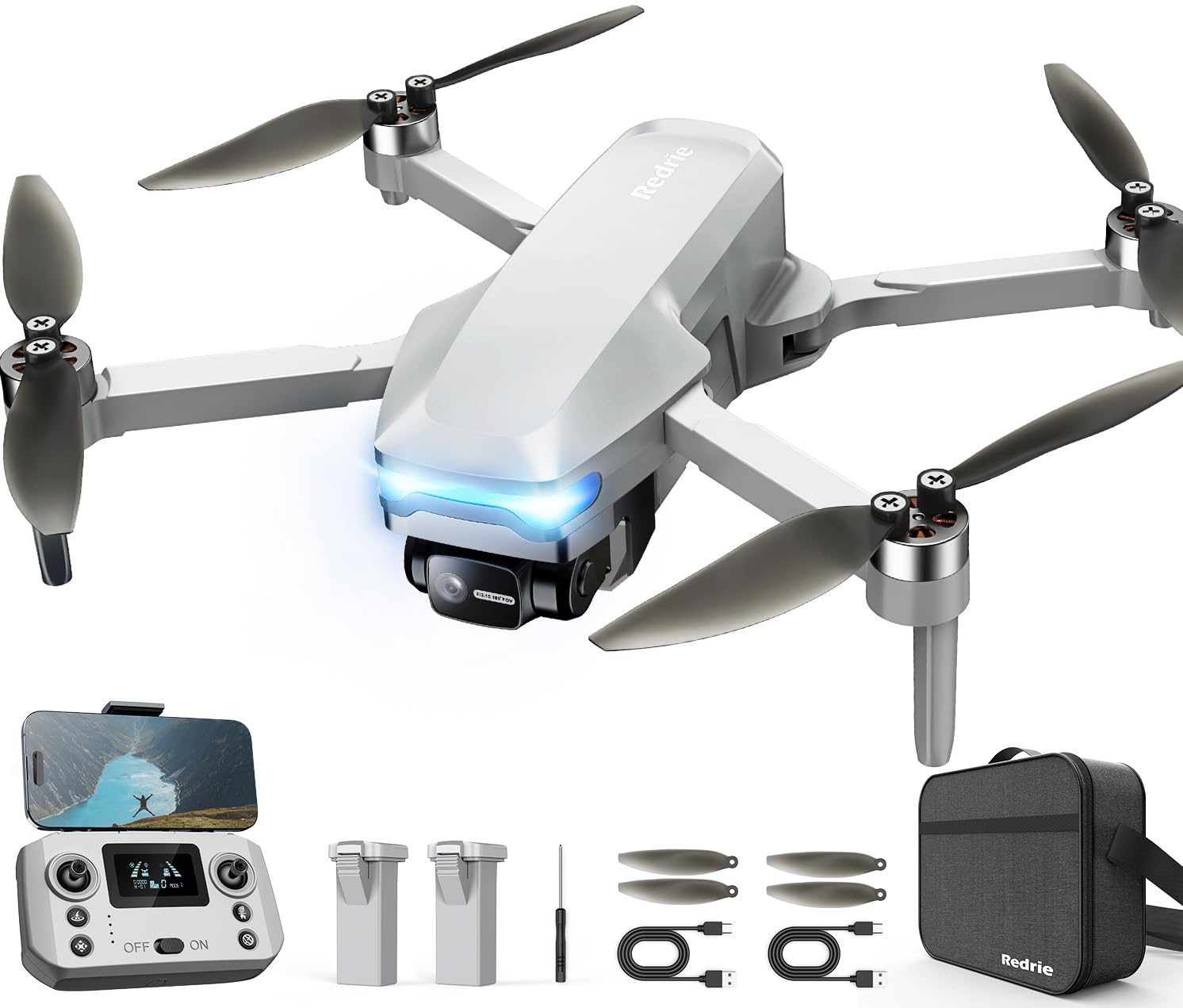
The REDRIE HK33 delivers a 2-axis mechanical gimbal — rare at this price point — that eliminates the vertical and horizontal shake that plagues EIS-only drones. The F2.15 110-degree wide-angle lens captures 4K stills at 4096x3072P and smooth 2K video, with a 90-degree remote-controlled angle adjuster for switching between landscape and portrait framing on the fly. Two 1800mAh batteries give a combined flight time of 40 to 45 minutes.
High-performance brushless motors keep the drone stable in Level 5 winds, and the 5G WiFi with a signal repeater pushes a stable video feed out to 300 meters, with control range reaching 500 meters. The onboard GPS module triggers automatic return when the signal drops, the battery runs low, or the drone exceeds the flight boundary. Smart flight modes include GPS Follow, route planning, and Fly Around, adding variety to your practice sessions.
The HK33 folds into a compact package with a carrying case, and at under 250 grams it avoids FAA registration. The cell phone holder on the controller is stiff and struggles with larger phones, and the video quality is noticeably softer than true 4K sensors. Customer reviews praise its durability after multiple crashes, making it a resilient first drone for learning the basics.
Why it’s great
- 2-axis mechanical gimbal provides real shake reduction
- Brushless motors handle Level 5 wind conditions well
- Very durable construction survives beginner crashes
Good to know
- Video resolution is softer than advertised 4K
- Phone holder on controller is tight for larger devices
- Camera stabilization is limited to 2 axes (no yaw control)
8. Suangrc X9
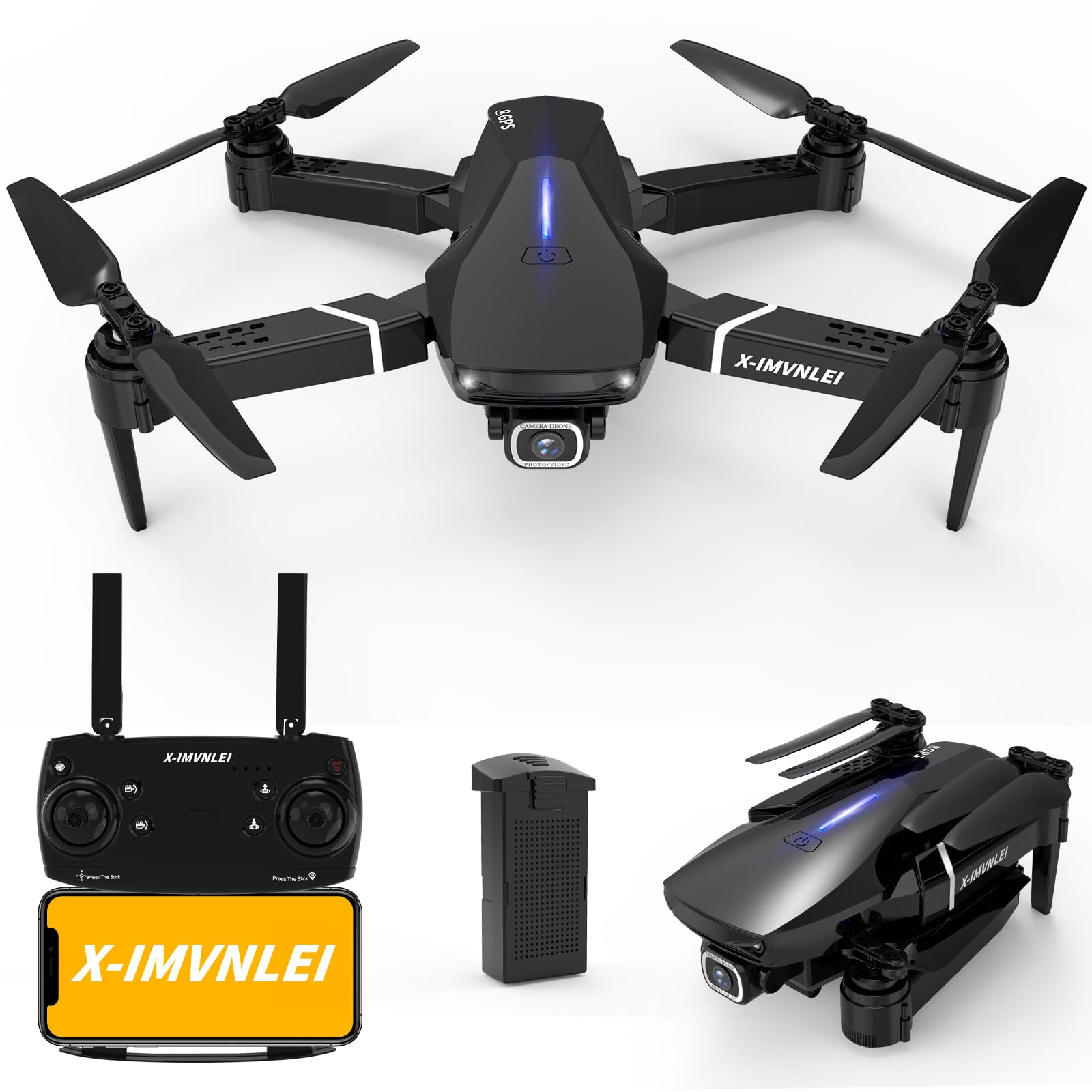
The Suangrc X9 stands out in the budget segment because its controller features a built-in 4.5-inch LCD screen that displays a live FPV feed without requiring a phone. The 4K camera has a 110-degree adjustable lens, and the controller screen lets you frame shots and check battery status immediately. GPS functions include Follow Me, Trajectory Flight, and one-touch auto return for peace of mind during early flights.
The brushless motors provide enough thrust for stable hovering, and the foldable frame weighs under 249 grams for easy travel. Three speed levels accommodate your growing skill set, while Headless Mode and Altitude Hold simplify orientation and altitude management. Gesture control and 360-degree flip modes add a fun element for casual flying with family.
Flight time per battery is around 18 minutes, which is on the shorter side, and some units arrive with weak 1200mAh batteries that struggle to lift the drone for more than 20 seconds before triggering an emergency landing. The app can also be unresponsive during setup. Despite these inconsistencies, the built-in screen makes the X9 an attractive choice for beginners who hate fumbling with phone mounts.
Why it’s great
- Built-in 4.5″ LCD screen eliminates phone connection hassle
- GPS follow, trajectory, and auto return for safer flying
- Under 249g with foldable frame for portability
Good to know
- Battery quality varies; some units have weak 1200mAh cells
- Short 18-minute flight time per battery
- App can be unresponsive during initial setup
9. Karuisrc K600
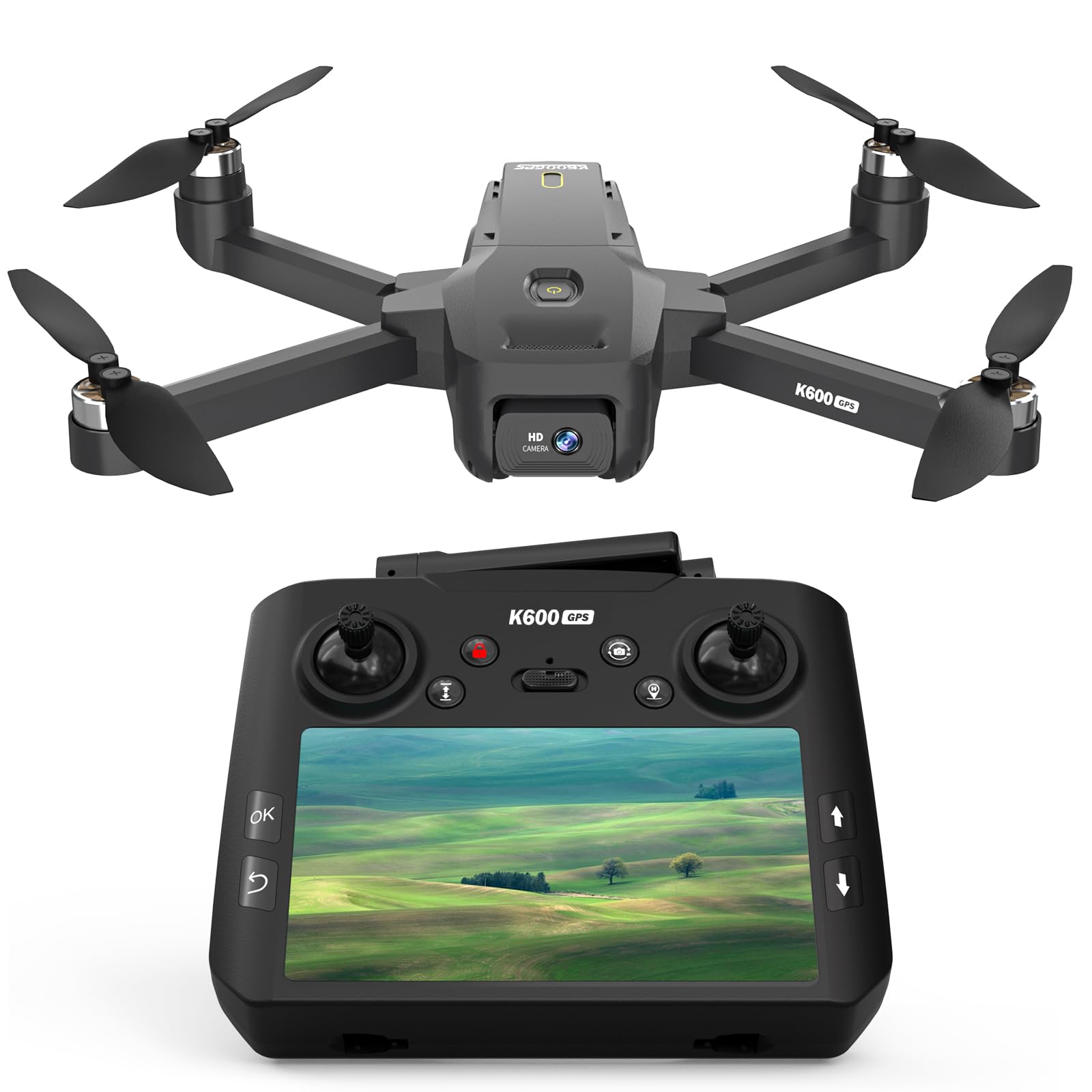
The Karuisrc K600 uses a 4.5-inch HD screen on the controller for real-time transmission, saving you from draining your phone battery or dealing with connection drops. Electronic image stabilization (EIS) smooths the 4K footage, and the GPS module provides rock-solid positioning with automatic return, Follow Me, Waypoint Navigation, and Orbit Mode. The 205-gram body is the lightest in this lineup after the DJI Neo 2, making it extremely portable.
The 2200mAh battery delivers about 25 minutes of flight time, and the brushless motors handle moderate wind without drift. The control range reaches 400 meters with stable HD transmission, and one-key takeoff and landing get you airborne in seconds. The K600 folds down small and comes with a storage bag for backpack-friendly transport.
EIS stabilization introduces a slight crop to the video frame and can struggle with fast, jerky movements compared to a mechanical gimbal. The matte black finish looks professional but absorbs heat in direct sunlight. For a sub- drone that includes a controller screen, the K600 is a well-balanced entry point for budget-conscious beginners.
Why it’s great
- Built-in 4.5″ HD screen for phone-free live viewing
- Very lightweight at 205g for easy portability
- GPS follow, waypoint, and orbit modes included
Good to know
- EIS crops video and struggles with fast motion
- Control range limited to 400 meters
- Dark finish can heat up under direct sun
FAQ
Do I need FAA registration for a sub-250g drone?
What is the minimum battery life I should expect from a beginner drone?
Is a 3-axis gimbal really necessary for a beginner?
Can I fly these drones indoors safely?
What does the 5G WiFi transmission spec really mean?
Final Thoughts: The Verdict
For most users, the beginner drone with camera winner is the Potensic ATOM LT because it combines an 80-minute total flight time, reliable GPS return-to-home, and a 4km transmission range at a price that undercuts the market leaders. If you want professional-grade stabilization and a built-in controller screen, grab the Bwine F7MINI for its true 3-axis gimbal and 96-minute battery life. And for palm-sized convenience and obstacle avoidance that makes every flight stress-free, nothing beats the DJI Neo 2.

Mo Maruf
I created WellFizz to bridge the gap between vague wellness advice and actionable solutions. My mission is simple: to decode the research and give you practical tools you can actually use.
Beyond the data, I am a passionate traveler. I believe that stepping away from the screen to explore new environments is essential for mental clarity and physical vitality.