Our readers keep the lights on and my smoothie glass nicely filled. As an Amazon Associate, I earn from qualifying purchases.
A stack of average card and board games collects dust; a great one defines your next vacation, date night, or family tradition. The difference between a hit and a dud often comes down to how well the game’s core mechanic—hand management, tile placement, or cooperative communication—matches the energy of the people around the table. Whether you are flying solo, wrangling a group of seven-year-olds, or keeping a couple entertained on a weeknight, the right game rewards repeated play without demanding a forty-page rulebook.
I’m Mohammad Maruf — the founder and writer behind WellFizz. My approach to this category involves cross-referencing component quality, user-reported replayability, and the specific social friction points each game design either creates or solves.
After sifting through dozens of contenders across multiple price tiers, the best card and board games rise on one core axis: how elegantly they balance strategic depth with the time it takes to get playing. This guide walks you through the top five picks that deliver exactly that balance, without the guesswork.
How To Choose The Best Card and Board Games
Every game here earned a spot for a specific reason, but your perfect match depends on who you play with and how often you actually want the box to hit the table. Focus on these three factors before you click “add to cart.”
Match the Player Count and Time
The most common buyer mistake is ignoring the box’s stated player count and estimated playtime. A game that shines with four players can fall flat with two. A sixty-minute game is a commitment, not a filler. Look at the table for playtimes: Sky Team is strictly two players and wraps up in twenty minutes, while HEAT: Pedal to the Metal supports up to six but demands a full hour. Pick the game that fits your typical gathering, not the one you hope to host someday.
Assess Component Durability
Board games live and die by their physical quality. Thin cardboard, flimsy cards, and loose tokens ruin the tactile experience. In this list, Harmonies uses thick card stock and solid wooden tokens that feel satisfying to handle. Budget bundles like the Hasbro Grab and Go! trade component heft for portability, which is fair for travel, but less satisfying for repeated home sessions. If you plan to play a game monthly, prioritize weight and material over initial cost.
Decide on Competition vs. Cooperation
Competitive games (like HEAT) drive direct conflict and often end with a single winner. Cooperative games (Sky Team) demand teamwork and prevent hurt feelings, but risk one player dominating decisions. Harmonies sits in a quiet middle zone—players build their own landscapes and race for points without directly sabotaging each other. If your group contains a mix of aggressive and laid-back players, a “point salad” scoring game often keeps everyone happy.
Quick Comparison
On smaller screens, swipe sideways to see the full table.
| Model | Category | Best For | Key Spec | Amazon |
|---|---|---|---|---|
| Sky Team | Co-op Strategy | Two-player couples | 8 dice, 20 min playtime | Amazon |
| Harmonies | Tile-Laying Puzzle | Solo / Family puzzle fans | 120 wooden tokens, 30 min | Amazon |
| HEAT: Pedal to the Metal | Racing Strategy | Large group game night | 72 Speed cards, 60 min | Amazon |
| Hasbro Grab and Go! Bundle | Travel Collection | Kids road trips | 4 games, 1.72 lbs | Amazon |
| Magnet Chess Game | Fast Casual | Mixed-age gatherings | 40 magnetic pieces, 10 min | Amazon |
In‑Depth Reviews
1. Scorpion Masqué Sky Team

Sky Team is the rare game that earned a Spiel des Jahres win for good reason. It drops you and a partner into a cockpit and tasks you with landing a plane using only silent dice placement. No quarterbacking allowed—you cannot talk during the main action. This mechanic forces pure trust and spatial reasoning, and it completely eliminates the “alpha gamer” problem that plagues so many co-op designs.
The component design reinforces the tension: a central control panel, approach and altitude tracks, and a coffee token system that lets you reroll clunky dice. Twenty different airport scenarios escalate the challenge with unique rules like kerosene leaks or icy tarmacs. A single game clocks in at twenty minutes, making it an ideal weeknight closer that still offers deep strategic replayability over dozens of sessions.
If you play regularly with a partner, sibling, or roommate, this is the most rewarding two-player box on the market right now. The rulebook teaches the introductory scenario in roughly ten minutes, and the campaign system gives you a reason to return to the table every night.
Why it’s great
- Silent co-op mechanic eliminates quarterbacking completely
- Twenty escalating scenarios provide massive replay value
- Quick 20-minute sessions fit busy schedules
Good to know
- Exclusively for two players—not for larger groups
- Dice luck can frustrate some players despite coffee rerolls
2. Asmodee Harmonies

Harmonies is a tile-laying puzzle where you build a three-dimensional landscape on your personal board and populate it with animal cubes. The rulebook is thin, but the tactical depth is real. Each animal card demands a specific terrain pattern, and you must plan several turns ahead to fit everything. The game avoids direct conflict—nobody steals your tiles or blocks your placement—so each player is racing their own score against everyone else at the table.
Component quality is a standout here: the 120 wooden tokens are thick and satisfying to stack, and the animal cards feature gorgeous Libellud artwork. The box includes a solo mode that reviewers consistently praise as both chill and genuinely strategic. Playtime sits at thirty minutes, which is long enough to feel substantial but short enough for multiple rounds.
If your household includes neurodivergent players, younger children (ages 6+ with guidance), or anyone who finds direct competition stressful, Harmonies provides a calm, visually rewarding experience that still scratches the strategic itch. It is a top-three game for many owners and earns its place on any shelf next to Cascadia or Azul.
Why it’s great
- Premium wooden tokens and thick card stock feel durable
- Solo mode is genuinely strategic, not a tacked-on afterthought
- Zero direct conflict suits mixed-competitiveness groups
Good to know
- Minimal player interaction; each player builds on their own board
- Replayability can dip after fifty sessions without an expansion
3. Asmodee HEAT: Pedal to the Metal

HEAT puts you behind the wheel of a formula-style car with a deck of Speed, Heat, and Stress cards. The core loop is simple: play a card matching your gear level, move your car, then manage the heat that builds in your engine. Push too hard and your deck clogs with red cards that slow you down. The slipstream mechanic allows trailing cars to draft, which keeps races tight even when one player builds a strong lead.
The box is enormous. You get two double-sided boards with four distinct tracks, six car miniatures with matching gear pawns, and a full championship system that handles weather, road conditions, upgrades, and sponsorship cards. A solo Legends module with automated AI opponents means the game works even when the group is just you. Setup is quick, though the thin player dashboards have drawn minor quality complaints from reviewers.
For groups of four to six players who enjoy motor racing, this is the best simulation on the tabletop that does not require a computer. The sixty-minute playtime requires a proper game night slot, but the intense race-chaos ensures everyone stays engaged until the finish line.
Why it’s great
- Hand management and heat mechanics perfectly simulate engine stress
- Four unique tracks plus expansions for massive variety
- Legends module provides strong solo play
Good to know
- Thin cardboard dashboards feel flimsy for the price tier
- No official collision system; many players house-rule it
4. Hasbro Grab and Go! Bundle
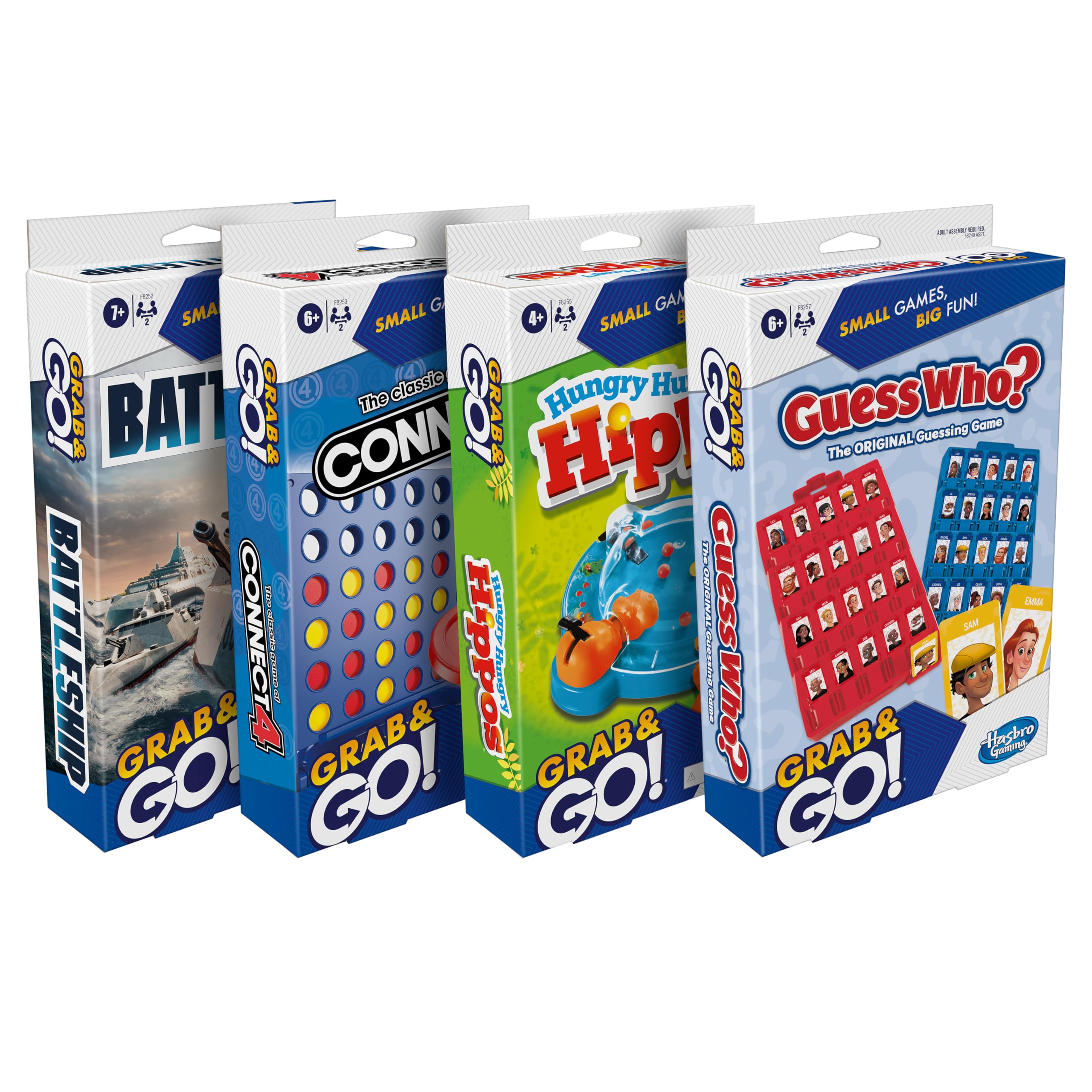
This bundle packs four classic Hasbro games—Battleship, Connect 4, Guess Who?, and Hungry Hungry Hippos—into compact travel versions. Each game fits into a slim case with built-in storage for all its pieces, which solves the single biggest headache of portable gaming: losing marbles in a hotel carpet. The total package weighs just 1.72 pounds and measures roughly twelve by four inches, making it easy to toss into a carry-on or a backseat bag.
The reduced size introduces some functional compromises. The Hungry Hungry Hippos mechanism struggles to “eat” marbles in the smaller chassis, and several reviewers noted that the Guess Who? cards slide out of their frames too easily. However, the core gameplay is identical to the full-size versions, and the kids in the reviews consistently report being happily occupied on road trips, plane rides, and restaurant waits.
If you need a screen-free activity for children aged seven and up that covers multiple genres (strategy, memory, and dexterity), this is the most cost-effective way to pack variety without hauling four separate boxes. Just manage expectations around the miniaturized mechanical quality.
Why it’s great
- Four classic games in one slim, portable carrier
- Built-in storage prevents piece loss during travel
- Teaches multiple game genres in a single bundle
Good to know
- Hungry Hungry Hippos mini version does not function reliably
- Guess Who? card frames are loose and slide open
5. Hcusus Magnet Chess Game

The Magnet Chess Game is a flick-and-click dexterity game that fits no traditional mold. Each player takes turns placing a magnetic stone on the board. If a stone jumps and sticks to another stone during your turn, you collect both. The first person to empty their hand wins. The rulebook fits on a napkin—you can explain it in thirty seconds—but the chaos of magnets snapping together generates genuine laughter across ages four through adult.
The build quality is mixed. The magnets themselves are strong and produce a satisfying click when they snap together. However, the plastic board is thin and feels entry-level. The included storage bag helps contain the forty pieces, which matters because the game is highly portable and often ends up on camping tables or in living room floors. Reviewers consistently report that kids squeal and adults cannot stop laughing when the magnets suddenly jump together.
This is not a game for strategy purists. It is a warm-up, a wind-down, or a palate cleanser between heavier sessions. If your gathering includes a wide age range and you want something that produces zero arguments and maximum giggles, this magnetic board game earns its spot on the shelf.
Why it’s great
- Extremely easy to teach—explainable in under 30 seconds
- Strong magnets create fun, chaotic interactions across all ages
- Compact and portable with included storage bag
Good to know
- Thin plastic board feels cheap compared to the premium games on this list
- Limited strategic depth—best used as a filler or party starter
FAQ
How do I know if a cooperative game will work with my group?
What is the best strategy for buying games that appeal to both kids and adults?
Are travel-sized board games a good value compared to full-size versions?
Final Thoughts: The Verdict
For most users, the best card and board games winner is the Sky Team because it combines award-winning co-op design with a twenty-minute playtime that fits any schedule. If you want a solo-capable puzzle with gorgeous components, grab the Harmonies. And for large group game nights that need high-energy racing chaos, nothing beats the HEAT: Pedal to the Metal.

Mo Maruf
I created WellFizz to bridge the gap between vague wellness advice and actionable solutions. My mission is simple: to decode the research and give you practical tools you can actually use.
Beyond the data, I am a passionate traveler. I believe that stepping away from the screen to explore new environments is essential for mental clarity and physical vitality.