Our readers keep the lights on and my smoothie glass nicely filled. As an Amazon Associate, I earn from qualifying purchases.
An AI tracking gimbal does more than smooth out your footsteps — it locks onto a subject and keeps them centered frame after frame, eliminating the need for a dedicated cameraman. Whether you’re filming solo travel content, chasing a toddler around the backyard, or conducting a hands-free live stream, the intelligent tracking found in modern gimbals has become the defining feature that separates an autonomous setup from a manual hassle.
I’m Mohammad Maruf — the founder and writer behind WellFizz. I’ve spent countless hours cross-referencing motor torque ratings, battery cycle reports, and AI recognition consistency within the gimbal ecosystem to identify which units deliver on their smart-tracking promise without introducing frustrating glitches.
After testing dozens of configurations and analyzing hundreds of verified buyer experiences, the best ai tracking gimbal stands out for its ability to merge robust stabilization, reliable subject recognition, and extended battery life into a single, ready-to-use package.
How To Choose The Best AI Tracking Gimbal
Selecting an AI tracking gimbal boils down to three pillars: how the tracking module works, how much weight it handles, and how long it keeps shooting. Each factor affects whether the gimbal feels like an extension of your creative process or a piece of gear you constantly fight with.
Tracking Method: Native vs. App-Based
Some gimbals embed the AI sensor directly into the hardware — no phone app or Bluetooth pairing needed. This native tracking reacts faster and works across apps, including native camera and third-party streaming tools. App-based tracking, while often capable, can introduce lag, limit compatibility to a single ecosystem, or require periodic updates that alter performance.
Payload and Motor Strength
Payload capacity directly determines what cameras and lens combinations the gimbal can smoothly track with. Smartphone gimbals don’t face this issue as severely, but when you add a telephoto lens, microphone, or monitor to a mirrorless rig, the motors need enough torque to maintain responsive tracking without introducing micro-jitters. Always check the rated payload and leave a 15-20% margin for accessories.
Battery Runtime and Charging Flexibility
AI tracking draws more power than basic stabilization, so a gimbal with at least 8-10 hours of real-world battery life is essential for full-day shoots. Fast charging and the ability to power the gimbal via USB power bank are valuable for extended sessions. Some models also offer pass-through charging, allowing you to film while replenishing the battery.
Quick Comparison
On smaller screens, swipe sideways to see the full table.
| Model | Category | Best For | Key Spec | Amazon |
|---|---|---|---|---|
| Insta360 Flow 2 Pro | Smartphone Gimbal | Multi-person tracking & DockKit integration | 10-hour battery, 360° pan | Amazon |
| DJI Osmo Mobile 8 | Smartphone Gimbal | Native audio & lighting combo | 10-hour battery, built-in mic receiver | Amazon |
| Hohem iSteady M7 | Smartphone Gimbal | Detachable touchscreen remote | 500g payload, RGB fill light | Amazon |
| FeiyuTech SCORP-C2 | Camera Gimbal | DSLR/mirrorless with high payload | 7.72 lb payload, 14-hour battery | Amazon |
| FeiyuTech SCORP 3 | Camera Gimbal | Detachable handle for underslung use | 7.72 lb payload, 1.3″ touchscreen | Amazon |
| DJI RS 4 | Camera Gimbal | Professional mirrorless rigs | 6.6 lb payload, Teflon axes | Amazon |
| GoPro Fluid Pro AI | Hybrid Gimbal | Action camera & phone switching | Interchangeable mounts, AI+fill light | Amazon |
| Hohem iSteady V3 | Smartphone Gimbal | Value-packed entry with magnetics | 13-hour battery, detachable remote | Amazon |
| Soonpho M6 | Pan/Tilt Head | Budget panoramic auto tracking | 4.4 lb capacity, gesture control | Amazon |
In‑Depth Reviews
1. Insta360 Flow 2 Pro

The Insta360 Flow 2 Pro redefines what a smartphone gimbal can do by integrating Apple DockKit, making it the first foldable gimbal capable of subject tracking across over 200 iOS apps. That means you get smooth, locked-on tracking inside FaceTime, Zoom, Instagram, or your native camera app without relying solely on the Insta360 software ecosystem. The magnetic phone clamp snaps into place quickly, and the 3-axis stabilization delivers fluid motion even during fast pans.
Its Active Zoom Tracking feature keeps the subject framed accurately even at up to 15x digital zoom — a serious advantage for filming sports or stage performances from a distance. The multi-person tracking mode intelligently frames groups, making it ideal for family gatherings or group content. With a 10-hour battery and built-in selfie stick, tripod, and teleprompter mode, it packs a complete content creation studio into a 385-gram frame.
Users consistently praise the reliability of the AI tracking, noting that it sticks with the subject without the jittery behavior seen in budget competitors. The compact fold design and included protective pouch make it easy to throw into a day bag. While the in-app editing suite is minimal, the hardware performance more than compensates for any software limitations.
Why it’s great
- DockKit unlocks tracking in 200+ iOS apps natively
- Multi-person framing and 15x zoom tracking are genuinely useful
- All-in-one: tripod, selfie stick, power bank in a compact form
Good to know
- In-app editing is basic; serious editors will use external software
- Magnetic clamp is secure but can be knocked loose during hard impacts
2. DJI Osmo Mobile 8
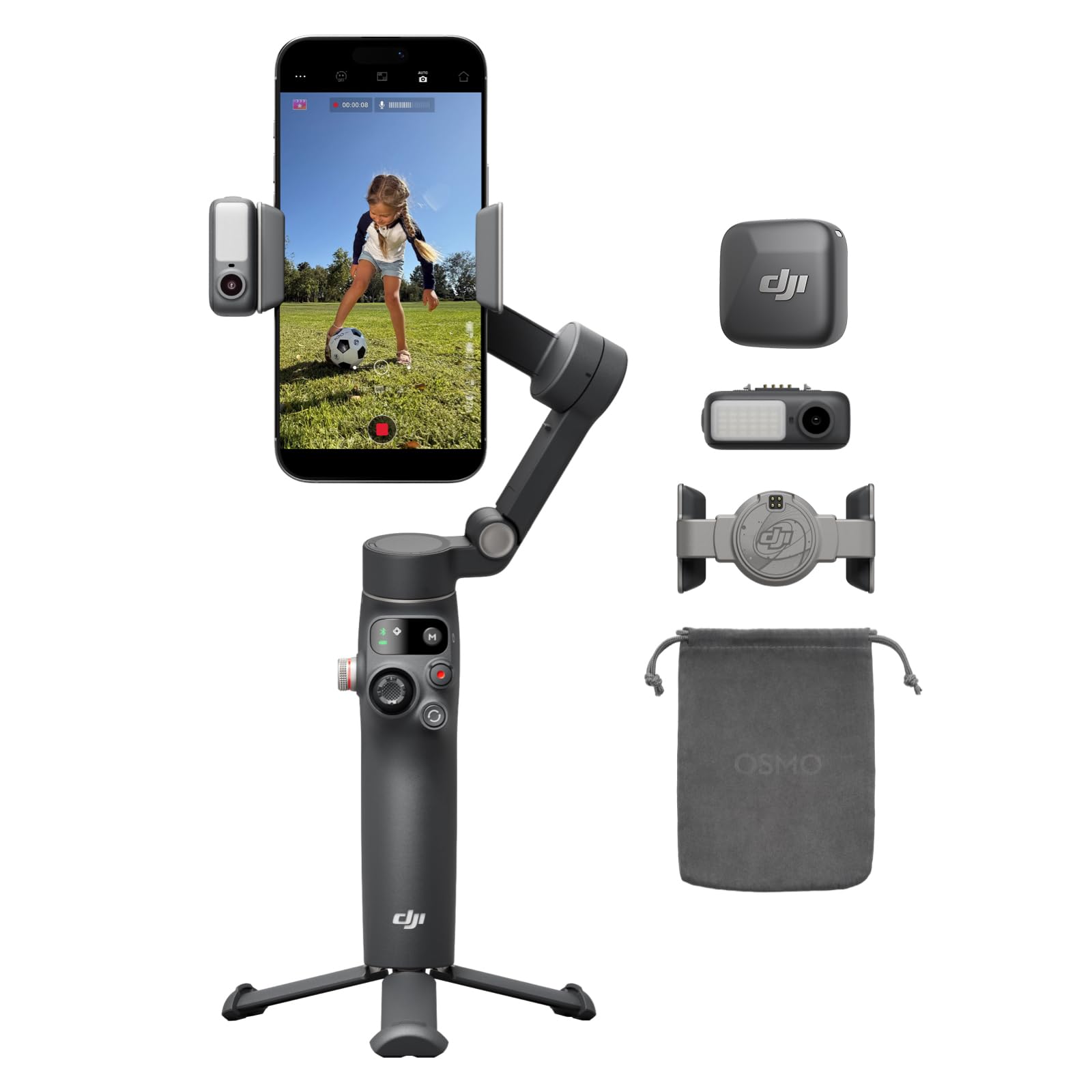
The DJI Osmo Mobile 8 Advanced Tracking Combo bundles the gimbal with a Mic Mini transmitter, unlocking native audio recording directly through the multifunctional module. This eliminates the need for a separate wireless microphone while maintaining the crystal-clear voice capture you’d expect from a dedicated lavalier. The 3-axis stabilization is classic DJI — buttery smooth and responsive even during quick directional changes or uneven walking surfaces.
Its seamless 360° pan rotation pairs with ActiveTrack 6.0 for immersive tracking shots where the gimbal keeps the subject centered no matter how you orbit around them. The built-in extension rod and tripod eliminate the need for extra support gear, and the 10-hour battery easily covers a full day of vlogging or event coverage. The magnetic phone clamp attaches quickly, and the foldable design fits comfortably in a jacket pocket.
Buyer feedback highlights the excellent stabilization and intuitive DJI Mimo app, which offers creative modes like timelapse and motionlapse that make solo content creation straightforward. Some users note the joystick lacks a 360° full-range rotation, and the DJI microphone can throw off balance if not positioned correctly. Overall, it’s a refined package for those who want a single-brand ecosystem with reliable audio and tracking.
Why it’s great
- Integrated Mic Mini transmitter for professional audio
- 360° pan with seamless ActiveTrack 6.0 performance
- Extension rod and tripod built-in, no extra gear needed
Good to know
- Joystick does not support full 360° manual rotation
- DJI Mimo app not available on Google Play; requires direct download
3. Hohem iSteady M7

The Hohem iSteady M7 takes a unique approach by placing a detachable 1.4-inch full-color touchscreen remote at the center of the experience. This remote lets you select a tracking target by simply double-tapping or dragging on the screen — even from 32 feet away. The magnetic AI tracker has been upgraded with higher pixel density for precise recognition, and it works with the phone’s native camera, giving you app-free, low-latency tracking for any recording software.
With a 500-gram payload capacity and three 1/4-20 expansion ports, this gimbal supports external microphones, fill lights, and lens accessories without sacrificing balance or stability. The built-in aluminum extension rod extends to 7.6 inches for creative low-angle or high-angle shots. The customizable CCT/RGB fill light offers cool, warm, and full-color lighting modes, all adjustable remotely from the touchscreen remote.
Users handling heavier phones like the Samsung S24 Ultra report quick 10-second balancing and smooth tracking without motor strain. The detachable remote is frequently cited as a game-changer for solo creators who need to see their framing and adjust settings without running back to the gimbal. Battery life hovers around 12 hours, and the gimbal can serve as a power bank in a pinch.
Why it’s great
- Detachable touchscreen remote with live preview at 32 ft range
- 500g payload handles heavy phones with accessories
- CCT/RGB fill light with remote brightness and color control
Good to know
- Motor noise can affect built-in phone mic; Bluetooth mic recommended
- Build quality is good but not as refined as premium DJI models
4. FeiyuTech SCORP-C2

The FeiyuTech SCORP-C2 is built for creators who need to stabilize and track with full-frame mirrorless rigs. Its 7.72-pound payload capacity easily handles a Sony A7 IV with a 24-70mm f/2.8 zoom lens, and the upgraded motor torque maintains steady tracking even during rapid lateral movements. The built-in AI Tracking 4.0 module does not require any app or Bluetooth pairing — it recognizes faces and bodies from up to 59 feet away and responds to gesture commands.
Native vertical shooting is achieved by repositioning the quick-release plate, keeping the camera sensor centered for high-quality vertical content destined for TikTok or Reels. The integrated underslung handle provides multiple grip angles, reducing wrist fatigue during low-angle “frog-eye” shots. A 4500mAh battery delivers up to 14 hours of runtime, and 18W Type-C fast charging brings it back to full in under three hours.
Users consistently describe it as the best value gimbal for larger camera setups, noting that the AI tracking works reliably without the complexity of external trackers. The learning curve is moderate — balancing a heavy mirrorless rig takes a few attempts — but the results are cinema-grade smoothness. Some users with very long lens combinations may need to check the balance arm clearance, but for most standard setups, it performs flawlessly.
Why it’s great
- Massive 7.72 lb payload for full-frame mirrorless rigs
- App-free AI tracking with 59 ft range and gesture control
- 14-hour battery with 18W fast charging
Good to know
- Long lens + adapter combos may struggle with rear clearance
- Heavier than smartphone gimbals; not ideal for casual walkaround
5. FeiyuTech SCORP 3
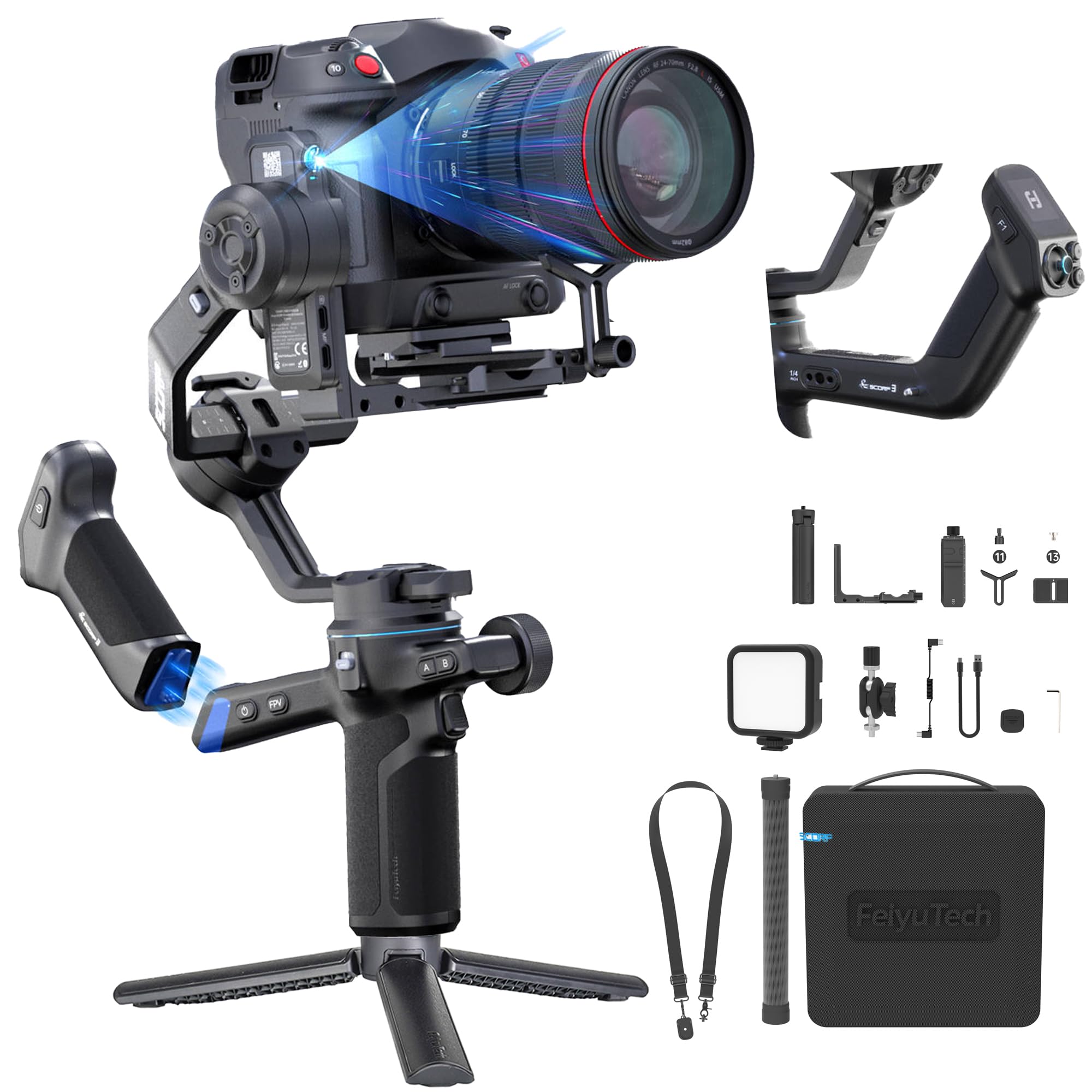
The FeiyuTech SCORP 3 Kit introduces a detachable underslung handle that communicates wirelessly with the gimbal, allowing you to monitor and adjust settings from up to 39 feet away. This makes it an exceptional tool for solo operators who need to frame themselves within a scene or capture low-angle shots without crouching. The built-in AI tracking module is more sensitive than its predecessor, with wider tracking width for keeping subjects in frame during dynamic movement.
Powered by the 10th-generation quaternion stabilization algorithm, the SCORP 3 cancels shakes from every axis simultaneously, producing cinema-grade smoothness even during running shots or sudden stops. The 1.3-inch HD touchscreen provides quick access to modes like pan follow, full lock, or 360° rotation, and the Bluetooth shutter lets you start/stop recording directly from the gimbal. Native vertical shooting is achieved by rotating the mounting slider 90 degrees.
Buyers who pair it with Sony A1 or A7 series cameras report near-instant setup times and rock-solid motor behavior with 4-pound loads. The included travel case has organized slots for the gimbal and accessories. Some users have encountered compatibility issues with specific Panasonic models, and the shoulder strap may vary. Overall, it’s a forward-thinking design for creators who value remote operation.
Why it’s great
- Detachable handle with 39 ft wireless control range
- 10th-gen stabilization algorithm for ultra-smooth footage
- 1.3″ touchscreen with intuitive UI for quick mode switching
Good to know
- Compatibility with Panasonic S1IIe requires wired connection only
- Shoulder strap packaging inconsistency reported by some buyers
6. DJI RS 4

The DJI RS 4 is the professional standard for mirrorless gimbal stabilization, featuring Teflon-coated axis arms that reduce friction during balancing — a detail that saves critical minutes on set. Its 6.6-pound payload capacity comfortably handles setups like a Canon R5 with an RF 24-70mm lens, and the extended tilt axis provides 8.5 mm more balancing space than the previous generation, accommodating larger lens hoods.
Second-generation native vertical shooting lets you switch from landscape to portrait immediately by releasing the horizontal plate and securing it vertically, keeping the camera sensor centered for maximum vertical resolution. The joystick mode switch quickly toggles between Pan Follow, Pan Tilt Follow, and FPV modes, with FPV supporting 3D Roll 360 for dramatic spinning shots. An RSA communication port opens up compatibility with third-party handles and remote-control rings.
Professional videographers praise its responsive motors, excellent build quality, and intuitive controls. The 12-hour battery covers most shoot days, and the optional BG70 grip extends that to 29.5 hours with charging pass-through. Users note that the RS 4 is slightly less forgiving with extremely heavy cinema rigs than the RS 4 Pro variant, but for hybrid shooters and event videographers, it delivers reliable, smooth tracking without excess bulk.
Why it’s great
- Teflon-coated arms make balancing faster and more precise
- Second-gen native vertical shooting without extra accessories
- RSA port for extensive accessory ecosystem
Good to know
- High-capacity battery grip sold separately and expensive
- Heavier loads with large cinema cameras may exceed comfortable range
7. GoPro Fluid Pro AI
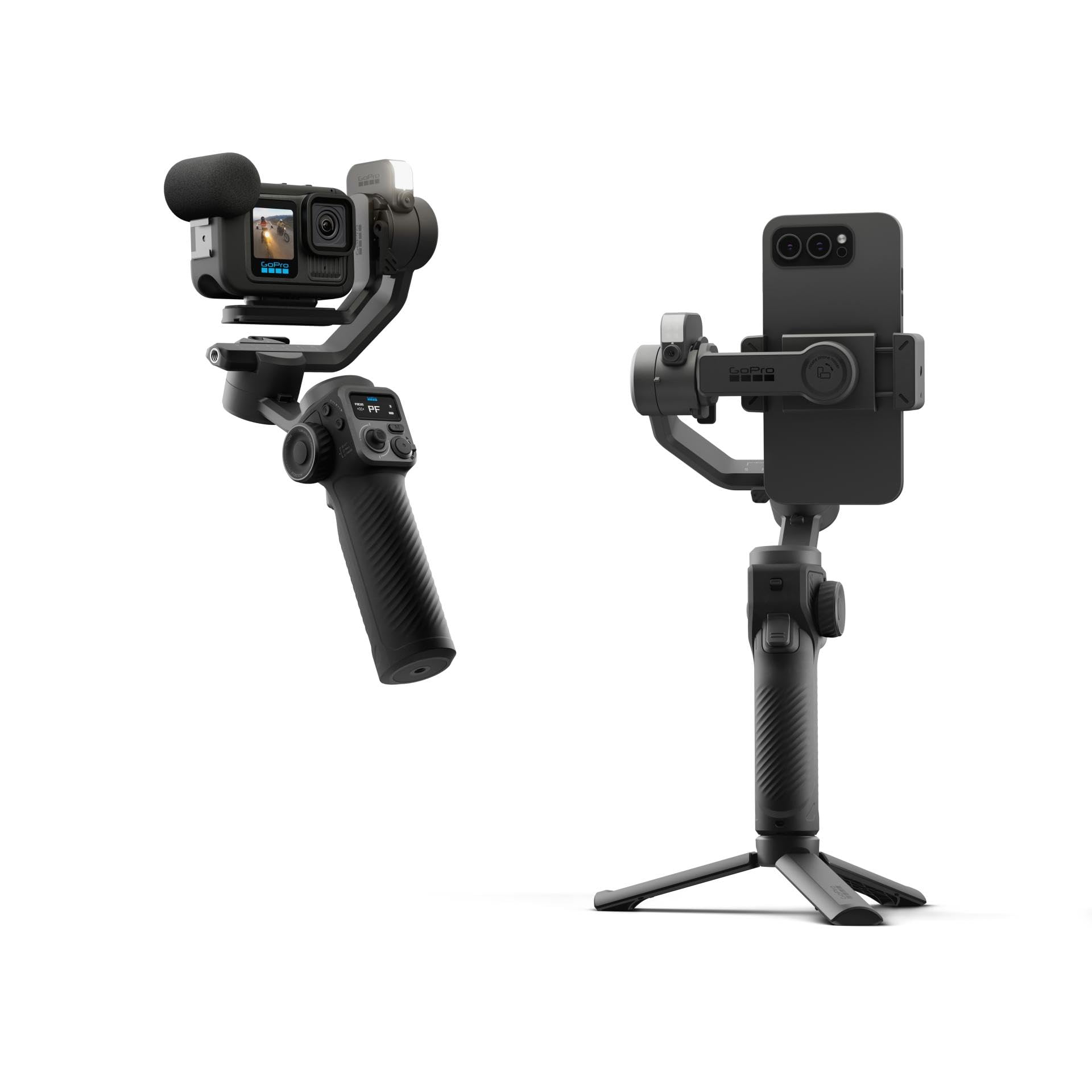
The GoPro Fluid Pro AI stands out by offering interchangeable mounting brackets that accept both smartphones and GoPro HERO cameras, as well as some compact point-and-shoot models. This makes it a rare hybrid tool for creators who switch between action cam and phone footage regularly. The forward- or rear-facing AI tracking module locks onto a person’s face or body with precision, and an integrated fill light balances exposure in low-light conditions.
The 3-axis gimbal provides smooth stabilization, and the wireless camera control lets you start/stop recording on compatible GoPro HERO models (9-13) directly from the gimbal handle. The kit includes a zippered case, tripod base, and all necessary cables, making it a complete out-of-box solution. Bluetooth pairing with GoPro cameras is quick, and the app-free AI tracker keeps the workflow simple for adventure content.
Buyers who have used it extensively note that the AI tracking is among the best available, especially for action camera footage where consistent framing is hard to maintain manually. The main drawback is that heavy zoom lenses may exceed the motor’s torque capacity. Some units have arrived with packaging that suggests prior handling, so inspecting on arrival is wise. For mixed-device creators, it’s the most versatile option in this class.
Why it’s great
- Works with smartphones, GoPros, and compact cameras via interchangeable brackets
- Forward/rear-facing AI tracker with integrated fill light
- Complete kit with zippered case and all mounts included
Good to know
- Cannot handle heavy zoom lenses or large camera rigs
- Some units reported with loose accessories; verify condition on arrival
8. Hohem iSteady V3

The Hohem iSteady V3 is the budget-friendly entry point that refuses to compromise on core features. Its magnetic AI tracker clips onto the gimbal and enables app-free face and body tracking using hand gesture controls — a feature usually reserved for pricier models. The 3-axis iSteady 8.0 anti-shake system keeps footage fluid, and the extended roll arm ensures wide-angle shots remain unobstructed by the motor housing.
An innovative detachable remote controller attaches magnetically to the handle for real-time charging and offers fingertip control of recording, zoom, and mode switching. The built-in extension rod stretches to 8 inches, and the magnetic fill light provides cold, warm, and natural light with adjustable brightness from 4% to 100%. The 13-hour battery life exceeds many competitors, covering full-day travel shoots without needing a recharge.
Users consistently praise the value-for-money ratio, noting that the AI tracking and built-in light make solo vlogging far easier than expected at this price tier. The foldable design fits in a pocket, and the Hohem Joy app offers creative modes like panorama and timelapse. Some users mention the gimbal can tip over when fully extended on its tripod base, and the magnetic light can detach if bumped. Overall, an excellent choice for budget-conscious creators.
Why it’s great
- Magnetic AI tracker works without app, uses hand gestures
- Detachable remote controller with magnetic charging
- 13-hour battery life is class-leading for this price tier
Good to know
- Can tip over when fully extended with heavy phone
- Magnetic fill light can disconnect if knocked accidentally
9. Soonpho M6
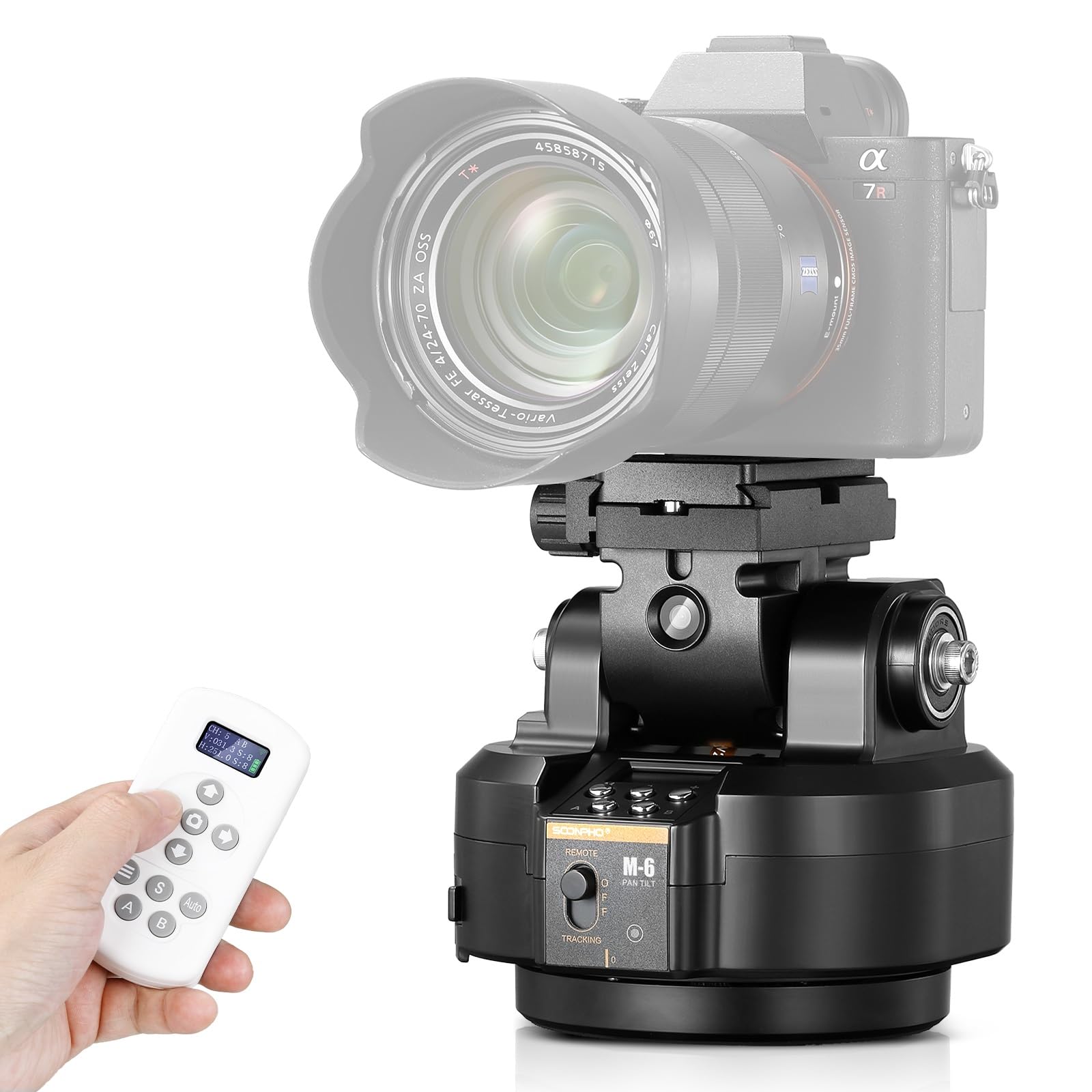
The Soonpho M6 is a motorized pan-tilt head rather than a full 3-axis gimbal, but it offers genuine AI face and body tracking at an entry-level price point. It tracks automatically without any app or Bluetooth connection, using gesture recognition to start and stop tracking. The 360° horizontal and 27° vertical rotation, adjustable across 8 speeds, makes it suitable for static filming setups like talk shows, lectures, or product demos.
Its A-to-B pan memory function lets the head scan between two programmed positions automatically — useful for sweeping shots or covering a stage. The remote control operates effectively beyond 60 feet and through walls, and the included phone clip works with most smartphones. The 1/4-inch quick-release shoe plate fits standard DSLR and mirrorless cameras, and the plastic build keeps weight low.
Users appreciate the long battery life (4+ hours of continuous use) and USB-C charging convenience. The tracking is best suited for a single stationary subject; fast-moving targets or multiple people can confuse the sensor. The motion can be slightly jerky in low-light conditions. For a dedicated pan-tilt solution on a tripod, it punches above its weight, but it is not a replacement for a full gimbal for walking shots.
Why it’s great
- App-free gesture-controlled tracking at a very low entry point
- A-to-B memory scanning for automated pan coverage
- Long battery life with USB-C power
Good to know
- Not a 3-axis gimbal; no stabilization for walking or running shots
- Tracking can be jerky in low light and struggles with fast motion
FAQ
Do AI tracking gimbals work without a smartphone app?
Can I use an AI tracking gimbal with a GoPro and a phone interchangeably?
Will a heavy telephoto lens prevent the gimbal from tracking smoothly?
Final Thoughts: The Verdict
For most users, the best ai tracking gimbal winner is the Insta360 Flow 2 Pro because it combines Apple DockKit compatibility, multi-person tracking, and a complete content-creation toolset in a compact, foldable design that works across 200+ apps. If you want native audio integration and a trusted brand ecosystem, grab the DJI Osmo Mobile 8. And for professional-grade mirrorless rigs requiring a 7.7-pound payload, nothing beats the FeiyuTech SCORP-C2.

Mo Maruf
I created WellFizz to bridge the gap between vague wellness advice and actionable solutions. My mission is simple: to decode the research and give you practical tools you can actually use.
Beyond the data, I am a passionate traveler. I believe that stepping away from the screen to explore new environments is essential for mental clarity and physical vitality.