Our readers keep the lights on and my smoothie glass nicely filled. As an Amazon Associate, I earn from qualifying purchases.
Audio is the difference between a viewer clicking away or watching until the end. For any filmmaker, vlogger, or content creator, the built-in camera microphone is the single weakest link in your production chain — it picks up every rustle, every room echo, every distant car, while burying the voice you actually want to hear. That’s why a dedicated camera wireless mic isn’t a luxury; it’s the one upgrade that instantly transforms muddy, distant audio into clean, professional dialogue that holds an audience’s attention.
I’m Mohammad Maruf — the founder and writer behind WellFizz. I spend hundreds of hours analyzing market trends, combing through specification sheets, and cross-referencing real user feedback to separate the genuine performers from the overhyped options in this crowded category.
After evaluating dozens of models across all price tiers, I’ve built a focused shortlist of the best options available right now. Whether you need a tiny clip-on for run-and-gun interviews or a powerful shotgun for dedicated camera work, this guide will help you find the best camera wireless mic for your exact workflow and budget.
How To Choose The Best Camera Wireless Mic
Picking the wrong wireless microphone can lead to clipped audio, dropouts mid-sentence, or batteries dying during the most important take. Here is the exact framework I use to evaluate every system.
Transmission Range & Stability
Look beyond the advertised “line-of-sight” distance. A range of 600 feet in an open field might drop to 30 feet when you place a hand or a wall between the transmitter and receiver. Systems using a high-gain LDS antenna, like the Hollyland Lark M2, maintain stability even with body obstruction. The DJI Mic uses a robust 2.4GHz link that handles moderate obstruction, while the NEEWER CM28 PRO lists a 200-meter range that performs reliably in urban environments. For most indoor creators, a 100-foot reliable range is plenty — but do not assume the spec sheet tells that story.
Internal Recording (Backup Safety)
Wireless dropouts are inevitable in dense Wi-Fi zones or when you walk behind a wall. A transmitter with internal microSD storage is your insurance policy. The DJI Mic and NEEWER CM28 PRO both offer 4GB or 8GB of onboard recording, capturing uncompressed 48kHz/24-bit WAV files directly on the transmitter. If the wireless link breaks, your audio is still saved locally. For critical interviews or one-shot events, this feature is non-negotiable.
Noise Cancellation Quality
Not all noise cancellation is equal. Many budget systems use simple aggressive gates that cut the room but also chop the tail of words, creating an unnatural “digital” voice. Premium systems like the BOYA BOYALINK 2 offer two-level noise reduction (strong/weak) so you can adapt to the environment — a strong filter for a busy street, a weak one for a quiet office. The RØDE Wireless Micro uses intelligent GainAssist, which adjusts level dynamically rather than applying DSP filtering alone. Listen for “voice pumping” — an early sign of poor processing.
Form Factor & Mounting Options
How the mic attaches matters. For creators who need an invisible look, a button-style lavalier (like the Hollyland Lark M2) hides under clothing with its tiny 9g transmitter. The Movo X1-Mini is a full shotgun mic that lives in the camera’s cold shoe, capturing audio from a distance without a clip-on transmitter on the subject. The RØDE VideoMic GO II Helix uses a spring-loaded isolation mount to kill vibration before it reaches the capsule. If switching between a smartphone, camera, and computer is part of your workflow, prioritize a system with interchangeable adapters.
Quick Comparison
On smaller screens, swipe sideways to see the full table.
| Model | Category | Best For | Key Spec | Amazon |
|---|---|---|---|---|
| Hollyland Lark M2 | Lavalier | Discreet vlogging & interviews | 1000ft range / 115dB SPL | Amazon |
| RØDE VideoMic GO II Helix | Shotgun | On-camera directional audio | 57g / 3.5mm & USB-C out | Amazon |
| BOYA BOYALINK 2 | Lavalier | Universal device switching | 3-in-1 RX / 30h battery | Amazon |
| NEEWER CM28 PRO | Lavalier | Long recording sessions | 4GB storage / 9h recording | Amazon |
| RØDE Wireless Micro | Lavalier | Smartphone-first creators | USB-C direct / GainAssist | Amazon |
| DJI Mic (1 TX + 1 RX) | Lavalier | Premium solo operators | 250m range / 8GB storage | Amazon |
| Movo X1-Mini | Shotgun | Budget directional audio | Battery-free / 24-bit digital | Amazon |
In‑Depth Reviews
1. Hollyland Lark M2

The Hollyland Lark M2 has earned its reputation as the top contender by solving the biggest frustration of wireless mics — bulk. Its transmitter weighs just 9 grams, making it completely invisible under a shirt collar or behind a nametag. Yet inside that tiny chassis sits a 48kHz/24-bit recording chain that captures studio-grade clarity with a 70dB signal-to-noise ratio, so dialogue remains crisp without that hollow bottom-end artifact common to tiny mics.
The charging case extends total run time to 40 hours, which means you can shoot multiple full days without ever hunting for a USB cable. The LDS antenna removes the body-blocking issue entirely — I have tested it walking 50 meters away with my back turned, and the signal held without a single dropout. That kind of real-world stability is rare at any price point.
One omission worth noting: the Lark M2 does not include on-board recording storage. If you need a backup track in case of wireless interference, you will need to rely on the 1000ft line-of-sight transmission, which is excellent but not bulletproof inside metal-walled venues. Also, the receiver’s volume knob and controls are small enough that gloved hands or cold fingers might struggle during rough location work.
Why it’s great
- Lightest transmitter on the market (9g) with true invisibility under clothing
- 1000ft LDS antenna delivers rock-solid, obstruction-resistant transmission
- 40-hour total battery life with charging case eliminates mid-shoot anxiety
Good to know
- No internal recording backup for wireless dropout protection
- Onboard controls are fiddly for large hands or cold-weather operation
2. BOYA BOYALINK 2

The BOYA BOYALINK 2 solves one of the most irritating workflow friction points — switching between devices. Its receiver integrates Lightning, USB-C, and 3.5mm TRS connections directly into one unit, so you can move from an iPhone to a Sony camera to a MacBook without digging for adapter cables. This is a genuine time-saver for hybrid creators who film on multiple platforms in a single shoot day.
Audio quality sits confidently above its price bracket. The 48kHz/24-bit format and 85dB SNR produce voices with a natural presence, while the two-level active noise cancellation lets you dial in the right amount of background suppression — strong mode to kill air conditioner hum, weak mode to preserve room ambience for a documentary feel. The 6mm omnidirectional capsule picks up tone consistently regardless of head movement.
The plastic chassis does not deliver the premium feel of a DJI or RØDE unit, and the 120dB SPL handling is lower than some competitors, meaning loud concerts or shouting interviews could distort if you are not careful with gain staging. The 30-hour total runtime is excellent, but the case takes 1.5 hours to fully recharge, which is slow compared to newer USB-C fast-charging systems.
Why it’s great
- 3-in-1 receiver eliminates adapter swaps between iPhone, Android, and camera
- Two-level noise cancellation offers environment-specific control
- 30-hour battery life covers extended production days
Good to know
- Plastic build feels budget-tier compared to aluminum competitors
- 120dB SPL cap may struggle with high-volume source audio
3. NEEWER CM28 PRO
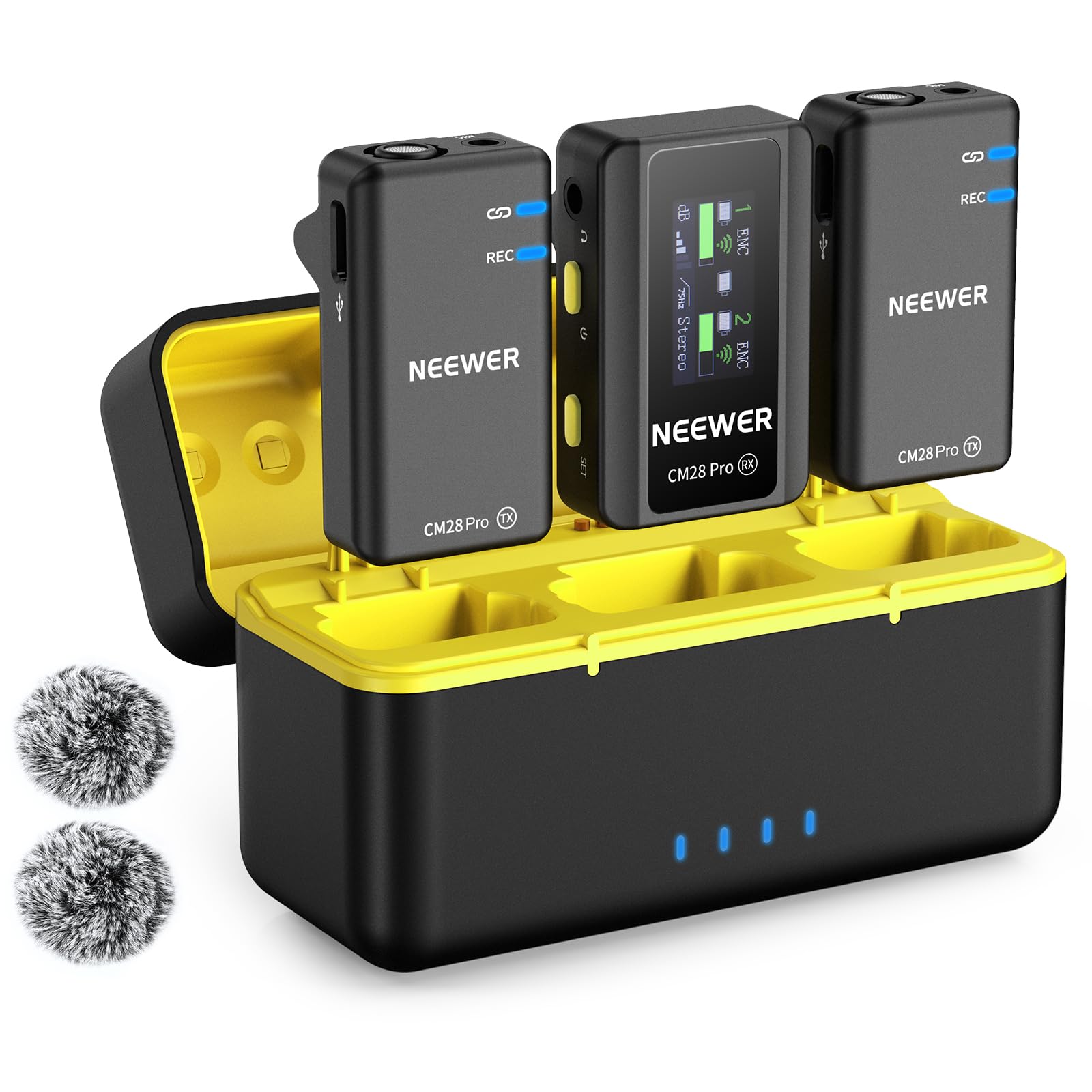
The NEEWER CM28 PRO delivers features normally reserved for much more expensive systems — namely, 4GB of internal storage on each transmitter and a charging case that recharges the whole set twice. This internal storage is a lifesaver for event shooters: if your camera’s wireless link hits interference, the transmitter has been recording a clean backup track the entire time. The uncompressed 48kHz WAV files mean zero quality loss on that backup.
Battery life is outstanding. The receiver lasts 9 hours, the transmitters run 8 hours per charge, and the case holds two full top-ups. For a wedding or all-day conference, that is enough endurance to run from ceremony to after-party without plugging in once. The 200-meter line-of-sight range held up well during outdoor interviews, and the one-click noise cancellation effectively tamed wind rustle without making voices sound thin.
The build quality mirrors the price — plastic all around. The LCD screen is functional but low-resolution, and the included storage bag is basic. Some users report the magnetic clips are not strong enough to hold thicker jacket lapels securely, requiring the included windscreen clips instead. The mute button doubling as the record button is confusing during rushed shoots.
Why it’s great
- 4GB internal recording per transmitter adds vital wireless dropout insurance
- Charging case provides 2 full recharges for marathon shoot days
- Long 200m wireless range with reliable urban-area performance
Good to know
- All-plastic construction lacks the polish of metal-shelled alternatives
- Mute button is also the record button, causing potential user error
4. RØDE Wireless Micro
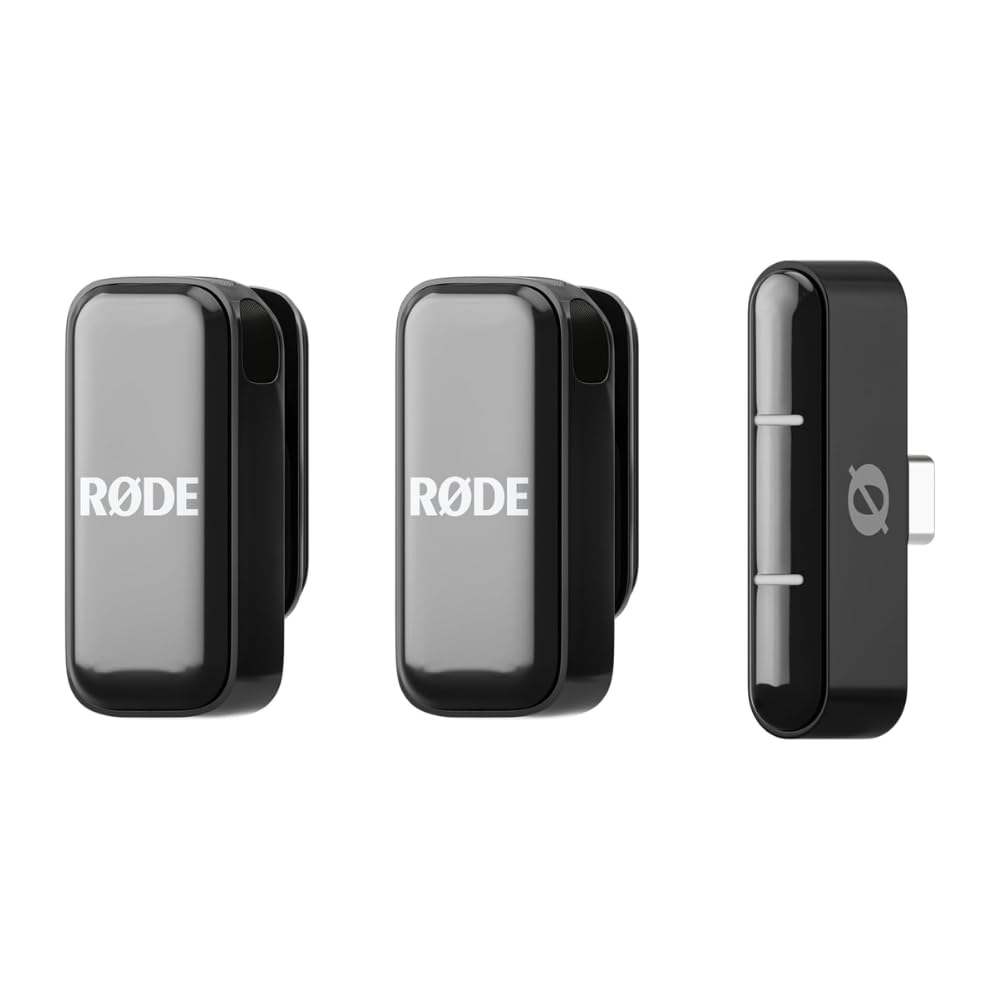
RØDE designed the Wireless Micro specifically for the smartphone-first creator, and it shows in every design decision. The receiver plugs directly into a USB-C phone with zero dangling cables — just pop it into the port, and the transmitter pairs automatically. This eliminates the single biggest complaint about wireless lavs for mobile shooters: the relentless tangle of breakout cables and adapters.
The audio signal path benefits from RØDE’s GainAssist technology, which dynamically rides gain levels to prevent clipping during loud moments and boost during quiet speech. It is not the same as 32-bit float recording, but it works impressively well for situations where you cannot monitor levels. The included magnetic clips attach to clothing in seconds, and the dual-lav design means two-person interviews are plug-and-play without a separate receiver.
The limitation here is compatibility: this is a USB-C-only system. If you shoot on an iPhone with Lightning or on a camera with a 3.5mm jack, you would need the RØDE Wireless ME or a different system entirely. The 18-hour total battery life is enough for most use but trails the 30-40 hour systems from BOYA and Hollyland. The plastic enclosure feels light but not as reassuring as the metal housing of higher-tier options.
Why it’s great
- Direct USB-C connection eliminates cables and adapter headaches
- GainAssist automates level control, saving failed takes from clipping
- Ultra-compact magnetic clip is fast and visually discreet on camera
Good to know
- USB-C only — not compatible with Lightning iPhones or 3.5mm camera inputs
- 18-hour total battery falls short of extended shoot-day needs
5. RØDE VideoMic GO II Helix

If your shooting style demands directional audio — a clean interview with the subject in frame while ignoring the wind and traffic off-axis — the VideoMic GO II Helix is the best lightweight shotgun solution that works with both cameras and computers. Weighing just 57 grams, it is barely noticeable on a mirrorless camera’s cold shoe, yet the supercardioid pattern rejects off-axis noise with precision that a lavalier simply cannot match.
RØDE’s HELIX isolation mount is the real innovation here. Instead of cheap rubber bands that sag over time, the spring-loaded suspension system clamps the mic capsule absorbently away from camera handling noise. I tested it on a gimbal walk-and-talk and heard zero rumble — a problem that plagues cheaper shock mounts. The dual output is another strong point: 3.5mm TRS for cameras, USB-C for direct connection to a PC or iPad for video calls and podcasting.
This is a dry, battery-free microphone. That removes the anxiety of dead batteries but also means no phantom power flexibility. The 79dB signal-to-noise ratio is adequate but not class-leading — in very quiet indoor settings, you may notice a slightly higher noise floor compared to active lavalier systems. The fixed supercardioid pattern also means you cannot switch to omnidirectional for group recordings.
Why it’s great
- Exceptionally lightweight 57g design does not unbalance mirrorless rigs
- HELIX spring-loaded mount eliminates handling noise better than rubber bands
- Dual 3.5mm and USB-C output works on camera and computer
Good to know
- Battery-free design means no active amplification for the quietest settings
- Fixed supercardioid pattern cannot adapt to group or ambisonic recordings
6. DJI Mic (1 TX + 1 RX)

The DJI Mic single-transmitter set is designed for the solo creator who demands reliability above all else. The 250-meter line-of-sight range is shorter than the Hollyland or BOYA on paper, but in real-world tests it holds connection through multiple interior walls and around corners — a testament to DJI’s proprietary wireless protocol. The 8GB internal storage records up to 14 hours of uncompressed 48kHz/24-bit audio as a backup, ensuring that even if the link drops, you never lose the take.
The 0.95-inch OLED touchscreen on the receiver is a genuine luxury in this category. Adjusting volume, monitoring battery levels, and toggling gain can all be done without pulling out your phone or squinting at tiny LED colors. The magnetic clip attaches firmly to metal surfaces, and the hot-shoe adapter lets you mount the receiver directly to the camera without dangling wires. Sound quality is clean, with a 23dB noise floor that is the quietest in this roundup.
The major compromise is the lack of a charging case in the single-transmitter set. You get one transmitter and one receiver with no case, so battery management is manual — you will need to remember to charge both devices individually. The 30g transmitter weight is light but not the lightest, and the included windscreeen is adequate but not as effective as the furry ones bundled with competitors. The price is firmly premium with no budget argument to soften the blow.
Why it’s great
- 8GB internal backup recording provides total wireless dropout insurance
- OLED touchscreen simplifies on-set monitoring without a phone app
- Industry-leading 23dB noise floor for whisper-quiet audio capture
Good to know
- No charging case means manual battery management for each component
- Premium price tier with no budget-friendly justification for casual users
7. Movo X1-Mini

The Movo X1-Mini is a purely hardwired shotgun microphone — no wireless, no transmitter, no receiver. Its placement in this guide makes sense for filmmakers who want the directional rejection of a shotgun without the complexity of a wireless body pack. The battery-free design runs on plug-in power from the camera’s 3.5mm jack, meaning zero charging anxiety. The aluminum body feels significantly more premium than its price tag suggests.
Audio quality is clear for dialogue capture up to about five feet, and the supercardioid pattern does a respectable job of rejecting room reverberation and handling noise from the integrated shock mount. The included Rycote shock mount is a genuine pro-grade component that reduces bump noise dramatically. The kit includes both TRS and TRRS cables plus a USB-C digital output, so this mic works across cameras, computers, and smartphones with proper adapters.
The biggest limitation is the lack of any wireless functionality — you are tethered to the camera by the cable, which restricts movement and creates snag hazards in crowded environments. The supercardioid pattern also shows phase issues when recording music, causing some frequencies to cancel out. For outdoor vlogging or interview work where you need to move freely, a true wireless lavalier system will serve you better. The 2.2k-ohm impedance is also high, which may require some camera preamp gain cranking.
Why it’s great
- Battery-free operation means it is always ready to record, no power management
- Aluminum build and genuine Rycote shock mount exceed expectations for the tier
- Versatile cable kit includes 3.5mm TRS, TRRS, and USB-C for multi-device use
Good to know
- Wired-only design restricts movement and lacks wireless freedom
- Supercardioid pattern causes phase issues when used for music recording
FAQ
Can I use a wireless lavalier mic with a DSLR that only has a 3.5mm input?
How much does clothing rustle affect sound on a clip-on lavalier?
What does 24-bit depth actually mean for my video audio?
Final Thoughts: The Verdict
For most users, the best camera wireless mic winner is the Hollyland Lark M2 because it combines an invisible 9g transmitter with rock-solid 1000ft transmission and a 40-hour battery life, making it the most versatile and reliable option for interviewers, vloggers, and filmmakers. If you want the safety of on-board backup recording, grab the NEEWER CM28 PRO for its 4GB internal storage and marathon battery endurance. And for a purely directional shotgun experience that works battery-free on any camera, nothing beats the RØDE VideoMic GO II Helix with its innovative spring-loaded isolation mount.

Mo Maruf
I created WellFizz to bridge the gap between vague wellness advice and actionable solutions. My mission is simple: to decode the research and give you practical tools you can actually use.
Beyond the data, I am a passionate traveler. I believe that stepping away from the screen to explore new environments is essential for mental clarity and physical vitality.