Our readers keep the lights on and my smoothie glass nicely filled. As an Amazon Associate, I earn from qualifying purchases.
When the spinal canal narrows and compresses nerves, every step, twist, or sit-down can send a jolt of pain through your lower back and legs. The right brace shifts the load off your compressed vertebrae and stabilizes your lumbar spine, allowing you to move without provoking those nerve roots.
I’m Mohammad Maruf — the founder and writer behind WellFizz. I analyze orthopedic supports and medical-grade braces to find the ones that deliver measurable clinical support for specific spine conditions, not just general lower back ache.
After comparing compression systems, removable spinal rods, and adjustable lumbosacral orthosis designs, the top-performing back brace for spinal stenosis provide targeted decompression while maintaining mobility for daily activities.
How To Choose The Best Back Brace For Spinal Stenosis
Not all back braces work for stenosis. Soft elastic support belts can compress the abdomen and provide general warmth, but they lack the rigid framework needed to prevent the forward flexion that narrows the spinal canal. For stenosis, you need a brace that encourages slight lumbar extension and stabilizes the vertebrae.
Support Rigidity: Soft, Semi-Rigid, or Rigid LSO
A lumbosacral orthosis (LSO) with removable spinal rods or an integrated arch plate is the gold standard for spinal stenosis. These braces limit excessive forward bending, which is the primary movement that compresses nerve roots. Semi-rigid designs balance enough stiffness for clinical support with enough flexibility for sitting and driving.
Compression Control and Adjustability
Dual-pulley or multi-zone compression systems let you tighten each side independently. This matters because spinal stenosis often creates asymmetrical pain—one hip may be more affected than the other. Look for a brace with at least two adjustable straps or a pulley system that can be operated without twisting or straining your back.
Lumbar Pad or Arch Plate Options
Some braces include a removable or adjustable arch pad that pushes the lower spine into a slight extension. This action can temporarily widen the spinal canal and reduce nerve impingement. For chronic stenosis, a brace with a rigid or semi-rigid posterior plate often provides more consistent relief than a simple foam pad.
Quick Comparison
On smaller screens, swipe sideways to see the full table.
| Model | Category | Best For | Key Spec | Amazon |
|---|---|---|---|---|
| Timtakbo LSO Back Brace | Rigid LSO | Maximum decompression & post-surgery | 26° adjustable arch plate | Amazon |
| BraceAbility Lumbar Decompression | Semi-Rigid LSO | Pre-op to post-op recovery | Triple-compression dual-pulley | Amazon |
| BraceAbility Spine Sport | Active Support | Sports & manual labor with stenosis | Sweat-wicking nylon mesh | Amazon |
| JIUFENTIAN Copper Back Brace | Mid-Range Rod | Adjustable rod support & heat/ice therapy | Removable dual steel rods | Amazon |
| FEATOL Back Brace | Entry-Level | Mild stenosis & daily compression | 4 support strips + lumbar pad | Amazon |
In‑Depth Reviews
1. Timtakbo LSO Back Brace with Maximum Decompression Plate

This LSO brace stands apart because of its Bionic Decompression Plate, which can be adjusted to a 26-degree lumbar extension angle. For spinal stenosis, creating that slight backward arch directly counteracts the forward-flexion posture that narrows the spinal canal. The plate physically separates the vertebrae, providing real decompression rather than just compression around the waist.
The dual-pulley system is a smart design choice for anyone with limited grip strength or trouble bending—you pull the tabs forward rather than twisting behind your back. The brace also includes an adjustable abdominal plate with an extension piece, which helps stabilize the pelvis and sacroiliac joint, an area often involved in stenosis-related pain.
Users report that this brace immobilizes about 80 percent of lower back movement, which is exactly the level of restriction needed for moderate to severe stenosis. It is bulkier than soft belts, but several reviewers noted it matched or exceeded the performance of surgical-issue LSO braces costing much more.
Why it’s great
- Adjustable 26-degree arch plate provides measurable lumbar decompression
- Pulley system easy to tighten without bending or twisting
- Abdominal extension piece adds pelvic stability
Good to know
- Bulkier design may not fit discreetly under thin clothing
- Arch plate requires some trial-and-error to find correct extension angle
2. BraceAbility Lumbar Decompression Back Brace
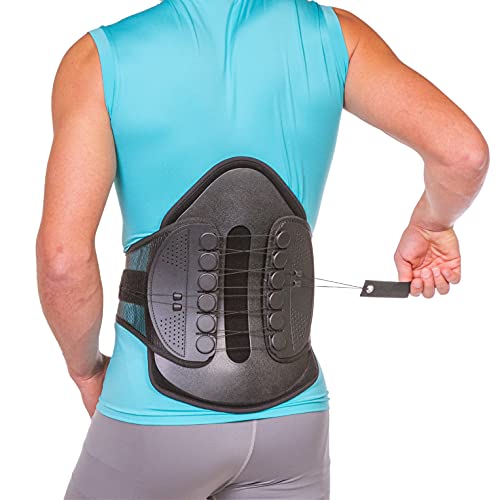
BraceAbility specifically markets this brace for pre-op and post-op spinal surgery recovery, which means its semi-rigid plastic frame is built for both immobilization and adjustability. The dual-pulley system provides what the company calls triple the compression of standard braces—critical for someone whose stenosis requires maximum stability between physical therapy sessions.
The wraparound design does not require twisting or bending to apply, a practical feature for anyone recovering from a laminectomy or discectomy. The brace limits forward bending more effectively than backward extension, which aligns with stenosis management goals. Users who alternated between this brace and a medical-issue LSO from their surgeon reported that the BraceAbility version was equally effective and more comfortable.
One limitation is that the plastic back panel can feel stiff when leaning back against a chair, and some users noted that lying on hard surfaces with the brace can cause the plastic to deform over time. For daily wear during standing and walking, however, it delivers consistent, reproducible support.
Why it’s great
- Triple-compression dual-pulley system for precise, high-level support
- Easy wraparound application with no twisting or bending
- Proven design for pre-surgery and post-surgery stenosis recovery
Good to know
- Plastic back panel can feel rigid against chair backs
- May cause discomfort if worn while lying on hard floors or beds
3. BraceAbility Spine Sport Lower Back Brace
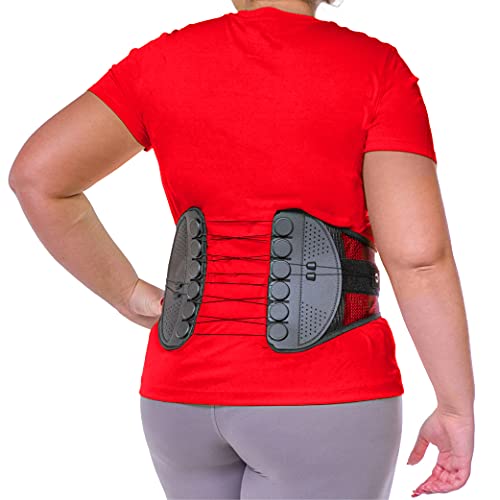
This is the only brace in the list explicitly designed for active use—golf, tennis, kayaking, running, and manual labor. Its nylon mesh construction is lightweight and breathable, which reduces heat buildup during physical activity. For someone with mild to moderate stenosis who wants to stay moving, this brace provides enough rigidity to prevent painful forward flexion without locking the torso completely.
The dual-pulley system is placed at the front, allowing quick tension adjustments between activities. The open-back design reduces sweat accumulation compared to solid-panel braces. Multiple customer reviews specifically mention using it for golf and tennis without residual pain, and one user noted it improved their swing mechanics by preventing over-rotation of the lumbar spine.
The trade-off is that the support is less rigid than an LSO with steel rods or an arch plate. For severe stenosis with nerve compression that causes leg weakness or foot drop, this brace may not provide enough immobilization. It is best suited for people whose stenosis is stable and who need active support rather than full immobilization.
Why it’s great
- Breathable mesh design ideal for active sports and physical work
- Front dual-pulley allows easy tension changes mid-activity
- Open back minimizes heat and sweat buildup
Good to know
- Less rigid than LSO braces with arch plates or steel rods
- Not recommended for severe stenosis with neurological symptoms
4. JIUFENTIAN Copper Lower Back Brace with Removable Dual Spine Rods
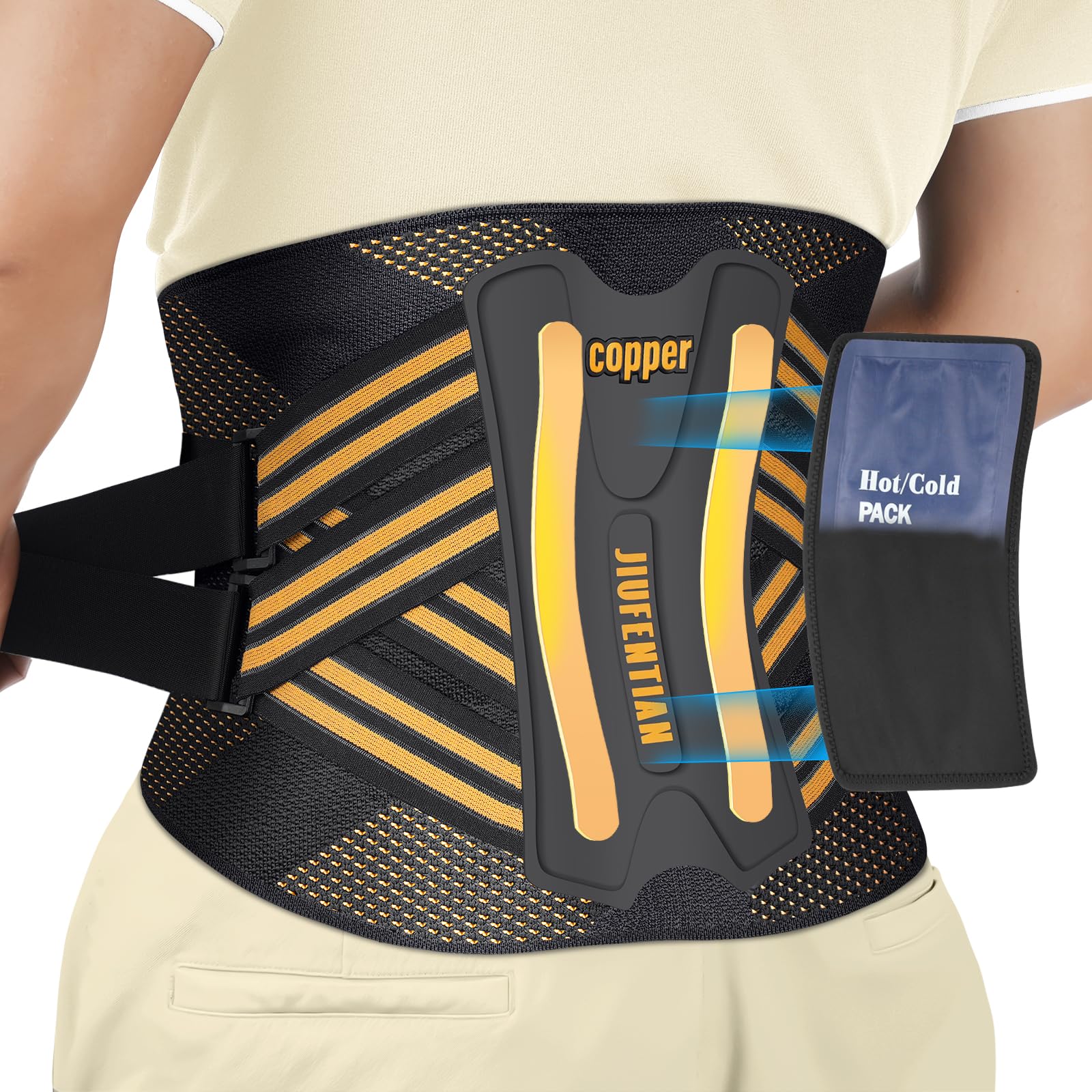
This brace uses two medical-grade steel support rods that can be removed or repositioned based on your pain level. For spinal stenosis, having removable rods means you can use full rigidity during flare-ups and softer support during recovery days. The four-zone independent compression system lets you tighten the left and right sides separately, which is useful when stenosis causes one-sided sciatic symptoms.
The built-in therapy pocket accepts gel packs for heat or cold therapy, which directly addresses the muscular spasms that often accompany stenosis-related nerve irritation. The copper-infused fabric is moisture-wicking and breathable, making it comfortable for full-day wear during work shifts or long periods of sitting and standing.
Customer reviews highlight that the brace resolved severe back pain to the point of avoiding surgery, and the adjustable cinching held up well even during long bus-driving shifts. The rod system does add some bulk, and the copper-infused fabric may not provide any therapeutic benefit beyond standard moisture management, but the overall package delivers good value for both acute and chronic stenosis management.
Why it’s great
- Removable dual steel rods allow customizable rigidity levels
- Four-zone independent compression for asymmetrical stenosis pain
- Therapy pocket for hot/cold packs addresses muscular spasms
Good to know
- Rod system adds noticeable bulk under tight clothing
- Copper fabric benefit is primarily moisture management, not therapeutic
5. FEATOL Back Brace for Lower Back Pain

This entry-level brace uses four internal support strips and an extra lumbar pad to provide 360-degree compression. While it lacks the rigid spinal rods or adjustable arch of an LSO brace, the combination of elastic neoprene and multiple support strips can still reduce forward flexion enough to relieve mild stenosis symptoms. The breathable fabric design prevents overheating, a common issue with all-neoprene braces.
The hook-and-loop closure system offers a wide adjustment range, and the brace is available in sizes up to 5XL, covering waist circumferences up to 74.8 inches. The lumbar pad is positioned to encourage a slight pelvic tilt, which can take pressure off the lower lumbar spine. Several customer reviews mention using it successfully during long hospital shifts and for moving heavy objects.
The main limitation is that the support strips are flexible, not rigid. For moderate to severe spinal stenosis where the spinal canal is significantly narrowed, this brace may not provide enough structural support to stop the forward-flexion movement that compresses nerves. It works best as a supplementary support for daily compression and postural awareness rather than as a standalone clinical device.
Why it’s great
- Four flexible support strips provide 360-degree compression
- Breathable neoprene reduces sweating during long wear
- Extended size range up to 5XL for larger waist circumferences
Good to know
- Flexible strips lack the rigidity needed for severe stenosis
- Lumbar pad offers gentle support, not true decompression
FAQ
Should I wear a back brace for spinal stenosis all day?
Will a rigid LSO brace prevent me from sitting comfortably?
Can a back brace fix spinal stenosis permanently?
Final Thoughts: The Verdict
For most users, the back brace for spinal stenosis winner is the Timtakbo LSO Back Brace because its adjustable 26-degree arch plate provides measurable lumbar decompression that directly addresses nerve compression. If you need a brace that transitions from pre-surgery to post-surgery recovery, grab the BraceAbility Lumbar Decompression Brace. And for staying active with mild to moderate stenosis, nothing beats the BraceAbility Spine Sport Brace.

Mo Maruf
I created WellFizz to bridge the gap between vague wellness advice and actionable solutions. My mission is simple: to decode the research and give you practical tools you can actually use.
Beyond the data, I am a passionate traveler. I believe that stepping away from the screen to explore new environments is essential for mental clarity and physical vitality.