Our readers keep the lights on and my smoothie glass nicely filled. As an Amazon Associate, I earn from qualifying purchases.
Walking into a camera store or browsing Amazon with zero experience and hunting for a beginner 35mm film camera can feel overwhelming. You are not just buying a camera; you are deciding how you will learn the craft—will it be a simple point-and-shoot that lets you focus on composition, or a vintage SLR that forces you to understand aperture and shutter speed? The wrong choice leads to blurry, under-exposed first rolls and a quick trip back to your phone. The right choice gives you a tactile, satisfying hobby that produces images worth printing.
I’m Mohammad Maruf — the founder and writer behind WellFizz. I have spent the last two years analyzing the specifications, user experiences, and market trends in the film camera resurgence, focusing specifically on which models provide the best learning curve without punishing beginners with technical failures.
After combing through hundreds of verified reviews and comparing the glass quality, focus systems, and build materials of the most popular entry-level models, I have identified the seven best contenders. This guide is your definitive resource for finding the best beginner 35mm film camera that matches your budget and learning goals without wasting money on disposable units or over-priced vintage gear that needs immediate servicing.
How To Choose The Best Beginner 35mm Film Camera
The right entry-level film camera balances simplicity with room to grow. The biggest mistake new shooters make is buying a vintage camera based on looks alone, only to discover the light seals are rotted or the lens has fungus. For beginners, the priority should be a working, predictable camera over the cheapest option.
Half-Frame vs. Full-Frame: The First Big Decision
A half-frame camera like the Kodak Ektar H35N or Pentax 17 captures two vertical photos on a single 35mm frame. This doubles your number of shots per roll—72 exposures from a standard 36-exposure roll—which significantly reduces the cost-per-shot of learning. Full-frame cameras give you a larger negative area, which means finer detail and better image quality, but at roughly double the film and development cost per image. For absolute beginners on a budget, half-frame is almost always the smarter start.
Glass Lens vs. Plastic: Sharpness Is Not Optional
The lens is the heart of any film camera. A multi-element glass lens, as found on the Kodak Snapic A1 or the Canon Rebel 2000, delivers sharpness, contrast, and color accuracy that a plastic lens simply cannot match. Cheaper disposable or novelty cameras often use plastic lenses that produce soft, hazy images. When reading product specs, look explicitly for “glass lens” or “coated glass lens” in the description. If it doesn’t say glass, assume plastic.
Manual Control vs. Auto-Only: How Much Do You Want to Learn?
SLR cameras like the Canon Rebel 2000 or the Canon AE-1 offer aperture priority, shutter priority, and full manual modes. These give you complete control over depth of field and motion blur, which is essential if you want to truly understand photography. Point-and-shoot cameras, on the other hand, handle exposure automatically. They are perfect for casual, stress-free shooting but limit your ability to grow technically. A good middle ground is a camera with exposure modes like the Canon Rebel G, which offers program, aperture priority, and shutter priority modes in a simple interface.
Quick Comparison
On smaller screens, swipe sideways to see the full table.
| Model | Category | Best For | Key Spec | Amazon |
|---|---|---|---|---|
| Pentax 17 | Half-Frame | Premium learning tool | 72 shots per roll | Amazon |
| Canon AE-1 | SLR | Classic manual control | 50mm f/1.8 FD lens | Amazon |
| Canon New EOS Kiss (Rebel G) | SLR | Autofocus reliability | ISO 100-3200 range | Amazon |
| Canon Rebel 2000 | SLR | Versatile exposure modes | 7-point AF system | Amazon |
| Kodak Snapic A1 | Point & Shoot | Compact street shooting | 3-element glass lens | Amazon |
| Kodak Ektar H35N | Half-Frame | Budget half-frame entry | Bulb function mode | Amazon |
| Kodak Funsaver 7-Pack | Disposable | Event party favors | ISO 400 film speed | Amazon |
In‑Depth Reviews
1. Pentax 17

The Pentax 17 is a modern reinterpretation of a half-frame compact, built from a solid magnesium alloy. Its 25mm f/3.5 lens features HD coating derived from Pentax SLR lenses, which delivers surprising sharpness for a half-frame format. The zone-focus system divides distance into six zones, removing the guesswork of manual focus while still giving you creative control over what is sharp. Because it captures 72 images on a standard 36-exposure roll, the cost-per-frame is exceptionally low for a camera in this tier, making it a dedicated learning tool you can shoot heavily without financial guilt.
User reviews consistently praise the quiet shutter mechanism, which is ideal for candid street photography. The manual film advance lever recreates the tactile ritual of older cameras, and the camera responds predictably in most lighting conditions. The ISO range of 50 to 3200 covers everything from bright daylight to indoor tungsten, though the fixed f/3.5 aperture means low-light performance depends heavily on your film choice. The HD coating on the glass lens noticeably reduces flare and improves contrast compared to uncoated alternatives in this category.
Yes, the price is the highest on this list. But you are paying for a brand-new, warrantied camera with modern manufacturing tolerances—zero risk of degraded light seals, inaccurate shutters, or fungus in the lens. For a beginner who wants reliability and a clear upgrade path, the Pentax 17 is the most deliberate investment. If the price is too steep, consider the Kodak Ektar H35N for a similar half-frame experience at a fraction of the cost.
Why it’s great
- HD-coated glass lens for sharp half-frame images
- 72 shots per roll reduces learning costs
- Modern build quality with magnesium alloy body
Good to know
- Highest price in this guide
- Zone-focus system requires practice to master
- Fixed lens cannot be swapped
2. Vintage Canon AE-1

The Canon AE-1 is arguably the most iconic 35mm SLR for a reason. Its shutter-priority automatic mode lets you choose the shutter speed while the camera sets the aperture, giving you control over motion blur without needing to calculate exposure. The 50mm f/1.8 FD lens that typically ships with renewed units is a brilliant piece of glass: wide aperture allows for beautiful background blur and better low-light performance than any camera in this guide except the Pentax. The built-in TTL metering system is surprisingly accurate for a camera of its age, provided the light seals have been replaced during servicing.
The metal body adds durability but also weight—this is not a pocket camera. You will need a strap and a bag. The film advance mechanism is smooth on well-maintained units, and the shutter sound is a satisfying mechanical click that film shooters love. Several users report that renewed units from Amazon often arrive with fresh light seals and working meters, but the experience is not universal. The first unit one reviewer received had issues, but the seller replaced it within a day. This variability is the trade-off for buying vintage gear.
If you want to learn the fundamentals of exposure—aperture, shutter speed, and ISO—the AE-1 is an excellent teacher. The manual mode is fully functional, and the FD lens mount opens up a world of affordable used glass. However, if you prefer modern convenience like autofocus, the Canon Rebel 2000 or Canon Rebel G would be a better fit. For the purest film education, the AE-1 is hard to beat.
Why it’s great
- Classic SLR with full manual and shutter-priority modes
- Fast f/1.8 lens for low light and bokeh
- Interchangeable FD lens system
Good to know
- Vintage condition varies between sellers
- No autofocus; requires split-prism manual focus
- Heavier and larger than point-and-shoot options
3. Canon New EOS Kiss (Rebel G)

The Canon New EOS Kiss, known as the Rebel G in North America, is a modern autofocus SLR from the late 1990s. It combines the convenience of a point-and-shoot—auto-wind, auto-rewind, built-in flash, and reliable autofocus—with the creative flexibility of interchangeable lenses and multiple exposure modes. The 35-80mm EF zoom lens included in the bundle covers a useful range from modest wide-angle to short telephoto, making it versatile for portraits, landscapes, and everyday snapshots. The ISO range of 100 to 3200 gives you broad film stock compatibility without camera limitations.
User feedback consistently highlights the “excellent condition” of renewed units, with many noting that the camera looks and functions like new. The autofocus system uses a wide-area point that locks quickly in good light, and the built-in flash includes red-eye reduction. The intuitive controls and clear LCD display mean you can start shooting within minutes of loading your first roll. Several buyers mentioned the included battery worked and the photos came out great on the first roll. The plastic body is lighter than the AE-1, making it easier to carry for extended periods.
This is the ideal sweet spot for a beginner who wants a fuss-free introduction to SLR photography. You get the image quality of a glass zoom lens and the ability to swap lenses later, but you do not have to wrestle with manual focus or guess exposure. The only trade-off is the all-plastic build, which lacks the tactile prestige of metal-bodied cameras. If you prioritize function over feel, this is arguably the most practical option on the list.
Why it’s great
- Reliable autofocus with a wide-area sensor
- Interchangeable EF lens mount for future upgrades
- Multiple exposure modes including aperture priority
Good to know
- Plastic body feels less premium
- Some units may arrive with battery corrosion
- Not a pocketable camera without a bag
4. Canon Rebel 2000
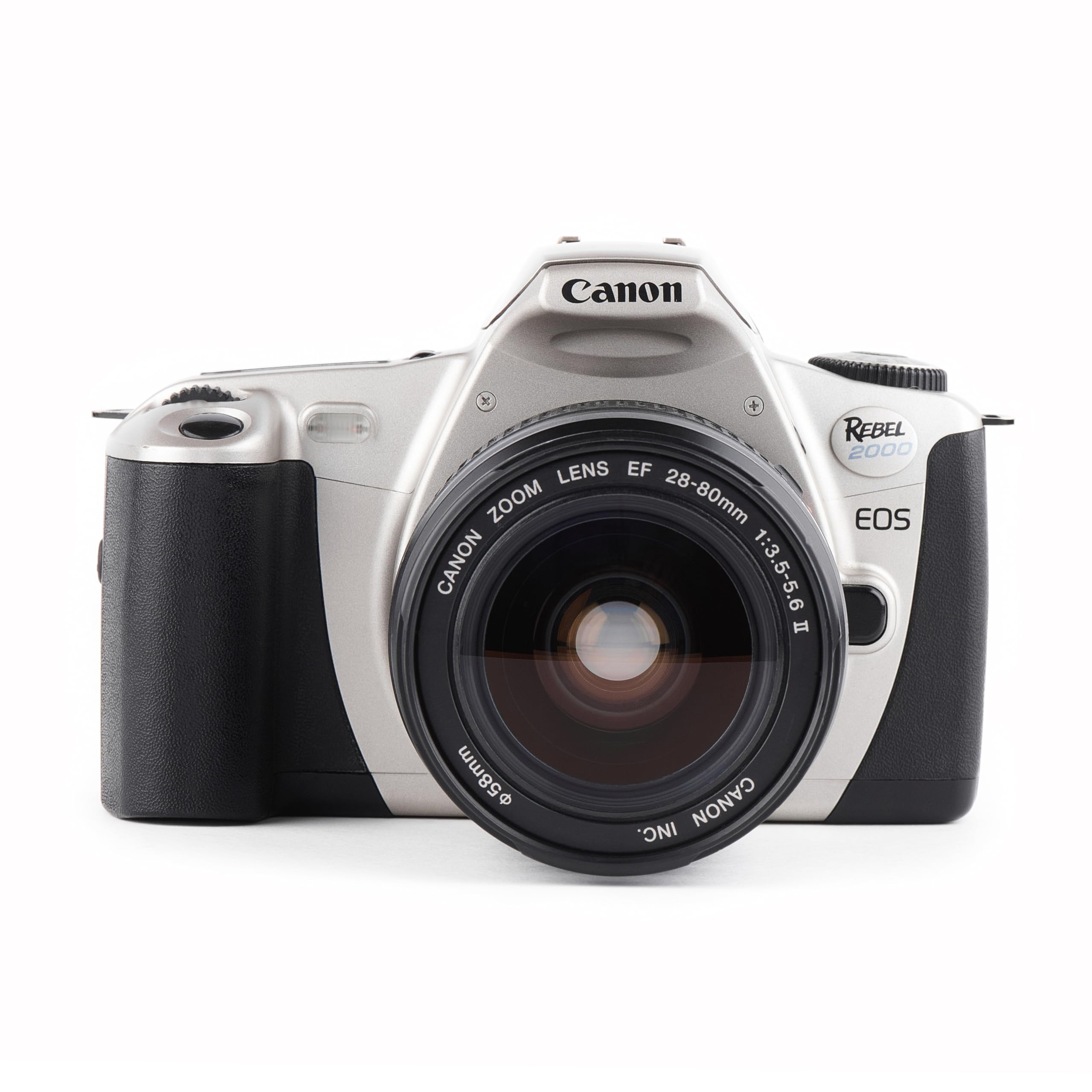
The Canon Rebel 2000 steps up from the Rebel G with a 7-point autofocus system that provides wider coverage and faster subject acquisition. It is fully compatible with modern EF lenses, meaning you can mount current Canon glass on a film body. The camera features four exposure modes—Program, Aperture Priority, Shutter Priority, and Manual—covering the full spectrum of creative control. The built-in pop-up flash is useful for fill light outdoors or primary light indoors, though its guide number is modest compared to external flashes.
Users repeatedly say this camera is “easy to use” and “perfect for everyday shooting.” The automatic film transport removes the common frustration of misloading film, and the LCD panel shows all key settings at a glance. One verified buyer called it “my favorite Amazon purchase ever” and noted how much use it gets. The 28-80mm EF lens bundled with the renewed unit is a solid all-purpose zoom, though it is not the sharpest glass in the Canon lineup. For a beginner, it is more than adequate for learning composition and exposure.
Where the Rebel 2000 really shines is as a tool for growing photographers. After mastering Program mode, you can switch to Aperture Priority to control depth of field, or Shutter Priority to freeze or blur motion. The manual mode is fully functional for when you are ready to take full control. The main disappointment from some buyers was the condition on arrival—one reviewer had to return a non-functional unit. Always check the seller’s return policy when buying renewed gear.
Why it’s great
- 4 exposure modes for progressive learning
- 7-point autofocus system is fast and reliable
- Compatible with modern Canon EF lenses
Good to know
- Renewed quality varies between sellers
- Kit lens is adequate but not premium glass
- Bulkier than compact point-and-shoots
5. Kodak Snapic A1
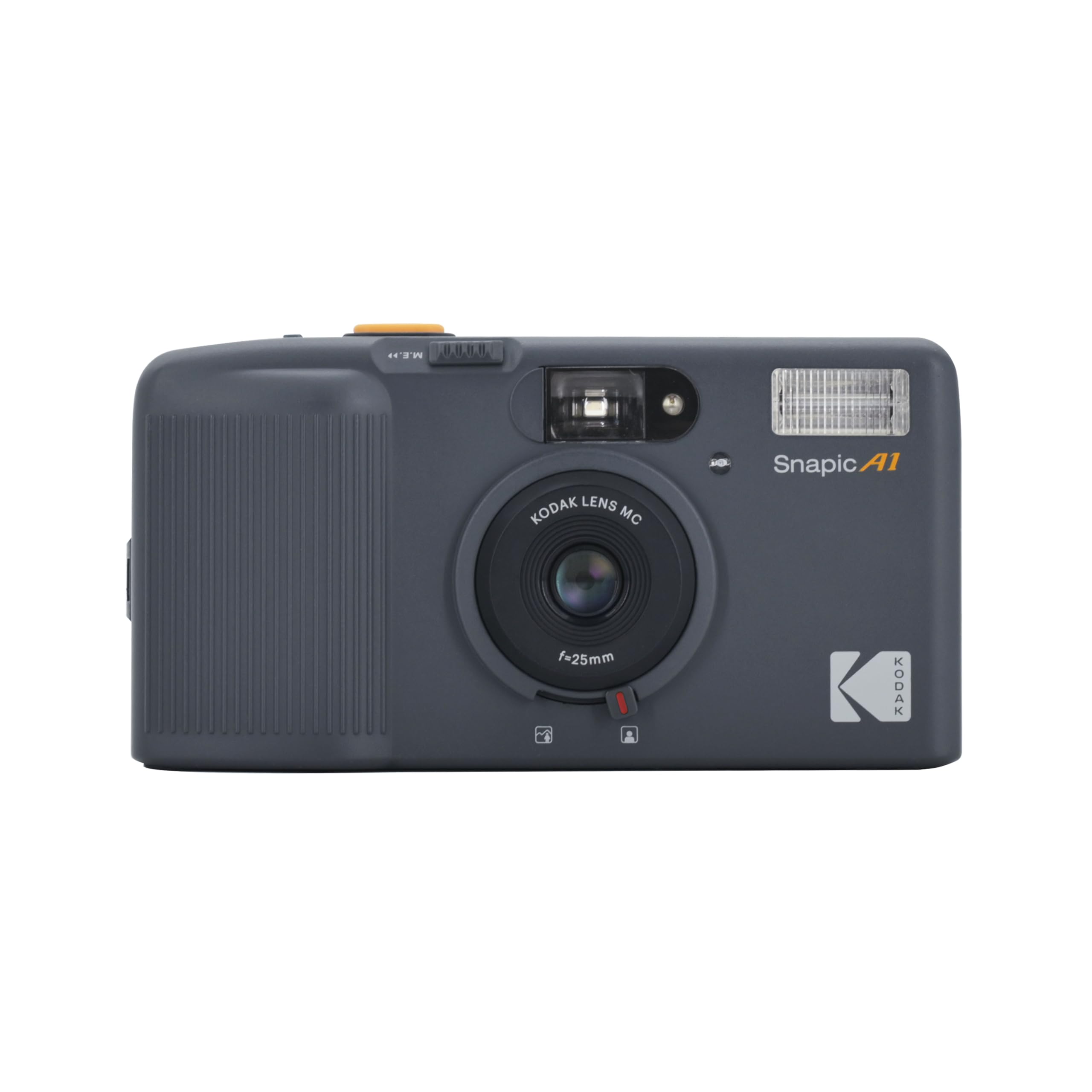
The Kodak Snapic A1 is a fully automatic point-and-shoot that focuses on simplicity. Its key differentiator from cheaper alternatives is the 3-element glass lens, which delivers significantly better sharpness and contrast than plastic-lens cameras. Features include 2-zone focus (switching between near and far subjects), built-in auto flash with red-eye reduction, and a multiple exposure mode that lets you blend two scenes on a single frame. The camera is lightweight at 117 grams and compact enough for a jacket pocket or small bag.
User reviews highlight the importance of using it in good light. With Kodak Gold 200 film outdoors, the camera produces pleasing, vibrant images. Night shots, however, often come out underexposed even with the flash. One reviewer noted that the flash button is easy to press accidentally, turning it off when you think it is active. Another confirmed that the camera only works with alkaline batteries, not NiMH rechargeables. These are minor quirks for an otherwise reliable entry-level camera.
The Snapic A1 is best suited for someone who wants the look and feel of film without any technical learning curve. Load the film, point, and shoot. The double exposure feature is a fun creative tool not commonly found on basic point-and-shoots. If you outgrow its fixed lens and automatic exposure, you will likely want to move to an SLR. But as a gateway camera, it offers excellent value for the price.
Why it’s great
- 3-element glass lens for sharp images
- Compact and lightweight for daily carry
- Double exposure mode for creative effects
Good to know
- Night performance is weak even with flash
- Requires alkaline batteries only
- Flash button can be accidentally pressed
6. Kodak Ektar H35N

The Kodak Ektar H35N is the most affordable reusable film camera on this list, and it packs several features usually reserved for higher tiers: a coated, improved glass lens, a bulb function for long exposures, and a built-in star filter that adds a four-beam flare to light sources. The half-frame format gives you 72 exposures per roll, making this the most economical way to learn film photography short of using a disposable. The focus-free system means everything from about 1 meter to infinity is in acceptable focus, removing any focusing errors.
Users love how compact and pocketable this camera is, with several mentioning it fits perfectly in a bag for hikes and concerts. The image quality is praised as “exceeding expectations” for an entry-level camera, especially when paired with Kodak Portra 400 or 800 film. The waterproof housing accessory included in some kits is a bonus for beach or pool use. One reviewer mentioned the slide-to-open button is a bit too accessible and can accidentally open the camera, but this appears to be a minor ergonomic quirk rather than a design flaw.
The Ektar H35N is the best pick for someone with a tight budget who still wants a glass lens and half-frame efficiency. You lose the double exposure feature of the Snapic A1 and the zone-focus control of the Pentax 17, but you gain a built-in star filter for creative night photography and a bulb mode for light trails. For the price, it is an incredible value that outperforms disposable cameras in every measurable way. Just remember to buy film and AAA batteries separately.
Why it’s great
- Half-frame format slashes film costs
- Built-in star filter for creative effects
- Bulb function enables long exposures
Good to know
- No focus control (focus-free system)
- Slide-open button can accidentally open
- Requires separate film and battery purchase
7. Kodak Funsaver 7-Pack

The Kodak Funsaver is a classic single-use disposable camera pre-loaded with 27 exposures of Kodak 35mm film at ISO 400. This 7-pack is designed for events—weddings, parties, bachelorette weekends—where you want to hand cameras to guests without worrying about them being lost or damaged. The fixed-focus lens is simple: everything from roughly 4 feet to infinity is acceptably sharp. The built-in flash works best within 4 to 10 feet; outside that range, you risk underexposed frames.
User feedback is overwhelmingly positive for its purpose. Multiple reviewers used them at weddings and the photos came out “great quality of pictures of professional color indoor and outdoor.” The flash is functional for indoor group shots, and the ISO 400 film handles a variety of lighting conditions reasonably well. Some users noted that for the price of a 7-pack, you could buy a reusable camera like the Ektar H35N and several rolls of film, which would be more cost-effective in the long run if you plan to shoot more than 27 frames.
The Funsaver 7-pack is not a learning tool; it is a convenience product. You cannot choose film stock, control exposure, or reuse the camera. But for its intended use—capturing candid, nostalgic moments at an event—it excels. The price per camera is higher than shooting a reusable camera over multiple rolls, but the hassle-free nature is worth it for many event planners. If you are serious about learning film photography, skip this and buy the Ektar H35N instead.
Why it’s great
- Zero learning curve; point and shoot
- ISO 400 film handles varied lighting
- Perfect guest camera for events
Good to know
- Not reusable; single-use only
- Higher cost per shot than reusable cameras
- Fixed plastic lens limits image quality
FAQ
What is the best film stock for a beginner using a 35mm film camera?
Is a half-frame camera like the Kodak Ektar H35N good for learning photography?
Should I buy a renewed/vintage camera or a new one for my first film camera?
Final Thoughts: The Verdict
For most users, the best beginner 35mm film camera winner is the Pentax 17 because it combines modern reliability with half-frame economics and a high-quality HD-coated glass lens. If you want autofocus and interchangeable lenses without breaking the bank, grab the Canon New EOS Kiss (Rebel G). And for the most budget-friendly half-frame option that still uses glass, nothing beats the Kodak Ektar H35N.

Mo Maruf
I created WellFizz to bridge the gap between vague wellness advice and actionable solutions. My mission is simple: to decode the research and give you practical tools you can actually use.
Beyond the data, I am a passionate traveler. I believe that stepping away from the screen to explore new environments is essential for mental clarity and physical vitality.