Our readers keep the lights on and my smoothie glass nicely filled. As an Amazon Associate, I earn from qualifying purchases.
The scraping sound of a carpenter bee carving a half-inch tunnel into your cedar fascia is unmistakable. One female can excavate six to eight inches of gallery in a single season, and that damage is structural—not cosmetic. The challenge is not simply killing the bee but preventing the annual return that degrades your trim, deck, and soffits year after year.
I’m Mohammad Maruf — the founder and writer behind WellFizz. I’ve spent over a decade analyzing pest control hardware and insecticide formulations, parsing EPA registration data and field-testing the difference between a chemical band-aid and a true barrier solution for wood-boring species.
In this guide, I strip away the marketing noise and evaluate the five most effective products on the market. Whether you need a trap that works silently for seasons or a dust that eliminates an active infestation, this breakdown of the best carpenter bee repellent delivers the specific data you need to protect your home.
How To Choose The Best Carpenter Bee Repellent
Carpenter bees are not social wasps. They are solitary tunnelers that return to the same gallery year after year, widening it with each generation. The wrong repellent may scatter them temporarily but fail to stop the structural rot that follows. Your selection should depend on whether you are treating an active infestation, preventing future drilling, or both.
Active Ingredient vs. Mechanical Trapping
Chemical dusts containing cyfluthrin or similar pyrethroids deliver a lethal residual that kills on contact within hours. They are ideal for treating existing tunnels but require direct application into the hole. Mechanical traps lure the bee into a chamber via a visual attractant or funnel geometry, then trap it alive until dehydration kills it. Traps work best as a long-term population control method—they reduce the number of bees that survive to the next season without introducing poison into the wood.
Foam Aerosols and Their Reach
Foam-based products expand after injection, filling the irregular voids of a tunnel network. This is critical because carpenter bee galleries often zigzag, and a liquid spray may never reach the brood chamber at the rear. A foam that hardens or stays viscous inside the tunnel also blocks the exit, preventing any bee inside from escaping to excavate new holes elsewhere.
Trap Placement and Coverage Radius
A single trap typically covers a radius of 12 to 15 feet. If your deck spans 40 feet of railing, you need multiple units positioned at the corners. The trap must be mounted in direct sunlight and hung at least four to five feet off the ground—bee flight paths are horizontal during the mating season, and a trap at eye level has a drastically higher capture rate than one tucked under the eaves.
Weather Resistance and Seasonal Longevity
Plastic traps that warp in the summer sun or lose their latch in winter freeze expose the captured bees to rain, allowing them to escape. Look for UV-stabilized polymers with an overhanging roof to deflect precipitation. Sticky traps should have glue guards—a perforated barrier that prevents birds, lizards, or beneficial insects from contacting the adhesive while still allowing carpenter bees to land on the luring panel.
Quick Comparison
On smaller screens, swipe sideways to see the full table.
| Model | Category | Best For | Key Spec | Amazon |
|---|---|---|---|---|
| Best Bee Brothers Turbo Trap 2.0 | Mechanical Trap | Long-term population suppression without chemicals | Four-chamber turbo funnel; 15-ft. radius | Amazon |
| Atticus Tirade 1% Cyfluthrin Dust | Insecticide Dust | Active tunnel treatment with 72-hour residual kill | 1.25 lbs; 1% cyfluthrin powder | Amazon |
| Spectracide Carpenter Bee & Ground-Nesting Yellowjacket Killer | Foam Aerosol | Reaching deep, zigzag tunnels in one application | 48 oz. total; expanding foam | Amazon |
| RESCUE! Carpenter Bee TrapStik | Sticky Trap | Quick visual attraction for queens and wasps | 4-pack; VisiLure multi-dimensional pattern | Amazon |
| Bee-Quick Organic-Approved Beekeeper Tool | Organic Repellent | Repelling honey bees from harvest supers (not carpenter bees) | 8 oz; USDA organic-certified herbal blend | Amazon |
In‑Depth Reviews
1. Best Bee Brothers Turbo Trap 2.0 (2 Pack)

The Turbo Trap 2.0 uses a four-chamber internal funnel instead of the single-chamber design found on budget traps. That geometry matters because carpenter bees are not easily fooled—they will attempt to escape upward, and the sequential chambers force them deeper into the holding vault. Bee Brothers also added roughly 20 percent more capacity compared to the original version, which translates to holding multiple generations of bees before needing emptying. The large viewport lets you check activity without opening the trap, which prevents accidental releases.
What separates this from the cheaper plastic traps is the roof overhang and the spring-loaded release door. The roof shields the interior from rain, so the bees inside don’t drown or rot prematurely, keeping the trap functional over winter. Field reviews consistently confirm that traps deployed in March catch the first emerged queens before they can drill new holes, reducing the following season’s population. Users have reported that after two years with this trap, their deck accumulated exactly zero new tunnels.
The trade-off is upfront cost relative to simple sticky traps. But because this trap is reusable indefinitely—you empty it, bait it with a drop of trap paste, and rehang it—the cost per season drops below most chemical-heavy alternatives. It also requires no gloves, no dust masks, and no concern about harming pollinators like honeybees, which rarely enter the funnel.
Why it’s great
- Four-chamber turbo funnel prevents escape even from determined bees
- Spring-loaded door with 9-ft. pull string enables touch-free disposal
- UV-stabilized plastic withstands three-plus seasons without warping
- Covers a 15-ft. radius; two traps handle a typical house perimeter
Good to know
- Requires initial baiting with trap paste to establish a scent trail
- Higher up-front price compared to sticky traps
- Best results require hanging in full sunlight at least 4 ft. off the ground
2. Atticus Tirade 1% Cyfluthrin Dust Insecticide
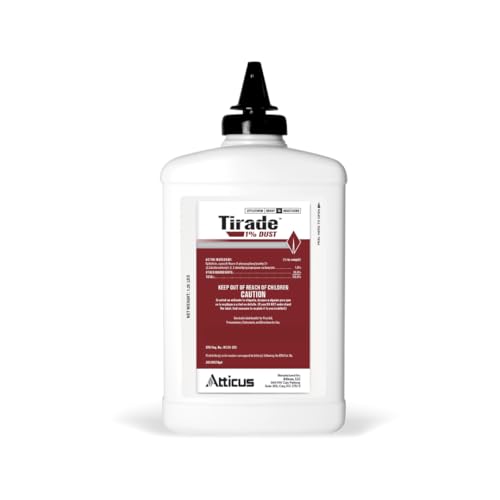
When an infestation is already inside the wood, traps will not stop the ongoing excavation. You need a dust that persists in the gallery, and the Atticus Tirade delivers a 1% cyfluthrin formulation that stays active for weeks inside dry timber. Because it is a powder rather than a liquid, it coats the bee’s exoskeleton on contact and is transported deeper into the tunnel as the bee moves, eventually reaching the brood chamber where larvae would emerge next season.
Multiple field reports confirm that a single dusting applied via a small puffer or bellows eliminated carpenter bee activity within 72 hours and prevented re-infestation for the remainder of the season. The 1.25-pound bottle holds enough material to treat roughly 30 to 40 tunnel openings, making it a mid-range value play that outperforms smaller aerosol cans on a per-application basis. The dust is also effective against wasps, hornets, ants, and roaches if you are treating a broader perimeter.
However, there are limitations. It is not for sale in Alaska, California, Hawaii, Puerto Rico, or Vermont due to state-level registration restrictions. And while the dust is low-odor, it is a synthetic insecticide—you should avoid blowing it into occupied living spaces or areas where pets forage. A duster tool is recommended for precise application into deep tunnels; you will need to purchase one separately.
Why it’s great
- Residual powder remains effective for weeks inside the tunnel void
- Controls carpenter bees plus wasps, ants, spiders, and roaches
- Low-odor formula that does not stain wood or paint
- Large 1.25-lb. bottle covers dozens of treatment sites
Good to know
- Requires a separate duster tool for deep tunnel injection
- Not registered for sale in five U.S. states
- Should not be used indoors where dust may circulate into HVAC
3. Spectracide Carpenter Bee & Ground-Nesting Yellowjacket Killer Foaming Aerosol (3 Pack)

Liquid sprays often fail against carpenter bees because the tunnel diameter is irregular—spray pools at the first bend and never reaches the brood chamber. Spectracide’s foaming aerosol solves this by expanding immediately upon injection. The foam travels around corners, fills the entire gallery, and suffocates any bee inside. This makes it the most effective single-product solution for a homeowner who discovers a new tunnel and wants immediate, guaranteed kill without waiting for residual action.
The three-pack provides 48 total fluid ounces of foam, which is enough to treat roughly 15 to 20 active tunnel entrances. The extension tube is narrow enough to insert directly into a typical half-inch round hole. One reviewer noted that the foam did not kill carpenter bees instantly on contact—the bees shook it off initially—but after three applications over the course of a week, the infestation was completely gone. This suggests that for heavy infestations, persistence matters more than single-shot knockdown.
On the downside, the foam is not a long-term preventative. Once it dries, it leaves no residual that deters future bees. You must reapply if new bees drill into the same wood the following spring. The foam also has a strong chemical odor during application, so you will want to wear a mask and ventilate the area.
Why it’s great
- Expanding foam reaches deep, zigzag tunnels that liquids cannot
- Extension tube fits standard half-inch carpenter bee holes
- Foam blocks the exit, trapping any bee inside the gallery
- Three-pack provides enough volume for heavy infestations
Good to know
- No long-term residual; bees can re-enter the same hole next season
- May require multiple applications for established colonies
- Strong chemical odor during and immediately after application
4. RESCUE! Carpenter Bee TrapStik (4 Pack)

Not every carpenter bee will enter a funnel trap. Some are too large, others simply do not navigate downward. The RESCUE! TrapStik uses VisiLure technology—a multi-dimensional pattern and bright green hue that mimics the visual cues of a nesting competitor—to attract bees directly onto a sticky surface. Once the bee lands, the adhesive is strong enough to hold the insect until it expires, typically within minutes. This design captures queens and workers from spring through fall without the bee ever needing to find a hole.
The four-pack is the highest-count option among the premium traps reviewed, and the per-unit cost is lower than most mechanical traps. Each TrapStik remains effective for roughly one full season when exposed to direct sun and wind, after which you replace the entire unit. The built-in glue guards create a barrier around the sticky face that reduces accidental catches of birds, butterflies, or lizards—a thoughtful touch for homeowners who want to target pests without collateral damage.
Some users report that the TrapStik catches more yellow jackets, paper wasps, and mud daubers than actual carpenter bees. This can be an advantage if your property has a mixture of stinging insects, but if your sole target is the large black-and-yellow carpenter bee, the mechanical trap may outperform it. The adhesive also becomes less effective in dusty environments or after heavy pollen seasons, so positioning it away from dirt roads and flowering plants extends its service life.
Why it’s great
- Visual lure catches bees that bypass funnel-style traps
- Glue guards prevent non-target animal captures
- Four-pack covers a large perimeter at a low per-unit cost
- No chemicals; safe to use near gardens and children
Good to know
- Adhesive degrades in dusty or pollen-heavy environments
- May catch more wasps than carpenter bees in mixed infestations
- Replacement required each season—not a long-term reusable
5. Bee-Quick Organic-Approved Beekeeper Tool

The Bee-Quick is not a carpenter bee repellent. It is an herbal-based repellent designed specifically to move honey bees out of super boxes during harvest, and the manufacturer explicitly warns against purchasing it for carpenter bee control. I include it here because it is commonly mis-bought by homeowners who search for “bee repellent” and see an organic-certified spray with good reviews, without reading the label.
This product is a sweet-smelling blend of natural oils that honey bees find aversive. Beekeepers apply it to a flannel board, place the board over the super, and the honey bees migrate downward to escape the scent, allowing the keeper to lift the box without smoking the colony. It works exceptionally well for that specific scenario. But carpenter bees are solitary tunnelers—they do not have a super to vacate, and a surface spray will not penetrate their tunnel.
For the homeowner who actually needs a carpenter bee solution, buying Bee-Quick is a costly mistake. It costs roughly the same as a mechanical trap but accomplishes nothing against Xylocopa virginica. My recommendation: pass this one over entirely unless you are a backyard beekeeper who also happens to have a honey bee swarm in a wall—in which case you still need a professional removal, not a spray.
Why it’s great
- Certified organic for USDA honey production
- Pleasant herbal scent; non-toxic to humans and bees
- Trusted by beekeepers for over 25 years
- Works fast on honey bees in super boxes
Good to know
- Not effective against carpenter bees at all
- Expensive for a product that does not solve the targeted problem
- Beekeeper-only use; misuse for carpenter bees wastes money
FAQ
Will a carpenter bee repellent kill the bees or just scare them away?
How long should I wait to seal the tunnel after treatment?
Why do carpenter bees keep coming back to the same spot every year?
Final Thoughts: The Verdict
For most users, the best carpenter bee repellent winner is the Best Bee Brothers Turbo Trap 2.0 because it provides season-after-season, chemical-free population suppression without requiring you to handle insecticides or reseal tunnels every spring. If you have active tunnels right now and need immediate kill, grab the Atticus Tirade 1% Cyfluthrin Dust and inject it directly into each hole with a duster. And for a quick knockdown of a small number of bees that avoids any dust or powder, nothing beats the Spectracide Foaming Aerosol—one shot fills the entire gallery and stops the excavation instantly.

Mo Maruf
I created WellFizz to bridge the gap between vague wellness advice and actionable solutions. My mission is simple: to decode the research and give you practical tools you can actually use.
Beyond the data, I am a passionate traveler. I believe that stepping away from the screen to explore new environments is essential for mental clarity and physical vitality.