Our readers keep the lights on and my smoothie glass nicely filled. As an Amazon Associate, I earn from qualifying purchases.
The most frustrating moment in 3D printing is watching a print fail because the first layer didn’t stick. That wasted filament and wasted time is exactly what auto leveling eliminates. Today’s machines use a sensor to probe the bed at multiple points, creating a digital height map the firmware uses to compensate for any unevenness in real-time. This means every print starts with a perfectly squished bead of plastic, no manual knob-twisting required.
I’m Mohammad Maruf — the founder and writer behind WellFizz. I’ve spent years analyzing the hardware specifications and real-world reliability data on dozens of FDM printers, focusing specifically on how their leveling systems actually perform under repeated use.
After analyzing nine of the most compelling models on the market, this guide breaks down which 3d printer with auto leveling matches your budget, build volume needs, and material ambitions.
How To Choose The Best 3D Printer With Auto Leveling
Auto leveling is a feature, not a brand. How it’s implemented — the sensor type, the number of probe points, and whether the printer also compensates for tilt — separates a good machine from a great one. Here are the three factors that actually matter.
Sensor Type: Inductive vs. Strain Gauge vs. Nozzle Touch
Inductive sensors are common on budget machines but require a metal build plate to work accurately, and they can be thrown off by textured surfaces. Strain gauge sensors (found on printers like the Creality K2 Plus) measure the pressure of the nozzle against the bed, giving a more direct reading. Nozzle-touch systems, like the one on the QIDI Q2, physically tap the bed with the hotend for the most precise measurement, but they add a few extra seconds to the leveling routine.
Build Volume: The Real Cost of Going Big
A larger build plate is harder to keep perfectly flat, which makes auto leveling more critical. Printers with a 256mm cube or smaller usually have excellent first-layer consistency. Jumping to a 350mm cube, like the Creality K2 Plus, requires a more robust leveling system with tilt compensation to handle the increased bed surface area. If you mostly print small parts, a compact machine like the Entina Tina2S is easier to keep dialed in.
Speed vs. Quality: When Auto Leveling Isn’t Enough
High-speed printers that push 500-600mm/s rely on input shaping and vibration compensation to maintain quality at those velocities. Auto leveling ensures the first layer sticks, but it doesn’t prevent ringing or ghosting on fast prints. Look for a machine that combines auto leveling with active flow rate compensation and vibration damping if you plan to print at the top end of the speed range. The Bambu Lab A1’s combination of full-auto calibration and active flow rate compensation is a standout example here.
Quick Comparison
On smaller screens, swipe sideways to see the full table.
| Model | Category | Best For | Key Spec | Amazon |
|---|---|---|---|---|
| Bambu Lab A1 | FDM Bed Slinger | Beginner/App Users | 10,000 mm/s² acceleration | Amazon |
| Bambu Lab P1S | CoreXY Enclosed | Production Prototyping | 500 mm/s, 20000 mm/s² | Amazon |
| FLASHFORGE Adventurer 5M | CoreXY Open | Entry-Level Speed | 600 mm/s, CoreXY | Amazon |
| ELEGOO Centauri Carbon | CoreXY Enclosed | Carbon Fiber Materials | 320°C Nozzle | Amazon |
| Anycubic Kobra S1 Combo | CoreXY Enclosed | Multi-Color Performance | Integrated Filament Dryer | Amazon |
| QIDI Q2 | CoreXY Enclosed | Engineering Materials | 65°C Heated Chamber | Amazon |
| Creality K2 Plus Combo | CoreXY Enclosed | Large Format | 350mm³ Build Volume | Amazon |
| Original Prusa MK4S | FDM Bed Slinger | Open-Source Reliability | Input Shaping | Amazon |
| Entina Tina2S | FDM Mini | Kids & Beginners | 200 mm/s, Dual Z | Amazon |
In‑Depth Reviews
1. Bambu Lab A1 3D Printer

The Bambu Lab A1 is the current benchmark for a truly hands-off printing experience. Its full-auto calibration system handles Z-offset, bed leveling, and flow rate compensation without any user intervention. The active flow rate compensation algorithm reads real-time extrusion data and adjusts on the fly, preventing over-extrusion blobs and under-extrusion gaps that plague less sophisticated printers.
With a 256mm cube build volume and a bed-slinger design that hits 10,000 mm/s² acceleration, it’s fast enough for most hobbyist workflows without the mechanical complexity of a CoreXY frame. The 1-Clip quick swap nozzle makes hotend changes a 10-second task, and the active motor noise canceling keeps it under 48 dB during operation.
Pairing it with the optional AMS Lite opens up multi-color printing, but even as a single-color machine, the A1 delivers exceptional reliability. The Bambu slicer ecosystem and mobile app make finding and slicing models trivial, which is why first-time buyers report success on their very first print.
Why it’s great
- Full-auto calibration eliminates all manual bed leveling
- Active flow rate compensation delivers consistent extrusion
- Quiet operation at ≤48 dB
Good to know
- Bed-slinger design limits top speed vs CoreXY
- AMS Lite for multi-color is an extra purchase
2. Bambu Lab P1S 3D Printer

The P1S takes the Bambu ecosystem and wraps it in a fully enclosed CoreXY frame. The auto bed leveling here is the same strain-gauge-based system as the A1, but the enclosed design means it can handle ABS and ASA without warping from drafts. The 500 mm/s top speed and 20,000 mm/s² acceleration make it a legitimate production tool.
Setup takes about 15 minutes out of the box, and the printer handles PLA, PETG, TPU, and PVA without profile tweaking. The ability to connect up to four AMS units for 16-color printing makes it the go-to for detailed multicolor parts. It’s essentially a mini-fridge-sized machine that delivers industrial print quality.
Reviewers consistently note that it outperforms printers costing significantly more. The auto-leveling routine is thorough but takes longer than some competitors; users report it scoring 98/100 for accuracy. If you need reliability at speed and are willing to pay for a proven enclosed system, the P1S is hard to beat.
Why it’s great
- Enclosed chamber enables high-temp material printing
- Up to 16 colors with multiple AMS units
- Set up and printing within 15 minutes
Good to know
- Auto-leveling routine is slower than some competitors
- Not recommended for carbon/glass fiber materials
3. FLASHFORGE Adventurer 5M 3D Printer

The Adventurer 5M packs a surprising amount of performance into a compact, open-frame CoreXY design. The one-click full-auto leveling uses a proximity sensor to map the bed, and the vibration compensation eliminates ghosting on fast prints. With a maximum speed of 600 mm/s and acceleration reaching 20,000 mm/s², it’s one of the fastest machines in its price tier.
The 50W heating power gets the 280°C nozzle to 200°C in 35 seconds, and the direct-drive extruder handles PLA, PETG, and TPU with a consistent 32mm³/s flow rate. The filament run-out sensor and power-loss recovery are welcome safety nets, and the dual-sided PEI steel plate provides strong adhesion for most materials.
Users report excellent first-layer consistency thanks to the auto-leveling system, though some have noted that the firmware can occasionally freeze during the calibration sequence. The open frame means you’ll want a stable surface and good ventilation, but for the combination of speed and auto-leveling reliability, this is a compelling entry point.
Why it’s great
- 600 mm/s CoreXY at a competitive price
- Rapid nozzle heating reduces wait time
- Vibration compensation for cleaner prints
Good to know
- Open frame requires a clean, draft-free space
- Some users report firmware stability issues
4. ELEGOO Centauri Carbon 3D Printer
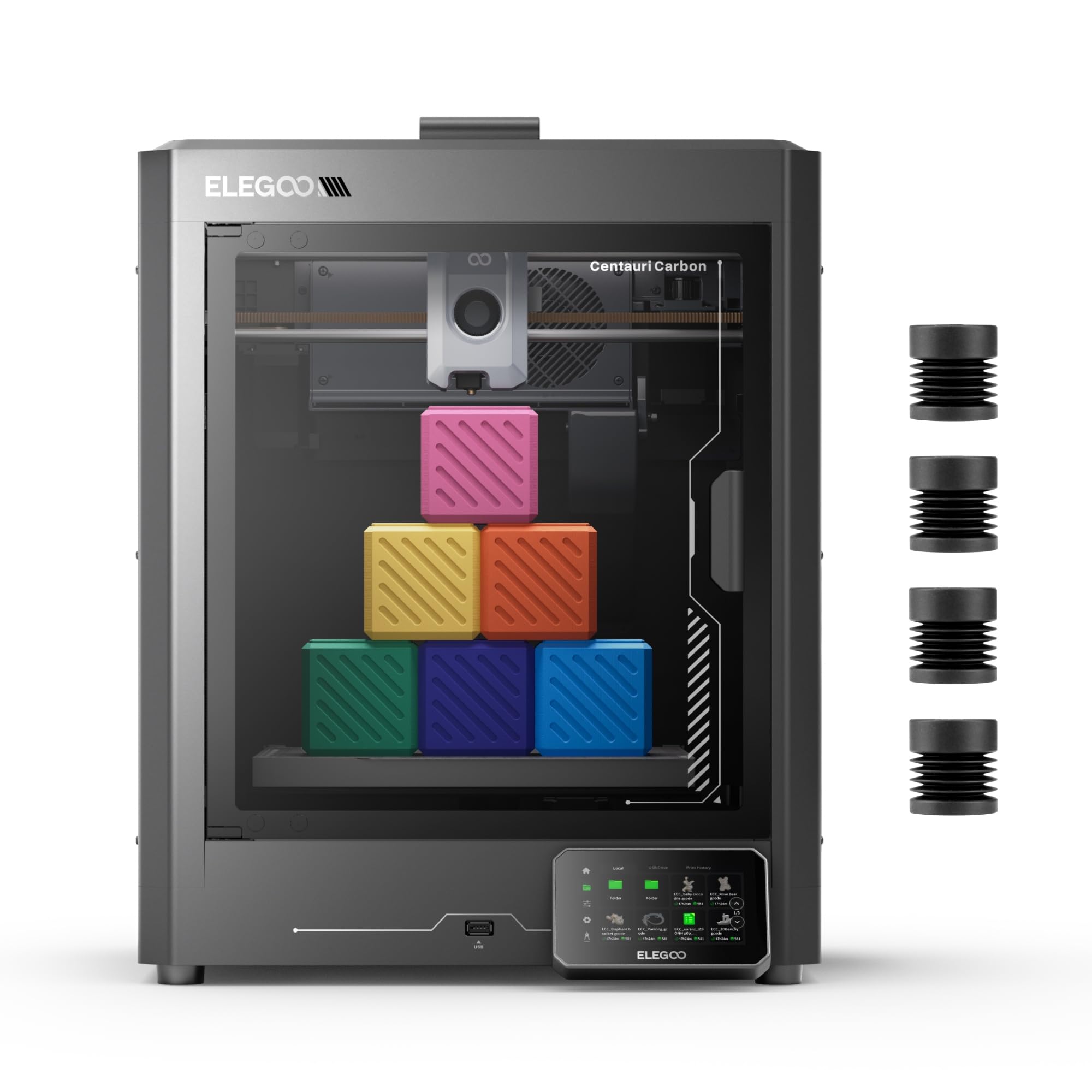
The Centauri Carbon arrives fully assembled with auto bed leveling pre-configured, meaning the first print can start minutes after unboxing. Its CoreXY structure supports 500 mm/s printing with 20,000 mm/s² acceleration, and the 320°C brass-hardened steel nozzle makes it ready for carbon fiber reinforced filaments right out of the box.
The die-cast aluminum frame provides the rigidity needed to maintain precision at high speeds, and the automatic vibration compensation pairs with the pressure advance algorithm to keep layers consistent. The built-in chamber camera and dual LED lighting allow real-time monitoring, and the time-lapse capture is a nice bonus for documentation.
Users report excellent print quality, with one noting that a 24-hour print on an older Ender 3 was reduced to just 5 hours on the Centauri Carbon. The dual-sided build plate with a PLA-specific surface provides excellent adhesion even at lower bed temperatures, which is a smart design choice for reducing warping on larger parts.
Why it’s great
- 320°C nozzle handles high-performance materials
- Die-cast frame minimizes vibration at high speeds
- Built-in camera and time-lapse support
Good to know
- Some early units experienced hotend communication errors
- Weight of 38.5 lbs requires a sturdy table
5. Anycubic Kobra S1 Combo 3D Printer
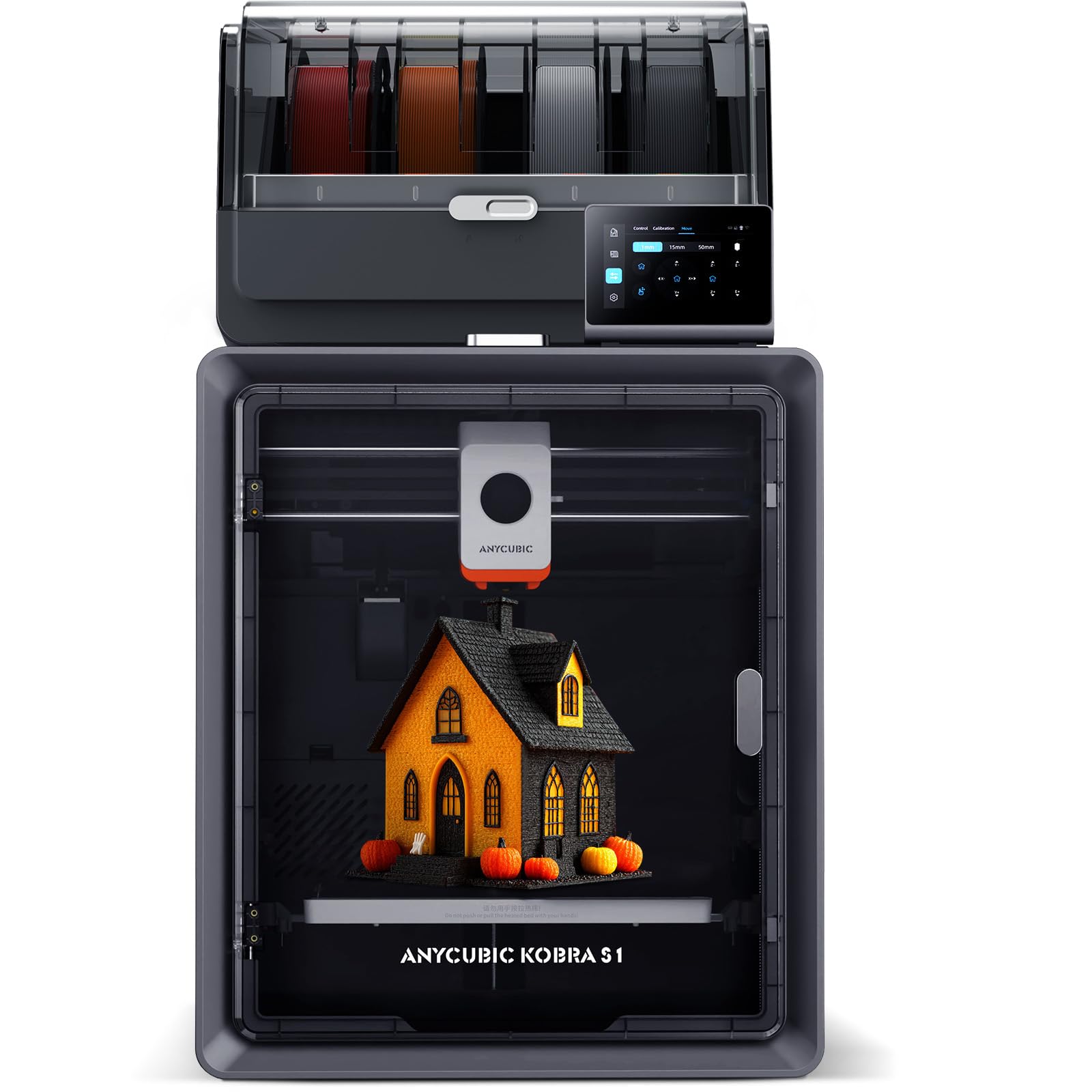
The Kobra S1 Combo distinguishes itself with the integrated ACE PRO filament dryer, which uses dual PTC heating and 360° hot air circulation to keep hygroscopic materials like PETG and TPU dry during printing. This is a feature usually reserved for much more expensive machines, and it directly improves print reliability by preventing moisture-induced popping and stringing.
The CoreXY frame hits 600 mm/s with 20,000 mm/s² acceleration, and the Anycubic OS handles flow compensation and auto-leveling through a nozzle-touch sensor. Combining two ACE PRO units unlocks eight-color printing, giving it flexibility that rivals systems costing significantly more. The Anycubic App allows one-click remote printing and multi-plate file parsing.
Build quality is excellent, with a full enclosure that stabilizes chamber temperature. Some reviewers reported initial units with error codes, but replacement units ran without issues for hundreds of hours. The ACE PRO dryer alone justifies the price for anyone who prints with moisture-sensitive filaments, as it eliminates a common failure point before the print even starts.
Why it’s great
- Integrated filament dryer prevents moisture-related failures
- True 600 mm/s in an enclosed CoreXY frame
- Expandable to 8-color printing
Good to know
- Some units shipped with hardware defects requiring replacement
- App-based control can feel limited for advanced users
6. QIDI Q2 3D Printer
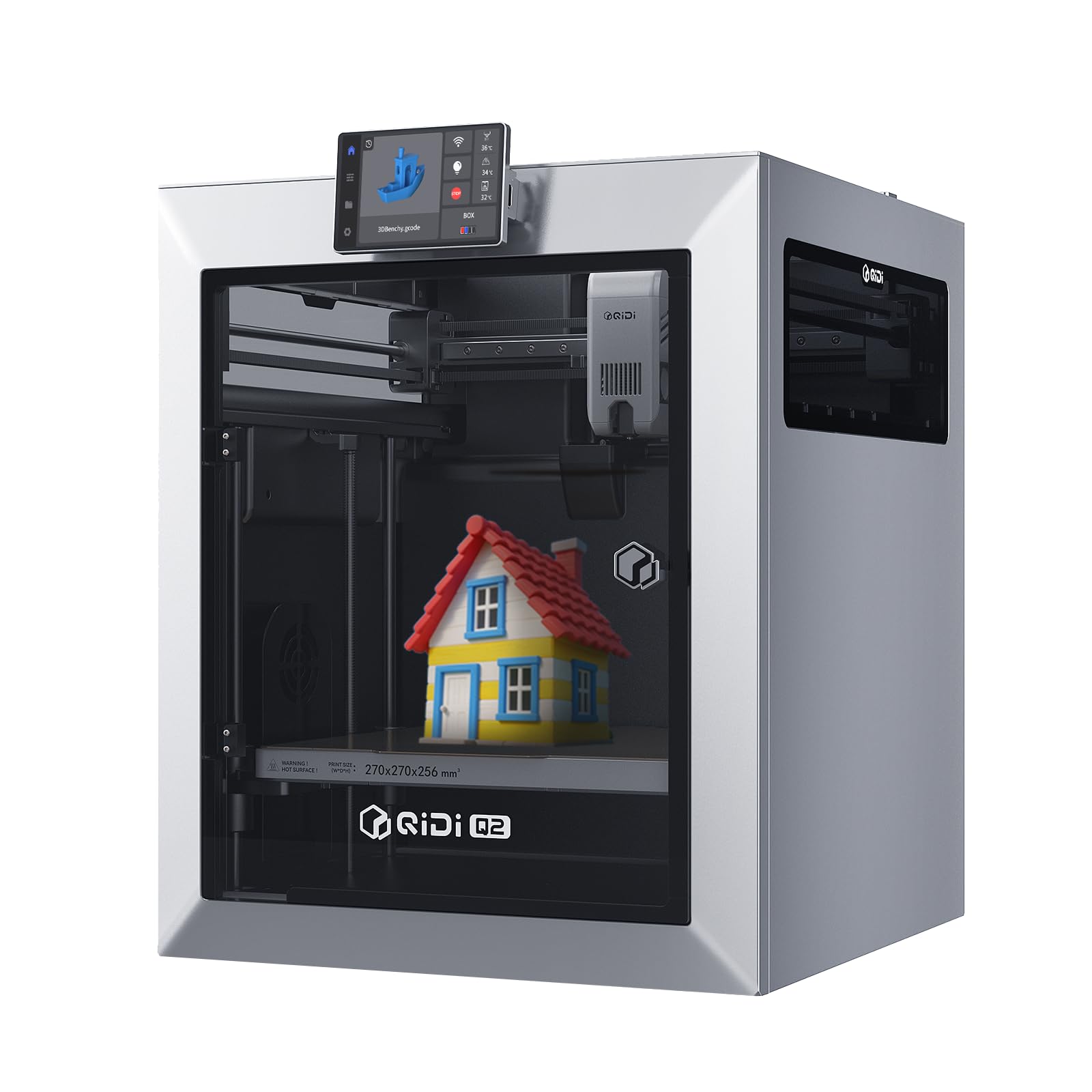
The QIDI Q2 is designed for users who need to print with high-temperature engineering materials like polycarbonate and nylon-carbon composites. Its second-generation PTC heated chamber maintains a steady 65°C, minimizing warping and ensuring strong interlayer adhesion. The auto-leveling system uses the nozzle itself as the sensor, physically tapping the bed for the most accurate height map possible.
The 370°C rated nozzle and full-metal CoreXY structure support 600 mm/s printing. The triple filtration system — G3 pre-filter, H12 HEPA, and activated carbon — makes it safe for indoor use even when printing with ABS or ASA. The AI camera provides real-time monitoring and spaghetti detection, and the 1.5GT synchronous belt reduces vibration artifacts for smoother surface finishes.
Reviewers consistently praise the out-of-box experience, with setup taking under 20 minutes. The ability to upgrade to 16-color multi-material printing via the QIDI BOX adds versatility. The only consistent complaint involves the AI spaghetti detection triggering false alarms, but this is a minor annoyance on an otherwise exceptional machine for the price.
Why it’s great
- Nozzle-touch leveling provides the most precise first layer
- 65°C heated chamber for warp-free engineering materials
- Triple filtration allows safe indoor use
Good to know
- AI spaghetti detection has occasional false positives
- Firmware updates can be inconsistent
7. Creality K2 Plus Combo 3D Printer

The K2 Plus Combo is a massive machine with a 350mm cube build volume, and its anti-tilt auto-leveling system is specifically designed to handle the challenges of a large bed. The dual independently motorized Z-axes automatically detect and reduce tilt, while the strain gauge sensor compensates for bed imperfections. This is not a simple three-point probe; it’s a sophisticated leveling system that accounts for bed flex.
The step-servo motor system delivers 30,000 mm/s² acceleration, making the K2 Plus one of the fastest large-format printers on the market. The Creality CFS (Creality Filament System) supports up to 16 colors by connecting four units, and the actively heated chamber enables printing with advanced materials like PPA-CF and PA-CF.
Users report excellent print quality with minimal setup, though the assembly instructions could be clearer. The printer is extremely heavy and loud during high-speed operation, so it needs a dedicated workspace. Some early units experienced communication failures due to loose cables, but support has been responsive in resolving these issues.
Why it’s great
- Anti-tilt auto leveling handles large-bed challenges
- 350mm³ build volume for oversized parts
- Step-servo motors achieve 30,000 mm/s² acceleration
Good to know
- Very heavy and loud during operation
- Early batches had QC issues with loose cables
8. Original Prusa MK4S 3D Printer

The Prusa MK4S represents the gold standard for open-source reliability. Its auto-leveling system uses a load cell integrated into the hotend, measuring the exact force of the nozzle against the bed. This provides highly repeatable first layers without needing to change any Z-offset settings, even when switching between different bed surfaces.
The addition of input shaping reduces ringing at higher speeds, though the MK4S isn’t trying to compete with the 500 mm/s CoreXY machines. It prioritizes print quality over raw speed, producing smooth surface finishes that require minimal post-processing. The open-source design means you can upgrade components over time, and the Prusa ecosystem — including the slicer and firmware — is consistently updated.
Users who assemble the kit version report a 3-day build process, but the result is a machine they understand intimately. The included 1kg spool of Prusament PLA gets you printing immediately, and the self-cleaning printhead reduces maintenance. For those who value long-term support and upgradability over raw specs, the MK4S is the clear choice.
Why it’s great
- Load-cell leveling ensures consistent first layers
- Open-source design allows long-term upgrades
- Superior surface finish with input shaping
Good to know
- Slower than similarly priced CoreXY printers
- Kit assembly takes significant time and focus
9. Entina Tina2S 3D Printer

The Entina Tina2S is designed specifically for absolute beginners and younger users. It arrives fully assembled and pre-calibrated, with a mini build volume of 3.9 x 4.7 x 3.9 inches that’s perfect for small toys, STEM projects, and keychains. The auto-leveling system is a simple induction probe that quickly maps the small bed, and the flexible spring steel plate makes part removal as easy as bending the plate.
The WiFi connectivity and Poloprint Cloud app provide access to over 1500 ready-to-print models, eliminating the step where most beginners get stuck: finding and slicing a file. It supports USB and TF card printing as well, and the dual Z-axis structure provides better stability than typical mini printers. The maximum speed of 200 mm/s is modest but appropriate for the size and target audience.
User reviews consistently mention quick setup and successful first prints, with the included preloaded TF card containing a frog model that prints in minutes. The printer is quiet and compact enough for a desk or classroom, and the enclosed structure adds a layer of safety for young users. It’s not a machine you’ll grow into for advanced materials, but as a learning tool, it’s excellent.
Why it’s great
- Fully assembled and pre-calibrated out of the box
- App-based control with 1500+ pre-sliced models
- Quiet, safe, and kid-friendly enclosed design
Good to know
- Small build volume limits large projects
- Slow speeds compared to entry-level CoreXY machines
FAQ
Does auto leveling completely eliminate first layer failures?
How many probe points should a good auto-leveling system use?
Will auto leveling help if my bed is physically warped or bent?
Final Thoughts: The Verdict
For most users, the 3d printer with auto leveling winner is the Bambu Lab A1 because it combines full-auto calibration with active flow rate compensation and a seamless user experience that eliminates virtually all beginner friction. If you need enclosed printing for ABS or advanced materials, grab the QIDI Q2 for its 65°C heated chamber and nozzle-touch leveling. And for large-format projects and multi-color prowess, nothing beats the Creality K2 Plus Combo.

Mo Maruf
I created WellFizz to bridge the gap between vague wellness advice and actionable solutions. My mission is simple: to decode the research and give you practical tools you can actually use.
Beyond the data, I am a passionate traveler. I believe that stepping away from the screen to explore new environments is essential for mental clarity and physical vitality.