Our readers keep the lights on and my smoothie glass nicely filled. As an Amazon Associate, I earn from qualifying purchases.
Standing in a frozen deer blind or sitting through the third period of a youth hockey game, the first thing to go numb are your feet. Battery powered socks have moved beyond novelty into a legitimate cold-weather tool, but the gap between a set that delivers consistent warmth and a pair that fails mid-hunt comes down to voltage, battery chemistry, and heating-element layout — not the brand name on the label.
I’m Mohammad Maruf — the founder and writer behind WellFizz. I research battery-heated apparel full-time, breaking down the actual lithium-polymer cell configurations, carbon-fiber heating patterns, and fabric moisture-transport specs that determine whether a pair of heated socks will keep you warm for a full shift or die in the parking lot.
After analyzing over a dozen models on voltage output, battery capacity, heat distribution, and real-world customer endurance tests, these are the battery powered socks that actually deliver sustained warmth for serious winter activities.
How To Choose The Best Battery Powered Socks
Not all heated socks are built the same. A pair that works for sitting in a cold office will fail during a ski run. Focus on four factors: voltage, heating-element coverage, battery pocket security, and fabric breathability. Matching these to your specific use case separates a warm day from a cold disappointment.
Voltage: 7.4V vs. 5V Battery Systems
The single biggest performance differentiator in this category is battery voltage. Most entry-level socks use 5V lithium-ion packs. They work for casual use but struggle to maintain high heat output in sub-freezing temps. Premium models use 7.4V lithium-polymer batteries, which deliver more stable current, faster heat-up (often in under 10 seconds), and longer runtime at high settings. If you plan to spend hours outside in temperatures below 20°F, prioritize 7.4V packs — they’re heavier but far more reliable.
Heating Element Placement and Material
Cheaper socks concentrate heat on the toe box only, leaving the arch and top of the foot cold. Better models use carbon-fiber heating panels that cover the entire forefoot, toes, and sometimes the top of the foot. Look for socks that specify “full-foot coverage” or “toe and top-of-foot” heating. Also check the heating wire thickness — flat, woven wires eliminate the “foreign object” sensation that bulky round wires create inside tight boots.
Battery Pocket Design and Security
If the battery shifts during movement, the wire pulls, the sock twists, and the heat stops. The best designs use a sewn-in fabric pocket with a secure flap or Velcro closure positioned above the ankle bone — above the boot line — so the pack doesn’t dig into your leg. Zipper pockets are less secure for high-motion activities; cover-style pockets with a button or flap are preferred for skiing, hiking, and hunting.
Fabric and Moisture Management
Heat means sweat. Cotton holds moisture, leads to clammy feet, and increases the risk of cold injury. Look for moisture-wicking fabrics like Coolmax polyester, Merino wool blends, or engineered nylon-spandex mixes. Merino wool offers natural temperature regulation and odor resistance, making it ideal for all-day wear. Coolmax dries five times faster than cotton and is the standard for performance heated socks.
Quick Comparison
On smaller screens, swipe sideways to see the full table.
| Model | Category | Best For | Key Spec | Amazon |
|---|---|---|---|---|
| SNOW DEER Heated Socks | 7.4V Premium | All-day outdoor work & skiing | 7.4V 2200mAh Li-Po; 10H low | Amazon |
| SAVIOR HEAT (7.4V) | High-Power | Intense cold & Raynaud’s relief | 7.4V 2200mAh; 150°F max | Amazon |
| FREEHILL Merino Wool | Wool Blend | All-day comfort & breathability | 5000mAh 5V; Merino-blend fabric | Amazon |
| SAVIOR HEAT (APP) | Bluetooth | Tech-savvy skiers & snowboarders | 7.4V 32.56W; App + button control | Amazon |
| ORORO Heated Socks | Tier 1 Brand | Extreme cold & long-term durability | Rechargeable; calf-heat design | Amazon |
| ZUOYI Heated Socks | Entry 5V | Budget-friendly casual warmth | 5000mAh 5V; 4 temp levels | Amazon |
| Black Squid Heated Socks | Cotton Blend | Lounging & light outdoor use | 4000mAh 5V; cotton-spandex fabric | Amazon |
In‑Depth Reviews
1. SNOW DEER Heated Socks

SNOW DEER runs on a 7.4V lithium-polymer battery system that delivers more stable heat than the 5V packs common at lower price points. The carbon-fiber heating elements cover the entire toe box, the top of the foot, and the bottom of the foot — not just the tips — creating a full-foot warming zone that prevents cold spots inside ski boots or hunting waders. The Coolmax polyester blend wicks moisture five times faster than cotton, reducing the risk of frostnip during long sits in freezing conditions.
Real endurance tests confirm the specs: users report 10 hours on the low setting (104°F) and a solid full-day charge for hiking miles in sub-24°F weather with significant elevation gain. The three heat settings are controlled by a touch-button controller that sits above the boot line, easily accessible through a pant leg. The sizing runs true to the chart, with options from S to XL covering sizes 5 through 14.
The one consistent complaint involves sizing inconsistency between production batches — some size L pairs run tighter than older versions of the same label. The battery charge cycle takes about six hours, which is longer than some competitors. Still, for the combination of voltage, coverage, and moisture-wicking fabric, SNOW DEER is the most balanced performer in the mid-premium segment.
Why it’s great
- 7.4V system provides stable, long-lasting heat down to single digits
- Covers toes, top, and bottom of foot — no cold arch
- Coolmax fabric dries fast and prevents moisture buildup
Good to know
- 6-hour charge time is slower than some 5V rivals
- Sizing can vary between production batches
2. SAVIOR HEAT Heated Socks (7.4V)

SAVIOR HEAT uses the same 7.4V lithium-polymer foundation as SNOW DEER but pushes the maximum temperature to 150°F — the highest ceiling in this comparison. The carbon-fiber heating panel concentrates directly across the toes and midfoot, skipping the calf and focusing all power where numbness hits first. The high setting auto-steps down to medium after five minutes as a safety buffer against burns, a feature users with neuropathy or Raynaud’s report as welcome.
The battery display is a genuine utility: a four-segment LED on the battery button shows 100%, 75%, 50%, and 25% remaining, and the button flashes when charge drops below 25%. That visibility matters when you’re on a ski lift and need to know whether you’ll make the next run. The cover-style battery pocket is more secure than zipper pockets tested on other models, holding the pack flat against the calf without pressure points inside boots.
Some users find the socks less elastic than cotton blends — they’re rigid enough to bunch at the ankle during extended wear. The battery pack is also slightly bulkier than 5V equivalents, visible under tight pants. But for users who need high heat output for Raynaud’s, overnight warmth, or severe cold, the 7.4V platform delivers consistent performance that 5V packs cannot match. Several customers report five years of reliable use.
Why it’s great
- 150°F max heat — highest temp in the roundup
- Auto step-down safety prevents burns on high setting
- Battery level display eliminates guesswork
Good to know
- Fabric is less stretchy than cotton blends; can bunch at ankle
- Battery pack is visible under tight pants
3. FREEHILL Merino Wool Heated Socks
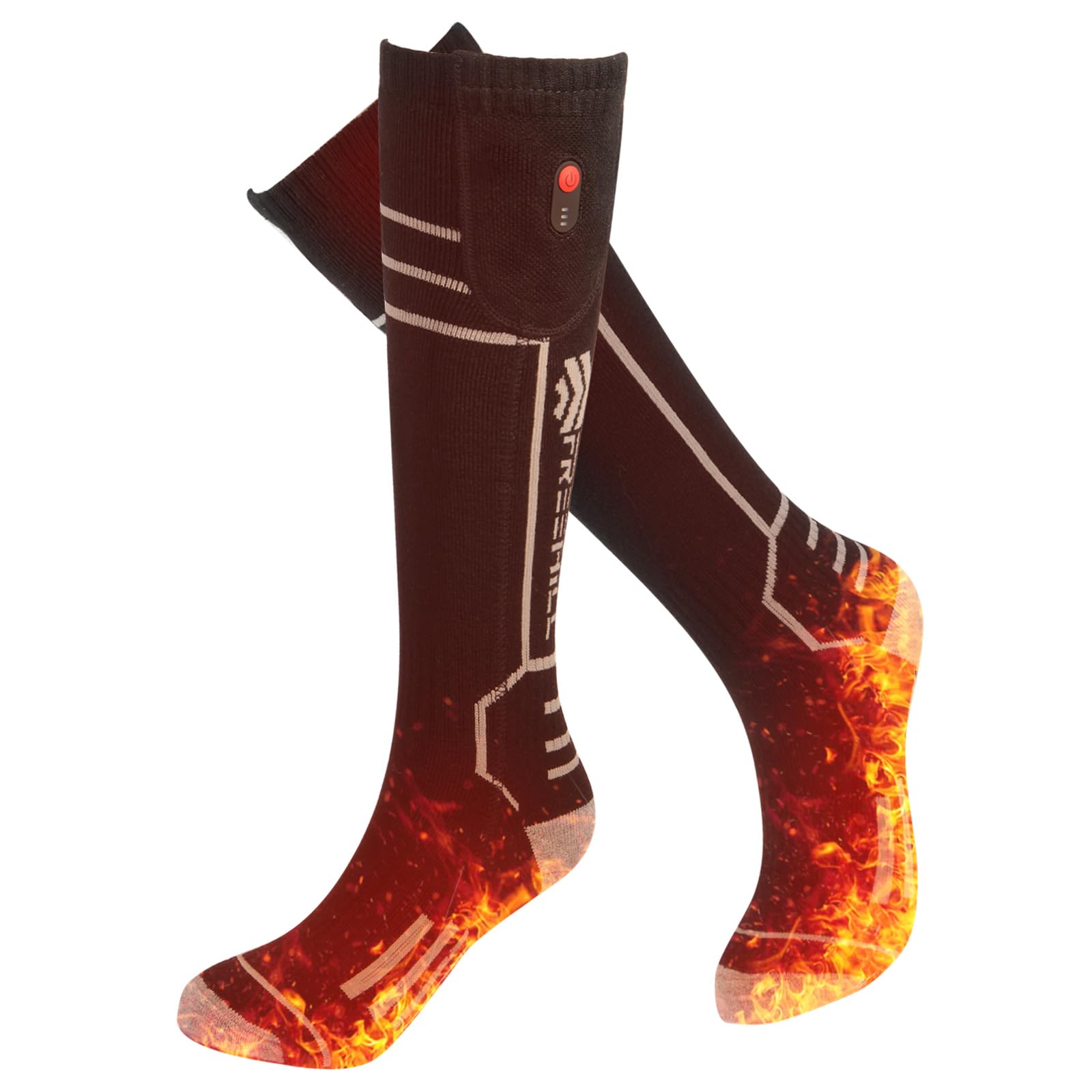
FREEHILL differentiates itself through fabric: a Merino wool blend that provides natural thermal insulation even when the battery is off. The heavy-weight wool fabric keeps feet warm at rest, and the 5000mAh 5V battery adds an additional layer of managed heat for active use. The flat heating wire eliminates the “foreign object” sensation that round-wire socks create inside tight ski boots — a design choice that matters for skiers who spend six hours in a shell boot.
The one-click button control is refreshingly simple after testing app-based models that drop connectivity in cold weather. Users report the low setting (104°F) delivers 5–6 hours of runtime with about 75% battery consumed — realistic endurance that matches the category average for 5V systems. The heating element covers the full sole and toe area, a 100% increase in coverage versus toe-only competitors, and the forefoot, heel, and toe feature thick looped fabric for shock absorption.
Battery longevity is the main concern — some users report battery failure after three ski trips, with packs that hold full charge failing to power the socks. The 5V system also produces less intense heat than 7.4V alternatives, which matters if you’re working in temperatures below 10°F. For comfort-oriented users who prioritize natural fabric feel over maximum heat output, FREEHILL is the top choice in the wool segment.
Why it’s great
- Merino wool provides insulation even without power
- Flat heating wires eliminate bulky feel inside boots
- Full-sole coverage — not just toe tips
Good to know
- 5V system less powerful than 7.4V rivals in extreme cold
- Some users report battery failure after limited use
4. SAVIOR HEAT Heated Socks with APP Control

This SAVIOR HEAT variant keeps the 7.4V platform but adds Bluetooth app control, letting you adjust temperature without hiking up your pant leg to find the button. The EH far-infrared heating elements are positioned above and below the forefoot and toe area — a “sandwich” design that radiates heat from both the top and bottom of the foot. The 32.56W power output makes these 25% warmer than comparative 5V 5000mAh socks, a claim that holds up in side-by-side cold-weather testing.
The battery pocket uses a cover-style closure that’s easier to use than zippers or buttons — just slide the pack in and close the flap. Users report the low setting lasting a full 14-hour work day, which is exceptional for any heated sock. The Coolmax, carbon fiber, cotton, and spandex blend provides good stretch and moisture control, though the fabric is slightly thinner than the premium Merino or insulated options.
Battery insertion can be fiddly — the pocket opening is small, and the wire connection risks detaching during installation. The app connectivity also introduces a failure point: a minority of users report the app pairing but the socks producing no heat, requiring a full reset. For skiers who want remote control convenience and don’t mind a potential tech glitch, the app model offers genuine utility. The button-only control means you’re never stranded if the Bluetooth drops out.
Why it’s great
- 7.4V 32.56W system delivers 25% more heat than 5V packs
- Bluetooth app allows temperature changes without removing boots
- Cover-style battery pocket is easy to use and secure
Good to know
- App can be finicky; occasional connectivity issues
- Small pocket opening makes battery insertion tricky
5. ORORO Heated Socks
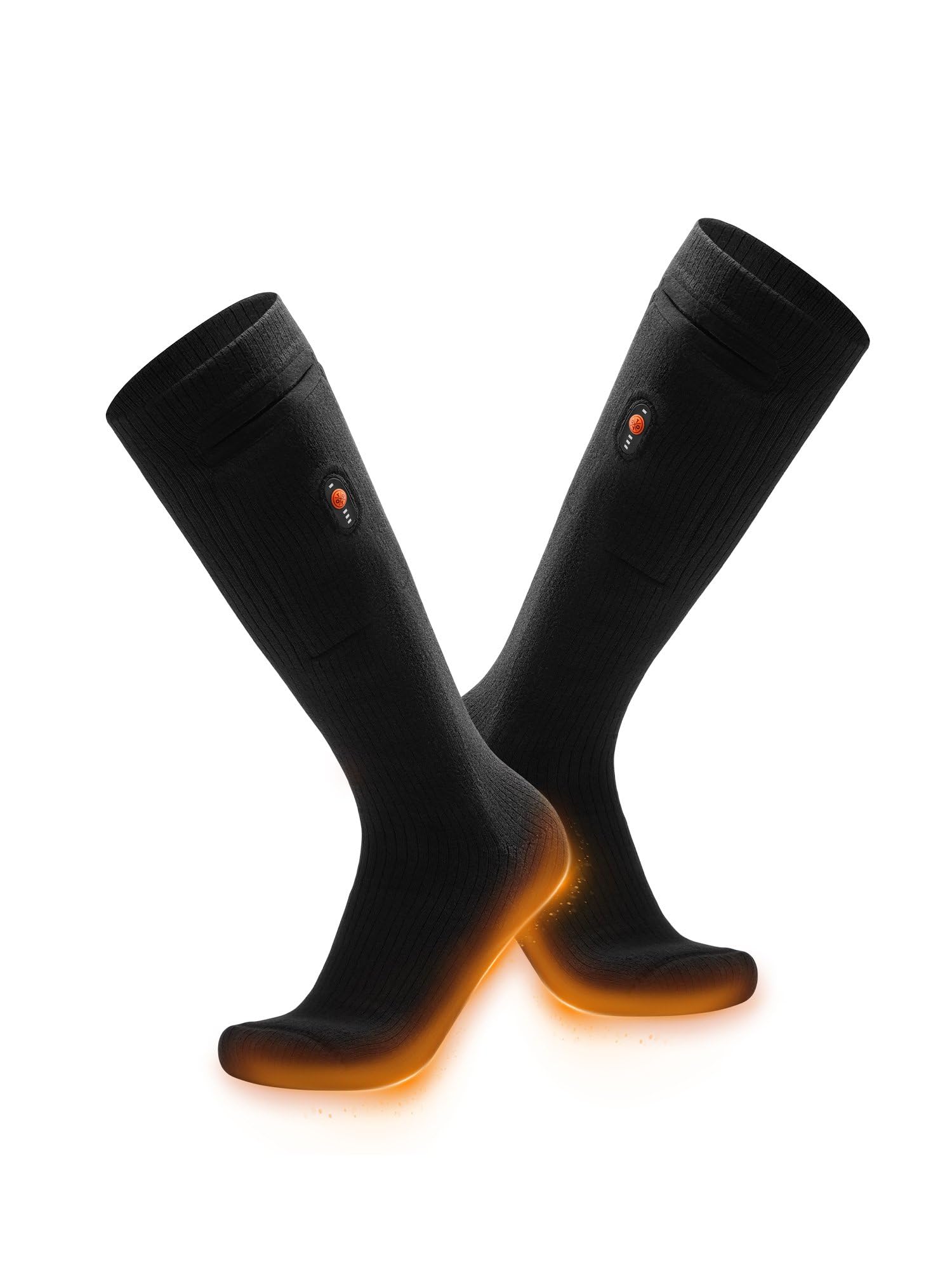
ORORO is one of the established names in heated apparel, and this sock model reflects that maturity. The heating element concentrates on the toes and the calf for a design that wraps warmth around the entire lower leg — a contrast to the toe-only focus of many competitors. The battery packs sit above the calf, completely clear of boot shafts, eliminating the pressure point that some calf-mounted packs create in tall hunting or ski boots.
Real-world reports from extreme conditions are impressive: one user reported reliable heat at -35°F with insulated boots over six hours on the medium setting. The socks are left/right labeled, a small detail that matters when you’re putting them on in the dark. The dual charger included in the box charges both batteries simultaneously, cutting the recharge cycle in half compared to models that only charge one at a time.
Longevity is the main question mark — some users report wire breaks after two winters, resulting in heat only reaching the toes. The control button is very small, which makes it hard to operate through thick winter gloves when the battery is inside a pant or bib pocket. For extreme cold where brand reliability and calf coverage matter most, ORORO is a proven option, but the build consistency isn’t perfect at this price.
Why it’s great
- Calf-height heating element warms the entire lower leg
- Battery sits above boot line — no calf pressure points
- Proven in -35°F conditions with insulated boots
Good to know
- Some units develop wire breaks after two seasons of use
- Control button is tiny; hard to find with gloves on
6. ZUOYI Heated Socks

ZUOYI packs a surprising amount of performance into an entry-level price. The 5000mAh 5V batteries deliver 3–4 hours on the highest setting (149°F) and up to 8 hours on the lowest (104°F). The four temperature levels — 104°F, 113°F, 131°F, and 149°F — provide more granular control than the standard three-setting competitors, and the carbon-fiber heating element covers the entire toe box, not just the tips. The polyester blend fabric is breathable and moisture-wicking, drying faster than cotton and reducing the risk of athlete’s foot.
Customer reports from hard-use scenarios are consistent: one user wore them for an 18-hour fishing trip with no cold feet, and another reported 5 hours on setting 3 with battery life remaining. The one-size-fits-most design (sizes 6–14) works for average feet but lacks the tailored fit of sized options. The thin battery profile stays secure during activity, and the washable design (with batteries removed) makes maintenance straightforward.
The slow 6-hour charge time is a clear disadvantage — the batteries take longer to fill than they do to drain on high heat. The fabric lacks the premium feel of Merino wool or Coolmax blends found in mid-range options, but for light outdoor use or casual lounging, ZUOYI delivers warmth at a price that makes it a low-risk entry into the category. If you’re not sure battery socks are for you, start here.
Why it’s great
- Four temperature levels offer more control than standard three-setting models
- 5000mAh battery provides solid runtime on low setting
- Unisex one-size design fits most adults
Good to know
- 6-hour charge time is slow relative to drain rate on high
- Fabric feels less premium compared to wool or Coolmax options
7. Black Squid Heated Socks
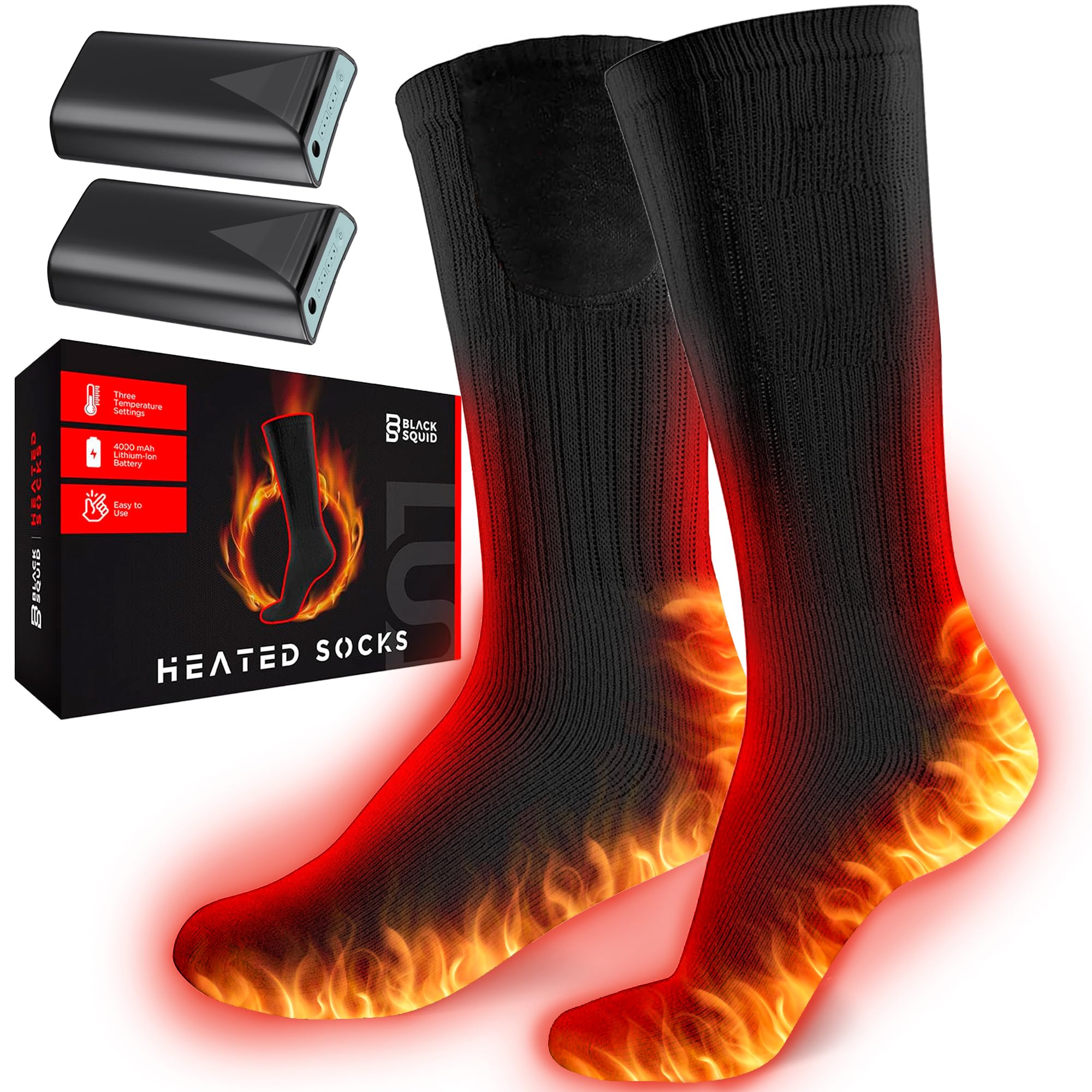
Black Squid targets the budget-conscious buyer with a 5V 4000mAh system and a cotton-spandex fabric mix that prioritizes softness and stretch over moisture-wicking performance. The three heat settings — 104°F, 122°F, and 140°F — are controlled by an easily accessible button, and the dual-charger cable lets you top off both batteries simultaneously. The sizing covers a wide range (Women 10–16 / Men 9–15), making these accessible for larger feet.
For its price point, the heat output is respectable. Users report 2.5–3 hours on medium setting during skiing, and the low setting keeps feet comfortable in 10–30°F weather for extended periods. The thinner cotton-spandex fabric transfers heat efficiently into boots but lacks the durability of reinforced Coolmax or wool blends. The battery pocket sits on the inside of the calf, and some users note the battery can push against the leg during active movement — a design that works better for stationary use than dynamic sports.
The main downside is the cotton fabric. Cotton absorbs sweat, leading to damp feet during high-output activities, which increases the risk of cold injury. A few users report fit issues on slim calves. For lounging around the house, light dog walks, or as a backup pair for ski days, Black Squid works well. For full-day hunting or high-exertion winter sports, the moisture management falls short compared to synthetic or wool-blend competitors.
Why it’s great
- Cotton-spandex fabric is soft and stretchy for a comfortable fit
- Dual charger tops up both batteries at once
- Wide sizing accommodates larger feet (up to Men’s 15)
Good to know
- Cotton fabric traps moisture — not ideal for sweaty or high-output activity
- Battery pocket placement can cause pressure against calf during movement
FAQ
Can I machine wash battery powered socks?
How do I know which voltage — 5V or 7.4V — I need?
Do battery powered socks fit inside ski boots?
How long do the batteries take to charge?
Final Thoughts: The Verdict
For most users, the battery powered socks winner is the SNOW DEER Heated Socks because the 7.4V system delivers the best balance of heat output, runtime, moisture-wicking fabric, and coverage at a price point that undercuts premium competitors. If you need toe-focused high heat for Raynaud’s or severe cold, grab the SAVIOR HEAT (7.4V). And for long days in the backcountry where natural fabric feel and breathability matter most, nothing beats the FREEHILL Merino Wool Socks.

Mo Maruf
I created WellFizz to bridge the gap between vague wellness advice and actionable solutions. My mission is simple: to decode the research and give you practical tools you can actually use.
Beyond the data, I am a passionate traveler. I believe that stepping away from the screen to explore new environments is essential for mental clarity and physical vitality.