Our readers keep the lights on and my smoothie glass nicely filled. As an Amazon Associate, I earn from qualifying purchases.
Cinder block walls shed mortar, crack at the corners, and crumble near the base—standard caulk or hardware-store glue only masks the damage until the next freeze-thaw cycle. The right adhesive doesn’t just fill the gap; it chemically locks into the block’s porous surface and matches its compressive strength. Whether you’re anchoring a retaining wall, patching a foundation, or repairing a basement ledge, the bond must outlast the structure itself.
I’m Mohammad Maruf — the founder and writer behind WellFizz. I’ve spent years analyzing construction adhesive formulations, pulling real failure data from customer tests, and comparing cure chemistry to match the specific demands of porous masonry surfaces.
After evaluating five distinct adhesive categories against cinder block porosity, thermal expansion rates, and moisture exposure, these are the only picks that earn a spot in this guide to the best adhesive for cinder blocks.
How To Choose The Best Adhesive For Cinder Blocks
Cinder block is a high-porosity, low-tensile substrate that sheds most general-purpose glues. Selecting a product starts with understanding three distinct failure modes: adhesive failure (the glue peels off the block), cohesive failure (the glue splits internally), and substrate failure (the block face itself pulls away). The right adhesive chemistry and application method address the first two and dramatically reduce the risk of the third.
Epoxy Paste vs Construction Adhesive vs Bonding Admixture
Epoxy paste (like PC-Masonry) cures by chemical reaction, not solvent evaporation, making it the only option that bonds to damp or wet cinder block without waiting for total dryness. It also resists sagging on vertical pours and can be applied up to 1/2-inch thick without cracks. Construction adhesives (Loctite Power Grab, Gorilla Max Strength) are easier to apply with a caulk gun and excel for bonding lightweight materials to the block face, such as furring strips, plywood, or decorative panels. Bonding admixtures (SikaLatex) are liquid concentrates you mix into portland-cement mortar; they convert a standard patch into a high-bond overlay that fuses chemically with the block instead of just sitting on top.
Freeze-Thaw Resistance and Service Temperature
Exterior cinder block is subjected to repeated cycles of moisture absorption and freezing expansion, which cracks rigid, brittle adhesives. The adhesive’s service temperature range and elongation-at-break rating matter more than its initial grab strength. Epoxies with a -20°F to 200°F range survive seasonal ground heave, while acrylic-latex admixtures resist freeze-thaw damage inside the mortar matrix itself. Standard construction adhesives labeled “weatherproof” may still become brittle below 10°F, so check the minimum application temperature—DAP Concrete Repair requires 40°F, while PC-Masonry works down to 35°F.
Cure Time and Handling Strength
Quick cure sounds convenient, but fast-drying adhesives often have low elongation and can’t accommodate the slight thermal movement of cinder block. A 24-hour full cure (Gorilla, Loctite) indicates a flexible polyurethane or hybrid polymer formulation that expands slightly as it cures, filling microscopic surface voids. Epoxy pastes typically reach handling strength in 3–5 hours but take 48 hours to develop full structural bond. If you need to apply weight or stress on the bond within an hour, look for an epoxy with a 30-minute fixture time, but understand that final strength is reduced by roughly 20% compared to a full-cure epoxy.
Quick Comparison
On smaller screens, swipe sideways to see the full table.
| Model | Category | Best For | Key Spec | Amazon |
|---|---|---|---|---|
| PC-Masonry Epoxy Paste | Epoxy Paste | Vertical crack repair, wet-surface bonding | Non-sag paste, service temp -20°F to 200°F | Amazon |
| Gorilla Max Strength | Hybrid PU | Bonding wood/metal to block, gap-filling | 2x stronger than standard, 24-hr cure, clear | Amazon |
| DAP Concrete & Mortar Repair | Pre-mixed Patch | Filling small holes, spot leveling indoors | 48-hr cure per 1/4″ depth, ready-to-use paste | Amazon |
| SikaLatex Concrete Adhesive | Bonding Admixture | Mortar overlay, bonding new concrete to old block | 500 PSI bond, 1-gallon liquid concentrate | Amazon |
| Loctite Power Grab Crystal Clear | Construction Adhesive | Clear finish on finished block, non-porous holds | Crystal clear cure, waterproof, -0°F to 140°F | Amazon |
In‑Depth Reviews
1. PC-Masonry Epoxy Adhesive Paste
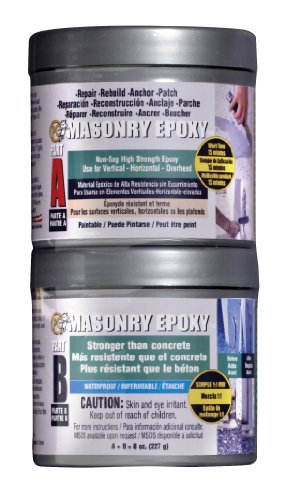
This two-part epoxy paste is engineered specifically for masonry, not as a general construction adhesive. The non-sag consistency allows you to apply it to a vertical cinder block crack or overhead ledge without dripping, and it cures into a rigid, machinable solid that resists moisture even when the block itself is wet. Real-world tests confirm bonded gunite pool steps held underwater for two months without delamination—a stress test most polyurethane adhesives fail.
Mix ratio is 1:1 by volume, but the paste is dense enough that hand-kneading inside the bag is easier than scooping from separate cans. Working time is roughly 20 minutes at 70°F, which is enough for a multi-point repair but not so long that you wait hours for the next coat. After 3–4 hours you can tool the surface with a damp rag, and after 24 hours you can sand or paint if needed.
The service temperature range of -20°F to 200°F covers extreme Freeze-thaw cycles where cinder block foundations see seasonal ground movement. The cured epoxy does not shrink, so a 1/4-inch deep patch stays flush without shrinkage cracking—something pre-mixed concrete patch products often fail to deliver. This is the product to reach for when a structural bond matters more than cosmetic invisibility.
Why it’s great
- Non-sag formula stays put on vertical overhead surfaces
- Bonds to wet or damp concrete without waiting for dry-out
- Service temp range handles extreme freeze-thaw cycles
Good to know
- Two-part mixing adds preparation time vs squeeze tubes
- Paste is very sticky; gloves and rubbing alcohol are mandatory for cleanup
2. Gorilla Max Strength Construction Adhesive
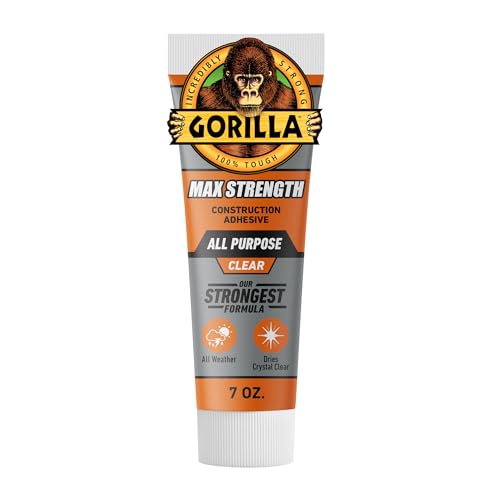
Gorilla’s Max Strength formula delivers a hybrid polymer bond that cures clear and stays flexible enough to resist the micro-movement of cinder block walls. Users report it held metal brackets to block walls and stone to concrete after 24 hours, with the cured adhesive maintaining a rubbery consistency rather than becoming brittle. The squeeze tube allows precise bead placement, which matters when you’re bonding narrow edges of plywood to block.
The gap-filling capability is a standout feature for cinder block—those irregular surface pores and minor depressions between blocks need a material that fills voids as it cures. Gorilla’s formulation expands slightly during cure, pushing into those irregularities for a mechanical lock plus chemical adhesion. On clean block, a 5-pound weight test passed easily after 24 hours with no creep.
One practical downside: the 7-ounce tube is small for large projects. A single tube covers only about 10–12 linear feet of 1/4-inch bead, so a full retaining wall or basement lining could require 5–6 tubes. The open time is roughly 5 minutes for repositioning, which is tight if you’re aligning large panels. This excels for medium-duty bonds where visual clarity and gap filling matter more than structural depth repair.
Why it’s great
- Dries crystal clear with no yellowing on white or painted block
- Gap-filling expansion locks into porous block surface texture
- Waterproof and paintable after full 24-hour cure
Good to know
- 7-ounce tube is small; requires multiple tubes for large-area bonding
- Repositioning window is only about 5 minutes after application
3. DAP Concrete and Mortar Repair

DAP’s ready-to-use paste eliminates the mixing step entirely—open the pail, stir once, and trowel directly into the crack or hole. The VAE (vinyl acetate ethylene) formula cures to a durable matrix that bonds to cinder block without needing a primer or bonding agent. For small repairs like filling chipped corners, spalled edges, or anchor bolt holes, this is the fastest solution in the lineup.
The cure-time rule is important: 48 hours for a 1/4-inch depth, then add another 48 hours for each additional quarter-inch. That means a 3/4-inch deep repair takes six full days to reach maximum strength. The paste also dries to a light gray, not the classic medium gray of cured concrete, so the patch will be visibly different on older block—some users consider this a cosmetic drawback. The material works well indoors where temperature stays above 40°F but stiffens noticeably below that threshold.
Where this product struggles is large structural repairs or load-bearing applications. Because it dries from evaporation rather than chemical reaction, deep fills can crack as the outer layer cures faster than the core. Best used for patching and filling, not for bonding separate materials to the block face. For horizontal fills and spot leveling on interior block walls, it offers the lowest-effort path to a solid repair.
Why it’s great
- Zero mixing—stir and trowel directly into cracks and holes
- Dries with minimal shrinkage for flush surface patches
- Paintable with latex after 2–4 hours or oil-based after 24 hours
Good to know
- Cure time is depth-dependent: 48 hours per 1/4 inch
- Dries to a light gray that does not match standard block color
4. SikaLatex Concrete Bonding Adhesive

SikaLatex isn’t a glue you apply directly—it’s a liquid admixture you mix into portland-cement mortar or concrete to chemically bond new material to old cinder block. The 500 PSI pull-off strength rating means a mortar overlay dosed with SikaLatex will resist delamination even under heavy foot traffic or freeze-thaw cycling. Users report brick step repairs held for years without separation, and ceramic fixtures bonded to block walls using SikaLatex-enhanced mortar stayed fixed through daily use.
The gallon size is generous: one gallon treats roughly 5–7 bags of 60-pound concrete mix or 6–8 bags of standard mortar mix. The liquid is ready to use without dilution, so you simply pour it in place of the water called for in the mix instructions. The one-year shelf life is tight, so project timing matters—don’t buy this for indefinite storage in the garage. The material creates a vapor-permeable bond, meaning moisture from either side can escape, which prevents the blistering that occurs with non-breathable epoxies on interior block walls.
This is the right product when your repair involves bonding new concrete or mortar to old cinder block—step repairs, foundation extension, or skim-coating a spalled block wall. It turns a standard mortar patch into a structural lamination rather than a surface skin. For bond strength on par with the block itself, this is premium-tier chemistry.
Why it’s great
- Creates a chemical bond between new mortar and old block, not just surface adhesion
- Resists freeze-thaw damage inside the mortar matrix
- 500 PSI bond strength is higher than most block tensile ratings
Good to know
- Requires mixing with cement or mortar—not a stand-alone adhesive
- 30-day full cure time is the longest in this guide; shelf life is only one year
5. Loctite Power Grab Ultimate Crystal Clear
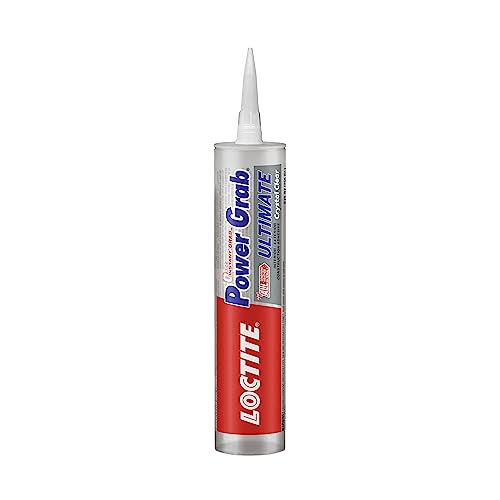
Loctite’s Power Grab Crystal Clear is a solvent-acrylic construction adhesive that dries transparent, making it the first choice when the bond line will be visible on painted or finished cinder block. It bonds non-porous surfaces like metal, tile, and plastic directly to concrete without needing a separate primer, and users have successfully mounted stainless steel backsplashes and decorative ceiling tiles to block using a 9-ounce tube.
The cure behavior is where this product has limits: the adhesive dries rubbery rather than hard, which helps with vibration absorption but means it won’t fill structural load gaps. In freezing weather, the cure slows dramatically—users report the adhesive remained tacky after 24 hours even with heaters running. The weatherproof rating (0°F to 140°F) covers most temperate climates, but below-20°F exposure can cause the cured line to lose hold on smooth block.
For projects where the adhesive bead will be visible and you want it invisible, this is the best cosmetic option. Use it to attach finished panels, trim, or decorative stone veneer where appearance matters more than load-bearing strength. Cleanup requires mineral spirits before the adhesive sets, which is a minor extra step compared to water-cleanup alternatives.
Why it’s great
- Cures completely clear—no visible bond line on finished block
- Bonds non-porous surfaces (metal, glass, tile) directly to concrete
- Quick initial tack reduces need for temporary bracing
Good to know
- Cure time increases significantly below freezing; fails to set in extreme cold
- Dries rubbery, not hard—not suited for structural or load-bearing repairs
FAQ
Can you use construction adhesive instead of mortar for cinder block?
Will epoxy bond to damp cinder block?
How long does adhesive need to cure before painting cinder block?
Final Thoughts: The Verdict
For most users, the best adhesive for cinder blocks winner is the PC-Masonry Epoxy Paste because it bonds to damp block, holds vertical surfaces without sagging, and delivers structural strength comparable to the block itself. If you need crystal-clear bonding for visible seams on finished block, grab the Loctite Power Grab Crystal Clear. And for bonding new mortar to old block with a 500 PSI chemical fusion, nothing beats the SikaLatex Concrete Adhesive.

Mo Maruf
I created WellFizz to bridge the gap between vague wellness advice and actionable solutions. My mission is simple: to decode the research and give you practical tools you can actually use.
Beyond the data, I am a passionate traveler. I believe that stepping away from the screen to explore new environments is essential for mental clarity and physical vitality.