Our readers keep the lights on and my smoothie glass nicely filled. As an Amazon Associate, I earn from qualifying purchases.
Walking the Camino de Santiago means carrying your entire world on your back for 30-plus days across cobblestones, gravel, and Roman roads. The wrong pack turns a spiritual journey into a orthopedic disaster — shoulder pain, sweaty backs, and blisters from an unstable load are the top reasons pilgrims quit early. A pack designed for this gauntlet needs a ventilated suspension, a sub-3.5-pound frame, and a capacity between 26 and 46 liters to balance weight distribution with enough room for a sleeping bag liner and three changes of clothes.
I’m Mohammad Maruf — the founder and writer behind WellFizz. I’ve spent the last two years analyzing load-transfer geometry, backpanel airflow channels, and hipbelt padding density across 60-plus hiking packs to isolate what actually works for multi-week pilgrimage carry.
This guide breaks down nine packs that have the suspension, ventilation, and durability to carry you from the Pyrenees to Santiago de Compostela without breaking your stride. My goal is to help you find the absolute best backpacks for camino de santiago based on real-world feedback and measurable specs, not marketing claims.
How To Choose The Best Backpacks For Camino De Santiago
Selecting a pack for the Camino is different from picking one for a weekend car-camping trip. You’ll walk 12 to 18 miles a day, often in 85°F heat with afternoon downpours. The pack must ventilate your back, transfer weight to your hips, and ride stable enough that you don’t fight lateral sway on descents. Prioritize three metrics: suspension ventilation, total empty pack weight, and the ability to stow or compress the pack so it slips under an airline seat when you fly to Saint-Jean-Pied-de-Port.
Ventilated Backpanel vs. Foam-Padded Panels
The Camino’s late-spring and early-fall walking windows mean daytime temperatures regularly exceed 80°F. A standard foam-padded backpanel traps heat against your spine and creates a soaked shirt within the first hour. Tensioned mesh suspensions — Osprey calls it AirSpeed, Gregory uses BioSync, Deuter has Aircomfort — create a gap between the pack body and your back, allowing air to flow across your entire spine. This gap also prevents the pack from slapping against your lower back on uneven descents, which reduces chafing.
Capacity Range for Multi-Week Pilgrimage
Pilgrims who use albergues and carry a sleeping bag liner, two shirts, one pair of hiking pants, a rain jacket, toiletries, and a water bladder typically fit everything comfortably in 26 to 36 liters. Those who carry a full sleeping bag, a second pair of shoes, or electronics often need 40 to 46 liters. Anything above 50 liters encourages over-packing, which pushes your total carry weight past the recommended 10 percent of body weight and accelerates fatigue on long stages.
Hipbelt Design and Fit Adjustability
The hipbelt is the load-transfer engine on a Camino pack. Look for contoured foam wings — not flat straps — that wrap your iliac crest and distribute weight across the entire pelvis. Adjustable torso length (at least 3 to 4 inches of range) lets you dial the fit so the hipbelt sits on your hip bones, not your waist. Hipbelt pockets sized to hold a smartphone and lip balm are a practical bonus; you won’t have to swing the pack off every time you check the map.
Raincover and Weather Protection
Galicia and the Pyrenees can see rain on 30 percent of walking days, even in summer. A pack that includes a dedicated raincover — stowed in a zippered pocket at the base — saves you the hassle of buying a separate cover that may blow off in wind. Some packs use DWR-treated fabrics and waterproof zippers as a secondary defense, but a full-coverage raincover remains the most reliable solution for keeping your sleeping bag and clothes dry during a two-hour downpour.
Quick Comparison
On smaller screens, swipe sideways to see the full table.
| Model | Category | Best For | Key Spec | Amazon |
|---|---|---|---|---|
| Osprey Hikelite 26L | Daypack | Ultralight pilgrims with a sleep-sheet-only setup | AirSpeed mesh backpanel, 1.89 lb | Amazon |
| Kelty Redwing Traveler 30L | Travel Hybrid | Pilgrims who want laptop storage and carry-on compatibility | Perimeter frame, 2.25 lb | Amazon |
| Osprey Sojourn Porter 46L | Convertible Travel | Long-haul pilgrims needing carry-on size with stowable straps | AirScape backpanel, 3.45 lb | Amazon |
| Osprey Nebula Commuter 32L | Commuter Hybrid | Pilgrims who also use the pack for daily urban carry | TSA clamshell laptop sleeve, 2.12 lb | Amazon |
| Gregory Miko 30L | Day Hiker | Pilgrims with neck/back issues needing flexible shoulder harness | BioSync flexible hipbelt, 2.5 lb | Amazon |
| Cotopaxi Allpa 28L | Travel Pack | Pilgrims who prefer suitcase-style clamshell packing | Full-wrap zip opening, 2.3 lb | Amazon |
| Osprey Stratos 44L | Multi-Day Hiker | Pilgrims carrying a full sleeping bag and extra layers | AirSpeed suspension, 3.64 lb | Amazon |
| Deuter Futura Air Trek 60+10 | Expedition | Long-route pilgrims carrying tent and cooking gear | VariSlide torso adjustment, 3.7 lb | Amazon |
| Osprey Atmos AG LT 65L | Backpacking | Pilgrims combining the Camino with multi-day off-trail hikes | Anti-Gravity suspension, 4.24 lb | Amazon |
In‑Depth Reviews
1. Osprey Hikelite 26L Hiking Backpack

The Hikelite 26L hits the Camino sweet spot: it’s light enough to barely notice empty, carries a 3L hydration reservoir, and its tensioned mesh backpanel creates a full inch of spinal airflow. At 1.89 pounds, it’s one of the lightest packs in this lineup that still includes a wire frame — the AirSpeed suspension uses a peripheral wire that prevents the pack from bouncing on steep descents.
The integrated raincover stows in a zippered base pocket and deploys without removing the pack. The main compartment is a single open cavity with a front shove-it pocket for a windbreaker or dirty shoes. Side stretch mesh pockets swallow a 1L Nalgene without spitting it out when you bend forward.
Where it falls short: 26 liters requires brutal packing discipline. If you need room for a full sleeping bag, a change of evening clothes, and a camera body, you’ll be stuffing the front pocket to capacity. The padded hipwings are fine for loads under 15 pounds but lack the load-lifter straps found on larger packs.
Why it’s great
- Exceptional back ventilation for hot-weather walking
- Integrated raincover adds nothing to carry weight
- Wire frame eliminates pack sway on uneven terrain
Good to know
- 26L demands minimalist packing — no room for a bulky sleeping bag
- Hipbelt wings are lightly padded; not for loads over 18 lb
- No external bottle holder accessible while walking
2. Kelty Redwing Traveler 30L
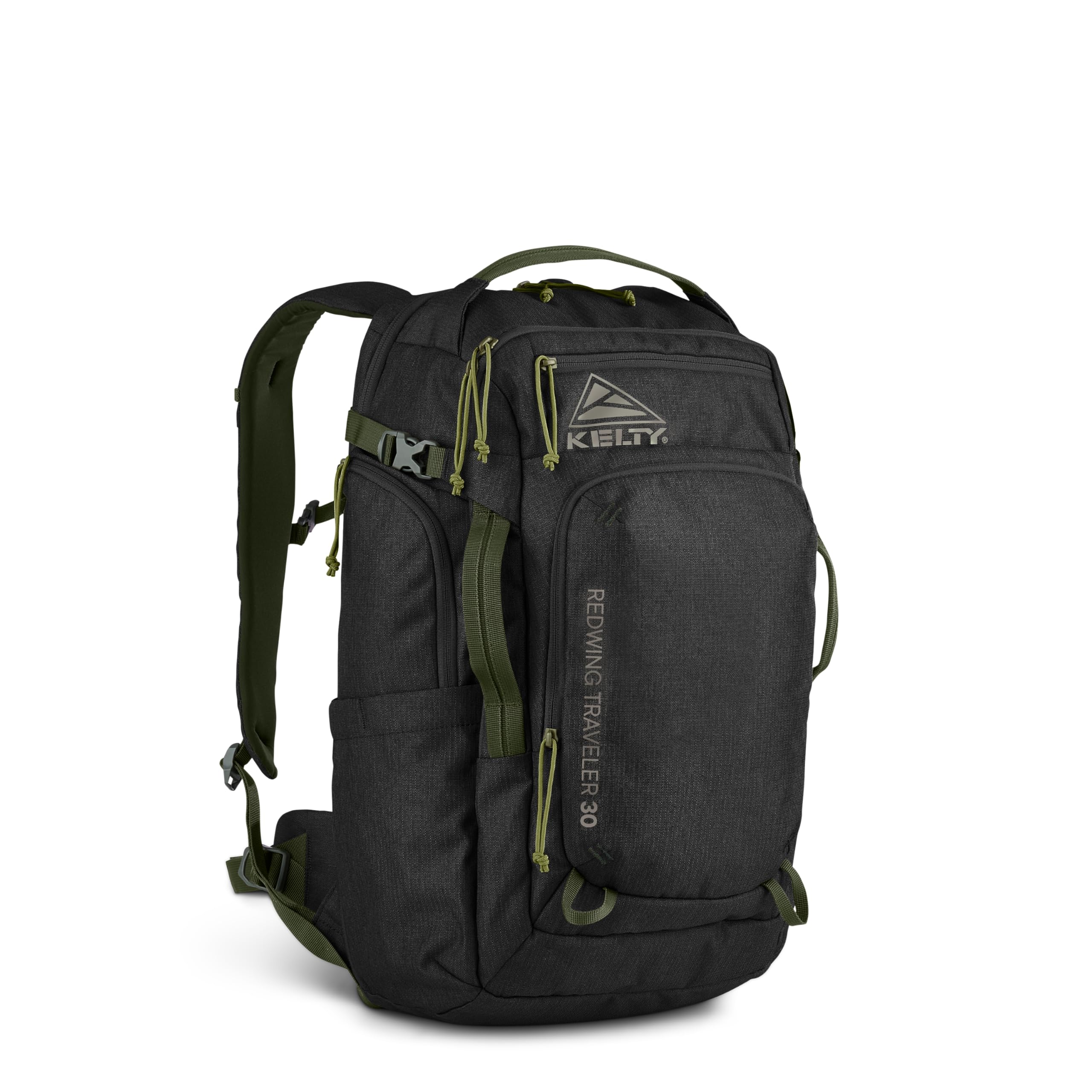
The Redwing Traveler 30L is a framed pack with a full perimeter wire structure that transfers load directly to the hipbelt, a feature usually reserved for packs costing significantly more. The hipbelt is stowable behind a zippered panel, letting you switch from backpack to duffel-mode when you throw it in overhead bins. At 2.25 pounds empty, it carries its weight class well for a framed pack.
Organization is the Redwing’s strongest card — signature wing side pockets with pass-behind functionality let you stash a water bottle, map, or rain jacket without undoing the hipbelt. The laptop sleeve is padded and accessible from the side, so you can pull out a tablet at a café without spilling the entire bag.
The con is backpanel ventilation: the Redwing uses a channeled foam backpanel rather than a tensioned mesh. It breathes decently, but on 85°F Meseta afternoons you’ll feel more heat buildup than with Osprey’s AirSpeed or Gregory’s BioSync systems.
Why it’s great
- Perimeter frame provides stable load transfer for a mid-range pack
- Stowable hipbelt doubles as a travel duffel
- Side wing pockets give quick access without removing the pack
Good to know
- Foam backpanel runs warmer than mesh suspension alternatives
- Capacity at 30L forces trade-offs if you pack electronics plus a sleeping bag
- No integrated raincover — you’ll need to buy one separately
3. Osprey Sojourn Porter 46L Travel Pack

The Sojourn Porter 46L solves the classic Camino dilemma: you need a pack that rides as a backpack on the trail but tucks into a duffel shape for flights and bus transfers. The entire harness and hipbelt stow behind a foam backpanel flap, transforming it into a rectangular carry-on that fits most airline sizers. The 46-liter capacity is generous enough for a sleeping bag, a pair of camp shoes, and a week’s worth of clothing without resorting to external straps.
The Wingjacket compression system uses flexible side panels with compression straps that cinch the load down when the pack is under-packed, preventing contents from shifting sideways during long walks. Interior mesh and liner pockets organize tech accessories and toiletries without adding weight.
The trade-off: 3.45 pounds is heavy for a pack at this capacity, and the stowaway strap mechanism requires a few tries to master on the trail. There is no external water bottle pocket, which forces you to open the main compartment every time you want a drink.
Why it’s great
- Stowaway harness transforms between backpack and duffel in seconds
- 46L capacity fits a full sleeping bag plus extras without bulging
- Wingjacket compression prevents load shift on long walking days
Good to know
- No external water bottle pocket — hydration bladder required
- Weight at 3.45 lb adds noticeable mass for ultralight pilgrims
- Harness deployment takes practice; not intuitive on first use
4. Osprey Nebula Commuter Backpack 32L
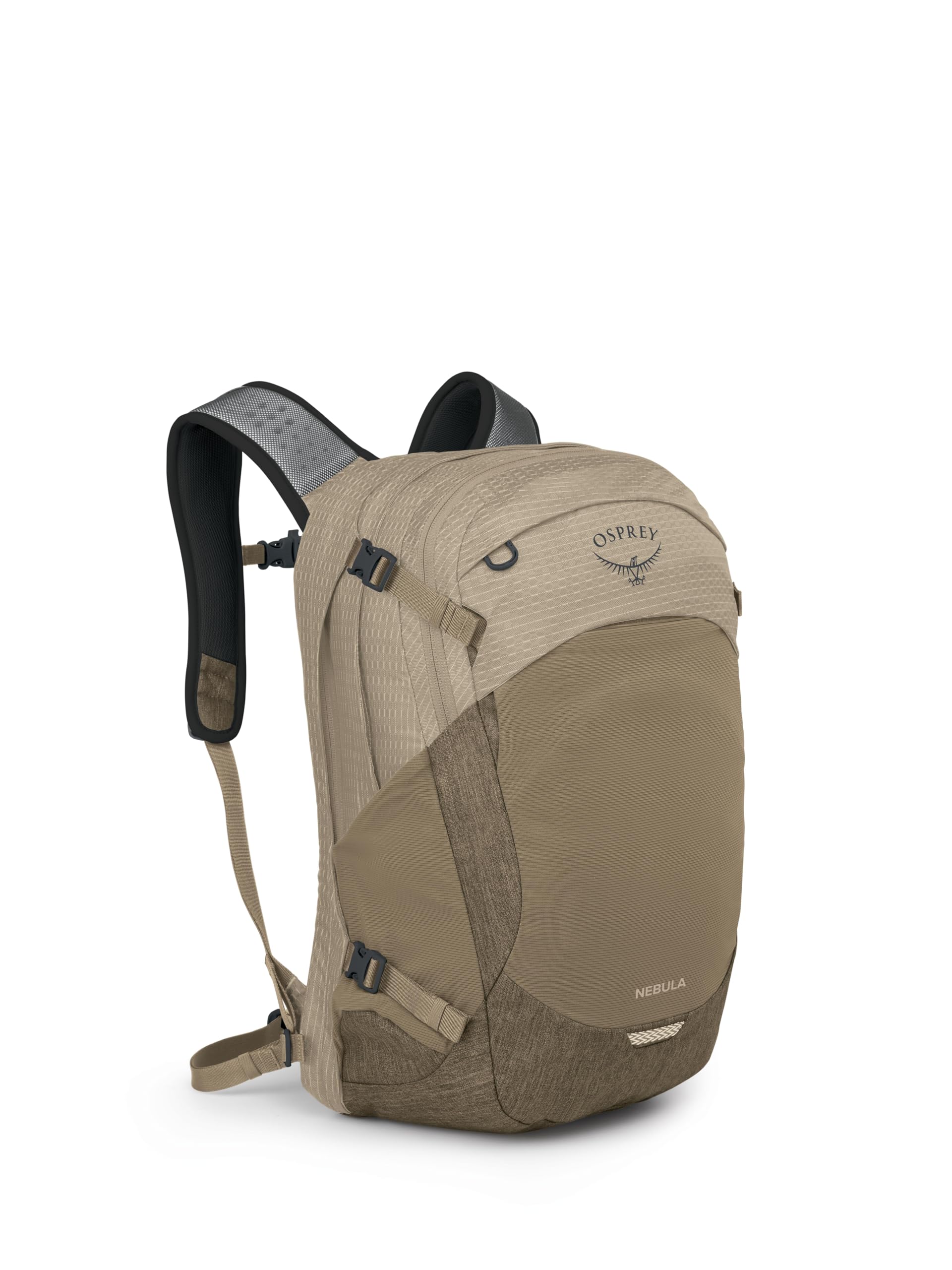
The Nebula is a 32-liter commuter pack that crosses into Camino territory by virtue of its TSA-compatible clamshell laptop compartment and removable webbing hipbelt. The main body opens flat for suitcase-style packing — a boon for pilgrims who prefer to lay out their gear at albergues rather than fish through a top-loading tube. The padded laptop sleeve fits up to 16-inch devices and doubles as a reservoir sleeve when you install a hydration bladder.
Dual stretch mesh water bottle pockets on the sides hold up to 42-ounce bottles, and the front shove-it pocket provides quick access to a rain jacket or hat without unzipping the main compartment. At 2.12 pounds, it’s lighter than the Sojourn Porter and still carries a week’s worth of essentials.
The hipbelt is removable and light-duty — it provides some load stabilization but not the structured weight transfer of a proper hiking hipbelt. Pilgrims carrying more than 12 pounds will feel the difference on long downhill sections.
Why it’s great
- Clamshell opening makes packing and repacking at albergues faster
- TSA-compatible laptop sleeve works for pilgrims working remotely
- Large water bottle pockets fit oversized containers
Good to know
- Removable hipbelt lacks the padding and structure for heavy loads
- No integrated raincover — buy a separate cover for Galicia rain
- Soft internal sunglasses pocket offers minimal impact protection
5. Gregory Miko 30L Unisex Day Hiking Backpack
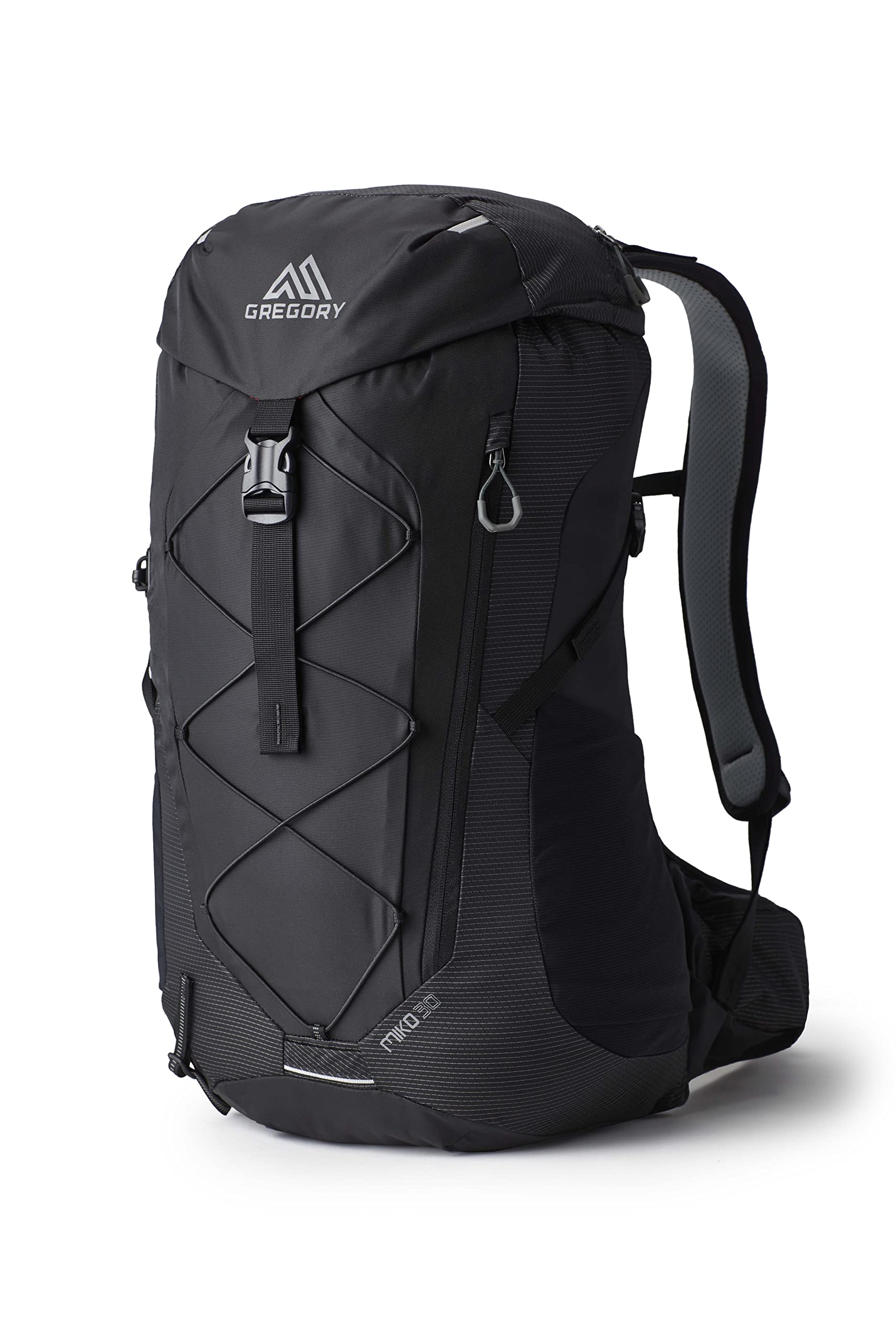
The Miko 30L is built around Gregory’s BioSync suspension — a flexible hipbelt and shoulder harness system that moves with your natural gait instead of fighting it. The hipbelt wings are padded with perforated foam and articulated at the pivot point, meaning they wrap your iliac crest without digging in even after 10 hours of walking. The torso adjusts 3.5 inches via a ladder system, accommodating body lengths from 16 to 20 inches in the same pack.
The channeled foam backpanel uses aerodynamic grooves to promote air movement. It’s not as open as a full mesh tension system, but the grooves create visible air gaps. Large zippered hipbelt pockets fit a modern smartphone and a tube of sunscreen without bulging into your thighs.
The Miko lacks a dedicated padded laptop sleeve — the hydration sleeve doubles for a tablet or thin laptop, but a 15-inch machine will slide around. The pack is also not waterproof; you’ll need the included raincover or a separate dry bag for electronics.
Why it’s great
- BioSync flexible hipbelt reduces pressure on hip bones over long distances
- Adjustable torso length (3.5 inches) fits a wide range of body types
- Hipbelt pockets are large enough for a phone and trail snacks
Good to know
- No dedicated padded laptop compartment
- Foam backpanel runs warmer than mesh suspension systems
- Not waterproof — rain cover or dry bag required for wet stages
6. Cotopaxi Allpa 28L Travel Pack

The Allpa 28L brings a suitcase-style full-wrap zipper opening to the Camino, letting you lay the entire pack flat like a duffel bag. Internal compression panels with color-coded YKK zippers divide the interior into three sections, keeping clean clothes separated from your sweat-soaked walking shirt. The padded laptop sleeve fits a 15-inch device, and the front accessory pocket includes a key clip plus mesh organization for chargers and passports.
The fabric is a heavy-duty 1000-denier polyester that sheds light rain without a cover, though a dedicated raincover is not included. The stretch mesh water bottle pocket on the side holds up to a 1-liter bottle, and four external webbing loops give you attachment points for carabiners or a packed-down rain jacket.
The tuckable waist belt is more of a stabilizer than a load-transference system — it keeps the pack from swaying but won’t carry weight off your shoulders the way a framed hiking hipbelt does. At 28 liters, you’re committing to true minimalist packing with no room for bulky extras.
Why it’s great
- Clamshell opening with internal compression keeps gear organized
- 1000-denier fabric withstands rough handling on buses and trains
- Color-coded zippers make finding compartments intuitive in low light
Good to know
- Waist belt is a stabilizer, not a load-transference hipbelt
- 28L requires strict minimalist packing — no room for a sleeping bag
- Raincover not included; fabric alone is not fully waterproof
7. Osprey Stratos 44L Men’s Hiking Backpack
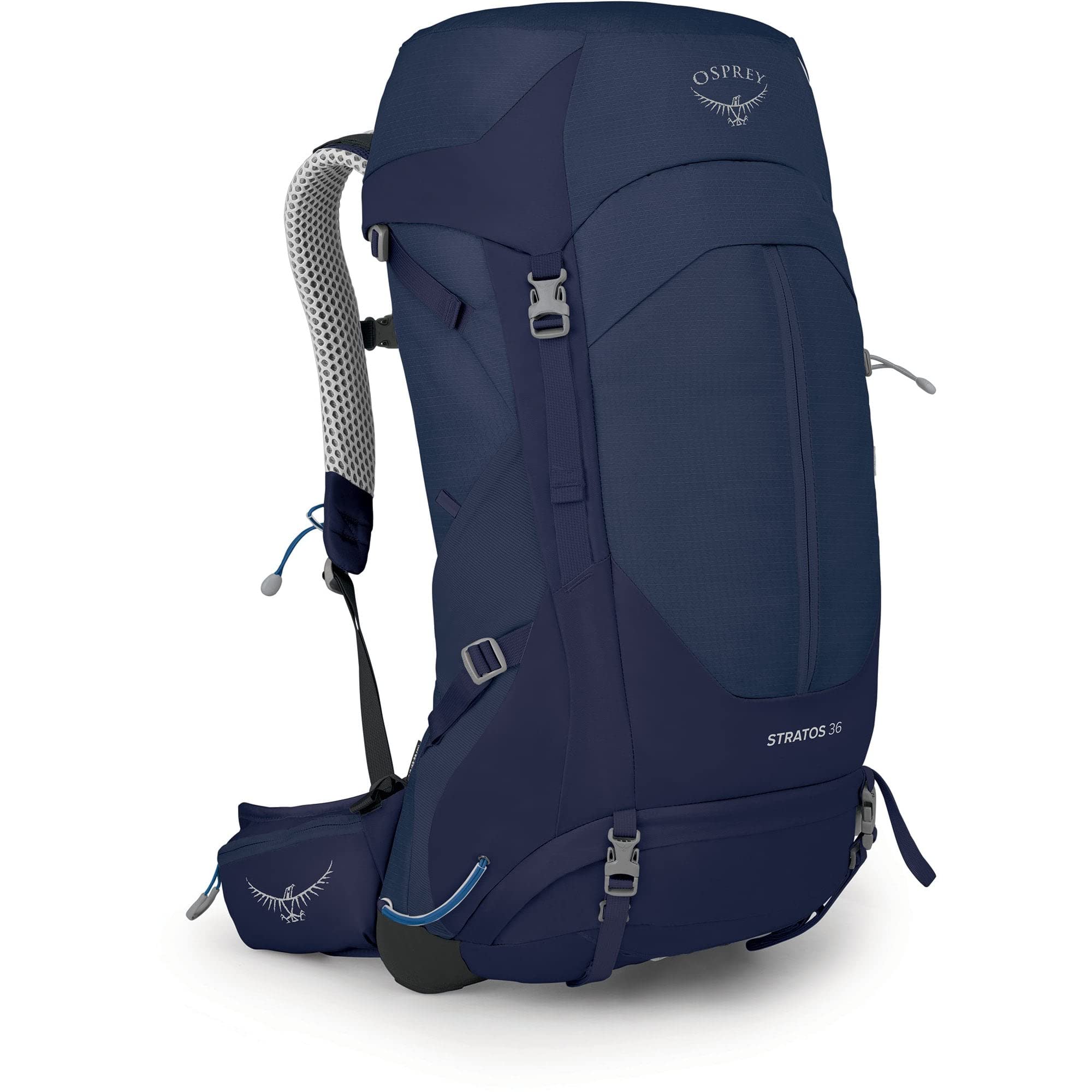
The Stratos 44L is the Camino pack for pilgrims who refuse to skip the sleeping bag, the camp pillow, or a second pair of hiking pants. Its AirSpeed suspension uses an adjustable injection-molded frame with 3D-tensioned mesh that keeps your back dry in August heat, while the taller ladder torso adjustment extends fit range for walkers between 16 and 20 inches of torso length. The included raincover deploys from a stash pocket without breaking your stride.
The top-loading main compartment cinches with a secure drawcord under the floating lid, which has a separate zippered pocket for items you need at lunch breaks. Dual front stash pockets hold a wet rain jacket or a pack towel. Side stretch mesh pockets are large enough for a 1.5-liter bottle, and the hipbelt includes zippered pockets wide enough for a trail map and phone.
At 3.64 pounds, the Stratos is heavier than the Hikelite by a full 1.75 pounds. If you are trying to keep total pack weight under 15 pounds, the Stratos eats into that budget substantially. The hard frame also makes overhead-bin fit tricky on regional European planes.
Why it’s great
- AirSpeed suspension delivers excellent back ventilation for hot climates
- 44L capacity fits a sleeping bag, extra clothing, and toiletries easily
- Integrated raincover and adjustable torso length improve fit and weather protection
Good to know
- Heavy at 3.64 lb — pushes total pack weight higher
- Hard frame may not fit under some airline seats
- Top-loader is less convenient than clamshell for albergue repacking
8. Deuter Futura Air Trek 60+10 Hiking Backpack

The Futura Air Trek 60+10 is designed for backpackers who need a sleeping bag, tent, stove, and four days of food — a load profile that exceeds what most Camino pilgrims carry, but useful if you plan to spend weeks after the Camino hiking the Picos de Europa. The Aircomfort carry system creates a tensioned mesh backpanel that pulls the pack away from your back, while the VariSlide system adjusts the back length by sliding the entire shoulder harness rather than using a ladder of webbing.
Storage is generous: a dedicated bottom compartment for a sleeping bag, front stretch stash pocket, two bellows side pockets that expand without flapping, and zippered hipbelt pockets large enough for a GPS unit. The permanently elastic spring steel frame provides lateral stability even when loaded to 40-plus pounds.
The biggest issue for a Camino-focused buyer is capacity — 60 + 10 liters encourages over-packing for albergue-supported walking. At 3.7 pounds empty, you’re carrying over a quarter of your body-weight budget in pack shell alone. The non-load-bearing daypack conversion is limited compared to the Osprey Sojourn Porter.
Why it’s great
- Aircomfort mesh backpanel keeps the load off your spine for excellent airflow
- VariSlide torso adjustment provides precise fit customization
- Bottom compartment and bellows pockets offer exceptional packing organization
Good to know
- 60+10L capacity is oversized for typical albergue-based Camino walking
- Heavy pack shell (3.7 lb) leaves less room for actual gear
- Not carry-on compatible — must be checked on flights
9. Osprey Atmos AG LT 65L Men’s Backpacking Backpack

The Atmos AG LT 65L is the most technologically advanced pack in this list, built around Osprey’s Anti-Gravity suspension — a continuous mesh panel that runs from the lumbar pad all the way up through the shoulder straps, creating a hammock-like cradle for the load. The Fit-on-the-Fly hipbelt uses a wrap-around foam panel that you adjust via a pull-tab ladder system, eliminating the need to remove the pack for fit changes. The integrated raincover and fabric-reinforced front shove-it pocket handle the dirty stuff, while the internal hydration sleeve exits through a center back port for balanced drinking tube routing.
The 65-liter capacity is overkill for an albergue-supported Camino, but it becomes essential if you plan to carry a tent, a bear canister, and cold-weather gear for a two-week autonomous stretch. The stripped-down LT (Light) version shaves about half a pound off the standard Atmos by simplifying the feature set — no sleeping bag divider, fewer compression strap buckles.
The sheer volume tempts over-packing, and the 4.24-pound empty weight means you’re carrying nearly a quarter of a typical 20-pound total load in pack shell alone. The Anti-Gravity suspension, while supremely comfortable, also reduces internal compartment space because the mesh cradle eats into the main cavity’s geometry.
Why it’s great
- Anti-Gravity suspension hugs the load to your body without pressure points
- Fit-on-the-Fly hipbelt adjusts on the move for varied terrain
- 65L can handle a full expedition load including tent and cook system
Good to know
- Heavy at 4.24 lb — limits your remaining carry capacity for gear
- 65L encourages over-packing for a standard albergue-based Camino
- Anti-Gravity mesh cradle reduces main compartment vertical space
FAQ
How many liters do I need for a summer Camino de Santiago?
Is a ventilated backpanel essential for the Camino?
Do I need a raincover for the Camino de Santiago?
Should I get a framed or frameless pack for the Camino?
Final Thoughts: The Verdict
For most pilgrims walking a standard albergue-supported route, the best backpacks for camino de santiago winner is the Osprey Hikelite 26L because it pairs an industry-leading ventilated suspension with a sub-2-pound shell and an integrated raincover — three features that directly address the Camino’s specific combination of heat, rain, and daily 15-mile carry distances. If you need more capacity for a sleeping bag and electronics, grab the Osprey Sojourn Porter 46L for its stowable harness and carry-on compatibility. And for pilgrims with neck or back issues who prioritize comfort above all else, nothing beats the Gregory Miko 30L and its BioSync flexible suspension system.

Mo Maruf
I created WellFizz to bridge the gap between vague wellness advice and actionable solutions. My mission is simple: to decode the research and give you practical tools you can actually use.
Beyond the data, I am a passionate traveler. I believe that stepping away from the screen to explore new environments is essential for mental clarity and physical vitality.