Our readers keep the lights on and my smoothie glass nicely filled. As an Amazon Associate, I earn from qualifying purchases.
When the power grid goes dark or a winter storm traps you indoors, a pantry full of ingredients you can’t eat raw won’t help. The right canned food for emergencies delivers immediate calories, protein, and comfort without requiring water, fuel, or cooking skills. This guide separates shelf-stable staples from marketing fluff, focusing on real-world nutrition density and ease of preparation during a crisis.
I’m Mohammad Maruf — the founder and writer behind WellFizz. I’ve spent the last several years analyzing survival food supply chains, nutritional adequacy in caloric-restricted diets, and the chemical stability of canned goods across temperature extremes to help families build resilient pantries.
From protein-packed stews to calorie-dense survival tabs with a 25-year shelf life, this guide evaluates seven of the most practical options to help you choose the right canned food for emergencies that fits your storage space and nutritional needs.
How To Choose The Best Canned Food For Emergencies
Not all canned goods are created equal when the goal is long-term survival. You need to assess caloric return per ounce, protein density per serving, water requirements for preparation, and the realistic shelf life of the packaging. Here are the three most important factors to prioritize.
Caloric Density and Protein Per Serving
In an emergency, your body burns more calories due to stress and physical activity. A can that delivers only 100 calories per serving will leave you hungry and fatigued. Look for options that provide at least 250 calories per serving and 10 grams or more of protein. Stews, chili, and SPAM-style meats deliver higher satiety than watery broths or plain vegetables.
Shelf Life and Storage Conditions
Moisture-based canned food like Hormel or Dinty Moore typically has a 2-to-5-year shelf life when stored in a cool, dark place. Freeze-dried alternatives such as Mountain House extend that window to 30 years. Survival tabs and dehydrated beans and rice kits also offer 25-to-30-year windows. Be skeptical of printed “best-by” dates on outer packaging — the actual lifespan of individual components often varies.
Preparation Requirements in a Power-Outage Scenario
When the stove is dead and the water main is broken, “just add hot water” becomes a problem. Prioritize canned foods that are fully cooked and can be eaten cold straight from the can. Items like SPAM, Dinty Moore stew, and Hormel chili require zero water or heat. Freeze-dried pouches and dehydrated beans require both fuel and water, making them less ideal for short-term emergencies but excellent for longer-term preparedness or bug-out scenarios.
Quick Comparison
On smaller screens, swipe sideways to see the full table.
| Model | Category | Best For | Key Spec | Amazon |
|---|---|---|---|---|
| Hormel Chili & Dinty Moore Variety Pack | Ready-to-Eat Stew/Chili | No-cook convenience | 10g protein per serving | Amazon |
| The Survival Tabs – 120 Count | Calorie Tablets | Ultra-light pack | 20 calories per tab | Amazon |
| Augason Farms 1-Week Kit | Add-Water Meal Kit | Family variety | 25-year shelf life | Amazon |
| SPAM Classic 12-Pack | Canned Meat | High-protein staple | 12 oz per can | Amazon |
| Hormel Roast Beef & Gravy 12-Pack | Canned Meat Meal | Hearty beef meal | 12 oz per can | Amazon |
| Mountain House 3-Day Kit | Freeze-Dried Meals | Long-term storage | 30-year shelf life | Amazon |
| Ready Hour Beans & Rice Kit | Dehydrated Staples | Bulk calorie storage | 100 servings per bucket | Amazon |
In‑Depth Reviews
1. Hormel Chili With Bean & DINTY MOORE Beef Stew Variety Pack, 15 oz. cans (8-pack)

This eight-can variety pack splits evenly between Hormel Chili with Beans and Dinty Moore Beef Stew, providing a solid two-meal rotation that requires no water, no fuel, and no cooking. Each 15-ounce can of Dinty Moore delivers 10 grams of protein per serving, and the chili offers comparable macros with a thicker texture that clings to crackers or noodles if you have them.
From a storage perspective, these are standard wet cans with a roughly 2-to-4-year practical shelf life when kept below 75 degrees. The package is compact enough to stash in a 5-gallon bucket or under a bed, weighing about 9.5 pounds total. During a power outage, you can open a can and eat it cold with a spoon — no extra steps needed.
Customer reviews consistently praise the taste and texture straight from the can, with several noting that adding a splash of water or chili powder improves the chili’s consistency. The beef stew stays “full of real meat chunks” according to one verified buyer, with gravy that isn’t watery. This is a pragmatic, high-protein, zero-fuss option for short-to-medium term emergencies.
Why it’s great
- Zero prep required — eat cold from the can
- High protein content (10g per serving in stew)
- Two different flavors reduce meal fatigue
Good to know
- Standard shelf life (2-4 years optimal)
- Heavy to carry in a bug-out bag
- Chili may need extra seasoning
2. Emergency Food Supply – 10 Days Survival Food – The Survival Tabs (120 tabs – Chocolate)

The Survival Tabs take a radically different approach to emergency nutrition: instead of eating meals, you chew 12 tablets per day (240 calories total) that contain 100% of 15 essential vitamins and minerals. Each tab packs 20 calories into a dense, chocolate-flavored chewable that tastes like malted chocolate ice cream, according to multiple verified buyers. At roughly 0.2 pounds per 24-tab pouch, this is the lightest option in the lineup.
The 25-year shelf life makes this set-and-forget storage — you can toss a pouch into a go-bag, car glovebox, or desk drawer and ignore it for two decades. The manufacturing process uses high-quality protein with no gluten or GMOs, and the resealable pouches protect against moisture. However, 240 calories per day is far below a normal adult’s maintenance needs, so this is strictly a “keep you alive” solution for worst-case scenarios, not a comfort food stash.
Customer feedback is overwhelmingly positive on taste and portability, though several reviews note that the tablets are smaller than the product photography suggests. For ultra-minimalist kits or as a supplement to canned meals, these tabs are a smart inclusion.
Why it’s great
- Extremely lightweight and portable
- 25-year shelf life with no temperature worries
- Contains complete vitamin/mineral profile
Good to know
- Only 240 calories per day — very low for sustained energy
- Not a “comfort” food — purely functional
- Smaller than pictured in product photos
3. Augason Farms BE Ready 1-Week Emergency Food Supply
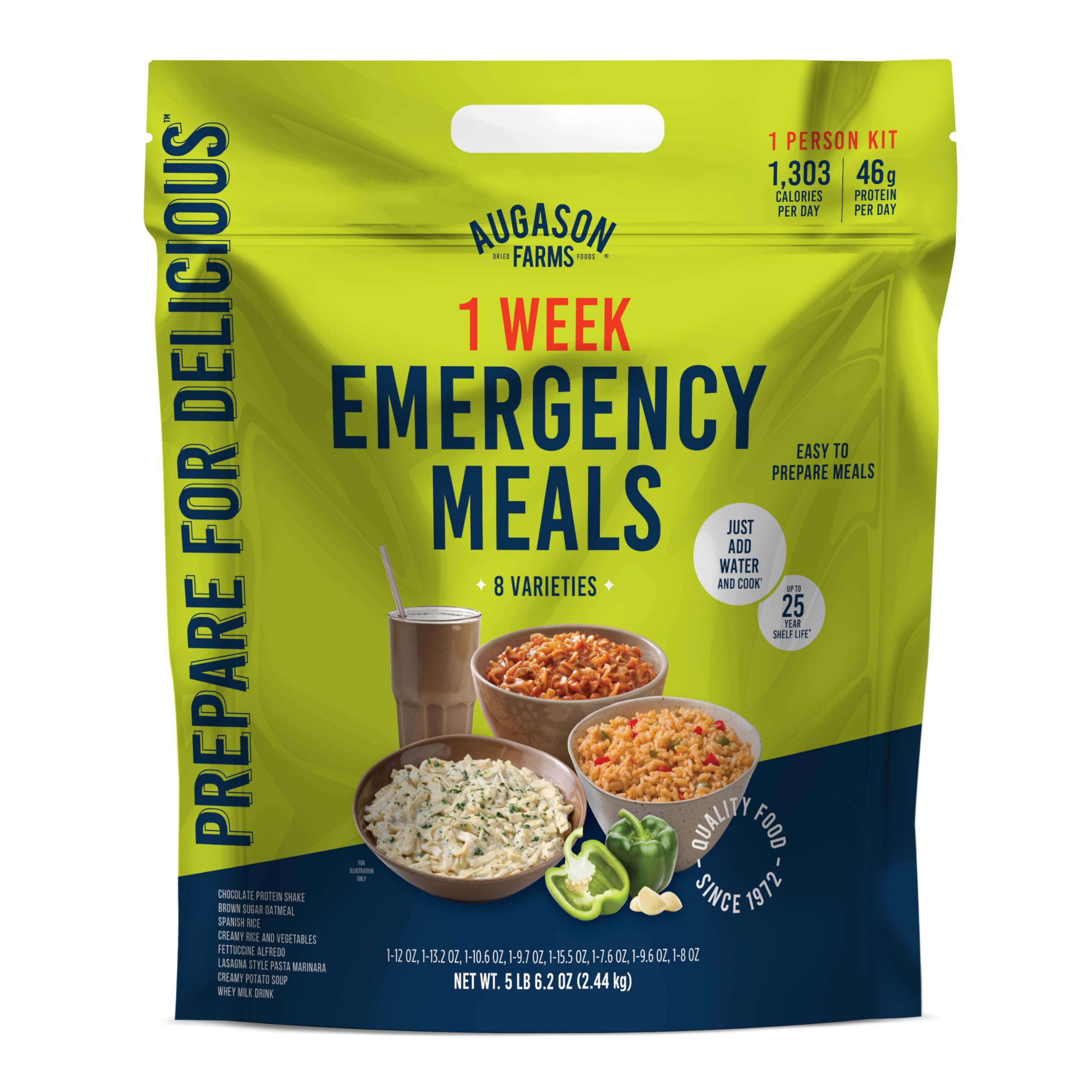
Augason Farms delivers a full one-week, 2,000-calorie-per-day supply for one person using lightweight, soft-sided pouches rather than heavy cans. The kit includes hot entrees for breakfast, lunch, and dinner, plus lowfat milk and banana chips for snacking. Each pouch requires just adding water and cooking for 12 to 15 minutes, making this a solid choice for situations where you have access to a camp stove or heat source.
The shelf-life picture here is important: the outer bag shows a 10-year best-by date, but individual components range from 10 years (banana chips) to 24 years (fettuccini). The manufacturer’s “up to 25-year” claim applies to the longer-lived items. This is typical for mixed-kit products and should not be a dealbreaker, but you should rotate the kit or inspect individual pouches every few years. The pouches are also great for car camping or extended power outages where weight matters.
Buyers appreciate the ease of preparation and the variety, with one calling it “so worth it” for a family’s emergency plan. The main caveat is that you need approximately 2.6 gallons of water for meal preparation, so this kit is not ideal for water-scarce emergencies. If you have stored water and a heat source, this is one of the most practical family-sized options available.
Why it’s great
- Provides full 2,000 calories/day for 7 days
- Lightweight pouches — easy to store and transport
- Includes variety across meals and snacks
Good to know
- Requires water and heat for preparation
- Shelf life varies by component (10 to 25 years)
- Outer bag shows 2032 expiration — read the fine print
4. SPAM Classic, SPAM Canned Meat, 12 oz Can (12 Pack)

SPAM is one of the most time-tested emergency foods on the market, and this 12-pack gives you 144 ounces of fully cooked, shelf-stable meat that requires zero preparation. Each 12-ounce can delivers roughly 60 grams of protein and 720 calories, making it one of the most calorie-dense options per cubic inch of storage space. You can slice it cold onto crackers, fry it in a pan if power is available, or chop it into ramen for a more filling meal.
The shelf life for unopened SPAM cans is approximately 2 to 5 years depending on storage temperature. The cans are sturdy and stackable, and the product holds up well in hot storage conditions better than many wet canned stews due to its low moisture content and high salt preservation. Customers frequently mention using SPAM for camping, musubi, and quick breakfasts, with one noting it yields three meals per can when stretched with rice or noodles.
The biggest practical concern is sodium content — SPAM is salty, which matters if your emergency water supply is limited. It also has a distinct flavor that not everyone loves, though most long-term reviewers describe it as a nostalgic comfort food rather than a survival penalty. If you want a dense, versatile protein source that can be eaten cold in a crisis, this is a foundational pantry purchase.
Why it’s great
- Extremely calorie-dense and high in protein
- Fully cooked — eat cold straight from the can
- Versatile: slice, fry, add to rice or ramen
Good to know
- High sodium content — requires adequate water
- Distinct flavor may not suit everyone
- Important to consume in moderation for health
5. Hormel Roast Beef & Gravy, 12-Ounce Can (Pack of 12)

Hormel Roast Beef & Gravy occupies a sweet spot between canned meat and a full meal. Each 12-ounce can contains medium-to-large chunks of cooked beef in a thick, non-watery gravy, delivering a texture and flavor that customers describe as “just like Mom made.” You can eat it cold from the can, but it truly shines when heated and served over rice, mashed potatoes, or bread for a hot, filling meal in under three minutes.
The ingredient list is straightforward — cooked beef, water, salt, modified food starch, and gravy seasonings — with no artificial preservatives. The protein content is substantial, though the exact grams per serving depend on portion size. The cans have a standard 2-to-4-year shelf life when stored in a cool, dark pantry. Several buyers specifically mention this product as a replacement for the discontinued Bunker Hill Beef, which speaks to its loyal following among emergency preppers.
Customer reviews highlight the versatility: mash the beef chunks for “Manhattan sandwiches,” add half a can of water to stretch the gravy, or simply heat and pour over starch for a quick dinner. One caveat is the consistency can be a bit gelatinous when cold, but it smooths out with gentle heating. This is a premium canned meal option that feels less like a survival ration and more like a real dinner.
Why it’s great
- Large, tender beef chunks — not shredded or mushy
- Thick, flavorful gravy that pairs with starches
- Versatile for cold eating or hot meal prep
Good to know
- Contains wheat flour (not gluten-free)
- Gravy can be gelatinous when cold
- Best heated for optimal texture
6. Mountain House Emergency Meal Assortment Kit, Freeze-Dried Survival Food, 30-Year Shelf Life
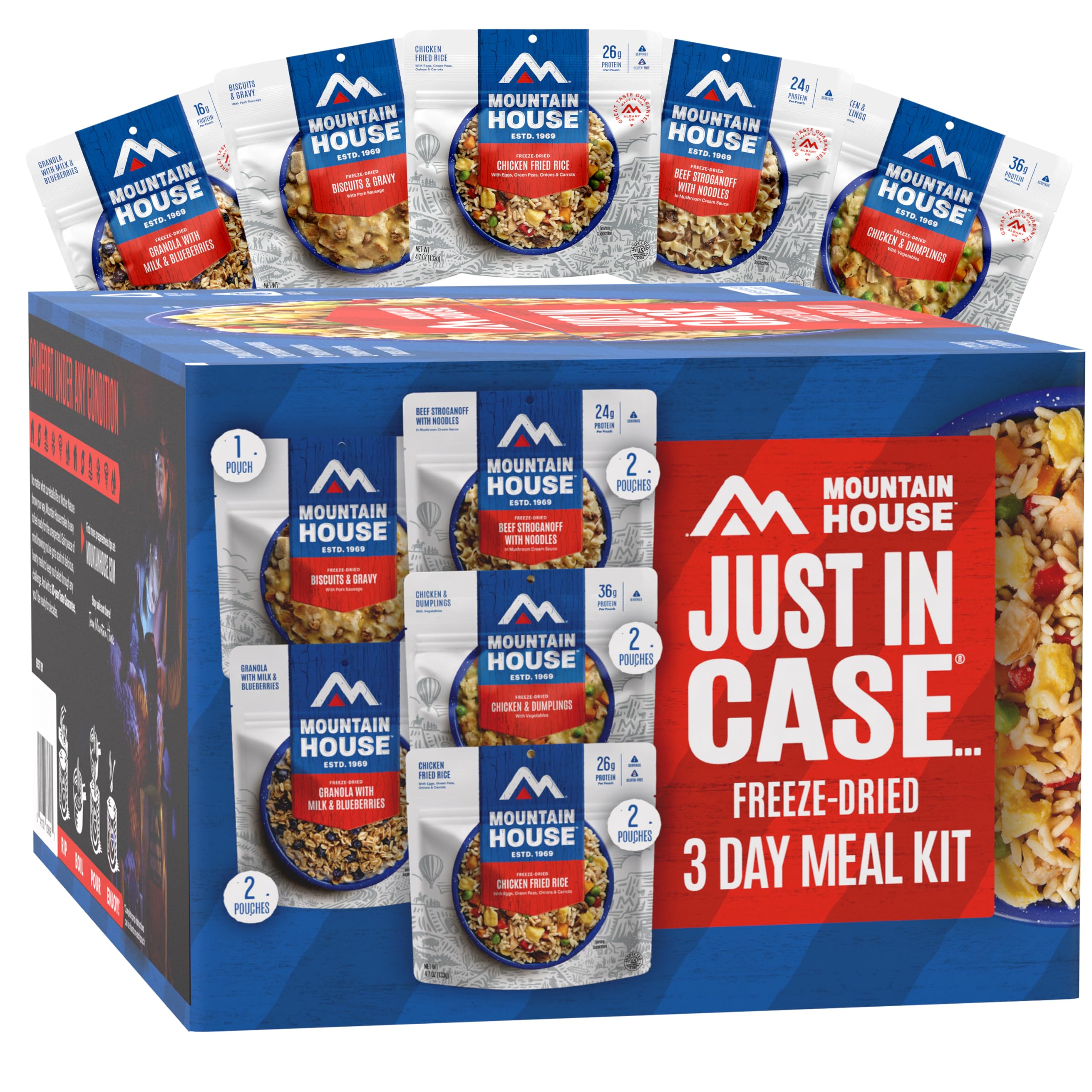
Mountain House is the industry benchmark for freeze-dried emergency food, and this 3-Day/72-Hour kit includes nine pouches designed to deliver 1,706 calories per day for one person. The meal lineup includes Biscuits & Gravy, Granola with Milk & Blueberries, Chicken Fried Rice, Chicken & Dumplings, and Beef Stroganoff with Noodles — real recipes with no artificial flavors or colors. Preparation is simple: add hot water directly to the pouch, stir, and wait less than 10 minutes.
The defining advantage here is the 30-year taste guarantee and shelf life — the longest proven track record in the industry. Freeze-drying removes oxygen and moisture at a molecular level, so the food stays fresh without refrigeration for decades. The entire kit weighs only 3.6 pounds and fits in a 13” x 10” x 9” space, making it one of the lightest and most compact options for a bug-out bag or car trunk. You can also prepare these meals with room-temperature water (double the hydration time) if you have no heat source.
Customer feedback is consistently excellent on taste, with the Beef Stroganoff being a particular favorite. The main drawback is cost per serving — freeze-dried meals are more expensive than wet cans. Also, each pouch requires about 1.3 cups of water, so water availability is still a factor. For the highest quality emergency food with the longest shelf life, Mountain House is the premium choice that preppers trust.
Why it’s great
- Proven 30-year shelf life with taste guarantee
- Lightweight, compact, and easy to carry
- Delicious meals that taste like real food
Good to know
- More expensive per serving than canned alternatives
- Requires water for rehydration
- Best with hot water for full texture
7. Ready Hour Beans Trio with Rice Kit Bucket (100 Servings), 30-Year Shelf Life

This 100-serving bucket from Ready Hour focuses on the foundational emergency calories: long-grain white rice, Southwest rice, black beans, red beans, and pinto beans. Beans and rice form a complete protein when eaten together, making this kit nutritionally sound despite its simplicity. Each pouch is quadruple-wrapped and packed into a rugged, water-resistant bucket with a collapsible handle for grab-and-go transport.
The preparation is straightforward but requires cooking: boil water, pour in the contents, and simmer for under 30 minutes. The 30-year shelf life is competitive with Mountain House, and the calorie density per dollar is among the highest in this roundup. This kit is ideal for long-term storage in a basement or garage where space is not at a premium. The bucket itself is reusable for water storage or organization once the food is consumed.
Customer reviews are generally positive, with an emphasis on packaging quality and ease of use. One buyer noted the shelf life of 25-plus years as a key selling point. The trade-off is that beans and rice require both water and a heat source for extended cooking, and the meals lack the variety and flavor of stew-based or freeze-dried options. If you want a high-calorie, long-lasting foundation for a family’s emergency pantry, this bucket delivers the most servings per unit of storage.
Why it’s great
- 100 servings — best cost-per-serving in the list
- 30-year shelf life with rugged packaging
- Complete protein when beans and rice are combined
Good to know
- Requires water and extended cooking (up to 30 min)
- Limited flavor variety compared to meal kits
- Heavy bucket is not ideal for a bug-out bag
FAQ
Can I eat canned emergency food cold without cooking it?
How do I verify the real shelf life of a “25-year” emergency food kit?
Should I prioritize canned food or freeze-dried pouches for a bug-out bag?
Final Thoughts: The Verdict
For most users, the canned food for emergencies winner is the Hormel Chili & Dinty Moore Variety Pack because it requires zero water, zero heat, and zero cooking while delivering solid protein and familiar flavors. If you want the longest shelf life with the best taste, grab the Mountain House 3-Day Kit. And for a budget-friendly bulk foundation that can feed a family for weeks, nothing beats the Ready Hour Beans & Rice Bucket for caloric volume per square foot of storage.

Mo Maruf
I created WellFizz to bridge the gap between vague wellness advice and actionable solutions. My mission is simple: to decode the research and give you practical tools you can actually use.
Beyond the data, I am a passionate traveler. I believe that stepping away from the screen to explore new environments is essential for mental clarity and physical vitality.