Our readers keep the lights on and my smoothie glass nicely filled. As an Amazon Associate, I earn from qualifying purchases.
That soupy green haze coating your pond’s rocks and waterfall isn’t just an eyesore—it starves your fish of oxygen and turns a backyard sanctuary into a maintenance chore you dread. Whether you’re fighting stringy filamentous mats or pea-soup planktonic blooms, the right treatment cuts through the mess without harming your koi, goldfish, or plants.
I’m Mohammad Maruf — the founder and writer behind WellFizz. I’ve spent years parsing technical labels, copper concentration tables, and EPA registration details to separate algaecides that actually deliver from those that just dilute your water.
After combing through gallons of customer reports and manufacturer data, I’ve assembled the most reliable guide to the best algae killer for ponds on the market right now.
How To Choose The Best Algae Killer For Ponds
Selecting an effective algaecide isn’t about grabbing the cheapest bottle. You need to match the active ingredient, application method, and dosage to the specific algae strain in your pond and the fish living there. The wrong choice can clear the algae but leave you with stressed or dead aquatic life.
Copper Chemistry: Chelated vs. Non-Chelated
Copper is the most common active ingredient in pond algaecides. Chelated copper stays suspended in the water column longer and remains effective across a wider pH range. Non-chelated formulas can precipitate out in hard water, reducing efficacy and increasing the amount you have to add. For safety, look for double-chelated formulas if you keep sensitive fish.
Algae Type Dictates the Approach
Planktonic algae (green water) responds best to liquid algaecides or water dyes that block sunlight. Filamentous algae (string or hair algae) requires contact killers in granular or spray form. Chara and blanketweed often need a combination of copper and a surfactant for penetration. Identify the dominant algae before you buy.
Fish Species and Pond Volume
Koi and goldfish are relatively tolerant of copper-based algaecides, but trout and certain minnows are extremely sensitive. Always verify the “target species” warning on the label. Pond volume determines dosage—under-treating stalls results, while over-treating can trigger an oxygen crash as dead algae decomposes. Treat in thirds for large blooms and ensure heavy aeration.
Quick Comparison
On smaller screens, swipe sideways to see the full table.
| Model | Category | Best For | Key Spec | Amazon |
|---|---|---|---|---|
| API Pondcare Algaefix (Pack of 2) | Liquid Copper | String & green water in fish ponds | 64 oz total, EPA registered | Amazon |
| Airmax Pond Dye Plus | Dye + Bacteria | Preventing algae via sunlight block | 1 gal treats 1 surface acre | Amazon |
| Cutrine-Plus Granulated | Granular Copper | Large lakes & heavy filamentous algae | 30 lbs, double-chelated | Amazon |
| Tetra Algae Control | Liquid Polyquat | Ornamental ponds with plants | 101.4 oz treats 36,000 gal | Amazon |
| Crystal Plex (Crystal Blue) | Liquid Copper | Farm ponds & livestock watering | 1 gal treats 1 acre (1-3 ft deep) | Amazon |
| Aquascape EcoBlast Granular | Granular Contact | Waterfall, stream, and rock surfaces | 38.4 oz treats 780 sq ft | Amazon |
| Fountec Fountain Algaecide | Liquid Clarifier | Fountains & small water features | 64 oz, no foaming/staining | Amazon |
In‑Depth Reviews
1. API Pondcare Algaefix (Pack of 2)

API’s Algaefix comes in a two-pack of 32-ounce jugs, giving you 64 ounces total at a price point that undercuts most single-bottle competitors. The liquid formula targets string algae, blanketweed, and green water algae without harming live plants when dosed correctly. Multiple reviews confirm visible clearing within days of the first treatment.
What sets Algaefix apart is its EPA registration, a mark of independent efficacy and safety testing. Users report that combining it with a UV filter amplifies results, as dead algae particles are mechanically removed instead of decomposing in the water column. Koi owners note no adverse behavior changes when they follow the labeled dosage.
Heavy aeration is non-negotiable with this product. Several customer reports link fish lethargy to insufficient oxygenation after treatment, especially in small, shallow ponds under 200 gallons. Plan to run a fountain or air stone continuously for 48 hours after each dose.
Why it’s great
- Two-pack provides excellent value for medium ponds
- Safe for koi and ornamental plants when used as directed
- Works quickly on both string and green water algae
Good to know
- Requires heavy aeration to prevent fish stress
- Frequent filter cleaning needed as dead algae releases
2. Airmax Pond Dye Plus

Airmax Pond Dye Plus takes a preventative approach by combining a deep blue-black dye with beneficial bacteria. The dye blocks sunlight penetration, starving algae at the photosynthetic source, while the bacteria consume the dissolved nutrients algae feed on. This dual action makes it ideal for ponds where you want to avoid copper altogether.
The dye creates a natural dark hue that reflects the surrounding landscape and provides shade shelter for fish from predators. Users with half-acre ponds consistently report the treatment lasting four to six months before needing a top-up. The formula is safe for livestock, birds, pets, and fish, and requires no mixing—just pour directly into the water.
The limitation is that Pond Dye Plus works best as a maintenance tool, not a rescue product. If you already have a thick algae bloom, it won’t kill existing growth. You’ll need to pair it with a contact algaecide first, then switch to dye for long-term control. Also, the dye tints the water, which may not appeal to everyone aesthetically.
Why it’s great
- No copper or harsh chemicals—safe for all aquatic life
- Single treatment lasts months on large ponds
- Adds aesthetic value and predator protection
Good to know
- Does not kill existing algae—use as a preventative only
- Water tint may not look natural to all owners
3. Cutrine-Plus Granulated Algaecide

Cutrine-Plus is the heavy hitter for large ponds and lakes where filamentous algae, chara, and planktonic blooms have taken over. The 30-pound bag of granules contains 3.7% chelated copper from mixed ethanolamine complexes, designed to remain active even in hard water with high carbonate levels. Users typically see visible reduction within 24 to 48 hours.
The granular form allows targeted application using a hand-held spreader along shorelines or near aerators where algae concentrates. Long-term users report that starting treatment early in spring prevents the worst blooms before they establish. The double-chelated formula is the key advantage here—it prevents copper precipitation that wastes product and risks under-dosing.
This product is not compatible with koi or goldfish if your water hardness falls below 50 ppm, and the 30-pound bag represents a significant upfront investment. For smaller ponds under a quarter acre, you may find cheaper alternatives with lower volume commitments. The bag is heavy and requires careful storage to keep granules dry.
Why it’s great
- Professional-grade double-chelated copper for hard water
- Excellent for large-scale filamentous algae control
- Works fast—visible results in 1-2 days
Good to know
- Not safe for koi in low-hardness water (<50 ppm)
- Large bag is impractical for small ponds
4. Tetra Algae Control

Tetra’s formula uses a polyquat-based active that combats green water, string algae, and blanketweed without the heavy copper load that stresses sensitive fish. The 101.4-ounce bottle treats up to 36,000 gallons, making it one of the highest coverage-per-dollar options on this list. The dosage is simple—25 mL per 300 gallons.
Customer reports are consistent: one dose clears green water overnight, while stubborn string algae requires two to three treatments spaced several days apart. Users emphasize diluting the concentrate in a bucket of pond water before adding it to avoid shocking fish. The formula is safe for live plants and ornamental fish when applied at the recommended rate.
The trade-off is that Tetra’s formula is less potent against heavy chara or established filamentous mats compared to copper-based alternatives. Some users also report needing to clean filters more frequently as the dying algae releases. For routine maintenance and light-to-moderate blooms, this is a reliable, fish-friendly option.
Why it’s great
- Massive coverage—treats up to 36,000 gallons per bottle
- Safe for fish and live plants with no copper
- Quick results on green water in under 24 hours
Good to know
- Stubborn string algae may need multiple treatments
- Less effective on thick chara mats
5. Crystal Plex Lake and Pond Algaecide

Crystal Plex is a liquid copper algaecide formulated for larger ponds and lakes, treating up to one surface acre at a depth of 1 to 3 feet. It targets filamentous, planktonic, and chara algae while remaining safe for livestock, pets, birds, and swimming when used as directed. The liquid form allows spraying along shorelines or through a wand from a boat.
Users with farm ponds report that a single 39-ounce dose mixed 10:1 with water and sprayed around the perimeter clears algae in 2 to 3 days, with full clarity returning within a week. The product is effective against swimmers itch algae—a key advantage for recreational ponds. It is safe for catfish, carp, sunfish, and turtles.
The critical limitation is that Crystal Plex is not for use in koi, goldfish, or trout ponds. The label explicitly warns against it. Additionally, you should only treat a third to half of the pond at a time to avoid oxygen depletion. A small minority of users report zero results, likely due to extreme bloom density or incorrect application.
Why it’s great
- Effective on multiple algae types including swimmers itch
- Safe for livestock, swimming, and non-koi fish
- Visible clearing within 2-3 days
Good to know
- Not safe for koi, goldfish, or trout
- Must treat in partial doses to avoid oxygen crash
6. Aquascape EcoBlast Contact Granular Algaecide
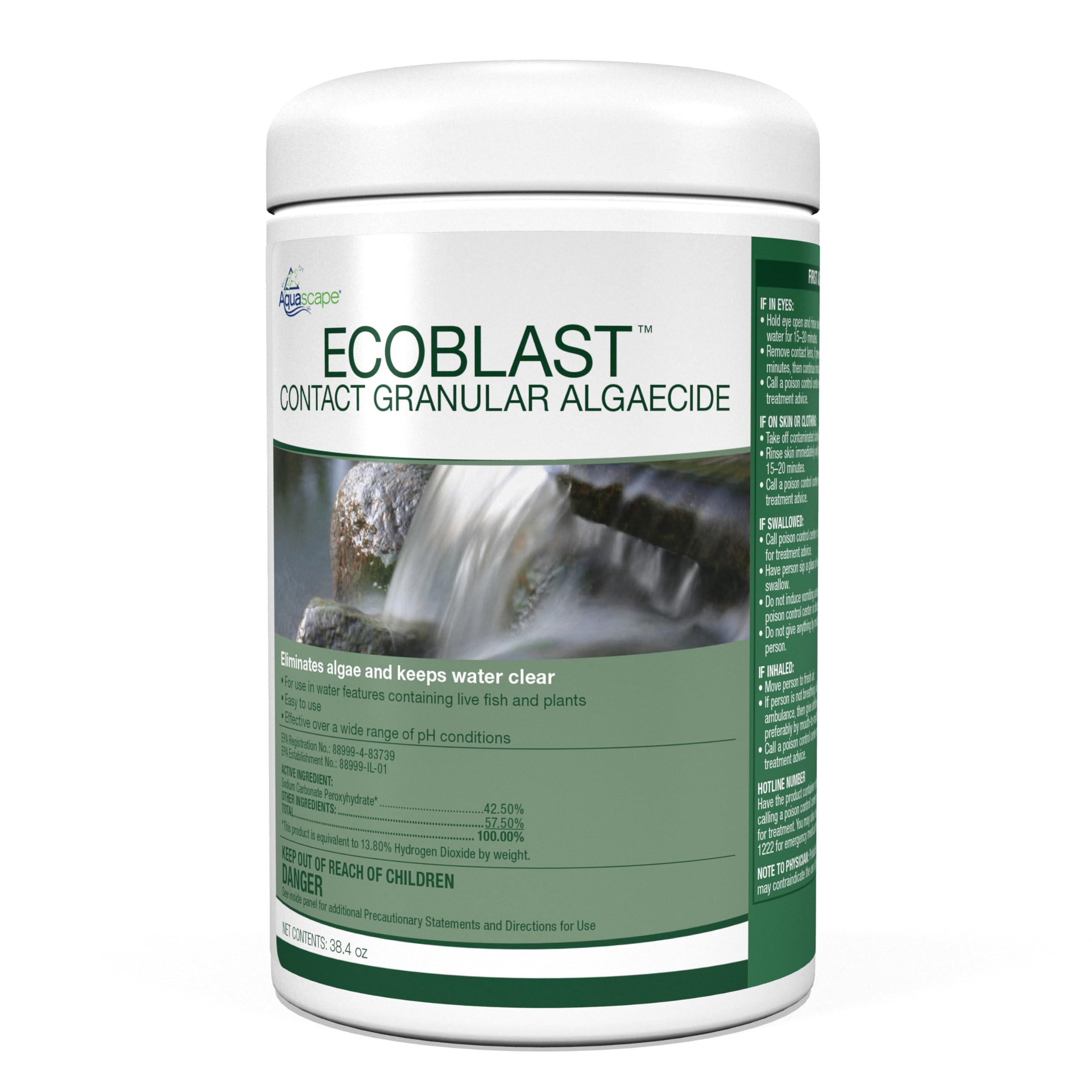
Aquascape EcoBlast is a contact granular algaecide designed specifically for surface treatment of waterfalls, rocks, streams, and fountain edges where algae clings in thick patches. The granules are sprinkled directly onto the affected area, making this a precision tool rather than a whole-pond treatment. The 38.4-ounce container covers up to 780 square feet of surface area.
Koi pond owners consistently rank EcoBlast as the best solution for clearing algae off rocks and waterfall faces without scrubbing. The formula works across a wide pH range and in any water temperature, which is critical for seasonal ponds. Users report complete clearing of green surface slime and moss within hours of application.
The downside is that EcoBlast does not treat the water column—it only kills algae on contact at the application site. Algae floating in the open water or settled at the bottom won’t be affected. A few users also note that established discoloration stains on porous rocks may persist even after the algae is dead.
Why it’s great
- Targets algae on rocks and waterfalls without scrubbing
- Works in any water temperature and pH range
- Safe for koi ponds
Good to know
- Does not treat algae in the open water column
- Some rock staining may remain after algae dies
7. Fountec Fountain Algaecide Clarifier

Fountec is purpose-built for fountains, small waterfalls, and decorative water features, not full-size ponds. It eradicated yellow and black algae while containing water clarifiers that remove the fine particles causing cloudy water. The formula does not foam, stain, or require weekly chlorine testing—key advantages for low-maintenance features.
Users in hot climates report that 1 tablespoon of Fountec keeps a fountain algae-free for three weeks or longer. The product is also noted for preventing pump clogs from algae buildup. Bird and pollinator owners appreciate that it does not harm hummingbirds or bees that visit the water feature for a drink. A single application can last up to five months of non-use during the off-season.
The biggest limitation is that Fountec is not intended for aquatic life. The label explicitly states it is safe for plants and animals but not for aquatic life, meaning it should not be used in koi or goldfish ponds. It also performs best as a maintenance product rather than a rescue treatment for heavy blooms already established in concrete basins.
Why it’s great
- Targets yellow and black algae in fountains specifically
- No foaming, staining, or pH testing required
- Very small weekly dose stretches the bottle for months
Good to know
- Not safe for ponds with fish or aquatic life
- Best as a preventative, not a heavy-bloom eliminator
FAQ
Can I use a copper algaecide safely with koi and goldfish?
Why do I need to treat only half the pond at a time?
How long does it take for an algaecide to clear a pond?
Final Thoughts: The Verdict
For most users, the best algae killer for ponds winner is the API Pondcare Algaefix (Pack of 2) because it combines EPA registration, koi safety, plant compatibility, and fast results against both string and green water algae at an unbeatable value. If you want a copper-free preventative approach for a large pond, grab the Airmax Pond Dye Plus. And for professional-grade control of heavy filamentous blooms on acre-plus properties, nothing beats the Cutrine-Plus Granulated Algaecide.

Mo Maruf
I created WellFizz to bridge the gap between vague wellness advice and actionable solutions. My mission is simple: to decode the research and give you practical tools you can actually use.
Beyond the data, I am a passionate traveler. I believe that stepping away from the screen to explore new environments is essential for mental clarity and physical vitality.