Our readers keep the lights on and my smoothie glass nicely filled. As an Amazon Associate, I earn from qualifying purchases.
A bird that flees the moment you lift your binoculars is no longer a secret — it’s a source of frustration. Every birder knows the sting of a blurry silhouette, a missed wing spread, or a subject reduced to a pile of pixels. Bridge cameras solve this by packing super-telephoto reach into a single, non-interchangeable body, letting you lock focus on a kingfisher from across a marsh without the bulk of a full DSLR rig.
I’m Mohammad Maruf — the founder and writer behind WellFizz. I’ve spent hundreds of hours parsing lens specs, sensor sizes, and stabilization systems to isolate the cameras that actually deliver sharp feather detail at maximum zoom.
Whether you are stalking warblers in dense brush or scanning shorelines for sandpipers, the best birding bridge camera must balance optical reach with image stabilization speed — and below I break down which models earn the carry.best birding bridge camera
How To Choose The Best Birding Bridge Camera
Bridge cameras sit in a unique spot between compact point-and-shoots and heavy interchangeable-lens systems. For birding, the critical specs revolve around how far you can see, how steady the image stays, and how fast the camera locks onto moving targets. Below are the four non-negotiable factors to weigh before buying.
Optical Zoom — The Real Reach
Ignore digital zoom entirely; it simply crops and enlarges pixels, costing you detail. Optical zoom is the lens’s physical magnification, expressed as a ratio (40x, 83x, 125x) or as a 35mm-equivalent focal length. For birding, a minimum of 40x (roughly 1000mm equivalent) gives you usable frame-filling shots on small songbirds at 30–50 feet. At 60x to 83x you reach across ponds and meadows. The Nikon P1000’s 125x (3000mm) edge is unmatched, but requires a rock-solid stance or tripod.
Image Stabilization — Handheld Vibration Killer
At maximum zoom, even your pulse becomes a source of blur. Lens-shift vibration reduction (VR) or optical image stabilization (OIS) physically moves lens elements to counter micro-movements. Dual-detect systems — like Nikon’s — combine lens-shift with sensor-shift for tighter handheld performance. Without capable stabilization, you’ll need a tripod for every shot beyond 60x, which turns fast-moving birding into a chore.
Autofocus Speed and Burst Rate
Birds rarely pose. Contrast-detection autofocus — common in budget bridge cameras — hunts in low contrast and can miss the moment. Phase-detection or hybrid systems lock on faster, especially useful for birds in flight. A burst rate of 6–7 frames per second gives you a sequence to pick the sharpest wing position. Cameras with dedicated Bird Scene modes also tweak shutter speed and focus priority for feathered subjects.
Sensor and Low-Light Performance
Bridge cameras typically use smaller 1/2.3-inch sensors, which trade some low-light ability for massive zoom range. A 16–20 megapixel sensor with backside-illuminated (BSI) construction captures more light per pixel, helping at dusk or in shaded forest. Higher ISO sensitivity (up to 6400) matters for dawn shoots, but expect visible noise past ISO 1600 on most models. For cleaner shadow detail, premium options with larger sensors or higher bit-depth processing give you more latitude.
Quick Comparison
On smaller screens, swipe sideways to see the full table.
| Model | Category | Best For | Key Spec | Amazon |
|---|---|---|---|---|
| Nikon COOLPIX P950 (Renewed) | Mid-Range | All-day field birding | 83x optical, 166x Dynamic Fine Zoom | Amazon |
| Nikon COOLPIX P950 | Premium | Top-tier feather detail | 83x optical, RAW + 4K UHD | Amazon |
| Nikon COOLPIX P1000 Bundle | Premium | Max reach for distant waders | 125x optical, 3000mm equiv. | Amazon |
| Nikon COOLPIX P1000 | Premium | Extreme telephoto capture | 125x optical, 16 MP, 4K | Amazon |
| Panasonic Lumix FZ82D | Premium | Hybrid AF + 60x zoom | 60x optical, 20–1200mm | Amazon |
| Panasonic LUMIX ZS99 | Mid-Range | Pocketable travel companion | 30x Leica lens, 4K video | Amazon |
| Canon PowerShot V1 | Mid-Range | Hybrid stills + video | 22.3 MP, 4K, CLog3 | Amazon |
| Kodak PIXPRO AZ528 | Value | Entry-level budget birding | 52x optical, 16 MP BSI CMOS | Amazon |
| Canon PowerShot SX530 HS (Renewed) | Value | Reliable Canon ecosystem | 50x optical, 24–1200mm | Amazon |
| Minolta MN40Z | Value | Budget-friendly wide zoom | 40x optical, 20 MP, AA power | Amazon |
| Nikon COOLPIX B500 (Renewed) | Value | Color-accurate snapshots | 40x optical, 80x Dynamic Zoom | Amazon |
In‑Depth Reviews
1. Nikon COOLPIX P950 (Renewed)

The Nikon COOLPIX P950 delivers an 83x optical zoom — equivalent to 24–2000mm — in a body that balances comfortably for handheld marsh walks. Dual Detect Optical VR keeps the frame steady even at full telephoto, and the built-in Bird Scene mode automatically lifts shutter speed and adjusts contrast to preserve feather detail against bright sky backgrounds. Renowned for its reach, this model often replaces a 600mm DSLR lens setup for a fraction of the weight.
Refurbished units typically arrive with original accessories and retain the same 16-megapixel sensor, 4K UHD video, and RAW capture as new units. Reviewers note the autofocus is slower than phase-detection systems — contrast-detection hunts briefly in low-contrast foliage — but the raw zoom length and stabilization more than compensate for casual and intermediate birders.
Bird mode works reliably on perched subjects; birds in flight require practice. The tilting LCD helps when shooting from low angles near water. For anyone moving up from a 30x or 40x compact, the P950’s 83x is a genuine leap in usable field range, and the refurbished price makes it the strongest mid-range value available.
Why it’s great
- 83x optical zoom captures distant waterfowl without visible shake
- Bird mode automatically prioritizes shutter speed for perched subjects
- RAW format gives editing latitude for tricky lighting conditions
Good to know
- Contrast-detect autofocus can struggle on fast-moving birds in low contrast
- Battery life is moderate; carrying a spare is wise for full-day outings
2. Nikon COOLPIX P950

The brand-new version of the P950 shares the same 83x zoom lens and 16-megapixel sensor as the refurbished model but comes with a full warranty and pristine optics. This matters for birders who want absolute lens clarity from day one — no potential for previous wear on the zoom mechanism. The built-in Bird and Moon modes are presets that adjust metering and focus for specific scenes.
At maximum 2000mm equivalent, the Dual Detect VR lets you shoot handheld with practice, but a monopod sharpens the keeper rate on small warblers. The manual focus wheel on the lens barrel is a genuine improvement over older P900 models, giving precise control when autofocus hunts. Reviewers praise its lightweight design (just over 2 lbs) for backpacking into remote birding spots.
The small 1/2.3-inch sensor shows its limits in deep shade, and smartphone connectivity via SnapBridge can be unreliable. Yet as an all-in-one superzoom for dedicated field birding, the P950 remains the standard that other bridge cameras are measured against.
Why it’s great
- Full warranty and fresh optics ensure consistent image quality
- Manual focus wheel on lens barrel gives fine control during autofocus hunting
- Bird mode optimizes settings for perched subjects automatically
Good to know
- Small sensor struggles in deep forest shadows and at dawn
- SnapBridge app connectivity can be slow and unreliable
3. Nikon COOLPIX P1000 Bundle
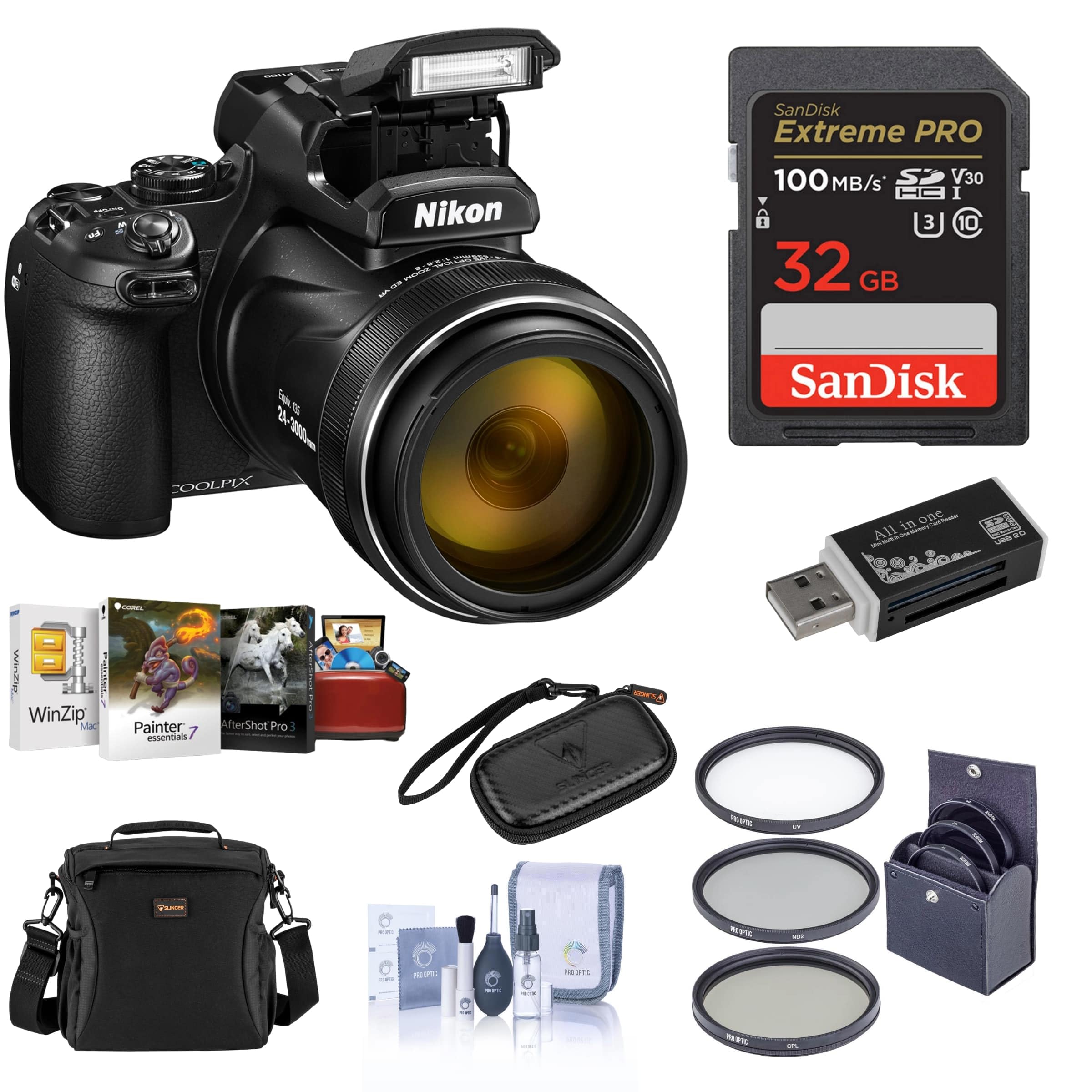
The Nikon P1000 holds the crown for raw zoom power: a 125x optical lens that stretches from 24mm to 3000mm equivalent. With the included bundle — filter kit, shoulder bag, memory card, cleaning kit — you have everything for immediate field deployment. The Dual Detect Optical VR helps tame the full 3000mm reach, but at those focal lengths, a tripod transforms marginal shots into sharp captures of distant raptors.
Birding mode and Moon mode are built-in, and the SnapBridge app enables quick social sharing right from the preserve. The camera supports RAW files, giving you latitude to recover shadow detail when shooting against a bright overcast sky. Reviewers consistently call the zoom “ridiculously good” and “insane,” noting that digital zoom at 6000mm is only for novelty use.
The trade-off is bulk — this is a large bridge camera that needs its own bag section. The processor also feels dated for high-speed burst sequences. But if your primary goal is to identify and photograph a heron from 300 feet away, nothing else in this list reaches that far.
Why it’s great
- 125x optical zoom is unmatched for extreme-distance identification shots
- Dual Detect VR allows handheld shooting at 2000mm with practice
- Bundle includes essential field accessories out of the box
Good to know
- Large, heavy body requires a dedicated bag and ideally a tripod
- Processor speed feels slow for action sequences and rapid buffer clearing
4. Nikon COOLPIX P1000

The standard P1000 — without the bundle — is the same core camera: 125x optical zoom, 16-megapixel sensor, 4K UHD video, and an accessory hot shoe for an external microphone or flash. The lens extends to a massive 3000mm equivalent, making it the most powerful superzoom ever produced for consumers. It includes RAW shooting, time-lapse, and full manual control for experienced photographers.
For birders who prioritize feather detail on stationary subjects across vast distances, this is the definitive tool. At 3000mm, atmospheric shimmer becomes a factor on hot days, and the autofocus can be slow at full telephoto, but follow-focus works in video mode. The 3.2-inch vari-angle LCD and high-resolution OLED viewfinder give flexible framing in brush or low angles.
The main drawbacks are its size — nearly 3.2 pounds — and the small sensor’s noise past ISO 1600. A special tripod plate is recommended for proper balance. Reviewers emphasize that high-quality keepers require stable support, but the zoom reach from a single lens is a genuine engineering feat for field birders.
Why it’s great
- 3000mm optical zoom enables identification of birds invisible to binoculars
- RAW and full manual controls satisfy advanced bird photographers
- Hot shoe allows external flash or microphone for hybrid use
Good to know
- Heavy build at 3.2 lbs demands a tripod for optimal results
- Sensor noise increases noticeably above ISO 1600
5. Panasonic Lumix FZ82D

The Panasonic Lumix FZ82D squeezes a 20–1200mm (60x) Leica DC Vario-Elmar lens into a compact bridge body, and its Hybrid autofocus system — combining contrast-detect and phase-detect points — locks on faster than pure contrast-detect rivals. For birders who photograph both perched and in-flight subjects, this hybrid AF reduces the hunting that plagues slower cameras.
The F2.8–5.9 aperture range allows decent light gathering at the wide end, though at 1200mm the f/5.9 maximum requires good daylight or higher ISO. It captures 4K video and 4K Photo bursts at 30 fps, letting you extract 8-megapixel stills from video frames — useful for catching a wing flap that the shutter missed.
Note that this model does not include built-in Wi-Fi, so file transfer requires removing the SD card and using a card reader. The lack of wireless connectivity may be a dealbreaker for instant-sharing enthusiasts, but the optical quality, hybrid AF, and robust build make it a strong choice for dedicated field work at a mid-range price point.
Why it’s great
- Hybrid autofocus system reduces hunting on moving birds
- 4K Photo burst at 30 fps allows frame extraction for perfect wing position
- Leica-branded lens delivers consistent optical sharpness across zoom range
Good to know
- No built-in Wi-Fi; file transfer requires a card reader
- Battery and charger are sold separately
6. Panasonic LUMIX ZS99

The Panasonic LUMIX ZS99 packs a 24–720mm (30x) Leica DC Vario-Elmar lens into a body that fits in a jacket pocket — a rarity for bridge cameras. The 5-Axis Hybrid OIS+ stabilization compensates for handheld shake, making it surprisingly capable for a compact. It records 4K video at 30p and 4K Photo bursts at 30 fps, plus slow-motion HD at 120 fps.
Birders who hike light or carry a second camera for casual sightings will appreciate the portability. The 1,840k-dot tiltable touchscreen aids low-angle shooting near water. With Bluetooth 5.0 and a dedicated Send Image button, transferring photos to your phone is seamless for sharing on eBird or social feeds.
The 30x zoom is shorter than dedicated birding bridges, so small birds at 100+ feet won’t fill the frame. The small sensor also limits low-light performance. But as a compact companion for travel birding where every ounce matters, the ZS99 delivers remarkable reach in an easy carry.
Why it’s great
- Pocketable body with 30x Leica lens for low-bulk carry
- 5-Axis Hybrid OIS+ keeps handheld shots steady at full zoom
- Bluetooth 5.0 + dedicated Send Image button for instant sharing
Good to know
- 30x optical zoom limits close-ups of small songbirds at long range
- Small sensor shows noise in low light compared to larger bridge cameras
7. Canon PowerShot V1

The Canon PowerShot V1 is a hybrid camera aimed at vloggers and content creators, but its 16–50mm equivalent F2.8–4.5 lens and large 1.4-type sensor (22.3 MP stills, 18.7 MP video) produce exceptionally clean images. The built-in cooling fan enables long 4K recording without overheating, and Canon Log 3 gives 10-bit color depth for advanced grading.
For birders who also create video field guides or live-stream birding outings, this hybrid excels. The Hybrid autofocus with 100 points tracks subjects reliably, and the wide-angle lens (16mm equivalent) is useful for documenting habitat context. The 10-bit CLog3 provides rich feather gradation in post-production.
The ultra-wide lens lacks the telephoto reach of traditional bridge cameras — no 1200mm equivalent here. It also has no built-in flash and relies on electronic image stabilization, which can be soft during walking shots. Its value leans toward shooter-creators who need high-quality video alongside stills, not pure long-range bird photography.
Why it’s great
- Large 1.4-type sensor captures clean low-light images with minimal noise
- 10-bit CLog3 video preserves feather gradation for professional grading
- Cooling fan allows extended 4K recording without thermal shutdown
Good to know
- Zoom range is limited to 16–50mm, not suited for distant bird subjects
- No built-in flash and relies on electronic IS for video stabilization
8. Kodak PIXPRO Astro Zoom AZ528
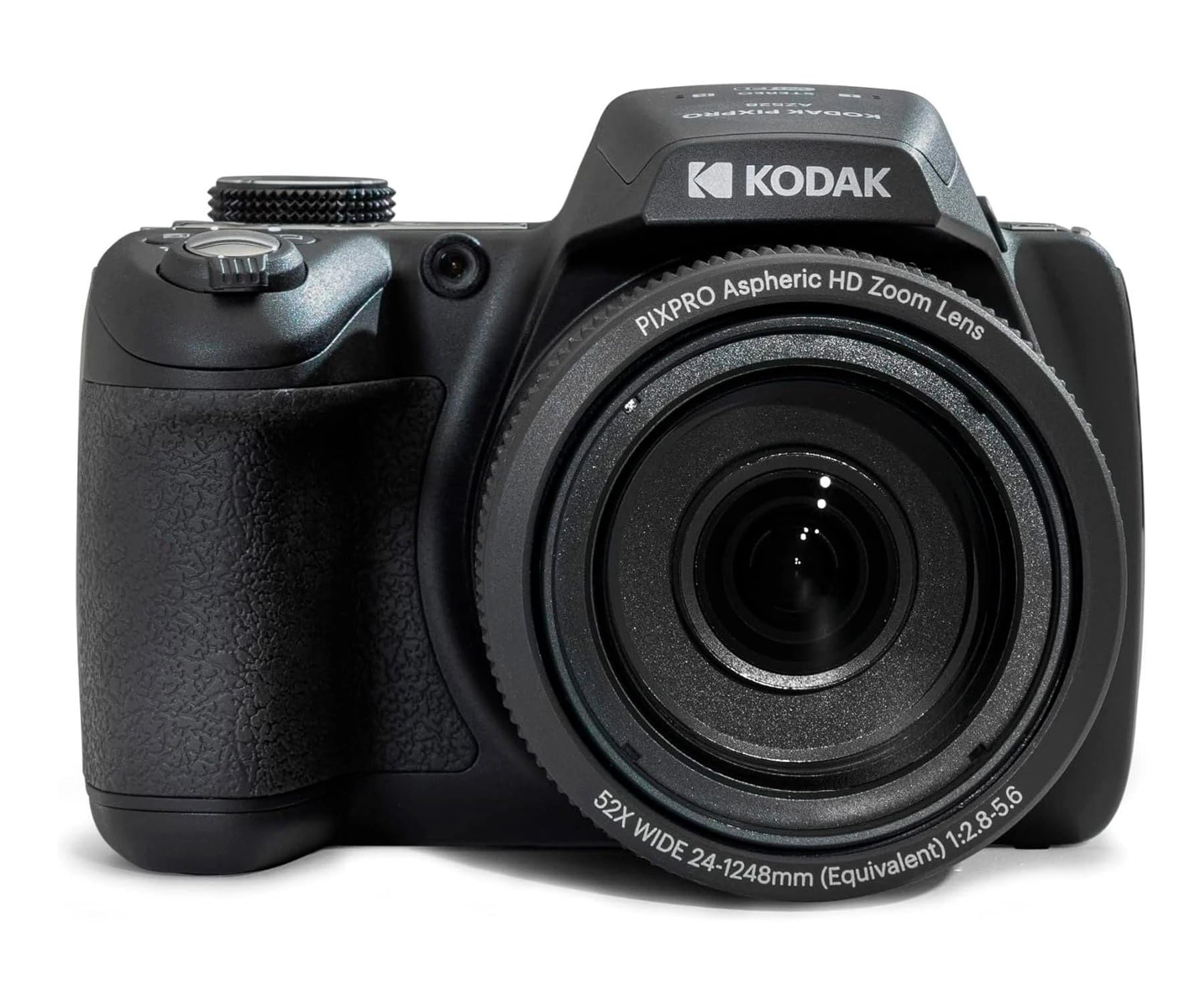
The Kodak PIXPRO AZ528 enters the budget tier with a 52x optical zoom (24–1248mm) and a 16-megapixel BSI CMOS sensor that captures decent feather detail in good light. The F2.8 aperture at wide angle helps in shaded environments, and the built-in optical image stabilization compensates for hand movement up to the telephoto end.
It shoots 1080p Full HD video, connects via Wi-Fi for smartphone transfer, and includes a burst mode at 6 fps — adequate for capturing a series of a bird taking off. The 3-inch LCD screen is functional, and the SCN mode with a Pet sub-mode can be repurposed for small wildlife with acceptable results.
Reviewers note that steady hands are essential at full zoom or the image becomes blurry, and the body scuffs easily. The included battery provides a full day of moderate use, but the camera lacks 4K video and RAW capture. For the birder on a strict budget who wants 50x-plus reach, the AZ528 delivers genuine value without breaking the bank.
Why it’s great
- 52x optical zoom reaches 1248mm for distant birds on a tight budget
- BSI CMOS sensor improves low-light performance vs older CCD sensors
- Wi-Fi connectivity allows quick smartphone transfer in the field
Good to know
- No 4K video or RAW capture; maximum resolution is 1080p and JPEG
- Body finish scuffs easily; recommended to keep in a case
9. Canon PowerShot SX530 HS (Renewed)

The Canon PowerShot SX530 HS brings the trusted Canon ecosystem to budget birding with a 50x optical zoom (24–1200mm) and a 16-megapixel High-Sensitivity CMOS sensor paired with the DIGIC 4+ processor. It captures 1080p Full HD video and features built-in Wi-Fi and NFC for seamless image sharing to a smartphone.
The 3-inch LCD with 461,000 dots provides a clear view for composition, and the dedicated movie button makes video recording immediate. The camera’s 50x reach is sufficient for many backyard and park birding scenarios, and the Canon color science produces pleasing feather tones straight out of camera.
Being a renewed model, battery life can vary — some units arrive with batteries that drain faster than expected. The continuous shooting rate of 1.6 fps is low compared to modern bridges, so capturing fast take-off sequences is challenging. Still, for birders loyal to Canon’s menu layout and image processing, the SX530 HS is a capable entry point at a friendly price.
Why it’s great
- 50x optical zoom provides 1200mm reach for medium-distance birding
- Canon color science delivers natural feather tones and pleasing skin tones
- Wi-Fi and NFC for quick wireless transfer to mobile devices
Good to know
- Burst rate of 1.6 fps is too slow for action sequences
- Renewed unit battery life can be inconsistent across different units
10. Minolta MN40Z
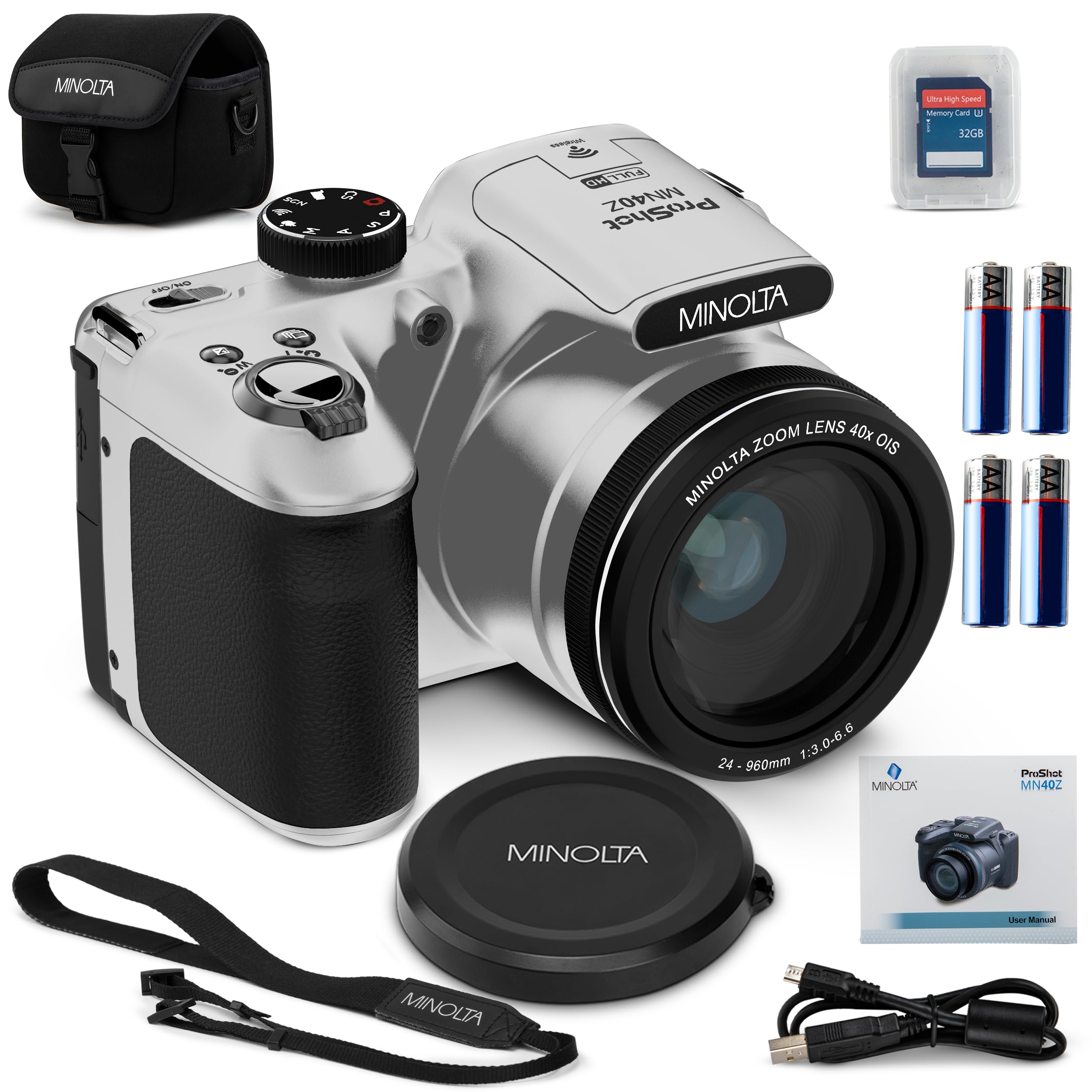
The Minolta MN40Z offers a 40x optical zoom and a 20-megapixel sensor in a body that runs on readily available AA batteries — a unique advantage for extended field trips where recharging is impossible. It records 1080p Full HD video, includes Wi-Fi sharing, and features face, smile, and blink detection for easier family shooting.
The 40x zoom is adequate for backyard feeders and medium-range pond birds, though the contrast-detection autofocus can be slow when locking onto fine branches. The included instruction booklet is clear, and the camera supports both Auto and Manual modes for learning exposure control. The 3-inch LCD screen is bright enough for outdoor framing.
While 40x falls short of the dedicated birding reach found in 83x or 125x models, the easy battery replacement and low entry cost make the MN40Z a practical starter. The supplied bag is basic, and the lens cap is not tethered, but overall it serves as an affordable introduction to long-zoom photography without the complexity of proprietary chargers.
Why it’s great
- Runs on AA batteries — ideal for remote birding without charging access
- 20-megapixel sensor offers high-resolution stills for cropping
- Manual mode supports learning exposure basics for bird photography
Good to know
- 40x optical zoom is modest compared to dedicated birding bridges
- Slow contrast-detect autofocus can miss fast-moving subjects
11. Nikon COOLPIX B500 (Renewed)

The Nikon COOLPIX B500 delivers a 40x optical zoom (up to 80x via Dynamic Fine Zoom) and a 16-megapixel sensor with a NIKKOR ED glass lens. It features a tilting 3-inch 921,000-dot LCD — excellent for low-angle composition near water — and records 1080p video at 120 fps for slow-motion playback of flight sequences.
Built-in Wi-Fi, NFC, and Bluetooth Low Energy maintain a constant connection to your smartphone for automatic image backup and remote shooting. Reviewers consistently praise its color accuracy — greens and reds appear natural, which helps when identifying subtle plumage differences. The lens-shift VR keeps framerate steady at full zoom.
The B500 runs on AA batteries (not included with the renewed unit), and macro focus can struggle with low-contrast subjects like pale feathers against a bright sky. At 40x optical, it sits at the lower end of birding bridge range, but for casual birders who prioritize color fidelity and an easy tilting screen, it remains a compelling budget entry in the Nikon lineup.
Why it’s great
- Color-accurate NIKKOR ED lens produces natural feather tones
- Tilting 921,000-dot LCD aids low-angle shooting from the ground
- Bluetooth Low Energy maintains constant connection for easy transfer
Good to know
- 40x optical zoom is limited for distant field birding; uses AA batteries
- Macro AF struggles with low-contrast subjects like pale feathers in bright light
FAQ
How much optical zoom do I need for bird photography?
Can I shoot birds in flight with a bridge camera?
Do I need a tripod for a bridge camera?
Final Thoughts: The Verdict
For most users, the best birding bridge camera winner is the Nikon COOLPIX P950 (Renewed) because its 83x optical zoom, Dual Detect VR, and dedicated Bird mode deliver high-quality feather detail at a price that undercuts the competition. If you want maximum reach for extreme distance photography, grab the Nikon COOLPIX P1000 Bundle. And for pocketable travel birding where every ounce counts, nothing beats the Panasonic LUMIX ZS99.

Mo Maruf
I created WellFizz to bridge the gap between vague wellness advice and actionable solutions. My mission is simple: to decode the research and give you practical tools you can actually use.
Beyond the data, I am a passionate traveler. I believe that stepping away from the screen to explore new environments is essential for mental clarity and physical vitality.