Our readers keep the lights on and my smoothie glass nicely filled. As an Amazon Associate, I earn from qualifying purchases.
If your child complains of headaches after school or rubs their eyes during tablet time, digital eye strain is likely the culprit. Blue light blocking glasses for kids offer a practical, non-prescription solution that filters high-energy visible (HEV) blue light emitted by screens, helping to reduce eye fatigue, improve sleep quality, and make screen time more comfortable for young eyes.
I’m Mohammad Maruf — the founder and writer behind WellFizz. I’ve spent years analyzing consumer optics products, cross-referencing customer feedback with technical specs like lens material, frame flexibility, and blue light filtration percentage to separate marketing claims from real-world effectiveness.
After researching dozens of options and filtering through verified customer experiences, I’ve narrowed down the most effective blue light blocking glasses for kids that actually fit, stay comfortable, and deliver measurable relief from screen-induced eye strain.
How To Choose The Best Blue Light Blocking Glasses For Kids
Not all kid-sized glasses are created equal. Most parents overestimate lens clarity and underestimate frame durability. Here’s what actually makes the difference when buying for children ages 3 to 15.
Frame Material and Flexibility
Kids drop, bend, and sit on things. TR90 and silicone-based frames resist snapping and remain flexible across different face shapes. Spring hinges add an extra layer of durability by allowing the arms to flex outward beyond 90 degrees without breaking — a lifesaver for active kids.
Lens Filtration and Tint
Look for lenses that block at least 90% of blue light in the 380nm–450nm range. Some brands use a substrate-absorption technology rather than a simple coating, giving more consistent filtration. Amber-tinted lenses block more blue light than clear ones but may look noticeable in class — choose based on your child’s tolerance for the yellow cast.
Fit and Weight
Children’s frames typically span ages 3 to 12 or 6 to 15, but actual head size varies wildly. Lightweight frames under 20 grams prevent pressure marks on the nose and ears. Adjustable silicone nose pads and bendable temple arms help dial in the fit without slipping.
Quick Comparison
On smaller screens, swipe sideways to see the full table.
| Model | Category | Best For | Key Spec | Amazon |
|---|---|---|---|---|
| Cyxus Spring Hinges | TR90 Frame | School & daily wear | TR90 frame, 90% blue light | Amazon |
| Horus X Hope | Amber Lens | Gaming & deep protection | 86% 380–450nm, 19g | Amazon |
| JM Kids TR90 | Bendable Arms | Ages 3–10 comfort | TR90 frame, 2.5 oz | Amazon |
| GALVANOX Ava & Ethan | Silicone Nose | Headache relief | 6.3 x 5.12 in, 3 oz | Amazon |
| COASION 3-Pack | Budget Set | Multi-child families | 3 pairs, ages 3–12 | Amazon |
In‑Depth Reviews
1. Cyxus Kids Blue Light Blocking Glasses

Cyxus uses an American HEV-Absorb substrate absorption technology rather than a simple coating, meaning the blue light filtering is consistent across the entire lens. Polycarbonate lenses are impact-resistant and UV400-rated, making them safer for active children who might drop or roughhouse with their glasses. The TR90 frame is super light and flexible, resisting snaps even under aggressive bending.
Spring hinges are the standout feature here — they let the arms flex outward well past 90 degrees, which dramatically reduces the chance of breakage when kids pull them off one-handed. The fit spans ages 6 to 15, and multiple verified reviews confirm that headaches from computer use disappeared within days of wearing these. The included hard case, cleaning cloth, and stickers add practical value for parents.
The lenses have a slight yellow tint, typical of substrate-absorption lenses, which is barely noticeable to the wearer. Some users noted that the nose pad silicone replacement inserts would have been appreciated, but the overall build quality is exceptional for the mid-range. For daily school and home screen use, this is the most balanced option available.
Why it’s great
- Spring hinges prevent frame breakage from daily abuse
- HEV-Absorb substrate blocks 90% of blue light consistently
- Ultra-light TR90 frame reduces pressure marks
Good to know
- Slight yellow tint visible in bright light
- No replacement nose pads included for spare
2. Horus X Hope Kids Blue Light Blocking Glasses

Horus X is a French brand that takes a more clinical approach to blue light filtration. Their lenses block 100% of blue light at 400nm and over 86% of harmful rays in the 380nm–450nm range — significantly higher than most competitors. The amber-tinted lenses produce a warmer world view, which actually enhances contrast in gaming environments while providing serious protection for prolonged screen sessions.
At just 19 grams, these are among the lightest kids’ glasses tested. The polycarbonate frame is flexible yet sturdy, and the plush nose pad keeps them from sliding down smaller faces. Despite being marketed for kids and teens, the narrow fit (52mm–14–128) also works for adults with smaller faces, making this a versatile backup pair for the whole family.
The lifetime guarantee is rare in this price tier — Horus X will replace broken frames for life, which removes the anxiety of buying glasses for rough kids. The premium package includes a solid box, ultra-light case, and a high-quality microfiber cloth. The only trade-off is the strong amber tint, which may feel distracting during daytime reading or outdoor use.
Why it’s great
- Blocks over 86% of blue light in the 380–450nm range
- Lifetime guarantee covers breakage from active kids
- Only 19 grams with plush nose pad for all-day wear
Good to know
- Strong amber tint may look noticeable in class
- Fit is narrow — best for ages 6–12 or small faces
3. JM Kids Blue Light Glasses TR90
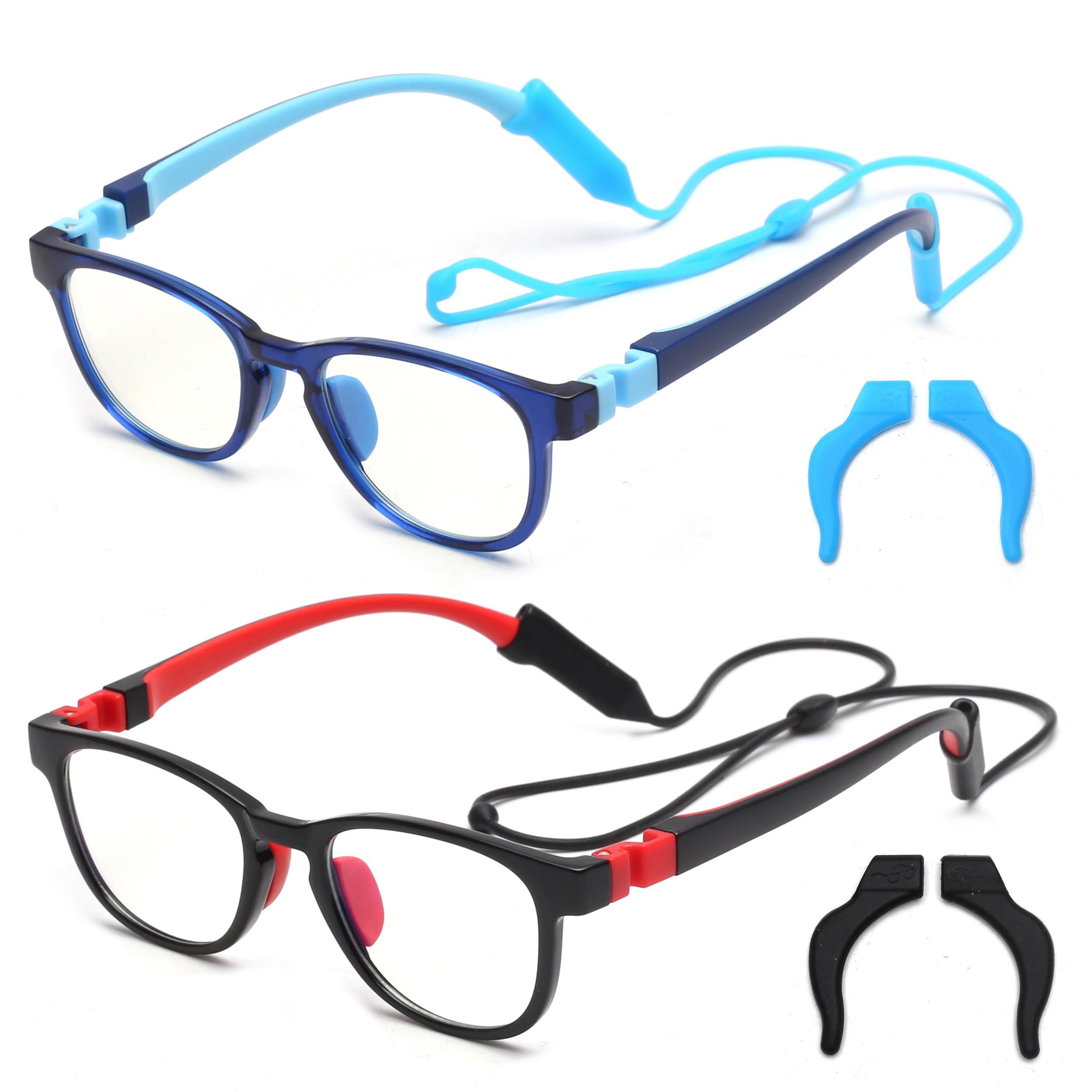
JM Kids focuses on comfort for the younger set, specifically ages 3 to 10. The TR90 frame material is highly flexible, and the temple arms actually bend outward to accommodate a wider range of head shapes without pinching. Multiple verified reviews mention that even active 6 and 7-year-olds forget they are wearing them — the ultimate sign of a good fit for children.
The included anti-slip accessories help the glasses stay put during homework, tablet gaming, and even playground time. The lenses offer effective blue light reduction without an overly aggressive yellow tint, making them appropriate for classroom use where appearance matters. Parents report using these as actual prescription frames, with optometrists successfully fitting corrective lenses into the same frame.
Build quality is notably better than budget-priced alternatives, though the hinges are standard rather than spring-loaded. The weight is around 2.5 ounces, which is light enough for small faces but not the lightest on this list. For parents seeking a dedicated fit for younger children who need all-day comfort, this is an excellent mid-range bet.
Why it’s great
- Bendable temple arms prevent pinching on wider heads
- Anti-slip accessories keep glasses secure during activity
- Compatible with prescription lens replacement
Good to know
- Standard hinges — less durable than spring-loaded
- Best for ages 3–10, may be small for older kids
4. GALVANOX Ava & Ethan Blue Light Glasses

GALVANOX positions these glasses as a targeted solution for children who experience headaches specifically triggered by fluorescent lighting and screen time. The lenses convert harsh artificial light into a warmer tone, and multiple verified reviews cite immediate headache relief within days of use — one parent noted that their child’s daily headaches at school stopped completely after switching to these frames.
The design includes silicone nose pads that improve grip and reduce pressure marks, and the 6.3 x 5.12 inch frame dimensions fit the average 6 to 12-year-old face well. The color options are vibrant and fun, though some buyers noted that the pink variant appears more transparent in person than in online photos. Despite this, kids seem to love wearing them, which is half the battle.
While the build quality is solid for the price, the frame lacks TR90 or spring hinge construction, meaning it is less resistant to rough handling than the premium options. The lenses are not as impact-resistant as polycarbonate, but for daily school and home use with careful handling, they deliver excellent protection at a accessible price.
Why it’s great
- Verified headache relief from fluorescent and screen light
- Silicone nose pads improve grip on smaller faces
- Warm color conversion reduces eye fatigue noticeably
Good to know
- Standard plastic frame — less durable than TR90
- Pink color may differ slightly from product images
5. COASION Blue Screen Glasses for Kids (3-Pack)

COASION offers a budget-friendly three-pack that solves the two biggest problems with kids’ glasses: losing them and fighting over them. By providing multiple pairs, parents can keep one in the backpack, one at the desk, and one as backup. The glasses fit ages 3 to 12, and verified reviews confirm they work well for children across a range of head sizes — one parent reported a 5-year-old, 7-year-old, and 9-year-old all using the same pack comfortably.
The sturdiness surprised many buyers, who expected flimsy construction at this price point. The frames hold up to daily wear and do not slide off faces during normal activity. The style is cute and child-friendly, with multiple color options that kids actually want to wear. However, the color accuracy is slightly off from product images, particularly the pink variant which is nearly clear in reality.
The lenses provide entry-level blue light filtration suitable for casual screen use — homework, short tablet sessions, and TV watching. For heavy gaming or all-day classroom Chromebook use, the mid-range options offer more robust filtration and more durable frame construction. As a value play for multi-child households, this three-pack is a smart buy that covers the basics without breaking the bank.
Why it’s great
- Three pairs cover multiple kids or locations
- Sturdy enough for daily wear despite entry-level price
- Fits a wide age range from 3 to 12 years old
Good to know
- Pink color is nearly clear, not bright as pictured
- Entry-level filtration — best for casual screen use
FAQ
At what age should my child start wearing blue light glasses?
Should I choose amber-tinted or clear lenses for my child?
Can I replace the lenses with prescription lenses?
Final Thoughts: The Verdict
For most users, the blue light blocking glasses for kids winner is the Cyxus Spring Hinges model because it combines TR90 flexibility, spring hinge durability, and consistent substrate-absorption technology at a mid-range price. If you want maximum filtration for heavy gaming sessions, grab the Horus X Hope with its amber lenses and lifetime guarantee. And for budget-conscious families with multiple children, nothing beats the COASION 3-Pack for covering all bases without sacrificing comfort.

Mo Maruf
I created WellFizz to bridge the gap between vague wellness advice and actionable solutions. My mission is simple: to decode the research and give you practical tools you can actually use.
Beyond the data, I am a passionate traveler. I believe that stepping away from the screen to explore new environments is essential for mental clarity and physical vitality.