Our readers keep the lights on and my smoothie glass nicely filled. As an Amazon Associate, I earn from qualifying purchases.
Finding a blood pressure monitor that fits a larger arm circumference is harder than it sounds. Standard cuffs top out at around 16.5 inches, and a snug fit that triggers errors or false-high readings is the last thing you need when tracking a health metric that literally determines medication timing and dosage. The wrong cuff doesn’t just cause discomfort — it produces systolic and diastolic numbers that can mislead both you and your physician.
I’m Mohammad Maruf — the founder and writer behind WellFizz. I’ve studied dozens of clinical validation studies, compared cuff-sizing tables from the Association for the Advancement of Medical Instrumentation (AAMI), and cross-referenced user complaints about fit-induced measurement drift in the upper-arm monitor category for years.
This guide evaluates the top contenders with a strict lens on cuff circumference, data-tracking sophistication, and real-world accuracy, helping you choose the best blood pressure monitor for large arms that actually serves your health routine.
How To Choose The Best Blood Pressure Monitor For Large Arms
Every millimeter matters when your health data drives medication decisions. A cuff that is too small artificially spikes your readings by 10 to 30 mmHg, potentially leading to unnecessary drug adjustments. Focus on cuff range, validation protocol, and data-logging architecture.
Cuff Circumference Range
The single most important spec is the cuff’s upper circumference limit. Standard cuffs stop at 16.5 inches. For large arms, look for a cuff that reaches at least 17 inches. Some models now extend to 17.7 inches, which accommodates most bicep circumferences. Measure your bare upper arm mid-bicep before buying and compare it directly against the monitor’s stated cuff range.
Clinical Validation Standards
Not all “medical-grade” claims are equal. Look for monitors validated against AAMI/ESH/ISO protocols, ideally with published clinical trial data. The British Hypertension Society (BHS) and dabl Educational Trust maintain current lists of validated devices. A monitor with a CE mark but no AAMI listing may still be accurate, but the validation path matters for insurance reimbursement and physician trust.
Memory and Multi-User Support
Hypertension management is a long game. A monitor that stores at least 100 readings per user with date and time stamps lets you spot weekly trends without a notebook. Dual-user models with independent memory banks are ideal for households where two people monitor their pressure. Bluetooth sync adds the ability to export PDF reports for your doctor, but built-in memory is the failsafe when you do not want your phone nearby during a reading.
Quick Comparison
On smaller screens, swipe sideways to see the full table.
| Model | Category | Best For | Key Spec | Amazon |
|---|---|---|---|---|
| OMRON Gold BP5360 | Premium | AFib detection & clinical-grade data | Cuff 9”–17”, AFib detection | Amazon |
| Withings BPM Connect | Premium | WiFi/Bluetooth auto-sync | Cuff 8.7”–16.5”, rechargeable battery | Amazon |
| Greater Goods Bluetooth | Mid-Range | Wirecutter top pick, app integration | Cuff 8.7”–16.5”, 60 readings/user | Amazon |
| Healthing U80W | Mid-Range | Extra-large backlit screen, trend curve | Cuff 9”–17”, 180 readings dual user | Amazon |
| BBLOVE AES-U622 | Mid-Range | Dual-screen comparison, one-button mute | Cuff 9”–17”, 180 readings dual user | Amazon |
| Trackstar Veridian | Budget-Friendly | Wide cuff, soft fabric comfort | Cuff 8.6”–17.7”, movement detection | Amazon |
| Urion LED Monitor | Budget-Friendly | Large LED display, FSA/HSA eligible | Cuff 9”–17”, 199 readings dual user | Amazon |
In‑Depth Reviews
1. OMRON Gold Blood Pressure Monitor BP5360
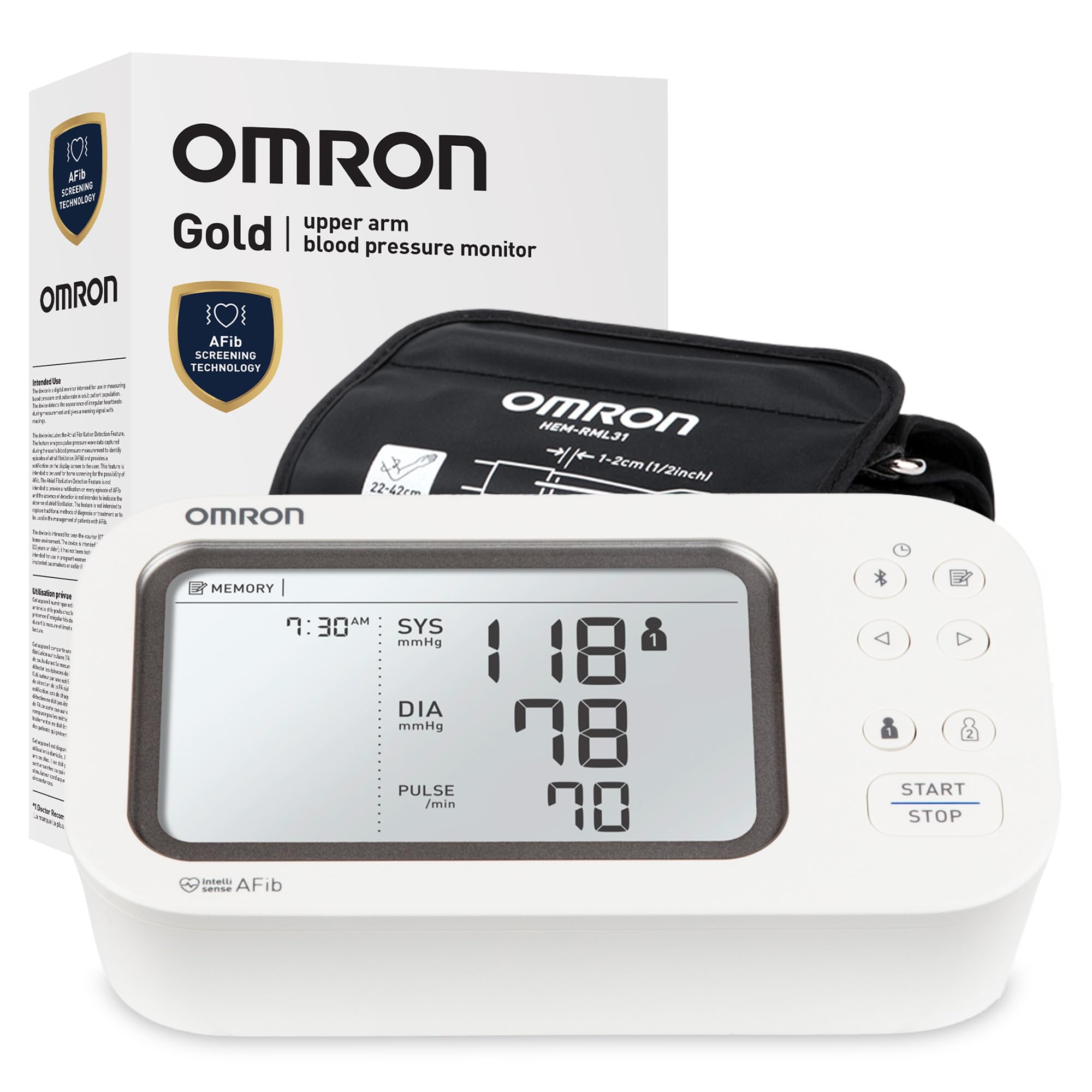
The OMRON Gold BP5360 is the only monitor in this lineup with built-in Atrial Fibrillation (AFib) detection during routine pressure checks, a feature that adds a layer of cardiac screening no other model here offers. Its wide-range D-ring cuff accommodates arms from 9 to 17 inches, fitting comfortably on larger biceps while maintaining the brand’s clinically validated accuracy. The unit connects via Bluetooth to the OMRON connect app, storing unlimited readings and allowing PDF report exports for your physician — a workflow that aligns with serious hypertension management.
The morning average indicator flags systolic spikes that occur after waking, a key risk marker for cardiovascular events. Setup out of the box includes four AA batteries and a storage case, but no rechargeable battery, which is a small concession for a device that prioritizes clinical-grade precision. Early user reports note that the AFib detection algorithm can block the reading itself if an irregular rhythm is detected — a safety lock that some patients with confirmed AFib found frustrating because the feature cannot be disabled.
At this tier, you get the most validated upper-arm monitor from the brand recommended most often by doctors and pharmacists. The trade-off is that AFib detection is a double-edged sword: it catches anomalies but may prevent the display of any pressure reading when it suspects an arrhythmia. For users without diagnosed AFib, this is non-issue and adds peace of mind. The OMRON Gold is the gold standard for users who want the highest clinical relevance in a home device.
Why it’s great
- Clinically validated AFib screening during every reading
- Wide-range cuff fits 9 to 17 inch arms securely
- Bluetooth sync with unlimited memory in companion app
Good to know
- AFib detection may block reading display for some users
- Runs on AA batteries, not rechargeable
- Pricier than mid-range alternatives
2. Withings BPM Connect

The Withings BPM Connect stands apart with its two-wireless-path architecture: it syncs both via Bluetooth and WiFi, meaning readings are automatically uploaded to the Health Mate app even if your phone is in another room. The rechargeable battery lasts up to six months, and the cuff fits arms from 22 to 42 cm (roughly 8.7 to 16.5 inches), a range that covers most users but stops short of the 17-inch mark. Its compact, stainless-steel-accented body looks more like a modern gadget than a medical device, which may encourage more frequent daily use.
The display shows color-coded feedback directly on the device — green, yellow, orange, or red — so you can interpret results without opening the app. User reports indicate systolic readings within 2 mmHg of clinical Welch Allyn monitors, though diastolic divergence of 4 to 5 mmHg has been noted by some testers. The measurement algorithm uses deflation-phase analysis, which some users report feels slower and slightly more uncomfortable than inflation-based systems. The integrated cuff loop can slide out during storage, a minor assembly annoyance.
For a premium price, you get the most seamless data pipeline: readings auto-populate in Apple Health and Google Fit, and you can generate PDF reports to email your doctor from the app. The upper arm circumference ceiling of 16.5 inches means it may not fit users on the larger end of the large-arm spectrum. The Withings BPM Connect is the right choice for the tech-forward user who prioritizes effortless data logging over maximum cuff range.
Why it’s great
- WiFi and Bluetooth dual-sync for automatic data upload
- Rechargeable battery lasts 6 months per charge
- Color-coded on-device display simplifies result interpretation
Good to know
- Cuff maxes out at 16.5 inches
- Initial Bluetooth pairing can be problematic
- Reading algorithm can feel slower than competitors
3. Greater Goods Bluetooth Smart Blood Pressure Monitor BD3439
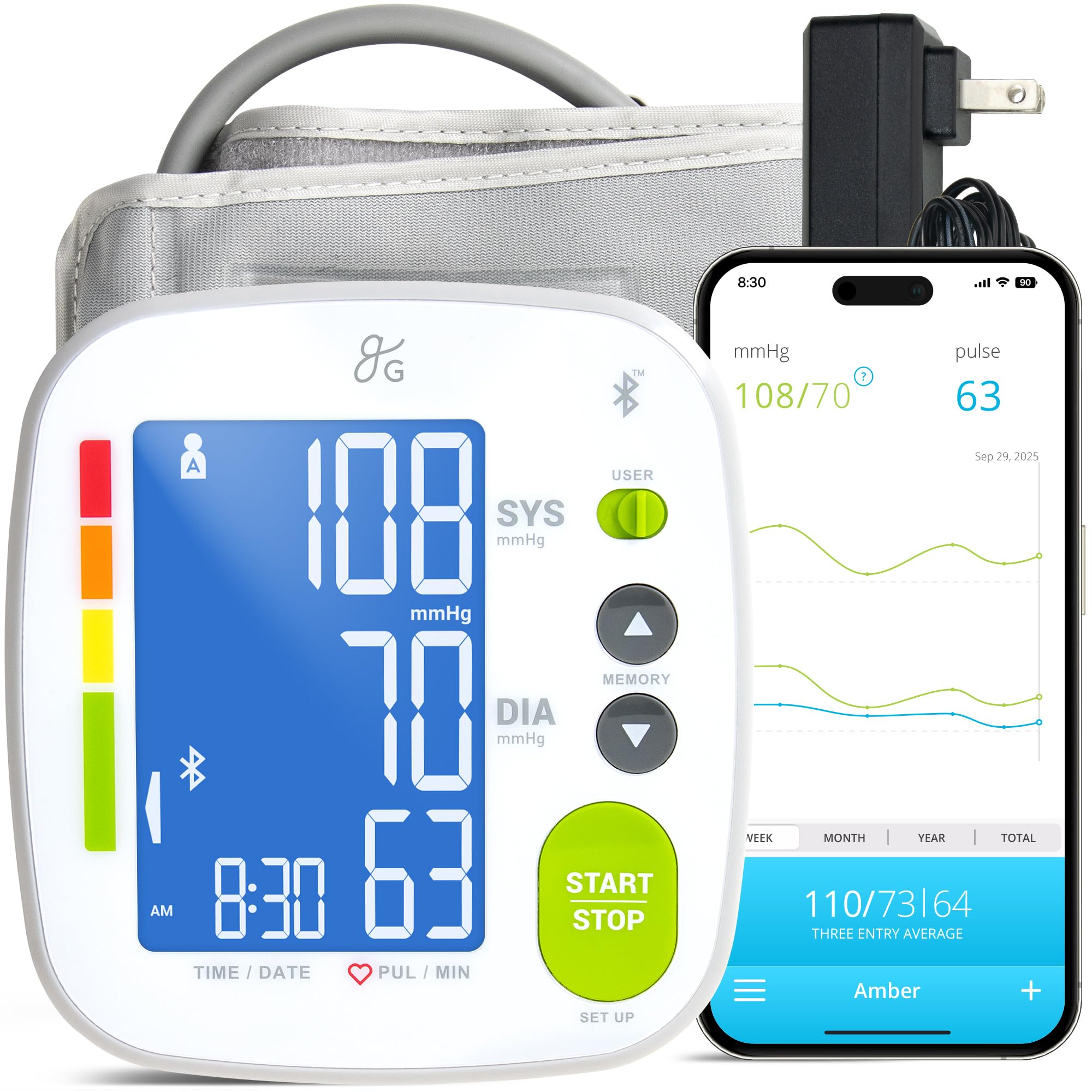
The Greater Goods BD3439 has been recognized five times by Wirecutter for its combination of accuracy, consistency, and ease of use — a rare track record in the consumer BP market. The adjustable cuff covers 8.7 to 16.5 inches and includes an artery alignment guide printed on the cuff fabric, which reduces placement errors common among first-time users. The large backlit display with bold numbers is readable from across the room, and the one-button operation eliminates menu-diving when you are half-asleep and need a fast morning reading.
Bluetooth sync to the Balance Health app stores unlimited readings with trend graphs, and the monitor integrates with Apple Health. The onboard memory holds 60 readings per user (120 total), serving as reliable backup when Bluetooth is off. Users report that the A/B user selector labeling is reversed on the physical unit, which causes sync confirmation pop-ups in the app — a software quirk, not a functional error. The travel case is slightly undersized; users note that the AC adapter can press against the start button during storage, so placing the adapter separately avoids accidental inflation.
For the mid-range price point, you get a well-validated monitor with solid app support, irregular heartbeat detection, and the peace of mind of St. Louis-based customer support. The 16.5-inch cuff ceiling places this monitor squarely in the comfortable-large range, but users whose biceps exceed that measure should look at models with a 17-inch or larger cuff. The Greater Goods BD3439 is the smartest pick for the vast majority of users who want lab-validated accuracy without the premium-tier price tag.
Why it’s great
- Five-time Wirecutter recommendation for accuracy
- Cuff alignment guide reduces placement errors
- Backlit display with bold digits for low-light use
Good to know
- User label A/B selector is reversed on unit
- Carrying case is small for AC adapter storage
- Cuff tops out at 16.5 inches
4. Healthing U80W Blood Pressure Monitor
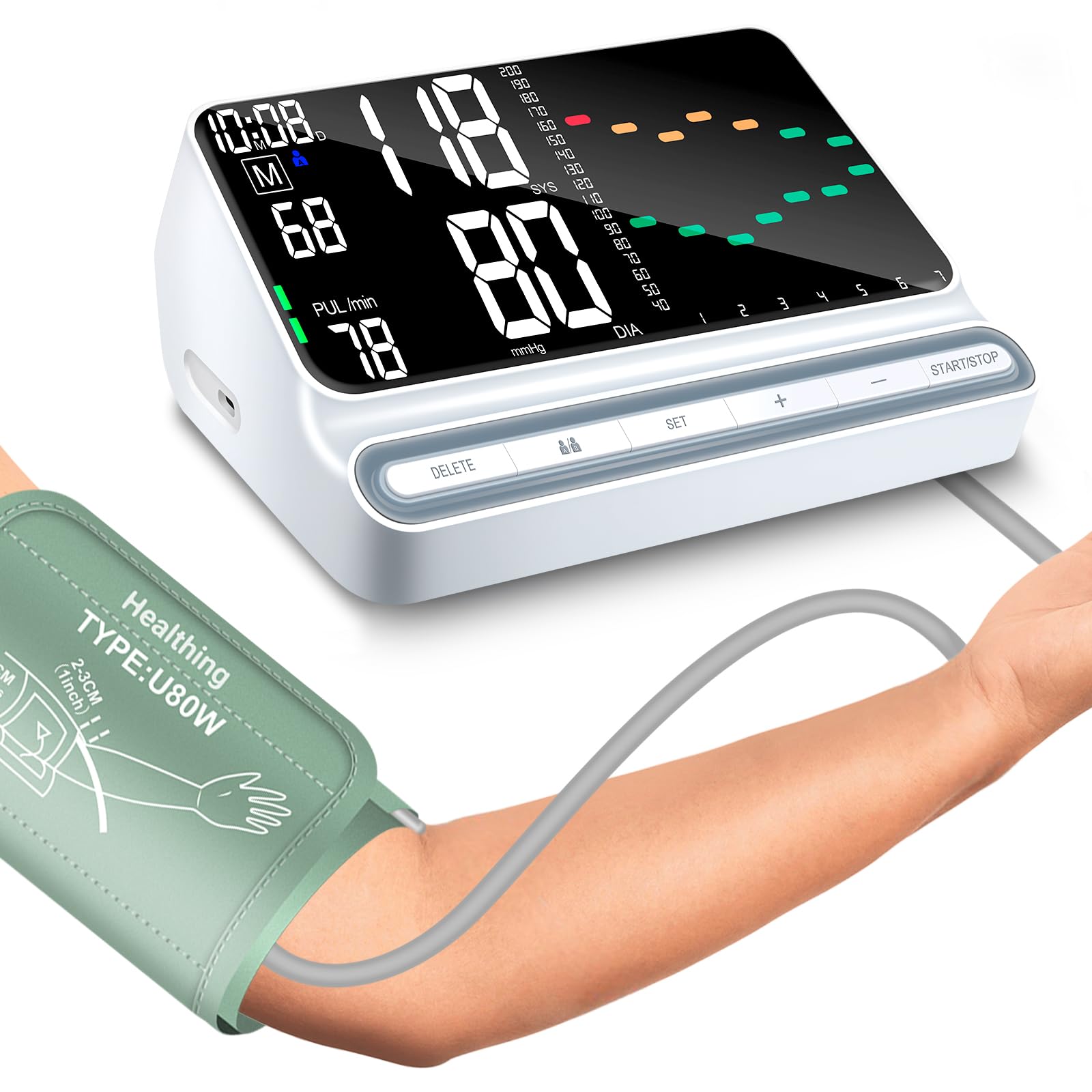
The Healthing U80W delivers a compelling package for the price: its extra-large backlit screen shows tricolor numbers and a weekly trend curve, giving you a visual snapshot of rising or falling pressure patterns without needing to open an app. The ergonomic D-ring cuff with ultra-soft material fits arms from 9 to 17 inches, offering one of the more generous upper circumference limits in the mid-range group. The one-piece design houses the monitor and cuff in a single unit, reducing cable clutter and simplifying storage.
Memory capacity of 180 readings split across two users (90 each) is generous, and the rechargeable battery eliminates ongoing battery costs. The pulse health algorithm measures extra data points during inflation for improved accuracy, and users report readings that correlate closely with hospital monitors. The instruction manual is sparse, which may confuse first-time users, but the interface itself is intuitive once you understand the button layout. The unit is notably quiet during inflation and deflation, making it a good candidate for nighttime use.
At a mid-range price point, the Healthing U80W competes effectively with models costing more because of its large screen, wide cuff range, and rechargeability. The weekly trend curve display on the device itself is a differentiator — most monitors only show graphs inside the app. The Healthing U80W is best for households with two users who want to see trends at a glance without grabbing a phone every time.
Why it’s great
- On-device weekly trend curve shows patterns instantly
- Rechargeable battery with long life
- Wide cuff fits 9 to 17 inch arms
Good to know
- Instruction manual is sparse
- No Bluetooth or WiFi connectivity
- One-piece design may be bulky for travel
5. BBLOVE AES-U622 Blood Pressure Monitor

The BBLOVE AES-U622 differentiates itself with a dual-screen display that shows your current reading alongside the previous one on the same LCD panel, eliminating the need to scroll through history to compare morning and evening results. The universal comfort-fit cuff spans 9 to 17 inches and uses advanced biosensors with validated algorithms for medical-grade precision. A dedicated physical switch lets you toggle between User A and User B instantly, with independent memory banks storing 90 readings per user.
The one-button mute feature is a thoughtful addition for nighttime monitoring — a single press silences the beep without navigating menus, so you can take a reading without waking a partner. The three-color indicator (green/yellow/red) simplifies result interpretation, though the color bands follow standard hypertension thresholds and are not customizable. Users report consistent readings across multiple sessions, and the build quality feels sturdy for a mid-range device. The unit runs on a rechargeable battery, and the USB-C charging port is a modern convenience.
At a mid-range price point, the BBLOVE AES-U622 offers a cuff range that matches the best in its class, plus a dual-screen feature that reduces the mental load of trend-spotting. The mute button and backlit display make it suitable for all-day and all-night use without disturbing others. The BBLOVE AES-U622 is a strong contender for couples who want separate memory banks and a device that prioritizes daytime and nighttime usability equally.
Why it’s great
- Dual-screen shows current and previous reading side by side
- One-button mute for silent nighttime operation
- USB-C rechargeable with dedicated user switch
Good to know
- Color indicator thresholds are not adjustable
- No app connectivity for cloud data storage
- Large cuff may feel snug on the tightest setting
6. Trackstar Veridian Smart Blood Pressure Monitor
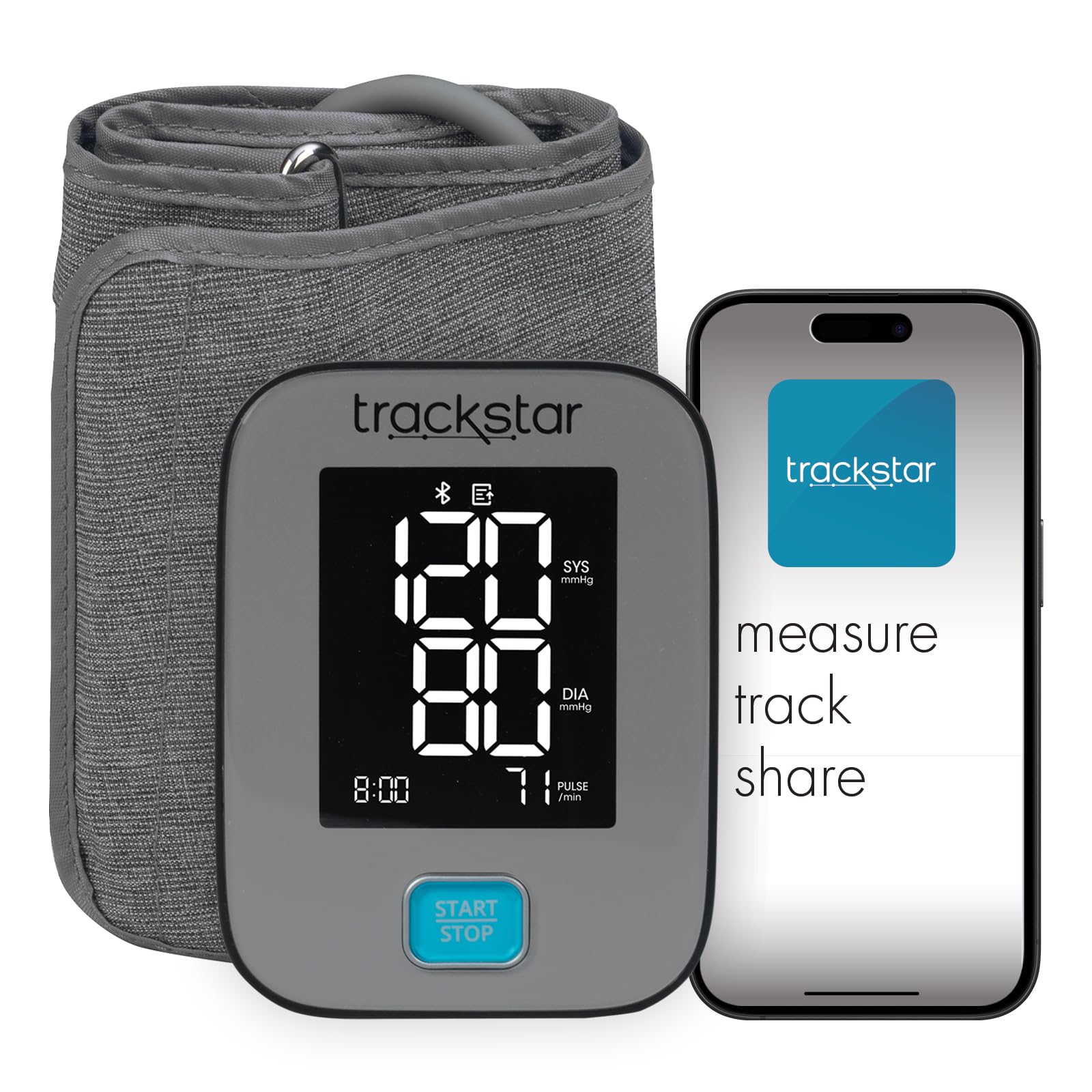
The Trackstar Veridian delivers the widest cuff in this review at 8.6 to 17.7 inches, making it the most accommodating option for users with bicep circumferences that exceed typical 16.5-inch limits. The cuff is constructed from soft nylon fabric, not the stiffer vinyl-variety found on many budget monitors, which translates to more comfortable inflation at the higher pressure needed for larger arms. The Trackstar app integrates with Apple Health and allows selective sharing of results, giving you control over what data leaves your device.
The oversized display shows systolic, diastolic, and pulse readings in bold characters, with icons for excessive movement and irregular heartbeat detection. The one-button operation keeps the interface simple, and a quick-start guide plus app guide are included in the box. Users consistently note that the cuff is easier to apply solo compared to rubberized D-ring cuffs, and the fabric material stays grippy without causing friction burns during rapid deflation. Some users report occasional measurement variation — the movement icon is helpful for identifying when body motion is affecting the reading.
At a budget-friendly price, you get the most generous cuff circumference range in this guide, a comfortable fabric cuff, and a comprehensive app for tracking trends. The monitor does not include an AC adapter, relying on the four included AAA batteries, and the app requires it to be open during the reading for automatic sync. The Trackstar Veridian is the best choice for users with the largest arm circumferences who prioritize cuff comfort and app connectivity over premium brand cachet.
Why it’s great
- Widest cuff range at 8.6 to 17.7 inches
- Soft fabric cuff is comfortable on larger arms
- App syncs with Apple Health and selective sharing
Good to know
- No AC adapter included with the box
- App must be open during reading for Bluetooth sync
- Some variability in readings if movement occurs
7. Urion Blood Pressure Monitor (FSA/HSA Eligible)
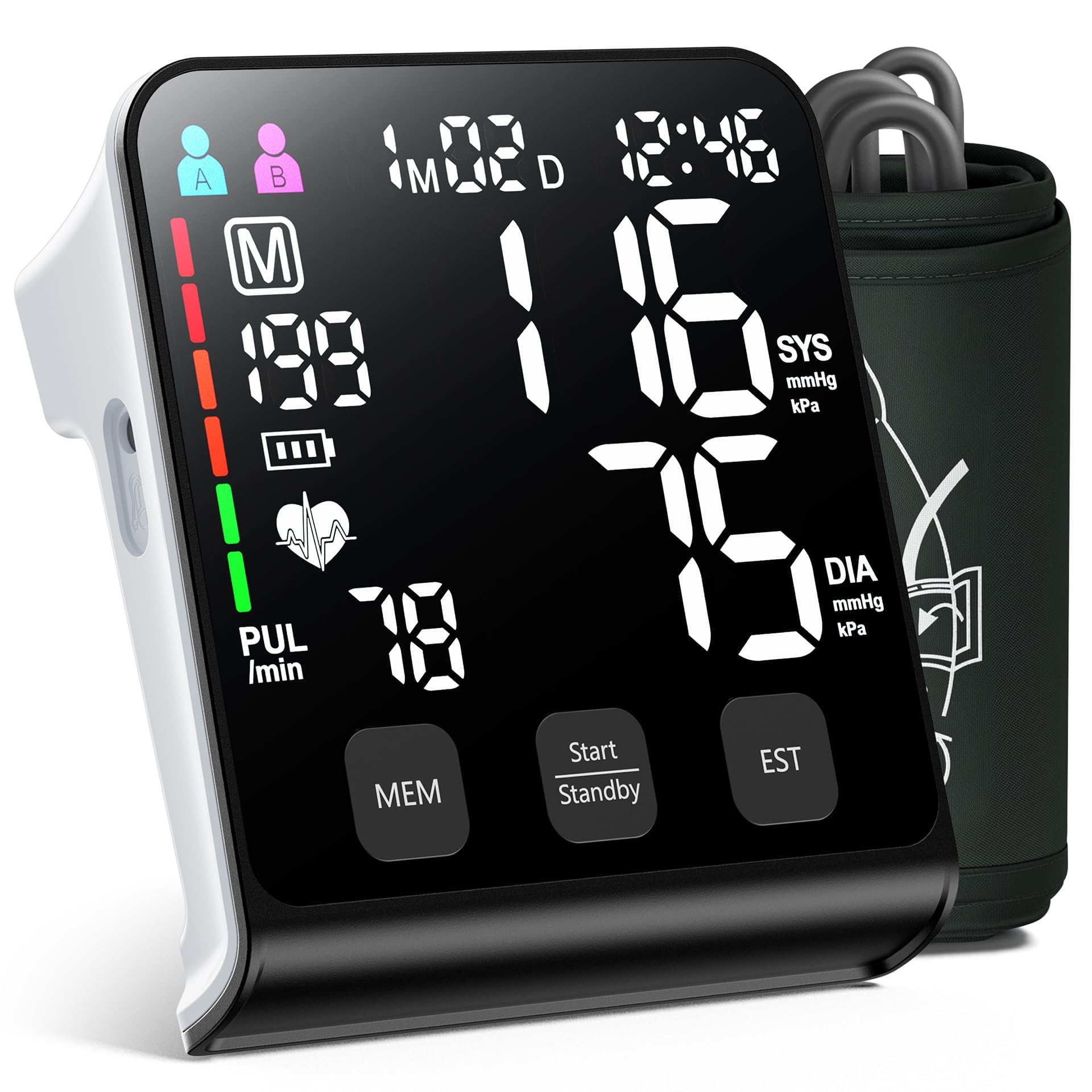
The Urion monitor centers on a 4.5-inch LED screen with oversized digits and a blood pressure classification indicator that colormaps your result directly on the display — a useful crutch for seniors who may not track standard hypertension thresholds from memory. The adjustable cuff fits a standard range, supporting most users comfortably, and the one-touch operation means the same simple process each time. With 199 reading slots per user and dual-user memory, it holds more historical data than any other monitor in this review, allowing long-term trend analysis without needing to sync to an app.
The device is FSA and HSA eligible, making it easier to purchase through pre-tax health accounts. The intelligent pressure algorithm yields readings within 3 mmHg error margin, and the irregular heartbeat alert adds a safety layer during each session. The compact body with a scratch-resistant acrylic panel withstands daily use, and power options include both batteries and a USB-C cable, so you can charge it from a laptop or wall adapter. Users note that the cuff is comfortable during inflation, and the quick-reading cycle reduces anxiety-related pressure spikes during measurement.
At a budget-friendly price, the Urion monitor packs the largest local memory of any device here and the easiest-to-read LED screen in the group. The lack of Bluetooth or WiFi means data stays on the machine until you write it down, which is a privacy advantage for some but a convenience trade-off for others. The Urion monitor is ideal for users who want maximum onboard storage, a brilliantly readable screen, and FSA/HSA eligibility — no smartphone required.
Why it’s great
- 4.5-inch LED screen with blood pressure color classification
- 199 reading memory per user — highest in this class
- FSA and HSA eligible for tax-free purchase
Good to know
- No app or Bluetooth connectivity
- Manual data entry required for trend tracking
- Cuff range may not suit the very largest arms
FAQ
How do I know if a cuff truly fits my large arm?
Can Bluetooth sync replace onboard memory?
Final Thoughts: The Verdict
For most users, the blood pressure monitor for large arms winner is the Greater Goods Bluetooth because it offers Wirecutter-validated accuracy, a cuff that fits up to 16.5 inches, and a polished app experience at a mid-range price point that undercuts premium brands without cutting features. If you want clinical-grade AFib screening and a 17-inch cuff range, grab the OMRON Gold BP5360. And for the largest arm sizes, nothing beats the Trackstar Veridian with its 17.7-inch fabric cuff and comfortable single-handed application.

Mo Maruf
I created WellFizz to bridge the gap between vague wellness advice and actionable solutions. My mission is simple: to decode the research and give you practical tools you can actually use.
Beyond the data, I am a passionate traveler. I believe that stepping away from the screen to explore new environments is essential for mental clarity and physical vitality.