Our readers keep the lights on and my smoothie glass nicely filled. As an Amazon Associate, I earn from qualifying purchases.
The single worst sound during a morning run is the plastic scrabble of an earbud skittering across pavement. You stop, bend over, pick up a now-damp bud, and spend the next half-mile pushing it back into your ear. The difference between a good run and a great run often comes down to whether your gear stays locked in place.
I’m Mohammad Maruf — the founder and writer behind WellFizz. I’ve spent years digging through Bluetooth audio tech, evaluating driver materials, IP ratings, and ANC filter depths to separate the gear built for motion from the gear built for a desk.
This guide breaks down the seven best contenders for a bluetooth headset for running, focusing on the fit mechanics, waterproofing, and battery longevity that keep you moving without interruption.
How To Choose The Best Bluetooth Headset For Running
Running introduces three forces that consumer earbuds don’t handle: constant vertical impact, lateral head sway, and sweat that seeps into every port. A headphone that sounds fine at a desk will fail within two miles if it lacks the right mechanical grip and moisture seal. These are the specs that matter most on the road or trail.
Fit Architecture: The Difference Between Staying and Slipping
Not all secure-fit designs are equal. Over-ear hooks wrap around the concha and distribute the weight of the bud across the outer ear, which works well during high-impact strides. Flexible wingtips tuck into the antihelix fold and are less intrusive but rely on precise tip sizing. Neckband models use a cable and clip system that shifts the weight off your ears entirely. Test which style contacts your ear shape before buying — a hook that rubs raw after 40 minutes is worse than a bud that falls out.
Water and Dust Sealing: The IP Code Cheat Sheet
The first digit represents solid particle protection; the second digit measures liquid ingress. For running, IPX4 (splash resistant) is the floor for light joggers, IP67 (full dust seal plus 30-minute submersion at one meter) is the standard for serious runners, and IP68 (continuous submersion beyond one meter) handles torrential rain, hose-down cleaning, and deep-sweat conditions. Higher ratings also mean the internal glue and mesh degrade slower over time.
ANC and Transparency for Road Safety
Active noise cancellation removes engine hum and wind roar, which let you hear your music at lower volumes and reduce hearing fatigue. But running near traffic requires a reliable transparency or ambient mode that pipes in external sound without introducing a tinny, robotic quality. Models with multi-mic beamforming and wind-filtering algorithms let you hear approaching cyclists or car horns clearly without pausing your track.
Quick Comparison
On smaller screens, swipe sideways to see the full table.
| Model | Category | Best For | Key Spec | Amazon |
|---|---|---|---|---|
| Soundcore Sport X20 | True Wireless | Gym & Road Running | IP68 + Rotatable Ear Hooks | Amazon |
| JBL Endurance Peak 4 | True Wireless | All-Day Wear & Calls | IP68 + TwistLock + 48H Play | Amazon |
| Beats Fit Pro (1st Gen) | True Wireless | Apple Ecosystem & Stability | Flexible Wingtip + H1 Chip | Amazon |
| Beats Powerbeats Fit | True Wireless | Intense Cardio & Multisport | Over-Ear Hook + IPX4 Case | Amazon |
| SoundPEATS Q40 HD | Neckband | Budget & Loss Prevention | IP67 + LDAC + 20H Battery | Amazon |
| GNMN V7 | True Wireless | Long Battery & Value | 45dB ANC + 96H Playback | Amazon |
| occiam T19 | True Wireless | Noise Canceling & Press Controls | 45dB ANC + 90H Playback | Amazon |
In‑Depth Reviews
1. Soundcore Sport X20 by Anker
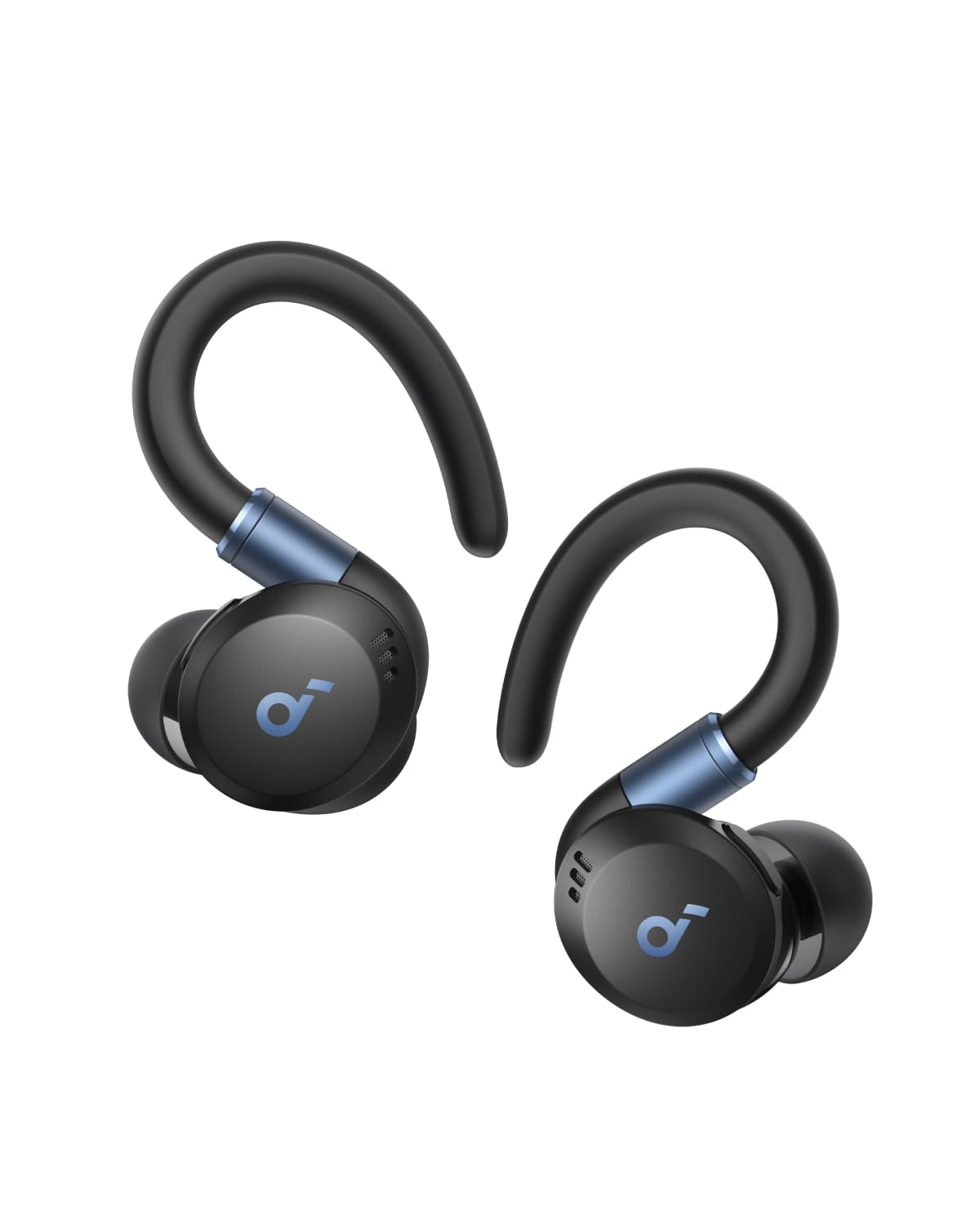
The Sport X20 solves the most common running complaint: earbuds that work loose after a mile. Anker engineered the hooks to both rotate up to 30 degrees and extend by 4mm, so you can dial in the exact angle that matches your ear’s concha ridge. The hook locks against the antihelix without applying pressure to the tragus, which means no ache after extended wear. At 12 hours of continuous playback per charge and 48 total with the case, these outlast any marathon training session.
The IP68 certification is the highest waterproofing in this lineup. Anker’s SweatGuard uses a submarine-inspired cavity seal that protects the dynamic 11mm drivers from moisture ingress even during full submersion in fresh water. The BassUp technology is not a gimmick — the dual-magnet motor pushes enough excursion to register sub-bass at 30 Hz, which cuts through ambient wind noise during outdoor runs without needing to crank the volume past safe levels.
The adaptive ANC uses four microphones to sample ambient noise at 50 kHz and cancel it in real time, while the transparency mode feeds external sound through without the hollow, processed effect common in budget ANC implementations. The customizable physical button eliminates accidental skips when you brush the bud with a hood or hat brim — a small detail that becomes crucial when gloved hands can’t manage touch surfaces.
Why it’s great
- Rotatable and extendable ear hooks provide a truly customizable secure fit across different ear shapes
- IP68 protection means zero concern about sweat, rain, or post-run rinsing under a faucet
- BassUp engine delivers palpable low-end punch without distortion at high volume
- Physical buttons prevent errant commands during high-motion activity
Good to know
- Charging case lacks a visual battery level indicator — you rely on the app to check case charge
- The hooks can feel intrusive if you wear glasses with thick temples; test the fit before long runs
- Wind noise cancellation is effective but not class-leading in strong crosswinds above 15 mph
2. JBL Endurance Peak 4

JBL’s Endurance lineage has been refining the TwistLock design for years, and the Peak 4 iteration uses a liquid silicone memory-wire ear hook with an OvalTube nozzle that seats deeper into the ear canal than most sport earbuds. The combination of the hook’s spring-back force and the oval nozzle’s rotational lock means these earbuds stay fixed even during rapid head turns on agility drills or trail descents. The 10 mm dynamic driver is tuned to deliver the JBL Pure Bass curve, which emphasizes the 60–120 Hz band for a thumping sensation that syncs with cadence.
The IP68 rating is thorough enough to survive immersion in salt water and sand, and the internal corrosion-resistant coating extends the lifespan for runners who train in coastal or dusty conditions. The spatial sound processing uses Personi-fi 3.0, which runs a brief ear-canal response test and customizes the EQ to your unique ear geometry. This is more precise than generic presets and makes the ambient-aware mode sound natural enough to wear on shared bike paths without safety concerns.
Call quality is a standout feature thanks to six microphones — three per side — with a beamforming algorithm that separates your voice from wind buffeting up to 20 mph. The lanyard hole on the case adds convenience for runners who carry gear on clip-in shorts or hydration vests. The multi-point connection lets you pair with a phone and a running watch simultaneously, so you can stream music from your Garmin while keeping your phone in a drop bag.
Why it’s great
- TwistLock with memory-wire hooks provides slip-free retention across all head movement axes
- Six-mic architecture with wind filtering delivers the clearest call quality in this comparison
- IP68 combined with corrosion resistance makes this a true all-weather trail companion
- Multi-point connection works simultaneously with phone and GPS watch
Good to know
- Maximum volume is slightly lower than competitors — runners who prefer very loud playback may need EQ boost
- The charging case is bulkier than average; it takes up noticeable space in a running belt
- Dedicated JBL Headphones app is required to fully customize sport modes and ambient levels
3. Beats Fit Pro (1st Gen)

Beats built the Fit Pro around a flexible wingtip that tucks into the ear’s natural contour without the protruding hook of traditional sport earbuds. This low-profile design fits under cycling helmets or winter headbands without dislodging, and the wingtip’s silicone compound provides enough friction to resist vertical jarring during high-cadence strides. The Apple H1 chip enables instantaneous switching between iPhone, Apple Watch, and iPad — a convenience multiplier for runners who use their watch for music and their phone for navigation.
The custom acoustic platform delivers a frequency response that leans slightly warm, with a 2–3 dB shelf boost below 100 Hz that gives footsteps a percussive feel without overwhelming the midrange. The spatial audio with dynamic head tracking locks the soundstage to your phone’s orientation, which can be disorienting during runs but works well for post-run cooldown video content. The transparency mode on the Fit Pro uses the same venting algorithm as the AirPods Pro, so ambient sound arrives with natural phase coherence rather than the phase-shift artifacts common on third-party ANC earbuds.
The IPX4 rating is the lowest ingress protection in this roundup, so these are best for controlled indoor conditions or short rain-dodging runs rather than all-weather training. Battery life sits at 6 hours per charge with ANC active, which is below the category median. The proprietary vent mesh on the sound exit is delicate — several long-term users report clogging after months of heavy sweat exposure, requiring periodic cleaning with a soft brush to maintain volume consistency.
Why it’s great
- Flexible wingtip fits snugly without over-ear hooks — excellent for helmet or hat compatibility
- H1 chip gives seamless switching across Apple devices during multi-device runs
- Spatial audio with head tracking adds immersion for post-run media consumption
- Transparency mode sounds more natural than most competitors in this price band
Good to know
- IPX4 splash resistance is inadequate for runners training in heavy rain or dusty trails
- Battery runtime of 6 hours with ANC is low — marathon runners may need a mid-run case charge
- Vent mesh on the sound nozzle is susceptible to sweat-clogging over extended use periods
4. Beats Powerbeats Fit
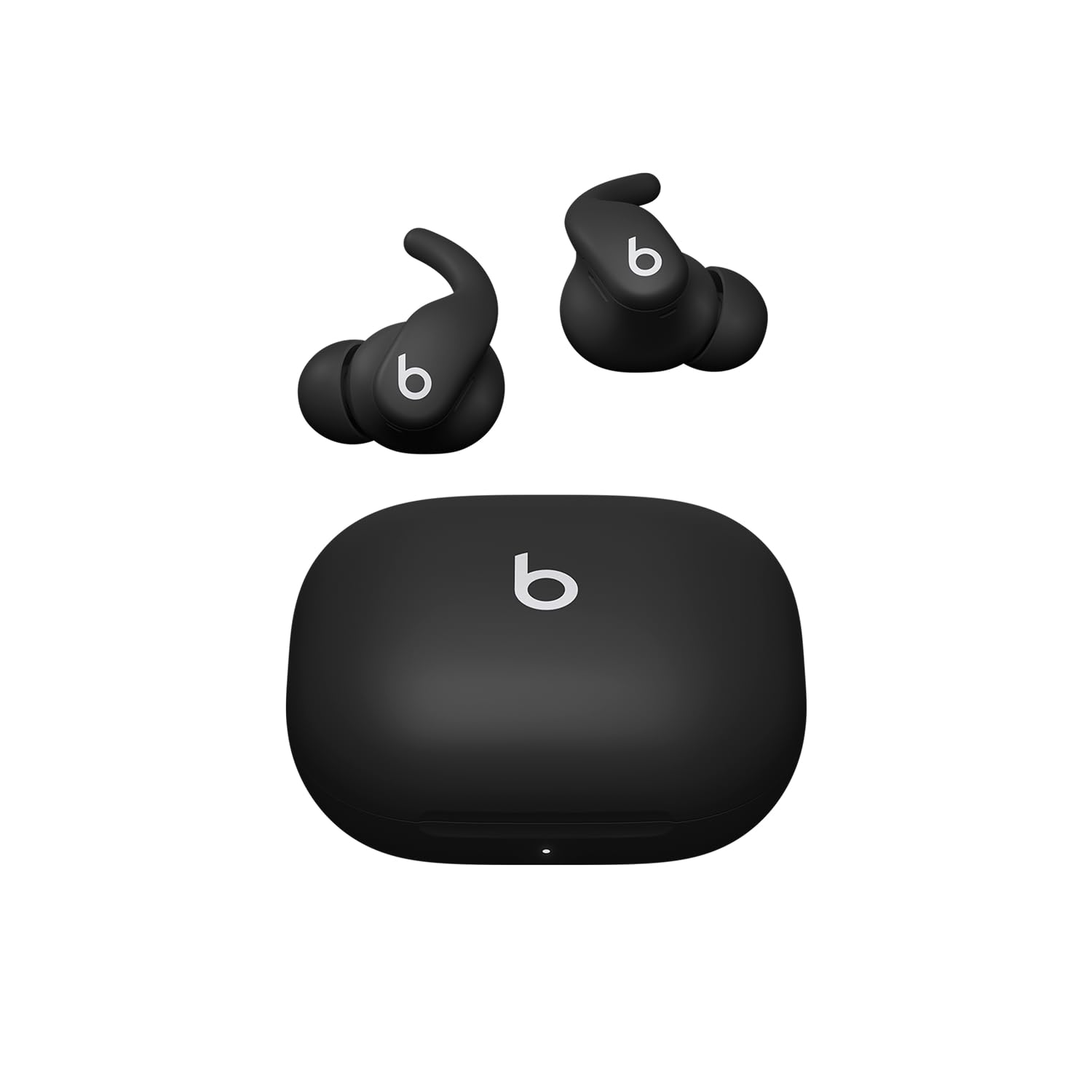
The Powerbeats Fit returns to the over-ear hook format that Beats pioneered, but the hook is now softer and shorter than the Powerbeats Pro 2, with a silicone compound that spreads clamp pressure across a wider surface. The hook secures the bud against the concha without digging into the crus of the helix, which makes these comfortable for multi-hour runs that would irritate rigid-hook designs. Each bud delivers 7 hours of playback per charge, and the IPX4-rated case extends the total to 30 hours — enough for a week of daily training without pulling out a charging cable.
The custom acoustic platform emphasizes a punchy low-end with a slight roll-off above 8 kHz that reduces sibilance on vocal-heavy playlists. Adaptive EQ measures the ear canal seal every 30 seconds and adjusts the frequency response to maintain consistent tonality regardless of head movement or sweat ingress. The beamforming microphone array includes an internal processor that strips out gym background noise — clanking weights, treadmills, group class instructions — so your voice cuts through without shouting.
Physical on-device buttons control volume, track skipping, and listening mode switching, and the auto-play/pause sensors trigger reliably when you tuck the bud into your ear or remove it. The H1 chip supports automatic switching within the Apple ecosystem, and the Beats app on Android provides one-touch pairing and locate-my-beats functionality. The case is 17 percent smaller than its predecessor, which improves pocketability during runs where you carry the case in a waist belt or short pocket.
Why it’s great
- Over-ear hook with softer silicone provides long-wear comfort without pressure points
- 7-hour per-bud battery with 30-hour case means weekly recharging only for most runners
- Physical buttons and auto-play/pause sensors work reliably with sweaty or gloved fingers
- Compact IPX4-rated case fits in most running belts and short pockets
Good to know
- Sound profile is slightly hollow in the upper mids — vocals can sound recessed compared to competitors
- No wireless charging support despite the premium price point
- USB-C to USB-C charging cable is not included in the box, requiring a separate purchase
5. SoundPEATS Q40 HD Neckband

The neckband format remains the most secure option for runners who lose true-wireless buds, and the Q40 HD brings modern codec support to this classic form. The LDAC support transmits audio at up to 990 kbps over Bluetooth 6.0, which resolves more micro-detail from high-bitrate streaming services than standard SBC or AAC connections. The 11 mm dual-magnet driver with a PU+LCP composite diaphragm delivers a bass response that hits 25 Hz with authority, making footsteps land with tactile weight even when ambient noise is high.
The IP67 rating means the neckband and bud housings are fully dust-tight and can survive submersion in one meter of water for 30 minutes — sufficient for torrential downpours, stream crossings, or post-run washing under a tap. The flexible neckband uses an adjustable cable clip that cinches the cord length to individual head size, eliminating the dangling loop that can slap against your collarbone during high-cadence runs. The 20-hour total battery life with a 10-minute quick charge delivering 5 hours of playback means you can grab a pre-run boost during your warm-up stretch.
The smart Dynamic EQ algorithm in the companion app shifts the sound profile based on activity detection — boosting the low shelf for runs, lifting the presence region for podcasts, and flattening to neutral for classical content. The 360-degree spatial audio mode uses crossfeed processing to widen the stereo image, which creates a more immersive sensation for live concert recordings. The magnetic bud housings clap together when not in use, preventing the cable from tangling inside a pack or jacket pocket.
Why it’s great
- Neckband design eliminates the risk of losing single buds during high-impact activity
- LDAC codec support delivers Hi-Res audio quality over Bluetooth for detail-oriented listeners
- IP67 dust and water sealing handles full submersion, not just splash resistance
- 10-minute quick charge provides 5 hours of playback — ideal for last-minute runs
Good to know
- The neckband can bounce against the back of the neck during very fast sprints unless the cable clip is adjusted short
- Strong magnet strength in the bud housings can create a clanking noise if they snap together while dangling
- Bass response out of the box is subdued until you enable bass boost mode in the SoundPEATS app
6. GNMN V7

The ANC uses dual feed-forward microphones per bud to sample external noise before it reaches the ear canal, and the feedback cancellation loop handles phase errors from the seal. The transparency mode is reactive enough to maintain awareness of traffic sound without the muffled lag that makes some ambient modes dangerous for road runners. The 16 mm speaker driver is unusually large for a sport earbud, and it produces a sound signature with a broad soundstage that separates instruments more cleanly than typical 10 mm drivers can manage.
Battery performance is the headline: 8 hours per bud on a single charge, and the case holds enough reserve to push total playback to 96 hours when using one bud at a time. The dual LED power display on the front of the case shows the exact charge percentage for the case and each bud independently, eliminating the guesswork of blinking indicator lights. The IPX7 rating protects against full immersion up to one meter for 30 minutes, which means these survive accidental drops into puddles or post-run rinsing without issue.
The over-ear hooks are flexible silicone with a spring-back memory that holds the bud in place during lateral head shaking. The physical button controls are tactile and click with a satisfying snap, reducing the chance of accidental presses compared to capacitive touch panels. The Bluetooth 5.3 chip maintains a stable connection up to 30 feet through obstacles, which is useful when your phone is in a waist belt or backpack pocket behind your body.
Why it’s great
- 45 dB ANC depth is among the highest measured in this price tier for sport earbuds
- 96-hour total battery life with single-bud use makes this the longest-lasting option in the list
- 16 mm driver produces a wider soundstage and cleaner instrument separation than smaller drivers
- LED power display on the case gives precise charge feedback without needing a phone app
Good to know
- Charging case is noticeably larger than average; it may be too bulky for shallow running pockets
- Touch control panel on the buds can be overly sensitive to incidental contact from hat brims
- The companion app is basic with limited EQ customization compared to Soundcore or JBL apps
7. occiam T19

The occiam T19 delivers 45 dB of active noise cancellation at an entry-level price point that undercuts most alternatives by a wide margin. The ANC implementation uses a hybrid feed-forward and feedback architecture that cancels noise across the 100 Hz to 1 kHz band, which covers most engine drone and HVAC hum. The transparency mode is less refined than premium options — sound arrives with a slight phase shift that can make ambient noise feel slightly hollow — but it remains functional for basic traffic awareness during neighborhood runs. The 10 mm coil driver provides clear vocal reproduction and decent bass extension down to 40 Hz, though the low-end lacks the tactile punch of larger 11 mm or 16 mm drivers.
The IPX7 rating handles sweat and rain exposure without any concern, and the flexible silicone ear hooks wrap around the ear to provide passive retention without clamping force. The buds come with three sizes of ear tips and the hook geometry holds the bud stable enough for moderate-intensity jogging and gym sessions. The Hall switch in the case enables automatic pairing when the lid opens, and the Bluetooth 5.4 chip locks onto the source device within two seconds of opening the case. The digital battery display on the case shows remaining charge in five-bar increments.
Physical push-button controls sit on each bud and manage playback, volume, and ANC mode switching without the accidental triggers that plague touch controls during sweaty runs. Each bud delivers 8 hours of playback on a single charge, and the case extends total runtime to 90 hours in mono mode or 48 hours in stereo. The mono mode is useful for runners who prefer to keep one ear open to ambient sound while the other delivers music — the buds can be used independently with full ANC function.
Why it’s great
- 45 dB ANC depth at an entry-level price point provides premium noise cancellation on a budget
- 90-hour total battery in mono mode eliminates charging anxiety for frequent runners
- Physical push-button controls avoid the accidental-trigger problem of touch-sensitive surfaces
- Hall switch in the case enables instant auto-pairing when you open the lid
Good to know
- Transparency mode introduces a slight hollow phase shift that makes ambient sound less natural
- Bass response is present but lacks the sub-40 Hz extension that bass-heavy listeners want for running
- The charging case is compact but the hinge feels slightly less robust than premium competitors
FAQ
Is a neckband or true-wireless design more secure for running?
What does the second digit in an IP rating actually mean for sweat exposure?
Final Thoughts: The Verdict
For most runners, the bluetooth headset for running winner is the Soundcore Sport X20 because its rotatable hooks work on the widest range of ear shapes, the IP68 rating eliminates all moisture anxiety, and the BassUp engine gives your stride a rhythmic anchor without distortion. If you want over-ear hook security with superior call quality for on-the-go meetings, grab the JBL Endurance Peak 4. And for budget-conscious runners who prioritize ANC depth above all else, nothing beats the occiam T19 at its price point.

Mo Maruf
I created WellFizz to bridge the gap between vague wellness advice and actionable solutions. My mission is simple: to decode the research and give you practical tools you can actually use.
Beyond the data, I am a passionate traveler. I believe that stepping away from the screen to explore new environments is essential for mental clarity and physical vitality.