Our readers keep the lights on and my smoothie glass nicely filled. As an Amazon Associate, I earn from qualifying purchases.
Choosing a pneumatic 6-inch orbital sander means balancing air consumption, pad orbit, and vibration control to get a swirl-free finish without arm fatigue by the end of the day. Whether you’re prepping auto body filler, feathering edges, or final-sanding primer, the right dual-action sander turns a tedious task into smooth, predictable work.
I’m Mohammad Maruf — the founder and writer behind WellFizz. I’ve spent countless hours comparing air sander specifications, analyzing user reports on pad wear and long-term durability, and cross-referencing real-world performance data to help you find the best tool for your shop.
After evaluating dozens of models across different price tiers, I’ve narrowed the field to the seven most reliable contenders in the best 6 inch orbital sander category, focusing on air efficiency, build quality, and finish quality.
How To Choose The Best 6 Inch Orbital Sander
Selecting a pneumatic dual-action sander for auto body or wood finishing requires a solid understanding of three core factors: the sander’s orbit size, its air consumption relative to your compressor, and the exhaust design that affects dust and operator comfort. Overlooking any one of these can make a capable tool feel sluggish or leave a swirl pattern on your work.
Orbit Diameter: Finish Quality vs. Material Removal
The orbit diameter — typically 3/16 inch (5 mm) or 3/32 inch (2.5 mm) — dictates how much material the sander removes per pass. A 3/16-inch orbit cuts faster and is ideal for heavy stock removal on body filler or rough wood. A 3/32-inch orbit leaves a finer finish with fewer pigtails, making it the go-to choice for final sanding of primer and clear coat before buffing. If you plan to use one sander for both tasks, a 3/16-inch orbit with variable speed gives you flexibility without sacrificing finish quality.
Air Consumption and Compressor Matching
Every pneumatic sander lists its CFM (cubic feet per minute) consumption at a given PSI. A typical 6-inch DA sander consumes between 4 and 17 CFM at 90 PSI. If your air compressor delivers less continuous CFM than the sander demands, the pad will stall under load and the tool will not perform. For continuous sanding, match the sander’s CFM requirement to your compressor’s SCFM rating at 90 PSI. A 60-gallon tank (10-12 SCFM) is often the baseline for professional-grade sanders, while smaller compressors may work fine with occasional trigger releases.
Exhaust Direction and Ergonomics
Rear exhaust directs air away from the work surface, keeping dust from blowing into your face or the finish, which is critical in auto body painting. Side exhaust, while sometimes quieter, can blow debris directly at the operator. Also consider the sander’s weight and grip texture. Tools under 2 pounds reduce hand fatigue during extended sessions, and a rubberized or contoured palm grip helps absorb vibration — measured by how smoothly the tool runs at speed rather than by a single decibel number.
Quick Comparison
On smaller screens, swipe sideways to see the full table.
| Model | Category | Best For | Key Spec | Amazon |
|---|---|---|---|---|
| Ingersoll Rand 300G | Premium | Pro finishing & prep | 3/16″ orbit, 10,000 RPM, 0.2 HP | Amazon |
| Astro 325 ONYX | Premium | Ultra-light finishing | 3/32″ stroke, 1.5 lbs weight | Amazon |
| Ingersoll Rand 311A | Mid-Range | Heavy body work | 0.25 hp, 12,000 RPM, side exhaust | Amazon |
| Chicago Pneumatic CP870 | Mid-Range | Rotary & orbital versatility | 10,000 RPM, 5 CFM, PSA pad | Amazon |
| CRAFTSMAN 6-in | Mid-Range | DIY wood & metal projects | Adjustable speed, low noise | Amazon |
| Gedu Professional Air Sander | Budget | Value-focused auto body | 12,000 RPM, low vibration | Amazon |
| POWER AERO NOVIA Pneumatic | Budget | Entry-level DA sanding | 10,000 RPM, 3/16″ orbit | Amazon |
In‑Depth Reviews
1. Ingersoll Rand 300G Random Orbital Air Sander

The Ingersoll Rand 300G is the reference standard for professional auto body technicians who demand a lightweight, durable sander that delivers a consistent swirl-free finish. Its 0.2 HP motor paired with a 3/16-inch orbit gives it enough bite to quickly flatten filler while still being controllable for final prep work. The composite housing keeps the tool surprisingly light, which reduces forearm fatigue when working overhead or on vertical panels for extended periods.
One standout detail is the 360-degree swivel vacuum adaptor, which makes connecting to a dust extraction system seamless — no kinked hoses interrupting your rhythm. The diffused rear exhaust keeps debris from blowing back onto the freshly sanded surface, a critical advantage when you’re moving through a multi-step paint process. Users consistently note that it performs on par with high-end truck-brand offerings at a fraction of the investment.
The trade-off is that this sander lacks an integrated speed control regulator, meaning you’ll need an inline regulator for variable speed capability. It also requires a substantial air supply — users with smaller compressors (under 60 gallons) report it can struggle to maintain full speed under load. For a dedicated shop with adequate air volume, the 300G is the clear benchmark.
Why it’s great
- Professional-grade finish quality at a mid-range budget entry point
- Extremely lightweight composite body reduces hand fatigue
- 360-degree swivel vacuum port keeps dust collection clean
Good to know
- No built-in speed adjustment requires an external regulator
- High air consumption demands a large compressor (ideally 60+ gallons)
2. Astro 325 ONYX 6-Inch Finishing Palm Sander

The Astro 325 ONYX is engineered specifically for the final sanding stages — color sanding clear coat, pre-buff finishing, and working with ultra-fine grits up to 3000. Its 3/32-inch orbit is what sets it apart: this shorter stroke produces minimal cut per pass but virtually eliminates the risk of pigtails or swirl marks, making it the favorite among detailers and paint specialists. At only 1.5 pounds, it is one of the lightest professional DA sanders on the market.
What makes the ONYX truly special is its vibration isolation. The small, palm-fitting body runs remarkably smooth, even at high RPM, which allows you to feel the surface rather than fight the tool. The built-in speed regulator gives you fine control as you step through grit progressions. Multiple users report that it outperforms Dynabrade and Snap-On units in terms of smoothness and comfort, despite costing significantly less.
The main limitation is its narrow scope — this is not a sander for fast stock removal on filler or heavy roughening. The 3/32-inch stroke simply does not have the aggression for body work. It’s also adhesive-back (PSA) compatible, though you can use hook-and-loop pads if you swap the backing. If your work is predominantly finishing, this is the specialist you want.
Why it’s great
- Short 3/32-inch stroke delivers flawless swirl-free finishing on clear coat and primer
- Ultra lightweight build (1.5 lbs) minimizes fatigue during long color-sanding sessions
- Built-in speed regulator for precise grit progression control
Good to know
- Not suited for aggressive material removal on filler or body work
- PSA pad limits quick disc changes; hook-and-loop requires backing swap
3. Ingersoll Rand 311A Dual-Action Angle Air Sander
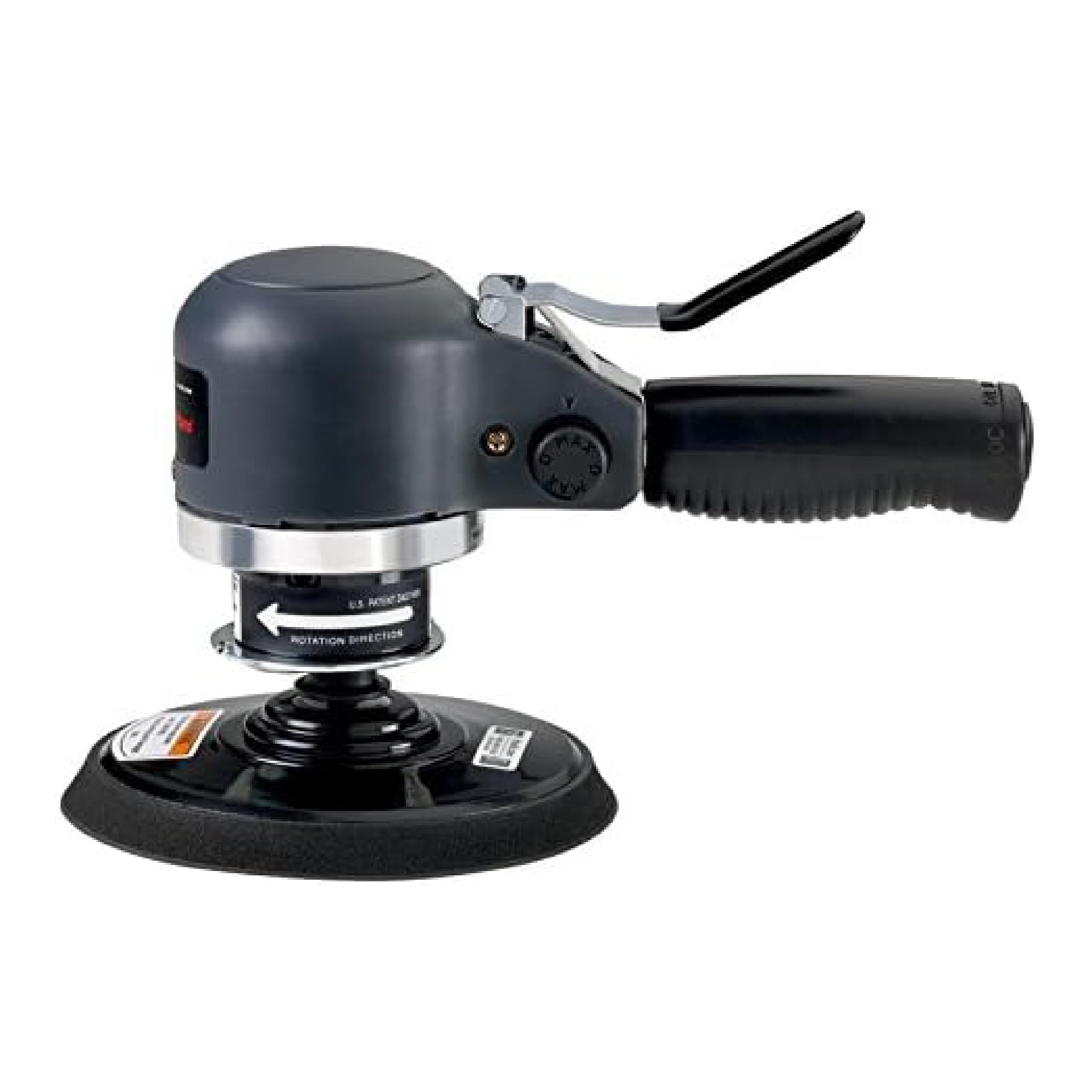
The Ingersoll Rand 311A is built for speed and stock removal. Its 0.25 HP motor spinning a 6-inch pad at 12,000 RPM makes it the most aggressive sander in this lineup, ideal for cutting through body filler, rough shaping, and heavy metal preparation. The side exhaust with built-in silencer keeps noise manageable, though it does blow air laterally rather than away from the work surface. Balanced ball-bearing construction reduces vibration noticeably for a tool in this power class.
What experienced users appreciate is the positive speed control provided by the adjustable regulator — you can dial back the RPM when you transition from heavy stock removal to finish work, making it more versatile than fixed-speed competitors. The compact head allows you to get into tight spots around trunk lips and door jambs better than many bulkier designs. In professional collision shops, this model often serves as the primary workhorse DA sander.
This tool’s appetite for air is considerable — it consumes 17 CFM at free speed, which means it absolutely requires a large compressor (80+ gallons recommended) and a clean air supply. The plastic regulator knob is also a known weak point after extended heavy use, though it is replaceable. If your compressor is undersized, you will not get the performance you are paying for.
Why it’s great
- Highest RPM (12,000) in the comparison for fast material removal
- Built-in regulator lets you adjust speed for finishing passes
- Compact head fits into tight vehicle body cavities
Good to know
- Extremely high air consumption (17 CFM) demands a large industrial compressor
- Plastic regulator knob can fail under heavy professional use over time
4. Chicago Pneumatic CP870 6-Inch Air Random/Rotary Sander

The Chicago Pneumatic CP870 is a time-proven design that offers something most dedicated DA sanders do not: a switchable mode between random orbital and rotary action. This makes it uniquely suited for blending filler, feather edging, and even light polishing when you need a rotary motion. The 10,000 RPM free speed provides predictable removal rates, and the insulated grip with lock-off throttle adds safety during extended work sessions.
What stands out from long-term user reports is its metal housing — many competitors at this tier use composite bodies, but the CP870 uses a sturdy metal construction that inspires confidence and feels substantial in the hand. Commercial sign shops and collision centers report that this sander outlasts expectations, with one facility replacing a competitor with this unit and ordering three more after a full year of daily aluminum and steel panel sanding. The PSA pad (pressure-sensitive adhesive) is the standard for those who prefer adhesive-backed discs over hook-and-loop.
The weight (4.25 pounds) is noticeably heavier than newer composite designs, which can become tiring during all-day use. It also consumes a moderate 5 CFM at 90 PSI, so while it does not require a massive compressor, it still needs a steady supply. The rotary mode, while useful, can introduce swirls if not handled carefully — this is a tool for experienced operators who know when to use each mode.
Why it’s great
- Dual random/rotary modes increase versatility for filler blending and polishing
- All-metal construction provides durability that outlasts composite alternatives
- Moderate air consumption (5 CFM) works with most single-stage compressors
Good to know
- Heavier (4.25 lbs) than composite-bodied sanders, leading to faster arm fatigue
- Rotary mode requires experience to avoid swirl marks on finished surfaces
5. CRAFTSMAN 6-in Dual Action Sander

The CRAFTSMAN 6-inch DA sander is built around a robust motor that delivers a dual oscillating action aimed squarely at the home workshop and light professional market. The anti-slip rubber handle grips absorb a meaningful amount of vibration, and the adjustable speed regulator gives the user control across materials from softwood to metal panels. The built-in muffler significantly reduces operating noise, making it a more comfortable choice for garage and basement workshops where noise can be an issue.
A feature that speeds up workflow is the spindle lock, which allows quick pad swaps without needing two wrenches. The 1/4-inch NPT air inlet with 5.2 SCFM consumption at 90 PSI keeps compressor compatibility broad — a typical 20-to-30-gallon tank handles this sander without frequent cycling. Users who need a general-purpose sander for weekend projects, furniture refinishing, and occasional bodywork will find the speed range adequate for most tasks.
This model does not offer the same aggressive cut as the Ingersoll Rand 311A for heavy body filler, and serious collision professionals may find its limits on prolonged, high-load sanding. The composite build is durable but not at the same level as metal-housed units like the Chicago Pneumatic. For the price point, however, it delivers strong overall value for the non-professional.
Why it’s great
- Adjustable speed control suits a wide range of materials from wood to metal
- Rubber grip and built-in muffler reduce hand fatigue and noise significantly
- Spindle lock allows quick pad changes for efficient workflow
Good to know
- Less aggressive cut on heavy body filler compared to high-RPM professional models
- Composite housing may not hold up as well as metal builds under daily pro use
6. Gedu Professional Air Random Orbital Palm Sander

The Gedu Professional Air Sander is a standout option for those who need a reliable, low-vibration tool for metal prep and wood finishing without spending premium-tier money. Its 12,000 RPM free speed matches the top performers in the category, and the enhanced heat-treated cast steel cylinder provides a smooth, consistent power delivery that resists binding under moderate pressure. The low center of gravity design helps keep the pad flat on the surface, reducing the chance of digging in on curves.
Auto body students and collision shop technicians have reported that this sander keeps pace with professional models from major brands during school and light commercial use. The palm-fit body is narrow enough to be comfortable for smaller hands, yet robust enough for all-day operation. The variable speed control (trigger or built-in regulator depending on production version) gives some flexibility when switching between aggressive cut and finish passes.
The pressure switch location has been noted as awkward by some users — it sits where the thumb naturally rests, leading to accidental shut-off. It is also not ideal for aggressive fiberglass cutting, as the motor lacks the torque needed for heavy composite work. Overhead use is fine due to its light weight, but the lack of a pad damper means you may feel more vibration than on premium competitors.
Why it’s great
- High free speed (12,000 RPM) for quick material removal on filler and primer
- Lightweight and low-profile design comfortable for extended use
- Heat-treated steel cylinder delivers good durability at a competitive price
Good to know
- Pressure switch placement can cause accidental tool shut-off during operation
- Not powerful enough for heavy fiberglass or composite cutting
7. POWER AERO NOVIA 6 Inch Pneumatic Random Orbit Sander
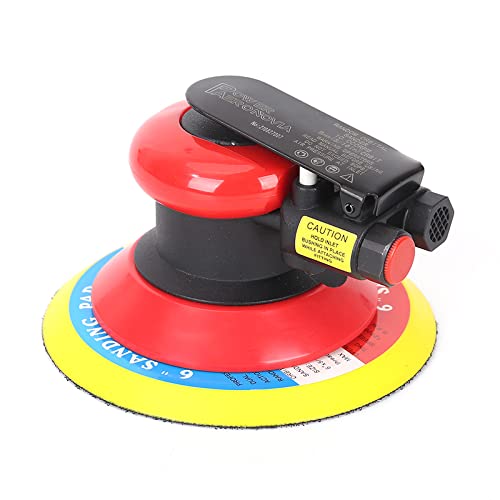
The POWER AERO NOVIA is the entry-level champion for those testing the waters of pneumatic sanding or building a set of tools on a tight budget. Its 10,000 RPM free speed with a 3/16-inch orbit provides enough cut for basic body filler shaping and paint prep. The nodular cast iron cylinder and powder metallurgy rotor are surprisingly robust components at this price point, giving the tool a feel that punches above its cost class. The rear exhaust directs dust away from the work, a design choice usually reserved for higher-end sanders.
User reports from auto collision classes show that this sander stands up to daily student use, handling long sessions on body filler and primer. The hook-and-loop pad holds discs securely and allows quick changes without adhesive cleanup. The compact body and lightweight design make it easy to maneuver into tight spots, and the quiet operation at speed is a welcome bonus for shop environments where noise adds up over the day.
Where the NOVIA shows its budget roots is in vibration dampening — expect more vibration through the housing than premium models, which can lead to faster hand numbness during extended sessions. It is also not the tool for cutting hard composites like fiberglass, as the motor bogs under sustained heavy load. For light-to-moderate sanding on a limited budget, it offers exceptional value.
Why it’s great
- Surprisingly robust nodular cast iron cylinder and rotor for the entry-level price
- Rear exhaust keeps dust away from the work surface, rare at this price point
- Light and compact design suits tight spaces and single-hand operation
Good to know
- Noticeably more vibration than premium models; fatigues hands faster
- Lacks power for heavy fiberglass or composite material removal
FAQ
What is the difference between a 3/16-inch and 3/32-inch orbit sander?
Can I use a 6-inch orbital sander with a small home air compressor?
Why is rear exhaust preferred over side exhaust for auto body sanding?
Final Thoughts: The Verdict
For most users, the best 6 inch orbital sander winner is the Ingersoll Rand 300G because it offers professional-grade finish quality, lightweight handling, and the 360-degree vacuum port essential for clean shop work. If you want the ultimate tool for color sanding and final finishing with no swirl risk, grab the Astro 325 ONYX. And for heavy stock removal on filler and metal preparation where raw power is the priority, nothing beats the Ingersoll Rand 311A.

Mo Maruf
I created WellFizz to bridge the gap between vague wellness advice and actionable solutions. My mission is simple: to decode the research and give you practical tools you can actually use.
Beyond the data, I am a passionate traveler. I believe that stepping away from the screen to explore new environments is essential for mental clarity and physical vitality.