Our readers keep the lights on and my smoothie glass nicely filled. As an Amazon Associate, I earn from qualifying purchases.
The difference between a sharp portrait and a blurry miss often comes down to a fraction of a second. Autofocus technology has evolved from basic contrast detection into sophisticated AI-driven systems that can track an eye through a crowd or lock onto a bird mid-flight. For photographers and videographers alike, the speed and accuracy of focus acquisition define whether a camera feels responsive or frustrating.
I’m Mohammad Maruf — the founder and writer behind WellFizz. Over years of analyzing imaging hardware, I’ve compared phase-detect coverage maps, evaluated low-light focus limits, and tested subject recognition reliability across hundreds of cameras to understand what actually drives keeper rates.
Whether you are upgrading from a smartphone or building a professional kit, choosing the right auto focus camera requires understanding how sensor type, processor power, and focusing algorithms work together to deliver consistent results in the real world.
How To Choose The Best Auto Focus Camera
Autofocus is not a single feature — it is a system involving the sensor, the processor, and the lens. Understanding how these components interact helps you pick a camera that matches how you actually shoot.
Phase Detection vs Contrast Detection
Phase-detection autofocus (PDAF) measures light split across paired pixels to calculate distance instantly, making it far faster than contrast detection, which hunts by measuring sharpness. Most modern mirrorless cameras use on-sensor PDAF, but the density of these pixels varies. Cameras with higher PDAF coverage track subjects more reliably across the frame, especially near the edges.
Autofocus Point Coverage and Density
A camera may list hundreds of AF points, but what matters is how much of the sensor they cover. Systems with 90 percent or more frame coverage allow you to compose off-center without losing focus. For action and wildlife, look for dense point arrays that maintain tracking as the subject moves unpredictably across the frame.
Subject Recognition and AI Processing
Modern cameras use dedicated AI processors to identify and track specific subjects — human eyes, animal faces, birds, vehicles. The best systems can detect a subject’s eye even when partially obscured or backlit. This technology is not just for sports photographers; it significantly improves keeper rates for portraits and family photography by reducing the need to recompose or refocus manually.
Low-Light Autofocus Performance
Autofocus sensitivity is rated in EV (exposure value). A camera rated to -4 EV or lower can lock focus in near darkness — useful for indoor events, evening street photography, or astrophotography. Larger sensor pixels and back-illuminated sensor designs both improve low-light AF capability by gathering more light for the focus system to work with.
Quick Comparison
On smaller screens, swipe sideways to see the full table.
| Model | Category | Best For | Key Spec | Amazon |
|---|---|---|---|---|
| Canon EOS R8 | Mirrorless | Hybrid Content Creation | 1,053 AF zones, 100% coverage | Amazon |
| Sony Alpha 6700 | Mirrorless | AI Subject Tracking | 759 AF points, AI processor | Amazon |
| Nikon Z 6II | Mirrorless | Full-Frame Versatility | 273 AF points, dual slots | Amazon |
| Canon EOS R5 | Mirrorless | High-Resolution Hybrid | 45MP, 1,053 AF points | Amazon |
| Panasonic LUMIX G100 | Mirrorless | Compact Vlogging | 49 AF points, contrast detect | Amazon |
| Nikon Z 30 | Mirrorless | Vlogging & Streaming | 209 AF points, hybrid system | Amazon |
| Canon EOS RP | Mirrorless | Entry Full-Frame | Phase detection, 4K UHD | Amazon |
| OM SYSTEM OM-5 II | Mirrorless | Travel & Outdoor | 121 AF points, weather sealed | Amazon |
| Sony a7 III | Mirrorless | General Full-Frame | 693 AF points, 93% coverage | Amazon |
| Sony Alpha 7 IV | Mirrorless | Pro Hybrid Shooter | 693 AF points, 33MP sensor | Amazon |
| Nikon Z f | Mirrorless | Retro Photo Experience | 273 AF points, 3D tracking | Amazon |
In‑Depth Reviews
1. Canon EOS R8 Mirrorless Camera Body

The Canon EOS R8 packs the same Dual Pixel CMOS AF II system found in the pricier R6 Mark II, covering 100 percent of the frame with 1,053 AF zones. This means you can compose a shot with your subject at the very edge and the camera will still lock focus instantly. The deep-learning subject detection recognizes people, animals, vehicles, and even aircraft, making it unusually versatile for a body at this level.
Video shooters benefit from uncropped 4K at 60 fps oversampled from 6K, with Canon Log 3 support for color grading. The 40 fps electronic shutter with full AF tracking is exceptional for capturing fast action — think sports or children running. At only 461 grams, this is Canon’s lightest full-frame body, making it comfortable for all-day handheld use.
The main tradeoffs are battery life and the lack of in-body stabilization. The LP-E17 battery delivers around 350 shots, so a spare is necessary for full-day shoots. Without IBIS, you will rely on lens-based stabilization or a gimbal for smooth handheld video. Despite these limitations, the AF performance alone justifies the price for hybrid shooters.
Why it’s great
- 100% frame AF coverage with 1,053 zones
- 40 fps burst with full autofocus tracking
- Uncropped 6K oversampled 4K60 video
Good to know
- No in-body image stabilization
- Small battery requires spare for extended use
- Single SD card slot limits backup options
2. Sony Alpha 6700

The Alpha 6700 puts Sony’s dedicated AI processing chip into an APS-C body, delivering real-time recognition for humans, animals, birds, insects, cars, and trains. With 759 phase-detection points covering nearly the entire sensor, this camera locks onto subjects quickly and holds them even during erratic movement. The AI processor can detect a subject’s pose even before the eye is visible, giving it a split-second advantage over traditional systems.
For video, the 26MP sensor oversamples 6K to produce sharp 4K at 60 fps in 10-bit 4:2:2, with the option for 4K 120 fps for slow motion. The compact body includes a fully articulating touchscreen and a large grip that handles well with heavier lenses. Battery life is solid for an APS-C mirrorless, rated at roughly 550 shots per charge.
The menu system remains Sony’s primary friction point — it is dense and less intuitive than Canon or Nikon alternatives. In-body stabilization is present but not class-leading; handheld walking shots still show some micro-jitter. For hybrid shooters who prioritize subject tracking above all else, the a6700 is hard to beat in this form factor.
Why it’s great
- Dedicated AI processor for unmatched subject recognition
- 759-point phase detection with near-full coverage
- 4K 120 fps and 10-bit internal recording
Good to know
- Complex menu structure requires learning time
- IBIS lacks the strength for smooth walking video
- No built-in flash
3. Nikon Z 6II

The Z 6II pairs a back-illuminated 24.5MP full-frame sensor with an Expeed 6 processor that delivers solid autofocus performance across a wide range of scenarios. Its 273 phase-detection points cover about 90 percent of the frame, and the system handles low-light focusing down to -4 EV — useful for shooting in dim interiors or at dusk. The camera also supports subject tracking for people and animals, though it is not as aggressive as Sony’s AI-based system.
Dual card slots (CFexpress/XQD plus UHS-II SD) give professionals a backup option that the R8 lacks. The body is weather-sealed, comfortable for long sessions, and compatible with Nikon’s growing Z lens lineup as well as F-mount lenses via an adapter. In-body stabilization provides up to 5 stops of correction, making handheld video and low-light stills more reliable.
Autofocus tracking can occasionally lose fast-moving subjects when they exit the frame and re-enter, and the burst rate of 14 fps is good but not class-leading. The Z 6II is a balanced tool for photographers who need full-frame quality, dual storage, and strong IBIS without jumping to the highest price tiers.
Why it’s great
- Dual card slots for professional workflow security
- Excellent low-light AF down to -4 EV
- In-body stabilization with 5-stop correction
Good to know
- Subject tracking can lose fast targets
- 14 fps burst is decent but not top tier
- No fully articulating screen
4. Canon EOS R5

The EOS R5 combines a 45MP full-frame sensor with Dual Pixel CMOS AF II across 1,053 points covering 100 percent of the frame. Eye Control AF lets you shift the focus point simply by looking at a different area of the viewfinder — a rare feature that speeds up composition in fast-paced shoots. The deep-learning subject detection handles people, animals, and vehicles with high reliability, making this a top choice for wildlife and portrait photographers alike.
Video capabilities are extreme: 8K RAW internal recording, 4K up to 120 fps, and Canon Log 3 for professional color grading. In-body stabilization provides up to 8 stops of correction when paired with stabilized RF lenses, enabling sharp handheld shots at slow shutter speeds. The mechanical shutter fires at 12 fps, while the electronic shutter reaches 20 fps with full AF.
Battery life is roughly 650 shots per charge, which is reasonable given the processor demands. Overheating during prolonged 8K recording has been a talking point, but for mixed stills and 4K work, the R5 runs cool enough for most real-world sessions. This is a flagship hybrid for users who demand resolution, speed, and AF precision in one body.
Why it’s great
- 45MP sensor with stunning detail and dynamic range
- Eye Control AF for intuitive focus point selection
- 8K internal recording and 4K 120 fps
Good to know
- High price point limits accessibility
- Extended 8K recording may trigger thermal limits
- Battery life is adequate but not exceptional
5. Panasonic LUMIX G100

The LUMIX G100 is designed for creators who prioritize portability and audio quality. It uses a contrast-detection autofocus system with 49 areas, which is slower and less reliable for tracking fast movement than phase-detect alternatives, but it performs well for stationary subjects and slow-paced vlogging. The built-in 360-degree microphone with tracking adjusts pickup direction automatically, solving a common pain point for solo shooters.
The 20.3MP Micro Four Thirds sensor delivers clean 4K 24p and 30p video, and the 5-axis hybrid image stabilization keeps handheld footage steady. The body is lightweight and includes a frame marker for social media aspect ratios, helping you compose for Instagram or TikTok without guessing. Face and eye detection work adequately in good light.
The big limitation is the 4K recording limit of roughly 10 minutes before the camera stops, which makes it impractical for long interviews or event coverage. The contrast-detect AF also hunts more in low light compared to phase-detect systems. For casual vloggers and content creators who value size and audio over action tracking, the G100 is a capable entry point.
Why it’s great
- Built-in 360-degree tracking microphone
- Ultra-lightweight and pocketable design
- Social media frame markers for easy composition
Good to know
- 4K recording limited to roughly 10 minutes
- Contrast-detect AF hunts in low light
- Small Micro Four Thirds sensor limits low-light quality
6. Nikon Z 30 with 16-50mm Lens

Nikon’s Z 30 is the smallest Z-mount mirrorless, built specifically for vloggers and streamers. Its hybrid autofocus system combines phase and contrast detection across 209 points, delivering reliable eye-tracking for humans and pets. The camera has no viewfinder, but the fully articulating 3-inch touchscreen makes self-recording straightforward, and the red REC light clearly indicates when recording is live.
Video quality is strong for the price: 4K at 30p with no recording time limit — a major advantage over the Panasonic G100. The 16-50mm kit lens includes vibration reduction, and the body supports plug-and-play UVC/UAC streaming over USB-C at 1080p 60 fps. The 20.9MP DX sensor produces pleasing stills, though it lacks the depth of larger full-frame sensors.
The absence of a viewfinder is a clear tradeoff for photographers who prefer eye-level composition. Battery life is moderate, and the lack of IBIS means you need stabilized lenses or a gimbal for walking shots. For pure content creation where video is the priority, the Z 30 offers an impressive feature set at a reasonable entry point.
Why it’s great
- Unlimited 4K 30p recording with no overheating
- Plug-and-play USB-C streaming with UVC/UAC
- Compact and lightweight for one-handed use
Good to know
- No viewfinder, relies entirely on rear screen
- No in-body stabilization
- Limited lens selection in DX Z-mount
7. Canon EOS RP with RF 24-105mm F4-7.1

The EOS RP is Canon’s most affordable full-frame mirrorless, offering a 26.2MP sensor with Dual Pixel CMOS AF for responsive phase-detection focusing. It features 4,779 selectable AF points (though the actual phase-detect array is less dense than newer models) and face/eye detection that works well for portraits and casual shooting. The camera is exceptionally light at 485 grams, making it a strong travel companion.
The included RF 24-105mm F4-7.1 IS STM lens provides a versatile zoom range with optical stabilization up to 5 stops, compensating for the body’s lack of IBIS. The vari-angle touchscreen is useful for overhead or low-angle shots, and the menu system is clean and beginner-friendly. Battery life is about 250 shots, which is below average and demands spares for day trips.
Autofocus performance is best in well-lit conditions; low-light hunting occurs more frequently than on newer Canon bodies like the R8. 4K video comes with a 1.6x crop and uses contrast detection, so it is less suitable for serious videography. For photographers transitioning from DSLR to full-frame mirrorless on a budget, the RP delivers solid image quality without the complexity of higher-end systems.
Why it’s great
- Lightest full-frame mirrorless body available
- Intuitive menu system ideal for beginners
- Kit lens includes 5-stop optical stabilization
Good to know
- Battery life is short — roughly 250 shots
- 4K video uses crop and contrast-detect AF
- Low-light AF performance lags behind newer models
8. OM SYSTEM OM-5 Mark II with 12-45mm F4.0 PRO
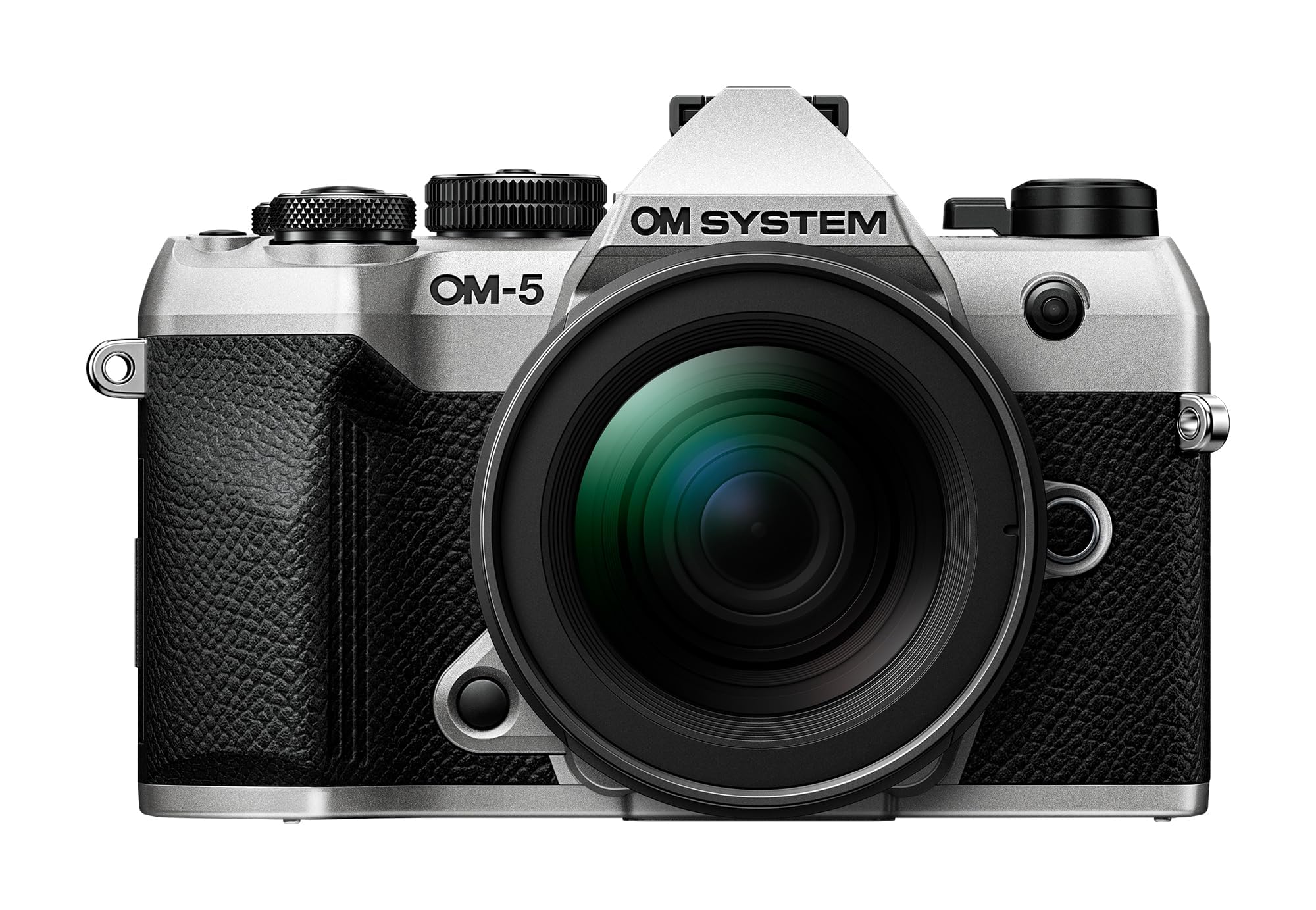
The OM-5 Mark II uses a 20.4MP Micro Four Thirds sensor with 121 phase-detection AF points and a computational photography button that unlocks features like live ND, focus stacking, and high-res shot mode. The autofocus is responsive and includes subject detection for humans and animals, though the smaller sensor means it relies more on the processing engine to maintain tracking in challenging conditions.
Weather sealing is IP53-rated, meaning it can handle rain, dust, and freezing temperatures without a second thought. The 5-axis IBIS provides up to 6.5 stops of correction (7.5 stops with Sync IS lenses), which is class-leading and makes handheld long exposures easy. The 12-45mm F4.0 PRO lens is a compact constant-aperture zoom that pairs beautifully with the small body.
The Micro Four Thirds sensor has less dynamic range and higher noise above ISO 3200 compared to APS-C or full-frame alternatives. The battery is small, so a spare is recommended for full-day adventures. For outdoor enthusiasts who need a rugged, lightweight system with exceptional stabilization, the OM-5 II is uniquely capable.
Why it’s great
- IP53 weather sealing for harsh environments
- Leading 6.5-stop in-body stabilization
- Computational features like live ND and focus stacking
Good to know
- Small sensor limits low-light performance
- Battery life requires spares for full-day use
- Grip may feel cramped for larger hands
9. Sony a7 III with 28-70mm Lens

The a7 III remains a benchmark entry into full-frame mirrorless years after its launch, thanks to a 24.2MP back-illuminated sensor and 693 phase-detection AF points covering 93 percent of the frame. The 425 contrast-detect points support the phase-detection system for fine-tuned accuracy. Real-time Eye AF for humans and animals was added via firmware, keeping the camera competitive for portrait and wildlife work.
Battery life is outstanding — the NP-FZ100 cell delivers around 710 shots per charge, easily lasting a full wedding or event day. The 5-axis IBIS provides 5 stops of stabilization, making the 28-70mm kit lens usable in lower light than expected. The 10 fps burst rate with continuous AF is adequate for most action scenarios.
The menu system is Sony’s older, more complex interface, and the rear screen is not touch-sensitive for menu navigation — only for focus point selection. 4K video is limited to 30p with 8-bit color, which falls behind newer cameras offering 10-bit 4:2:2. For stills-focused photographers who value battery life and reliable all-around AF, the a7 III is a proven workhorse.
Why it’s great
- Class-leading battery life at 710 shots per charge
- 693 AF points with 93% frame coverage
- In-body stabilization with 5-stop correction
Good to know
- Menu system is complex and non-intuitive
- Rear screen lacks touch menu navigation
- 4K video limited to 30p 8-bit
10. Sony Alpha 7 IV

The Alpha 7 IV combines a new 33MP full-frame sensor with the BIONZ XR processor, delivering autofocus performance that rivals the company’s higher-end models. The 693 phase-detection points work with real-time Eye AF for humans, animals, and birds, and the system is noticeably faster and more tenacious than the a7 III. The 7K oversampled 4K 30p footage is exceptionally detailed, and 4K 60p in Super 35mm crop is available for tighter framing.
S-Cinetone color science makes it easy to achieve cinematic skin tones straight out of camera, which is a major draw for videographers. The fully articulating touchscreen, large grip, and dual card slots (CFexpress Type A / SD) provide a professional shooting experience. IBIS is effective but still a stop or two behind Canon’s best implementations.
The 1.5x crop at 4K 60p is a limitation if you frequently shoot high-frame-rate video with wide-angle lenses. Battery life is rated at roughly 600 shots, which is solid but not spectacular. For hybrid shooters who need high-resolution stills and advanced video features in a single body, the a7 IV is a refined, capable tool.
Why it’s great
- 33MP sensor with outstanding detail and dynamic range
- S-Cinetone color profile for professional video
- Dual card slots for backup and overflow
Good to know
- 4K 60p uses 1.5x crop factor
- IBIS not as strong as Canon’s implementation
- Menu system still has a learning curve
11. Nikon Z f with 40mm f/2 Lens

The Nikon Z f wraps a 24.5MP BSI full-frame sensor and EXPEED 7 processor in a retro-styled body with brass top plates and mechanical dials. Its 273 phase-detection points support subject recognition for nine different categories — including birds, trains, and horses — and the 3D Tracking system inherited from the flagship Z 8 makes it one of the most capable AF systems in a compact, affordable full-frame body.
Pixel Shift shooting creates 96MP stills for maximum detail in static scenes. The 3.2-inch vari-angle touchscreen includes a Touch Fn feature that lets you move the AF point while looking through the viewfinder. Video capabilities include 4K 60p oversampled from 6K and 10-bit internal recording with N-Log and HLG. The included 40mm f/2 SE lens is compact and sharp, with a retro look that matches the body.
The grip is small and can be uncomfortable for long sessions with heavier lenses — a SmallRig grip is a common aftermarket addition. The body is dense and feels solid but is heavier than its size suggests. For photographers who value tactile controls and vintage aesthetics alongside modern AF performance, the Z f delivers a unique shooting experience.
Why it’s great
- Classic mechanical dials with modern AF performance
- Pixel Shift for 96MP high-resolution output
- Excellent low-light AF down to -4 EV
Good to know
- Small grip requires aftermarket solution for comfort
- Dense body feels heavier than expected
- 40mm kit lens has plastic build quality
FAQ
What is the difference between phase detection and contrast detection autofocus?
How many AF points do I need for sports or wildlife photography?
Does a higher megapixel sensor affect autofocus performance?
Final Thoughts: The Verdict
For most users, the auto focus camera winner is the Canon EOS R8 because it combines the pro-grade Dual Pixel AF II system with 100 percent frame coverage in a lightweight, affordable full-frame body. If you want the absolute best AI-based subject tracking for video and action, grab the Sony Alpha 6700. And for photographers who prioritize rugged outdoor performance with leading stabilization, nothing beats the OM SYSTEM OM-5 Mark II.

Mo Maruf
I created WellFizz to bridge the gap between vague wellness advice and actionable solutions. My mission is simple: to decode the research and give you practical tools you can actually use.
Beyond the data, I am a passionate traveler. I believe that stepping away from the screen to explore new environments is essential for mental clarity and physical vitality.