Our readers keep the lights on and my smoothie glass nicely filled. As an Amazon Associate, I earn from qualifying purchases.
Volatile organic compounds (VOCs) and persistent odors are not just an annoyance—they are a constant chemical burden on your indoor air. Whether off-gassing from new furniture, fumes from cooking, or the lingering smell of pets, these invisible pollutants can trigger headaches, respiratory irritation, and general fatigue. A standard dust-catching air purifier simply cannot handle this chemical load; you need a dedicated system with a dense activated carbon or specialized media layer that adsorbs gaseous molecules rather than just trapping particles. This guide cuts through the marketing noise to find the machines that genuinely neutralize the chemistry of your air.
I’m Mohammad Maruf — the founder and writer behind WellFizz. My research process involves dissecting third-party lab certifications, carbon bed weights, and filter-stage architecture to separate real chemical-filtration capacity from hollow “carbon filter” claims.
After analyzing hundreds of customer verified-purchase reports and independent test data, these are the specific models that consistently prove effective at removing VOCs and odors. This is your definitive resource for selecting the best air purification systems for removing vocs and odors, ranked by real-world adsorption capability, not just HEPA particle-capture specs.
How To Choose The Best Air Purification Systems For Removing VOCs And Odors
When your primary concern is gaseous chemicals and smells, particle-capture specs like standard HEPA ratings become secondary. The critical component is the gas-phase filter—typically granular activated carbon, activated carbon cloth, or a blend with potassium permanganate (KMnO4). You need to evaluate the mass of carbon, the airflow rate through it, and whether the filter is designed to force air through the media rather than bypassing it. Here are the specific factors that matter for VOC and odor neutralization.
The Carbon Bed Matters More Than the HEPA Grade
A thick, dense bed of activated carbon with high iodine number (measuring its adsorption capacity) is the fundamental requirement for removing lighter VOCs like formaldehyde and benzene. Lightweight,thin mesh carbon filters found in budget units saturate quickly and stop adsorbing within weeks. Premium units use carbon pellets or carbon-impregnated foam with significantly more mass—some exceeding 2-3 pounds of carbon. For heavy cooking odors, pet smells, or off-gassing from construction materials, look for a unit that visibly lists the weight of its carbon media or uses a filter stage specifically marketed for “gas-phase” or “chemical” reduction.
Airflow Through the Carbon (CADR for Gases)
Clean Air Delivery Rate (CADR) for particles is standard, but there is no universal CADR for VOCs. However, a unit’s maximum airflow—measured in cubic feet per minute (CFM)—directly determines how many times the room air passes through the carbon bed each hour. Higher CFM with a dense carbon filter means faster elimination of acute odors like smoke or cooking fumes. Look for a unit that can achieve at least 200-300 CFM on high speed for a standard-sized living room (300-500 sq ft). The combination of high carbon mass and high CFM creates the “scrubbing” power needed for rapid odor clearance.
Filter Configuration: Pre-Filter, HEPA, and Carbon in Sequence
For long-term VOC and odor control, a multi-stage setup is essential. A washable pre-filter captures large dust and pet hair, protecting the main HEPA filter from clogging. The HEPA filter then traps fine particles like allergens before air reaches the carbon stage. If the carbon filter is placed after the HEPA, it stays cleaner and lasts longer. Some advanced units also incorporate an additional ozone-reduction filter or a dedicated VOC-adsorbing media (like potassium permanganate) to handle chemical specificity. Avoid units that combine carbon and HEPA into a single disposable cartridge unless the carbon section is substantial—these often have insufficient carbon to be effective.
Quick Comparison
On smaller screens, swipe sideways to see the full table.
| Model | Category | Best For | Key Spec | Amazon |
|---|---|---|---|---|
| Winix 5520 | Mid-Range | VOCs & pet odors | AOC Carbon Filter | Amazon |
| Dhyala KJ02 | Mid-Range | Large room & pet dander | 271 CFM CADR | Amazon |
| Coway AP-1512HH | Mid-Range | Auto-mode & quiet operation | 4-stage Deodorization | Amazon |
| PuroAir 400 | Mid-Range | Allergens & odor reduction | HEPA CarbonTech Filter | Amazon |
| Nuwave OxyPure ZERO | Premium | Zero replacement waste | Bio-Guard 360 Filters | Amazon |
| Blueair Blue SP3i | Premium | OdorFence vapor breakdown | 7-stage HEPASilent | Amazon |
| Nuwave Forever | Premium | VOC & ozone reduction | 7-Stage + KMnO4 | Amazon |
| Sans True HEPA | Premium | Extra large room & UV-C | UV-C Light Layer | Amazon |
| AirDoctor AD3500 | Premium | Hospital-grade gas removal | UltraHEPA + Carbon/KMnO4 | Amazon |
In‑Depth Reviews
1. AirDoctor AD3500
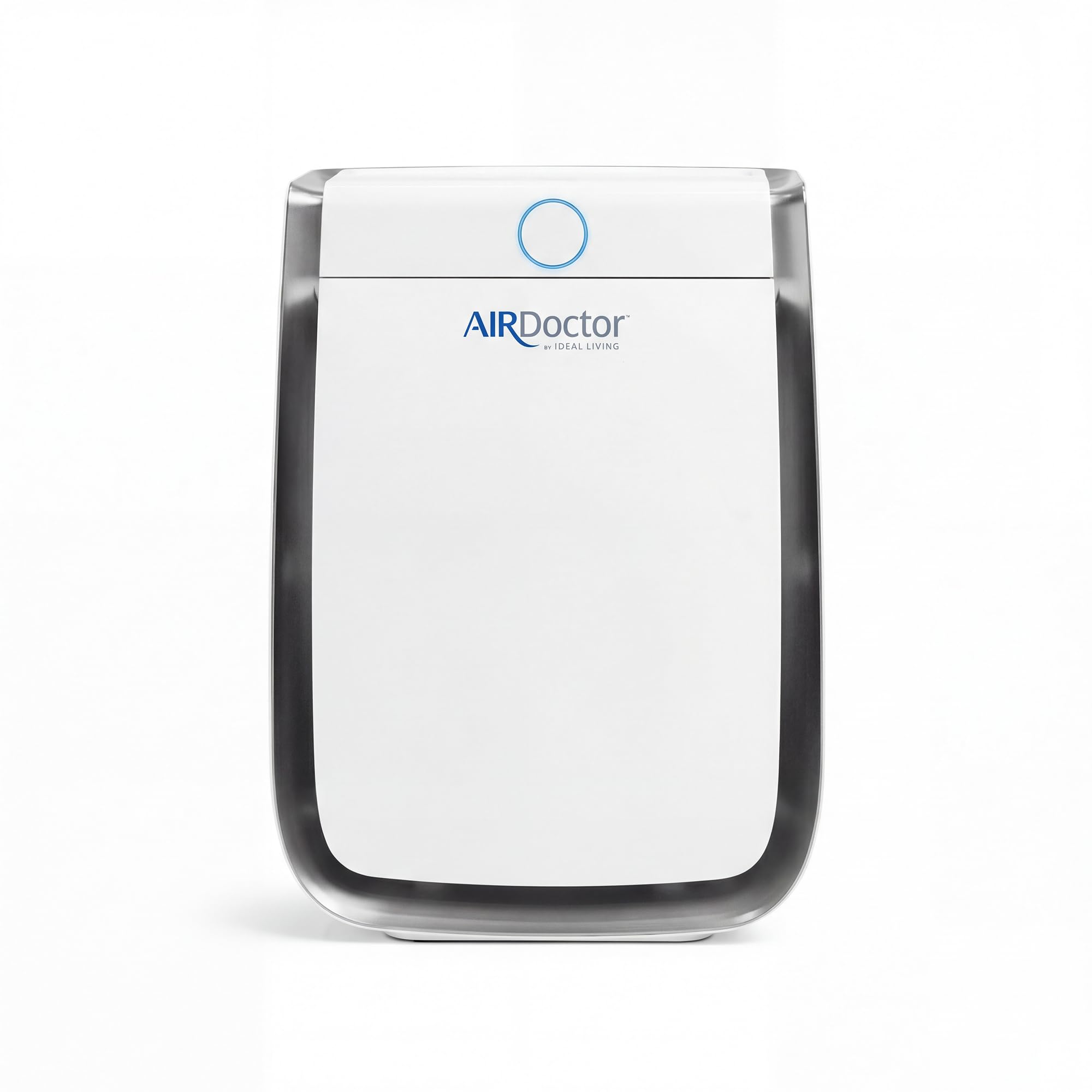
The AirDoctor AD3500 stands at the apex of residential gas-phase filtration. Its premium activated carbon filter is impregnated with potassium permanganate—a chemical oxidizer that actively breaks down formaldehyde, hydrogen sulfide, and other stubborn VOCs rather than merely trapping them. The UltraHEPA stage captures particles down to 0.003 microns, 100 times smaller than the standard HEPA threshold, ensuring that mold spores, bacteria, and viruses are also removed alongside chemical contaminants. With a coverage of up to 2,520 square feet, this unit is designed for the largest open-plan spaces where multiple VOC sources coexist.
Independent third-party testing confirms the AD3500 reduces 99.99% of airborne particles at that ultra-fine micron level. The Auto Mode with the Halo sensor provides color-coded feedback (blue to red) and automatically ramps up the fan speed when it detects a spike in PM2.5 or gas-phase pollutants. Multiple verified buyers report significant reductions in cooking odors, bathroom smells, and even the “new furniture” off-gassing that typically lingers for weeks. The construction is solid at 24 pounds, with a whisper-quiet low fan speed that allows 24/7 use in a bedroom without sleep disruption.
The carbon filter requires replacement every 6 months, while the UltraHEPA stage lasts a full year—this ongoing cost is a trade-off for the superior chemical scrubbing capability. The unit is also FSA/HSA eligible, which partially offsets the periodic filter expenditure. The AD3500 excels in scenarios where chemical sensitivity is a primary concern, such as households with recent renovations, new flooring, or individuals with MCS (Multiple Chemical Sensitivity). It is the most conclusive solution for removing the widest spectrum of VOCs and persistent organic odors.
Why it’s great
- Medical-grade UltraHEPA captures 0.003-micron particles
- Potassium permanganate-impregnated carbon actively breaks down VOCs
- Large coverage area (2,520 sq ft) with automatic air quality sensor
Good to know
- Replacement filter costs are higher than average
- Bulky footprint at over 27 inches tall
2. Nuwave OxyPure ZERO

The Nuwave OxyPure ZERO is a standout for those who prioritize zero ongoing waste and zero filter replacement costs. Its patented dual 4-stage filtration system includes two washable Bio-Guard filters plus a Bio-Guard 360 filter that is designed to be cleaned rather than tossed. This electrostatic and mechanical capture system removes up to 100% of particles down to 0.1 microns, including smoke, dust, and pollen, while the ozone emission removal filter eliminates toxic ozone and many VOCs. The adjustable 30°, 60°, and 90° air vents allow you to direct the airflow precisely where odors are strongest.
Intertek Lab certification confirms the unit can cover a 2,002-square-foot area. Verified owner reports describe this unit as a “beast” for severe allergies and odors, with one user noting it cleared construction dust and cooking smoke in minutes. The auto mode is responsive enough to detect a spike in chemical or particulate load and adjust the fan speed instantly. Sleep mode is exceptionally quiet at 21.41 dB, making it suitable for continuous nighttime use. The build quality is substantial at 22 pounds, with wheels for easy room-to-room portability.
The washable filters do require a more involved cleaning process—vacuuming the stainless-steel pre-filters and rinsing the Bio-Guard media, then allowing 24 hours to dry completely. This maintenance schedule is a trade-off for never buying replacement cartridges. The unit also includes two ozone emission removal filters, which are the only components that need periodic replacement (roughly every 2-3 years). For pet owners and households with strong cooking smells, the OxyPure ZERO offers a sustainable solution that keeps performing without recurring consumable costs.
Why it’s great
- Zero filter replacement waste—all main filters are washable
- Removes ozone and VOCs with dedicated emission removal filter
- Adjustable airflow vents direct purified air to problem zones
Good to know
- Washable filters require a thorough 24-hour drying process
- Loud on maximum fan speed
3. Dhyala KJ02
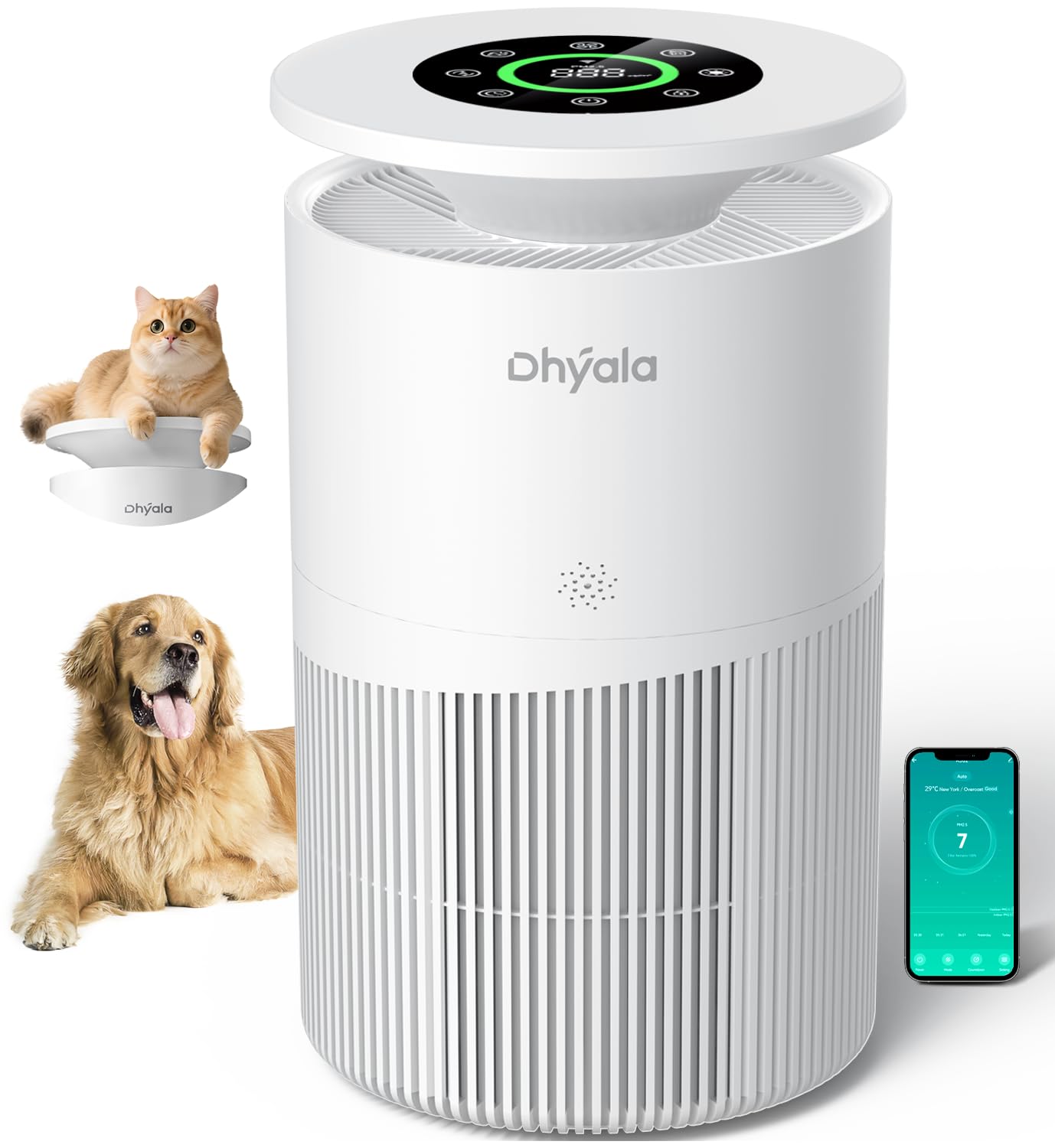
The Dhyala KJ02 challenges the premium category by offering a massive 3,620-square-foot coverage in a compact 9-pound package. Its 5-stage HEPA filtration system includes a pre-filter with electrostatic adsorption technology that captures 40% more pet dander and dust than a standard pre-filter, followed by a high-efficiency activated carbon layer engineered to neutralize tough odors from smoke, pets, and cooking with three times the adsorption capacity. The 360° wide grid intake accelerates wind pressure for a CADR of 271 CFM, far exceeding many larger units.
Smart features include WiFi and app control, touch screen display, and voice compatibility with Alexa and Google Assistant. The built-in smart sensor monitors real-time air quality and triggers Auto Mode to adjust fan speed automatically. Verified users report that the unit reacts to cooking smells from across the room, ramping up until the odor is neutralized. The sleep mode drops to 22 dB, which is genuinely quiet enough for light sleepers. The pet-friendly design includes a lying platform, bite-proof power cord, and a child/pet safety lock—details that demonstrate attention to household realities.
EPA, ETL, FCC, and CE certifications, along with compliance with CARB and CA65 standards, provide confidence in its safety and emissions. The included filter assembly combines pre-filter and main filter into one replaceable unit, which simplifies replacement but means the carbon layer is consumed at the same rate as the HEPA. The 24-month warranty and lifetime technical support are generous. For large open-concept homes where both odor and VOCs are a concern, the Dhyala KJ02 delivers premium volumetric coverage at a mid-range investment level.
Why it’s great
- Exceptional coverage (3,620 sq ft) with 271 CFM CADR
- Triple-adsorption carbon layer for tough odors
- Pet-friendly design with safety lock and bite-proof cord
Good to know
- Combined filter assembly must be replaced as one piece
- Touch screen can be overly bright in dark rooms
4. Winix 5520
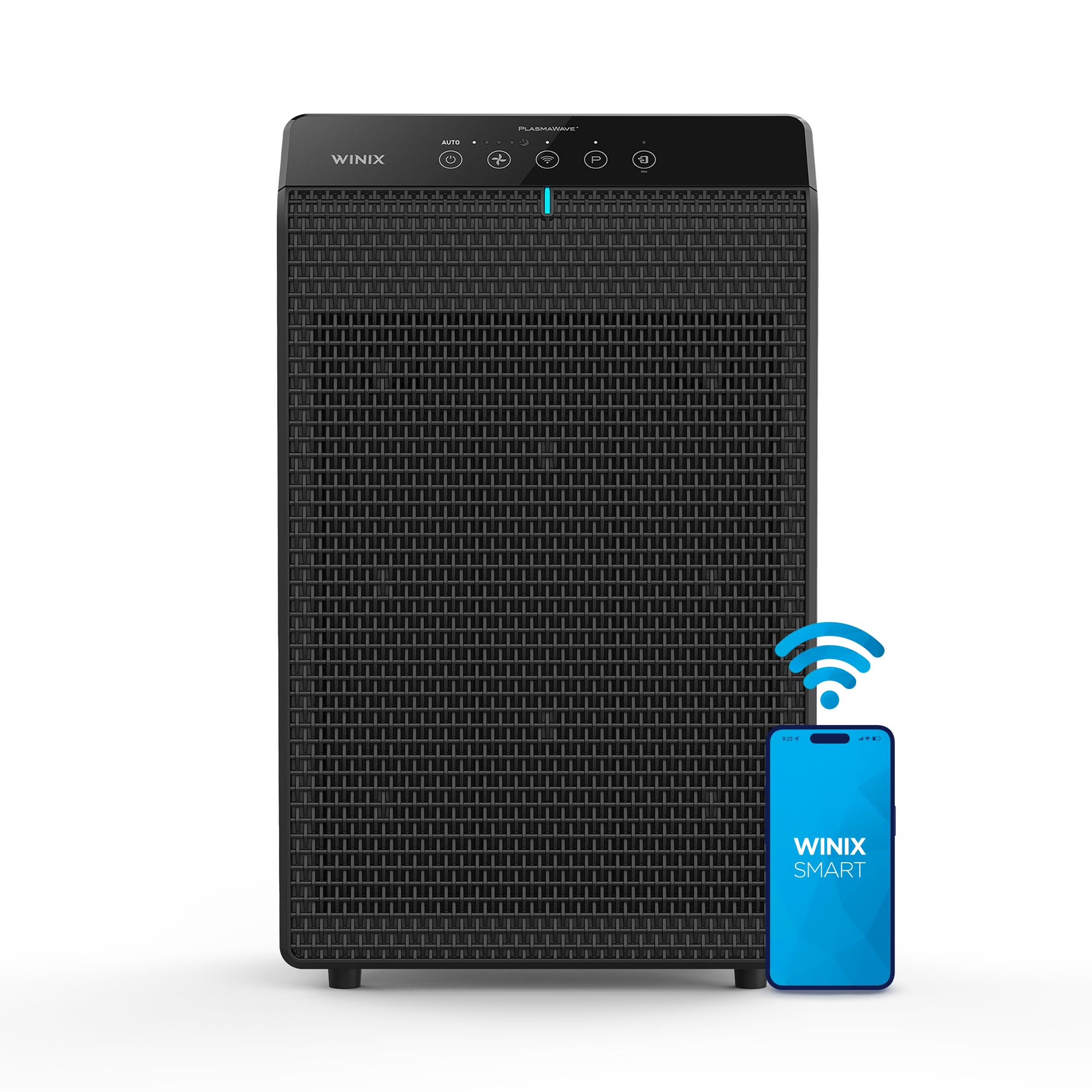
The Winix 5520 brings proven odor control technology to a more accessible price point without sacrificing essential filtration architecture. Its Advanced Odor Control (AOC) Carbon Filter is a dedicated, thick carbon media layer engineered specifically to reduce VOCs and household odors from cooking, pets, and smoke. This is coupled with a True HEPA filter certified to capture 99.99% of airborne particles as small as 0.01 microns, including pollen, dust, smoke, and pet dander. The washable Fine Mesh Pre-Filter provides a first line of defense, extending the life of the more expensive HEPA and carbon stages.
AHAM verification confirms the unit cleans rooms up to 1,882 square feet in one hour, with faster cycles for smaller spaces. The built-in air quality indicator uses a blue/orange/red LED to display real-time conditions, and the Smart Sensors + Auto Mode adjust fan speed accordingly without manual input. The Winix Smart App adds remote control and monitoring capabilities. Verified users consistently report immediate improvement in air quality after cooking or when pets are present, with the unit automatically ramping up in response to odor events. At 23.5 dB on the lowest setting, it is nearly silent for sleep.
The separate carbon and HEPA filters can be replaced individually, allowing you to swap the carbon more frequently if odors are your primary concern without wasting the HEPA. The optional PlasmaWave technology generates hydroxyls to neutralize bacteria and VOCs, but can be turned off if preferred. The unit covers a large area efficiently, though some users note it is noticeable on higher fan speeds (modes 2-4). For budget-conscious buyers who prioritize actual gas-phase filtration over particle-only cleaning, the Winix 5520 delivers substantial chemical adsorption capacity per dollar spent.
Why it’s great
- Dedicated AOC Carbon Filter for VOC and odor reduction
- Separate replaceable filters (carbon and HEPA) for cost efficiency
- Ultra-quiet operation at only 23.5 dB on lowest speed
Good to know
- Loud on higher fan speed settings (levels 2-4)
- App interface feels dated compared to newer competitors
5. Blueair Blue SP3i
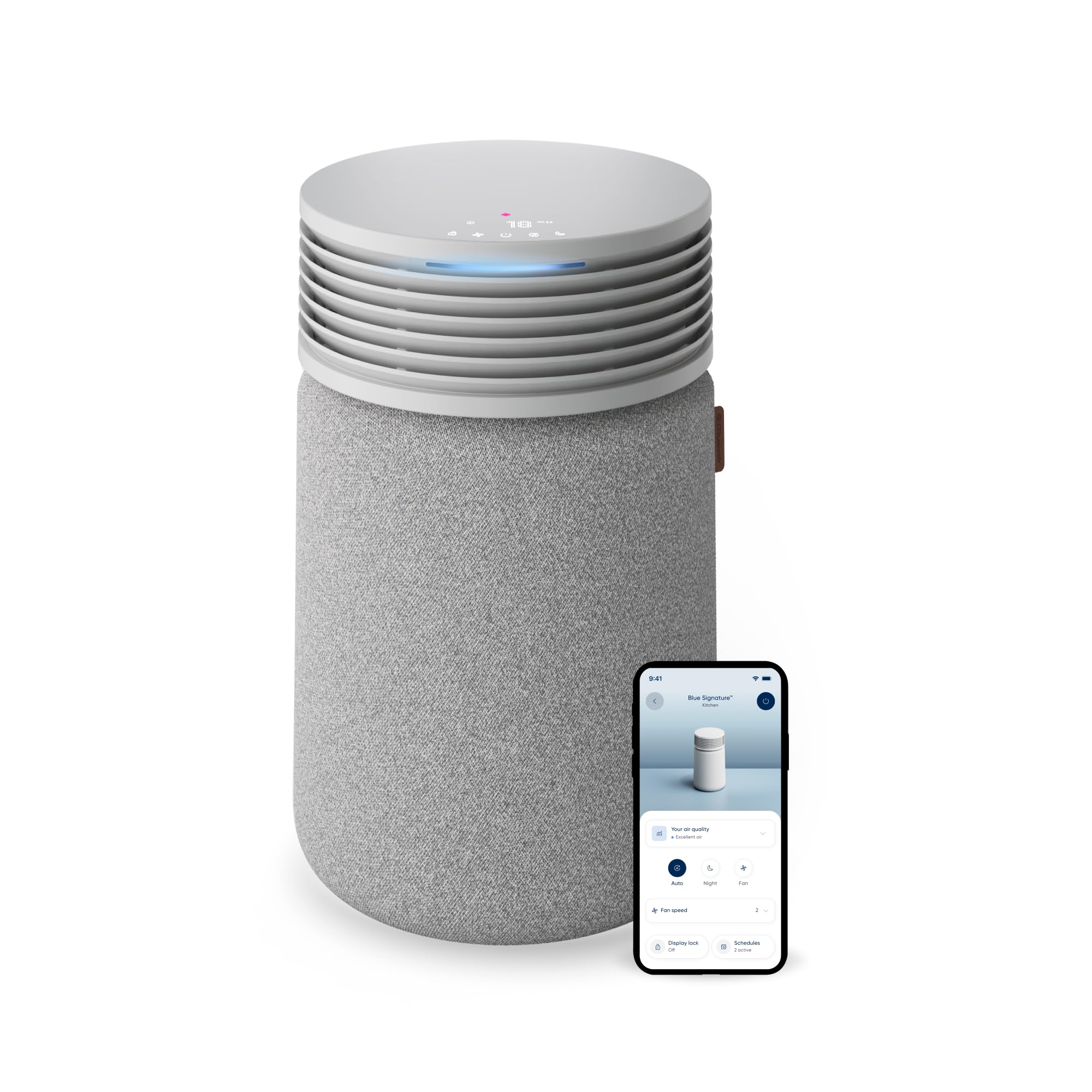
The Blueair Blue SP3i integrates advanced 7-stage HEPASilent filtration with a proprietary OdorFence technology that breaks down odors, gases, and VOCs at a molecular level. This is not a simple carbon pad—the OdorFence stage uses a chemically active media to neutralize a broader range of gaseous pollutants than standard activated carbon alone. The unit captures 99.97% of airborne particles down to 0.1 microns and operates as low as 19 dB, making it one of the quietest high-capacity purifiers available for a room up to 498 square feet (with 2,250 sq ft single-pass coverage per hour).
The Scandinavian design uses interchangeable pre-filters in various colors to blend with any interior, and the air quality indicator built into the air outlet displays five color-coded levels from excellent (blue) to poor (red). WiFi connectivity via the Blueair app provides full scheduling, fan speed control, and real-time monitoring from anywhere. Verified buyers consistently praise the noticeable improvement in freshness—one user noted the kitchen air quality light shifted from red to blue within minutes of cooking startup. The unit is lightweight at 9.5 pounds and fits neatly into a table-style design that does not dominate the room visually.
Replacement filters are an ongoing expense, and the filters are proprietary to Blueair, limiting aftermarket options. The app has received mixed reviews for occasional slowness or connectivity drops. However, the combination of whisper-quiet operation, effective gas-phase filtration via OdorFence, and a refined aesthetic makes the SP3i a strong choice for smaller homes, apartments, or bedrooms where both noise and appearance are critical factors alongside odor removal performance.
Why it’s great
- Proprietary OdorFence technology actively breaks down VOCs and gases
- Whisper-quiet 19 dB operation suitable for nursery or bedroom
- Furniture-grade design with interchangeable colored pre-filters
Good to know
- Proprietary replacement filters are expensive
- App connectivity can be slow or unreliable
6. Nuwave Forever Smart Air Purifier

The Nuwave Forever takes the washable filter concept of the OxyPure ZERO and adds a 7-stage filtration system designed to never require filter replacements. The system includes stainless-steel pre-filters, Bio-Guard electrostatic filters, a dedicated ozone emission removal filter, and the Bio-Guard 360 that targets airborne micropollutants. Critically, the ozone removal media also uses a chemical process to reduce VOCs and odors to less than 1 part per billion (ppb)—about 70 times below the EPA safe level. This makes it one of the few residential units that can verifiably claim active VOC reduction in the ppb range.
Intertek Lab certification confirms particle capture down to 0.1 microns, and coverage extends to 2,002 square feet. Verified users report that the unit eliminates wet dog smell from four large dogs within hours, and that auto mode sensitively detects cooking odors and adjusts fan speed accordingly. The adjustable flow panel on the unit allows you to direct air upwards or outwards depending on the room layout. WiFi app control provides remote scheduling and monitoring. At 21.85 pounds, the unit is solid but not overly heavy, with a footprint that is narrower than many competitors.
The washing and drying process for the multiple filters is more involved than replacing a disposable cartridge—the electrostatic filters need gentle handling and thorough drying to maintain their charge. The unit is loud above fan level 3, though sleep mode is acceptably quiet for a bedroom. The long-term savings on filter replacements are substantial, especially for households that would otherwise replace expensive HEPA and carbon cartridges every 6-12 months. For those committed to zero-waste and long-term economy, this Nuwave model provides chemical VOC removal with a lifetime of reusable filtration.
Why it’s great
- No replacement filters ever—all stages are washable and reusable
- Reduces VOCs and ozone to less than 1 ppb
- 7-stage filtration covers chemical, particulate, and odor removal
Good to know
- Filter washing and drying cycle takes 24 hours when needed
- Noticeably loud on fan settings above level 3
7. Coway Airmega AP-1512HH
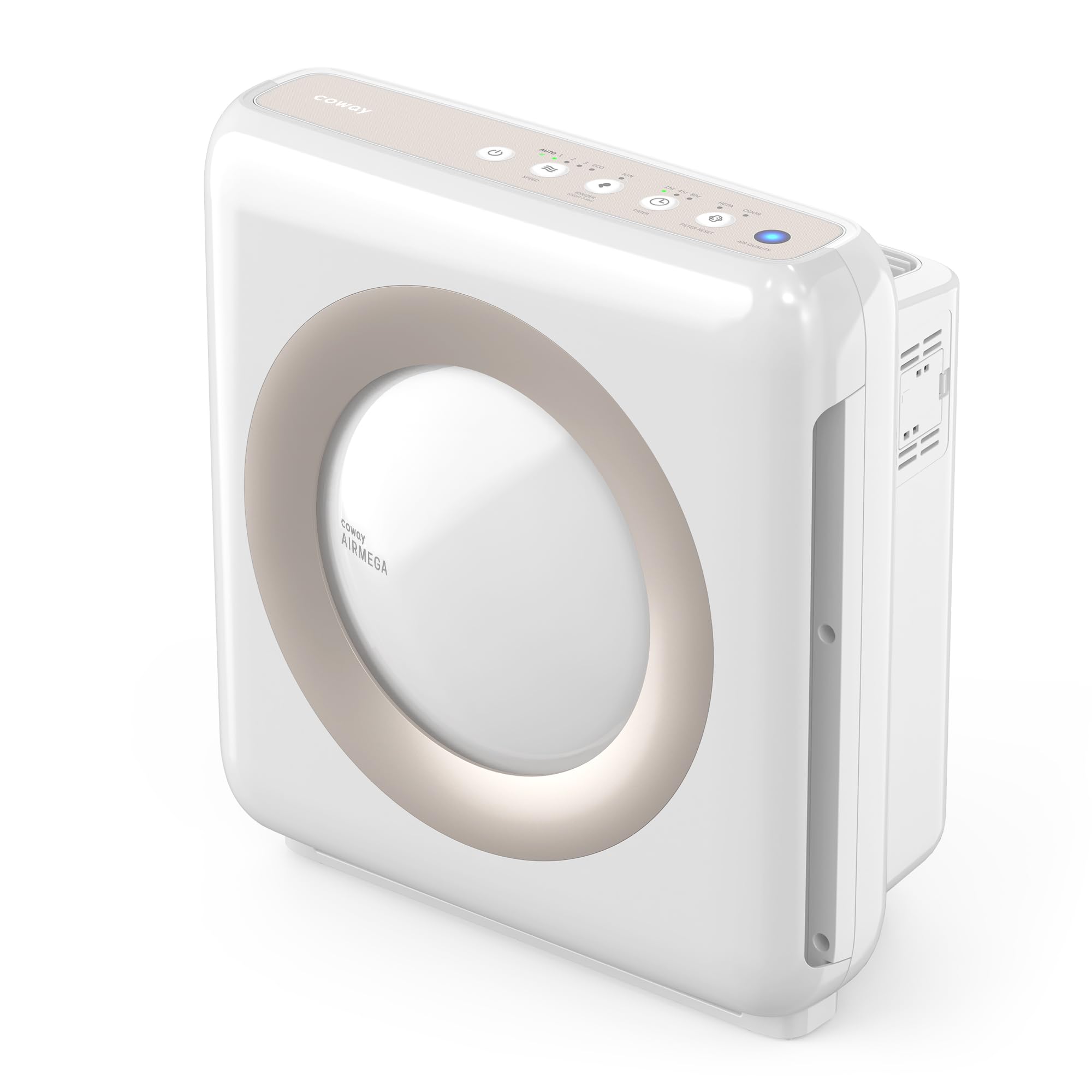
The Coway Airmega AP-1512HH has earned its reputation as a Wirecutter “Best Air Purifier” winner for good reason—it packs genuine 4-stage filtration (Pre-filter, Deodorization carbon filter, True HEPA, and Vital Ion) into a compact, quiet, and reliable package. The Deodorization filter is a dedicated activated carbon layer designed to reduce VOCs and odors, and it works in conjunction with the True HEPA to capture 99.97% of particles down to 0.3 microns. With a CADR of 246 (dust), 240 (pollen), and 233 (smoke), it is optimized for rooms up to 361 square feet.
The pollution sensor communicates air quality via a brightly colored LED (blue for good, red for poor), and Auto Mode automatically adjusts fan speed between levels 1-3 based on real-time readings. An Eco Mode stops the fan when no pollution is detected for 30 minutes, saving energy. Verified owner reports confirm the unit rapidly cleared wildfire smoke from an NYC apartment within five minutes, and that it is sensitive enough to detect cooking odors from a distance. The noise level ranges from an ultra-quiet 24.4 dB to a max of 53.8 dB, making it unobtrusive during sleep or work.
The 77W power consumption is efficient, and the filter replacement indicator tracks both the pre-filter and HEPA separately. The unit lacks WiFi or app control, which may be a drawback for some, but its intuitive manual controls and responsive auto-mode make it a set-and-forget device. The 1-year warranty on internal parts and 3-year coverage on the motor provide reasonable protection. For small to medium rooms where VOCs and odors are intermittent (cooking, occasional smoking), the Coway AP-1512HH offers reliable chemical filtration without the premium price tag.
Why it’s great
- Proven 4-stage filtration with dedicated deodorization carbon layer
- Ultra-quiet operation starting at 24.4 dB
- Auto Mode with Eco function for energy savings
Good to know
- No WiFi or smart app control
- Top exhaust may not suit all room layouts
8. PuroAir 400
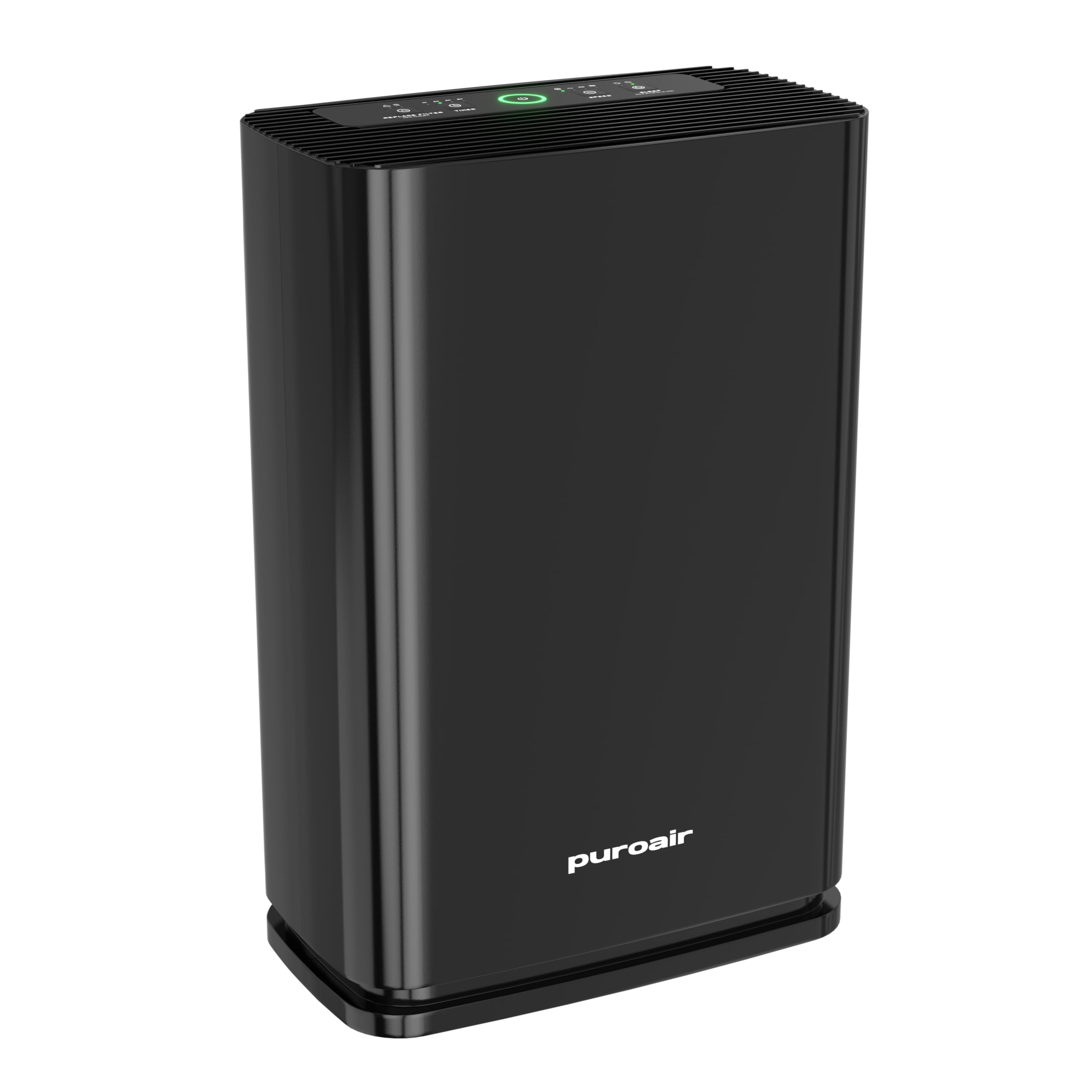
The PuroAir 400 positions itself as a powerful, no-frills solution for large rooms up to 2,000 square feet. Its 3-layer filtration system (pre-filter, HEPA filter, and activated carbon) is marketed as “CarbonTech,” indicating a focus on enhancing the carbon layer’s adsorption capacity for VOCs and odors. The HEPA filter is proven to capture up to 99.9% of pollutants, including particles 700 times smaller than a human hair, while the activated carbon stage absorbs gaseous chemicals. Independent testing by an ISO 17025 certified laboratory backs the performance claims.
The smart particle sensor monitors real-time air quality and automatically adjusts fan speed in Auto Mode. The built-in Sleep Mode dims the display and reduces fan noise to a near-silent level, making it suitable for continuous bedroom use. Verified customers report that the unit eliminated allergy symptoms from mold within three weeks and that houseguests commented on the noticeably fresh air. The compact footprint (17.5 x 10.6 x 12.5 inches) and 14.73-pound weight make it easy to relocate between rooms as needed.
Some users find the unit slightly loud on the highest setting, though most agree it is acceptable as background white noise. The ongoing replacement filter cost is moderate, and the 2-year risk-free warranty from PuroAir provides peace of mind. The lack of WiFi or app control is a trade-off for the straightforward interface. For those needing entry-level VOC and odor removal in an open living space without smart home integration, the PuroAir 400 delivers effective gas-phase adsorption at a budget-friendly price point.
Why it’s great
- Large room coverage (2,000 sq ft) with HEPA and carbon filtration
- Smart sensor auto-adjusts fan speed for optimal odor removal
- Compact and lightweight design for easy portability
Good to know
- No WiFi or app control
- Can be loud on the maximum fan setting
9. Sans True HEPA Air Purifier

The Sans True HEPA Air Purifier distinguishes itself with an integrated UV-C light layer that provides an additional sterilization step for bacteria and mold spores, which is beneficial when VOCs are accompanied by microbial growth (e.g., basements or bathrooms with recurring moisture). Its 3-in-1 filtration system uses a pre-filter, a medical-grade True HEPA filter, and a heavy-duty activated carbon layer designed specifically for stubborn odor absorption, including smoke and VOCs. The unit covers an extra-large area of up to 1,854 square feet, making it a candidate for open basements or combined living-dining spaces.
Verified users report that auto mode detects smells from a shower drain or cooking from a floor below, kicking into high gear to clear them within an hour. One long-term owner noted that the unit helped resolve an unexplained lung condition after months of continuous use, suggesting effective VOC and particulate removal. The sleep mode is described as the quietest of any air purifier owned, and the carbon-activated layer effectively traps pet hair and dander before they settle. The onboard filter replacement indicator simplifies maintenance, with genuine replacements swappable in under 60 seconds.
The UV-C bulb is an added consumable that requires periodic replacement, adding another ongoing cost despite the unit’s overall efficiency. The 5-year warranty (registered directly with Sans) is excellent, but it is worth noting that the warranty is only available when purchased through their site, not Amazon. The unit lacks WiFi or smart control, relying on manual buttons and an automatic sensor. For large households or multi-pet homes where microbial VOCs (from dampness or organic decay) are a concern, the Sans purifier’s UV-C layer provides a distinct advantage over standard HEPA + carbon alternatives.
Why it’s great
- UV-C light layer adds sterilization for bacteria and mold
- Coverage up to 1,854 sq ft for extra-large rooms
- Auto-detects and rapidly clears strong odors from cooking and drains
Good to know
- UV-C bulb replacement adds to ongoing maintenance cost
- No WiFi or app control
FAQ
How often should I replace the carbon filter for VOC and odor removal?
Can a standard HEPA filter remove VOCs like formaldehyde or benzene?
Final Thoughts: The Verdict
For most users, the air purification systems for removing vocs and odors winner is the AirDoctor AD3500 because its UltraHEPA and potassium permanganate-impregnated carbon provide the most comprehensive gas-phase and particle filtration available for large homes. If you want zero ongoing filter waste and adjustability for directing airflow, grab the Nuwave OxyPure ZERO. And for an entry-level investment that still delivers a real dedicated carbon filter, nothing beats the price-to-performance ratio of the Winix 5520.

Mo Maruf
I created WellFizz to bridge the gap between vague wellness advice and actionable solutions. My mission is simple: to decode the research and give you practical tools you can actually use.
Beyond the data, I am a passionate traveler. I believe that stepping away from the screen to explore new environments is essential for mental clarity and physical vitality.