Our readers keep the lights on and my smoothie glass nicely filled. As an Amazon Associate, I earn from qualifying purchases.
That stale kitchen smell that lingers an hour after cooking bacon, the chemical whiff from a new furniture delivery, the persistent odor from a neighbor’s cooking that seeps through the walls — an ordinary HEPA-only air purifier lets those volatile organic compounds (VOCs) and gaseous odor particles sail right through its filter media. A carbon air purifier solves this specific problem by adding a thick layer of activated carbon that chemically adsorbs these gas-phase pollutants rather than just trapping solid particles like dust and pollen.
I’m Mohammad Maruf — the founder and writer behind WellFizz. My deep market research into air filtration technology has focused on understanding how different carbon weights and mesh densities interact with specific household odor molecules, combustion byproducts, and chemical off-gassing patterns across dozens of brands and filter configurations.
After combing through hundreds of verified buyer experiences and technical specifications across seven distinct carbon air purifier models, I’ve identified the exact criteria that separate an effective odor and VOC controller from a unit that merely blows air through a thin carbon pad. This guide is built around finding your best carbon air purifier for the specific volatile challenges inside your home.
How To Choose The Best Carbon Air Purifier
Selecting a carbon air purifier requires shifting your evaluation criteria away from standard particulate-focused metrics. The carbon component — its weight, density, and integration within the filter stack — determines how well the unit handles the gases and odors that HEPA filters cannot touch.
Carbon Quantity and Quality
The single most important spec for carbon performance is the physical weight of activated carbon in the filter. A thin carbon coating on a HEPA filter (common in budget units) provides minimal odor adsorption capacity and saturates within weeks. Look for separate, dedicated carbon filters with visible pellet density — the more carbon mass, the longer the unit remains effective against cooking fumes, pet odors, and VOCs. Coconut-shell-based activated carbon with a higher surface area-to-weight ratio generally outperforms lower-grade coal-derived options for household odor control.
Filter Configuration: Carbon Pre-Filter vs. Dedicated Layer
Many purifiers sandwich a thin carbon layer as a pre-filter before the HEPA media. This configuration works for light odor control but forces the carbon to compete with larger dust and pet hair particles, clogging the carbon’s adsorption pores faster. Premium designs separate the carbon stage entirely, positioning it after the pre-filter and before or after the HEPA stage, allowing the carbon to focus exclusively on gas-phase pollutants. Units with a dedicated, replaceable carbon filter that sits independently of the HEPA filter offer the most cost-effective long-term operation because you replace only the saturated carbon while the HEPA continues its particulate duty.
Room Size and Air Change Rate
Carbon adsorption is a contact-based process — the air must spend sufficient time passing through the carbon bed for effective gas capture. A unit with extremely high fan speed but a thin, low-density carbon filter may have a high CADR for particulates but poor odor removal. Balance the fan speed settings with carbon density; running a unit on medium speed with a thick carbon bed often outperforms a unit on high with a token carbon layer. For odor-dominant rooms like kitchens or pet areas, a lower air change rate with denser carbon provides better real-world results than chasing maximum CADR numbers.
Filter Replacement Cost and Frequency
Carbon filters saturate based on exposure to gases and odors, not on a fixed calendar schedule. A kitchen unit will need carbon replacement roughly every 3-4 months, while a bedroom unit in a low-odor environment may stretch to 6-8 months. Compare the price of replacement filter packs carefully — some premium units offer individually replaceable carbon and HEPA filters, which can halve your long-term operating costs compared to all-in-one monolithic filter packs that force you to discard still-functional HEPA media when the carbon layer saturates.
Quick Comparison
On smaller screens, swipe sideways to see the full table.
| Model | Category | Best For | Key Spec | Amazon |
|---|---|---|---|---|
| Levoit Core 200S-P | Smart Compact | Bedrooms under 150 ft² | 27 dB sleep mode | Amazon |
| Levoit Core 300-P | Medium Room | All-purpose single rooms | 143 CFM CADR | Amazon |
| GermGuardian AC4825E | Tower HEPA + UV | Multi-room coverage | UV-C light included | Amazon |
| Coway Airmega 100 | Smart Medium | Kitchen and living areas | Auto mode with AQI monitor | Amazon |
| Winix 5520 | Large Smart | Open plan large rooms | 23.5 dB low speed | Amazon |
| Coway Airmega Mighty2 | Premium Large | Whole-home flagship | 249 CFM pollen CADR | Amazon |
| CleanForce Rainbow | Whole-Home | Very large open spaces | 2250 ft² coverage | Amazon |
In‑Depth Reviews
1. Coway Airmega Mighty2 (AP-1512N)
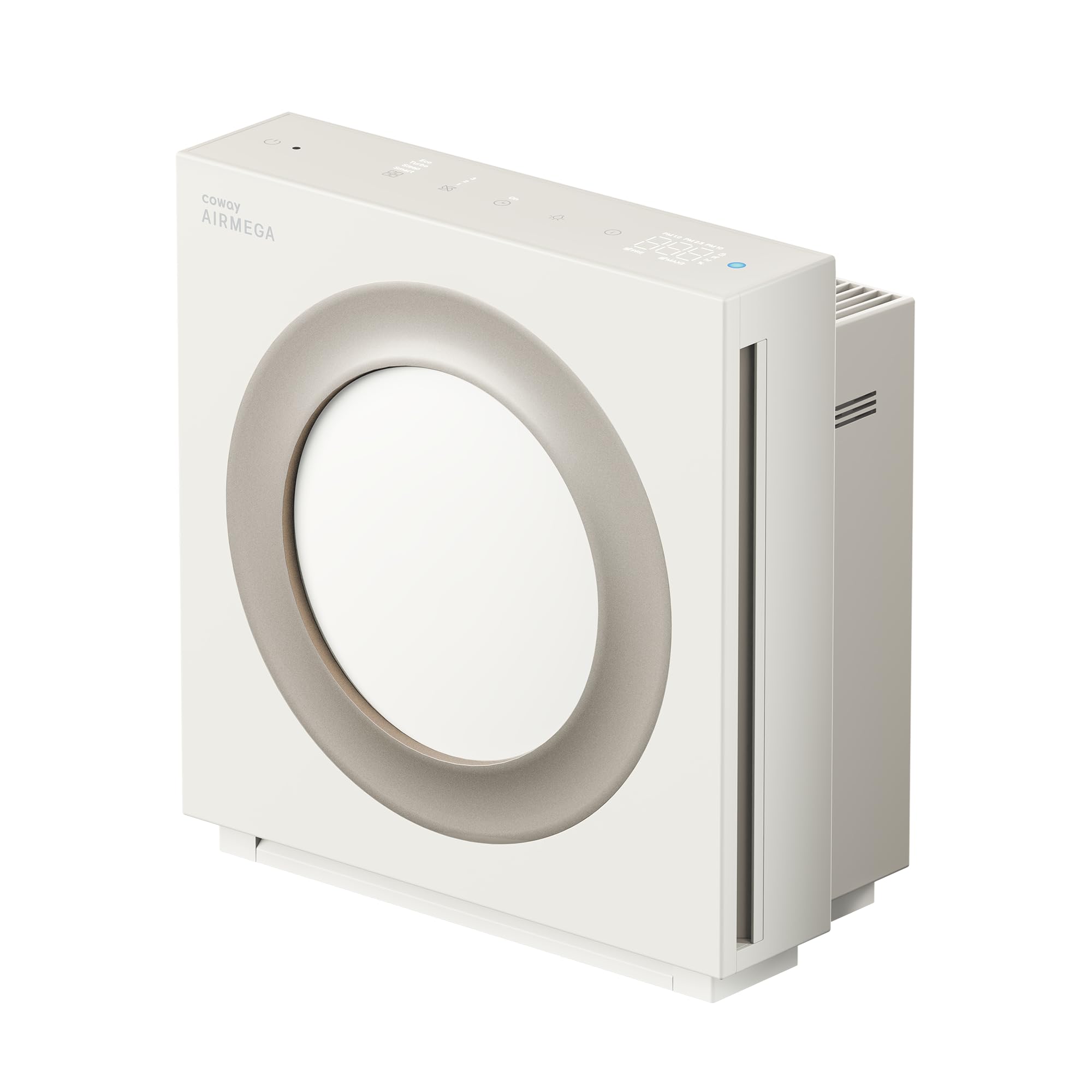
The Coway Airmega Mighty2 represents a genuine generational leap over the already-acclaimed AP-1512HH that Wirecutter recommended for years. Its upgraded Max2 filter combines a true IEST-certified HEPA layer with an Active Carbon layer that is substantially denser than the thin carbon sheets found in most competitors. The practical result is a unit that suppresses cooking odors and household VOCs with visible effectiveness — reviewers consistently report the sensor switching from red to blue within minutes of a smoke or odor event.
The MegaScan laser sensor is the standout smart feature here, providing real-time numerical readouts for PM1.0, PM2.5, and PM10 particle sizes. This granular feedback lets you actually see how quickly the carbon-HEPA combination responds to airborne contaminants. The Smart Mode auto-adjusts fan speeds based on sensor input, and when the room darkens, the light sensor triggers Sleep Mode at a whisper-quiet 19 dB — quieter than any other unit on this list. The washable pre-filter slides out without opening the front cover, making monthly maintenance genuinely effortless.
On the downside, some users report that the Auto Mode can be overly sensitive to humidity changes — a steamy bathroom or shower can trigger the high fan speed for extended periods, which is disruptive during sleep hours. A dedicated sleep mode toggle that overrides the auto sensor would solve this. Additionally, while the 3-year warranty is industry-leading, the replacement Max2 filter costs are higher than budget alternatives, though the individual component design means you only replace what’s actually saturated.
Why it’s great
- IEST-certified HEPA with dense active carbon layer provides exceptional VOC and odor adsorption
- Real-time PM1.0/2.5/10 numerical display gives precise feedback on air quality changes
- Whisper-quiet 19 dB Sleep Mode with automatic light-sensor activation
- Slide-out washable pre-filter simplifies maintenance without disassembly
Good to know
- Auto Mode can be triggered by bathroom humidity, running on high for extended periods
- Replacement Max2 filters are premium-priced compared to budget alternatives
- Physical footprint is larger than cylindrical tower designs
2. Winix 5520
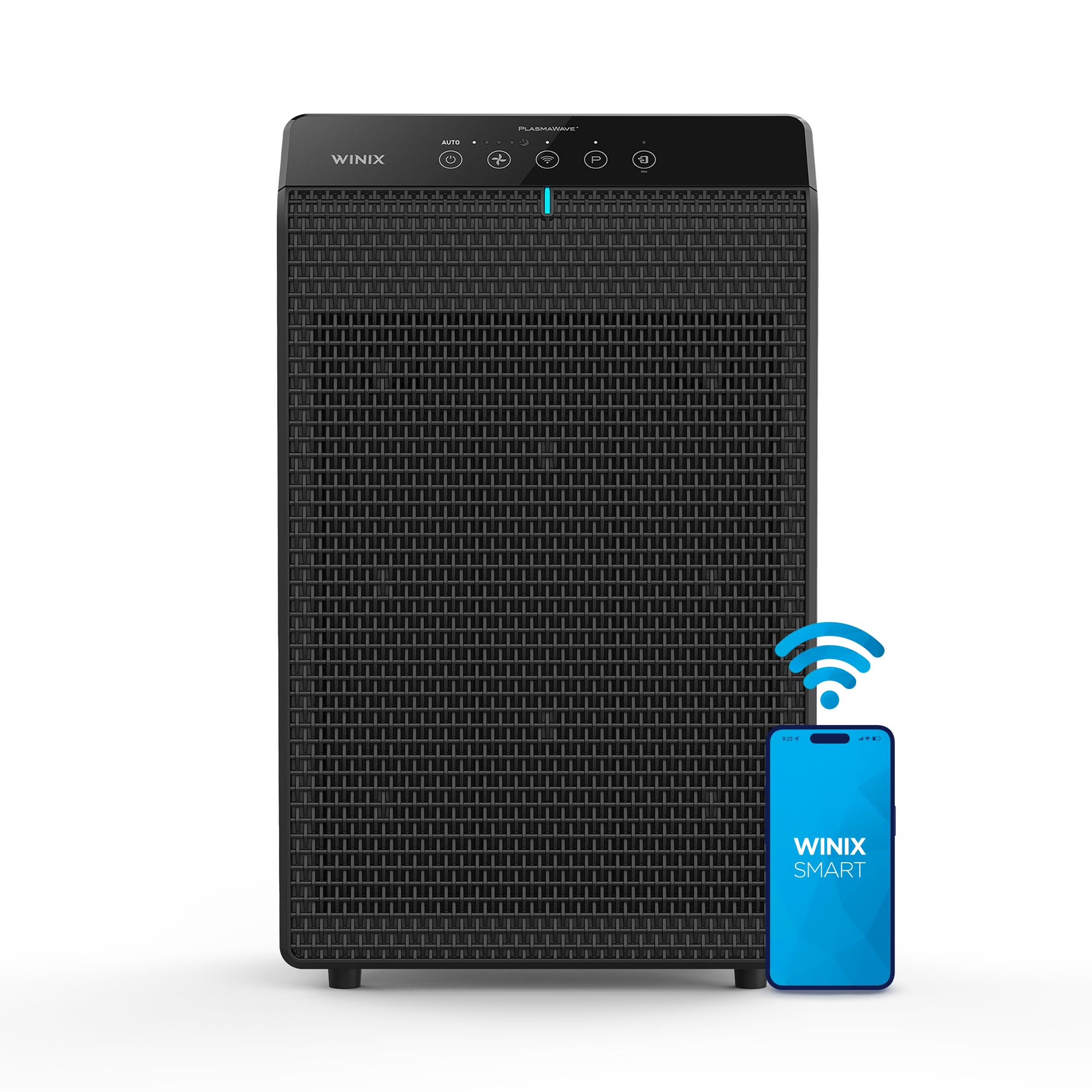
The Winix 5520 brings a genuinely premium feature set — including an air quality monitor, Auto Mode, and smart app compatibility — at a price point that undercuts most competitors with equivalent carbon filtration capabilities. Its Advanced Odor Control Carbon filter is a separate, dedicated stage that sits behind the washable fine mesh pre-filter and before the True HEPA filter. This three-stage separation ensures the activated carbon isn’t competing with dust and pet hair for adsorption surface area, extending its effective life against cooking odors and VOCs considerably.
The unit’s 392 square foot AHAM Verifide rating (with the ability to cycle larger spaces at lower air changes per hour) makes it a viable option for open-plan living areas. The real-time air quality indicator uses green/amber/red LED lights to show current conditions, and the Smart Sensors automatically ramp fan speed when the carbon filter detects increased gaseous pollutants. At 23.5 dB on its slowest speed, it is genuinely near-silent for overnight use in a bedroom.
A notable limitation is the noise profile on higher fan speeds — levels 2 through 4 produce a distinct whooshing sound that some users find intrusive in quiet environments, and the unit does not retain manual settings (like ionizer off or sleep mode) after a power cycle, requiring reconfiguration via the Winix Smart App each time. The app interface itself feels dated compared to Coway’s implementation, though the core air cleaning performance remains strong.
Why it’s great
- Separate dedicated carbon filter prevents pre-clogging by dust and hair
- Washable fine mesh pre-filter extends HEPA and carbon filter lifespan
- Near-silent 23.5 dB operation on lowest speed for undisturbed sleep
- Smart App and Alexa control for remote monitoring and scheduling
Good to know
- Audible whoosh on higher fan speeds may bother noise-sensitive users
- Unit does not retain ionizer off or sleep mode settings after power loss
- App interface feels dated compared to current smart home standards
3. Coway Airmega 100
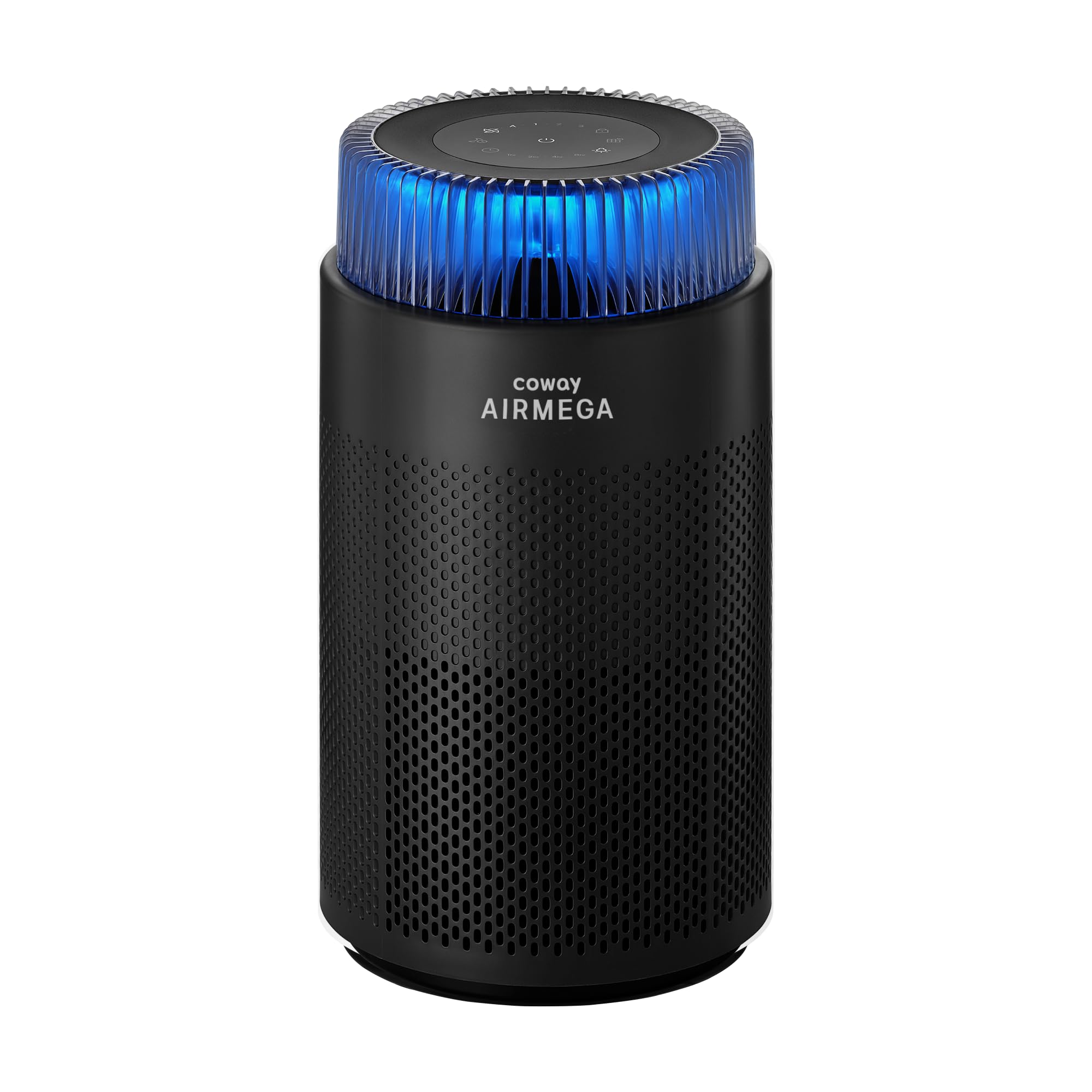
Coway’s Airmega 100 distills the brand’s proven filtration architecture into a more compact, budget-friendly package without compromising the carbon-HEPA combination that made the Mighty series famous. The 3-stage filtration system uses a washable pre-filter, a deodorization filter (carbon-based), and a true HEPA filter working in sequence. The deodorization filter is specifically designed for VOC and odor capture — multiple reviewers confirmed it eliminates cooking smells and pet odors in real-world kitchen and living room use, with one user reporting the machine cleared bacon odor within minutes of the sensor detecting it.
The Auto Mode is surprisingly sophisticated for the price tier. The built-in AQI monitor continuously samples the air and adjusts fan speed in real-time, and the Sleep Mode dims all indicator lights while running the fan at its lowest speed. At 7.5 pounds with an 8.66-inch square footprint, it is one of the most space-efficient units here, fitting easily on a kitchen counter or nightstand without dominating the visual space.
The main trade-off is filter replacement frequency. Several users reported needing to replace the filter set every 5 months rather than the 12 months Coway suggests, particularly in environments with heavy cooking or pet odors. At roughly per two-filter pack, this pushes the annual operating cost higher than some competitors. Additionally, the carbon deodorization filter is an integrated part of the filter pack rather than a separately replaceable component, meaning you cannot independently replace the carbon when it saturates while keeping the HEPA.
Why it’s great
- Compact 8.66-inch square footprint fits kitchen counters and small spaces
- Auto Mode with real-time AQI monitoring adjusts fan speed to pollutant levels
- 3-stage filtration with dedicated deodorization carbon layer
- Sleep Mode fully dims lights for zero bedroom light pollution
Good to know
- Carbon and HEPA filters are integrated, cannot be replaced separately
- Real-world filter life in high-odor environments may be 5 months, not 12
- Annual filter replacement cost is higher than some competitors at this price tier
4. Levoit Core 300-P

Levoit’s Core 300-P is the rare mid-range unit that offers genuine filter customization for carbon-focused buyers. The standard 3-in-1 filter includes a high-efficiency activated carbon layer, but Levoit additionally sells specialized replacement filters: the Toxin Absorber Filter (optimized for smog, toxins, and VOCs), the Smoke Remover Filter (for wildfire smoke and particulates), and the Pet Allergy Filter (for dander and odors). This modular approach means you can swap in a carbon-heavy filter when seasonal odors are worst and switch to a particulate-focused filter during high-pollen months.
The 56W high-torque motor delivers 143 CFM CADR for smoke, which is impressive for a unit covering 222 square feet at 4.8 air changes per hour. The QuietKEAP technology drops noise to 24 dB in Sleep Mode — genuinely whisper-quiet for overnight bedroom use. The touch controls, timer (2/4/6/8 hours), and display-off button give granular control over operation without needing a smartphone app.
Where the Core 300-P falls short is its carbon layer thickness in the standard filter. The activated carbon is a thin, sheet-like layer bonded to the HEPA media rather than a deep granular bed, which limits its odor adsorption capacity compared to units like the Winix 5520 or Coway Mighty2 that use separate, denser carbon stages. For light household odors the standard filter works fine, but for heavy kitchen or pet odors, you will want to upgrade to the specialized Smoke Remover or Toxin Absorber filter.
Why it’s great
- Interchangeable specialty filter options for targeted VOC, smoke, or pet odor control
- QuietKEAP technology delivers genuine 24 dB Sleep Mode for undisturbed rest
- 56W high-torque motor provides strong 143 CFM smoke CADR for its size
- Display-off button and programmable timer offer flexible control without app reliance
Good to know
- Standard carbon layer is thin sheet-type, not deep granular pellet carbon
- Specialized replacement filters are more expensive than standard 3-in-1 packs
- Does not have an integrated air quality monitor or Auto Mode
5. Levoit Core 200S-P

The Levoit Core 200S-P packs smart home integration — WiFi connectivity with voice control via Alexa and Google Assistant — into a compact 8-inch cylindrical body that covers up to 140 square feet. Its 360-degree air intake design draws air from all directions rather than just the front, which improves overall room circulation in small spaces like nurseries, home offices, or dorm rooms. The 3-in-1 filter includes a high-efficiency activated carbon layer for basic odor and fume reduction.
The smart features are genuinely useful here: you can monitor filter life, set schedules, and adjust fan speed from the Levoit app without getting up. The 27 dB Sleep Mode is nearly silent, and the Display Off button eliminates all light pollution for sensitive sleepers. Multiple reviewers confirmed significant dust reduction visible in sunlight within a day of operation, and several asthma and allergy sufferers reported noticeably easier breathing overnight.
The carbon layer in the Core 200S-P is proportionally thinner than even the Core 300-P’s standard filter due to the compact form factor. This unit is best suited for very light odor environments — a spare bedroom or office with minimal cooking, smoking, or pet activity. For any room where odors are a primary concern, the carbon will saturate noticeably faster than on larger units, making filter replacement a more frequent expense.
Why it’s great
- Smart WiFi with voice control via Alexa and Google Assistant at a budget-friendly tier
- 360-degree air intake maximizes airflow in small rooms under 150 ft²
- Near-silent 27 dB Sleep Mode ideal for light-sleeping children or adults
- Compact cylindrical design fits discreetly on nightstands or desks
Good to know
- Carbon layer is thin and saturates faster in rooms with cooking or pet odors
- 140 ft² coverage limits effectiveness in larger bedrooms or living areas
- Filter replacement cost is proportionally higher due to smaller carbon capacity
6. GermGuardian AC4825E

The GermGuardian AC4825E has been a consistent performer since 2011, and its longevity on the market speaks to its reliable HEPA-carbon-UV-C filtration architecture. The activated carbon filter targets odors from cooking, pets, and smoke, while the True HEPA filter captures 99.97% of particulates down to 0.3 microns. The optional UV-C light adds an additional layer of airborne pathogen reduction, which is a differentiator in this price range.
The 22-inch tower form factor with a 10.25 x 6.75-inch footprint is space-efficient despite its height, and the top-mounted control dial with UV button is refreshingly simple — no app pairing, no touchscreen menus. The washable pre-filter captures larger particles before they reach the carbon and HEPA stages, which extends the life of the more expensive filters. Reviewers consistently report dramatic reductions in asthma symptoms and sneezing within days of use.
The carbon filter is a standard sheet-type layer rather than a deep granular bed, and the AC4825E’s 153 square foot primary coverage means it is best suited for individual rooms rather than open spaces. The UV-C bulb adds an ongoing replacement cost, and the unit is notably loud on the highest fan setting — measured at levels that some users find disruptive for TV watching or conversation. The lack of smart features or an air quality monitor means you are operating blind to actual air quality changes.
Why it’s great
- Proven long-term reliability with consistent performance since 2011
- UV-C light provides additional airborne pathogen reduction beyond carbon-HEPA
- Simple top-mounted dial control requires no app or menu navigation
- Washable pre-filter extends carbon and HEPA filter life between replacements
Good to know
- Carbon layer is thin sheet-type with limited odor adsorption capacity
- No air quality monitor, Auto Mode, or smart connectivity features
- UV-C bulb is a recurring replacement cost beyond filter changes
7. CleanForce Rainbow
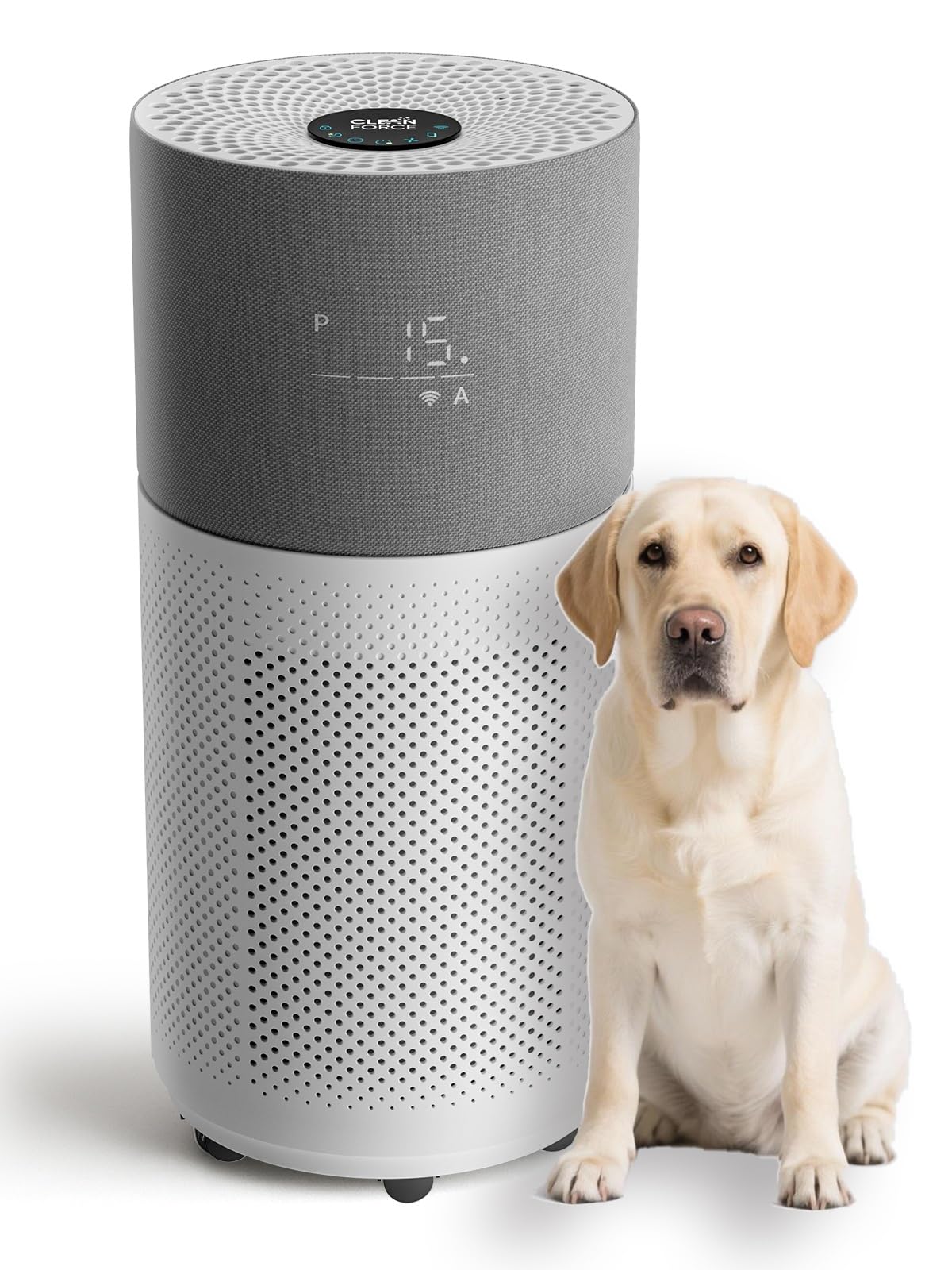
The CleanForce Rainbow is the largest capacity unit in this lineup, covering up to 2,250 square feet with its multi-stage AllerSync filter system that combines a pre-filter, HEPA media, and a high-capacity activated carbon layer. The carbon layer here is notably deeper than most competitors, designed specifically for VOC and odor reduction from pets, cooking, and smoke. It is certified by the Asthma and Allergy Foundation of America (AAFA), which adds third-party validation for allergy households.
The integrated smart display shows real-time PM2.5 readings with a color-coded air quality indicator, and the Auto Mode adjusts fan speed based on sensor input. Voice control via Alexa and the CleanForce App allow remote monitoring and scheduling. The built-in wheels make it genuinely mobile between rooms despite its 15.4-pound weight and 25.5-inch height, which is a practical advantage for whole-home use. Reviewers from HVAC backgrounds specifically praised its ability to move more air at lower, quieter speeds than smaller costlier units.
The primary drawback is the replacement filter cost — at roughly for a pair, the annual operating expense is the highest among these seven models. Some users also noted that the white plastic exterior develops a yellow tint when exposed to direct sunlight over time. While the 29 dB Sleep Mode is impressively quiet for such a large unit, the highest fan speeds produce significant noise that is noticeable in quiet environments.
Why it’s great
- Massive 2,250 ft² coverage for whole-home or open-plan spaces
- Deep high-capacity activated carbon layer optimized for VOCs and heavy odors
- AAFA certified for asthma and allergy households
- Built-in wheels allow easy mobility between rooms despite large size
Good to know
- Replacement filter pair costs approximately , highest operating expense
- White plastic housing may yellow over time in direct sunlight exposure
- High fan speeds produce noticeable noise despite quiet sleep mode
FAQ
How often should I replace the carbon filter in my air purifier?
Can a carbon air purifier remove wildfire smoke odor completely?
Why does my carbon air purifier smell musty even after replacing the filter?
Final Thoughts: The Verdict
For most users, the best carbon air purifier winner is the Coway Airmega Mighty2 because its dense Max2 carbon-HEPA combination, real-time PM sensor feedback, and whisper-quiet 19 dB Sleep Mode deliver premium odor and VOC control without compromise. If you want dedicated carbon filter customization with interchangeable specialty filters for different odor types, grab the Levoit Core 300-P. And for very large open-plan homes where whole-home coverage matters most, nothing beats the CleanForce Rainbow with its deep carbon bed and 2,250 ft² capacity. Each of these units brings a specific carbon density and filter architecture that matches a different set of real-world odor challenges.

Mo Maruf
I created WellFizz to bridge the gap between vague wellness advice and actionable solutions. My mission is simple: to decode the research and give you practical tools you can actually use.
Beyond the data, I am a passionate traveler. I believe that stepping away from the screen to explore new environments is essential for mental clarity and physical vitality.