Our readers keep the lights on and my smoothie glass nicely filled. As an Amazon Associate, I earn from qualifying purchases.
Matching a turntable to the wrong speaker is the fastest way to flatten the warmth your vinyl deserves. Passive bookshelf units need a separate amplifier and phono preamp, while powered speakers include the amp internally—but neither approach guarantees a clean signal if your turntable relies solely on a PHONO output. The difference between a lively, detailed soundstage and a muddy, hum-filled mess comes down to one compatibility check: LINE versus PHONO.
I’m Mohammad Maruf — the founder and writer behind WellFizz. I’ve spent months studying powered and passive speaker specifications, analyzing driver materials, crossover topologies, and frequency response curves to separate genuine value from marketing noise in the audio market.
Whether you are pairing a new entry-level deck or upgrading an older model, these selections cover a range of connectivity needs and room sizes so you can find the budget speakers for turntable that actually fit your setup without guesswork.
How To Choose The Best Budget Speakers For Turntable
The narrow slot of budget turntable speakers sits between entry-level computer speakers and hi-fi separates. Your biggest risk is buying a powered set that expects a LINE-level signal when your turntable only outputs a PHONO signal. A phono preamp—either built into the turntable or added externally—raises the tiny cartridge signal to LINE voltage and applies the RIAA equalization curve. Without it, the sound is thin and quiet.
Powered vs Passive: The Connection Fork
Powered speakers (also called active speakers) contain an internal amplifier, so you only need a LINE signal from your turntable or an external phono preamp. Passive speakers require a separate stereo amplifier or receiver, which means more boxes and cables but gives you the freedom to swap components later. For a tight budget, powered speakers usually deliver better value because the amplifier is already matched to the drivers.
Driver Materials and Crossover Quality
Silk dome tweeters produce smoother highs than metal dome tweeters, which can sound harsh on poorly recorded vinyl. Kevlar or carbon-fiber woofers resist distortion at higher volumes better than paper cones. A two-way crossover with an electronic high-pass filter preserves clarity by sending only the correct frequencies to each driver—avoid single-driver speakers for turntable use because they lack the separation needed for instrumental detail.
Size and Placement Constraints
A 4-inch woofer works well for nearfield listening on a desk or shelf less than four feet away. A 5.25-inch or 6.5-inch woofer fills a medium living room but needs space—rear-ported enclosures require at least six inches of clearance from the wall to avoid bass bloat. Measure your available surface area before buying.
Inputs You Actually Need
RCA inputs are the standard for connecting a turntable preamp. AUX (3.5mm) and Bluetooth add convenience for streaming, but the vinyl path should use RCA for the cleanest signal. Optical and USB inputs are unnecessary for turntable use and add cost you shouldn’t pay for in a budget model.
Quick Comparison
On smaller screens, swipe sideways to see the full table.
| Model | Category | Best For | Key Spec | Amazon |
|---|---|---|---|---|
| Edifier R1280T | Mid-range | Powered versatility with remote | 42W RMS, 4″ full-range driver | Amazon |
| Edifier MR3 | Premium | Hi-Res nearfield monitoring | 36W RMS, 3.5″ driver + 1″ tweeter | Amazon |
| Sony CS SS-CS5M2 | Premium | Passive 3-way soundstage | 3-way, 5.12″ woofer | Amazon |
| Ortizan C7 | Mid-range | Studio monitoring on a budget | 3.5″ carbon fiber woofer | Amazon |
| Rockville RockShelf 68C V2 | Mid-range | Passive with Kevlar woofers | 6.5″ Kevlar woofer, 8Ω | Amazon |
| Saiyin DS6701S Pro | Entry-level | Compact powered with sub out | 60W, 3.75″ woofer | Amazon |
| OHAYO 60W | Entry-level | Low-cost powered stereo | 60W, 3″ carbon fiber driver | Amazon |
In‑Depth Reviews
1. Edifier R1280T Powered Bookshelf Speakers

The Edifier R1280T uses a 13mm silk dome tweeter paired with a 4-inch full-range driver in an MDF wood cabinet. The silk dome avoids the metallic hardness that budget metal tweeters introduce on vinyl pops, giving vocals a natural presence without fatigue. The 42 watts RMS output fills a small to medium room comfortably at moderate listening levels.
Two AUX inputs let you connect the turntable preamp and a second source simultaneously—no plug-swapping required. The remote control adjusts volume from your seating position, and the side-mounted bass and treble knobs offer tone shaping without leaving the sweet spot. Setup involves connecting the included speaker wire between the active and passive units, then plugging the active speaker into power.
Bass extension is polite rather than thunderous; a subwoofer output is absent, so listeners who want low-end rumble will need to add an amplifier with a sub connection. The wood-effect vinyl finish is attractive but not real veneer. For a straightforward powered pair that works with any LINE-level turntable, the R1280T is the benchmark at this tier.
Why it’s great
- Silk dome tweeter avoids harshness on vinyl
- Remote control for volume from across the room
- Dual AUX inputs for simultaneous connections
Good to know
- No subwoofer output
- Bass is polite, not deep
- No Bluetooth or digital inputs
2. Edifier MR3 Powered Studio Monitor Speakers

The Edifier MR3 brings Hi-Res Audio certification to the budget monitor space, with a frequency response reaching 40kHz. The 3.5-inch mid-low driver paired with a 1-inch tweeter produces a flat response that reveals detail in vinyl grooves without exaggerating surface noise. The 18-watt RMS per channel output is modest, but the peak SPL of 92.5dB means clean volume at close range.
Connectivity is unusually generous for this class: balanced TRS inputs for professional gear, RCA, AUX, and Bluetooth 5.4 with multi-point pairing. The EDIFIER ConneX app lets you switch between Music, Monitor, and Custom modes, plus adjust a parametric EQ. The MDF cabinet keeps resonance low, and the compact footprint works on a crowded desk.
There is a faint idle hiss that some users notice in a silent room, and the bass extension won’t satisfy listeners expecting low-end thump without a subwoofer. The volume knob uses incremental jumps rather than a smooth analog pot. For critical nearfield listening where accuracy matters more than raw power, the MR3 is an exceptional value.
Why it’s great
- Balanced TRS inputs for pro gear compatibility
- Flat frequency response for accurate monitoring
- App-based EQ with customizable modes
Good to know
- Idle hiss noticeable in quiet rooms
- Bass is tight but limited in depth
- Volume knob has stepped increments
3. Sony CS Speakers SS-CS5M2 (Pair)

The Sony SS-CS5M2 is a passive 3-way design that separates the workload across a 5.12-inch woofer, a precision tweeter, and a wide-dispersion super tweeter. This three-driver arrangement creates a wide soundstage with off-axis detail—voices stay centered even when you’re not in the exact sweet spot. The bass reflex enclosure tuned to 53Hz lowers distortion at moderate volumes.
You need a separate stereo amplifier or receiver with at least 20 watts per channel and a phono preamp (or a turntable with a built-in preamp) to drive these speakers. The 6-ohm impedance is compatible with most modern amps, but budget receivers may struggle at very high volumes. The reinforced cellular cone maintains composure during dynamic passages.
The super tweeter can sound bright on poorly recorded vinyl or with bright-sounding amplifiers. Bass extension below 60Hz is limited without a subwoofer. These are best suited for listeners who already own a stereo amp and want to upgrade from ordinary bookshelf speakers without spending premium money.
Why it’s great
- Three-driver design creates expansive soundstage
- Super tweeter adds air and detail to high frequencies
- Reinforced cone reduces distortion at higher volumes
Good to know
- Requires separate amplifier and phono preamp
- Can sound bright with poor recordings
- Limited bass below 60Hz
4. Ortizan C7 Dual-Mode 2.0 Studio Monitors

The Ortizan C7 uses a 3.5-inch carbon fiber woofer and a 0.75-inch silk dome tweeter with an electronic 2-way crossover. The carbon fiber cone is stiffer than paper or polypropylene, so it resists breakup at higher volumes and keeps midrange vocals clear. The built-in 24-bit DAC accepts digital audio via USB-C, though for turntable use you will connect through RCA or AUX.
The balanced 6.35mm TRS input is rare at this price point and allows connection to professional mixing consoles or audio interfaces. The front panel includes a headphone output and auxiliary input for quick swaps. The suspended sound structure decouples the drivers from the cabinet, reducing mechanical resonance.
The volume knob uses digital increments that jump from silent to audible—fine-tuning between tracks can be awkward. There is a faint electronic hiss when no signal is playing, and the bass extension is polite rather than deep. For listeners who want flat, honest sound for mixed-use desktop setups, the C7 punches well above its tier.
Why it’s great
- Carbon fiber woofer resists distortion
- Balanced TRS input at a budget price
- Built-in DAC for USB-C digital audio
Good to know
- Volume knob has coarse increments
- Idle hiss audible without signal
- Bass limited for larger rooms
5. Rockville RockShelf 68C V2 Bookshelf Speakers

The Rockville RockShelf 68C V2 features a 6.5-inch Kevlar woofer and a 1-inch silk dome tweeter in a sealed MDF cabinet. Kevlar is notably rigid and light, so the woofer delivers punchy, controlled low frequencies without the heavy coloration of paper cones. The 87dB sensitivity means a 50-watt amplifier will drive them to satisfying levels in a medium room.
Gold-plated 5-way binding posts accept banana plugs, spade terminals, or bare wire, making hookup straightforward with any standard amplifier. Integrated wall-mount brackets are built into the cabinet, saving shelf space. The magnetically attached grille can be removed for a cleaner look without exposing visible mounting holes.
These are passive speakers, so you need a separate amplifier and a phono preamp for turntable use. The sealed cabinet design means less bass output than a ported enclosure of the same size—extension rolls off around 65Hz. For listeners who already have an amp and value low distortion over low-end quantity, these provide excellent driver quality at a competitive price.
Why it’s great
- Kevlar woofer provides clean, controlled bass
- Wall-mountable with integrated brackets
- Gold-plated binding posts accept multiple connector types
Good to know
- Sealed cabinet limits bass depth
- Requires separate amplifier and phono preamp
- Smaller than expected for a 6.5″ driver
6. Saiyin DS6701S Pro Powered Bookshelf Speakers
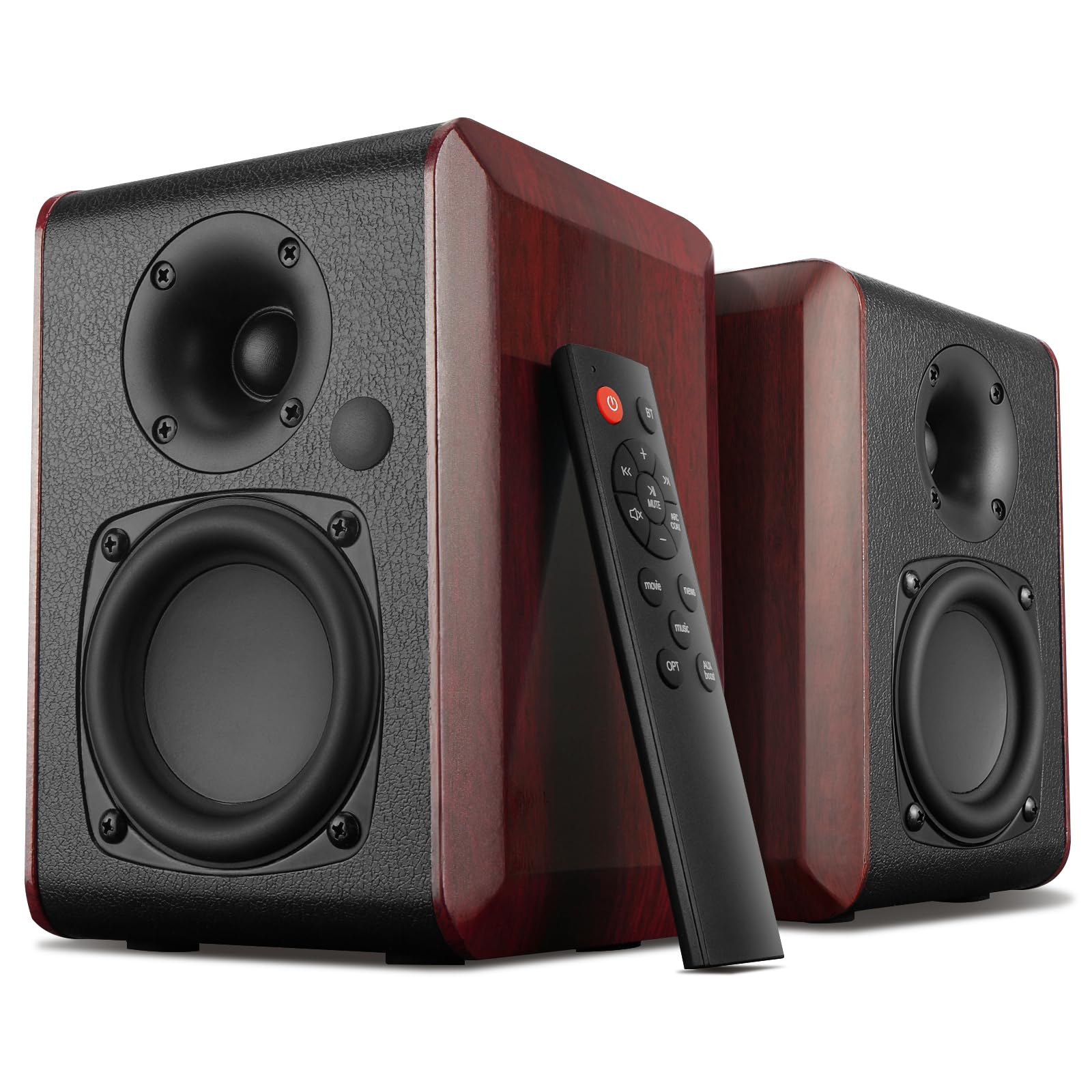
The Saiyin DS6701S Pro uses a 3.75-inch woofer with a 20mm silk dome tweeter in a compact cabinet measuring 5.9 by 5.3 inches. The 60-watt total output is sufficient for nearfield listening on a desk or console, and the subwoofer line output lets you add a powered sub later without replacing the speakers. The wine-red piano lacquer finish with PVC leather panel adds a vintage aesthetic that complements turntable setups.
Connectivity includes Bluetooth, AUX, optical, and TV-ARC—the optical input is useful for connecting a TV, but turntable users should rely on the AUX or RCA through an external preamp. This model requires the turntable to output a LINE-level signal; if your turntable only has a PHONO output, you must add a phono preamp before connecting. The remote control provides volume and input selection from a distance.
Bass depth is moderate due to the small woofer size—the subwoofer output exists precisely for this reason. The absence of speaker grilles leaves the drivers exposed to dust and accidental contact. For a compact powered solution that grows with your system via subwoofer expansion, the DS6701S Pro is a thoughtful entry point.
Why it’s great
- Subwoofer output for future bass expansion
- Compact size fits tight shelves and desks
- Vintage aesthetic with piano lacquer finish
Good to know
- Turntable must output LINE-level signal
- No speaker grilles included
- Bass limited without subwoofer
7. OHAYO 60W Computer Speakers

The OHAYO 60W speakers combine a 0.75-inch carbon fiber silk dome tweeter with a 3-inch carbon fiber full-range driver in an MDF wooden enclosure. Despite the compact size, the system outputs 30 watts per channel—enough for desktop or small-room listening. The rear bass port extends the low-end response beyond what the driver alone can produce.
Multiple input options include Bluetooth 5.3, RCA, AUX, and USB, making it compatible with turntables that have a built-in phono preamp or an external preamp. The front volume knob integrates power control and doubles as a Bluetooth pairing button. The wood cabinet helps reduce box resonance compared to plastic alternatives at this price tier.
With 3-inch drivers, deep bass is physically constrained—lower frequencies lack the weight needed for dance music or orchestral peaks. The frequency response extends to 20kHz but the low end rolls off noticeably below 80Hz. For entry-level listeners who want a simple powered setup for occasional vinyl playback, the OHAYO delivers clear mids and decent clarity for the lowest entry cost.
Why it’s great
- MDF cabinet reduces resonance over plastic
- Multiple input options including Bluetooth 5.3
- Compact footprint for small desks
Good to know
- Bass extension limited by 3-inch drivers
- Volume knob pairs with Bluetooth by default
- Not suitable for medium to large rooms
FAQ
Can I connect a turntable directly to powered speakers without a preamp?
How does the 3-way design in the Sony SS-CS5M2 improve vinyl playback?
What size room works best with a 4-inch woofer speaker?
Final Thoughts: The Verdict
For most users, the budget speakers for turntable winner is the Edifier R1280T because it combines a silk dome tweeter, dual AUX inputs, and a remote control in a powered package that works with any LINE-level turntable without extra gear. If you want true nearfield monitoring accuracy with balanced inputs and app-based EQ, grab the Edifier MR3. And for passive purists who already own an amplifier and crave the widest soundstage, nothing beats the Sony CS SS-CS5M2.

Mo Maruf
I created WellFizz to bridge the gap between vague wellness advice and actionable solutions. My mission is simple: to decode the research and give you practical tools you can actually use.
Beyond the data, I am a passionate traveler. I believe that stepping away from the screen to explore new environments is essential for mental clarity and physical vitality.